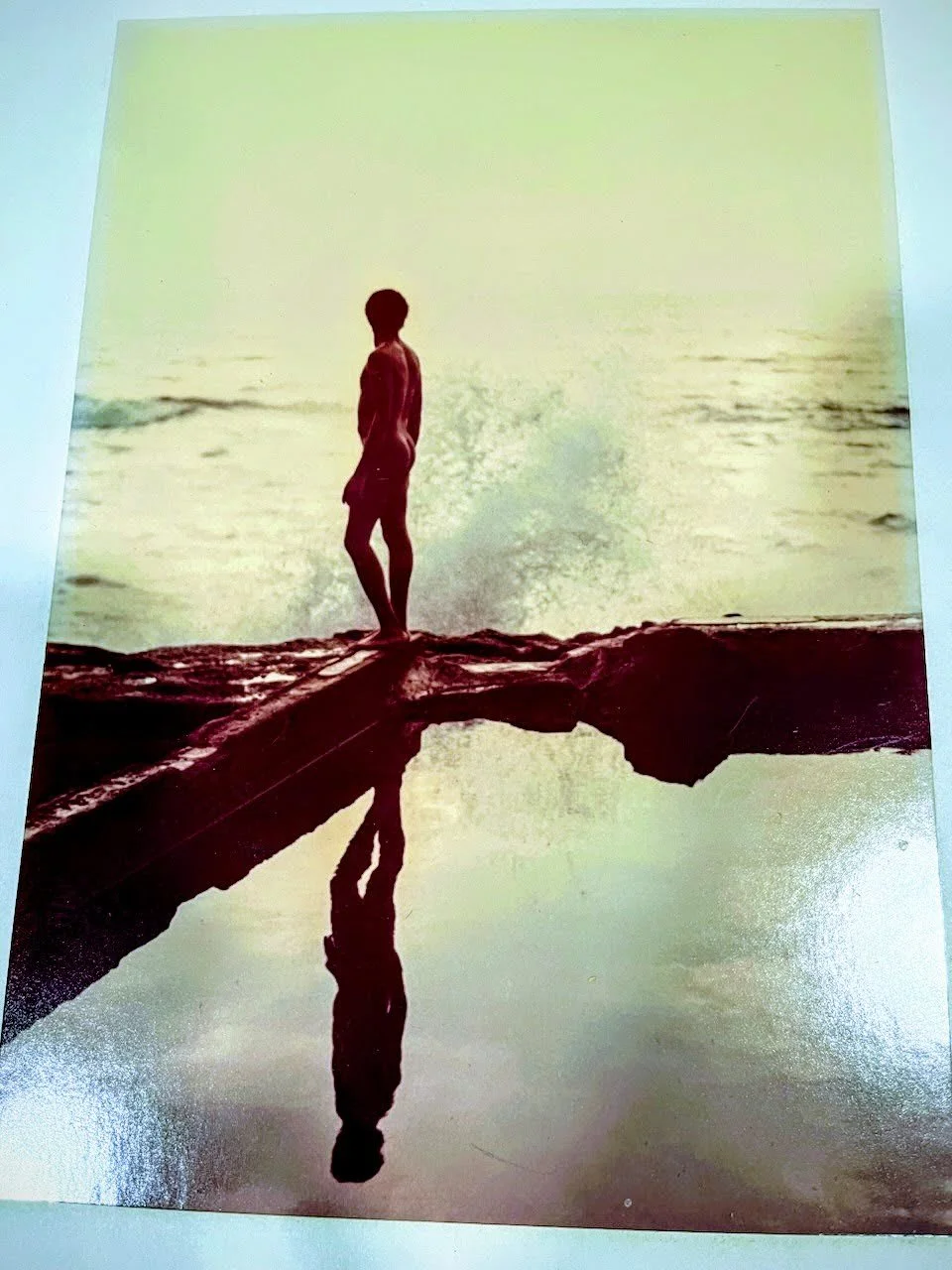
Running After Loves – Ray Bradbury on Fostering Hunger in Writing

(thedewdrop.org)

Vanessa Able

“A well-fed man keeps and calmly gives forth his infinitesimal portion of eternity.”

– Ray Bradbury


‘How long has it been since you wrote a story where your real love or your real hatred somehow got onto the paper?’ Finding the truth of our authentic passions is the key to forming the foundations of a writing practice, according to science fiction author Ray Bradbury. In his essay collection, Zen in the Art of Writing, he indulges in a series of pointers and incitements for writers in the process of forging their craft. In this extract from the essay, How to Keep and Feed a Muse, he talks about the importance of recognizing and then nurturing our deepest inspirations, in the understanding that it is the sheer energy of the Muse that drives the engine of labor required for a lifetime of writing. For more on the process of writing, read Norman Fischer’s Poetics Statement, and other thoughts from Natalie Goldberg and Patti Smith. For the text that inspired the title of Bradbury’s book, check out Eugene Herrigel.


The Feeding of the Muse seems to me to be the continual running after loves, the checking of these loves against one’s present and future needs, the moving on from simple textures to more complex ones, from naïve ones to more informed ones, from nonintellectual to intellectual ones. Nothing is ever lost. If you have moved over vast territories and dared to love silly things, you will have learned even from the most primitive items collected and put aside in your life. From an ever-roaming curiosity in all the arts, from bad radio to good theatre, from nursery rhyme to symphony, from jungle compound to Kafka’s Castle, there is basic excellence to be winnowed out, truths found, kept, savored, and used on some later day. To be a child of one’s time is to do all these things.

Do not, for money, turn away from all the stuff you have collected in a lifetime.

Do not, for the vanity of intellectual publications, turn away from what you are—the material within you which makes you individual, and therefore indispensable to others.

To feed your Muse, then, you should always have been hungry about life since you were a child. If not, it is a little late to start. Better late than never, of course. Do you feel up to it?

“By living well, by observing as you live, by reading well and observing as you read, you have fed Your Most Original Self.”

It means you must still take long walks at night around your city or town, or walks in the country by day. And long walks, at any time, through bookstores and libraries.

The Muse must have shape. You will write a thousand words a day for ten or twenty years in order to try to give it shape, to learn enough about grammar and story construction so that these become part of the Subconscious, without restraining or distorting the Muse.

By living well, by observing as you live, by reading well and observing as you read, you have fed Your Most Original Self. By training yourself in writing, by repetitious exercise, imitation, good example, you have made a clean, well-lighted place to keep the Muse. You have given her, him, it, or whatever, room to turn around in. And through training, you have relaxed yourself enough not to stare discourteously when inspiration comes into the room.

You have learned to go immediately to the typewriter and preserve the inspiration for all time by putting it on paper.

“At the exact moment when truth erupts, the subconscious changes from wastebasket file to angel writing in a book of gold.”

And you have learned the answer to the question asked earlier: Does creativity like loud or soft voices?

The loud, the passionate voice seems to please most. The voice upraised in conflict, the comparison of opposites. Sit at your typewriter, pick characters of various sorts, let them fly together in a great clang. In no time at all, your secret self is roused. We all like decision, declaration; anyone loudly for, anyone loudly against.

This is not to say the quiet story is excluded. One can be as excited and passionate about a quiet story as any. There is excitement in the calm still beauty of a Venus de Milo. The spectator, here, becomes as important as the thing viewed.

Be certain of this: When honest love speaks, when true admiration begins, when excitement rises, when hate curls like smoke, you need never doubt that creativity will stay with you for a lifetime. The core of your creativity should be the same as the core of your story and of the main character in your story. What does your character want, what is his dream, what shape has it, and how expressed? Given expression, this is the dynamo of his life, and your life, then, as Creator. At the exact moment when truth erupts, the subconscious changes from wastebasket file to angel writing in a book of gold.

Look at yourself then. Consider everything you have fed yourself over the years. Was it a banquet or a starvation diet?

“To feed well is to grow. To work well and constantly is to keep what you have learned and know in prime condition.”

Who are your friends? Do they believe in you? Or do they stunt your growth with ridicule and disbelief? If the latter, you haven’t friends. Go find some.

And finally, have you trained well enough so you can say what you want to say without getting hamstrung? Have you written enough so that you are relaxed and can allow the truth to get out without being ruined by self-conscious posturings or changed by a desire to become rich?

To feed well is to grow. To work well and constantly is to keep what you have learned and know in prime condition. Experience. Labor. These are the twin sides of the coin which when spun is neither experience nor labor, but the moment of revelation. The coin, by optical illusion, becomes a round, bright, whirling globe of life. It is the moment when the porch swing creaks gentle and a voice speaks. All hold their breath. The voice rises and falls. Dad tells of other years. A ghost rises off his lips. The subconscious stirs and rubs its eyes. The Muse ventures in the ferns below the porch, where the summer boys, strewn on the lawn, listen. The words become poetry that no one minds, because no one has thought to call it that. Time is there. Love is there. Story is there. A well-fed man keeps and calmly gives forth his infinitesimal portion of eternity. It sounds big in the summer night. And it is, as it always was down the ages, when there was a man with something to tell, and ones, quiet and wise, to listen.

Ray Bradbury (1920-2012)

From: Zen in the Art of Writing

The Art of Looking: Eleven Ways of Viewing the Multiple Realities of Our Everyday Wonderland

By Maria Popova (themarginalian.org)

“How we spend our days,” Annie Dillard wrote in her timelessly beautiful meditation on presence over productivity“is, of course, how we spend our lives.” And nowhere do we fail at the art of presence most miserably and most tragically than in urban life — in the city, high on the cult of productivity, where we float past each other, past the buildings and trees and the little boy in the purple pants, past life itself, cut off from the breathing of the world by iPhone earbuds and solipsism. And yet: “The art of seeing has to be learned,” Marguerite Duras reverberates — and it can be learned, as cognitive scientist Alexandra Horowitz invites us to believe in her breathlessly wonderful On Looking: Eleven Walks with Expert Eyes (public library) — a record of her quest to walk around a city block with eleven different “experts,” from an artist to a geologist to a dog, and emerge with fresh eyes mesmerized by the previously unseen fascinations of a familiar world. It is undoubtedly one of the most stimulating books of the year, if not the decade, and the most enchanting thing I’ve read in ages. In a way, it’s the opposite but equally delightful mirror image of Christoph Niemann’s Abstract City — a concrete, immersive examination of urbanity — blending the mindfulness of Sherlock Holmes with the expansive sensitivity of Thoreau.

Horowitz begins by pointing our attention to the incompleteness of our experience of what we conveniently call “reality”:

Right now, you are missing the vast majority of what is happening around you. You are missing the events unfolding in your body, in the distance, and right in front of you.

By marshaling your attention to these words, helpfully framed in a distinct border of white, you are ignoring an unthinkably large amount of information that continues to bombard all of your senses: the hum of the fluorescent lights, the ambient noise in a large room, the places your chair presses against your legs or back, your tongue touching the roof of your mouth, the tension you are holding in your shoulders or jaw, the map of the cool and warm places on your body, the constant hum of traffic or a distant lawn-mower, the blurred view of your own shoulders and torso in your peripheral vision, a chirp of a bug or whine of a kitchen appliance.

This adaptive ignorance, she argues, is there for a reason — we celebrate it as “concentration” and welcome its way of easing our cognitive overload by allowing us to conserve our precious mental resources only for the stimuli of immediate and vital importance, and to dismiss or entirely miss all else. (“Attention is an intentional, unapologetic discriminator,” Horowitz tells us. “It asks what is relevant right now, and gears us up to notice only that.”) But while this might make us more efficient in our goal-oriented day-to-day, it also makes us inhabit a largely unlived — and unremembered — life, day in and day out.

Art by Maira Kalman from ‘On Looking: Eleven Walks with Expert Eyes’

For Horowitz, the awakening to this incredible, invisible backdrop of life came thanks to Pumpernickel, her “curly haired, sage mixed breed” (who also inspired Horowitz’s first book, the excellent Inside of a Dog: What Dogs See, Smell, and Know), as she found herself taking countless walks around the block, becoming more and more aware of the dramatically different experiences she and her canine companion were having along the exact same route:

Minor clashes between my dog’s preferences as to where and how a walk should proceed and my own indicated that I was experiencing almost an entirely different block than my dog. I was paying so little attention to most of what was right before us that I had become a sleepwalker on the sidewalk. What I saw and attended to was exactly what I expected to see; what my dog showed me was that my attention invited along attention’s companion: inattention to everything else.

The book was her answer to the disconnect, an effort to “attend to that inattention.” It is not, she warns us, “about how to bring more focus to your reading of Tolstoy or how to listen more carefully to your spouse.” Rather, it is an invitation to the art of observation:

Together, we became investigators of the ordinary, considering the block — the street and everything on it—as a living being that could be observed.

In this way, the familiar becomes unfamiliar, and the old the new.

Her approach is based on two osmotic human tendencies: our shared capacity to truly see what is in front of us, despite our conditioned concentration that obscures it, and the power of individual bias in perception — or what we call “expertise,” acquired by passion or training or both — in bringing attention to elements that elude the rest of us. What follows is a whirlwind of endlessly captivating exercises in attentive bias as Horowitz, with her archetypal New Yorker’s “special fascination with the humming life-form that is an urban street,” and her diverse companions take to the city.

First, she takes a walk all by herself, trying to note everything observable, and we quickly realize that besides her deliciously ravenous intellectual curiosity, Horowitz is a rare magician with language. (“The walkers trod silently; the dogs said nothing. The only sound was the hum of air conditioners,” she beholds her own block; passing a pile of trash bags graced by a stray Q-tip, she ponders parenthetically, “how does a Q-tip escape?”; turning her final corner, she gazes at the entrance of a mansion and “its pair of stone lions waiting patiently for royalty that never arrives.” Stunning.)

But as soon as she joins her experts, Horowitz is faced with the grimacing awareness that despite her best, most Sherlockian efforts, she was “missing pretty much everything.” She arrives at a newfound, profound understanding of what William James meant when he wrote, “My experience is what I agree to attend to. Only those items which I notice shape my mind.”:

I would find myself at once alarmed, delighted, and humbled at the limitations of my ordinary looking. My consolation is that this deficiency of mine is quite human. We see, but we do not see: we use our eyes, but our gaze is glancing, frivolously considering its object. We see the signs, but not their meanings. We are not blinded, but we have blinders.

These “blinders,” despite psychologists’ concentrated efforts to dissect this strange phenomenon we call “attention,” remain largely a mystery — or, at best, a series of misconstrued hypotheses:

Though paying attention seems simple, there are numerous forms of payment. … To concentrate, to pay attention, is viewed as a brow-furrowing exercise. Sit still, don’t blink, and attend.

[…]

This may do for a moment of concentration, but it is not the way to better attention in your daily life. For that, we need to know what attention is. The very concept is odd. Is it an ability, a tendency, a skill? Is it processed in a special nugget in the brain, or by your eyes and ears? …

The longtime model used by psychologists is that of a “spotlight” that picks out particular items of interest to examine, bringing some things into focus and awareness while leaving other things in the dim, dusty sidelines. The metaphor makes me feel like a headlight-wearing spelunker who can only see what is right in front of her in the darkness of the cave. Such a comparison can be misleading, because in fact one can still report on what was within one’s peripheral vision at rates better than chance. And despite that spotlight, we seem to miss huge elements of the thing we are ostensibly attending to.

A better way of thinking about attention is to consider the problems that evolution might have designed “attention” to solve. The first problem emerges from the nature of the world. The world is wildly distracting. It is full of brightly colored things, large things casting shadows, quickly moving things, approaching things, loud things, irregular things, smelly things.

Thus, evolution’s problem-solving left us modern humans with two kinds of attention: vigilance, which allows us to have a quick and life-saving fight-or-flight response to an immediate threat, be it a leaping lion or a deranged boss, and selective attention, which unconsciously curates the few stimuli to attend to amidst the flurry bombarding us, enabling us to block out everything except what we’re interested in ingesting. (Selective attention, of course, can mutate to dangerous degrees, producing such cultural atrocities as the filter bubble.) Much like French polymath Henri Poincaré argued that to invent is simply to choose ideas, to attend, it turns out, is simply to choose stimuli — but what sounds so deceptively simple turns out to be marvelously complex. In her walks with expert companions, Horowitz tickles this latter type of attention to unravel all the unseen, unsmelled, and unheard miracles of a city block, the wonderlands of sensation and awareness that bloom behind the looking glass of our evolutionarily primed everyday inattention.

The first “expert” Horowitz walks with is her very own toddler, from whom we learn that a walk is not necessarily the purposeful and linear transfer of a body from point A to point B, but rather an exploratory exercise in touching and — eek! — tasting textures and surfaces, pointing at sights, pausing to absorb the tickling brush of the breeze:

A walk is, instead, an investigatory exercise that begins with energy and ends when (and only when) exhausted.

Much of what makes the story so compelling is Horowitz’s ability to swiftly weave scientific insight into the details of these anecdotal experiences. Here, she notes:

The perceptions of infants are remarkable. That infants reliably develop into adults, who for all their wisdom or kindness are often unremarkable, blinds us to this fact. The infant’s world is a case study in confused attention. … The world is not yet organized into discrete objects for these new eyes: it is all light and dark, shadow and brightness.

Infants, in fact, seem to experience syneshtesia as a baseline sensory given. (Perhaps MoMA’s Juliet Kinchin touched on a bigger cognitive truth when she reflected that “children help us to mediate between the ideal and the real.”) But, eventually, they grow out of this wondrous multidimensional awareness, which William James called “aboriginal sensible muchness,” and we, the sensible and selectively attentive adults, emerge:

Part of normal human development is learning to notice less than we are able to. The world is awash in details of color, form, sound — but to function, we have to ignore some of it. The world still holds these details. Children sense the world at a different granularity, attending to parts of the visual world we gloss over; to sounds we have dismissed as irrelevant. What is indiscernible to us is plain to them.

Part of toddlers’ extraordinary capacity for noticing has to do with their hard-wired neophilia — the allure of the new and unfamiliar, which for them includes just about everything that we, old and jaded, have deemed familiar and thus uninteresting. (Horowitz points to one systematic exception for us adults — vacations — which brim with enough novelty to produce such fascinating, reality-warping psychological phenomena as the holiday paradox. The reason, Horowitz argues, lies in two factors: “We actually do see new places and second, we bother to look.”)

In a way, “experts” have a toddler’s ability to zoom in on the details, the very fabric of experience, that most of us glide adaptively by.

From beloved artist and reconstructionist Maira Kalman — a woman of boundless wisdom on life and unrelenting faith in walking as a creative device, whom Horowitz aptly describes as “a hoarder, in the finest sense of that word, of both experience and image” — we learn that looking at the ordinary, looking and really seeing it, seeing its extraordinary wonder, is a special talent that takes patient cultivation. Horowitz writes:

One perceptual constraint that I knowingly labor under is the constraint that we all create for ourselves: we summarize and generalize, stop looking at particulars and start taking in scenes at a glance—all in an effort to not be overwhelmed visually when we just need to make it through the day. The artist seems to retain something of the child’s visual strategy: how to look at the world before knowing (or without thinking about) the name or function of everything that catches the eye. An infant treats objects with an unprejudiced equivalence: the plastic truck is of no more intrinsic worth to the child than an empty box is, until the former is called a toy and the latter is called garbage. My son was as entranced by the ubiquitous elm seeds near our doorstep as any of the menus, mail, flyers, or trash that concern the adults.

Echoing Anaïs Nin’s timeless words on the shared magic of the child and the artist, Horowitz writes:

To the child, as to the artist, everything is relevant; little is unseen.

Once you look at what seems ordinary long enough, though, it often turns odd and unfamiliar, as any child repeatedly saying his own name aloud learns. I had the suspicion that walking with Kalman would be the ambulatory equivalent of saying my own name aloud a hundred times.

But Kalman’s singular spirit came to life not in the purposeful stride of a destination-walk but in the creative digression of an amble:

With Kalman, walking around the block entered a fourth dimension. … Eventually, we made it from A to B, but not before visiting all of the later letters of the alphabet. … Objects and people on our route became possibilities for interaction, rather than decoration or obstruction, as the urban pedestrian might define them.

Kalman gently nudges Horowitz to remove the “invisibility cloak” so familiar to us urbanites as we shield ourselves from strangers, and the two do something city dwellers — especially New Yorkers — never do: They talk to policemen, movers, a mailman, churchgoers, and the social workers tending to a halfway house. In other words, they cease to simply coexist with their fellow citizens and, for the duration of the walk, live with them instead, attend to them with presence and curiosity, see them; they slow their cadence, now tourists in their native fast-paced New York; they amble. Horowitz once again returns to her potent blend of philosophical reflection and scientific substance:

I had not noticed, until forced to by Kalman’s sociability, how I was engaging in a fundamentally social activity by walking out in public.

Still, we all have a sense of the “appropriate” personal space around us — a kind of zone of privacy that we wear, even on the social sidewalk. Indeed, we have many coencentric circles of personal spaces, plural. The Swiss zoologist Heini Hediger, elaborating from studies of animal behavior, proposed that the personal zones around us fall into a few categories. Those with whom we do not mind “inescapable involvement” — as our loved ones — can broach the closest zone and get nearer than eighteen inches to us. At that proximity, we can smell them, feel the heat of their bodies, their breath, hear the small sounds they mutter or emit. We can whisper together. Most social interactions take place in a comfortable zone about one and a half to four feet away — closer in some cultures (Latin American) than others (North American). Friends can waltz through; acquaintances can hover on the edge. We have a social distance up to twelve feet from our bodies for more formal transactions, or for those we don’t know well. Beyond that is a kind of public distance in which we use our “outdoor” voice. All of these zones are artificial, varying with differing relationships, based on context and the physical setting — but we have a bodily sense of the reality of these spaces. Violate them, and we may feel stressed and anxious.

Art by Maira Kalman from ‘On Looking: Eleven Walks with Expert Eyes’

Eventually, Horowitz realizes that Kalman has a wholly different way not only of looking, but also of seeing — she challenges the normative expectations of where one is allowed to go in the city and experiences space not “as defined by an edge, but as an infinitely explorable openness” — and so she wonders what it is about the artist’s brain that enables that limitless perception of possibility. Though she is careful to insure against any phrenology-like pseudoscience of the “creative brain,” Horowitz does point to a curious study that suggests brains like Kalman’s might, in fact, be wired differently:

One research team, though, reported a correspondence between the brains of those who seem to be especially creative thinkers. Certain people, they found, have fewer of one kind of dopamine receptor in the thalamus of the brain. These people also performed well on tests of “divergent thinking,” in which people are asked to concoct more and more elaborate uses for ordinary objects, for instance. The reduction in receptors might actually increase information flow to various parts of the brain, essentially allowing them to think up new and interesting solutions. “Thinking outside the box might be facilitated by having a somewhat less intact box,” the researchers wrote.

(For more on this research by Stanford’s Carol Dweck, see this.)

A typographic storefront from James and Karla Murray’s Store Front: The Disappearing Face of New York

From typography nerd Paul Shaw, who brought us the almost true story of New York’s subway Helvetica, we learn that our minds are constantly coerced into reading the “dull, tedious words” that bombard us from storefronts, billboards, and computer screens nearly every waking moment — but besides the linguistic burden, embedded in each letter we ingest is also a design one, for typography can quietly convey an unwritten message, set a mood, create an ineffable sense of something being either terribly wrong or terribly wonderful. A letter, Horowitz reminds us as she discovers the humanistic quality of words while touring New York’s type-smothered streets with Shaw, can be “jaunty” or “uncomfortable” amidst awkward kerning, an ampersand can be “pregnant” and an S “complacent.” She encapsulates:

Three hours of walking with Shaw later, I felt relieved, for the moment, of my compulsion to read what was readable, to parse text when I saw it. Surprisingly, this relief came not from avoiding text, but from seeking it out — only to zoom in on the details held within. It was a vision that let me miss the forest and see the trees. Rather than words, I saw the components of words. Some small part of my brain (the linguistic part) rested; the shape-identifying part hummed with activity.

[…]

The thing you are doing now affects the thing you see next.

From geologist Sidney Horenstein of the American Museum of Natural History we learn that our entire world consists of only two types of things: minerals and the biomass of plants and animals. A city suddenly becomes not a sterile “man-made” object but a thriving ecosystem of living and once-living landscapes, “an ersatz natural landscape writ small … on every single block,” a place suddenly brimming with reminders of its own impermanence:

Viewed with this lens, the city feels less artificial. The cold stone is natural, almost living: it absorbs water, warms under the sun, and sloughs its skin in rain. Like us, stone is affected by time, its outer layer softened and its veins made more prominent. And viewed as a natural landscape, the city feels less permanent: even the strongest-looking behemoth of an apartment tower is gradually deteriorating under the persistent, patient forces of wind, water, and time.

Organisms inhabiting a single cubic foot of space from One Cubic Foot by photographer David Liittschwager

From field naturalist and insects advocate Charlie Eiseman, we learn that on every square inch of surface, entire microcosms oscillate between vibrant life and violent death. (“If a driveway holds an ecosystem,” Horowitz ponders, “what of a parking lot? Perchance a universe.”) Over the next few hours, the two proceed to discover traces of just about every kind of insect — from spider egg cases to discarded fly exoskeletons — lacing the most ordinary of city blocks. What emerges is a keen awareness that the negative space of the unseen is itself a source of rich information:

Surprisingly, those leaves that have no sign, no holes, no smattering of excrement, are themselves sign of something else. They indicate that the tree is probably not from around here.

Once again, Horowitz explores what enables Eisenman’s brain to function so differently from her own and pops the cognitive hood of his singular selective attention, tracing it to the work of notable early twentieth-century bird-watcher Luunk Tinbergen:

Continue reading The Art of Looking: Eleven Ways of Viewing the Multiple Realities of Our Everyday Wonderland

California teen lost touch with reality, walked off Mount Whitney, dad says

‘He was in an altered mental state, and I don’t know what caused it’

By Sam Mauhay-Moore, National Parks Reporter

June 25, 2025 (SFGate.com)

Zane Wach, 14, from Santa Clarita, Calif.Courtesy of Ryan Wach

A 14-year-old boy from Santa Clarita has not yet regained consciousness after falling off a steep slope while hiking on Mount Whitney earlier this month. 

Ryan Wach and his son Zane summited the mountain on June 10 via the Mountaineer’s Route, a shorter but more technically advanced trail compared to the popular Mount Whitney Trail. Zane and his father, an experienced hiker and mountaineer, had summited mountains before, but this was Zane’s first time on Mount Whitney. The pair planned to complete the trek in a single pass — an impressive feat, but one Ryan Wach wasn’t worried about, as his son regularly competes in distance running, swimming and triathlons and had plenty of prior hiking experience. 

“He’s in better shape than I am,” Wach told SFGATE. “The idea was that this would be kind of like his introduction to mountaineering.”

When Zane began exhibiting symptoms of altitude sickness, his father decided to take the easier route back to the trailhead. By then, the pair had already gotten the hardest parts of their route — scrambling and climbing over granite cliffs and loose rock to reach Whitney’s summit — out of the way, and just needed to hike several miles down the Mount Whitney Trail back to where their car was parked. 

“He started to experience some hallucinations,” Wach said. “He knew he was hallucinating. He said he saw things like snowmen and Kermit the Frog.” 

Wach said Zane started feeling “considerably better” once they reached Mount Whitney’s Trail Camp, which is about 6 miles from the trailhead at Whitney Portal. Then, about an hour later, Zane began losing touch with reality again. 

“He was in an altered mental state, and I don’t know what caused it. We still don’t know,” Wach said. “My best guess is a combination of exhaustion, sleep deprivation, probably some dehydration and lasting effects from the altitude sickness. But he essentially started to doubt reality.”

Zane Wach, 14, was transported to Sunrise Children’s Hospital in Las Vegas after falling over 100 feet on Mount Whitney earlier this month.Courtesy of Ryan Wach

Shortly after, the pair needed to stop along the trail because Zane believed they had “already finished the hike multiple times over,” Wach said.

“It was completely bizarre,” he said. “He told me he couldn’t tell if he was dreaming or not, and he would shake his head in disbelief, like, ‘This is not real.’ Like he was in the movie ‘Inception’ or something.”

At this point, a separate group of hikers contacted search and rescue teams due to Zane’s condition. According to Wach, Zane began making strange, erratic movements toward a ledge that dropped off into a steep granite slope. When Wach grabbed his son, Zane said he was going to the car, which was in the direction of the ledge but several thousand feet down the trail. Wach later grabbed Zane again near the same spot, and when he asked what he was doing, Zane told his father that he was getting dinner. 

“I was kind of losing my mind, in a way, because I was so scared and frustrated,” Wach said. “I had to wipe away tears. I was holding my hands to my eyes, and he walked off again. This time, I didn’t hear it until he was about at the edge, and when I went to reach for him, he was 10 feet away from me. I couldn’t get him, and he walked off the edge.” 

Wach ran down the slope to where Zane landed, which he estimates to be about 120 feet from where he fell. One of the nearby hikers, an EMT named Ariana, immediately began coordinating rescue efforts, Wach said. Wach waited there with Zane for about six hours until Inyo County Search & Rescue teams arrived and flew Zane via helicopter to Southern Inyo Hospital in Lone Pine. From there, he was flown to Sunrise Children’s Hospital in Las Vegas, the closest hospital with a pediatric trauma center.

File – Mount Whitney near Lone Pine, Calif.David McNew/Getty Images

Zane remains in a medically induced coma at Sunrise Children’s Hospital. Besides the trauma to his head, his injuries from the fall were relatively minor: He broke an ankle, a finger and part of his pelvis, Wach said, adding that doctors have expressed that it is “fairly miraculous” he wasn’t injured further.  

Shortly after the accident, a family friend created a GoFundMe for Zane’s recovery costs. It has raised close to $18,000. 

Wach said that despite the long road ahead of them, he’s hoping for a full recovery.

“It’s going to be a survival story in the end, but right now we’re still in the middle of it,” Wach said. 

June 25, 2025

Sam Mauhay-Moore

NATIONAL PARKS REPORTER

Sam Mauhay-Moore is a National Parks reporter for SFGATE. He grew up in Long Beach and studied journalism and ethnic studies at San Francisco State. When he’s not home in Oakland, he’s truck camping in the mountains somewhere. You can email him at sam.moore@sfgate.com.

Improperly Dressed Applebee’s Diner Provided Loaner Stained Hoodie

Published: June 25, 2025 (TheOnion.com)

BLOOMINGTON, IL—Stopping the polo-clad man and ushering him off toward the bathroom, restaurant staff reportedly provided an improperly dressed Applebee’s patron with a loaner stained hoodie on Wednesday. “I’m sorry, sir, but we cannot seat you unless you are wearing something more in line with this establishment’s dress code,” said Applebee’s hostess Angeline Reilly, who explained that while it was nothing to be embarrassed about, the other diners would just be more comfortable around someone properly attired in a black hoodie that bore the remnants of barbecue sauce and other condiments that failed to come out in the wash. “We also have tattered sweatpants you can wear in lieu of your khakis. If you don’t like the hoodie look, I can offer you a ripped Chicago Bears 2006 NFC champions T-shirt that could be worn with a pair of ratty cargo shorts. Unfortunately, we can’t have people walking in here with collars and buttons on their shirts and ruining the mood we’ve cultivated. This isn’t Red Lobster. And I’m afraid your guest will have to change out of her blouse and into this oversized Looney Tunes sweater with half of the words peeling off.” At press time, an Applebee’s waiter was seen apologetically handing out a $50 gift card to a table that had been seated for nearly 20 minutes without seeing a single customer start a fistfight in the bar after throwing a strawberry margarita in someone’s face.

Tarot Card for june 26: The Prince of Wands

The Prince of Wands

This card is full of boundless energy and power. Here we see the healing rush of force, producing enthusiasm and exhilaration. Among their many other attributes, the suit of Wands relates to morality and a strong sense of ethics, so this card also draws in matters of integrity and honesty.On a day ruled by the Prince of Wands, expect to feel full of life, ready to tackle any challenge. Be alert for situations in which you are able to assist somebody else who has need of your strength. Also, be aware of how your strength feels to you – this will stand you in good stead on lesser days, when you aren’t feeling quite so vital and alive.This Prince sets us free of limitation and self doubt bringing, instead, a new confidence and verve. If we allow his force to flow through us, we shall find ourselves making excellent progress in everything we turn our hands to.If, when he appears, you are emerging from a tough time in your life, this Prince will mark a turning point where things begin to improve and brighten up. One of the key phrases often associated with this card is ‘out of darkness, into light’.So enjoy the day!! Have fun, get lots done and feel glad to be you at the end of the day!!

Affirmation: “My life has no limits. It is filled with boundless energy.”

Free Will Astrology: Week of June 26, 2025

BY ROB BREZSNY | JUNE 24, 2025 (NewCity.com)

Photo: Rumman Amin

ARIES (March 21-April 19): The Hawaiian word po refers to a primal darkness from which all life flows. It’s not a fearsome void, but a fertile mystery, rich with future possibilities and the ancestors’ hopes. In the coming weeks, I invite you to treat your inner life as po. Be as calm and patient and watchful as an Aries can be as you monitor the inklings that rise up out of the deep shadows. Have faith that the cloudy uncertainty will ultimately evolve into clarity, revealing the precise directions you need.

TAURUS (April 20-May 20): In the seventeenth century, the Taurus polymath Athanasius Kircher constructed a fantastical machine called the Aeolian harp. It wasn’t designed to be played by human fingers, but by the wind. It conjured music with currents invisible to the eye. I nominate this sublime contraption as your power object for the coming weeks, Taurus. The most beautiful and healing melodies may come from positioning yourself so that inspiration can blow through. How might you attune yourself to the arrival of unexpected help and gifts? Set aside any tendency you might have to try too hard. Instead, allow life to sing through you.

GEMINI (May 21-June 20): The painter Vincent van Gogh wrote, “Great things are done by a series of small things brought together.” That’s good advice for you right now. Your ambitions may feel daunting if you imagine them as monumental and monolithic. But if you simply focus on what needs to be done next—the daily efforts, the incremental improvements—you will be as relaxed as you need to be to accomplish wonders. Remember that masterpieces are rarely completed in a jiffy. The cumulative power of steady work is potentially your superpower. Here’s another crucial tip: Use your imagination to have fun as you attend to the details.

CANCER (June 21-July 22): Welcome to a special edition of “What’s My Strongest Yearning?” I’m your host, Rob Brezsny, and I’m delighted you have decided to identify the single desire that motivates you more than any other. Yes, you have many wishes and hopes and dreams, but one is more crucial than all the rest! Right? To begin the exercise, take three deep breaths and allow every knot of tension to dissolve and exit your beautiful body. Then drop down into the primal depths of your miraculous soul and wander around until you detect the shimmering presence of the beloved reason you came here to this planet. Immerse yourself in this glory for as long as you need to. Exult in its mysterious power to give meaning to everything you do. Ask it to nurture you, console you and inspire you.

LEO (July 23-Aug. 22): In certain medieval maps, unexplored territories were marked with the Latin phrase hic sunt dracones—“here be dragons.” It was a warning and a dare, a declaration that no one knew what lay beyond. In the coming weeks, Leo, you may find yourself traveling into one of those unlabeled regions. Rather than flinching or dodging, I invite you to press forward with respectful curiosity. Some of the so-called dragons will be figments. Others are protectors of treasure and might be receptive to sharing with a bright light like you. Either way, productive adventures are awaiting you in that unmapped territory. Go carefully—but go.

VIRGO (Aug. 23-Sept. 22): In traditional Japanese carpentry, joints are made so skillfully that they need no nails, screws or adhesives. Carpenters use intricate joinery techniques to connect pieces of wood so tightly that the structures are strong and durable. They often require a mallet for assembly and disassembly. In metaphorical terms, you are capable of that kind of craftsmanship these days, Virgo. I hope you will take advantage of this by building lasting beauty and truth that will serve you well into the future. Don’t rush the joinery. If it’s not working, don’t force it. Re-cut, re-measure, breathe deeply, and try again.

LIBRA (Sept. 23-Oct. 22): Here’s one of my unruly rules about human competence: In every professional field, from physicians to lawyers to psychics to teachers, about fifteen percent of all the practitioners are downright mediocre, even deficient. Seventy-five percent are at least satisfactory and sometimes good. And ten percent of the total are surpassingly excellent, providing an extraordinary service. With this in mind, I’m happy to say that you now have a knack for gravitating toward that exceptional ten percent in every domain you are drawn to. I predict that your intuition will consistently guide you toward premium sources.

SCORPIO (Oct. 23-Nov. 21): The Japanese concept of shinrin-yoku means “forest bathing.” It invites people to immerse themselves in the natural world, drawing on its restorative power. In accordance with astrological portents, I urge you Scorpios to maximize your forest bathing. To amplify the enrichment further, gravitate toward other environments that nourish your soul’s need for solace and uplift. The naked fact is that you need places and influences that offer you comfort, safety and tender inspiration. Don’t apologize for making your life a bit less heroic as you tend to your inner world with gentle reverence.

SAGITTARIUS (Nov. 22-Dec. 21): The camera obscura was a precursor to modern cameras. It projected the outside world upside down onto interior walls. Artists loved it because it helped them see reality from new angles. I hereby proclaim that you, Sagittarius, will be like both the artist and the camera obscura lens in the coming weeks. Your perceptions may feel inverted, strange, even disorienting, but that’s a gift! So let unfamiliarity be your muse. Flip your assumptions. Sketch from shadow instead of light. Have faith that the truth isn’t vanishing or hiding; it’s simply appearing in unfamiliar guises. Don’t rush to turn right-side-up things. Relish and learn from the tilt.

CAPRICORN (Dec. 22-Jan. 19): I’m sure you enjoy gazing into some mirrors more than others. It’s amazing how different you might look in your bathroom mirror and the mirror in the restroom at work. Some store windows may reflect an elegant, attractive version of you, while others distort your image. A similar principle is at work in the people with whom you associate. Some seem to accentuate your finest attributes, while others bring out less flattering aspects. I bring this to your attention, dear Capricorn, because I believe it will be extra important in the coming weeks for you to surround yourself with your favorite mirrors.

AQUARIUS (Jan. 20-Feb. 18): Leonardo da Vinci filled thousands of pages with sketches, notes and experiments. He never finished many of them. He called this compilation his “codex of wonder.” It wasn’t a record of failures. It was an appreciation of his complex process and a way to honor his creative wellspring. Taking a cue from da Vinci’s love of marvelous enigmas, I invite you to be in love with the unfinished in the coming weeks. Make inquisitiveness your default position. Reconsider abandoned ideas. Be a steward of fertile fragments. Some of your best work may arise from revisiting composted dreams or incomplete sketches. Here’s your motto: Magic brews in the margins.

PISCES (Feb. 19-March 20): In the remote Atacama Desert of Chile, certain flowers lie dormant for years, awaiting just the right conditions to burst into blossom in a sudden, riotous explosion of color and vitality. Scientists call it a superbloom. Metaphorically speaking, Pisces, you are on the verge of such a threshold. I’m sure you can already feel the inner ripening as it gathers momentum. Any day now, your full flowering will erupt—softly but dramatically. You won’t need to push. You will simply open. To prepare yourself emotionally, start rehearsing lively shouts of “Hallelujah! Hooray! Whoopee!”

Homework: What action or project could you undertake that would provide you with a rich new sense of meaning? Newsletter.FreeWillAstrology.com

Showing Up

Calvin Harris

May 30, 2025 (from Vesper Flights at TheProsperos.org)

It is interesting that when you work several months on a Class or a workshop like Translation® or Releasing the Hidden Splendour™, you tend to start using the techniques more yourself. One day after a session using a combination of the Techniques I wrote the short piece that follows.

Showing Up

Oh, you say you see me, do you?

Oh, you remember the strength of my love?

Man looking at waves with reflection in water
Image courtesy of Calvin Harris, H.W.,M.

Well that my friend was a hand-me- down suit, sewn from expectation and tailored by trauma, It was Hard to breathe in it, being Too Tight in the chess But still I showed up wearing it Like it fit.

In it, I had been taught how to be palatable, seeking, but not receiving Love.

Showing up in it, to display humility for safety’s sake to be less offensive to people who could not handle my creative androgynous curiosity unfiltered.

Thus, it had to be camouflaged to protect it, In a world weaponized against Androgyny.

A change like a bush fire occurred through RHS™ /Translation® for me,

Afterwards if one had the audacity to ask Why you were not acting like before?

My answer was just tired of paying Rent in places that taxed

My equilibrium and peace. Tired of being a safe house for people

who burned down every boundary to my mental health.

With RHS™/Translation®, I built a new house that it speaks of inclusion of the self.

You see it isn’t loud, but it needs to be seen and heard.

Cause it needs to be heard, because silence betrayed me.

Know this isn’t angry, it comes from life’s library,

Archived is Every wound catalogued. And bookmarked is every betrayal

That now goes through the process of RHS/Translation … to refile pain, not to feel it again, but to never forget

who the “I” was before the fire.

The fire of Truth taught me how to be a flame

To be the I AM, a balance, that flickers high out of what was once was

a grave of my own making, Dirt still under the fingernails

But now the Scriptured words, I Am, is the fire in mouth that arises within me,

And now every “No”, I use to fear is wrapped in the fabric of logical thinking

Leading me to Love rather than to feeling like a bleeding sacrifice

without reciprocity, or a life of unbefitting words leading towards spiritual suicide.

You learn not to pray for attention anymore

But your demeanor demands a presence be known

Not for attention but because you finally

Sits in the center of the Love you use to give away.

No more crying at doors that will not open. Now you build homes instead.

Where your presence does not need permission, your presence is its own welcome mat.

I Will not apologize for showing up, as this one I Am, and not the one that should have been, if healing and wholeness had not been an option.

Calvin

Leonardo da Vinci on art

Leonardo da Vinci

“Art is never finished, only abandoned.”

― Leonardo da Vinci

Leonardo di ser Piero da Vinci (April 15, 1452 – May 2, 1519) was an Italian polymath and founding figure of the High Renaissance. He was a painter, sculptor, architect, engineer, scientist, inventor, and musician. Largely self-educated, da Vinci filled notebooks with theories, observations, and inventions, including the helicopter, bicycle, and tank. He was a pioneer in human anatomy documentation, and his detailed drawings established drawing as a scientific investigative tool. (Wikipedia.org)

The US bombed Iran. Now what?

Ian Bremmer | TED Explains the World with Ian Bremmer

• June 2025

On June 21, the United States launched strikes on three Iranian nuclear sites, escalating the ongoing conflict between Israel and Iran. Political scientist Ian Bremmer explains why President Trump decided to bomb Iran, the risk of a broadening war and what to look for next at this uncertain moment. (This interview, hosted by TED’s Helen Walters, was recorded on June 22, 2025.)

Want to use TED Talks in your organization?

Start here

About the speakers

Ian Bremmer

Political scientistSee speaker profile

Helen Walters

Head of Media and Curation at TEDSee speaker profile

Eureka! The brain science behind lightbulb moments

Experiences of insight come with a burst of brain activity — and a memory boost.

By 

June 25, 2025 (nature.com)

Illustration showing a finger pointing at a bright, glowing smiley face within the folds of a brain.
Illustration: DAQ

Mindia Wichert has taken part in plenty of brain experiments as a cognitive-neuroscience graduate student at the Humboldt University of Berlin, but none was as challenging as one he faced in 2023. Inside a stark white room, he stared at a flickering screen that flashed a different image every 10 seconds. His task was to determine what familiar object appeared in each image. But, at least at first, the images looked like nothing more than a jumble of black and white patches.

“I’m very competitive with myself,” says Wichert. “I felt really frustrated.”

Cognitive neuroscientist Maxi Becker, now at Duke University in Durham, North Carolina, chose the images in an attempt to spark a fleeting mental phenomenon that people often experience but can’t control or fully explain. Study participants puzzling out what is depicted in the images — known as Mooney images, after a researcher who published a set of them in the 1950s1 — can’t rely on analytical thinking. Instead, the answer must arrive all at once, like a flash of lightning in the dark (take Nature’s Mooney-images quiz below).

Becker asked some of the participants to view the images while lying inside a functional magnetic resonance imaging (fMRI) scanner, so she could track tiny shifts in blood flow corresponding to brain activity. She hoped to determine which regions produce ‘aha!’ moments.

Over the past two decades, scientists studying such moments of insight — also known as eureka moments — have used the tools of neuroscience to reveal which regions of the brain are active and how they interact when discovery strikes. They’ve refined the puzzles they use to trigger insight and the measurements they take, in an attempt to turn a self-reported, subjective experience into something that can be documented and rigorously studied. This foundational work has led to new questions, including why some people are more insightful than others, what mental states could encourage insight and how insight might boost memory.

Becker’s study aimed to find out how the rapid reorganization and integration of knowledge that she and others think is a defining feature of insight happens in the brain and whether it’s linked to memory2. Through such work, researchers could better explore memory and learning more generally, and perhaps find ways to enhance both.

“We are at this extremely exciting verge, where we can get closer to insight than we have ever come before,” says Becker.

Capturing the flash

Whereas analytical thinking involves using logic and reasoning to arrive at a solution in a step-by-step way, insight is a sudden realization that seems to pop into conscious awareness. These mental leaps can lead to a grand discovery or solution, or something more mundane — the answer to a daily word puzzle, for example.

Throughout the twentieth century, cognitive psychologists wrestled with how to distinguish insight from analytical problem solving. Although consensus was growing that insight was distinct, not everyone agreed. Cognitive psychologist Robert Weisberg at Temple University in Philadelphia, Pennsylvania, has argued, for example, that insight might not be as different from analytical thinking as it seems. He has suggested that insight, too, comes from the brain gradually building on what it already knows — incorporating new information with each failed attempt. For him, the main feature of insight is the emotion that someone feels after finding an answer or creating something that seems new.

“It’s true that we get aha! experiences,” says Weisberg. “But that doesn’t mean the underlying process is different. It just means the outcome knocks your socks off.”

Cognitive neuroscientist John Kounios, who began studying insight in the 1990s at Tufts University in Medford, Massachusetts, has a different view. For him, insight isn’t about adding up knowledge to arrive at an answer. Instead, it’s when a person spontaneously forms new knowledge. Sometimes, says Kounios, now at Drexel University in Philadelphia, “it’s the solution to a problem they didn’t even know they had”.

Most early insight research was based on self-reports alone. Kounios decided to bring a different type of data into the field. In the early 2000s, he began using technologies including fMRI and electroencephalogram (EEG) — which captures electrical activity — to look for a distinct signature of insight in the brain. “We were prepared to be proven wrong,” he says.

In the laboratory, he and cognitive neuroscientist Mark Beeman at Northwestern University in Evanston, Illinois, used what are known as remote associate problems to trigger aha! moments. Participants were tasked with finding a word that connects three seemingly unconnected ones, such as ‘home’, ‘sea’ and ‘bed’. (The answer is ‘sick’.) After each attempt, they reported whether the solution came with an aha! feeling. If so, they rated the strength of the feeling. Kounios and Beeman used fMRI scans and EEGs to monitor participants’ brains as they solved the puzzles.

In their early experiments3, Kounios, Beeman and their colleagues found that insight was accompanied by a burst of activity and blood-flow changes in the right side of the brain, in a region called the right superior temporal gyrus, which is associated with learning, memory and language processing. This activity occurred just 300 milliseconds before participants pressed a button to report being consciously aware of the answer. Kounios and Beeman had detected an aha! signal in the brain.The consciousness wars: can scientists ever agree on how the mind works?

The pair also found that neural activation linked to insight is more sudden and localized than that for analytical problem-solving, supporting the notion that insight is an abrupt realization of knowledge rather than a gradual accumulation.

Further studies have shown that insight consistently includes a burst of high-frequency gamma waves that can involve different areas of the brain. Another common region of activity is the anterior cingulate cortex, which is involved in attention, emotion and decision-making.

Kounios, Beeman and others have done “really rigorous research” to demonstrate how insight is grounded in brain activity, says cognitive psychologist Daniel Schacter at Harvard University in Cambridge, Massachusetts, adding that such work will improve our understanding of other forms of creative cognition.

In 2020, cognitive neuroscientist Carola Salvi at John Cabot University in Rome reported another line of evidence supporting the idea that insight and analytical problem-solving are distinct processes. In an experiment with 38 participants, Salvi discovered that people’s pupils rapidly dilated about 500 milliseconds before they reported having an insight — signalling a shift in awareness4. When participants solved problems analytically, their eyes instead made tiny, rapid movements known as microsaccades.

Early cognitive psychologists who described insight as a distinct process were onto something, says Salvi. “A hundred years later, we were finally able to say they were right,” she says.

Memory follows insight

Salvi thinks that pupil dilation reflects a shift in cognitive processing linked to activity in a brain network involved in regulating attention and arousal, which might also influence memory formation.

A link to memory would make sense, Salvi says. Psychologists have observed that people tend to better remember moments of their lives marked by strong emotions. “That’s why you can remember a lot of details of events like your first date or your wedding,” says Salvi.

For the past decade, cognitive psychologist Amory Danek at the Technical University of Munich, Germany, has been studying whether such a memory boost also comes with the emotional experience of insight.

She decided to move away from the three-word puzzles that other researchers had been using. She suggests that these stimuli lack an element present in real-world aha! moments: an initial false representation that forced people to restructure the problem to solve it. “They were quite boring,” says Danek. “I was not satisfied with that.”Are the Internet and AI affecting our memory? What the science says

Instead, Danek decided to collaborate with a professional magician for her experiments. After showing study participants videos of a magician performing tricks, she asks the participants to attempt to work out how the tricks were done. Participants come up with a solution and report whether they arrived at it through insight. “Magicians put the observers in the wrong mental set before they do a trick,” says Danek. “Observers have to break free from this initial wrong problem representation in order to understand how it’s done.”

Danek also thought magic tricks would elicit more intense emotions, which people easily recognize and can thus reliably report. She asks study participants reporting a solution to rate on a scale from 0 to 100 their feelings of suddenness, certainty and pleasure, for example.

In one experiment, participants tried to remember the solutions two weeks after watching the tricks5. Danek found that people who reported discovering how a magic trick was achieved through insight were better able to remember the solution than were those who didn’t experience insight. She calls this memory boost the “insight memory advantage”6.

Cognitive neuroscientist Roberto Cabeza at Duke University says that insight often comes with mental processes related to memory, such as semantic learning — when people find that solutions align well with what they already know — and emotional memory, which strengthens recall through emotional engagement.

Other research hints that people are better at remembering unrelated, random information that they encounter around the time of aha! moments, as well as ‘d’oh!’ moments, when a solution is revealed and suddenly feels obvious7.

Login or create a free account to read this content

Gain free access to this article, as well as selected content from this journal and more on nature.com

Access through your institution

or

Sign in or create an account

References

  1. Mooney, C. M. Can. J. Psychol. 11, 219–226 (1957).Article PubMed Google Scholar 
  2. Becker, M., Sommer, T. & Cabeza, R. Nature Commun. 16, 4341 (2025).Article PubMed Google Scholar 
  3. Jung-Beeman, M. et al. PLoS Biol. 2, E97 (2004).Article PubMed Google Scholar 
  4. Salvi, C., Simoncini, C., Grafman, J. & Beeman, M. NeuroImage 217, 116933 (2020).Article PubMed Google Scholar 
  5. Danek, A. H., Fraps, T., von Müller, A., Grothe, B. & Öllinger, M. Front. Psychol. 5, 1408 (2014).Article PubMed Google Scholar 
  6. Danek, A. H. & Wiley, J. Cognition 205, 104411 (2020).Article PubMed Google Scholar 
  7. Salvi, C., Keller, N., Cooper, S. E., Leiker, E. & Dunsmoor, J. Cogn. Affect. Behav. Neurosci. 24, 505–516 (2024).Article PubMed Google Scholar 
  8. Kizilirmak, J. M., Thuerich, H., Folta-Schoofs, K., Schott, B. H. & Richardson-Klavehn, A. Front. Psych. 7, 1693 (2016).Article Google Scholar 
  9. Kizilirmak, J. M. et al. Front. Aging Neurosci. 13, 661346 (2021).

(Contributed by Michael Kelly, H.W.)