
FIVE MINUTE NEWS ✪ Members first on June 3, 2025 FIVE MINUTE NEWS New profile pic? Trump’s official portrait tells us everything we need to know about who he wants to be. Waking up every day to news of more horror and chaos. This is dystopian America.
Monthly Archives: June 2025
Tarot Card for June 4: Disappointment
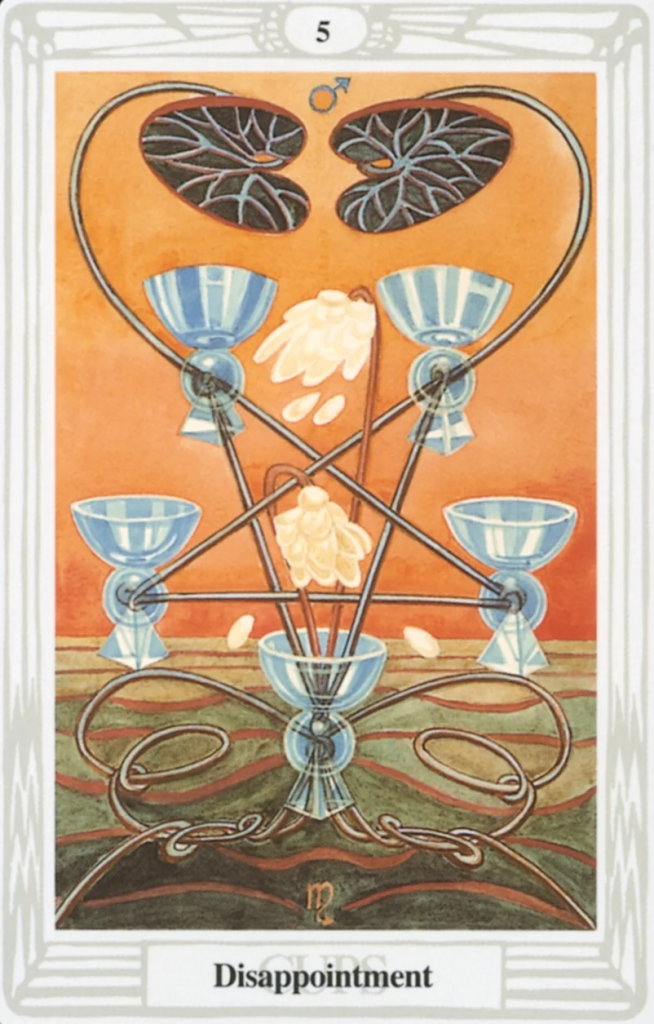
| The Five of Cups In our first discussion of the Lord of Disappointment, we said that none of us look forward to this card turning up… but since turn up it will, I thought perhaps it would help to have a discussion about how to reduce levels of disappointment in life, how to improve our chances of contentment and how to deal with disappointment when, inevitably, we have to face it.First and foremost, it’s important to realise that, whilst our disappointments often come from outside sources, the reason that we experience them is because of internal beliefs and expectations. We are disappointed when the company refuses to offer us that job we wanted and hoped for so much. We are disappointed when friends, lovers, family let us down and fail to treat us in a fashion we had believed they should. We are disappointed when something does not work out the way we had hoped.Yet we cannot go through life without expectations. And we cannot protect ourselves by holding negative expectations. Hope is a fighter.no matter how much we try to squash it down, it pops back up again.often in the sneakiest fashion.So… perhaps we simply have to be brave enough to hope, honest enough to assess our expectations realistically, and courageous enough to accept that sometimes, no matter how hard we try, we are going to be hurt by disappointment. Maybe we have to make the choice to risk ourselves, and accept that, sometimes, we will get let down…So on a day that is ruled by the 5 of cups, don’t go looking for disappointment… rather, spend some time assessing your expectations. Look for imbalance, or lack of realism, in your expectations of people and situations. If you find any, then be true to yourself, and adjust those expectations till they serve you better.Look for negative expectations (nothing good ever happens to me; I am always going to be lonely/miserable/unhappy; I am too weak/inadequate/uninformed to achieve what I need) and tackle these with gusto… they create darkness in your life, and serve no earthly purpose. Drive them out of your head with determined use of the affirmation, and agree to go after them every single time they surface.And finally… expect a nice surprise in every single day you live. Expect to find something that fills your heart with joy and gratitude every single day. Go looking for these things… make it part of your daily routine to discover something which makes joy arise within you… Affirmation: “I expect happiness to flow through my life, driving out negative thoughts and emotions.” |
(Angelpahts.com)
Karl Barth on “yes” and “no”

Christian Pornographer Refuses To Film Sex Tape For Gay Couple
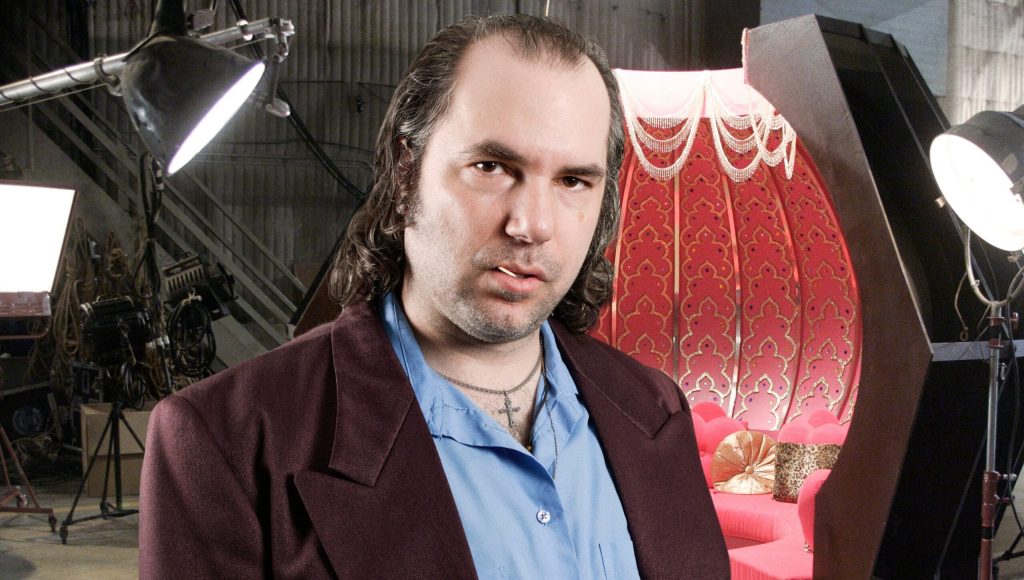
Published: August 3, 2018 (TheOnion.com)
ATLANTA—Saying it would violate his deeply held religious beliefs, area pornographer Chet Kirkendall, a 57-year-old Christian who frequently films explicit amateur videos for his clients, confirmed Friday he had denied service to a gay male couple that wished to hire him to direct their sex tape. “I’ve been in this business 25 years, and I strongly believe rim jobs, facials, and other hardcore sex acts should only take place between one man and one woman, or one man and two women, or in some cases five men taking turns with one woman—but never two men,” said Kirkendall, who told reporters that after a career directing hundreds of gang bangs, scenes of “barely legal” teenagers, and a variety of stepmother-themed material, he wasn’t about to violate his traditional Christian values by filming man-on-man action. “I take my work very seriously and am always proud to capture on video the sacred union of a man thrusting deep inside a woman and then cumming on her tits, or sometimes her face. God condones such sucking and fucking, but in His eyes, filming homosexual men bringing each other to orgasm through anal sex or vigorous fisting would be an abomination. It’s right there in the Book of Leviticus.” Asked whether he also would have denied service to a lesbian couple, Kirkendall refused to give a definitive answer, saying it might be permissible to accept such a job “as long as it was two hot chicks.”
Story: Foresight

Prosperos Assembly September 5-8
 |
| The Prosperos Assembly 2025 Integrity – The Key to Freedom Expanding consciousness through new paradigms of wholeness September 5 – 8, San Diego, California  In the midst of cataclysmic changes around the world we will use this weekend experience to explore the Ontological message : Back and behind the universe of time, space, and change lies a fundamental and changeless reality. It is exactly in times such as these that we have the opportunity to turn our vision from “wars and rumors of wars” to the ever-living Truth that provides each person with their keystone for bringing Integrity forth in their personal life and finding their way to communal wholeness.From the Aloha settingto our dynamic program, and activities -You are warmly invited to join us in person! We are coming together at the Island Palms Hotel on the Hawaii-infused Shelter Island next to the Bay in balmy San Diego ! This is your opportunity for reconnecting in community, rejuvenating in nature and re-discovering the Self each person has that can heal a fractured world.More information including hotel and event registration can be found on The Prosperos website (follow link to the announcement). Meanwhile, here is the introduction to your spiritually-infused haven : Video for Island Palms Hotel (San Diego):  |
| Copyright © 2025 The Prosperos, All rights reserved. Our mailing address is: The Prosperos P.O. Box 4969 Culver City, CA 90231 Want to change how you receive these emails? You can update your preferences or unsubscribe from this list. |
Jiddu Krishnamurti on going beyond the thought of “me”

Tarot Card for June 3: Indolence
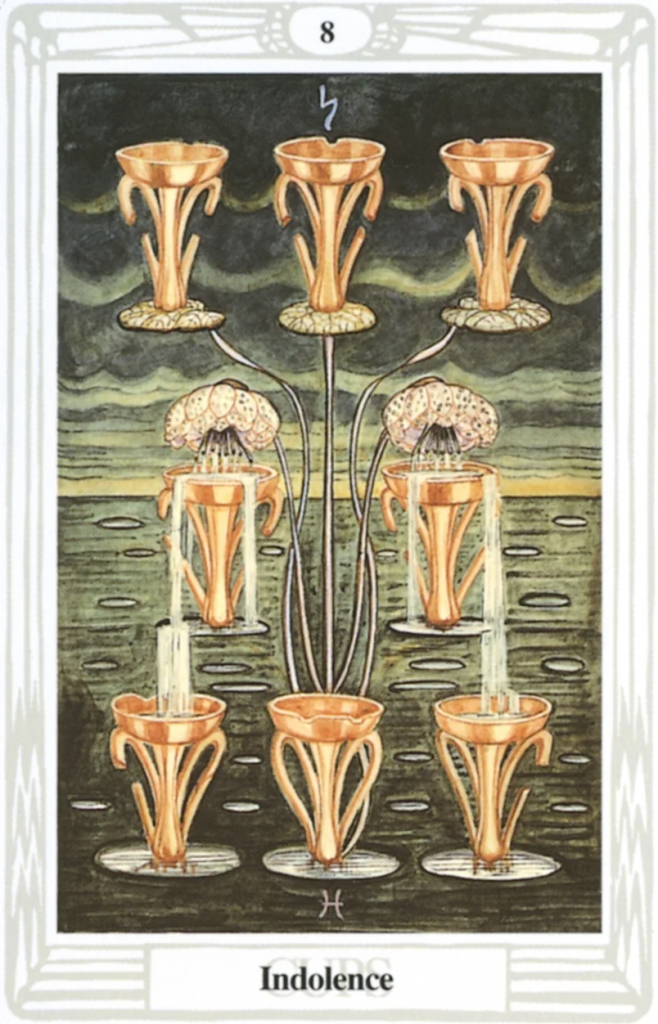
| The Eight of Cups The Lord of Indolence arises when energy is blocked, and where it is beginning to stagnate. This is, obviously, a nasty and potentially dangerous situation which must be addressed if it is to be cleared out of the way. You may, though, feel tired and apathetic about challenging issues which seem too big or too stubborn to deal with.If you are currently feeling quite trapped by life, then today is a day where you can make a profound difference to the way things around you are affecting you. Target one area which is taking more energy from you than it gives back. Think through your reactions and responses to this situation. Consider whether you’re tending to slide a bit toward feeling like a victim – don’t judge this, just consider it. If you judge something that sensitive, you will become defensive, and therefore be unable to tackle the problem properly.If you, after analysis, decide that you are contributing to the difficulty, then you have it in your power to simply refuse to worsen it with a negative attitude. Tackle the affirmation with great gusto! That should shift your own blockages.If, on reflection, you feel that the problem is not yours, but somebody else’s, the first thing you need to do is refuse to react by giving more energy. Just stop. For this day, refuse to play the game. And do the affirmation! That should cause some shift, if only in your own approach.Finally, if you feel you do not have any major problems today, then consider the whole energy exchange that is the sum total of your life. Assess things realistically. Ensure that there are no areas of leakage. If there are, then consider what you can do. If there aren’t, congratulate yourself for living your life in accordance with the dance of the Universe!! Affirmation: “My energy is the energy of the Universe. My power is my own.” |
Trump Amplifies Another Outlandish Conspiracy Theory: Biden Is a Robotic Clone
President Trump reposted another user’s false claim that the former president had been “executed” in 2020 and replaced by a robotic clone.


Reporting from Washington
June 1, 2025 (NYTimes.com)
President Trump shared an outlandish conspiracy theory on social media on Saturday night saying former President Joseph R. Biden had been “executed in 2020” and replaced by a robotic clone, the latest example of the president amplifying dark, false material to his millions of followers.
Mr. Trump reposted a fringe rant that another user had made on the president’s social media platform, Truth Social, just after 10 p.m. on Saturday. The White House did not respond to requests for comment on the post about Mr. Biden, whom Mr. Trump has targeted for criticism almost daily since the start of his second term.
The president has blamed Mr. Biden for all manner of societal ills and assailed his mental acuity, including with the specious theory that Mr. Biden’s aides used an autopen to enact policies and issue pardons without Mr. Biden’s knowledge. (Mr. Trump has acknowledged that his administration uses the autopen system on occasion.)
Mr. Trump has long had a penchant for sharing debunked or baseless theories online, but his embrace of conspiracies is not limited to social media. He has also elevated false claims inside the White House and surrounded himself with cabinet officials promoting such theories.
Last month, while sitting next to the president of South Africa in the Oval Office, Mr. Trump claimed that white South African farmers were victims of mass killings and displayed an image intended to back up his assertion; the image was actually of the conflict in eastern Congo. Mr. Trump has falsely asserted that white South Africans are victims of genocide, even though police statistics do not show that white people in the nation are any more vulnerable than other groups.
Mr. Trump’s first four years in the White House were filled with false or misleading statements — according to one tally, he made 30,573 of them, or 21 a day on average — and he repeatedly shared conspiracy theories in the lead-up to the 2024 election.
A New York Times analysis of thousands of Mr. Trump’s social media posts and reposts over a six-month period in 2024 found that at least 330 of them described both a false, secretive plot against Mr. Trump or the American people and a specific entity supposedly responsible for it. They included suggestions that the F.B.I. had ordered his assassination and accusations that government officials had orchestrated the Capitol riot on Jan. 6, 2021.
Mr. Trump’s repost of the robot conspiracy theory came a day after Mr. Biden told reporters that he was feeling good after beginning treatment for an aggressive form of prostate cancer. Mr. Trump has suggested that Mr. Biden’s diagnosis last month was not new and had been concealed from the public.
Zolan Kanno-Youngs is a White House correspondent for The Times, covering President Trump and his administration.
See more on: Donald Trump, Joe Biden, U.S. Politics
Empaths
From Wikipedia, the free encyclopedia
(Redirected from Empath (parapsychology))
This article is about the descriptor for someone with high empathy. For the comic book character, see Empath (character). For other uses, see Empath (disambiguation).
 | A request that this article title be changed to Empath (parapsychology) is under discussion. Please do not move this article until the discussion is closed. |
Empath (/ˈɛmpæθ/; from Ancient Greek ἐμπάθ(εια) (empáth(eia)) ‘passion’) is a term for people who have a higher than usual level of empathy.
In parapsychology, the mechanism for being an empath is said to be psychic channeling; psychics and mediums say that they channel the emotional states and experiences of other living beings, or the spirits of dead people, in the form of “emotional resonance“. Studies of such claims have found them to be the result of mundane empathy and charisma, with no actual supernatural capabilities involved.[1]
Paranormal usage
The term’s paranormal usage flows mostly from the work of American psychiatrist Judith Orloff. Orloff uses the term to describe people who have an innate ability to read the emotional state of others. She believes that empaths are able to sense the thoughts, feelings and energy of those around them, and that they are able to use this ability to provide healing or comfort to others, if they manage their condition correctly.[2] Orloff’s work is controversial, as she says that she is a clairvoyant (psychic);[3][4] her definition and classification of types of empaths is neither recognized by mainstream psychiatry nor is it included in the DSM-5. For her part, Orloff believes her psychiatric colleagues to be “stuck in the Dark Ages”.[5]
Two studies focused on such claims of telepathy have found them to be the result of mundane empathy and charisma, not supernatural capabilities.[1]
In popular culture
Paranormal Empaths have featured in various works of fiction, such as the Marvel Comics character Empath[6] Forest Whitaker‘s character Dan Smithson in Species (film) (1995) and the Star Trek: The Next Generation character Deanna Troi.[7] The concept is further explored in Star Trek: The Original Series, Season 3, Episode 12, titled The Empath.[8]
More at: https://en.wikipedia.org/wiki/Empath
The Empath: The Opposite of Narcisissm
29 May, 2025 (elisabettafranzoso.com)
Having recently written two articles on the topic of Narcissism and Egocentrism, I told myself I thought it would be good to balance things out and start writing something on its polarity.
So this article’s focal point is the empath, or the empathic structure.
I always recognised a lot of myself in the definition of an empath even though for many years I didn’t know much about it. So it has been a great opportunity to learn about myself first and now finding pleasure in my ability and platform to share it with others.
There are several common traits unifying empathic people, one of which is the commonly associated personality trait, empathy. Empathy is defined as a sign of emotional intelligence and emotional ability to understand other people’s feelings as if they were one’s own. Empathy is the act of putting ourselves in other people’s shoes and reaching our hearts out to others.

It’s worth noting that empathy is not the same as sympathy, which is more an act of pitying or feeling sorry for another. As the Dalai Lama says, “Empathy is the most precious human quality”. It allows us to keep our hearts open to love and nurture our acceptance and understanding of ourselves and others. In my opinion, it is the most important value that our society needs to foster and focus on today. According to Daniel Goleman, author of Emotional Intelligence, it is a predominant characteristic in individuals found to have high EQ’s.
People with high empathy, or empaths, are praised and valued in society for obvious reasons. But we often neglect the ‘dark side’ of an empath. An empath is the direct opposite of a narcissist in that they are extremely sensitive to the emotions and energy of others. But this can sometimes backfire on an empath, as they also tend to struggle standing up for themselves or recognising what is best for them. As Judith Orloff, a psychiatrist and an empath herself put it: “The trademark of an empath is feeling and absorbing other people’s emotions and/or physical symptoms because of their high sensitivities”.
Empaths are people who are extremely aware of the emotions around them. To an empath, it doesn’t just feel like “being aware” or others feelings… their experience is one of actually absorbing other people’s emotions as though they were their own. Furthermore, when overwhelmed with the impact of challenging or relentless emotions, empaths can very easily begin to experience depression, fatigue, apathy, panic attacks or fall into addictive behaviours using food, sex or drugs. As Andre Solo, co-founder of Highly Sensitive Refuge, affirmed, “For empaths, this ability is both a gift and a curse. It can be hard because most of the time empaths feel that they cannot ‘turn it off’, or it takes them years to develop ways to ‘turn it down’ when needed. As a result, an empath can find themselves going from perfectly happy to overwhelmed with stress, anxiety or other feelings, simply because someone else walked into the room. At the same time, an empath’s ability to absorb feelings is their greatest strength. It allows them to understand others and connect deeply with them. It’s also what makes them extraordinary caretakers, friends and partners – especially when others understand and appreciate their gift.”
I remember a time when my ex husband and I individually took a famous personality test that a couples counsellor had recommended. Once completed, we were asked to overlap the two separate tests to merge the results. This way we could recognise our similar and opposite traits. What we found was surprising for both of us and the counsellor: my spouse was at the higher limit of the indifference spectrum and I found myself on the opposite end, as a highly sensitive person. Today I recognise that I have an empathic structure.
This was back in 2006. At that time, a lot of information was still not as readily available online as it is now. I didn’t realise that a result that high on the empathic spectrum meant I was lacking safe boundaries and needed to learn how to protect myself in many areas of my life, including with myself.
Today, having studied and trained on the subject, I’m far more aware of what it means. This awareness has had a huge impact on my life, and allowed me to learn and integrate many lessons over the 26 years of my marriage and the subsequent long years that followed my divorce.
All my life I had been living as an emotional sponge. Too often I’d give away so much, too much, without any limitation and to anyone, be it my husband, daughter, mum, dad, friend or colleague. I would take on everyone’s pain without even realising it. There were times when I would actually sense it in my body and the consequence of that was this relentless need to try and fix, help and save people from their feelings and pain. I couldn’t help it, it was a true compulsion that I was totally unaware of. One that was in truth fulfilling a deep, unconscious need to be seen and recognised.
Interestingly enough, when my psychotherapist suggested I explore and dive into counselling and coaching as a profession, it gripped me immediately. For the first time, I had a deep interest in what I was doing and a real passion for my profession.
In delving into this new profession, I learnt so much more about the consequences of my extreme empathy. Having been so unable to set boundaries with and for myself and other, I didn’t understand what loving authentically really meant. I was feeling, sensing and loving everyone around me, my husband, daughter, friends and clients but rarely asked myself how that was impacting me. I was the opposite of a narcissistic personality and though much of society would see this overwhelming love and self-sacrifice as ‘altruism’, what it really was, was too much love. In reality, when we feel and love too much we’re not really feeling or loving at all.

Too much, or excessive love, giving and feeling, has nothing to do with real empathy. They are more reactions to feeling sympathy. We believe that we are givers, therefore good, altruistic people that must help, give, love and feel for others to alleviate their pain or struggle. But we’re deceiving ourselves. We think we’re loving, generous and selfless, but when it’s too much, we are not manifesting the authentic sense of these words. Fooled by a society that values and reveres love and altruism, we are kept in the dark about the less positive aspects of being an empath. As an emotional sponge, an empath can take on others’ heavy burdens and responsibilities without even realising it, without even being asked to.
The consequences of being an ‘under the radar’ empath can be subtle but immense. An empath can in fact put themselves in risky situations and/or become invasive for others around. For example, an empath might not see how they’re not giving their children space to grow into independent and authentic adults. Or they might impede their spouse to grow and expand according to their own rhythm and willingness. The empath can dominate or suffocate a partner with their too much sensing and feeling, trying to fix, help and save without being asked or required to do so. Unaware of this damaging side, the empath can be a powerful emotional manipulator or blackmailer, much like their narcissistic counterpart. In fact, neither one is better than the other, both a narcissist and an empath have their shortcomings because the truth is they exist at the extremes of a spectrum.
Since I was a teen, I always played the empath role, the one who feels too much, loves too much, gives too much to others and very rarely to themselves. The one who, through their excessive love, attention, giving to others, was often deliberately controlling other people’s lives at the expense of their own needs. Although, I’d receive some recognition and approval from all this too much, I never gave to myself or filled my own cup, busy juggling the woes of the world. This left me hospitalised twice from total burn out.
When I finally recognised the empath within me, I chose to begin a journey of self-transformation. It’s been a long and challenging journey, I admit, partly because I didn’t fully understand what it meant to have an empathic structure until after my divorce. It was only in solitude that I was able to observe myself and learn more about this trait of mine.
Today, I’m grateful to find myself in a different, balanced space. I’ve learnt over time to “turn off” my high sensitivity to others’ feelings and needs and even go so far as be emotionally distant, if that’s what I need to protect myself or care for myself. I consciously choose to allow others to be free to be who they really want or decide to be, feel and behave. In this way I can practice true authenticity with myself and then others, without acting out of fear of losing, hurting, displeasing, abandoning, rejecting or betraying. I have chosen to nurture a deeper level of emotional intelligence that allows me to access a balanced and healthy level of empathy.
Being an authentic empath means being sensitive to others’ needs without neglecting our own. It means being responsible for our own emotions, in a healthy, selfish way, and letting go of emotional responsibilities that are not ours. It means allowing others to be emotionally responsible for their own feelings (which is highly relevant when it comes to being a parent and watching our children grow up and go through their emotional growing pains).
I don’t mean to suggest that an empath should not be sensitive to the emotional needs of others. It means that we can still be highly sensitive without entering the trap of over-loving, over-giving and taking on others’ burdens. To achieve this balanced empathy, we need to let go of deep-rooted toxic conditioning and embrace a new way of living, no matter how uncomfortable at first.

Over time, behaviours and traits can become habitual, so it might feel counter-intuitive or selfish to change your behaviours at first. But with practice, persistence, patience and self-compassion, you can change the way in which you express your empathy so that it doesn’t become damaging for yourself or others. According to Dr. Orloff, “Empaths can also learn to centre themselves so that they don’t feel too much or become overloaded”.
As we’ve touched upon, empaths can be prone to burnout if we don’t know how to set boundaries with others and ourselves and take time to recharge. On the one hand, our emotional openness and sensitives can help others to feel safe and so we are able to build profound connections with others. On the other hand, we need to know how to manage the stress and consequences of taking on too much of others’ stuff.
Vulnerabilities of an Unaware / Unbalance Empath
- Empaths have a strong awareness of the negative and heavy burdens in the world – this makes us extra vulnerable to the toxicity that exists in the world.
- Empaths are intuitively knowledgable about human experience and relationships with people can often make them feel overloaded with and responsible for emotions which are not their own.
- Empaths can struggle to remain focused as a result of their highly sensitive nature. Empaths are usually capable of noticing all the details and nuances around them, which disperses their attention significantly.
How to Recognise If We Are Empaths / Highly Sensitive People
In her book, The Empath’s Survival Guide: Life Strategies for Sensitive People, Dr. Orloff offers a list of traits that empathic people share.
I’ve summarised them here alongside additions from my own research and experience:
- Empaths are highly sensitive.In order to be healthy and in balance in their life, they need to be firm and focused in their new way of living.
- Empaths, like sponges, absorb other people’s moods.When around peace and love, they flourish. Being around negative emotions, such as anger, anxiety, fear and depression can deplete them.
- Empaths are highly intuitive.For them it is relevant to learn to listen to their own gut feelings about people and situations.
- Empaths need alone time.As empaths are often strongly affected by the emotions and moods of other people, they need a lot of time alone to regain their energy and centre. Solitude is a great way of maintaining overall wellbeing.
- Often, empaths are introverted.When an empath is more extroverted, they may benefit from limiting how much time they spend with people so that they can recharge themselves.
- Deep down, empaths are afraid of losing their identity when in relationships.They may avoid intimate relationships because of their tendency to take on others’ ‘stuff’.
- For empaths to be at ease in a relationship, the traditional paradigm for being a couple must be redefined and they must practice self-awareness and being present.Often empaths are targets for energy vampires.Especially dangerous are the ones such as narcissists, who lack empathy and are focused on themselves: they can make empaths believe they are not worthy of love and sabotage their confidence and self-esteem.
- Empaths replenish themselves in nature.The busyness of everyday life can become too much for the empath. They can take refuge in the presence of the ocean or forest. I recognise myself in this very much, for it is by recharging in nature that I have been able to stay away from burning out.
- Empaths have highly tuned senses.
- Empaths, especially if extroverted, have huge hearts and more often then not, they give too much.
Empaths are big-hearted people and try to relieve the the pain of others: a distraught friend, a hurt child, a homeless person etc. They don’t merely offer support to ease the pain of the suffering people, they take it on as if it belonged to themselves.
Final Words
Empaths’ ‘dark side’ is painful to carry. By taking on board others’ negative emotions, empaths often tend to forget their own needs and carry burdens that aren’t theirs on their shoulders throughout their lives.
Helping others while you have your own problems is totally exhausting, especially if you’re an empath. As they’re able to sense other people’s feelings, it is little surprise that they can feel drained and exhausted after a day at work. After enough time passes, burn out seems inevitable.

The main thing to take home from this article is that coping with the issues of others is not an obligation or duty. To prevent our empathy from become unhealthy, one should try not to give all of themselves to every single person that they encounter in their day to day lives. Empaths should also let go of the walls that they have built over time because of negative experiences. Only by healing, rebuilding trust, paying more attention to themselves and being more attentive of whom they spend their energy with and on, can empaths finally allow their authentic selves do real good in their lives and others.
Coach / Counsellor Suggestions
- If you are an empath, the first step is to acknowledge that you are.
- Be responsible for yourself – true responsibility is not a duty, it is the ability to respond to what you have in front of you.
- Take action – choose to look for the support or a well prepared coach or counsellor with experience in emotional management and EQ.
- Nurture willingness, focus, self-discipline and self-compassion, acknowledging that this is a journey and not a quick fix. Be patient with yourself.
- Use visualisation, movement, gratitude, mindfulness and prayer as a part of your daily routine.
- Enjoy the ride with fun and joy in your heart!
A Personal Note:
As an empath myself, married to a narcissist for many many years and unconsciously becoming the ‘aggressor’ on occasion towards myself, my daughter and others in order to protect myself and survive, I had to first spend time in counselling and training to de-condition myself from my childhood family conditioning and entanglements.
I then had to study and understand the narcissistic and empathic structures in real depth, honestly recognising them in others and myself too. I had to learn to observe and take care of myself, to be healthily selfish and less over-altruistic. I had to educate myself on the true meaning of self-love and self-care and had to rebuild my self-esteem from scratch.
Today I have a daily routine that keeps me grounded and use several tools to protect my deep sensitivity, such as firm time management when I am with someone who I might recognise to be unhealthy for me (be they manipulative, narcissistic etc). I must set healthy boundaries with people I find draining and of course, with myself too (we are our own worst enemy after all). I practice a daily mindfulness practice to centre myself and slow down the thinking – action process. And I deliberately and regularly choose to spend time in nature as often as I can.
After acknowledging the curse that accompanies the empathic structure I was born with and after transforming the compulsive and unhealthy consequences that followed allowing it to run wild, I was finally able to see the blessing in disguise, the silver lining, and feel thankful for the gift of being an empath.
We must remember that as empaths we have special needs and we need special care from ourselves, to ourselves. If it so happens that you recognise yourself in the above, as an empath, it’s important to honour the empath in you first and then to learn to recognise your special needs, whilst possibly deciding to clearly communicate them to your loved ones.
header image by Ahmet Sali
The following blog posts go into more detail on some of the topics and themes touched on above:
Is Narcissism the Same as Egocentrism?
Everyone is a Narcissist, Everyone is a Victim
Do I Need a Life Coach?
If what I’ve written has resonated with you and you think I could be the right support for you, feel free to get in touch and schedule a Free 30 Minute Consultation by clicking the button below.
► Elisabetta Franzoso is a multi continental Life and Wellness Coach practicing between Barcelona, London, Milan and Singapore where she has many loyal clients.
► Elisabetta empowers men and women to master their mind, body and personal relationships through renewing their confidence and building a sense of wellness. She does this through her unique Coaching In 4 Dimensions framework which takes into account the physical, emotional, intellectual and relational aspects of humanity.
► Elisabetta will inspire you to live the life you want to live, maximise your potential and achieve self mastery. Aside from coaching, Elisabetta is a passionate social activist and spokesperson against abuse.
► Elisabetta has been featured extensively across international and UK press including Thrive Global, Grazia Magazine, Breathe Magazine and Health & Wellbeing Magazine. Stay up to date with Elisabetta at www.instagram.com/elisabettafranzoso, www.linkedin.com/elisabettafranzoso and www.elisabettafranzoso.com.