(Courtesy of Larry@EcoDelMar.org )


| JUN 5, 2025 from Marianne Williamson |
Guest post by Matthew Albracht
In our hyper-polarized political and social climate, the urge to demonize those we disagree with has never been stronger—and it’s in full force. But what if blanket vilification is actually making things worse? When we deploy a strategy of wholesale demonization, we deepen polarization, halt productive exchange, and make real change unattainable. Drawing from personal experience as a longtime activist, I explore why hate closes the door to the connection and transformation our world desperately needs. This isn’t about being passive in the face of injustice—it’s about finding more effective ways to create the change we’re advocating for. Sometimes the most radical act is refusing to let hate and anger lead the way.

In these charged and honestly frightening political times in America, it can be incredibly tempting to vilify those whose views clash with our own. The stakes feel impossibly high, and the divisions seem insurmountable. From political activists to everyday citizens—and especially among the pundit and political class—hate-filled demonization of our “opponents” has reached toxic levels. It’s a thick fog of dysfunction, and I don’t know many people who aren’t feeling overwhelmed by it.
That urge to continually vent frustration onto the “other side” can feel utterly irresistible. But when hate fills our hearts, there is no room left for anything else. Hate is an intense, consuming emotion that most of us cannot leap over to find common ground or genuine connection. Some trash opponents just to release pent-up frustration, or convince themselves it will help their cause—shock people into seeing the folly of their views or as a means to rally our allies. In reality, it does the opposite. By using personalized attacks and demeaning others, we push them deeper into defensive positions and reinforce the very divisions we claim to want to heal.
As a lifelong activist, I’ve been guilty of this, thinking my anger and vitriol might enroll others or jolt my “opponents” awake. Instead, I began to see that it was counterproductive—it simply built more division. That is not to say there aren’t people doing truly vile things. Calling out real injustice powerfully and forcefully is important. The danger arises when anger-fueled critique becomes our wholesale strategy: constantly demonizing or mocking everyone with whom we disagree. It weakens our ability to speak out when strong criticism is truly justified, and it creates a divide so wide we can never reach common ground. Dialogue stalls, disconnection compounds, and the walls between us rise higher. That toxic cycle can even prompt opponents to take wilder swings, driving us further down the path of entrenched polarization. This approach also alienates potential allies who value collaboration and constructive dialogue—and are exhausted by all the games.
Don’t get me wrong, strong feelings—even rage—can be completely understandable, especially when confronting profound injustice. However, when anger is our primary and ongoing source of fuel, it burns hot and often peters out quickly, leaving quite a mess in its wake. Festering anger usually (though not always) masks deeper, more vulnerable emotions that haven’t been acknowledged. For instance, what might be lying beneath my anger in any given moment is heartbreak: care for humanity, a longing for genuine community that cares for one another, and a deep fear that we may never achieve it. I often feel heartbroken (along with a healthy dose of rage) by the suffering I see under terrible policy choices and by how far we’ve strayed from a vision of unity. I worry not only for myself, but for the millions who lack the resilience and resources I have.
I don’t deny or try to pretend away anger or rage when it justifiably arises, I just work hard not to live there full time. When I allow myself to tap into the more tender spaces—share authentic sadness or fear when that is what I’m really feeling—others are far more likely to hear me. Most people can connect with those feelings in a way they cannot with unfettered rage. If I approach someone and say, “I’m heartbroken and fear for what’s happening,” they are more likely to pause and hear me than if I barrell in yelling. Operating from a deeper place of vulnerability creates space for genuine conversation.
There is a pervasive idea that political engagement must be a constant battle, a fight. We watch political pundits lob bombs and insults at each other. Too many of us jump onto Twitter, cable news or podcasts, etc., and consume and/or contribute to the endless vitriol. But does it have to be that way? Can we not engage more respectfully, even with passion?
I grew up on a farm in Texas, where much of my family votes very differently than I do. Early on in my adulthood, I reveled in the fight—trying to win heated arguments felt like the point. That approach wore down our relationships and—honestly—my relationship with myself. The constant stress and disconnection took a toll I didn’t fully recognize until later.
Now I understand that it takes real commitment and emotional regulation to resist fighting fire with fire—or to stop igniting the fire myself in the first place. I’ve found much more peace since stepping back from constant political combat (though still a work in progress).
I do however strongly believe in the power of nonviolent resistance, now more than ever. Especially in the face of frightening anti-democratic movements. We can speak out and act vigorously against vile tactics without demonizing every person on the other side. This is different than the game too many are playing right now. Nonviolent resistance can not only affect real change, but the very nature of it can humanize the resistance—make it more compelling even.
When we stand face-to-face with someone, we generally treat each other with kindness and respect. We hold doors open, say please and express gratitude, we reach out a helping hand (without even asking how each other might vote!), we recognize each other’s humanity. Not always, but often. Yet, something shifts when there’s distance between us —whether in traffic, on social media, or in our political discourse. Behind every social and political position stands a real human being with fears, hopes, and experiences. But when they’re not right in front of us, it’s easy to forget that—and become vicious. Such a bizarre and destructive dynamic.
As I said, I still get worked up when I see injustice or hear views that deeply irritate me. I’ll curse, kvetch, feel genuine anger—that’s part of how I process it all at this stage of my emotional development. But experiencing those feelings does not mean I have to lash out or weaponize them. There is a crucial difference between privately processing our emotions and unleashing them as a public strategy. How we handle charged feelings makes all the difference.
What if we brought the same face-to-face, humanizing energy to our political conversations? What if we remembered that even those we vehemently disagree with are fellow human beings navigating a complex world? This doesn’t mean abandoning our values or failing to stand up for what matters. It means advocating for our beliefs without dehumanizing others who see things differently—and accepting that lasting change rarely comes through shame and attack. Instead, it comes through the hard work of building bridges and finding common ground.
I learned this lesson firsthand through my work at The Peace Alliance. Over the past 20 years we have been in operation, we often met with congressional offices to promote our peacebuilding agenda. One meeting—around the time of the Iraq war—stands out. We were speaking with Nancy Pelosi’s chief of staff, who came in guarded: arms crossed, not looking at us, and braced for confrontation. We proceeded anyway. We stayed kind, gracious, and articulate about our cause, leaning on nonviolent communication techniques we had been learning. Halfway through, he paused, he had started to loosen up and he shared something really illuminating. He admitted, “I came in expecting to be berated, because most people show up mad. I didn’t think I’d have a respectful, productive conversation.” From that moment, the dynamic changed. He even gave us more time than scheduled. That meeting showed us how building connection opens doors rather than immediately slamming them shut.
In a time of so much social and political intensity, when the temptation to demonize our “opponents” feels almost overwhelming, perhaps our greatest act of resistance is refusing to let hate win. Perhaps our most radical choice is to keep our hearts open, even when it’s hard—especially when it’s hard. The world we long for—a world of genuine community and connection—will not be built on hatred and rage. It will be built through the brave choice to see each other’s humanity across our deepest differences, to honor those differences, and to engage with respect and care, even when we are working towards different goals. That is more fertile ground. Refusing to vilify may be the most radical act of resistance left to us.
This is a guest post written by Matthew Albracht. You can subscribe to his Substack here. Matthew is the former Executive Director and a Board Member of The Peace Alliance. His writings have appeared on CNN, Salon, HuffPost and other outlets. Follow Matthew on: Instagram, Twitter, and Facebook
Ian Bremmer | TED Explains the World with Ian Bremmer
• June 2025
Ukraine’s surprise drone strike deep inside Russia damaged billions of dollars’ worth of irreplaceable military aircraft and marks a major milestone in the ongoing conflict. Political scientist Ian Bremmer breaks down how the Ukrainians pulled off the astonishing attack, the risk of nuclear retaliation from Putin and why “asymmetric warfare” is here to stay. (This interview, hosted by TED’s Helen Walters, was recorded on June 2, 2025.)
Want to use TED Talks in your organization?
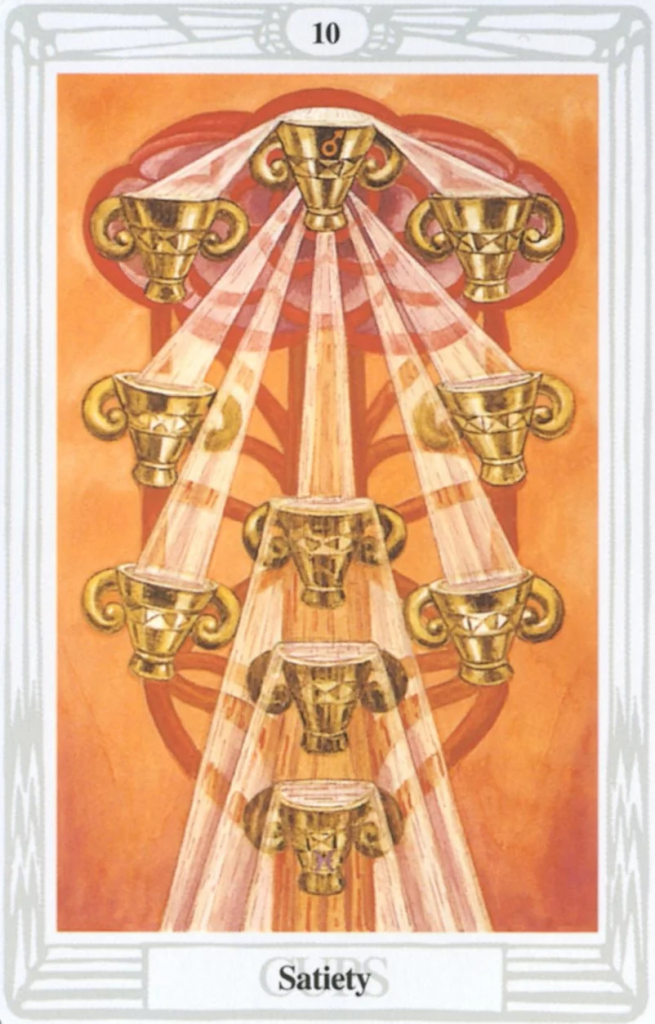
| The Ten of Cups The Lord of Satiety is a sanctuary card… it indicates a blissful moment in time where we feel contented, happy and emotionally satisfied. It’s easy to be at one with the Universe when you feel this blessed. We are more readily able to make contact with the High Powers, and to experience their energies in our lives.So on a day ruled by the Ten of Cups, be aware that you are probably walking closer to the Gods (however you conceive them) than on most more ordinary days. Expect intuition to be heightened, and make sure you give yourself the time to listen to it.Try to make an oasis of silence around yourself every now and again, so that you can simply experience and feel and know the quality of your life. This doesn’t have to be for long periods – five minutes here and there throughout the day will make for a happy interlude.Remember – when you feel loved yourself, you radiate love to others. You don’t have to do anything more complicated than allow yourself to be satisfied. Days like this are rare enough. But when they come around, if you let the brightness inside your soul, it lights you up from the inside. We gather strength on these days – strength that carries us forward through the challenges and storms that inevitably touch our lives from time to time.Strive to be peaceful and secure in your home environment too. And don’t let yourself be impatient for the things that have not found their right moment in your life yet. Absorb, grow, rest and replenish… these are the important things to do on a day ruled by the Lord of Satiety. Affirmation: “Today my life gives me everything I need to be happy.” |
(Angelpaths.com)
Translation is a 5-step process of “straight thinking in the abstract” comparing and contrasting what seems to be truth with what you can syllogistically, axiomatically and mathematically (using word equations) prove is the truth. It is not an effort to change, alter or heal anything.
The claims in a Translation may seem outrageous, but they are always (or should always be) based on self-evident syllogistic reasoning. Here is one Translation from this week.
1) Truth is that which is so. That which is not truth is not so. Therefore Truth is all that is. Truth being all is therefore total, therefore complete, therefore whole, therefore one, therefore united, therefore harmonious, therefore orderly. I think therefore I am. Since I am and since Truth is all that is, therefore I, being, am Truth. Since I, being, am Truth, therefore i, being, have all the attrbutes of Truth. Therefore I, being, am total, complete, whole, one, united, harmonious, orderly. Since I am mind (self-evident) and since I (being) am Truth, therefore Truth is Mind. (Two things beinq equal to a third thing are equal to each other.) Since Truth is Mind, therefore Mind has all the attributes of Truth. Therefore Mind is total, complete, whole, one, united, harmonious, orderly.
2) Dissociative amnesia is like having a hole in your psyche.
Word-tracking:
dissociate: separate from
dissemble: to be different, to disguise, to hide your true self
disguise: to appear different
guise: manner, wise, knowledge
amnesia: to forget
forget: to leave behind, to neglect, to lose hold of
psyche: Goddess of the soul, spirit, breath, animation, life, mind
hole: burrow, hide
3) Truth being all that is, there can be nothing different from all that is, therefore Truth cannot be disguised, dissembled, separate or dissociated from Itself. Truth being Mind cannot be forgetfulness as well, therefore Truth holds all, remembers all, neglects nothing, leaves nothing behind. Truth being Mind is therefore psyche, therefore life, therefore animation, therefore breath, therefore spirit. Therefore that which is not psyche, life, animation, breath, spirit is not so. Truth being one Mind cannot hide from Itself, cannot disguise Itself, cannot dissemble Itlse, therefore Truth always knows Itself in whatever guise or disguise.
4) Truth cannot be disguised, dissembled, separate or dissociated from Itself.
Truth holds all, remembers all, neglects nothing, leaves nothing behind.
Truth is psyche, life, animation, breath, spirit.
Truth always knows Itself in whatever guise or disguise.
5) Truth does not and cannot hide from Itself.
Weekly Invitational Translation Group invites your participation. If you would like to submit a Translation on any subject, feel free to send your weekly Translation to zonta1111@aol.com and we will anonymously post it on the Bathtub Bulletin on Friday.
For information about Translation or other Prosperos classes go to: https://www.theprosperos.org/teaching.
From Wikipedia, the free encyclopedia
For the opera by Gluck, see Orfeo ed Euridice.

In Greek mythology, the legend of Orpheus and Eurydice (Greek: Ὀρφεύς, Εὐρυδίκη, romanized: Orpheus, Eurydikē) concerns the pitiful love of Orpheus of Thrace, located in northeastern Greece, for the beautiful Eurydice. Orpheus was the son of Oeagrus and the Muse Calliope. It may be a late addition to the Orpheus myths, as the latter cult-title suggests those attached to Persephone. The subject is among the most frequently retold of all Greek myths.

In Virgil‘s classic version of the legend, it completes his Georgics, a poem on the subject of agriculture. Here the name of Aristaeus, or Aristaios, the keeper of flying insects, and the tragic conclusion was first introduced.[1]
Ovid‘s version of the myth, in his Metamorphoses, was published a few decades later and employs a different poetic emphasis and purpose. It relates that Eurydice’s death was not caused by fleeing from Aristaeus, but rather by dancing with nymphs on her wedding day.[2]
In the Bibliotheca by Pseudo-Apollodorus Eurydice is simply bitten by a serpent before dying and Orpheus goes to Hades to retrieve her.[3]
Other ancient writers treated Orpheus’s visit to the underworld more negatively. According to Phaedrus in Plato’s Symposium,[4] the infernal deities only “presented an apparition” of Eurydice to him. Plato’s representation of Orpheus is in fact that of a coward; instead of choosing to die in order to be with his love, he mocked the deities in an attempt to visit Hades, to get her back alive. As his love was not “true”—meaning that he was not willing to die for it—he was punished by the deities, first by giving him only the apparition of his former wife in the underworld and then by having him killed by women.[4]
| This section does not cite any sources. Please help improve this section by adding citations to reliable sources. Unsourced material may be challenged and removed. (October 2019) (Learn how and when to remove this message) |
Apollo gave Orpheus a lyre and taught him how to play. It had been said that “nothing could resist Orpheus’s beautiful melodies, neither enemies nor beasts.” Orpheus fell in love with Eurydice, a woman of beauty and grace, whom he married and lived with happily for a short time. However, when Hymen was called to bless the marriage, he predicted that their perfection was not meant to last.
A short time after this prophecy, Eurydice was wandering in the forest with the Nymphs. In some versions of the story, the shepherd Aristaeus saw her and, beguiled by her beauty, made advances towards her and began to chase her. Other versions of the story relate that Eurydice was merely dancing with the Nymphs. Whether fleeing or dancing, she was bitten by a snake and died instantly. Orpheus sang his grief with his lyre and managed to move everything, living or not, in the world; both humans and gods learnt about his sorrow and grief.
At some point, Orpheus decided to descend to Hades by music to see his wife. Any other mortal would have died, but Orpheus, being protected by the gods, went to Hades and arrived at the Stygian realm, passing by ghosts and souls of people unknown. He also managed to attract Cerberus, the three-headed dog, who had a liking for his music. He presented himself in front of the god of the Greek underworld, Hades, and his wife, Persephone.
Orpheus played with his lyre a song so heartbreaking that even Hades himself was moved to compassion. The god told Orpheus that he could take Eurydice back with him, but under two conditions: she would have to walk behind him while walking out from the caves of the underworld, and he could not turn to look at her as they walked.
Thinking it a simple task for a patient man like himself, Orpheus was delighted; he thanked Hades and left to ascend back into the living world. Unable to hear Eurydice’s footsteps, however, he began to fear the gods had fooled him. Eurydice might have been behind him, but as a shade, having to come back into the light to become a full woman again. Only a few feet away from the exit, Orpheus lost his faith and turned to see Eurydice behind him, sending her back to be trapped in Hades’s reign forever.
Orpheus tried to return to the underworld but was unable to, possibly because a person cannot enter the realm of Hades twice while alive. According to various versions of the myth, he played a mourning song with his lyre, calling for death so that he could be united with Eurydice forever. He was killed either by beasts tearing him apart or by the Maenads in a frenzied mood. His head remained fully intact and still sang as it floated in the water before washing up on the island of Lesbos. According to another version, Zeus decided to strike him with lightning, knowing Orpheus might reveal the secrets of the underworld to humans. In this telling, the Muses decided to save his head and keep it among the living people to sing forever, enchanting everyone with his melodies. They additionally cast his lyre into the sky as a constellation.
CNN Jun 3, 2025 CNN will air the penultimate performance of this 5x Tony-nominated play LIVE for one night only – you won’t want to miss this historic live event on June 7 at 7p ET on CNN’s cable channel, digital platforms and streaming live on Max. “Good Night, and Good Luck” tells the gripping true story of journalist Edward R. Murrow’s legendary showdown against McCarthyism.
BY ROB BREZSNY | JUNE 3, 2025 (NewCity.com)
ARIES (March 21-April 19): You have had resemblances to cactuses in recent days. It hasn’t always been pleasant and cheerful, but you have become pretty skilled at surviving, even thriving, despite an insufficiency of juicy experiences. Fortunately, the emotional fuel you had previously stored up has sustained you, keeping you resilient and reasonably fluid. However, this situation will soon change. More succulence is on its way. Scarcity will end, and you will be blessed with an enhanced flow of lush feelings.
TAURUS (April 20-May 20): I foresee abundance emerging from modest sources. I predict breakthroughs arising out of your loving attention to the details of the routine. So please don’t get distracted by poignant meditations on what you feel is missing from your life. Don’t fantasize about what you wish you could be doing instead of what you are actually doing. Your real wealth lies in the small tasks that are right in front of you—even though they may not yet have revealed their full meaning or richness. I invite you and encourage you to be alert for grandeur in seemingly mundane intimate moments.
GEMINI (May 21-June 20): It’s time for your Uncle Rob to offer you some fundamental advice for living. These tips are always worthy of your contemplation, but especially now. Ready? Being poised amidst uncertainty is a superpower. You may attract wonders and blessings if you can function well while dealing with contradictory feelings, unclear situations and incomplete answers. Don’t rush to artificial closure when patience with the unfinished state will serve you better. Be willing to address just part of a problem rather than trying to insist on total resolution. There’s no need to be worried or frustrated if some enigmas cannot yet be explained and resolved. Enjoy the mystery!
CANCER (June 21-July 22): Acclaimed Cancerian poet Lucille Clifton published fourteen books and mothered six children. That heroism seems almost impossible. Having helped raise one child myself, I know how consuming it is to be a parent. Where did she find the time and energy to generate so much great literature? Judging from the astrological omens, I suspect you now have access to high levels of productivity comparable to Clifton’s. Like her, you will also be able to gracefully juggle competing demands and navigate adeptly through different domains. Here’s my favorite part: Your stellar efficiency will stem not from stressfully trying too hard but rather from good timing and a nimble touch.
LEO (July 23-Aug. 22): One of the seven wonders of the ancient world was the Colossus of Rhodes, located on a Greek island. Symbolizing power and triumph, it was a towering statue dedicated to the sun god Helios. The immediate motivation for its construction was the local people’s defeat of an invading army. I hereby authorize you to acquire or create your own personal version of an inspiring icon like the Colossus, Leo. It will symbolize the fact that the coming months will stimulate lavish expressions of your leonine power. It will help inspire you to showcase your talents and make bold moves. PS: Be alert for chances to mobilize others with your leadership. Your natural brilliance will be a beacon.
VIRGO (Aug. 23-Sept. 22): The Great Barrier Reef is the world’s biggest structure built by living things. Lying beneath the Coral Sea off the east coast of Australia, it’s made by billions of small organisms, coral polyps, all working together to create a magnificent home for a vast diversity of life forms. Let’s make the Great Barrier Reef your symbol of power for the next ten months, Virgo. I hope it inspires you to manage and harness the many details that together will generate a robust source of vitality for your tribe, family and community.
LIBRA (Sept. 23-Oct. 22): One of my favorite poets, Arthur Rimbaud, wrote all of his brilliant work before he became an adult. I suspect that no matter what your age is, many of you Libras are now in an ultra-precocious phase with some resemblances to Rimbaud from age sixteen to twenty-one. The downside of this situation is that you may be too advanced for people to thoroughly understand you. You could be ahead of your time and too cool for even the trendsetters. I urge you to trust your farseeing visions and forward-looking intuitions even if others can’t appreciate them yet. What you bring to us from the future will benefit us all.
SCORPIO (Oct. 23-Nov. 21): Blacksmiths still exist. They were more common in the past, but there are many twenty-first-century practitioners. It’s a demanding art, requiring intense heat to soften hard slabs of metal so they can be forged into intricate new shapes. The process requires both fire and finesse. I think you are currently in a phase when blacksmithing is an apt metaphor. You will need to artfully interweave passion and precision. Fiery ambition or intense feelings may arise, offering you raw energy for transformation. To harness it effectively, you must temper your approach with patience, restraint and detail-oriented focus.
SAGITTARIUS (Nov. 22-Dec. 21): Jean-Paul Sartre and Simone de Beauvoir were two feisty, independent, strong-minded French writers. Beauvoir was a trailblazing feminist, and Sartre was a Nobel Laureate. Though they never officially married, they were a couple for fifty-one years. Aside from their great solo accomplishments, they also gave us this gift: They proved that romantic love and intellectual equality could coexist, even thrive together, with the help of creative negotiation. I propose we make them your inspirational role models for now. The coming months will be a favorable time to deepen and refine your devotion to crafting satisfying, interesting intimate relationships.
CAPRICORN (Dec. 22-Jan. 19): Over 2600 years ago, ancient Babylonian astronomers figured out the highly complex cycle that governs the recurrence of lunar and solar eclipses. It unfolds over a period of eighteen years and eleven days. To analyze its full scope required many generations of researchers to carry out meticulous record-keeping with extreme patience. Let’s make those Babylonian researchers your role models, Capricorn. In the coming months, I hope they inspire you to engage in careful observation and persistent investigation as you discover meaningful patterns. May they excite your quest to discern deep cycles and hidden rhythms.
AQUARIUS (Jan. 20-Feb. 18): I invite you to try this visualization exercise, Aquarius: Picture a rosebud inside your body. It’s located in your solar plexus. Imagine it’s steadily and gently opening, filling your body with a sweet, blissful warmth, like a slow-motion orgasm that lasts and lasts. Feel the velvet red petals unfolding; inhale the soft radiance of succulent fragrance. As the rose fully blooms, you become aware of a gold ring at its center. Imagine yourself reaching inside and taking the ring with your right hand. Slip the ring onto your left ring finger and tell yourself, “I pledge to devote all my passionate intelligence to my own well-being. I promise to forever treat myself with tender loving respect. I vow to seek out high-quality beauty and truth as I fulfill my life’s mission.”
PISCES (Feb. 19-March 20): I foresee the arrival of a living fossil, Pisces. An influence you thought was gone may soon reappear. Aspects of your past could prove relevant to your current situation. These might be neglected skills, seemingly defunct connections, or dormant dreams. I hope you have fun integrating rediscovered resources and earmarking them for use in the future. PS: Here’s a lesson worth treasuring: While the world has changed, a certain fundamental truth remains true and valuable to you.
Homework: What is the best surprise gift you could give yourself right now? Newsletter.FreeWillAstrology.com
Lei Cheng | TED2025
• April 2025
Accused of leaking state secrets, journalist Lei Cheng was imprisoned in China for more than three years, where she was detained in tight quarters and kept under constant supervision. “Freedom is wasted on the free,” she says, recounting how she and fellow inmates found joy in the smallest of moments: the smell of rain, a poem delivered in secrecy, kindness where it seemed undeserved. She distills the unexpected lessons that confinement taught her — and challenges us to rethink what freedom really means.
Want to use TED Talks in your organization?
Lei Cheng
Journalist


