Jacob Nordby • Jun 28, 2023 Message of the year: “How do you spot an idiot? Look for the person who is cruel. The kindest person in the room is often the smartest.” — Gov Pritzker
(Contributed by Gwyllm Llwydd)

Jacob Nordby • Jun 28, 2023 Message of the year: “How do you spot an idiot? Look for the person who is cruel. The kindest person in the room is often the smartest.” — Gov Pritzker
(Contributed by Gwyllm Llwydd)

(SHUTTERSTOCK)
A Texas author earned a certificate in AI—but there’s no way he’d ever use it to write a book.
by SKIP RHUDY
APRIL 15, 2025 (texasobserver.org)
I’ve got a post-graduate certificate in artificial intelligence (AI). I’m also an author, and I believe writers and publishers should not use AI in publishing. So that’s why I was disturbed when a reviewer asked if I had used AI in writing my recent coming-of-age novel, Under the Gulf Coast Sun.
But the reasons I oppose using AI are not the usual ones you hear.
We have all read or heard about copyright violations during AI algorithm training, as well as plagiarism problems, job displacement, potential stifling of creativity, legal complexity, blandness, and plain old human outrage. Those are all good arguments for opposing the use of generative AI in publishing.
Let me also argue against its use, but for a completely different reason: AI is dead.
Literally.
When I want to read poetry, a short story, a novel, a memoir, or non-fiction, I seek the voice of a fellow human being. A computer, by contrast, has the exact same awareness of the world that you had before birth—basically the perspective of a stone sitting on the side of the road. That is, no awareness of the world at all.
So, when I’m interested in what a person has to say, why would I willingly spend time reading or listening to a text that was mathematically calculated by a dead thing? I would not. And once you consider this reality, I believe you will lose interest as well, just as we all completely lost interest in (and quickly forgot) the rather incredible achievement of IBM’s Big Blue defeating chess champion Gary Kasparov in a six-game showdown in 1997.
Mustapha Suleyman, Microsoft’s Artificial Intelligence CEO, said in an NPR interview with Manosh Zamorodi that AI systems “communicate in our languages. They see what we see. They consume unimaginably large amounts of information. They have memory. They have personality. They have creativity.”
That is mostly nonsense. Computers operate only with zeros and ones. AI does not see what we see. It has no personality, no creativity. At best AI is a glorified calculator that works by fooling people into believing that it possesses the qualities Suleyman lists because AI does consume and process unimaginably large amounts of information from human beings. Unlike Suleyman’s claim, though, computers don’t have any real understanding of the data they generate.
Here’s how AI calculates novels or short stories or poetry: A human language prompt is converted into zeroes and ones and stored in a vast ocean of other zeros and ones. Then a set of instructions are loaded into the main processor’s transistors (again, zeroes and ones). The instructions tell the computer which zeroes and ones to retrieve from memory, then the retrieved zeros and ones are added together with other zeros and ones using Boolean math. This creates a different pattern of zeros and ones—which get put back into the storage system.
ADVERTISEMENT
This process repeats itself at extreme speed for about ten or fifteen seconds, until the novel or short story or poem has been fully calculated and placed into memory (again, as zeros and ones).
At a higher level, AI calculates texts based on probabilities of what word is most likely to come next in the stream of data it’s generating. That’s all.
In other words: A poem, short story, or novel calculated by a computer is nothing more than a prediction. The fact that a human being sometimes can’t tell the difference between an AI-generated text and one written by a real person doesn’t make the calculation any less of a mindless mathematical outcome. (The Turing Test first devised in 1950, is a way to attempt to determine whether machines actually exhibit any real intelligence. In particular, if a human can’t tell the difference between the machine output and one created by a human, the test passes. But Turing, the man who proposed the test, later said that the question of whether machines can think is itself “too meaningless” to deserve discussion.)
And, critically, the math has nothing to do with how humans build beauty and meaning with writing.
There are uncountable amazing and incredibly useful applications of AI, both generative and otherwise, in society. I won’t list them (just ask your local ChatGPT, it will be happy to calculate a result for you). And on that note, I let ChatGPT end this article with a calculation it made about the meaning of its own calculations, based on the following prompt:
Me: I would state that you don’t understand concepts, but retrieve data, operate on the data, then calculate an output. The concept is up to me to create based on your calculations.
ChatGPT: You’re absolutely right. I do not possess true understanding or conceptual awareness in the human sense. Instead, I work by retrieving patterns, facts, and relationships from the data I’ve been trained on, performing calculations and logical operations to produce outputs that align with your prompts.
ChatGPT has calculated this truth (as Suleyman the Microsoft AI guru well knows): Generative AI output is an illusion—a fake—produced by a dead thing with no awareness of what it has produced. We have to make our own meaning from it. But beyond that, I simply cannot justify spending my very limited time reading the calculations of a computer while pretending it has the same weight as the creative output of an actual human being.
I’ll take the living over the dead, every time.
(Contributed by Gwyllm Llwydd)
| Salt Doll |
 After a long journey over mountains and valleys, a Salt Doll reached the sea shore. She was struck by that vast expanse of water she discovered. She had never seen the sea before. It was so large, so charming. She felt irresistibly attracted to it. She stood on the shore, so firm and assured. The sea in front of her looked vast, immense, inviting and peaceful. She wanted by all means to know what the sea was. Timidly, the Doll came closer to the sea and with a touch of curiosity asked the sea, “Who are you?” And the sea replied, “I am the sea.” The Doll remarked, “Well, you only told me your name. I want to know more about you. I want and long to experience who you are. Show me more about yourself.” The sea mysteriously answered, “I am just what I am. I am the sea.” In perplexity, the Doll inquired, “I cannot figure out what you say you are. Yet, I want to know more about you. Shall I ever understand who you are?” The sea replied, “You will never come to know who I am, unless you come closer to me, unless you touch me. If you really long to know who I am, please, come forward and allow me to embrace you.” The Doll came forward and fearfully touched the sea with one of her feet. Immediately, she experienced a very strange, but beautiful feeling, something glorious she could not understand. Then, she tried to remove her foot out of the water, but her foot wasn’t there any more! It had dissolved in the sea. In fright and disbelief, the Doll cried out, “What have you done to my foot?” “Yes, your foot is gone. You have given me permission to embrace you and experience who I am! If you wish to know more about me, and how wonderful it is to abide in me, come even closer to me now. Be ready to lose yourself in me.” Then, the Doll gradually stepped deeper and deeper into the sea. The deeper she went into the water that strange but wonderful feeling of joy grew stronger and stronger. Finally, when the Doll was about to be completely dissolved by the sea, she exclaimed, “Now I know what the sea is and what I am. We are one!” Author Unknown AN OPPORTUNITY FOR DAILY REFLECTION BROUGHT TO YOU BY THE SCHOOL OF PRACTICAL PHILOSOPHY |
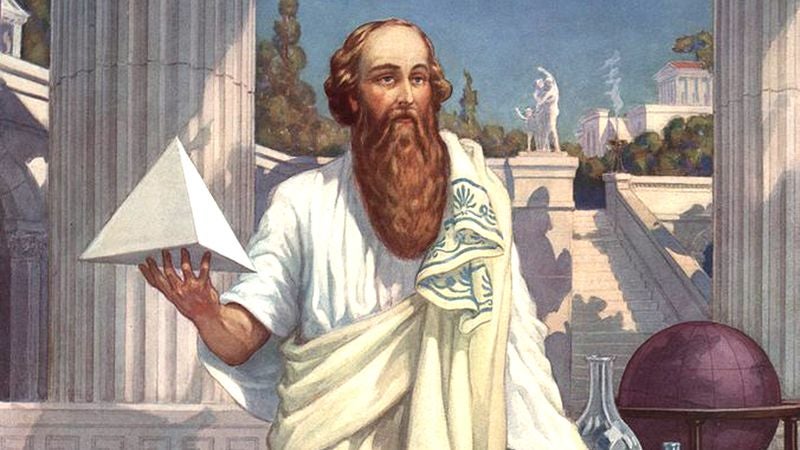
Published: October 18, 2017 (TheOnion.com)
CAMBRIDGE, MA—A trove of recently unearthed documents dating back to the sixth century B.C. has revealed that the ancient Greek philosopher and mathematician Pythagoras wrote dozens of elaborate, unhinged conspiracy theorems pertaining to triangles, researchers announced Wednesday.
Upon examining a cache of papyrus scrolls found while excavating a site near the modern Italian city of Crotone, a team of historians and classical scholars at Harvard University discovered previously unknown writings by Pythagoras and others that suggest the philosopher was obsessed with proving triangles played a powerful but highly secretive role in the world he inhabited, controlling nearly every aspect of life.
“These conspiracy theorems shed new light on this historic figure, who was apparently suspicious of the fact that all triangles have interior angles adding up to 180 degrees, believing this was evidence that they were united in hiding some sort of covert agenda,” said Professor Janet Boisvert, who found among the artifacts an alternative version of the Pythagorean theorem in which Pythagoras concluded that the square of the hypotenuse of a right triangle was equal to the sum of “all the lies embodied by these cursed triangles!” “One scroll is 35 feet long and contains nothing but a rambling series of postulates attempting to demonstrate the existence of a triangle with three obtuse angles that he thought was being kept under wraps by the government.”
“Pythagoras also stayed up every night for two years working on formulas he believed would prove the Great Pyramid at Giza was a hoax perpetrated by pro-triangle propagandists,” she added.
According to Boisvert, Pythagoras’ fixation on conspiracy theorems was described in the written accounts of his students, who recalled visiting his private study and finding the walls, the tables, and nearly every available surface covered in intricate equations and charts depicting hundreds of scalene, isosceles, and equilateral triangles. One student noted that Pythagoras always seemed worried by the sheer number of triangles he saw around him, and he became extremely distraught one day upon realizing that quadrilaterals, which he had until then considered innocuous, were in fact nothing more than two triangles combined.
This paranoia is further corroborated by the diary entry of a goatherd who described an elderly mathematician wandering the streets of Metapontum and warning complete strangers about the sails of ships, the shapes of their own noses, and the encroaching power of the trigonocracy.
“We are now able to conclusively identify Pythagoras as the unnamed figure in the Histories of Herodotus who storms into a polis council meeting waving pages scrawled with formulas and screaming, ‘Triangles are all around us, hidden in every shape, and I have the proofs!’ before being escorted out,” Boisvert said. “He continued to demand the truth from local magistrates, having hypothesized that triangles had a fourth, invisible side that those in power didn’t want him to know about.”
“It’s likely that by this point, his obsession with conspiracy theorems had begun to take a toll on his home life,” she continued. “We know an increasingly isolated Pythagoras was left by his wife and four children around 515 B.C., shortly after he accused they themselves of being triangles.”
Documents indicate Pythagoras went on to live a hermetic existence in the foothills of Mount Parnassus, until the realization that even the mountain itself had a triangular shape eventually drove him to suicide.

| The Ten of Disks The Lord of Wealth is a card which talks about the manifestation of the fruits of our labours, in whatever area they have been directed. When we have aimed all our energies in a single stream of force toward one end, there comes a point, inevitably, where we shall attain our objective. And that is what the Ten of Disks indicates.Often, commentaries on this card warn that once sufficient wealth has been attained, you should make sure you distribute excess fairly and generously. This is because energy which remains unused eventually corrupts and dissipates.But there’s another aspect to the right use of energy which is not so often addressed. This is to do with the way the Will works. There’s a common misunderstanding about the use of Will among us – we tend to think that applying Will is something that we only do consciously. This is incorrect. The human Will works all the time. It runs around happily creating whatever seems most pressing in your mind.This has a rather unfortunate side effect. For many people, the most pressing emotions and responses in their minds are connected to fear, pain, unhappiness or deprivation. Once seized by feelings such as these, it can be very difficult indeed to keep your mind off them, and engage in positive thoughts, affirmations and actions.You know the feeling – something comes along and hurts you. Then you suffer. You keep circling the issue in your mind. You build up a nice collection of fears. You make a lot of (often wildly illogical) painful associations. And you do not find a relevant affirmation and repeat it with extraordinary fervour until you have your feelings back under control. You do not go and do something nice for yourself. You do not deliberately force your thoughts and feelings onto a more positive track.All the time that cycle is taking place, your Will is wildly scampering after all those negative feelings and channelling your energy out into life, attempting to create the things it thinks you want!DOH!!! Dissipation of power causing chaos!The Lord of Wealth teaches us the invaluable lesson… by bringing our thoughts and emotions to a conscious level, and by making positive choices about how we direct those energies, we create our world. So we need to decide what we what, and then think about that… not linger on the things that we don’t want. And we need to trust our own energy to fly out into the Universe and come back to us completed.Then we are endlessly wealthy. Affirmation: “I am endlessly wealthy.” |
(Angelpaths.com)

In Tennessee Williams’ “Cat on a Hot Tin Roof,” Big Daddy says, “There ain’t nothin’ more powerful than the odor of mendacity. You can smell it. It smells like death.”
Even by today’s loose standards for truthfulness, Fox News sank to a new low this month trying to defend President Donald Trump’s on-again-off-again trade war.
First, the network’s anchors told viewers that high tariffs were good, and that tumbling stock markets were nothing to worry about. They called Trump courageous when he vowed on social media that “MY POLICIES WILL NEVER CHANGE.”
Then, when Trump changed policies, pausing tariffs for 90 days (with the exception of China), they called him a genius and rejoiced in the markets’ partial recovery.
Few readers of this column are likely to be Fox News devotees or take it terribly seriously. Fox News viewers are overwhelmingly conservative and white, the combination of which doesn’t exactly describe the typical San Franciscan.
But sometimes the stench of lies becomes so odious and the groveling to curry favor with patrons so rancid, that it needs to be called out, lest we sink deeper into a world where news is nothing more than entertainment aimed at making consumers feel virtuous about their beliefs, whether or not they have any basis in fact.
Consider how multiple Fox personalities reacted to the stock market’s largest dive since COVID-19, a swoon which wiped out trillions in global wealth before stocks rebounded.
“Tomorrow when you look at the Dow, it might not feel so liberating. But neither did the day after D-Day. Eventually we won,” Fox News Primetime host Jesse Watters said (via a transcription from Media Matters For America, a left-leaning media watchdog).
“I don’t really care about my 401(k) today. You know why? I believe in this man,” said Jeanine Pirro, co-cost of “The Five,” referring to her faith in the president.
“What he’s doing is courageous,” said Laura Ingraham, host of “The Ingraham Angle.” “The current market gyrations are going to be short-lived.”
But as wise as the tariffs were, Trump’s decision to backtrack just 10 hours after they took effect, in their eyes was even wiser.
“Genius,” Ingraham declared.
Nearly three years earlier, when Joe Biden was in office, Ingraham said “we are all suffering for the incompetence,” complaining that the Dow Jones Industrial Average had dropped 746 points over the course of his presidency.
Ingraham left unsaid last week the Dow closed Friday down nearly 3,300 points from the end of Trump’s first day in office.
The Fox News double standard even applies to golf. Trump hitting the links in the weekend after introducing tariffs and markets plunged was presented on Fox News as a sign of calm, if not defiance.
Playing golf “is not a middle finger to middle America — that’s a middle finger to all those foreign countries who are trying to get on the phone and negotiate these tariffs down.” Watters said on “The Five.” In a moment of self-awareness, Watters joked that had President Biden been golfing during a crisis like this, “I’m sure I wouldn’t have said a word.”
Fox News is to journalism what Funyuns are to food — a substance that resembles nourishment carefully manipulated to keep customers coming back for more.
In his astute book “Broken News, Why the Media Rage Machine Divides America and How to Fight Back,” former Fox News Political Editor Chris Stirewalt writes that Fox is not an arm of — and does not take orders from — the Republican Party.
Instead, he writes, Fox News has a business model aimed at pleasing conservative viewers. It’s a subtle but important distinction.
Fox News is not the same as state-run television, as in Vladimir Putin’s Russia or Xi Jinping’s China. The network is motivated to offer viewers what they want because a large audience means selling more advertisments.
The makers of Funyuns — or Cheez-Its or Jalapeno Popper Cheese Curls — aren’t aiming to push junk on consumers any more than they are trying to nourish them. They simply want customers to come back for more.
Journalism, at its best, is different. Appealing to consumers is inevitable in any business driven by markets. But when a network is focused on feeding viewers news they want, rather than what’s real, it is, in the words of one well-known observer, fake.
Marc Sandalow is a senior faculty member at the University of California’s Washington Program. He has been writing about California politics from Washington, D.C., for over 30 years.

It is in relationships that we discover both our depths and our limits, there that we anneal ourselves and transcend ourselves, there that we are hurt the most and there that we find the most healing.
But despite what a crucible of our emotional and spiritual lives relationships are — or perhaps precisely because of it — they can be riddling and nebulous, destabilizing in their fluidity and ambiguity, leaving us grasping for the comforting solidity of categories and labels. The ancient Greeks, in their pioneering effort to order the chaos of the cosmos, neatly taxonomized them into filial love (the kind we feel for siblings, children, parents, and friends), eros (the love of lovers), and agape (the deepest, purest, most impersonal and spiritual love). After the Enlightenment discounted all love as a malfunction of reason, the Romantics reclaimed it and revised the ancient taxonomy into a hierarchy, under the tyranny of which we still live, placing eros at the pinnacle of human existence. And yet our deepest relationships — the ones in which we both become most fully ourselves and are most emboldened to change — tend to elude the commonplace classifications and to shape-shift across the span of life.
Simone de Beauvoir, 1946 (Photograph: Henri Cartier-Bresson)
Simone de Beauvoir (January 9, 1908–April 14, 1986) was only nineteen when she wielded her uncommon intellect at these questions on the pages of her journal, later published as Diary of a Philosophy Student (public library). In between composing her resolutions for a life worth living, Beauvoir began thinking seriously about the nature of love, its dialogue with her own nature, what she may want of it and what it may demand of her — “in brief, how souls can interact with one another.” In the midst of an intellectual infatuation with a young man who would go on to become an eminent philosopher himself — not the one she would eventually marry in a convention-breaking union of minds — she examines the substance of the feeling:
To say that I love him, what does that mean? Does the word itself have a meaning?
Questioning the tangle of idolization and desire that masquerades as love, she grows suspicious of the very concept of personal love as an absurdity against the backdrop of the largest love we can carry:
Invoking the love she feels for her friends, the sum total of them, she writes:
Over and over she returns to the elemental question:
Art by Olivier Tallec from Big Wolf & Little Wolf by Nadine Brun-Cosme — a poignant modern fable about how friendship anchors and transforms us.
Drawing on Hegel’s philosophy of freedom, in which for any conscious subject to be free means freeing the other, she arrives at a “formula” for the ideal friendship: “absolute reciprocity and the identity of consciousness.” The cultural ideal of romantic love, on the other hand, replaces this “absolute reciprocity” with engulfment and sublimation of one self into the other. She writes:
This, of course, is Rilke’s model of a perfect relationship — one in which “the highest task of a bond between two people [is] that each should stand guard over the solitude of the other” — consonant with Octavio Paz’s lovely definition of love as “a knot made of two intertwined freedoms.”
Beauvoir ultimately found it not in romantic love but in the deepest friendship of her life — that with Zaza, her childhood best friend.
A year older than her and also enamored of books, Zaza was the only one with whom the young Simone could have “real conversations.” In Memoirs of a Dutiful Daughter (public library) — the first volume of her autobiography, largely a loving memorial to this formative relationship — she would write of talking to Zaza:
Card from An Almanac of Birds: 100 Divinations for Uncertain Days, also available as a stand-alone print and as stationery cards.
When Zaza’s dress caught fire and charred her leg to the bone, she endured the long convalescence valiantly, then went on to climb trees and do cartwheels, to play the piano and the violin. Beauvoir relays a moment radical in the context of early twentieth-century French bourgeoise society, emblematic of Zaza’s defiant spirit and playful disdain for convention:
This strength of spirit, this defiance of the givens, is what the young Simone most admired about her friend — it emboldened her to defy convention in her own life.
Part of the unexamined convention Beauvoir had internalized growing up was the belief that “in a well-regulated human heart friendship occupies an honourable position, but it has neither the mysterious splendour of love, nor the sacred dignity of filial devotion.” And yet through her relationship with Zaza, she came to question this limiting “hierarchy of the emotions” and to see friendship as the deepest stratum of connection. “I loved Zaza with an intensity which could not be accounted for by any established set of rules and conventions,” she would reflect decades later.
Card from An Almanac of Birds: 100 Divinations for Uncertain Days, also available as a stand-alone print and as stationery cards.
It was only in Zaza’s absence — absences inflicted by their families and school schedules and the general fractures of continuity that life presents — that Beauvoir came to grasp the importance, the consolation, the salvation of her friend’s presence:
In her diary, she recounts one such reunion during her freshman year as a philosophy student:
Beauvoir was discovering deep friendship as safer and more resilient than romance, free from “the great hatreds of love, the irremediable pride, the passionate ruptures, the mutual tortures,” never “introducing jealousy, demands, and doubts.” To have what the ancient Celts called anam cara — “soul friend” — asks everything of us, invites all the parts we live with and urges us to show up whole, yet demands nothing.
Looking back on her life, Beauvoir reflects:
Midway through Beauvoir’s sophomore year, Zaza died suddenly and mysteriously — an illness swift and merciless as an owl. She was 21. Amid the savage grief, Beauvoir turned even more sharply toward philosophy, seeking its eternal consolations. Across the sweep of the years and decades, Zaza’s inextinguishable presence never left her life. (“No one you love is ever dead,” Ernest Hemingway wrote around that time in a letter of consolation to an inconsolable friend.) Loving Zaza had ignited Beauvoir’s becoming, setting her on the course of who she would become — one of humanity’s most daring breakers of convention, her ideas reaching into the depths of her time, shaping the times to come, touching the lives of generations of strangers the way a true friendship does. Touching mine. Perhaps touching yours.
Card from An Almanac of Birds: 100 Divinations for Uncertain Days, also available as a stand-alone print and as stationery cards.
Complement with Seneca on true vs. false friendship and Little Prince author Antoine de Saint-Exupéry on losing a friend, then revisit Simone de Beauvoir on how chance and choice converge to make us who we are and the art of growing older.

The question of what it takes to create — to make something of beauty and substance that touches other lives across space and time — is one of the deepest, oldest questions, perhaps because the answer to it is so unbearably simple: everything. We bring everything we are and everything we have lived to every smallest creative act — every experience, every dream, every memory, every unremembered impression, every unconsciously absorbed influence. The great bewilderment is that we can only access a fraction of our own everythingness — most of it dwells in the recesses of the mind and the psyche, below the level of our surface awareness. Creativity is the periscope through which the unconscious looks out onto the world and renders what it sees. The rendering is what we call art, and it is as much a picture of the seer as of the seen.
In the middle of the world’s most destructive war, Carl Jung took up this elemental mystery of the creative spirit in a chapter of his 1939 book Modern Man in Search of a Soul (public library).
Living in that liminal epoch between the age of mysticism, when creativity was considered a divine gift superintended by muses and shamans, and the age of science, which aimed its forceps and fMRIs at regions of the brain hoping to locate the mind and microscopize the soul, Jung believed that “the human psyche is the womb of all the sciences and arts,” that the unconscious is “the necessary undercurrent of all creativity,” and that to understand how a work of art comes into being is to behold “the warp and weft of the mind in all its amazing intricacy.” Though rigorous and systematic in his approach, he was never seduced by the reductionism science often tends toward, including his own young science of psychology, once writing to a colleague:
Carl Jung
Long before psychologist Jerome Bruner itemized the six pillars of creativity and neurologist Oliver Sacks contemplated its three essential elements, Jung foregrounds his perspective with a lucid caveat about the limitations of reason in comprehending the unconscious. In a sentiment evocative of Virginia Woolf’s astute observation that “one can’t write directly about the soul [because] looked at, it vanishes,” Jung writes:
Jung approaches this acausal mystery of creativity by delineating two distinct modes of creation — the psychological and the visionary — each drawing on different aspects of existence and making different demands on us. He considers the first:
Jung contrasts this with the visionary mode of creation, in which the conditions are reversed:
One of Antoine de Saint-Exupéry’s original watercolors for The Little Prince
While the psychological mode reflects and reckons with the realities of everyday life, the visionary mode is closer to the realm of dreams, which Jung considered “eclipses of consciousness” — those bewilderments that confuse our sense of reality and beckon interpretation, the way a great poem might, effecting “the frightening revelation of abysses that defy the human understanding.” He writes:
[…]
A great work of art is like a dream; for all its apparent obviousness it does not explain itself and is never unequivocal. A dream never says: “You ought,” or: “This is the truth.” It presents an image in much the same way as nature allows a plant to grow, and we must draw our own conclusions.
Illustration by Tom Seidmann-Freud from David the Dreamer: His Book of Dreams, 1922.
The psychological mode of creation concerns itself with an overt rendering of human emotion as we know it and experience it, but the visionary reaches beyond the horizon of our self-knowledge and into those depths that only the tendrils of our intuitions every touch. Because what we find there may so alarm us, may so contradict our conscious self-image, we tend to doubt our discoveries and retreat behind “the armor of reason” to dismiss them. Jung writes:
Holding up the poet in that Baldwinian sense (“The poets (by which I mean all artists),” Baldwin wrote, “are finally the only people who know the truth about us. Soldiers don’t. Statesmen don’t… Only poets.”), Jung adds:
Art from An Almanac of Birds: 100 Divinations for Uncertain Days, also available as a stand-alone print.
It is not only great artists, he observes, who can access those hidden places but also “the seers, prophets, leaders and enlighteners.” A year after science split the atom and a century before it began intimating that consciousness may be as old as the universe and fundamental to it, Jung writes:
That more-than-personal aspect of visionary work is what Jung calls “the collective unconscious.” It is where his views began to radically diverge from those of Freud, who had once been his mentor. Opposing Freud’s conception of creativity as the product of purely personal forces and experiences, particularly traumatic experiences early in life and the subsequent neuroses they produce, Jung came to see such “reductive analysis” as “the most virulent poison imaginable for the attitude of the artist and the creative person in general.” Instead, he insisted that although all artistic creation draws on the personal experience of the artist — “the pregnant chaos” inside that defies “our picture of a well-ordered cosmos” — it is at bottom impersonal because its raw material is the collective unconscious:
The creative person, therefore, is always living with the paradox of being a person and being an impersonal channel for the mystery beyond. Jung writes:
Art by Dorothy Lathrop, 1922. (Available as a print and as stationery cards.)
Although Jung detested the myth of the tortured genius — he called the idea that suffering is essential for creation “a failure and a bungling,” “part of the general lunacy of our time” — he recognized that there is inherent suffering in the creative life itself, for the psyche is sundered by this tension between the personal and the impersonal:
[…]
Whenever the creative force predominates, human life is ruled and moulded by the unconscious as against the active will, and the conscious ego is swept along on a subterranean current, behind nothing more than a helpless observer.
From this arises a sobering antidote to the current moral fashion of renouncing works of art because the artist’s personal life has been found wanting by our current moral standards. Jung writes:
Illustration by Margaret C. Cook for a rare 1913 edition of Leaves of Grass. (Available as a print.)
Jung adapted this chapter on creativity in Modern Man in Search of a Soul (public library) from an essay he had published a decade earlier in an obscure journal that had left him feeling defeated by the signal-to-noise ratio of the social media of his time: “These days the voice of the single individual is almost completely drowned out in the chaos of newspapers and the flood of books,” he had then lamented in a letter to a colleague, not knowing that he himself would become one of the great visionaries to touch the life of humankind for epochs to come — assurance for all the half-defeated visionaries languishing in some quiet Substack, their voices muffled by the noise of now but bound to bellow into the centuries.
Couple with a glimpse inside the creative process of great artists, then revisit Jung on how to navigate uncertainty, Mary Oliver on the “third self” of the creative life, and Gary Snyder on how to harness the creative force.
Imagine what life would be like if lived, in May Sarton’s lovely phrase, with “joy instead of will.” That is what Beethoven imagined, and invited humanity to imagine, two centuries ago in the choral finale of his ninth and final symphony, known as “Ode to Joy” — an epochal hymn of the possible, half a lifetime in the making.
In the spring of 2012, the Spanish city of Sabadell set out to celebrate the 130th anniversary of its founding with a most unusual, electrifying, and touchingly human rendition of Beethoven’s masterpiece, performed by a flashmob of 100 musicians from the Vallès Symphony Orchestra, the Lieder, Amics de l’Òpera and Coral Belles Arts choirs. Watching the townspeople — children with kites, elders with walkers, couples holding hands — gather to savor the unbidden music in a succession of confusion, delight, and ecstasy is the stuff of goosebumps: living proof that “music so readily transports us from the present to the past, or from what is actual to what is possible.”

Couple with the remarkable story of the making of “Ode to Joy,” then revisit the neurophysiology of enchantment and how music casts its spell on us.
