Nature’s Medicine: Can Forests Calm Inflammatory Conditions?

The prescription for what ails us may, at least in part, be written not in the pharmacy but in the forest.

THOM HARTMANN APR 16, 2025 (WisdomSchool.com)

Every weekend, Louise and I visit Forest Park here in Portland, the largest wild area within a city in the world, with 5,200 acres and over 80 miles of trails. There are some pretty steep climbs and we try to get seriously out of breath.

Not only is it good exercise and a nice opportunity to get away from our electronics and just talk with each other, but communing with nature has well-known positive emotional and psychic effects that help regulate mood and even improve physical health.

On last Sunday’s walk, Louise wondered out loud if regularly walking in nature could also help reduce inflammatory conditions like asthma. It reminded me that back in the early 1990s, I met a woman named Sarah at a conference in Portland who told me something I found both fascinating and counterintuitive.

Sarah had suffered from severe asthma her entire adult life, requiring multiple medications and occasional emergency room visits. “Then I moved to a small cabin near Mount Hood,” she said, “and within three months, I was using my rescue inhaler maybe once a month instead of daily.” When I asked her what changed, she simply said, “I walk in the forest every morning. That’s the only thing different in my life.”

I thought about Sarah recently when my conversation with Louise led to my reading about the “hygiene hypothesis,” first proposed by epidemiologist David Strachan in 1989. His radical suggestion was that our increasingly sanitized modern environments might actually be contributing to the alarming rise in allergies, asthma, and autoimmune disorders we’ve seen over the past several decades. It struck me as deeply ironic — our quest for cleanliness potentially undermining our health.

The hygiene hypothesis has since evolved into what scientists now more accurately call the “Old Friends’“ hypothesis. The problem isn’t simply that we’re too clean; it’s that we’ve lost regular contact with specific microorganisms that humans co-evolved with throughout our evolutionary history. These “old friends” — found in soil, plants, animals, and unpolluted natural environments — appear critical in training our immune systems to distinguish between harmless environmental particles and genuine threats.

Think about it: for 99% of human existence, we lived intimately connected to natural environments, constantly exposed to a rich diversity of microbes. Only in the past few generations have we created virtually sterile indoor environments, doused everything in antimicrobial chemicals, and separated ourselves from the microbial world that shaped our immune system’s development. Our bodies simply haven’t adapted to this dramatic change.

The consequences are becoming increasingly clear. A landmark 2015 study published in the New England Journal of Medicine compared the immune profiles of Amish children (who grow up on traditional farms with daily exposure to livestock and soil) to genetically similar Hutterite children (who live on industrialized farms with limited direct exposure to animals and soil). Despite their genetic similarities, Amish children had dramatically lower rates of asthma and allergies, a difference the researchers attributed directly to their microbial exposure.

But what about those of us who didn’t grow up on farms or spend our childhoods playing in the dirt? If you’re like Sarah, already suffering from asthma or other inflammatory conditions, is it too late to recalibrate your immune system?

Emerging research suggests it may not be. A fascinating body of evidence comes from studies on “forest bathing” (Shinrin-Yoku), a Japanese practice of immersing oneself (with your clothes on!) in forest environments. Dr. Qing Li, an immunologist at Nippon Medical School in Tokyo, has conducted extensive research showing that when people spend time in forests, they experience measurable changes in their immune function.

In one study, Li took a group of middle-aged Tokyo businessmen into the forest for three days. Blood tests revealed significant increases in natural killer (NK) cells, the immune cells that play a vital role in fighting infections and cancerous cells. More remarkably, these participants showed decreased levels of pro-inflammatory cytokines, the very signaling molecules that drive excessive inflammatory responses in conditions like asthma. Most surprisingly, these beneficial immune changes persisted for more than 30 days after their forest visit.

It makes perfect sense, after all. Our immune systems didn’t evolve in a vacuum; they developed in constant dialogue with the microbial world around us. When we restore some of that dialogue through forest exposure, we’re essentially reminding the immune system how it was designed to function.

This makes intuitive sense when you consider our evolutionary history. Our ancestors didn’t suffer from high rates of allergies and asthma despite (or perhaps because of) their constant exposure to diverse microbial environments. The human immune system appears to need this microbial diversity to develop properly and maintain balance.

A groundbreaking 2020 study published in Science Advances provided even more direct evidence. Researchers in Finland modified urban daycare playgrounds, replacing sterile gravel with forest floor materials: rich soil, native plants, and the diverse microbiota they contain. After just 28 days, children playing on these naturalized playgrounds showed increased diversity in both their skin and gut microbiomes. More importantly, they exhibited increases in regulatory T cells, those specialized immune cells that help prevent allergic reactions and dampen excessive immune responses.

While this particular study focused on children, its implications extend to adults as well. Our microbiomes remain somewhat plastic throughout life, capable of responding to environmental changes. When we walk through biodiverse forests, we expose ourselves to a rich tapestry of microorganisms that can influence our own microbial communities and, by extension, our immune function.

There’s another fascinating aspect to forest exposure that has particular relevance for asthma sufferers: phytoncides. These are natural oils released by trees and plants as part of their defense system against bacteria and insects. When humans inhale these aromatic compounds during forest walks, they trigger beneficial physiological responses.

Research shows that phytoncide exposure reduce levels of stress hormones, decreases sympathetic nervous system activity (associated with the “fight-or-flight” response), and enhance parasympathetic nervous system function (associated with “rest-and-digest” activities). For asthma sufferers, whose symptoms can be triggered or worsened by stress, these effects could provide additional relief beyond the direct immune-modulating benefits.

Laboratory studies have gone further, demonstrating that certain phytoncides have direct anti-inflammatory properties. Alpha-pinene, for example, a compound abundant in pine forests, has been shown to reduce inflammatory markers in lung tissue and may help soothe irritated airways, potentially reducing the hypersensitivity characteristic of asthma.

Not all green spaces offer equal benefits, however. A 2019 study published in Environmental Health Perspectives found that adults living near areas with greater biodiversity had lower rates of asthma exacerbations and hospital visits compared to those living near less diverse green spaces. This suggests that the microbial diversity of the environment plays a crucial role; old-growth forests with varied plant species likely offer greater immune benefits than manicured urban parks with limited biodiversity.

It turns out there’s a growing body of research suggesting that regular forest exposure may help moderate inflammatory conditions. The combination of stress reduction, exposure to diverse microbiota, and inhalation of beneficial plant compounds appears to create an environment conducive to immune balancing.

None of this means we should abandon modern medicine or hygiene practices. Prescription medications save lives, and basic hygiene prevents the spread of dangerous pathogens. Forest walks won’t “cure” asthma or completely reverse the effects of growing up in highly sanitized environments. But they may offer a meaningful complement to conventional treatments; a way of addressing one of the potential root causes of our modern epidemic of inflammatory conditions.

If you suffer from asthma, allergies, or other inflammatory conditions, consider adding regular walks in biodiverse natural environments to your self-care routine. Seek out older, established forests with diverse plant species rather than recently planted or highly manicured parks. Go regularly: benefits appear to accumulate with consistent exposure. And when you’re there, engage fully: touch plants (safely), breathe deeply, and fully engage your senses.

The prescription for what ails us may, at least in part, be written not in the pharmacy but in the forest. Our immune systems evolved in constant dialogue with the natural world. Perhaps it’s time we rejoined that conversation.


OpenAI’s Sam Altman talks ChatGPT, AI agents and superintelligence — live at TED2025

Sam Altman | TED2025

• April 2025

The AI revolution is here to stay, says Sam Altman, the CEO of OpenAI. In a probing, live conversation with head of TED Chris Anderson, Altman discusses the astonishing growth of AI and shows how models like ChatGPT could soon become extensions of ourselves. He also addresses questions of safety, power and moral authority, reflecting on the world he envisions — where AI will almost certainly outpace human intelligence. (Recorded on April 11, 2025)

About the speaker

Sam Altman

CEO of OpenAI

God Placed Into Deity Protection Program After Witnessing Murder

Our Lord And Heavenly Father Now In Hiding

Published: April 16, 2025 (TheOnion.com)

ARLINGTON, VA—In an effort to ensure the continued safety of the almighty being, the U.S. Marshals Service confirmed Monday that God, He Who Created the Heavens and the Earth, has been placed into the Deity Protection Program after witnessing a grisly gangland murder.

Federal agents said they were contacted at 3:47 a.m. by the Lord Our God, who, after telling them He had seen a killing on the Camden, NJ docks that implicated members of the DeCavalcante crime family, expressed fear for His own safety. As soon as officials took His statement, U.S. marshals reportedly rushed to supply the 6,000-year-old Supreme Ruler of the Universe with a new identity and relocate Him to an undisclosed location far from His Heavenly Throne.

“When God called to report the shooting, He wanted our absolute assurance that if He gave testimony, no one would ever find Him or His Son,” said an anonymous FBI source  who described the Divine Creator as “incredibly shaken up” as He discussed the terms of protective custody over a cup of black coffee in a holding room. “He kept warning us that the guys in the crime family would hunt Him down and do things to Him far worse than death. Unfortunately, most gods in a situation like this don’t survive without our assistance.”

“But some very bad people are going away for a long time thanks to the Lord’s cooperation,” the source added. “For that we’re grateful.”

The Deity Protection Program, first established by Congress in 1970 after the Hindu god Ganesha became an expert witness in a federal racketeering case, has gone on to shelter thousands of omnipotent beings who were threatened after testifying against crime syndicates, drug traffickers, and extremist groups. While specific details about God’s arrangement are unconfirmed, in the past the program has provided new identities, $60,000 in support, help finding a job, and U.S. marshal escorts to divinities ranging from Sumerian fertility idols to Chinese dragon kings.

As of 2024, there were an estimated 900 gods, goddesses, and demigods living in American trailer parks, motels, and safe houses under the auspices of the program, which boasts a 100% success rate for those who follow provided safety protocol.

Agency insiders confirmed that the evidence provided by all-seeing, all-knowing sources often helped to win convictions of the worst criminals. However, many deities struggle with the temptation to return to their former divine life. Officials pointed to the 1983 case of ancient Norse god and federal witness Bældæġ, who was found pierced through the heart with an enchanted spear after abandoning his identity as a line cook at a New Hampshire diner.

“What makes this program so important is that many of these deities have made very powerful enemies in their time,” said domestic crime expert Deborah Tuchman, adding that such gods were not necessarily innocent themselves, and were often linked to trillions of crimes through their history overseeing the universe’s endless cycle of birth and death. “Some of them have suffered for thousands of years after instilling humans with the ability to do evil. They feel trapped.”

“In fact, many only agree to testify in order to reduce their own lengthy sentences chained to a rock or imprisoned in Tartarus,” she continued.

Those familiar with the program described the wrenching decision faced by deities who enter the program, pointing to the difficult challenge of leaving behind billions of supporters, angels who cater to their every whim, and a meaningful role overseeing the cosmos in order to spend the foreseeable future working retail in Middle America. Many have complained of the stress caused by neighbors questioning their supplied backstory after they were spotted resurrecting the dead, swallowing lightning, or flying over the face of the planet.

“Do I miss sitting on a lotus flower all day, entirely at one with the universe’s profound stillness? Of course,” said Ron D. Polacheck, the Buddhist being of infinite compassion formerly known as Avalokiteśhvara, who now travels the world speaking to audiences about his decades spent in hiding. “From the second you sign that agreement, you’re just some regular jerk. Nothing tastes as good. Your neighbors don’t know that you used to be somebody big, someone really important. You keep asking yourself, ‘What the hell am I doing working at a hardware store? I’m the Awakened One, for Christ’s sake.’ But it beats getting tracked down by those lunatics in the Medellín Cartel.”

“Plus, once you get used to it, Kenosha isn’t so bad,” the awakened one added. 

American Concentration Camps

Once a regime starts to send people to concentration camps — including those in El Salvador — it creates a system of detention that eschews due process and disappears citizens into black holes.

CHRIS HEDGES APR 16, 2025

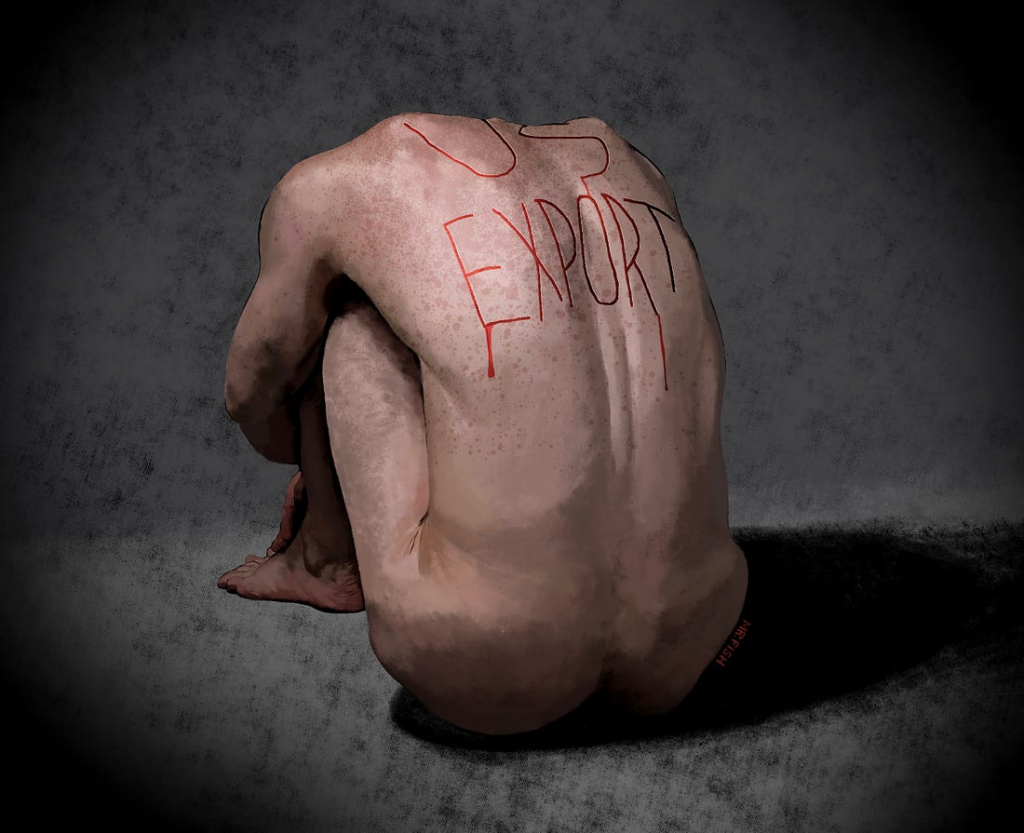
U.S. Export – by Mr. Fish

Our offshore concentration camps, for now, are in El Salvador and Guantánamo Bay, Cuba. But don’t expect them to remain there. Once they are normalized, not only for U.S.-deported immigrants and residents, but U.S. citizens, they will migrate to the homeland. It is a very short leap from our prisons, already rife with abuse and mistreatment, to concentration camps, where those held are cut off from the outside world — “disappeared” — denied legal representation and crammed into fetid, overcrowded cells.

Prisoners in the camps in El Salvador are forced to sleep on the floor or in solitary confinement in the dark. Many suffer from tuberculosis, fungal infections, scabies, severe malnutrition and chronic digestive illnesses. The inmates, including over 3,000 children, are fed rancid food. They endure beatings. They are tortured, including by water-boarding or being forced naked into barrels of ice-cold water, according to Human Rights Watch. In 2023, the State Department described imprisonment as “life-threatening,” and that was before the Salvadoran government declared a “state of exception” in March 2022. The situation has been greatly “exacerbated,” the State Department notes, by the “addition of 72,000 detainees under the state of exception.” Some 375 people have died in the camps since the state of exception was established, part of El Salvadoran President Nayib Bukele’s “war on gangs,” according to the local human rights group Socorro Jurídico Humanitario.

These camps — the “Centro de Confinamiento del Terrorismo” (Center for Terrorism Confinement) known as CECOT, to which U.S. deportees are being sent, holds some 40,000 people — are the model, the harbinger of what awaits us.

Metal worker and union member Kilmar Ábrego García, who was abducted in front of his five-year-old son on March 12, 2025, was accused of being a gang member and sent to El Salvador. The Supreme Court agreed with District Judge Paula Xinis who found that García’s deportation was an “illegal act.” Trump officials blamed their deportation of García on an “administrative error.” Xinis ordered the Trump administration to “facilitate” his return. But that does not mean he is coming back.

“I hope you’re not suggesting that I smuggle a terrorist into the United States,” Bukele told the press at a White House meeting with Trump. “How can I smuggle — how can I return him to the United States? Like, I smuggle him into the United States? Well, of course I’m not going to do it…the question is preposterous.”

US President Donald Trump meets with El Salvador’s President Nayib Bukele in the Oval Office of the White House in Washington D.C., April 14, 2025. (Photo by BRENDAN SMIALOWSKI/AFP via Getty Images)

This is the future. Once a segment of the population is demonized — including U.S. citizens Trump labels “homegrown criminals” — once they are stripped of their humanity, once they embody evil and are seen as an existential threat, the end result is that these human “contaminants” are removed from society. Guilt or innocence, at least under the law, is irrelevant. Citizenship offers no protection.

“The first essential step on the road to total domination is to kill the juridical person in man,” writes Hannah Arendt in “The Origins of Totalitarianism.” “This was done, on the one hand, by putting certain categories of people outside the protection of the law and forcing at the same time, through the instrument of denationalization, the nontotalitarian world into recognition of lawlessness; it was done, on the other, by placing the concentration camp outside the normal penal system, and by selecting inmates outside the normal judicial procedure in which a definite crime entails a predictable penalty.”

Upgrade to paid

Those who build concentration camps build societies of fear. They issue relentless warnings of mortal danger, whether from immigrants, Muslims, traitors, criminals or terrorists. Fear spreads slowly, like a sulfurous gas, until it infects all social interactions and induces paralysis. It takes time. In the first years of the Third Reich, the Nazis operated ten camps with about 10,000 inmates. But once they managed to crush all competing centers of power — labor unions, political parties, an independent press, universities and the Catholic and Protestant churches — the concentration camp system exploded. By 1939, when World War II broke out, the Nazis were running over 100 concentration camps with some one million inmates. Death camps followed.

Those that create these camps give them wide publicity. They are designed to intimidate. Their brutality is their selling point. Dachau, the first Nazi concentration camp, was not, as Richard Evans writes in “The Coming of The Third Reich” “an improvised solution to an unexpected problem of overcrowding in the goals, but a long-planned measure that the Nazis had envisioned virtually from the very beginning. It was widely publicized and reported in the local, regional and national press, and served as a stark warning to anyone contemplating offering resistance to the Nazi regime.”

Immigration and Customs Enforcement (ICE) agents, wearing plainclothes and circling neighborhoods in unmarked cars, kidnap legal residents such as Mahmoud Khalil. These abductions replicate those I witnessed on streets of Santiago, Chile under the dictatorship of Augusto Pinochet, or in San Salvador, El Salvador’s capital, during the military dictatorship.

ICE is swiftly evolving into our homegrown version of the Gestapo or The People’s Commissariat for Internal Affairs (NKVD). It oversees 200 detention facilities. It is a formidable domestic surveillance agency that has amassed data on most Americans, according to a report compiled by The Center of Privacy & Technology at Georgetown.

“By reaching into the digital records of state and local governments and buying databases with billions of data points from private companies, ICE has created a surveillance infrastructure that enables it to pull detailed dossiers on nearly anyone, seemingly at any time,” the report reads. “In its efforts to arrest and deport, ICE has — without any judicial, legislative or public oversight — reached into datasets containing personal information about the vast majority of people living in the U.S., whose records can end up in the hands of immigration enforcement simply because they apply for driver’s licenses; drive on the roads; or sign up with their local utilities to get access to heat, water and electricity.”

Those abducted, including the Turkish national and PhD student at Tufts University, Rümeysa Öztürk, are accused of amorphous behaviour such as “engaging in activities in support of Hamas.” But this is a subterfuge, accusations no more real than the invented crimes under Stalinism where people were accused of belonging to the old order — Kulaks or members of the petit bourgeoisie — or were convicted for plotting to overthrow the regime as Trotskyites, Titoites, agents of capitalism or saboteurs, known as “wreckers.” Once a category of people is targeted, the crimes they are charged with, if they are charged at all, are almost always fabrications.

Concentration camp inmates are severed from the outside world. They are disappeared. Erased. They are treated as if they never existed. Nearly all efforts to obtain information about them are met with silence. Even their death, should they die in custody, becomes anonymous, as if they were never born.

Those who run concentration camps, as Hannah Arendt writes, are people without the curiosity or the mental capacity to form opinions. They don’t, she notes, “even know any more what it means to be convinced.” They simply obey, conditioned to act as “perverted animals.” They are intoxicated by the God-like power they have to turn human beings into quivering flocks of sheep.

The goal of any concentration camp system is to destroy all individual traits, to mold people into fearful, docile, obedient masses. The first camps are training grounds for prison guards and ICE agents. They master the brutal techniques designed to infantilize inmates, an infantilization that soon warps the wider society.

The 250 purported Venezuelan gang members shipped to El Salvador in defiance of a federal court were denied due process. They were summarily herded onto planes, which ignored the judge’s order to turn back, and once they arrived, were stripped, beaten and had their heads shaved. Shaved heads are a feature of all concentration camps. The excuse is lice. But of course it is about depersonalization and why they are in uniforms and identified by numbers.

The autocrat openly revels in the cruelty. “I look forward to watching the sick terrorist thugs get 20 year jail sentences for what they are doing to Elon Musk and Tesla,” Trump wrote on Truth Social. “Perhaps they could serve them in the prisons of El Salvador, which have become so recently famous for such lovely conditions!”

Those that build concentration camps are proud of them. They show them off to the press, or at least the sycophants posing as the press. Secretary for Homeland Security Kristi Noem, who posted a video of herself visiting the El Salvadoran prison, used the shirtless and head shaved inmates as a stage prop for her threats against immigrants. If fascism does one thing well, it is spectacle.

TOPSHOT – US Secretary of Homeland Security Kristi Noem speaks during a tour of the Terrorist Confinement Center (CECOT) as prisoners stand, looking out from a cell, in Tecoluca, El Salvador, on March 26, 2025. (Photo by Alex Brandon / POOL / AFP) (Photo by ALEX BRANDON/POOL/AFP via Getty Images)

First they come for the immigrants. Then they come for the activists on foreign student visas on college campuses. Then they come for green card holders. Next are the U.S. citizens who fight Israeli genocide or the creeping fascism. Then they come for you. Not because you broke the law. But because the monstrous machine of terror needs a constant supply of victims to sustain itself.

Totalitarian regimes survive by eternally battling mortal, existential threats. Once one threat is eradicated, they invent another. They mock the rule of law. Judges, until they are purged, may decry this lawlessness, but they have no mechanism to enforce their rulings. The Department of Justice, turned over to the Trump sycophant Pam Bondi, is, as in all autocracies, designed to block enforcement, not facilitate it. There are no legal impediments left to protect us. We know where this is going. We have seen it before. And it is not good.

(Contributed by John Fraser)

The Prosperos Community & Activities — April 2025


Community & Activities

April 2025Celebrating Community

A Month of New Beginnings and New Freedoms 

In The Prosperos, we celebrate new beginnings of a different sort; for within the heart of every person, a field of pure potentiality becomes a doorway through which the originality and genius of each person can enter the world. We leave behind ideas that are just never big enough to house the extraordinary essence of the human soul. We find new beginnings, the unpredictable good hidden within every moment and every circumstance


Sunday Meeting with Dean William Fennie, H.W., M.

New Life or Zombie ? Finding Resurrection at Easter

April 20, 2025 @ 11:00 am Pacific Time

Further Info:    Sunday Meeting – William Fennie
TRANSLATION CLASS

We are excited to announce that The Prosperos School of Ontology’s Foundation Class, Translation®, will be presented this April  in Tulsa, Oklahoma by Prosperos Mentor Calvin Harris.This Foundation Class is a curated collection of lessons which encapsulates research and expertise that has stood the test of time, spanning over 50 years. Providing a technique which magnifies the authentic self Going beyond human behaviorism and programming, this Operative  Class training is your key to unlocking a world where understanding the depths of human transformation becomes your ultimate edge.This is your invitation to a retreat, to set aside a space-in-time for this event of clarity, of mystery and of self-mastery.This is a Top-tier Professional Seminar using the ancient method of Storytelling. These lessons when applied will give you step-by-step instructions which will make the biggest impact for you:Gain a 50-year-old,  field-tested blueprint to analyze, understand, and influence your perception in any situation.Master the powerful tools to guide and change inner conversations, decode human behavior, and influence outcomes—whatever the perceived stakes are.Eliminate self-doubt and rewire your mindset to show up with unshakable confidence in Truth.Learn how to consciously read your motives, emotions, and intentions accurately, giving you an edge not experienced before.Develop a presence newly identified  to you as your Authentic Being.Workshops will be made available to gain proficiency and mastery in the use of this skill.If you have read this far, thank you, and here are further details:   This Seminar will be a Two-Day Event. You will be learning using a classroom modality, a mix of audio/visual as well as live classroom formatted  lessons.

 Dates/ Times:Saturday, April 26, 2025 9:00 am to 5:00 pm Central                                Sunday, April 27, 2025 10:00 am to 5:00 pm

CentralLocation:            Oklahoma State University
                                          Tulsa Conference Center – Tulsa Room
                                                700 N Greenwood Ave
                                                Tulsa, Oklahoma 74106

Class Fees:    $195.00 – New to class; $ 75.00 – Review Student

 Click HereTo Register

We have a room block with the Hyatt Hotel Downtown in Tulsa at a phenomenal rate of $129 plus taxes and fees for double occupancy. The room block is registered for The Prosperos on the nights of Friday, Saturday and Sunday.  The class ends on Sunday at 5 pm, which may be too late for many to drive home, or fly home if that is how you arrived. 


Lucid Dreaming Group Meetings with Hugh John Malanaphy 

Releasing the Hidden Splendour™️
Monitored by Mara Pennell, H.W., m.
With Lessons by Thane 
May 17 & 18, 2025
More Info Here

 “Within each person is a unique goodness that will come forth”


In Memory of Suzanne Deakins, H.W., M.  

The Celebration of  Her LIfe was held last December
 

The Prosperos Assembly 2025
Integrity – The Key to Freedom
Expanding consciousness through new paradigms of wholeness
September 5 – 8, 2025 

Assembly As A Way To Boost Happiness

By Calvin Harris, H.W., M.

The Prosperos Assembly is an unparalleled Experience. That means Real Value for your money spent by participating in ontological education in a burgeoning spiritual  community. Seeking fulfillment? Reach for meaningful experiences. Yale University offered A Happiness Course, and what was discovered was that buying things or buying experiences will bring the same level of joy and happiness at the onset. But Experiences keep making you happy over time, while the excitement for material things dissipates quickly.Reminder: Nearly everyone without an active U.S. passport will need a REAL ID card to fly anywhere (including Assembly 2025) after May 7, 2025. Do you have yours yet?

HAIKU By Sue Beck, H.W., M.
(Dharma name:  Satya)

(A haiku is a type of short-form poem that originated in Japan. Haiku poems are typically written in three lines, with five syllables in the first line, seven in the second, and five in the third. They are unrhymed, but some poets may choose to rhyme the first and third lines for added challenge. Haiku poems often focus on nature or the seasons, and emphasize simplicity, intensity, and directness of expression.)

FIRE
Ember glow of fire
Lights the log and the story
Of this perfect night

MEMORIES                                                                    TRADITION
Like dropping snow flakes,                                              My holidays bring
Holiday memories come,                                                 A blanket of memories
Gathering to dance.                                                         And warm traditions.

ORNAMENT                                                                  MAGIC
Our tree ornaments                                                        Holidays stream past
Showcase the evergreen tree                                    Forming reminiscences
Each a memory.                                                             Of a magic time

FRIDAY DISCUSSION GROUP
Open Discussions
Fridays, at 5:30 PM Pacific / 6:30 Mountain / 7:30 Central / 8:30 Eastern

Clint Lambert and John Atwater, H.W. facilitate a Prosperos social hour


Llink: https://zoom.us/j/579891643
Meeting ID: 579 891 643


A Celebration of Life for Alex Gambeau, H.W.,m. …was held March 16, 2025, 2 days after his birthdate, and after many transforming experiences in his life. He was a dear friend to us and a student of Truth who put Love into daily practice. Soon after the Celebration, we received a letter from Beth Kuper, a longtime Prosperos student who was there:  
     
“I’m sending this to all of you who attended Alex Gambeau’s Memorial Zoom. I  deeply appreciated everything you shared about knowing him, and I learned so much I never knew about him. Your stories uplifted and inspired me! 

Thanks to Anne who led the meeting and all who attended this “Rebirth Day” for Alex.”  

VESPER FLIGHTS
Don’t miss a single post from the Vesper Flights blog! 
Find out a little bit about synchronicity in this article by Mara Pennell, H.W., m. called “Lord Have Mercy: Part 1

”MAY WE HELP YOU?
High Watch Translation Service
Need help with a problem? 

You can request Translation® for any issue: illness, relationships, professional difficulties, etc. Members of The Prosperos High Watch — students who have shown their understanding of Translation® — will work to reveal the Truth behind the appearance. Contributions are welcome; all information is confidential. Please post your request at: https://www.theprosperos.org/hwts.

Personal Counseling
Our Mentors (Teacher/Counselors) offer lay counseling based on the techniques of Translation® and Releasing the Hidden Splendour™ taught through The Prosperos. If you wish to arrange for personal counseling, or need questions answered about the techniques, or just want to talk, Prosperos Mentors are ready to help. For counselor names and contact information, please contact us at info@theprosperos.org.

FOR MORE INFORMATION…
We invite you to visit our websites for information about the School, as well as for descriptions of our wide selection of printed, recorded, and online resources (many are free; others are available for purchase).General Information – For our calendar, class descriptions and blogs, as well as other articles and information, please visit https://TheProsperos.org.

Audio Center – This site offers free podcasts, talks and lectures, plus a wealth of other recorded material for our students and friends. To see what’s available, please visit https://TheProsperos.com.
Copyright © 2022 The Prosperos, All rights reserved.

Our mailing address is:
The Prosperos
P.O. Box 4969
Culver City, CA 90231

Want to change how you receive these emails?
You can update your preferences or unsubscribe from this list.
 

Diane Ackerman on What Working at a Suicide Prevention Hotline Taught Her About Loneliness and Resilience

By Maria Popova (themarginalian.org)

“How are we so optimistic, so careful not to trip and yet do trip, and then get up and say OK?” Maira Kalman pondered in her visual philosophy. Such is the magnificent resilience of the human spirit. Our culture is haunted by the unholy ghost of suicide; those who succumb to it are mercilessly judged by the media and those who stay behind are at risk of contagion. How, then, do we help those on the brink of self-destruction “get up and say OK?” And what does that act of help reveal about our own trials and triumphs as we learn to be OK?

That’s precisely what Diane Ackerman explores in the gorgeous essay “A Slender Thread” in the anthology The Impossible Will Take a Little While: Perseverance and Hope in Troubled Times, adapted from her altogether sublime 1998 book A Slender Thread: Rediscovering Hope at the Heart of Crisis (public library | IndieBound), which recounts her time working as a volunteer crisis counselor at a suicide prevention hotline, performing a “slow tango of life and death” that demands of its dancers impossible “grace and cunning.”

Ackerman — scientific sorceress of the senses and supreme historian of the human heart — marvels at the humbling, uniquely human notion of the very concept of a suicide prevention hotline:

We use only a voice and a set of ears, somehow tied to the heart and brain, but it feels like mountaineering with someone who has fallen, a dangling person whose hands you are gripping in your own.

Ackerman recalls one particularly poignant call, with Louise — a frequent caller with “many talents, a lively mind, a quirky and unusual point of view, and a generous heart” — whom she had reeled back from the brink of suicide many times before. Louise’s anguish, like that of many on the downward spiral of the psyche, stems from feeling, as Ackerman puts it, bereft of choices. (Which is why Kerkhof’s pioneering suicide-prevention technique is so effective both in clinical contexts and in controlling our everyday worries.) Ackerman reflects on this uniquely human dance with possibility:

Choice is a signature of our species. We choose to live, sometimes we choose our own death, but most of the time we make choices just to prove choice is possible. Above all else, we value the right to choose one’s destiny. The very young and some lucky few may find their days opening one onto another like a set of ornate doors, but most people make an unconscious vow each morning to get through the day’s stresses and labors intact, without becoming overwhelmed or wishing to escape into death. Everybody has thought about suicide, or knows somebody who committed suicide, and then felt “pushed another inch, and it could have been me.” As Emile Zola once said, some mornings you first have to swallow your toad of disgust before you can get on with the day. We choose to live. But suicidal people have tunnel vision—no other choice seems possible. A counselor’s job is to put windows and doors in that tunnel.

Talking to Louise, Ackerman contemplates the enormous and vulnerable and terrifying responsibility of the crisis counselor as a torchbearer of luminous choice amid the darkness of the tunnel:

Every call with Louise has seemed this dire, a last call for help, and she has survived. But suppose tonight is the exception, suppose this is the last of last times? What is different tonight? I’m not sure. Then it dawns on me. Something small. I’m frightened by how often she has been using the word “only,” a word tight as a noose.

Assuring Louise that she would stay with her, Ackerman flickers a sidewise beam on the other meaning of “only” — that of the lonesome one, gripped with our civilizational anxiety of being alone:

So often loneliness comes from being out of touch with parts of oneself. We go searching for those parts in other people, but there’s a difference between feeling separate from others and separate from oneself.

When Louise laments her own weakness, Ackerman invokes her acts of everyday heroism, shared during previous calls — like volunteering during the flood, “filling sandbags and making sandwiches” for the victims. “Broaden the perspective,” Ackerman writes. “The hardest job when someone is depressed.”

Because something feels different about the call — because Ackerman feels the tar-thick darkness of that particular tunnel — she alerts the police while on the line with Louise, who had made her promise not to bring in the authorities. When they arrive — faster than expected — Louise swells with the rage of betrayal, screams at Ackerman, calls her a liar, hangs up. Ackerman loses Louise — loses the call, that is, which holds the grim possibility of losing the life. She writes:

Knowing and not knowing about callers, that’s what gets to me. My chest feels rigid as a boat hull, my ribs tense. Taking a large breath and letting it out slowly, I press my open palms against my face, rub the eyebrows, then the cheekbones and jaw, and laugh. Not a ha-ha laugh, a small sardonic one, the kind we save for the ridiculous, as I catch myself slipping into a familiar trap. I did fine. I did the best I could. Maybe the best anyone could tonight.

Ackerman circles back to the question of choice, so human and so riddled with perplexity:

Helping Louise survive is always an ordeal. Tonight she sounded even more determined and death bound than usual. It was the right choice. I think. Maybe. On the write-up sheet, under “Caller,” I write “Louise,” put the letter “H” for “high” in the box marked “suicide risk,” attach a yellow Lethality Assessment sheet, and add a few details of the call. Pressing my fingertips to my face, I push again on the brow bones, as if I could rearrange them, but they ache from a place I can’t reach with my hands.

A few weeks after that fateful call with Louise, the Crisis Center received a postcard from her, thanking the counselor — always anonymous, as was Ackerman to her caller — for, essentially, illuminating her tunnel. After the police had taken her to the emergency room, she had checked herself into a psychiatric hospital in Pennsylvania for three weeks of “palatial bedlam.” Upon returning home, she had found a new job to replace the one she had lost and begun volunteering again, reporting that she was finally “in a good place.”

Ackerman’s closing words emanate far beyond the grimly glimmering grace of suicide prevention and into the broader and immeasurable beauty of asking for help. Beholding that postcard in disbelief, she writes:

She blesses the soul who “took my life in her hands that night,” thanks us all for our good work, is just writing “to let you know what happened — I bet you don’t hear that very often.” We don’t.

People take our lives in their hands all the time — parents, mentors, lovers, teachers, patrons. How often do they hear from us?

The Impossible Will Take a Little While, which also gave us Victoria Safford on what it really means to “live our mission,” is a soul-raising read in its totality. Complement this particular excerpt with Bukowski’s beautiful letter of gratitude to the man who changed his life, then revisit Ackerman on what the future of robots reveals about the human condition and a fascinating look at how the psychology of suicide prevention can help us control our everyday worries.

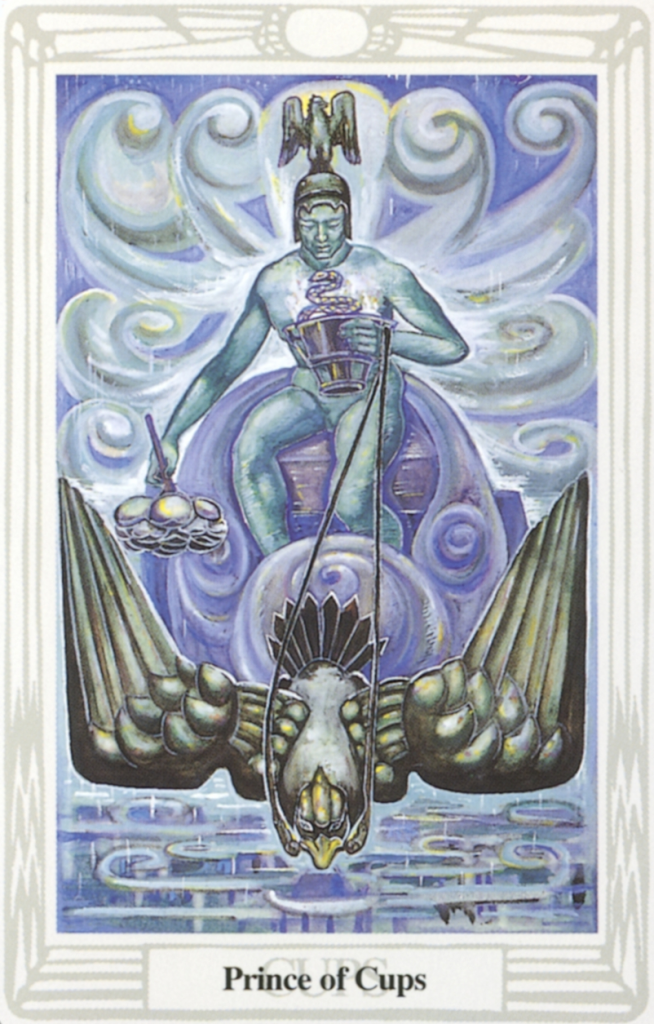
Tarot Card for April 17: Prince of Cups

The Prince of Cups

This card represents the watery quality of air, and as such brings a very important life principle to our experiences when it rules the day. It teaches us about how to shape our desires into realities, and offers a powerful supportive energy to assist us.As we’ve said so often, the things that we wish hardest for, invest most energy into, manifest in our lives. This is why it is so crucial to be vigilant and watchful about the way we’re thinking and feeling. If we sink into negativity, and empower that feeling with strong emotions like loneliness, grief or suffering we inadvertently introduce even more negativity into our lives.Likewise, when we want something strongly enough, and charge that desire with our longing, our hope, our positive energy we will find that thing manifesting for us. This card teaches us how to do this.how to explore our dreams, our desires, our wishes and to propel them into everyday life.The things we work with can be material, emotional or spiritual – the Prince of Cups works with desire on all levels. All we have to do is wish hard enough. And his energy will help us to achieve our aims.So on a day ruled by him, select one thing that you really really want, and spend a little time visualising it, imagining what it would feel like to have it, or experience it, and then gather all your strong feelings up into a bundle and push them out into the Universe…Stay alert, over the four weeks which follow, for signs that you are moving closer to your goal, or have already achieved it. Some things will take longer than others.but as long as you keep your hopes high for that particular wish, it will eventually wing its way back to you.

Affirmation: “I create my life daily and build my future.”

(Angelpaths.com)

Free Will Astrology: Week of April 17, 2025

BY ROB BREZSNY | APRIL 15, 2025 (NewCity.com)

Photo: Robin Schreiner

ARIES (March 21-April 19): I am always surprised when there appears yet another authoritative article or book that implies there is one specific right approach to meditation. The truth is, however, that there are many ways. Here’s teacher Christopher Bamford: “Meditation is naturally individual, uniquely our own. There are no rules. Just as every potter will elaborate their own way of making pots, so everyone who meditates will shape their own meditation.” This is excellent counsel for you right now, Aries. The planetary alignments tell me you have extra power to define and develop your unique style of meditation. Key point: Have fun as you go deeper and deeper!

TAURUS (April 20-May 20): From 1501 to 1504, the artist Michelangelo worked to create a seventeen-feet-tall marble sculpture of the Biblical king known as David. Today it stands in Florence’s Galleria dell’Accademia and is one of the most famous statues in the world. But the block of marble from which it was carved had a troubled beginning. Two other artists worked on it but ultimately abandoned their efforts, regarding the raw material as flawed. Michelangelo saw potential where they didn’t. He coaxed a masterpiece from what they rejected. Be like him in the coming weeks, dear Taurus! Look for treasure in situations that others deem unremarkable. Find the beauty hidden from the rest of the world.

GEMINI (May 21-June 20): The Judean date palm was considered extinct for over 800 years. Then scientists germinated a 2,000-year-old seed discovered in the ancient fortress of Masada. That was twenty years ago. Today, the tree, named Methuselah, is still thriving. Let’s regard this as your metaphor of power, Gemini. You, too, are now capable of reviving a long-dormant possibility. An old dream or relationship might show unexpected signs of life. Like that old seed, something you thought was lost could flourish if you give it your love and attention.

CANCER (June 21-July 22): In more than a few ancient cultures, dolphins were regarded as playful allies that would guide lost ships and assist sailors in stress. In ancient Greek myth, dolphins were sacred companions and agents of the sea god. In Maori culture, dolphins were thought to deliver important messages that were unavailable any other way. Many modern Westerners downplay stories like these. But according to my philosophy, spirit allies like dolphins are still very much available for those who are open to them. Are you, Cancerian? I’m pleased to tell you that magical helpers and divine intermediaries will offer you mysterious and useful counsel in the coming weeks—if you are receptive to the possibility.

LEO (July 23-Aug. 22): Do you know about the Leo liberator Simón Bolívar (1783–1830)? This Venezuelan statesman and military officer accomplished a cornucopia of good works. Through his leadership, Venezuela, Colombia, Peru, Panama, Bolivia and Ecuador gained independence from the Spanish Empire. He was one of history’s greatest crusaders for liberal democracy. I propose we make him one of your inspiring symbols for the next twelve months. May he inspire you, too, to be a courageous emancipator who helps create a better world.

VIRGO (Aug. 23-Sept. 22): Virgo conductor Leonard Bernstein was a global superstar because of his stellar musicianship, activism, philanthropy and teaching. He transformed classical music by dissolving barriers between “high” and “low” culture, bringing elegant symphonies to popular audiences while promoting respect for jazz and pop. He wanted all kinds of music to be accessible to all kinds of listeners. I think you are currently capable of Bernstein-like synergies, Virgo. You can bridge different worlds not only for your own benefit, but also others’. You have extra power to accomplish unlikely combinations and enriching mergers. Be a unifier!

LIBRA (Sept. 23-Oct. 22): A rainbow is gorgeous, with its spectacular multi-hued arc sweeping across the sky. Here’s another element of its poetic appeal: It happens when sunlight and rain collaborate. In a sense, it’s a symbol of the sublimity that may emerge from a synergy of brightness and darkness. Let’s make the rainbow your symbol of power in the coming weeks, Libra. May it inspire you to find harmony by dealing with contrasts and paradoxes. May it encourage you to balance logic and emotion, work and rest, light and shadow, independence and partnership. I hope you will trust your ability to mediate and inspire cooperation.

SCORPIO (Oct. 23-Nov. 21): You now have more power than usual to transform ordinary things into extraordinary things. Your imagination will work at peak levels as you meditate on how to repurpose existing resources in creative ways. What other people might regard as irrelevant or inconsequential could be useful tools in your hands. I invite you to give special attention to overlooked assets. They may have hidden potentials waiting for you to unlock them.

SAGITTARIUS (Nov. 22-Dec. 21): If you google the term “the religion of work,” many critical references come up. They condemn the ways humans place an inordinate importance on the jobs they do, thereby sacrificing their health and soulfulness. The derogatory English term “workaholic” is a descriptor for those who are manically devoted to “the religion of work.” But now let’s shift gears. The artist Maruja Mallo (1902–1995) conjured a different version of “the religion of work.” Her paintings celebrated, even expressed reverence for, the agricultural laborers of rural Spain. She felt their positive attitudes toward their tasks enhanced their health and soulfulness. In the coming weeks, Sagittarius, I invite you to explore Mallo’s version of the religion of work.

CAPRICORN (Dec. 22-Jan. 19): Astrologer Aliza Kelly likes Capricorns for their “fearless ambition, limitless resilience, and ability to keep pushing forward, even in the face of challenging adversity.” But she also praises their “secret wild side.” She writes, “Inside every earnest Capricorn is a mischievous troublemaker” that “loves to party.” I agree with her assessments and am happy to announce that the rowdier sides of your nature are due for full expression in the coming weeks. I don’t know if that will involve you “dancing on tables,” an activity Kelly ascribes to you. But I bet it will at least include interludes we can describe as “untamed.”

AQUARIUS (Jan. 20-Feb. 18): In 1922, Aquarian author James Joyce published “Ulysses,” a novel recognized as one of the masterworks of twentieth-century world literature. Seventeen years later, he produced “Finnegans Wake,” an uproarious experimental novel that was universally reviled when it first emerged because of its wild wordplay, unusual plot and frantic energy. In the ensuing years, though, it has also come to be regarded as a monument of brilliant creativity. It’s one of my favorite books, and I’m glad Joyce never wavered in his commitment to producing such an epic work of genius. Anyway, Aquarius, I’m guessing you have been toiling away at your own equivalent of “Finnegans Wake.” I beg you to maintain your faith! Keep going!

PISCES (Feb. 19-March 20): Years ago, in the early days of my infatuation with a new lover, she put a blindfold on me and ushered me around the city of Columbia, South Carolina. The goal was to enhance my non-visual senses. The experiment worked. I heard, smelled, and felt things I would never have noticed unless my dominating eyesight had been muffled. Ever since, my non-visual senses have operated with more alacrity. This fun project also improved the way I use my eyes. The coming days would be an excellent time for you to try a similar adventure, Pisces. If my idea isn’t exactly engaging to you, come up with your own. You will benefit profoundly from enhancing your perceptual apparatus.

Homework: What could you do to transform one of your uncertainties into creative energy? Newsletter.FreeWillAstroloy.com