AMERICAN SPECTACULAR

Becoming who we need to be in order to do what we need to do

MAR 9, 2025

Something seriously strange is going on these days. I’ve been heartened, however, at how the word is starting to spread, pieces are falling into place, and the larger patterns are becoming clear. The only thing to fear is people going numb, looking the other way, or acquiescing to the madness. I see a dark cloud over this country, that’s for sure, but I also see an extraordinary amount of spirited protest, expressed in many different ways, tying millions of people together in a collective cry of Hell No.

As Joni Mitchell sang, “You don’t know what you’ve got till it’s gone.” I’d amend that to, “We didn’t know what we had until it was almost gone – and now we’re pissed.” People who hadn’t ever spent five minutes thinking about how lucky we were that America was (more than not) a free society, are now for the first time thinking about what that really means. There is a Spirit of America, infused into our founding in some metaphysical way, that gets us all riled up when we start to feel the walls of freedom closing in on us. What we had forgotten as a nation was how much vigilance it takes to make sure they don’t.

But that’s changing now. The alarm’s gone off.

American’s are often chronically disengaged from the deeper issues of life, but we are not stupid. And we are not uncaring. From Pearl Harbor to 9/11, Americans have proven we’ll show up for our country when we feel it threatened. But the threat to America now is coming not via bombs dropping from the sky. It’s coming from a long-term systematic propaganda campaign by which millions are being led to believe that democracy isn’t really a good idea anyway. A democratic government is never efficient, after all (they’re wrecking it as we speak, in order to prove that to you). So we may as well just turn the whole things over to some techno billionaires dictators – since they’re the only ones who can be trusted to take care of the little guy. (Huh?)

In the midst of all this, like a small purple flower growing up between broken pieces of cement, a new Americanism is rising up. People are not taking this lying down. Those most bent on destroying our freedom, our government, and our security, are awakening within us a long buried spirit. It isn’t about Left or Right. It isn’t about Democrat or Republican. It’s about totalitarianism and reckless autocrats versus freedom and the rule of law.

Share

As I’ve said before, nature is organizing the resistance. It’s futile to think traditional political strategy alone can override the forces arrayed against us. We the People have to augment that. We can think of ourselves as peaceful, artful, and creative guerrilla forces. Jump at ‘em with a podcast over here, a genius computer move over there, a social media post over there, a political campaign over here, an organizing effort over there, a protest over here, a media project over there, a comedy routine over here, agit prop theatre over there, an educated argument at dinner over here, a refusal to accept the unacceptable over there. Do the thing that you can do. It’s not a single effort that’s going to fix this. It’s a field of energy by which we will elegantly, collectively, and powerfully fuck them up.

Dedicate your life to it. Don’t let a day go by that you don’t do something. Everything we do is a participatory particle in a rising wave of a new American spirit. God knows this country has made some terrible mistakes. America has even done some evil things. But never has there failed to be a generation that rose up among us courageous and humble enough to course-correct. Let’s not be the first generation to wimp out on doing so. In the process, we will find some power we didn’t even know we had within us. In the words of Winston Churchill, “Never give in, never give in, never, never, never, never—in nothing, great or small, large or petty—never give in except to convictions of honor and good sense.”

The forces arrayed against our democracy are petty, mean-spirited, and in many ways cruel. Let us meet them with honor and good sense, plus a fierce and patriotic love – of each other, our country, and our planet. They planned all this for a very long time, but let’s prove that they made one mistake in their planning. They thought their takeover would easy because they assumed we would be soft. They assumed we would be weak. They assumed we would not be brave.

Let’s prove them not as smart as they thought they were, by being more spectacular than we even knew we could be.
Passion – No One Has Ever Loved Me

haafang • Mar 1, 2012 Donna Murphy and Jere Shea in the Tony Award-winning Broadway musical PASSION by Stephen Sondheim.

No One Has Ever Loved Me lyrics

Giorgio
No one has ever loved me
As deeply as you.
No one has truly shown me
What love could be like until now:

Not pretty or safe or easy
But more than I ever knew.
Love within reason –
That isn’t love.
And I’ve learned that from you…
Are you cold?
Fosca
No, I’m afraid.
Giorgio
Of what?
Fosca
All this happiness,
Coming when there’s so little time.
Too much happiness
More than I can bear.
I pray for the strength to enjoy it.
You’ll leave tomorrow.
This is the only time we have.
You do love me, don’t you?
Giorgio
Yes, I love you.
Fosca
Say it again.
Giorgio
I love you.
Fosca
Once more.
Giorgio
I love you.
Be calm. Be strong. I am yours.
Fosca
This isn’t a dream?
Giorgio
This isn’t a dream.
(She begins to lead him towards the bed but Giorgio resists)
No, Fosca, we can’t.
Fosca
To die loved is to have lived.
(They kiss. Fosca becomes weak, and Giorgio lifts
her and carries her to the bed where he gently puts
her down. He stares at her momentarily; her strength
returns and she pulls him onto the bed as the music
swells and the lights fade.)

(Lyrics from Allmusicals.com)

Something’s Coming

West Side Story On B • May 11, 2020 “It is always hard to see the light at the end of a tunnel and even more so, that of a tunnel we’ve never been in before. ‘Something’s coming, something good!’ would be good to keep in mind looking to a much brighter time when all this is over.” Lead Trumpeter Dominic Derasse organized a very special digital rendition of “Something’s Coming” featuring Isaac Powell and the WEST SIDE STORY orchestra. “I saw this video as a special opportunity to credit all the orchestra members whose hard work you always hear, but whose faces you don’t often see” (Isaac Powell). www.westsidestorybway.com

5 WAYS DRUMS ARE USED TO COMMUNICATE

9 years ago (omahaschoolofmusicanddance.com)

Omaha School of Music and Dance

Music Lessons

When you think of a drum, what image does it bring to mind? A rock band? A marching band? Many of us are unaware of the history behind this amazing instrument, and that is has been used for communication for hundreds of years. It has been used for long-distance communication, ceremonies, and religious functions in Africa as well as other foreign countries. Drum communications are not actual languages, but they are based on natural languages and speech patterns. Learning to talk in drum language can be very difficult and not many are willing to try. But it is a fascinating concept that we should not ignore! Below are listed 5 ways that drums are used to communicate.

  1. Drums are used for Ceremonies and Rituals

There are many rhythms that simply express the joy of life and in many traditional cultures, they celebrate the joys of life with ceremonies and rituals. Villages come together and dance from dusk until dawn with many people joining in. There is a lot of call and response and singing to go along with the drum beat they are dancing to, as well as story-telling and other rituals. This type of community drumming also gives the chance to pass on traditions from generation to generation.

Historically, drums were beaten by kings on special occasions, such as during wars when they wanted to address their subjects. Drums were the driving force behind the art of war back then. It was a way to get the adrenaline pumping for the soldiers, and terrify the enemy with the thunderous noise coming from the drums. Modern armies still march to the beat of a drum, but it isn’t used the same in war time because of the change in ammunition. But the drums still forge a sense of unity.

  1. Drums are used for communicating over long distances

Africans and Europeans developed a wireless communication system long before cell phones were invented! In a time and place where roads didn’t exist, men went into deep in the forest to hunt and women walked long distances to gardens. They needed a way to be informed if something went wrong in town. Drums were used to send detailed messages from village to village much faster then a person could walk or ride a horse. The sound of talking drums could reach up to 4 to 5 miles. These drums have hollow chambers and long, narrow openings that resonate when they are struck. They are made out of hollow logs. The larger the log, the louder the sound would be. The drummer would communicate through phrases and pauses, and low tones referred to males while high tones referred to females. Some have called this a way to gossip, or learn information through the grapevine.

  1. Drums are used for slave communication and entertainment

As we all know, music can make any work much more fun to do as it energizes the workers. It the past, as hunters and gatherers were transitioning into seeders and harvesters, the drums made the boring and repetitive work fun instead of boring. It would help them to past he time playfully.

Drum rhythms are also a type of code. During the slave trades, drums were banned because the slaves were communicating to each other over long distances using a code their owners couldn’t understand.

  1. Drums mimic the tone of human speech

The “talking drum” is an hourglass shaped drum from West Africa (pictured above). The pitches that come from this drum can mimic the tone of human speech. It has two drumheads that are connected by leather tension cords. When the chords are squeezed, it changes the pitch of the drum. The leather cords are held under the arm of the player and squeezed while they play. The drum can capture pitch, volume, and rhythm of human speech.

  1. Drums connect humans to the sprit world

Many cultures have healers, psychics, and specialists called Shamans who are considered to be professional trance travelers. They handle communication between humans and the spirit world. They ask the spirits for help with a good hunt, diagnosing/curing the sick, and transitioning a dying human into the spirit world. The shaman uses drums, rattles, and gourds wrapped in beads in their many techniques to go into a trance and speak to the spirits. Sounds like a fun profession, don’t you think?

Mutual Dreaming, Part Two, with Linda Lane

New Thinking • Mar 7, 2025 This video is a special release from the original Thinking Allowed series that ran on public television from 1986 until 2002. It was recorded in about 1991. It will remain public for only one week. Linda Lane Magallón, MBA invested more than 18 years in conducting dreamwork and researching lucid, mutual, telepathic and flying dreams. Practicing under the discipline of the “Dream-Art Scientist” (a model based on the Jane Roberts’ Seth material), she has mastered many dreaming skills and dreamwork techniques. Linda authored the ground-breaking book, Mutual Dreaming. She served as editor and publisher of a principal magazine in the dream field, Dream Network. Here she delve more deeply into both the techniques and results of her investigations of mutual dreaming. Now you can watch all of the programs from the original Thinking Allowed Video Collection, hosted by Jeffrey Mishlove. Subscribe to the new Streaming Channel (https://thinkingallowed.vhx.tv/) and watch more than 350 programs now, with more, previously unreleased titles added weekly. Free month of the classic Thinking Allowed streaming channel for New Thinking Allowed subscribers only. Use code THINKFREELY.

Word-built World: by and large

(Image: Pixabay)

A.Word.A.Daywith Anu Garg

by and large

PRONUNCIATION:

(by uhn LARJ) 

MEANING:

adverb: In general; on the whole.

ETYMOLOGY:

From the world of sailing, describing a ship that could sail well in almost all wind conditions. Earliest documented use: 1669.

NOTES:

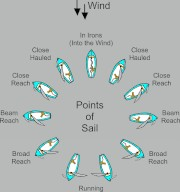
This phrase has its roots… or should we say, its anchor… in the world of sailing. It originally described a ship that was highly maneuverable. To simplify things a bit, such a ship that could sail well both:
By the wind: Sailing into the wind (a tricky maneuver). Think of this as the ship handling the headwinds of life.
Large: Sailing with the wind at its back (much easier!). This is the smooth sailing part. Large here means unrestricted, as in at large.
So, a ship that was good by and large could handle pretty much any wind condition. It was the all-terrain vehicle of the 17th-century seas!

Book: “The Undiscovered Self”

The Undiscovered Self

C.G. JungR.F.C. Hull (Translator)

One of the world’s greatest psychiatrists reveals how to embrace our own humanity and resist the pressures of an ever-changing world.

In this challenging and provocative work, Dr. Carl Jung—one of history’s greatest minds—argues that civilization’s future depends on our ability as individuals to resist the collective forces of society. Only by gaining an awareness and understanding of one’s unconscious mind and true, inner nature—”the undiscovered self”—can we as individuals acquire the self-knowledge that is antithetical to ideological fanaticism. But this requires that we face our fear of the duality of the human psyche—the existence of good and the capacity for evil in every individual.

In this seminal book, Jung compellingly argues that only then can we begin to cope with the dangers posed by mass society—”the sum total of individuals”—and resist the potential threats posed by those in power.

About the author

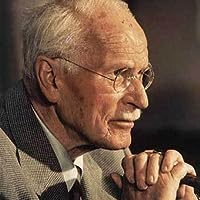
C.G. Jung

Carl Gustav Jung (/jʊŋ/; German: [ˈkarl ˈɡʊstaf jʊŋ]), often referred to as C. G. Jung, was a Swiss psychiatrist and psychotherapist who founded analytical psychology. Jung proposed and developed the concepts of extraversion and introversion; archetypes, and the collective unconscious. His work has been influential in psychiatry and in the study of religion, philosophy, archeology, anthropology, literature, and related fields. He was a prolific writer, many of whose works were not published until after his death.

The central concept of analytical psychology is individuation—the psychological process of integrating the opposites, including the conscious with the unconscious, while still maintaining their relative autonomy. Jung considered individuation to be the central process of human development.

Jung created some of the best known psychological concepts, including the archetype, the collective unconscious, the complex, and synchronicity. The Myers-Briggs Type Indicator (MBTI), a popular psychometric instrument, has been developed from Jung’s theory of psychological types.

Though he was a practising clinician and considered himself to be a scientist, much of his life’s work was spent exploring tangential areas such as Eastern and Western philosophy, alchemy, astrology, and sociology, as well as literature and the arts. Jung’s interest in philosophy and the occult led many to view him as a mystic, although his ambition was to be seen as a man of science. His influence on popular psychology, the “psychologization of religion”, spirituality and the New Age movement has been immense.

Featured Books from New Thinking Allowed

Despite the race issue being at the core of American society, Americans have yet to achieve much in the way of racial healing, but this text aims to pave the way for readers to bring about a meaningful change in their own lives and the lives of others. The authors use personal stories and the twelve spiritual keys of attitudinal healing to look at racism in fresh, open, and non-judgmental ways. Using universal spiritual principles, topics include the essence of our being is love, health is inner peace, and ways to let go of the past and of the future.


Taking readers on a thought-provoking journey into our ancestors’ beliefs about death, dying, and the afterlife, Gregory Shushan reveals the powerful influence of near-death experiences (NDEs) on religious beliefs and ritual practices throughout human history. Focusing on five ancient world regions in Egypt, Mesopotamia, India, China, and Mesoamerica, Shushan expertly explores each civilization’s afterlife beliefs. He explains how each of these civilizations developed independently of one another, yet there is a series of similarities among afterlife beliefs too consistent and specific to be mere coincidence.

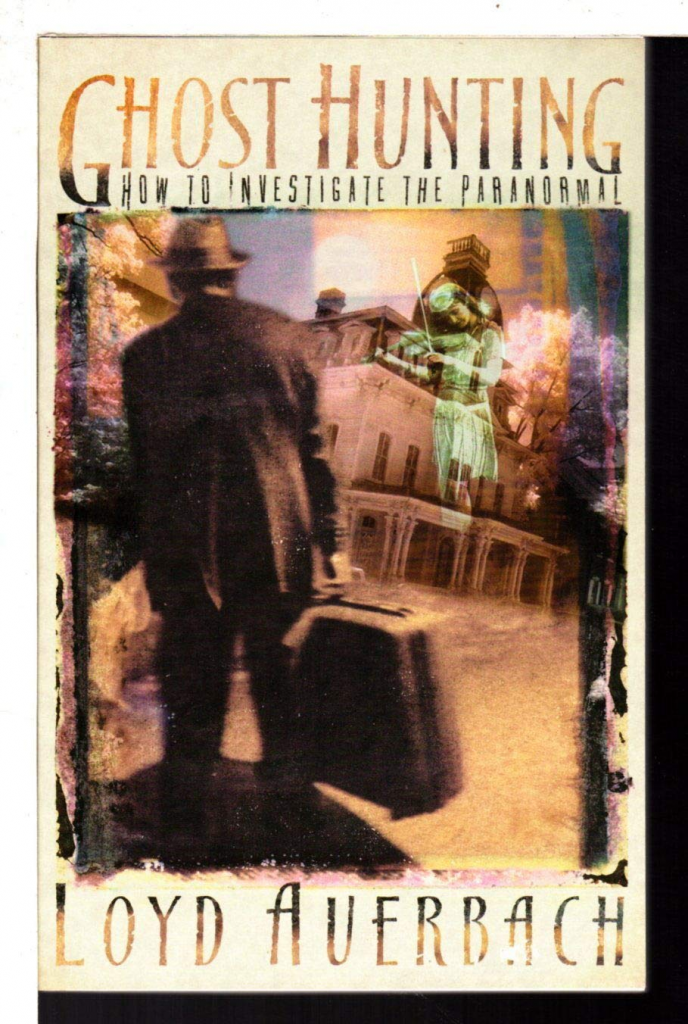
Ghost Hunting covers the investigative process from the initial call and assessment to the on-site investigative techniques and technology. It deals with how to come up with solutions and resolutions for ways to get “rid” of the phenomena. It includes a discussion of the use of technology and the use of psychics in paranormal investigations and if anyone can prove the existence of ghosts. Finally, the book covers information resources and organizations that the new ghost-hunter and the person who encounters a ghost can find to learn more about the subject and for help with cases they’re investigating or phenomena they’re experiencing.

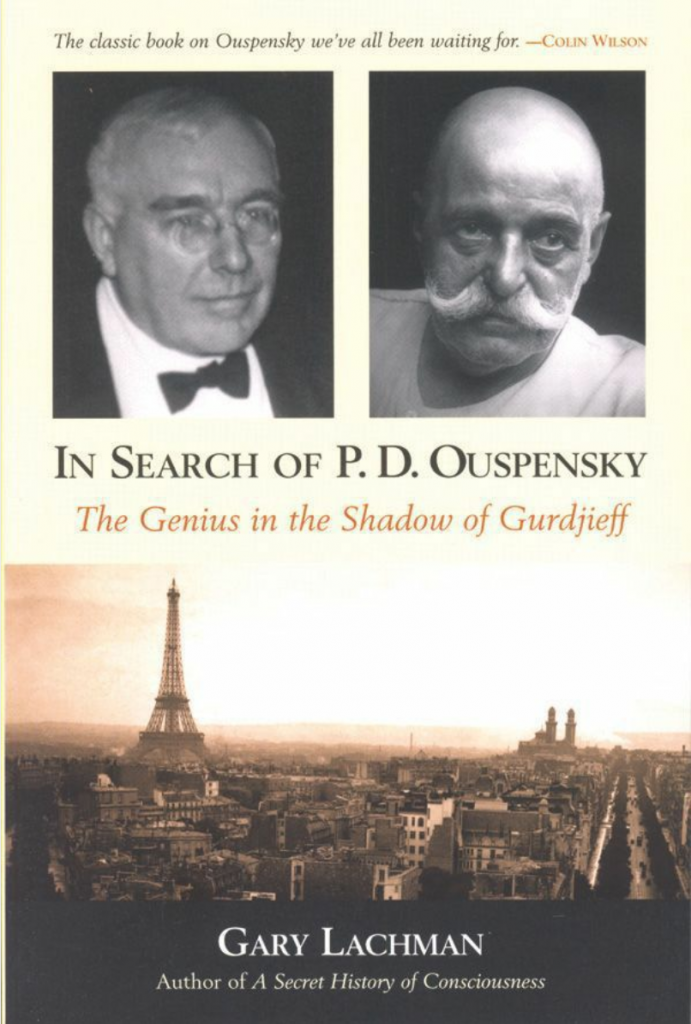
This book moves Ouspensky’s own story center stage, against the backdrop of the Russian Revolution, the dervishes of Constantinople, and a cosmopolitan Europe entre deux guerres. The archetypal encounter it describes echoes that of Don Juan and Castaneda, or perhaps Mephistopheles and Faust. One of the great mystical adventures of our time, it will fascinate everyone interested in the farthest reaches of what it means to be human. 

This 820 page book details the academic research findings of the world’s first comprehensive multi-language quantitative and qualitative 5 year academic research study on individuals that have had UFO related contact with Non Human Intelligence. This is the study referred to in the Robert Davis interview. Over 5 years FREE has collected detailed responses to 3 extensive quantitative and qualitative surveys from over 4,200 individuals from over 100 countries. The findings from these thousands of “Experiencers” contradict much of what is circulating in mainstream materialist Ufology.

Building on the groundbreaking research of two previous anthologies, Irreducible Mind and Beyond Physicalism, Edward Kelly and Paul Marshall gather a cohort of leading scholars to consider the significance of extraordinary experiences for our understanding of reality. The vision sketched here provides an antidote to the prevailing postmodern disenchantment of the world and demeaning of human possibilities. It not only more accurately and fully reflects our human condition but engenders hope and encourages ego-surpassing forms of human flourishing.

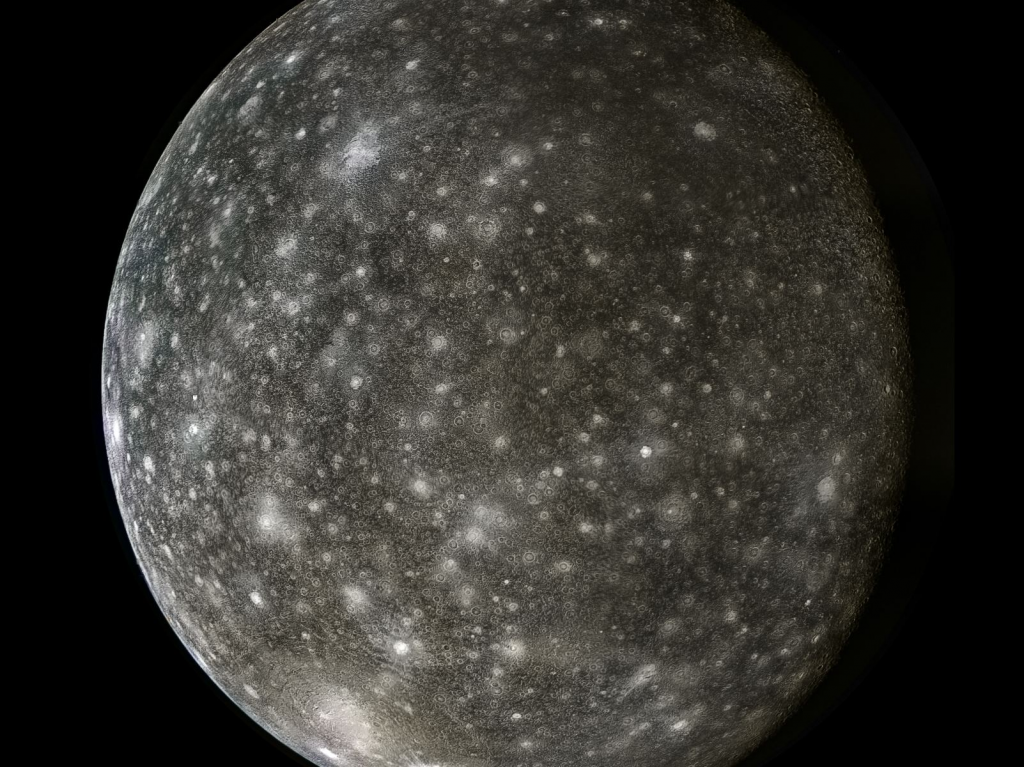
Jupiter’s second largest moon Callisto

Callisto is Jupiter’s second-largest moon, the third-largest moon in the Solar System, and the outermost Galilean moon. This processed image of Callisto is from unfiltered images taken by Voyager 2 on July 8 1979.  It has a dark, icy surface covered in craters. But its induced magnetic field indicates the possibility of a salty ocean beneath all that ice.

(from New Thinking Allowed)

Study: Majority Of Children Lack Strong Male Supermodels

Published: August 22, 2013 (TheOnion.com)

WASHINGTON—A troubling new report from the U.S. Department of Health and Human Services revealed Thursday that fewer than 4 percent of American children have a strong male supermodel in their lives. “During their formative years, it is essential that our young people have a lean, strong-jawed Adonis to look up to,” said the department’s deputy secretary, Bill Corr, adding that many children don’t even have a father at home, let alone one who is “chiseled and knows how to look good in anything.” “In America today, the percentage of fathers, uncles, and male educators who have high cheekbones and wax all of their body hair is at an all-time low. With such a lack of positive examples, how will our kids learn to handle themselves in a photoshoot or on the runway? Who will teach them important life skills like showing up on time, making bedroom eyes at the camera, and pursing one’s lips while squinting?” Corr also expressed his concern that without enough positive male supermodels, today’s children may never grow to feel comfortable getting in front of the camera in their underwear.