
The Chris He • Mar 8, 2025 This was pulled from my last livestream, which you can watch here: https://www.youtube.com/live/yNqucrPSrtM Support my independent journalism at Substack: https://chrishedges.substack.com/ Follow me on social media: https://linktr.ee/chrishedges Photos: Fantasy sky – abstract teplate – stock photo Computer generated image. (Getty Images) Daniel and Philip Berrigan Handcuffed (Original Caption) 12/14/1970-Hartford, CT- The reverends Daniel (L) and Philip Berrigan (C) leave Hartford’s Federal Court in the custody of U.S. Marshal Guy Russo. The brothers, who are both serving prison terms in the Federal prison at Danbury, for destroying draft records, are seeking injunctions to keep officials from interfering with the rights of prisoners to practice their religion. Albert Camus (Original Caption) Albert Camus, 1959. PALESTINIAN-ISRAEL-CONFLICT-GAZA Palestinians children wait to collect food at a donation point in a refugee camp in Rafah in the southern Gaza Strip on December 23, 2023, amid continuing battles between Israel and the militant group Hamas. (Photo by Mahmud HAMS / AFP) (Photo by MAHMUD HAMS/AFP via Getty Images) BRITAIN-US-ECUADOR-AUSTRALIA-DIPLOMACY-COURT-ASSANGE WikiLeaks founder Julian Assange gestures from the window of a prison van as he is driven out of Southwark Crown Court in London on May 1, 2019, after having been sentenced to 50 weeks in prison for breaching his bail conditions in 2012. A British judge on Wednesday sentenced WikiLeaks founder Julian Assange to 50 weeks in prison for breaching his bail conditions in 2012. Assange took refuge in Ecuador’s London embassy to avoid extradition to Sweden and was only arrested last month after Ecuador withdrew his asylum status. (Photo by Daniel LEAL / AFP) (Photo by DANIEL LEAL/AFP via Getty Images) Julian Assange Supporters Rally In Brisbane BRISBANE, AUSTRALIA – DECEMBER 09: Demonstrators take to the streets during a rally in support of WikiLeaks founder Julian Assange on December 9, 2010 in Brisbane, Australia. Assange was remanded to a British prison today and is facing extradition to Sweden where he has been accused of raping one woman and molesting another earlier this year. (Photo by Marc Grimwade/Getty Images) President Biden Spends Fourth Of July At The White House WASHINGTON, DC – JULY 04: President Joe Biden and Vice President Kamala Harris join hands in the air as they view the fireworks on the National Mall with First Lady Jill Biden and Second Gentleman Doug Emhoff from the White House balcony during a 4th of July event on the South Lawn of the White House on July 4, 2024 in Washington, DC. The President is hosting the Independence Day event for members of the military and their families. (Photo by Samuel Corum/Getty Images)
Monthly Archives: March 2025
TRUMP’S VISION FOR AMERICA: I AM GOD
Talia Lavin, journalist and author of “Wild Faith,” on the right-wing Christian ideology and characters guiding Trump.

March 7 2025 (TheIntercept.com)

Photo illustration: Fei Liu / Photo: Alex Wong/Getty Images
IN AN ADDRESS to Congress on Tuesday, President Donald Trump once again cast himself as a divine savior of the American people.“I was saved by God to make America great again,” he claimed as he recounted the failed assassination attempt in Butler, Pennsylvania.
During his 100-minute speech, Trump made direct appeals to the Christian right, a major segment of his base: “This will be our greatest era. With God’s help over the next four years, we are going to lead this nation even higher.”
He framed a series of policy proposals — many attacking civil rights for minorities and trans people — as part of God’s plan for the nation. He called on Congress “to pass a bill permanently banning and criminalizing sex changes on children,” proclaiming “our message to every child in America is that you are perfect, exactly the way God made you.”
MOST READ

Pentagon Keeps Pouring Cash Into Golf Courses — Even As Trump Slashes Government Spending

We Found Elon Musk’s DOGE Email Address and We’re Fighting to Reveal His Messages

In some ways, Trump is the kind of political leader the Christian right has been seeking for decades. He has fully championed the movement’s long-held policy priorities: overturning Roe v. Wade, pushing prayer in schools, and curbing LGBTQ+ rights. Now he is taking their movement even further, embedding right-wing Christian ideology into every facet of federal policy.
It’s a “broad coalition across Christian denominations,” says journalist Talia Lavin, “whose goal is an extremely socially restrictive agenda.” Lavin, author of “Wild Faith: How the Christian Right Is Taking Over America,” argues that today’s Christian right is more receptive to authoritarianism than previous generations. “They’ve reached a kind of acme or apotheosis of their power and influence, where that sort of attitude towards democracy has attained real relevance in the way we’re governed.”
On this week’s episode of The Intercept Briefing, Lavin and Intercept reporter Jessica Washington examine the Christian right’s growing influence, its long-term strategy, and what, if anything, can be done to curb their vision for the country.
Related
How Trump Twisted DEI to Only Benefit White Christians
Washington warns that many liberals dismiss Trump’s alliance to the Christian right as fringe, missing its deep political impact. “While it’s this convenient political organizing tool, it is also a deeply held belief,” she says — one that rejects the idea that Black people and queer people have a rightful place in American leadership. Trump, she adds, validates the belief that only white Christian males are the true inheritors of the nation’s legacy. “Trump is both a product of and an accelerant of this movement.”
Countering the rapid lurch toward Christian nationalism, Washington argues, requires solidarity. “We all have to band together and fight this together. And not allowing ourselves to be siloed into different issues. And recognizing that this is an attack on everyone who doesn’t fit this very specific mold.”
Lavin calls for active resistance — a “joyous cacophony” — to the Christian right’s war on diversity, on the poor, and democracy: “We’re gonna be gender rebels. We’re not going to accept the gutting of social services. We’re not going to accept a king.” Rather than doomscrolling, she encourages people to do “something, anything — feeding someone, attending a protest — whatever it is. All of that is how we win.”
Listen to the full conversation of The Intercept Briefing on Apple Podcasts, Spotify, or wherever you listen.
Trumpism and New Thought
Dr. Steven Ha • Mar 9, 2025 • How are cult tactics influencing today’s political landscape? In this powerful episode of Cult Conversations: The Influence Continuum, Dr. Steven Hassan sits down with cult intervention expert Joe Szimhart to uncover the chilling links between Russian Cosmism, Agni Yoga, and modern political movements. Joe shares his personal journey from being recruited into the Church Universal and Triumphant to helping others escape undue influence. They dive deep into how authoritarian leaders like Trump and Putin may be drawing from these dangerous ideologies — and why it matters now more than ever. ???? Key Topics Covered: ✅ Cult tactics influencing U.S. and Russian politics ✅ Michael Flynn’s connection to Church Universal and Triumphant ✅ Putin and the rise of Russian Orthodox extremism ✅ How Andrew Tate’s tactics mirror cult recruitment methods ✅ The dangerous rise of Christian Nationalism
Chapters 00:00 – Introduction – Joe Szimhart’s Background and Cult Expertise 02:50 – Trump, Zelensky, and Vance at the White House – Political Fallout 15:14 – Theosophy, Russian Cosmism, and Putin’s Religious Influence 26:12 – Michael Flynn’s Cult-Linked Prayer – Direct Ties to CUT 42:28 – Andrew Tate, Trafficking, and Cult Tactics 50:58 – How Cult Psychology is Driving U.S. and Global Politics 56:27 – How to Spot Undue Influence – Practical Advice 01:01:15 – Joe’s Final Thoughts and How to Connect with Him
Tarot card for March 10: Gain
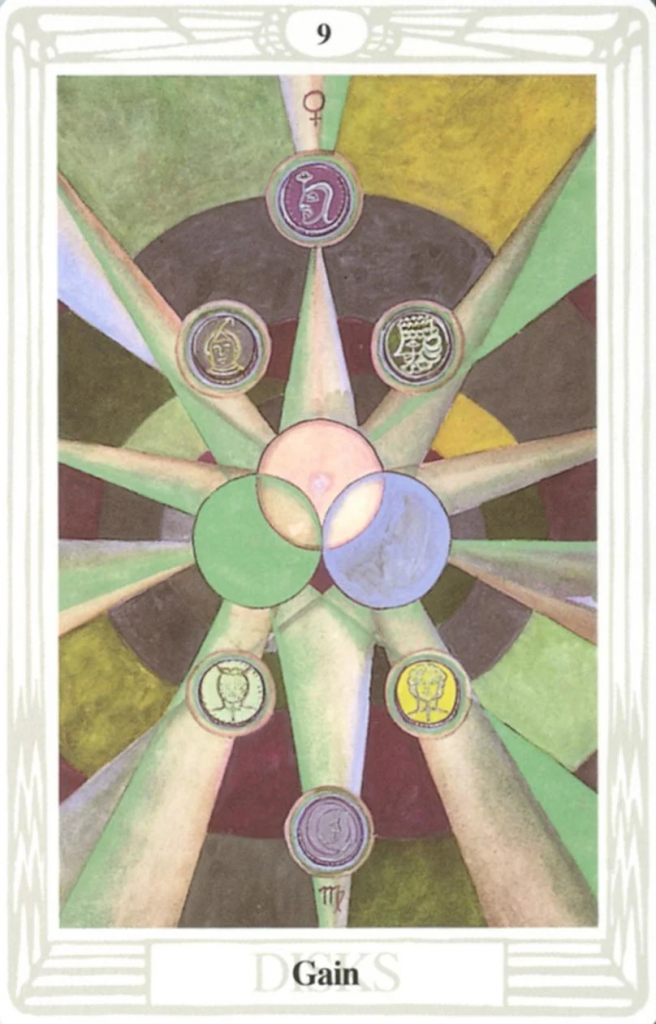
That phrase ‘what goes around comes around’ is very relevant to this card. The Lord of Gain is a card that indicates that we have set in motion some plan or project, and we are now reaching a point of completion with it.
So on the day ruled by the Nine of Disks, we need to be open to opportunities which allow us to conclude work that has been outstanding; remain alert to new chances opening up before us; and ready to seize the moment when it appears.
This card accords with the ancient wisdom that we give what we get in life – so this is also a day to look for opportunities to offer our help and resources with no immediate expectation of return.
Take up chances to serve – whether in a mundane fashion, or to a higher source, in the sure knowledge that the things you give with love are the ones which build a bright new world.
It is the help we give to others with a happy heart, the sympathy we offer without judgement, the gentleness with which we treat ourselves and others that will change things.
When we do this, we set in motion a stream of positive, caring energy, which will travel around the world and return to us – vastly changed, and yet almost the same. What we gave to somebody else with no thought of reward or gain, is what we truly gain when it comes our way again.
Affirmation: “I open myself to life’s bounty with gratitude”
(Angelpaths.com)
Socrates on following the truth

S. Leonard Syme, the father of social epidemiology, dies at 92
Professor emeritus was beloved by the public health community as a trailblazer and mentor
- Published January 28, 2025 (publichealth.berkeley.edu)
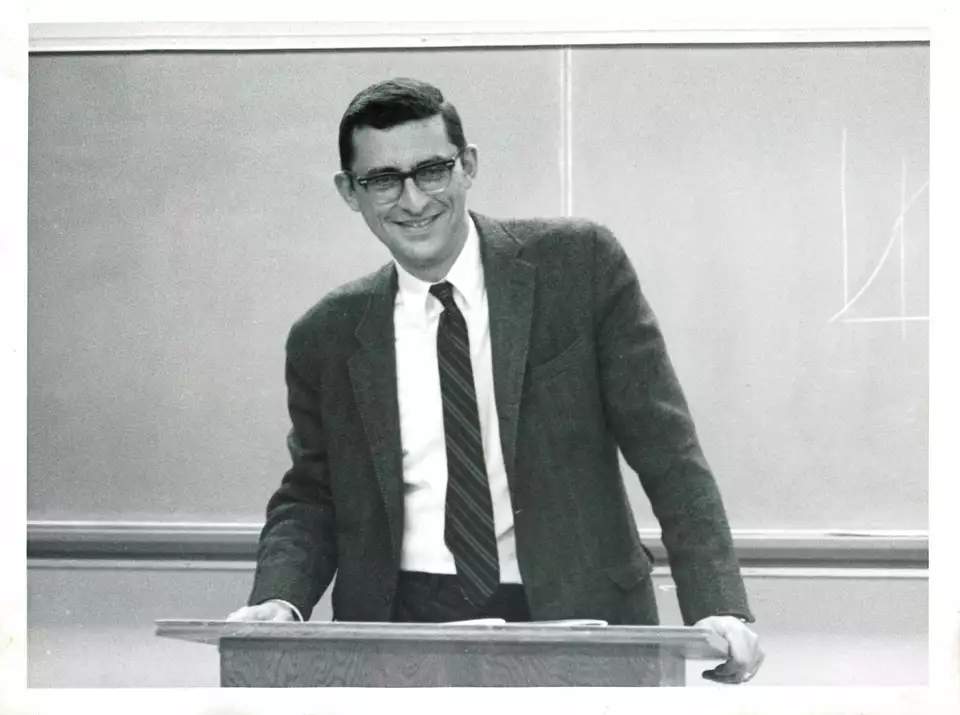
Len Syme in his classroom at the UC Berkeley School of Public Health.Courtesy UC Berkeley School of Public Health
S. Leonard Syme, who pushed the study of the psychosocial determinants of disease from the fringes to a central tenet of the field of public health, passed away of silent aspiration pneumonia on January 26, 2025, in Cabo San Lucas, Mexico. He was 92, having been born on July 4, 1932.
“Len was a true giant, the father of social epidemiology, and one of the most beloved teachers and mentors Berkeley Public Health has ever had,” said Michael C. Lu, dean of the UC Berkeley School of Public Health. “Few individuals have transformed public health as profoundly as Len. He pioneered the study of social determinants of health, which has fundamentally transformed medicine and public health and continues to shape research, practice, and public policy today in our nation and around the world.”
As a professor of epidemiology and community health—and prior to that, working for the National Institutes of Health and other federal agencies—he demonstrated the impact that such factors as poverty, stress, social class, and social isolation have on health. His research examined these psychosocial stressors on people around the world: bus drivers in San Francisco, civil servants in London, and Japanese men at home and abroad.
Syme served for more than 20 years as co-principal investigator at Berkeley Public Health’s Health Research for Action, where his team developed the model for grassroots, community based-interventions to prevent disease and promote health. This model has proven a highly effective, highly impactful vehicle to deliver medical information to underserved populations.
“Len was deeply committed to not only pioneering work in figuring out the underlying determinants of health. but also to putting theory into action with deep community involvement in finding solutions, which he did through the school’s Health Research for Action center with highly successful projects over 30 years,” said UC Berkeley Professor Linda Neuhauser.
Along the way, Syme was elected to the National Academy of Sciences and won many coveted awards for his research and teaching, among them the Wade Hampton Frost Leadership Award—one of the most prestigious awards in the field of epidemiology—from the American Public Health Association, for developing the study of social epidemiology. He also received the Berkeley Citation for distinguished service to the university and was given the Panunzio Prize as Outstanding Emeritus Professor in the statewide university system.
Syme’s drive to examine the psychosocial factors that compromise one’s ability to stay healthy—rather than following the traditional medical model to study the etiology of individual diseases—has become such a mainstay of public health thinking that it’s hard to remember that it was, during the 1960s and much of the 1970s, heresy.
“It was the fringe of the fringe,” said Sir Michael Marmot, director of the Institute of Health Equity at University College London, who came to Berkeley to study with Syme in the mid-1970s. “Epidemiology was the fringe part of medicine, and social epidemiology was the fringe part of epidemiology. Len made respectable the idea that social and psychosocial influences on diseases—cardiovascular disease in particular—could be important. It was with scientific rigor, which made it respectable.”
A tough boyhood in Canada to a PhD from Yale
It was an unusual journey for a boy who spent an uneasy childhood in Winnipeg, Canada, then a small, dreary city in the Canadian prairie. In his 2011 autobiography, Memoir of a Useless Boy, Syme described surviving tough threats from inside and outside his home, which provided challenges but also gave him empathy for people facing obstacles and a conviction about the protective powers of strong social ties and, above all, hope.
Syme was the first in his family to attend college, starting at a local school and then transferring to the University of Manitoba in 1949. It was a small school, but nearly the entire faculty were Oxford or Cambridge–trained teachers, working in Canada until the post-war job market opened up back home. He received his bachelors and masters degree from UCLA in 1955 and then landed at Yale, where he earned a PhD in what was then called the sociology of medicine.
Syme’s early research at NIH, examining the psychosocial causes of heart disease, was scoffed at by the established medical community. When he presented his theory on the influence of social factors on health to an American Heart Association meeting, Syme was chastised.
“One man took me aside and said, ‘Don’t ever do that again,”’ he recalled in an interview in 2023. “He told me to stick with the things we already know about: high serum cholesterol, cigarette smoking, high blood pressure.”
He didn’t listen.
As the decades went by, and Syme completed more ground-breaking studies, the Public Health establishment slowly began to embrace his perspectives, began to adopt his new approach, and eventually even began to celebrate his contributions. It was a long road, but changed the direction of public health forever.
In a message to UC Berkeley School of Public Health, Syme’s daughter, Karen Englund, wrote that the beloved researcher had enjoyed the holidays in Mexico surrounded by family, directly before he died.
“His days were full of good food, football, stories, warmth, and laughter,” Englund wrote. “He loved waking up everyday to a different sunrise and then ending each day with a gorgeous sunset over the ocean.”
“He wanted me to share that he felt at peace with his life,” she added. “He told me, ‘It’s a good feeling to have reached 92 with no regrets!’”
Syme was grateful, Englund wrote, that he was able to accomplish what he set out to do in his life.
Syme is survived by three children: Karen Englund (husband Steve Englund), of Cabo San Lucas, Mexico, David Syme of Orinda, and Janet Syme Piller (husband Greg Piller) of Herndon, VA; and four grandchildren Chris Piller (wife Mairead Horton) of Chicago, Nolan Englund (partner Jordan Ellison) of Los Angeles, Melanie Piller (wife Catherine Weathered) of Portland, OR, and Jenna Englund of Cabo San Lucas, Mexico. His wife, Marilyn, predeceased him in December 2006.
Donations in Syme’s honor are welcome to the S. Leonard Syme endowment fund. Please make your check payable to the UC Berkeley Regents and mail to: Gift Services, 1995 University Ave, Ste 400, Berkeley, CA 94704. Write “School of Public Health Fund R083780000” on your check.
In the Media:
- “Father of social epidemiology”: professor emeritus S. Leonard Syme dies at 92
The Daily Californian
UC Davis responds to backlash over ‘all gender’ locker room design
By Aidin Vaziri, Staff Writer Updated March 6, 2025 (SFChronicle.com)

UC Davis officials are responding to backlash from right-wing groups and concerned students after announcing plans to overhaul its locker room facilities, replacing traditional men’s and women’s sections with all-gender “universal” spaces.
The $5 million renovation, announced last month and slated for completion in September, has sparked considerable opposition from conservative activist groups and some students.
• RELATED: Gavin Newsom draws liberal backlash over trans athlete remarks in podcast with MAGA celebrity
The university cited student feedback as the motivation for the change, initially stating, “All campus recreation members can use our universal locker rooms, regardless of who they are or how they identify. These spaces are inclusive of members with disabilities and all gender identities.”
After the criticism had surfaced, the university revised the announcement, replacing the original wording with a more neutral statement: “All Campus Recreation members will be able to use our new locker rooms. These spaces include ADA-accessible facilities for members with disabilities.”
Concerns about the new design have been voiced by some, particularly on Reddit. One user wrote, “Women already have to worry about men looking at them when they are working out, and adding men to their locker room is just wrong.”
These comments gained traction among critics of gender-inclusive policies, including conservative figures such as Beth Bourne, Elizabeth Barcohana and former tennis pro Martina Navratilova, who called the move “beyond f—ed up,” warning that it could alienate many women.
Despite the criticisms, UC Davis maintains that privacy is a top priority.
Bill Kisliuk, a spokesperson for the university, emphasized that the new locker rooms will offer fully enclosed spaces for changing, showering and using restrooms.
“In the redesign, common space is for use by all members, and the changing areas, showers and restrooms are fully private,” he said in a statement. “These spaces have floor-to-ceiling walls and doors.”
The university’s floor plan shows that separate men’s, women’s and gender-inclusive toilets will still be available. The design also includes private cabanas, changing rooms and toilet rooms.
However, some critics argue that the plan may not be sufficient for the high traffic expected at the recreation center.
One Reddit user questioned, “Did the college ask its female students how they feel about universal bathrooms or locker rooms?” Another commenter asked, “Was there any problem with how the locker rooms were before?,” and others expressed concerns about the loss of traditional locker room spaces. “RIP locker room talk,” one wrote.
Safety concerns have also been raised, with one Reddit user asking, “What happens when a man or other slips into this ‘private’ room, and now has phyical (sic) cover (a private room) to sexually assault a woman / other?”
Still, UC Davis officials insisted the renovation will address privacy and safety concerns while improving operational efficiency, allowing for quicker emergency responses, and ensuring accessibility for individuals with disabilities.
“We are committed to creating a welcoming environment for our campus community,” Kisliuk said.
Reach Aidin Vaziri: avaziri@sfchronicle.com
March 5, 2025|Updated March 6, 2025 10:52 a.m.
STAFF WRITER
Aidin Vaziri is a staff writer at The San Francisco Chronicle.
Word-Built World: transhumanar
“Transhumanar” is a neologism used by Dante Alighieri in his Divine Comedy, specifically in the Paradiso, to describe the process of transcendence or moving beyond the human condition.
Here’s a more detailed explanation:
- Context: Dante uses “trasumanar” to describe the internal transformation and spiritual ascent he undergoes during his journey through the afterlife.
- Meaning: The word literally means “to become more than human” or “to transcend the human”.
- Example:In Paradiso, Dante compares his internal transformation to the change experienced by Glaucus, a fisherman-turned-god, who becomes immortal after purifying himself of his mortal elements.
- Significance: “Trasumanar” highlights Dante’s exploration of the human capacity for spiritual growth and the potential for transcending the limitations of the earthly realm.
- Trasumanar (neologism) – DanteworldsHe compares the internal transformation he undergoes during this ascent to the change experienced by Glaucus, a fisherman-turned-g…Danteworlds
- Dante Alighieri expressed the transcendence of the human condition …Mar 1, 2023 — The seven main monsters – namely Minos, Cerberus, Plutus, Minotaur, Centaurs, Harpies, and Geryon – have the active rol…
American Comparative Literature Association
Generative AI is experimental.
Are you chosen?
Find The P • Feb 18, 2025 • CHOSEN FROM THE CRADLE Signs That Show Your Purpose Since Childhood YOU ARE NOT ORDINARY! POWERFUL SIGNS THAT GOD CHOSE YOU FROM BIRTH Peace, brothers! It is in God, through studying the Bible, that we find true wealth for an abundant and spiritually prosperous life. In the Bible, we discover the prosperity that comes from the Lord and learn to live with health and wisdom from above. This way, we become true millionaires, not in earthly possessions, but in the eternal riches of heaven. Share this video with your friends and support the channel by liking and subscribing.???? / @findthepower7 Since the beginning of time, a silent war has been waged—one between darkness and light, between truth and deception. And in the midst of this battle, certain individuals have been marked, chosen, and set apart for a divine purpose. But here’s the shocking reality: most of them never realize it. They go through life struggling, questioning, lost in a world that prioritizes wealth, status, and material gain over the undeniable calling that has been on their lives since birth. What if you were one of them? What if, since childhood, signs have been revealing your divine purpose, but you either ignored them or failed to recognize what they truly meant? What if everything you have been through—your struggles, your victories, your moments of deep isolation—were all part of a greater plan? The world teaches us that success is measured by riches, luxury, and financial prosperity. That if you don’t have money, you have nothing. But the truth is, God’s ways are higher. His definition of abundance goes beyond material wealth—it is tied to destiny, to purpose, to the impact you were created to make in this world. Look around. People chase after money, believing it will bring them happiness, but they still feel empty. They pursue luxury, convinced it will give them security, yet they live in fear of losing it all. But when God marks someone, when He places a calling over a person’s life, there is nothing in this world—no amount of riches, no human ambition—that can compare to walking in His divine will. If you have ever felt different, if you have ever sensed that you don’t quite fit into the world’s mold, if challenges have come against you since childhood, pay close attention. That is no coincidence. Many of the greatest men and women in the Bible—those who changed history—were set apart from birth. But they all had to recognize the signs, embrace their calling, and step into their purpose. And today, you are about to discover something that could change your life forever. Signs that God may have been revealing to you since childhood. Signs that indicate you were chosen, set apart, and destined for something much greater than what this world offers.
The Rise of the Brutal American

The Atlantic (March 5, 2025)
Opinion by Anne Applebaum

The Rise of the Brutal American© Brian Snyder / Reuters
A book festival in Vilnius, meetings with friends in Warsaw, a dinner in Berlin: I happened to be at gatherings in three European cities over the past several days, and everywhere I went, everyone wanted to talk about the Oval Office performance last Friday. Europeans needed some time to process this event, not just because of what it told them about the war in Ukraine, but because of what it told them about America, a country they thought they knew well.
In just a few minutes, the behavior of Donald Trump and J. D. Vance created a brand-new stereotype for America: not the quiet American, not the ugly American, but the brutal American. Whatever illusions Europeans ever had about Americans—whatever images lingered from old American movies, the ones where the good guys win, the bad guys lose, and honor defeats treachery—those are shattered. Whatever fond memories remain of the smiling GIs who marched into European cities in 1945, of the speeches that John F. Kennedy and Ronald Reagan made at the Berlin Wall, or of the crowds that once welcomed Barack Obama, those are also fading fast.
Quite apart from their politics, Trump and Vance are rude. They are cruel. They berated and mistreated a guest on camera, and then boasted about it afterward, as if their ugly behavior achieved some kind of macho “win.” They announced that they would halt transfers of military equipment to Ukraine, and hinted at ending sanctions on Russia, the aggressor state. In his speech to Congress last night, Trump once again declared that America would “get” Greenland, which is a part of Denmark—a sign that he intends to run roughshod over other allies too.
[Read: A Greenland plot more cynical than fiction]
These are the actions not of the good guys in old Hollywood movies, but of the bad guys. If Reagan was a white-hatted cowboy, Trump and Vance are Mafia dons. The chorus of Republican political leaders defending them seems both sinister and surprising to Europeans too. “I never thought Americans would kowtow like that,” one friend told me, marveling.
The Oval Office meeting, the subsequent announcements, and the speech to Congress also clarified something else: Trump, Vance, and many of the people around them now fully inhabit an alternative reality, one composed entirely of things they see and hear in the ether. Part of the Oval Office altercation was provoked by Zelensky’s insistence on telling the truth, as the full video clearly shows. His mistake was to point out that Russia and Ukraine have reached many cease-fires and made many agreements since 2014, and that Vladimir Putin has broken most of them, including during Trump’s first term.
It’s precisely because they remember these broken truces that the Ukrainians keep asking what happens after a cease-fire, what kind of security guarantees will be put in place, how Trump plans to prevent Putin from breaking them once more and, above all, what price the Russians are willing to pay for peace in Ukraine. Will they even give up their claims to territory they don’t control? Will they agree that Ukraine can be a sovereign democracy?
But Trump and Vance are not interested in the truth about the war in Ukraine. Trump seemed angered by the suggestion that Putin might break deals with him, refused to acknowledge that it’s happened before, falsely insisted, again, that the U.S. had given Ukraine $350 billion. Vance—who had refused to meet Zelensky when offered the opportunity before the election last year—told the Ukrainian president that he didn’t need to go to Ukraine to understand what is going on in his country: “I’ve actually watched and seen the stories,” he said, meaning that he has seen the “stories” curated for him by the people he follows on YouTube or X.
Europeans can also see that this alternative reality is directly and profoundly shaped by Russian propaganda. I don’t know whether the American president absorbs Russian narratives online, from proxies, or from Putin himself. Either way, he has thoroughly adopted the Russian view of the world, as has Vance. This is not new. Back in 2016, at the height of the election campaign, Trump frequently repeated false stories launched by Russia’s Sputnik news agency, declaring that Hillary Clinton and Obama had “founded ISIS,” or that “the Google search engine is suppressing the bad news about Hillary Clinton.” At the time, Trump also imitated Russian talk about Clinton starting World War III, another Russian meme. He produced a new version of that in the Oval Office on Friday. “You’re gambling with World War III. You’re gambling with World War III,” he shouted at Zelensky.
[David Frum: Trump, by any means necessary]
But what was ominous in 2016 is dangerous in 2025, especially in Europe. Russian military aggression is more damaging, Russian sabotage across Europe more frequent, and Russian cyberattacks almost constant. In truth, it is Putin, not Zelensky, who started this conflict, Putin who has brought North Korean troops and Iranian drones to Europe, Putin who instructs his propagandists to talk about nuking London, Putin who keeps raising the stakes and scope of the war. Most Europeans live in this reality, not in the fictional world inhabited by Trump, and the contrast is making them think differently about Americans. According to pollsters, nearly three-quarters of French people now think that the U.S. is not an ally of France. A majority in Britain and a very large majority in Denmark, both historically pro-American countries, now have unfavorable views of the U.S. as well.
In reality, the Russians have said nothing publicly about leaving Ukrainian territory or stopping the war. In reality, they have spent the past decade building a cult of cruelty at home. Now they have exported that cult not just to Europe, not just to Africa, but to Washington too. This administration abruptly canceled billions of dollars of food aid and health-care programs for the poorest people on the planet, a vicious act that the president and vice president have not acknowledged but that millions of people can see. Their use of tariffs as random punishment, not for enemies but for allies, seems not just brutal but inexplicable.
And in the Oval Office, Trump and Vance behaved like imperial rulers chastising a subjugated colony, vocalizing the same disgust and disdain that Russian propagandists use when they talk about Ukraine. Europeans know, everyone knows, that if Trump and Vance can talk that way to the president of Ukraine, then they might eventually talk that way to their country’s leader next.