It’s March, and the Second presentation of the Salon Calvin Season. This month’s Salon Calvin begins with the first of this year’s presentations of the master storyteller William Shakespeare’s plays.
Storytelling is drawn from a personal odyssey of the author’s own path or the path of the author’s protagonist. It always begs to ask a question or point a finger to an issue or answer that may not be apparent to its audience until it is pointed out. storytelling is one of the most effective ways to connect with people’s hearts and minds.
The Question of this Play is What is the Price of Revenge?
So unplug and slow down for a few hours that will invigorate and revitalize you through the enjoyment of the Art of Storytelling, to reimagine the past and offer ideas for us to imagine new and beautiful futures.
An accomplished though conceited young archer once dared a Zen master famed for his prowess in archery, to a test of their skills. The youth’s proficiency was extraordinary. His first arrow found its target, a far-off bull’s eye, with ease; with his next shot, he split the first arrow into two.
“Think you can match that?” he asked the old man condescendingly.
Instead of responding, the elderly monk gestured to the young man to follow him up a mountain. After some time, they arrived at a deep gorge. An old and unsteady log spanned the distance to the other side. The master serenely walked to the middle of the log, aimed at a distant tree and in a clean movement, released an arrow that flew straight into the tree trunk.
“Your turn now,” said he, stepping back casually onto the cliff edge.
The youth stared into the chasm below and trembled uncontrollably. He could not put a foot onto the log, much less take aim at anything beyond.
The master observed, “You have great control over your bow, but little with the mind that lets loose the arrow!”
Zen Story
Author Unknown
AN OPPORTUNITY FOR DAILY REFLECTION BROUGHT TO YOU BY THE SCHOOL OF PRACTICAL PHILOSOPHY
This card brings in a swift, bright energy which clears our heads, allowing us to see right the way to the heart of things, undistracted by clutter or red herrings. Here we can ‘cut to the chase’ so to speak, avoiding any of the tempting, but wasteful, side issues that may come up around important issues.If you flow well with this energy, you’ll finding yourself thinking quickly and clearly, finding unexpected solutions to apparently intractable problems. Matters which had, until now, refused to yield their solutions, will suddenly start willingly spitting them out, so you can clear several obstacles from your path on a day ruled by the Knight of Swords.Intuition plays quite a strong role here, too, as you move into closer touch with your psychic ability, thereby accessing answers to awkward questions which you had before felt frustrated by.Accordingly, on a day ruled by the Knight of Swords, pick out the things which have been giving you headaches in the last little while. Spend a little time (not too much) considering the apparent obstacles and difficulties of the problem. Then forget it! At some point during the day, a solution should quite simply pop into your head. Also keep a close watch on your dreams overnight – these may contain the answers you seek. You can probably get away with dealing with two medium serious problems – but if you have one BIG one, only concentrate on that.Also be alert to messages and hints coming through the normal patterns of life. Sometimes you’ll get explanations from the most unexpected sources.
Affirmation: “Every problem contains the seed of its own resolution.”
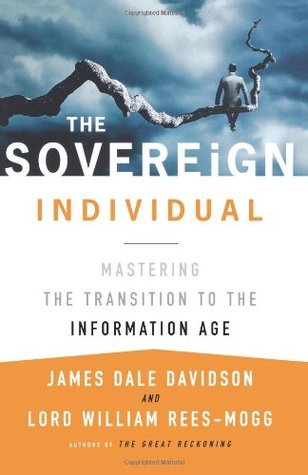
Two renowned investment advisors and authors of the bestseller The Great Reckoning bring to light both currents of disaster and the potential for prosperity and renewal in the face of radical changes in human history as we move into the next century.
The Sovereign Individual details strategies necessary for adapting financially to the next phase of Western civilization.
Few observers of the late twentieth century have their fingers so presciently on the pulse of the global political and economic realignment ushering in the new millennium as do James Dale Davidson and Lord William Rees-Mogg. Their bold prediction of disaster on Wall Street in Blood in the Streets was borne out by Black Tuesday. In their ensuing bestseller, The Great Reckoning, published just weeks before the coup attempt against Gorbachev, they analyzed the pending collapse of the Soviet Union and foretold the civil war in Yugoslavia and other events that have proved to be among the most searing developments of the past few years.
In The Sovereign Individual, Davidson and Rees-Mogg explore the greatest economic and political transition in centuries—the shift from an industrial to an information-based society. This transition, which they have termed “the fourth stage of human society,” will liberate individuals as never before, irrevocably altering the power of government. This outstanding book will replace false hopes and fictions with new understanding and clarified values.
James Dale Davidson is an American writer and private investor. He specializes in the domain of economics and finance. Davidson had a successful career as a financial advisor, and in the year 1969, he established the National Taxpayers Union. James Dale Davidson was an alumna of the Oxford University. He pursued an undergraduate degree in the institution. As of now, we aren’t aware of any additional details about his education.
Currently, Mr. Davidson holds the position of Co-Editor in the department of Strategic Investment at Banyan Hill Publishing. He retired from the world of investment in the year 2004, only to eventually return to the firm.
He has spent a significant part of his life discussing about an overreaching government. He is best known as an economist and financial predictor, who allegedly predicted every significant financial event since the last thirty years.
A century and a half after Novalis declared that laboratories will be temples, the poet turned marine biologist Rachel Carson (May 27, 1907–April 14, 1964) consecrated science in her lyrical writings about the natural world. At the center of her creative cosmogony was a vital symbiosis between literature and science in illuminating the nature of reality — a credo she formulated directly only once, in the acceptance speech, excerpted in Figuring, for the National Book Award her 1951 book The Sea Around Us had earned her: “a work of scientific accuracy presented with poetic imagination and such clarity of style and originality of approach as to win and hold every reader’s attention,” read the award citation.
Rachel Carson
At the ceremony held on January 29, 1952, the drama critic John Mason Brown welcomed Carson to the stage with introductory remarks that captured the unexampled allure of her scientific-artistic sensibility:
Miss Carson [has] made those odd creatures of the sea, those bipeds known as men and women, interested the world over in the mystery of our beginnings and the profundity and beauty of something far greater than mortals, with their petty egotisms and vanities, can hope to know… She has atomized our egos and brought to each reader not only a new humility but a new sense of the inscrutable vastness and interrelation of forces beyond our knowledge or control. She has placed us as specks in time and yet inheritors of a history older, and certainly deeper, than many of us realized… Where prose ends and poetry begins is sometimes hard to say. But I do know that Miss Carson writes poetic prose or prose poetry of uncommon beauty.
Rising from the table she shared with the poet Marianne Moore, Carson took the podium, looked softly, almost shyly, at the audience with her eyes the color of sea water, and spoke with confident composure about the animating ethos of her work:
The materials of science are the materials of life itself. Science is part of the reality of living; it is the what, the how, and the why of everything in our experience. It is impossible to understand man* without understanding his environment and the forces that have molded him physically and mentally.
The aim of science is to discover and illuminate truth. And that, I take it, is the aim of literature, whether biography or history or fiction; it seems to me, then, that there can be no separate literature of science.
19th-century Solar System quilt by Ellen Harding Baker, embroidered over the course of seven years as a teaching tool in an era when women were barred from higher education in science. (Available as a print.)
Speaking before we discovered the double helix, before we set foot on the Moon, before we heard the sound of spacetime in the collision of two black holes, Carson considers how science invites us to be wonder-smitten by reality, which is the ultimate poetry of existence:
We live in a scientific age; yet we assume that knowledge of science is the prerogative of only a small number of human beings, isolated and priestlike in their laboratories. This is not true. It cannot be true. The materials of science are the materials of life itself. Science is part of the reality of living; it is the what, the how, and the why of everything in our experience. It is impossible to understand man without understanding his environment and the forces that have molded him physically and mentally.
[…]
The winds, the sea, and the moving tides are what they are. If there is wonder and beauty and majesty in them, science will discover these qualities. If they are not there, science cannot create them. If there is poetry in my book about the sea, it is not because I deliberately put it there, but because no one could write truthfully about the sea and leave out the poetry.
In a sentiment she would echo a decade later in her bittersweet farewell and challenge to posterity, she intimates that such a worldview can make us better stewards of this irreplaceable world — which means, invariably, better stewards of our own survival:
I wonder if we have not too long been looking through the wrong end of the telescope. We have looked first at man with his vanities and greed and his problems of a day or a year; and then only, and from this biased point of view, we have looked outward at the earth he has inhabited so briefly and at the universe in which our earth is so minute a part. Yet these are the great realities, and against them we see our human problems in a different perspective. Perhaps if we reversed the telescope and looked at man down these long vistas, we should find less time and inclination to plan for our own destruction.
Where we go when we go to sleep and why we go there is one of the great mysteries of the mind. Why the mind at times refuses to go there, despite the pleading and bargaining of its conscious owner, is a greater mystery still. We know that ever since REM evolved in the bird brain, the third of our lives we spend sleeping and dreaming has been a crucible of our capacity for learning, emotional regulation, and creativity. But the price we have paid for these crowning curios of consciousness has been savage self-consciousness, thought turned in on itself, nowhere more maddening in its mania for rumination than in insomnia — that awful moment when, facing the fissure between your conscious wishes and your unconscious will, you realize that you are helpless against yourself, that there is not a single you pulling the strings of the mind but a tangle of thought and feeling rendering you a troupe of marionettes.
Against this already discomposing backdrop, insomnia foregrounds an added cruelty: the more you think about not being able to sleep, the less able to sleep you are, spiraling into anxiety about how the night’s helpless wakefulness will compromise your day. But while lack of sleep does diminish basic functions like reflexes and recall, paradoxically, the brink of sleep can be salutary to creativity: In that liminal space between restlessness and rest, the mind’s organizing principles begin to fray with the fatigue of the day’s conscious labors and unbidden thoughts begin to emerge from the recesses of the unconscious, begin to collide with one another in the seething cauldron of the insomniac’s angst, begin to form the unexpected combinations we call originality.
Franz Kafka (July 3, 1883–June 3, 1924) — one of history’s most prolific insomniacs — knew this, celebrated it, relished it.
Franz Kafka
Throughout his struggles with creative block, Kafka regularly found himself sleepless. Like Patti Smith, who fights insomnia with an imaginative visualization, he would cross his arms and lay his hands over his shoulders, visualizing himself laying as heavy as possible “like a soldier with his pack.” On his good days, he saw his insomnia as a badge of honor for a mind ablaze with thought: “I can’t sleep because I write too much,” he writes in his diary. On his bad days, he felt in it the tension between “the vague pressure of the desire to write” and “the nearness of insanity,” feared it left him too tired for creative work. On one such day, he records:
Because of fatigue did not write and lay now on the sofa in the warm room and now on the one in the cold room, with sick legs and disgusting dreams. A dog lay on my body, one paw near my face.
But another part of him realized that sleeplessness, rather than a hindrance to his creative vitality, is a function of it, honed on the edges of the night:
Sleeplessness comes only because… I write. For no matter how little and how badly I write, I am still made sensitive by these minor shocks, feel, especially towards evening and even more in the morning, the approaching, the imminent possibility of great moments which would tear me open, which could make me capable of anything, and in the general uproar that is within me and which I have no time to command, find no rest.
In a passage that suggests the creative impulse may just be our best way of calibrating how much reality we can hold, how much of the pain and rapture of being alive we can bear — what Virginia Woolf called “the shock-receiving capacity” that makes one an artist — Kafka adds:
In the end this uproar is only a suppressed, restrained harmony, which, left free, would fill me completely, which could even widen me and yet still fill me. But now such a moment arouses only feeble hopes and does me harm, for my being does not have sufficient strength or the capacity to hold the present mixture, during the day the visible word helps me, during the night it cuts me to pieces unhindered.
It is in the liminal times bookending the sleepless night that he discovers the fount of his creative powers:
In the evening and the morning my consciousness of the creative abilities in me is more than I can encompass. I feel shaken to the core of my being and can get out of myself whatever I desire.
One of the most discomposing things about the sense of individuality is the knowledge that although there are infinitely many kinds of beautiful lives, there is but one way to come alive — through the bloody, sweaty flesh of another; the knowledge that your own flesh is made of someone else’s cells and genes, the fact of you a fractal.
While mothering can take many forms and can be done by many different kinds of people, the process of one organism generating another from the raw materials of its own being — a process known as matrescence — is as invariable as breathing, as inevitable to life as death. In blurring the biological boundary between the creature imparted and the one doing the imparting, matrescence is the ultimate refutation of the self, the ultimate affirmation that individuality is an illusion — a cocoon of ego to keep us from apprehending the plurality we are. The science behind it is so intricate and so defiant of our commonsense intuitions about the possible that it seems to partake of the miraculous. Nested within it are questions of profound and sweeping implications, questions relevant and deliriously fascinating even to those of us without the psychological impulse or biological ability to bear children, questions that touch on some of the most elemental experiences of being human: change, vulnerability, reciprocity, resilience, belonging.
English journalist Lucy Jones takes up these questions in Matrescence: On Pregnancy, Childbirth, and Motherhood (public library), braiding together her own experience of originating new life, some revelatory scientific studies that undermine our basic assumptions about personhood and our most unquestioned political priorities, and some astonishing counterpoints to the illusion of individuality in the nonhuman world, from the maternity colonies of vampire bats to a species of tiny marine larvae that digest their own tail, brain, and nerve cord to become an unrecognizably different adult organism.
Recalling how her first pregnancy gave her a taste of this simultaneous dissolution and exponentiation of the self — the substance of which, as Borges so memorably observed, is time — Jones considers the infinities nested in any one life:
Time started to bend. I was carrying the future inside me. I would learn that I was also carrying the eggs, already within my baby’s womb, that could go on to partly form my potential grandchildren. My future grandchildren were in some way inside me, just as part of me spent time in the womb of my grandmother. I was carrying inside me a pool of amniotic fluid, which was once rivers, lakes and rain. I was carrying a third more blood, which was once soil and stars and lichen.[2] The baby was formed of the atoms of the earth, of the past and the future. Every atom in her body existed when the earth formed 4.5 billion years ago. She will live for many years, I hope, when I have returned to the ground. She will live on the earth when I am gone. Time bends.
Time brings space along with it, bending the universe itself toward the cosmic nativity story that is a human being. Jones recounts the postpartum awakening to a reality larger than herself, larger than her new baby, encompassing everything that ever was and ever will be, consonant with the deepest meaning of love as the act of unselfing:
Back at home with our daughter, just one day old, I found that our flat felt different, as if I’d stepped through a portal into a parallel universe, or onto the set of a film.
In my arms, a collection of trillions of atoms that had cycled through generations of ancient supernova explosions.
We were both so old, made from stars born billions of years ago.
We were both so new, she, breathing, outside me; I being made again in matrescence.
I couldn’t believe my eyes. I couldn’t sleep for the beauty of her. Little pink mouth. Doughball cheeks. Plant-stalk soft bones. Her astral holiness.
Body of my body, flesh of my flesh.
I heard the contraction and expansion of the universe bouncing into existence, new galaxies, axons, dendrites; cells and love, cells and love.
Art by Derek Dominic D’souza from Song of Two Worlds by physicist Alan Lightman
This altered state is not merely a psychological experience — it is a profoundly physiological one. Jones cites a series of landmark studies of the cellular exchange between mother and baby via the placenta, which found that maternal cells, actual entire cells, remain in the child’s body throughout life, while fetal cells can dwell in the mother’s brain decades after giving birth. The medical geneticist and neonatologist Diana Bianchi, who spearheaded the research, termed this phenomenon microchimerism, after the chimera from Greek mythology — creatures composed of different parts from multiple animals. Microchimerism is possible because humans have one of the most invasive placentas among animals, colonizing one hundred uterine vessels and arteries with thirty-two miles of capillaries that would span the whole of London if laid out along the Thames — an enmeshment impossible to extract without a trace.
Because matrescence is such a system-wide neurobiological reconfiguration, impacting everything from metabolism to memory, research has found the pregnant brain to be as plastic as the adolescent — a time in which “dynamic structural and functional changes take place that accompany fundamental behavioural adaptations.”
These processes are so powerful that alter the neural basis of the self, so powerful that they reach beyond the biological boundaries of the mother and into the behavioral adaptations of anyone involved in post-birth childcare, which is also part of matrescence — fathers, grandparents, caretakers of any kind for whom the newborn becomes a primary focus of attention. Drawing on a body of research, Jones writes:
Caregiving neural circuitry exists in both male and female brains. Early neuroscientific research on humans is now showing that caregiver brains experience significant plasticity, even without the experience of pregnancy. Hands-on caring shapes brain circuitry and causes other biological changes. In 2020, a groundbreaking study showed that having a baby changes a father’s brain anatomy.
Art by Alessandro Sanna from Crescendo by Paola Quintavalle — a picture-poem about the science of pregnancy.
This caretaking is essential for our survival, as infant individuals and as an adolescent species, in a way that it is not for most other creatures, for out of it arise the hallmarks of our humanity. Unlike the newborn giraffe calf, who can rise to her feet and walk within hours of birth, or the newly hatched turtle, who can take to the woods or the waves immediately, human are born utterly helpless, to be fed and bathed and gurgled at, remaining dependent for years as the 400 grams of rosy flesh grow in their bone cave to become a three-pound miracle coruscating with one hundred trillion synapses, ablaze with the capacities for the guillotine and the Goldberg Variations.
Jones writes:
To be a smart species — to be able to learn and read and write and draw and solve and build and invent and empathize and imagine — humans have to be born vulnerable. Few other species of animal on earth are as helpless and immature as human babies. The brains of other primates are much more developed at birth. Humans are one of the only mammals with brains that grow so significantly outside the womb. The benefit of this early helplessness is that it means the brain can adapt and rewire as the infant grows.
Given how fundamental matrescence is to the flourishing of the human species and the human animal, to systemically deprioritize and marginalize pregnancy and motherhood, as our society does, seems like plain self-sabotage. With an eye to the disproportionate precedence of mental illness in new mothers and the consistent findings that social support is the single most effective means of inoculating them against it, Jones quotes those unforgettable lines by Gwendolyn Brooks — we are each other’s harvest / we are each other’s business / we are each other’s magnitude and bond — and writes:
Increasingly, social isolation and loneliness are recognized as risk factors for mental and physical health problems and early mortality. Loneliness is as damaging for health as smoking up to fifteen cigarettes a day. Although we know that it can increase during transitional periods of life — for example, during adolescence, illness, bereavement, retirement — researchers have only recently started studying loneliness in the perinatal period. In the last decade or so, the first work has been published recognizing that women experiencing loneliness in pregnancy and new motherhood are more likely to suffer from mental illness. Studies suggest that loneliness also exacerbates symptoms of depression in fathers. The findings suggest serious fault lines in our society. It is striking that we’ve so forgotten our interdependence that we need scientists to prove to us that we need other people to survive.
This is precisely why matrescence, in all its plasticity and its revelation of interdependence, in being “a crucible in which the dross can be burned off and the wilder, more authentic self remains,” can serve as a recalibration of our collective priorities far beyond the mother’s experience of motherhood. Jones writes:
Times of transformation, whatever they might be, are opportunities to find new connectedness; to choose and consolidate the things that matter; to bring repressed selves out of the shadows into the light; to forgive; to grow layers of nacre, of resilience, of acceptance.
Emanating from the book is a reminder of what we so readily forget and are so steadily conditioned to forget: that we don’t have to accept the choices handed down to us by our culture as givens. Noting that “a culture can choose what it diminishes and what it grow,” Jones envisions a different choice:
We have to see the structures we’ve inherited in order to tear them down. So many women believe their struggles with matrescence are the result of their own weakness and moral failing. This is a lie and it inhibits honest talk and social change. The difficulties of modern matrescence in neoliberal Western societies are structural and systematic. Seeing the oppressive nature of the institution of motherhood for what it is, and acknowledging the failure of society to support care work, allows us to think critically. Talking makes the structures of discrimination more visible. It allows us to identify what must change.
From pregnancy, women need health professionals who will give them full and accurate information without ideology or misinformation. We want the facts about birth and postnatal recovery, about breastfeeding, about what happens to the brain and our psychological lives. We need to improve maternal mental healthcare by introducing screening for issues in pregnancy and far more investment so mothers can get specialist treatment quickly. We need a meaningful focus on tackling systemic inequalities in maternal health outcomes. We need new birth rituals that acknowledge the gravity of childbirth without obscuring the reality and risks.
The government must urgently invest in midwives, mental health practitioners and wider postpartum care to fix the maternity crisis. Not investing in maternal health is a political decision.
These choices are the placenta permeating the body politic, its tendrils touching every aspect of life — not just the life of mother and baby, not even the life of the society in which they exist, but life itself as a planetary phenomenon. Bridging matrescence and ecology into what she terms matroecology, Jones writes:
The experience — one we have all had — of being part of another has much to teach us about our relations with the earth, the psychic and corporeal reality of our interdependence and interconnectedness with other species.
We have all experienced this becoming-within-another who is both known and unknown, an “otherness-in-proximity.”
[…]
What kind of world could we imagine and create if, instead of pretending we were thrown into existence, as though by magic, we truly considered our vulnerable, intimate, tactile, entangled, animal origins?
These are not merely political or philosophical questions — they are profoundly personal. (“The shortest statement of philosophy I have,” Audre Lorde wrote from the center of a politically invigorated life, “is my living, or the word ‘I.’”) Jones is not merely theorizing matroecology — walking home hand in hand with her small child, she is feeling it in the marrow of her being:
Seeds break through pods around us; buds break open with the leaves they have been holding folded, grown by the sunlight of the previous summer; green beads flecking the hedgerows break open; red beads in the maple trees above break open. The moon is up, and it pulls the ocean back and forth: a spring tide, the biggest tide, transforming the coasts of this island, breaking apart shell and stone, fish and bone. Beneath us, the trees are talking, making plans, breaking through soil and sediment. Above us, stars are being born and others are dying. We walk through the cemetery where organisms are being born and others are dying and creatures are being eaten and others are eating. The continent we are on is moving (at the speed of a fingernail growing), and the round rock we are on is moving (tilted on its axis, spinning). Farther below, plates are crushing and stretching, magma is cooling and heating and leaking, rock is forming and changing. The ebb and flow, the ebb and the glow. The lilting earth, and we lilting, too, in our one flicker of consciousness in this incessant motion. We sit underneath the canopy of a beech tree, a mother tree, and rake the earth, the soft brown soil, and the broken beech mast casings, and the hard brown seeds, and the chunks of soft white chalk made from the skeletons of ancient creatures from the sea, lit by a tender light, and we breathe.
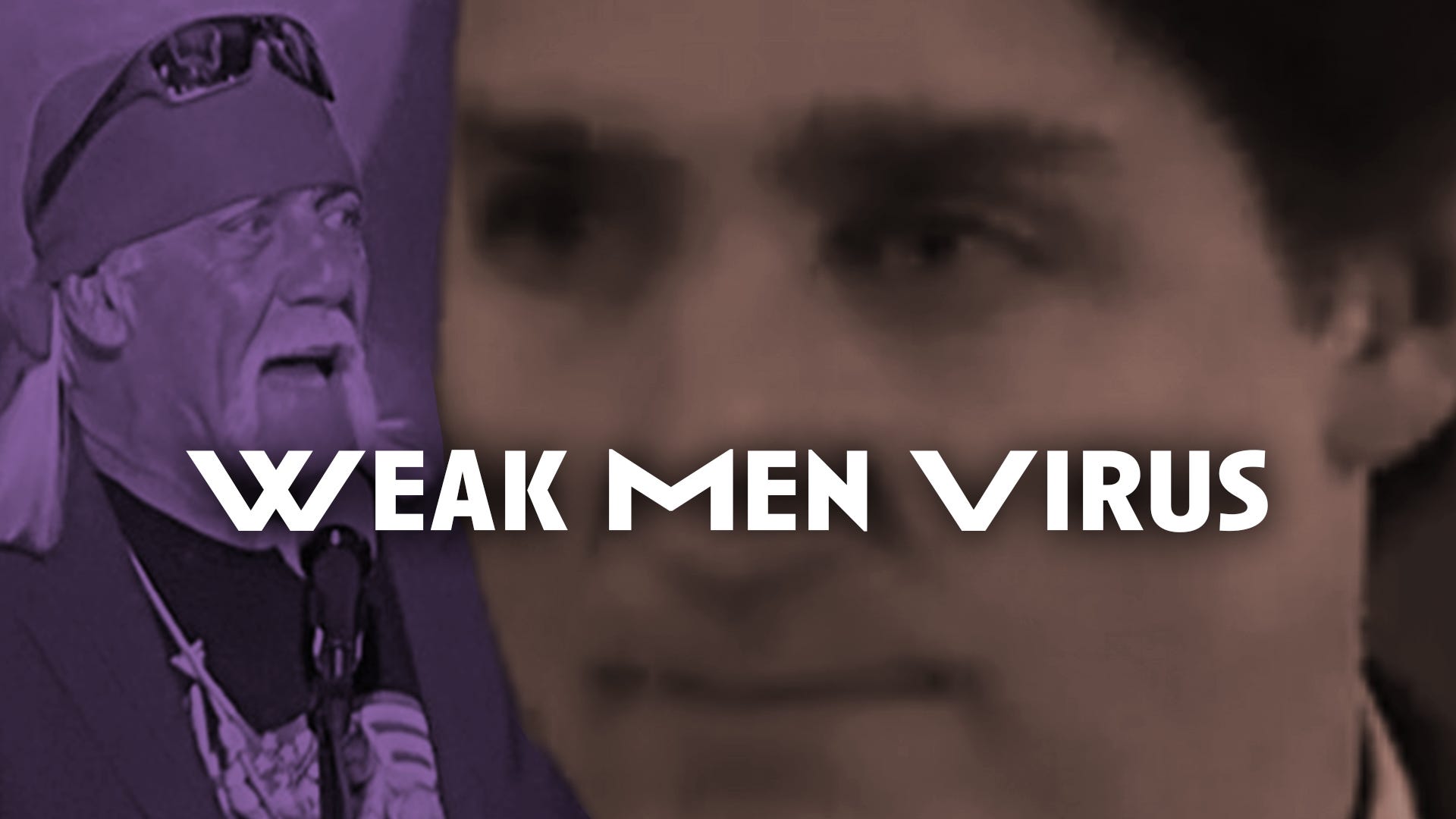
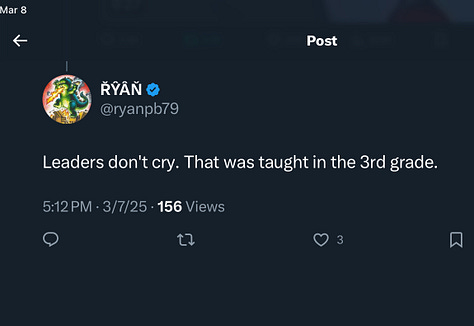
The Prime Minister of Canada Justin Trudeau, regardless of what you think of his politics, manifestly cares about his people. When he showed a bit of emotion, the hate machine on “X” went into overdrive, so I posted a message of support.
The epic wailing of both American and Maple MAGA men who assailed me and Trudeau for various infractions of their model of what leadership and maleness should be about is a symptom what I’d like to dub the Weak Men Virus (WMV). There are thousands of comments like this.
America, and humanity for that matter, has been misogynist since the dawn of civilization. The biological evolutionary differences between men and women have been exploited by men to dominate women for millennia. Nevertheless, in fits and starts, we have begun correcting for this immoral behavior over the ages.
Society, is, in theory, about finding higher meaning in human beings — to elevate our essential humanity above the old Darwinist model.
It was just over a century ago that women gained the vote in the United States of America, in 1920, while the current regime is openly trying to eliminate the post-WWII order, to bring us back to the 1940s — just to start. Peter Thiel said, when he declared that he no longer believed that freedom and democracy are compatible, that women’s suffrage was responsible. This is social darwinism, a construct used to justify genocide, slavery and oppression.
With that in mind, the easiest way to divide a population is by sex. It’s 50-50, right down the middle. If you can create a schism between men and women, the rest of the society will follow. That’s why the Russian government and its fascist American collaborators have been intentionally promoting a culture of misogyny — as well as its racist, antisemitic and anti-LGBTQ+ counterparts — which actively strip people of empathy.
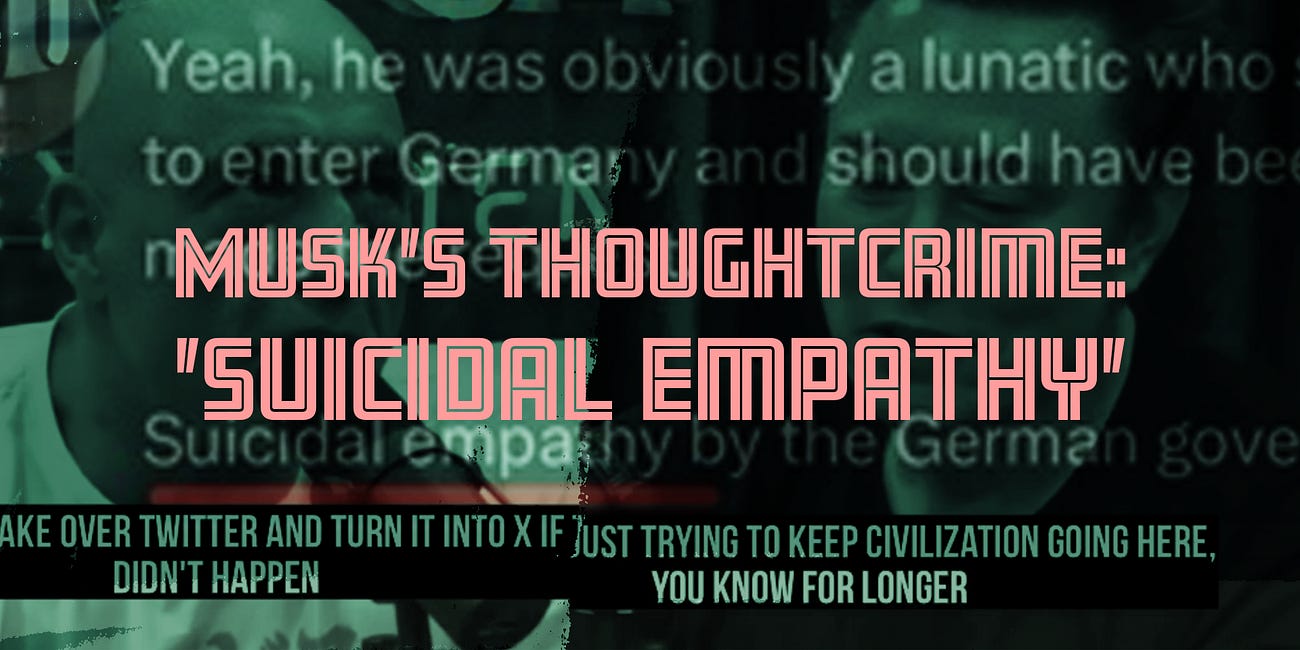
For example, Elon Musk’s admonitions about “suicidal empathy” are an explicit execution of this strategy. Demagogues, narcissists and fascists don’t want you to care about others, they only want you to care about them.
Peter Thiel is a gay man who was brought up to hate himself. That’s why he had a lifelong relationship with Opus Dei priest Arne Panula, who groomed him to hate the American democratic government — and ultimately to help bring it down. That’s why when the open secret that he was gay was revealed, Thiel hired Hulk Hogan to be the front man for destroying the website that dared to report it, Gawker. It’s also why Hulk Hogan was prominently at the RNC last Summer.
Peter Thiel is patient zero of the Weak Men Virus. All of his democracy-destroying projects, which he has funded through a variety of front groups and paid operators, include misogyny as a core feature. These include funding and supporting incel culture, GamerGate, the alt-right, MAGA3X, Pizzagate, QAnon, Rumble, Donald Trump and misogynist muppet JD Vance — not to mention the Federalist Society, Opus Dei and the takeover of the Supreme Court by misogynists.
But perhaps Thiel’s greatest project is cultivating his fellow PayPal Mafia co-conspirator, the man who bought Twitter and turned it into a system for stripping emotion, empathy and decency out of human beings, Elon Musk — who is currently the largest superspreader of the Weak Men Virus. One of the first people Musk reinstated was a demigod of the incel movement, who is now in Florida instead of in Romania awaiting trial for rape and trafficking charges, thanks to Donald Trump.
While normally the sexual dysfunction of a man would not be in any way relevant to reasonable discourse on the geopolitics of the planet, unfortunately we are not in a normal timeline. Elon Musk has had most, if not all, of his fourteen known children through IVF. He is obsessed with phallic symbols. And he rejected his own trans daughter, who he accuses of being “killed by the woke mind virus”.
If Elon Musk is not technically an incel, his behavior surely mirrors one. The weakness in his psychology is wildly transparent. He is genocidally insecure, a little boy who pulls littler girls’ pigtails — who now has the power of the US federal government.
It is not the “woke mind virus” that is destroying America, and modern civilization, it’s the Weak Men Virus, a scourge of insecurity which metastasized into a messianic narcissist coup of the most powerful nation on Earth.
Men, do not fall for this trap. Standing up for your fellow human beings, regardless of who they are, is the most man thing you can do. You either want a society that elevates humanity, or you want to reverse its evolution — in which case find a cave to live in. Empathy is the point. The “Pursuit of Happiness” is in the Declaration of Independence for a reason. Take it away, and you get another Revolution.
Long Live a Free America. Glory to Ukraine.
Consciousness, sexuality, androgyny, futurism, space, the arts, science, astrology, democracy, humor, books, movies and more

 Calvin





 Miss Carson [has] made those odd creatures of the sea, those bipeds known as men and women, interested the world over in the mystery of our beginnings and the profundity and beauty of something far greater than mortals, with their petty egotisms and vanities, can hope to know… She has atomized our egos and brought to each reader not only a new humility but a new sense of the inscrutable vastness and interrelation of forces beyond our knowledge or control. She has placed us as specks in time and yet inheritors of a history older, and certainly deeper, than many of us realized… Where prose ends and poetry begins is sometimes hard to say. But I do know that Miss Carson writes poetic prose or prose poetry of uncommon beauty.