Erik Erikson’s Stages of Psychological Development: The 8 Inner Conflicts That Shape Who We Are

By Maria Popova (themarginalian.org)

It never ceases to stagger that some stroke of chance in the early history of the universe set into motion the Rube Goldberg machine of events that turned atoms born in the first stars into you — into this temporary clump of borrowed stardust that, for the brief interlude between not having existed and no longer existing, gets to have ideas and ice cream and orgasms, gets to yearn and to suffer and to love.

Perhaps the most hopeful thing about being alive is that we are never finished and complete. Perhaps the most exasperating is that we are never entirely new, that we are nested with every self we have ever been, each stage of our development shaped by the singular needs and tensions of each preceding stage, our character shaped by how those needs and tensions were met and resolved.

Art by Ofra Amit for The Universe in Verse

The influential psychoanalyst Erik Erikson (June 15, 1902–May 12, 1994), who coined the term identity crisis and readily recognized that “an individual life is the accidental coincidence of but one life cycle with but one segment of history,” took up this tessellated question of our incremental becoming in his 1950 book Childhood and Society (public library) — an investigation of “the growth and the crises of the human person as a series of alternative basic attitudes.”

Erikson identifies eight sequential stages of human development, each marked by a particular battery of opposite psychic charges — one a positive developmental achievement that strengthens one’s self-trust, world-trust, and creative potency, the other a danger that fosters antagonism, isolation, and despair. He writes:

The strength acquired at any stage is tested by the necessity to transcend it in such a way that the individual can take chances in the next stage with what was most vulnerably precious in the previous one.

[…]

There is in every child at every stage a new miracle of vigorous unfolding, which constitutes a new hope and a new responsibility for all.

[…]

In view of the dangerous potentials of man’s long childhood, it is well to look back at the blueprint of the life-stages and to the possibilities of guiding the young of the race while they are young.

1. BASIC TRUST VS. BASIC MISTRUST (0-18 MONTHS)

Art by Violeta Lópiz for At the Drop of a Cat

The first intense experience of life is separation — infant and mother are no longer one, and the infant must learn to trust that the mother is still there even when she vanishes from view. Erikson writes:

The infant’s first social achievement, then, is his willingness to let the mother out of sight without undue anxiety or rage, because she has become an inner certainty as well as an outer predictability. Such consistency, continuity, and sameness of experience provide a rudimentary sense of ego identity.

[…]

This forms the basis in the child for a sense of identity which will later combine a sense of being “all right,” of being oneself.

This kind of trust is the foundation of confidence, for it is also training ground for the self-trust necessary to withstand separation, to have faith in one’s inherent okayness. The absence of such maternal consistency and continuity, Erikson observes, may be one of the most difficult cards to be dealt in life, predisposing people to habitual “depressive states” in later stages.

This is also the stage in which we learn to discern where we end and the rest of the world begins — the vital distinction that enables us to differentiate between the rewards of interdependence and the dangers of codependence, to navigate the myriad traps that strew the meeting ground between self and other. Erikson writes:

The early process of differentiation between inside and outside [is] the origin of projection and introjection which remain some of our deepest and most dangerous defense mechanisms. In introjection we feel and act as if an outer goodness had become an inner certainty. In projection, we experience an inner harm as an outer one: we endow significant people with the evil which actually is in us… These mechanisms are, more or less normally, reinstated in acute crises of love, trust, and faith in adulthood and can characterize irrational attitudes toward adversaries and enemies in masses of “mature” individuals.

2. AUTONOMY VS. SHAME AND DOUBT (18 MONTHS-3 YEARS)

Art by Giuliano Cucco from Before I Grew Up

The hallmark of the second stage is a physiological development that becomes an analogue for one of the most important psychological skills in life — to hold on and to let go, central to such fundamental capacities as intimacy, compassion, tenacity, and forgiveness. Erikson writes:

Muscular maturation sets the stage for experimentation with two simultaneous sets of social modalities: holding on and letting go. As is the case with all of these modalities, their basic conflicts can lead in the end to either hostile or benign expectations and attitudes. Thus, to hold can become a destructive and cruel retaining or restraining, and it can become a pattern of care: to have and to hold. To let go, too, can turn into an inimical letting loose of destructive forces, or it can become a relaxed “to let pass” and “to let be.”

This is the stage at which the experience of shame first emerges and we must learn to have our “basic faith in existence” not jeopardized by the embarrassments of getting things wrong. (“Shame is an experience that affects and is affected by the whole self,” the pioneering sociologist and philosopher Helen Merrell Lynd would write a few years later in her insightful take on shame and the search for identity.) For the infant at this stage, Erikson observes, shame springs from the emergence of a new developmental phenomenon: the “sudden violent wish to have a choice, to appropriate demandingly, and to eliminate stubbornly.” He writes:

Shame supposes that one is completely exposed and conscious of being looked at: in one word, self-conscious. One is visible and not ready to be visible… Shame is… essentially rage turned against the self.

With an eye to the development of these crucial capacities for holding on, letting go, and withstanding shame, he adds:

This stage, therefore, becomes decisive for the ratio of love and hate, cooperation and willfulness, freedom of self-expression and its suppression, From a sense of self-control without loss of self-esteem comes a lasting sense of good will and pride; from a sense of loss of self-control and of foreign overcontrol comes a lasting propensity for doubt and shame.

3. INITIATIVE VS. GUILT (AGES 3-5)

Illustration by Maurice Sendak from Kenny’s Window — his little-known philosophical first children’s book.

As we begin to take initiative in completing tasks, we develop what Erikson calls “anticipatory rivalry” — which may be another word for envy — toward those who complete the same tasks better. Here, we learn that what the world asks of us often requires the repression and inhibition of our own hopes and desires.

The danger of this, if we successfully cede desire to demand, is a sense of self-righteousness — “often the principal reward of goodness,” Erikson astutely observes a decade before Joan Didion admonished against mistaking self-righteousness for morality, a tendency painfully pronounced in our own time of virtue signaling.

4. INDUSTRY VS. INFERIORITY (AGES 6-11)

Art by Giuliano Cucco from Before I Grew Up

This is the stage at which our natural creativity and capacity for play begin being sublimated to our civilizational cult of productivity. School starts, forcing the child to part with earlier hopes and wishes as their “exuberant imagination is tamed and harnessed… to be a worker.”

The danger in this overidentification with accomplishment, building upon the earlier development of envy, is “a sense of inadequacy and inferiority,” which may lead the child to believe themselves “doomed to mediocrity or inadequacy.” (This, of course, is the perennial danger of all self-comparison, acute even for adults in today’s broadcast selfhood of social media.)

5. IDENTITY VS. ROLE CONFUSION (AGES 12-18)

Art by Mouni Feddag for a letter by Alain de Botton from A Velocity of Being: Letters to a Young Reader. (Available as a print.)

Here begins our concern with what we appear to be to others versus what we feel we are — an integration that marks the emergence of our ego identity. Erikson considers the many guises in which the great danger of this stage — role confusion — can appear:

To keep themselves together [adolescents] temporarily overidentify, to the point of apparent complete loss of identity, with the heroes of cliques and crowds. This initiates the stage of “falling in love,” which is by no means entirely, or even primarily, a sexual matter — except where the mores demand it. To a considerable extent adolescent love is an attempt to arrive at a definition of one’s identity by projecting one’s diffused ego image on another and by seeing it thus reflected and gradually clarified. This is why so much of young love is conversation.

In a passage of far-reaching insight and extraordinary empathy for the vulnerabilities of the psyche, which most people would rather fault than fathom, he adds:

Young people can also be remarkably clannish, and cruel in their exclusion of all those who are “different,” in skin color or cultural background, in tastes and gifts, and often in such petty aspects of dress and gesture as have been temporarily selected as the signs of an in-grouper or out-grouper. It is important to understand (which does not mean condone or participate in) such intolerance as a defense against a sense of identity confusion. For adolescents not only help one another temporarily through much discomfort by forming cliques and by stereotyping themselves, their ideals, and their enemies; they also perversely test each other’s capacity to pledge fidelity. The readiness for such testing also explains the appeal which simple and cruel totalitarian doctrines have on the minds of the youth.

6. INTIMACY VS. ISOLATION (AGES 18-40)

Art by Sophie Blackall from Things to Look Forward to

This is the stage at which emotional integrity develops — we learn the particular form of self-trust and self-respect that come from making commitments and keeping them, even when it is difficult to do so. The self-permission to break promises and cancel plans stems from a failure at the developmental achievement of this stage and the price we pay for it, quite apart from disappointing and hurting others, is always an erosion of self-trust and self-respect. Erikson writes:

The young adult, emerging from the search for and the insistence on identity… is ready for intimacy, that is, the capacity to commit himself to concrete affiliations and partnerships and to develop the ethical strength to abide by such commitments, even though they may call for significant sacrifices and compromises.

Observing that this is when we first face the “fear of ego loss” in situations that may require compromise and sacrifice, he adds:

The avoidance of such experiences because of a fear of ego loss may lead to a deep sense of isolation and consequent self-absorption.

The great challenge of this stage is that “intimate, competitive, and combative relations are experienced with and against the selfsame people.” It is necessary to learn to tolerate and resolve such tensions, or otherwise we face the great danger of this stage — isolation, which Erikson defines as “the avoidance of contacts which commit to intimacy.”

7. GENERATIVITY VS. STAGNATION (AGES 40-65)

Art by Carson Ellis from What Is Love? by Mac Barnett

Erikson counters our culture’s hyperfocus on children’s dependence on parents with the insistence that the older generation is also dependent on the younger, for elders “need to be needed.” (A generation before him, Jane Ellen Harrison addressed this with great geniality and great percipience in her meditation on Old Age and Youth.)

Erikson terms the animating achievement of this life-stage generativity, which he defines as “the concern in establishing and guiding the next generation,” noting that it is “meant to include such more popular synonyms as productivity and creativity, which, however, cannot replace it.”

Whether generativity manifests as physically producing the next generation through procreation or contributing to the world through acts of creation, a failure to attain it results in “a pervading sense of stagnation and personal impoverishment.”

8. EGO INTEGRITY VS. DESPAIR (AGE 65-DEATH)

Art by the 16th-century Portuguese artist Francisco de Holanda. (Available as a print and as stationery cards.)

“One’s life has value so long as one attributes value to the life of others, by means of love, friendship, indignation, compassion,” Simone de Beauvoir wrote in her sixties as she reflected on the art of growing older. That we must die is precisely what impels us to render our lives valuable. We can only do so, Erikson argues, by moving through the prior seven stages toward this final fruition of what he calls ego integrity — “the ego’s accrued assurance of its proclivity for order and meaning,” built of our adaptation “to the triumphs and disappointments adherent to being.”

In a passage evocative of Loren Eiseley’s exquisite late-life meditation on the first and final truth of life, Erikson writes:

[Ego integrity] is a post-narcissistic love of the human ego—not of the self — as an experience which conveys some world order and spiritual sense, no matter how dearly paid for. It is the acceptance of one’s one and only life cycle as something that had to be and that, by necessity, permitted of no substitutions.

One consequence of this acceptance is “a new, a different love of one’s parents.” Another is that “death loses its sting,” for the fear of death stems from the lack of a sense of cohesion and consonance with universal life — a lack that takes shape as despair. (This may be why D.H. Lawrence called death “the last wonder” and wrote: “If you want to live in peace on the face of the earth / Then build your ship of death, in readiness / For the longest journey.”)

Erikson ends with one of the most potent formulae in the science of the psyche:

Healthy children will not fear life if their elders have integrity enough not to fear death.

Couple with Erikson’s contemporary Ernest Becker on the relationship between our fear of death and our search for meaning, then revisit this Jungian field guide to navigating the particularly treacherous middle stages of life.
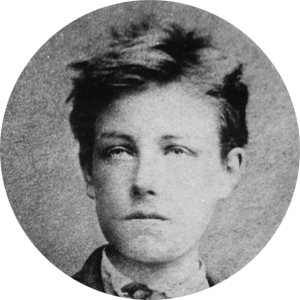
Arthur Rimbaud on being a poet

“A Poet makes himself a visionary through a long, boundless, and systematized disorganization of all the senses. All forms of love, of suffering, of madness; he searches himself, he exhausts within himself all poisons, and preserves their quintessences. Unspeakable torment, where he will need the greatest faith, a superhuman strength, where he becomes among all men the great invalid, the great criminal, the great accursed–and the Supreme Scientist! For he attains the unknown! Because he has cultivated his soul, already rich, more than anyone! He attains the unknown, and if, demented, he finally loses the understanding of his visions, he will at least have seen them! So what if he is destroyed in his ecstatic flight through things unheard of, unnameable: other horrible workers will come; they will begin at the horizons where the first one has fallen!”

–ARTHUR RIMBAUD

Jean Nicolas Arthur Rimbaud (October 20, 1854 – November 10, 1891) was a French poet known for his transgressive and surreal themes and for his influence on modern literature and arts, prefiguring surrealism. Wikipedia

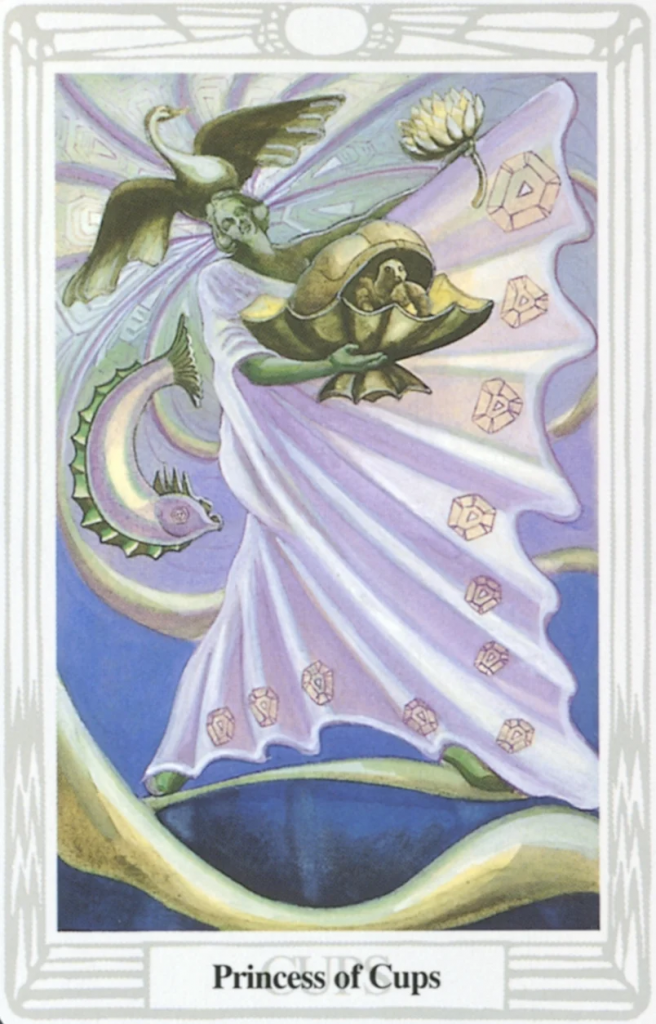
Tarot Card for October 21: Princess of Cups

The Princess of Cups

The Princess of Cups is a dreamer… and in the Thoth deck we see her dancing her dreams into manifestation, thus revealing one of her more secret aspects. This card represents the earthy part of water… where dreams can become reality.On the day that I wrote the commentary for working with this card, it came after the Nine of Cups, which you will remember, is the Wish Card… that seemed to me to make for a very auspicious and important set of circumstances. At that time, I had written up the details on 56 out of the 78 cards… the fact that the Wish Card was followed by this one concentrated my attention on her remarkable ability to make dreams come true.The push and shove of daily life, the pain, the sadness and the suffering can all make us afraid to dream, to wish, to hope. And often we lose sight of the fact that, if we do not dream our dreams, we shall have no dreams come true.In our darkest moments, if we can only, even for a single second, dream of golden shiny happy days… of contentment and a sense of safety in our lives… then we give the Princess of Cups something to dance into reality for us. It is a desperately hard thing to, just for a second, open our hearts to hope, sometimes. But it is essential, too.But if we cease to dream, then our dreams cannot emerge, for they do not exist. If we relinquish hope, then hopeful things will not happen in our lives. If we surrender optimism, then we can guarantee we shall never ever have anything to be optimistic about.So… in your darkest hour… lift up your eyes to the sky… search out a perfect flower… seek to touch something you love… and for that moment, let yourself hope and dream and wish – then the Princess will have something to work for on your behalf.And when your life if full and happy and replete… on a day ruled by this card… PLEASE… spare a thought for those who suffer… and hope for fulfilment and contentment for all of those who seek it!Affirmation: “Glory and grace manifest throughout my life.”

Magic: Chaos and Transcendental with Ronnie Pontiac

New Thinking • Oct 20, 2024 Ronnie Pontiac was the personal research assistance for Manly P. Hall at the Philosophical Research Society in Los Angeles. He is author of American Metaphysical Religion: Esoteric and Mystical Traditions of the New World. He is coauthor with Tamra Lucid of The Magic of the Orphic Hymns: A New Translation for the Modern Mystic. Here he shares his personal experiences with the practice of chaos magic. He describes the history of this approach and various colorful practitioners. He also explores its application in politics. Then he compares chaos magic with Eliphas Levi’s writings on transcendental magic (and beyond). 00:00:00 Introduction 00:02:41 Ronnie’s history with chaos magic 00:10:57 Paschal Beverly Randolph & Madame Blavatsky 00:17:57 Austin Osman Spare 00:30:44 Chaos magic in Russia 00:42:48 Magical symbols 00:47:11 Eliphas Levi and transcendental magic 00:52:30 Marsilio Ficino, William Burroughs, and love 01:01:05 Yoruba culture 01:08:41 Conclusion New Thinking Allowed host, Jeffrey Mishlove, PhD, is author of The Roots of Consciousness, Psi Development Systems, and The PK Man. Between 1986 and 2002 he hosted and co-produced the original Thinking Allowed public television series. He is the recipient of the only doctoral diploma in “parapsychology” ever awarded by an accredited university (University of California, Berkeley, 1980). He is also the Grand Prize winner of the 2021 Bigelow Institute essay competition regarding the best evidence for survival of human consciousness after permanent bodily death. (Recorded on September 13, 2024)

The Third House in Astrology

The Astrology Podcast Oct 20, 2024 In episode 465 astrologers Chris Brennan and Leisa Schaim present a deep dive into the meaning of the third house in astrology, with a comprehensive workshop analyzing over 100 birth charts of notable figures, revealing surprising insights into how the third house shaped their lives. The third house is associated with topics such as siblings, extended family, short distance travel, early education, and communication. We open the episode by talking about all of the significations of the third house, and then afterwards the bulk of the episode is divided into three parts: 1. The Ruler of the Ascendant in the third house 2. The ruler of the third house in each of the 12 houses 3. Each of the planets in the third house After that we have some concluding remarks and then wrap up our deep dive into the third house! This is essentially three separate episodes, but we decided to release it as one long episode because then you can really see the totality of what the third house means by looking at all of the different ways it has manifested in people’s lives. 3rd House Research Notes Booklet Dive deeper into the third house with our exclusive 75-page research notes! This PDF includes a handy episode guide plus bonus content not featured in the episode.

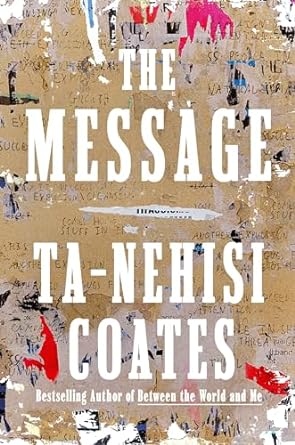
Book: “The Message”

The Message

Ta-Nehisi Coates

Ta-Nehisi Coates originally set off to write a book about writing, in the tradition of Orwell’s classic Politics and the English Language, but found himself grappling with deeper questions about how our stories—our reporting and imaginative narratives and mythmaking—expose and distort our realities.

The first of the book’s three intertwining essays is set in Dakar, Senegal. Despite being raised as a strict Afrocentrist, Coates had never set foot on the African continent until now. He roams the “steampunk” city of “old traditions and new machinery,” but everywhere he goes he feels as if he’s in two places at once: a modern city in Senegal and a mythic kingdom in his mind. Finally he travels to the slave castles off the coast and has his own reckoning with the legacy of the Afrocentric dream.

He takes readers along with him to Columbia, South Carolina, where he meets an educator whose job is threatened for teaching one of Coates’s own books. There he discovers a community of mostly white supporters who were transformed by the “racial reckoning” of 2020. But he also explores the backlash to this reckoning and the deeper myths of the community—a capital of the confederacy with statues of segregationists looming over its public squares.

And in Palestine, Coates discovers the devastating gap between the narratives we’ve accepted and the clashing reality of life on the ground. He meets with activists and dissidents, Israelis and Palestinians—the old, who remember their dispossessions on two continents, and the young, who have only known struggle and disillusionment. He travels into Jerusalem, the heart of Zionist mythology, and to the occupied territories, where he sees the reality the myth is meant to hide. It is this hidden story that draws him in and profoundly changes him—and makes the war that would soon come all the more devastating.

Written at a dramatic moment in American and global life, this work from one of the country’s most important writers is about the urgent need to untangle ourselves from the destructive nationalist myths that shape our world—and our own souls—and embrace the liberating power of even the most difficult truths.

About the author

Profile Image for Ta-Nehisi Coates.

Ta-Nehisi Coates

Ta-Nehisi Coates is the author of the #1 New York Times bestseller Between the World and Me, a finalist for the National Book Award. A MacArthur “Genius Grant” fellow, Coates has received the National Magazine Award, the Hillman Prize for Opinion and Analysis Journalism, and the George Polk Award for his Atlantic cover story “The Case for Reparations.” He lives in New York with his wife and son.

(Goodreads.com)

“The Hammer”: Unions teach us the democracy that our families, our schools and our bosses haven’t

The Hammer: Power, Inequality, and the Struggle for the Soul of Labor

Hamilton Nolan

A timely, in-depth, and vital exploration of the American labor movement and its critical place in our society and politics by acclaimed labor reporter Hamilton Nolan.

The thesis is simple: Inequality is America’s biggest problem. Unions are the single strongest tool that working people have to fix this problem. But the labor movement of today has failed to enable enough individuals to join unions. Thus, organized labor’s powerful potential is being wielded incompetently. And what is happening inside of organized labor will—far more than most people realize—determine the economic and social course of American life for years to come.

In deeply reported chapters that span the country, Nolan shows readers how organized labor can and does wield power effectively—in spots—but also why it has long been unable to build itself into the powerful institution that the working class needs. These narratives both inspire by example and motivate by counter-example. Whether it’s a union that has succeeded in a single city, and is trying to scale that effectiveness nationally, or the ins and outs of a historically large and transformative union campaign, or the human face of a strike, or a profile of the most anti-union state in America, Nolan highlights the actual mechanisms that connect labor to politics to real change. Throughout, Nolan follows Sara Nelson, the powerful and charismatic head of the flight attendants union, as she struggles with how (and whether) to assert herself as a national leader of the labor movement, to try to fix what is broken about it. The Hammer draws the line from forgotten workplaces to Washington’s halls of power, and shows how labor can utterly transform American politics—if it can first transform itself.

Nolan is an expert who has covered labor and politics for more than a decade, and has helped to unionize his own industry. The time has come for his poignant and enlightening book as we prepare for the historic 2024 presidential election. The Hammer is a unique on-the-ground excavation of the present and the future of the labor movement. It is the story of what the labor movement can be, and why it isn’t that…yet.

(Goodreads.com)