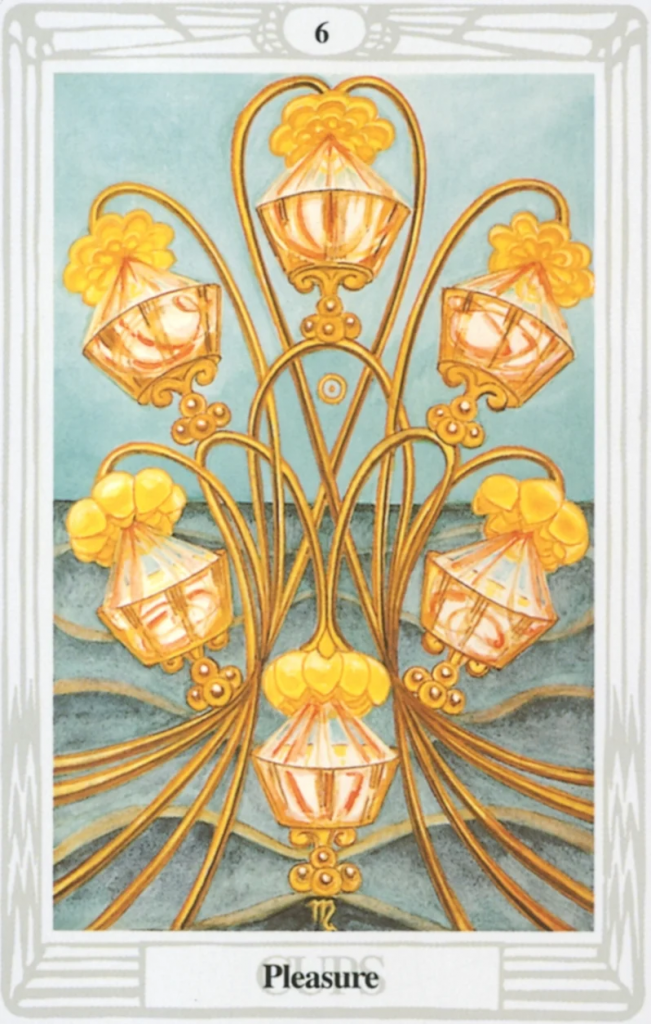
The Lord of Pleasure is a welcome card in any reading, bringing in a sense of harmony and balance. Existing relationships broaden and deepen, giving an extended sense of contentment and satisfaction.It’s important to recognise, with this card, that its influence extends only to established relationships – those which already have a history of their own. It will come up in a reading to indicate major steps forward, strengthened commitment, marriage, recovery after trial.Mostly, it will relate to intimate relationships because of a strong link to contentment within sexual partnerships. Sometimes, the Lord of Pleasure will appear to mark the point at which a previously purely romantic relationship extends to become a sexual one as well. Because of this influence, there are also several connotations of creativity and fertility.We have tended, in recent times, to lose sight of the true higher interpretation of the word ‘pleasure’, and that sometimes leads to misunderstanding about the Six of Cups. The card is not so much about the act of sex, but rather about the wealth of emotional contentment that can arise from being in a fulfilled sexual relationship. Good sexual experience is one of the greatest acknowledgements of our physical state. It adds richness to our understanding of ourselves as humans.
These timeless questions resonate today more than ever, no matter where you are in your life’s journey.
Spiritual counselor and teacher Richard Hartnett, H.W., M. shares how these questions can stimulate a life-long quest into deeper meaning and greater satisfaction in his exciting new three-part Sunday Meeting Series: Exploring Cosmic Intention.
Let your curiosity lead you to attend the first session this Sunday…
SUNDAY MEETING 2/25/2024 11:00 am Pacific/Noon Mountain/1:00 Central/2:00 Eastern
“If you were to rush into this room right now and announce that you had struck a deal–with God, Allah, Buddha, Christ, Krishna, Bill Gates, whomever–in which the ten years since my diagnosis could be magically taken away, traded in for ten more years as the person I was before–I would, without a moment’s hesitation, tell you to take a hike . . . I would no longer want to go back to that life–a sheltered narrow existence fueled by fear and made livable by insulation, isolation, and self-indulgence. It was a life lived in a bubble . . . “ ― Michael J. Fox, Lucky Man
Michael Andrew Fox (born July 9, 1961), known professionally as Michael J. Fox, is a Canadian and American activist and retired actor. Beginning his career as a child actor in the 1970s, he rose to prominence portraying Alex P. Keaton on the NBC sitcom Family Ties and Marty McFly in the Back to the Future film trilogy. Wikipedia
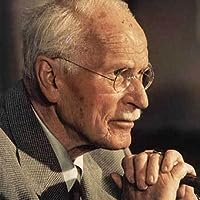
“The greatest tragedy of the family is the unlived lives of the parents.” ― Carl Gustav Jung
Carl Gustav Jung (July 26, 1875 – June 6, 1961) was a Swiss psychiatrist and psychoanalyst who founded analytical psychology. He was a prolific author, illustrator, and correspondent, and a complex and controversial character, presumably best known through his “autobiography” Memories, Dreams, Reflections. Wikipedia
Translation is a 5-step process of “straight thinking in the abstract.” The first step is an ontological statement of being beginning with the syllogism: “Truth is that which is so. That which is not truth is not so. Therefore Truth is all there is.” The second step is the sense testimony (what the senses tell us about anything). The third step is the argument between the absolute abstract nature of truth from the first step and the relative specific truth of experience from the second step. The fourth step is filtering out the conclusions you have arrived at in the third step. The fifth step is your overall conclusion.
The claims in a Translation may seem outrageous, but they are always (or should always) be based on self-evident syllogistic reasoning. Here is one Translation from this week.
1) Truth is that which is so. That which is not truth is not so. Therefore Truth is all that is. Truth being all is therefore total, therefore complete, therefore whole, therefore full, therefore fulfilling, therefore fulfilled. I think therefore I am. Since I am and since Truth is all that is, therefore I am Truth. Since I am Truth, therefore I, being, have all the attributes of Truth. Therefore I, being, am total, whole, complete, full, fulfilled, fulfilling. Since I, being, am Triuh and since I am mind/consciousness, therefore Truth is Mind/Consciousness.
2) Evil almost always tries to hide its face.
Word-tracking: evil: liars, haters, evil-doers, Ku Klux Klan, gaslighters, exceeding due limits, transgressing gaslight: subvert due: proper hide: to conceal, out of sight, out of mind dox: expose identity identity: the same as, face
3) People who do evil things like the Ku Klux Klan, gaslighters, haters, usually have at least enough self-awareness to want to stay hidden. To sin is to transgress due or proper limits. Truth being all and there being no limit to all, therefore there are no proper limits to Truth OR Truth is properly limitless. Truth being all that is, there can be no identity, no face other than the identity/face of Truth, therefore the face is Truth is everyone, everything, everywhere. Truth being Mind/Consciousness and Truth being all that is, therefore Truth is all-knowing. Truth being all-knowing, nothing can be hidden or concealed from Truth, therefore Truth doxes everybody/everything everywhere. Truth being all that is is therefore all that takes place, all that happens, all that occurs. Since Truth is all that occurs, therefore all that takes place must be Truthful. Since liars, haters, and gaslighters (subverters) are not truthful, the Truth is that all that can occur is truth-tellers, lovers and upholders of the Truth.
4) There are no proper limits to Truth OR Truth is properly limitless. The face is Truth is everyone, everything, everywhere. Truth is all-knowing. Truth doxes everybody/everything everywhere. All that takes place must be Truthful. All that can occur is truth-tellers, lovers and upholders of the Truth.
5) The face of Truth is everyone, everything, everywhere, everywhen speaking the Truth, loving the Truth and upholding the Truth.
Edgar Allan Poe is said to have called the 1841 story “The Murders in the Rue Morgue” his first “tale of ratiocination.” Many today agree with his assessment and consider that Poe classic to be literature’s first detective story. Poe didn’t actually use ratiocination in “Rue Morgue,” but the term does appear three times in its 1842 sequel, “The Mystery of Marie Roget.” In “Marie Roget,” the author proved his reasoning ability (ratiocination traces to ratio, Latin for “reason” or “computation”). The second tale was based on an actual murder, and as the case unfolded after the publication of Poe’s work, it became clear that his fictional detective had done an amazing job of reasoning through the crime.
The #1 bestseller and fastest selling autobiography of all time, “Private Parts, ” will be released on March 14 as a major motion picture from Paramount Pictures and Rysher Entertainment. This is the event Stern’s millions of fans have been waiting for. Yes, The King of All Media is back, letting it all hang out in his outrageous new movie. And here is the book that tracks the odyssey. In “Private Parts” Stern spills his life story, from his dysfunctional beginnings to his unlikely, turbulent rise to super stardom. In the process, he shares his views on everything from foreign policy to fatherhood and Madonna to masturbation, with lots of lesbians in between. No matter whose side you’re on — Cher’s “I hate him. He’s just a creep, ” or Stallone’s “I love him. I really love him” — Stern’s brutally frank “Don’t ask, I’ll tell” tome spares no group or institution. Studded throughout with Howard’s favorite photos, pickings from the Hate-Mailbag and illustrations, this is the original, in-your-face manifesto complete with movie art that will once again have fans storming the bookstores…and everyone else running for cover.
Howard Stern is an American radio host, humorist and media mogul. Stern hosts The Howard Stern Show four days a week (Monday–Thursday) on Howard 100, a Sirius Satellite Radio station.
The self-proclaimed “King of All Media” has been dubbed a shock jock for his highly controversial use of scatological, sexual, and racial humor. Stern has said that the show was never about shocking people, but primarily intended to offer his honest opinions on a gamut of issues (ranging from world affairs to problems among his own staff). Though controversial, he is the highest-paid radio personality in the United States and the most fined personality in radio broadcast history.
He is best known for his national radio show, which for many years was syndicated on FM radio stations (and a few AM stations) throughout the United States until his last terrestrial radio broadcast on December 16, 2005. He began broadcasting on the subscription-based Sirius satellite radio service on January 9, 2006.
In addition to radio, Stern moved into publishing, television, feature films, and music. He has written two books, Private Parts, which he adapted into a film, and Miss America. Stern’s television endeavors include a variety show on New York City’s WWOR-TV, a nightly E! show documenting his radio broadcasts, a similar CBS program that competed with Saturday Night Live for a time, “Howard On-Demand” for digital cable subscribers in various markets, and Son of the Beach, a parody of Baywatch for FX which Stern executive produced.
In 2006, Howard Stern was elected into Time Magazine‘s “Time 100: The People who shape our world” and was ranked #7 in Forbes Magazine‘s 2006 annual Celebrity 100. On February 13, 2007, Stern became engaged to his long-time girlfriend, model Beth Ostrosky.
SKEPTICAL = disbelieving, mistrustful, doubting; an attitude of doubt or a disposition to incredulity either in general or toward a particular object
QUESTION: Are you skeptical about something?
STORY: What are you skeptical about? I am skeptical about 5G. 5G is the fifth-generation technology and cellular phone companies began deploying it worldwide in 2019. Yet, no real scientific testing has been done on the safety of electro-magnetic-radiation flowing through our bodies. The Dalai Lama says: “With the new era in biogenetic science, the gap between moral reasoning and our technological capacities has reached a critical point. It is now almost impossible for ethical thinking to keep pace with these changes. Much of what is soon going to be possible is less in the form of new breakthroughs or paradigms in science than in the developments of new technological options combined with the financial calculations of business and the political and economic calculations of governments.” While Artificial Intelligence appears to be stunningly intelligent, it is a machine and it differs from humans in that it can’t be skeptical. AI doesn’t doubt or question the truthfulness of something. When humans doubt something, psychologists refer to this as “metacognition” – or the ability to think about your thinking – to recognize when you might be wrong or when it might be wise to seek a second opinion. Our conscience tells us when something feels wrong or right. We must listen to our conscience.
QUOTES
“Conscience is the organic link in the human biological instrument connecting us with the Mind and Heart of the Creator.” ~ Red Hawk
“The development of full artificial intelligence could spell the end of the human race. It could take off on its own and re-design itself at an ever increasing rate. Humans, who are limited by slow biological evolution, couldn’t compete and could be superseded.” ~ Steven Hawking
“The real danger is not that machines are more intelligent than we are – but that we will overestimate our latest thinking tools, prematurely ceding authority to them far beyond their competence.” ~ Daniel Dennett
“We are most inclined to overvalue science & technology.” ~ Thane
EXERCISE
STOP.
Sit quietly. Assume an erect posture. Sense the breath.
Sit calmly and bring to mind something you are skeptical about.
Get your pen and paper and write words or draw lines expressing yourself being skeptical about something and then listening to your conscience.
Move forward into your day honoring yourself for being willing to be curious.
“Your task is not to seek for love, but merely to seek and find all the barriers within yourself that you have built against it.” — Rumi
I know, we hear this all the time, ‘love is not found outside, but within.’
It has become a cliché in the spiritual community, but what does that really mean for our everyday lives? I have yet to read something to truly explain the depth and significance of this sentence.
Let us first begin by examining what is love for most of us.
Many of us approach love primarily from an egocentric viewpoint. Our chief concern often revolves around being loved by our partners, friends, and family.
The central issue is about being lovable, which typically involves being admired and accepted in the external world.
Our quest for love is a quest for acceptance.
And acceptance is always something external. Even if you struggle to accept yourself, the aspects of yourself that you find difficult to accept have been rejected by your external environment. Without external rejection, self-acceptance becomes obsolete.
Romantic love: Conforming to ideals
We often see love as something outside ourselves, something that can be given by another, possessed, and clung to.
In our quest to be loved, we tend to adhere to external expectations.
For many men, this involves striving for success, ascending the social ladder, and accumulating power and wealth as a means to gain love and acceptance.
On the other hand, a path frequently pursued by women centers on enhancing physical attractiveness. This pursuit encompasses meticulous attention to appearance, fashion, and beauty routines, all aimed at maintaining youth and allure.
In this context, the concept of love becomes conflated with notions of power, popularity, and physical attraction.
Explore YouTube, and you’ll notice a trend: channels appealing to men frequently emphasize hustling, and wealth accumulation, and are centered around themes of relentless effort and motivation. As for women — just take a look at the beauty industry.
Consequences
This adherence to external standards of success often leads to an unhealthy attachment to these ideals, fostering anxiety and fear. The underlying fear of not being ‘good enough’ and consequently not being loved can lead to profound distress and sorrow in life. Individuals who feel they fall short in these domains might experience depression, rooted in a belief that they are unlovable.
It’s important to note that these emphases are also biologically driven. Women are naturally inclined to seek traits in partners that promise security and care for their offspring. Similarly, men often view beauty and youth as indicators of a healthy lineage, ensuring the survival of their genetic material posthumously.
These dynamics of biological attraction result in a cycle of mutual exploitation, where men objectify women for sexual gratification, and women view men as providers of security and means for procreation.
Is love something to be found outside?
Yet, Rumi points out that our attention should be on addressing the internal obstacles that hinder our capacity to love.
The primary barrier to experiencing love is not the lack of external affection, but rather the internal defenses we erect.
Love is not an external pursuit but an internal transformation. It is not something we can get from others but something that flows naturally from within ourselves.
We desperately long to be loved because our hearts are empty. An empty cup wants to be full; however, a heart that is full of love never seeks someone to fill it up. Instead, it radiates love, never asking anything back.
Rumi encourages a shift from seeking conditional love — based on the specific criteria and expectations outlined above — to cultivating a more unconditional form of love that is accepting and all-encompassing.
We love because hence we do not love at all.
“Why do you love me?” we tend to ask our partners. “I love you because you are smart, beautiful, hard-working, and take care of me,” are some of the usual responses.
Our love is not love, but a transaction, an exchange. In the words of Jiddu Krishnamurti:
If I love you because you love me, that is mere trade, a thing to be bought in the market; it is not love. To love is not to ask anything in return, not even to feel that you are giving something.
As long as this transaction meets the conditions set by both parties, we say we love each other. Yet, the moment there is any deviation, there is great pain and frustration.
This phenomenon is not limited to romantic relationships; it is also prevalent in friendships and parent-child relationships. Upon careful observation, it becomes clear that the conflicts and the ensuing pain in these relationships stem from one factor: expectations.
This pain is there to wake us up to the fact that what we seek is not love, but attachment. We seek someone to cover up our feelings of utter isolation. We seek someone to fulfill our desires.
Rumi’s quote is a call to turn inward and do the necessary inner work to remove the obstacles that prevent us from being love itself.
The only barrier to love: Time
All these barriers are products of time; they are the past with our traumas and the future with our expectations.
Our past traumas close off our hearts to avoid being hurt again.
Yet, as Rumi said:
“The cure for pain is in the pain.”
“The wound is the place where the light enters you.”
The pain from our past holds the answer, the light, the wisdom. We get hurt because we expect, and we expect because we are selfish, hence having no love in our hearts, only desire.
Love is the ending of time. And with time, fear ends.
Even if one finds ‘love’ externally, that love always comes with fear — the fear of that love coming to an end. That fear is the future, the expectation, the demand for permanency in an impermanent world.
Yet, love has nothing to do with all that.
Love is pure presence. It is a state of constantly letting go, meeting every person with a fresh, clear mind, not chained to past trauma, memories, and grievances.
Love is truly a state of being — being truly alive, here and now.
The question then arises:
Can an ambitious person, who is constantly living in the future, ever truly know love?
What about an overthinker, someone riddled with anxieties and fears?”