In 1913, C.G. Jung started a unique self- experiment that he called his “confrontation with the unconscious”: an engagement with his fantasies in a waking state, which he charted in a series of notebooks referred to as The Black Books. These intimate writings shed light on the further elaboration of Jung’s personal cosmology and his attempts to embody insights from his self- investigation into his life and personal relationships. The Red Book drew on material recorded from 1913 to 1916, but Jung actively kept the notebooks for many more decades.
Presented in a magnificent, seven-volume boxed collection featuring a revelatory essay by noted Jung scholar Sonu Shamdasani—illuminated by a selection of Jung’s vibrant visual works—and both translated and facsimile versions of each notebook, The Black Books offer a unique portal into Jung’s mind and the origins of analytical psychology.
Right about now, our organizations are working…in all the wrong ways. They’re solving yesterday’s problems, mostly, still. But those problems have already been solved. Yet today’s and tomorrow’s haven’t. They’re just getting bigger, spinning out of control, and so the future’s unravelling — or what’s left of it.
What do I mean by that? Here are the three problems our creaking old Industrial Age organizations were built to solve, and did solve.
Profit. We know how to build organizations to maximize profits. Profits hit record-shattering levels, and then earth-shattering ones. That doesn’t mean that every organization is profitable, but it does mean that maximizing profits is very much a solved problem. Efficiency, scale, reach, make it all look glamorous, perhaps. We know how to solve this problem — to death.
Scale.We know how to build organizations at massive, and I mean massive scales. Think about how big some of the world’s biggest really are. They employ millions of people, and informally employ even more than that, as contractors and temps and so forth. We have incredibly complex systems of management for all this, from “matrix management,” to the sheer grunt work of modern day “Human Resources,” to the way poor old job-seekers have to send out billions of CVs just to get maybe a handful of interviews. The scale at which we work is colossal. Solved problem.
Reach. We know how to build organizations that can reach…right across the globe. Impress their brands and marketing and messages upon not just millions but even billions of minds. That’s not even particularly complicated anymore — though it can take work. We have, again, incredibly complex systems to manage and manipulate this. Reach means finance, too — now, someone with a pension in Malaysia or Norway can unwittingly be an investor in American insurance company which has to pay for climate-disaster damages in Kansas. Solved problem — we’ve integrated the economy in this way as a thing of unprecedented reach.
But tomorrow’s problems? Which are becoming more and more evident…today? Take a hard look around the globe. What do you see? Here’s what CEOs see, and you can take a look at any number of CEO-agenda style research to back it up. A world of rising geopolitical tension. One of fragmenting societies. Where social contracts are being pushed to the brink, and extremism’s rising. Meanwhile, climate change’s mega-scale impacts are arriving…now…decades ahead of schedule. Economies are predicted to stagnate for the rest of this decade, more or less — and what happens after that isn’t going to be pretty.
Tomorrow’s problems? which are becoming today’s? They’re the Big Ones. They’re new ones. They’re not the old ones of profit, scale, and reach. So what are they? Well, I’d put them like this.
Leaving the world a better place than you found it. Some people might think of that as idealism, yet it’s anything but. Good luck to you if you’re not aboard that boat, because the one we’re on…is sinking. Organizations today have real work to do. We’re still a civilization dependent to about 80% or so on fossil fuels, and that’s understandable, because they’ve powered centuries of growth. But now? We’ve got to make an energy transition — the greatest in human history, which will reshape everything. And that’s about reinventing everything, too, from manufacturing, to governance, to leadership, to priorities.
So this problem’s about investment, not justprofit-maximization. And that’s hard, because it’s unclear. The old problem of maximizing profits? Hire an investment bank, a management consultancy, a brand agency — job done. But now? To do this work? The work of the 21st century? Leaving the world a better place than you found it? Investing in next-generation…everything? Time to get real — and innovate at a high level again, institutionally, managerially, economically, systemically. You have to do this work — you and you alone, because now? It’s the only authentic source of competitive advantage left that there is.
That brings me to problem number two, which is building the future, not just surviving it. As we solved the problems of profit, reach, and scale, we learned how to build organizations that could last…a hundred years or so. They’re some of the world’s most iconic brands today. But now? Are they going to last for another hundred? What about another two hundred? Three?
We don’t know how to build organizations that last on those timescales. And yet this is one of the great challenges of now, because of course those organizations will also be building systems, pathways, infrastructures, ideas that are now meant to last. When we talk about “preventing climate change” or “transcending geopolitical tension” or “redefining governance” that’s what we really mean in a deeper sense. Building stuff that can last…a lot longer…than the last generation of successful organizations did. That isn’t going to fizzle out in another decade or three or even five.
We don’t know how to solve this problem, even remotely, yet. Who do you hire to tell you how to do this? Most of the advisors on the list above, investment banks, consultancies, brand agencies — they’ll talk to you about next quarter. Because of course our focus became ultra myopic. Now as our time horizons extend, and we contend with building organizations and systems that are going to be around after things like climate change or the current wave of geopolitical tension…we’re not just talking about those who can somehow straggle along desperately and somehow survive it, but those who can build, imagine, create, construct, innovate for a world and an age beyond it.
How do you do that? That brings me to problem number three, which is about existence, how you matter, why, to whom, not just what we used to call “vision.” Right about now, our economies and societies are facing existential crises. Why do they exist? What’s their point. Just to create mass stagnation and set people at each others’ throats? Bad answer. Tensions rise. But organizations exist in that matrix, and they face this question, too.
Why do most organizations exist right now? Get beyond the prettified nostrums of vision and mission, and the real answer, too often, comes right back to…profit, scale, and reach. We exist to make even more money! By…being bigger than the next guy! And we do that by bombarding even more people with noise, stuff, from products to “likes,” than our competitors! Bad answers.
Because they have no resonance — none — in the world we live in now. Nobody cares about organizations like this. Not employees. Not customers. Not their managers. Not even, really shareholders, whose horizons, at least at the institutional scale, are shifting outwards and upwards, towards the long-term and the holistic senses of governance and performance. Organizations like this are living under a death sentence of their own cynicism and indifference, they just don’t know it yet. The first chance they get? Everyone — customers, shareholders, employees, managers — flees.
Smarter organizations, right about now, know this — and so they’re groping for a point. A reason. A good answer to the question: why do we exist now? Or at least a better one than the Industrial Age, or even Information Age ones of profit, reach, scale, and profit. Only good answers to that question — ones that make sense in light of today’s Existential Threats to civilization, society, our economies, from climate change to fanaticism to stagnation — count anymore. Really good ones. We’re here to make your life better in this way, positive, concrete, real, tangible, not just some imaginary emotional Mad Men era benefit, not to hurt you, leave you worse off, devalue and dehumanize you, make your increasingly tenuous place in this destabilizing world even more precarious.
Tough question to answer. Yet answering it well is the agenda of the 21st century. All the rest flows from there. So if you’re thinking about the future — begin at the beginning, which is also the ending, the end, the point, the purpose, what matters. Tomorrow’s problems are here today, but tomorrow’s organizations aren’t. Those that get there first? That’s what the real race in this century is about, not solving yesterday’s problems.
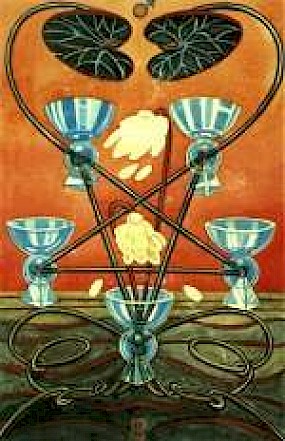
None of us feel too good when the Five of Cups, Lord of Disappointment, turns up in our readings. It almost always means that somebody somewhere is going to make us feel let down or sad about something. And often when that happens we can end up giving ourselves a hard time, and hurting ourselves unnecessarily.
But there’s one important thing to consider when we get disappointed – we feel that way because an expectation we had is not fulfilled, whether by ourselves or by somebody else. So if you get this card coming up often, it’s worth taking a good look at your expectations. Are they unrealistic? Are they geared to the abilities and characteristics of the person you hold them of? Or do you expect too much – this is an attitude we tend to apply most viciously to ourselves. Are you expecting more than you have a right to? Are you expecting things that the person in question -yourself or somebody else – is simply not able to provide? If the answer to any of the above is yes, then if you change your expectation, you’ll stop being disappointed.
When this card comes up, it warns us that either we have failed to resolved an old difficulty, or that – realistic or not – our expectations are about to be disappointed. Often this will happen in an emotional situation (because this is a Cup card) but can happen elsewhere in our lives too, because disappointment itself is an emotion and therefore belongs to Cups. Aside from locating where the problem lies, there’s rarely much that can be done except preparing ourselves to accept the inevitable consequence of being alive – into each life a little rain must fall etc.etc.
One thing that is always worth bearing in mind with a card like this is that the feelings which arise when it occurs often scare us into failing to take another risk, failing to make another effort, hiding away where we can’t be disappointed again. But then if we give in to those sort of feelings we’re expecting to be disappointed again, aren’t we? So maybe we need to think about the Nine of Wands when we see the Five of Cups, reminding ourselves of that inner reserve of strength and capability we can all release inside us!
This Jungian Life Aug 30, 2023 This Jungian Life As Jung’s anthropological studies expanded and his international travel exposed him to new cultures and ideas, he was taken by the concept of ‘loss of soul.’ A collapse of energy, a strange sudden alteration of personality, or episodes of blinding rage could signify a loss of soul from a shamanic perspective. The soul carries the animating and regulating forces as well as memory. In most traditions, it was expected to fly away upon death, much like the Egyptian Ba, depicted as a bird with a human head. Because the soul had an independent life, it might flee suddenly, leaving a listless body behind. The shaman’s task was to retrieve and escort the wandering soul into the body again. In Michael Harner’s book The Way of the Shaman, he cataloged various ancient practices and distilled a small set of universal techniques. Soul retrieval involves tying a red string on the patient’s wrist and, with the help of one’s spiritual power animal, traveling to the inner worlds, identifying the lost soul by the red string also on its wrist, bringing it back to the waking world and blow it into the patient’s body. Loss of soul in this contemporary system is often associated with trauma, and the imagery is congruent with modern conceptualizations of dissociation. Jung linked shamanic descriptions with the work of psychiatrist Janet and called “abaissement du niveau mental.” Jung described this as “a slackening of the tensity of consciousness, which might be compared to a low barometric reading, presaging bad weather. The tonus has given way, and this is felt subjectively as listlessness, moroseness, and depression. One no longer has any wish or courage to face the tasks of the day. One feels like lead because no part of one’s body seems willing to move, and this is due to the fact that one no longer has any disposable energy.” In modern psychiatry, several clinical descriptions might be assigned to such despair and collapse, but those may not capture the psychospiritual depth of ‘loss of soul.’ For Jung, the soul carries creativity and grants meaning; it links us to the divine and represents all we could be if wholeness were possible. Whatever the cause, to be abandoned by one’s soul is devastating, and to be reunited, the greatest gift. HERE’S THE DREAM WE ANALYZE: “I was trying to save a younger girl or woman at the start. She was like a little sister. I was working, trying so hard to protect her. I am teaching and nurturing her, defending her. She grew stronger along the way. We were looking for plants for a bouquet, and an evil man viciously and ruthlessly attacked us. I fought back, and I was just as ruthless. I physically threw him out. He lost and was brutally injured. I realized the girl with me was powerful in her way. She had special abilities to sense things others did not. We continued and came upon a theater performance in front of a school. We volunteered for roles, mostly because the roles seemed meant for us. I realized the girl I cared for could give a voice to those who could not speak for themselves. We realized some people in the school were oppressed, and their oppressors had control. We broke something, an entire wall came down, and wild horses ran everywhere. We climbed the school structure that was left to try to get to safety or maybe to try to jump onto a horse from higher ground. I lost the girl in the struggle to climb higher, and a bull with horns started attacking me. He could climb, too, and the higher I got, the closer he got. I started falling, but I wasn’t scared because I knew something was coming to catch me. A creature caught me and started to fly. I intuitively knew this creature was meant for me, and he felt like an old friend. He was scarier, darker than a horse. My dragon. He was black and had spikes everywhere. All of a sudden, I felt less alone. I realized I had been carrying so much; finally, someone was carrying me. I rode this animal as he flew. We bonded, and I got accustomed to him. We took a break for me to get snacks … 1 noticed people staring at me, and they seemed scared or in awe or respect. Someone told me my dragon liked chocolate. So I got some for me and some for him. I got back on his back and fed him the chocolate. He liked it, and as he ate, I noticed his body was huge and strong and his head smaller. I wake up.”
The Holy Grail and its quest is a legend that has had a powerful impact on our civilization and culture. The Grail itself is an ancient Celtic symbol of plenty as well as a Christian symbol of redemption and eternal life, the chalice that caught the blood of the crucified Christ. The story of the Grail sheds profound light on man’s search for the supreme value of life, for that which makes life most meaningful.
Writing in a clear and readable style, two leading women of the Jungian school of psychology present this legend as a living myth that is profoundly relevant to modern life. We encounter such universal figures as the Fool (the naive young Perceval), the Wise Old Man (the Hermit Gornemanz), the Virgin Maiden (Blancheflor), the Loathly Damsel, and such important themes as the Waste Land, the Trinity, and the vessel of the Grail. Weaving together narrative and interpretation, the authors show us how the legend reflects not only fundamental human problems but also the dramatic psychic events that form the background of our Christian culture. Emma Jung–analyst, writer, and wife of the famous psychologist C. G. Jung–researched and worked on this book for thirty years, until her death in 1955. Marie-Louise von Franz, also eminent in the field of depth psychology, completed the project.
Eternalised Aug 23, 2023 The Quest for the Holy Grail has fascinated the Western consciousness for a long time. It epitomises the true spirit of Western man and is, in many ways, the myth of Western civilisation. It is a perennial and timeless pattern that expresses fundamental concerns of the human condition. The Holy Grail is a mysterious object guarded by a king in a hidden castle. It has been described as a cup, dish, or a magical stone that can provide healing powers, immortality, eternal youth, and unlimited nourishment. It represents the fulfilment of the highest spiritual potentialities in human consciousness, which endows the world with a symbolic and spiritual meaning. The quest for the Holy Grail is always more or less the same, it is the hero’s journey, at the end of which one obtains the “treasure hard to attain.” It is the search for that which makes life most meaningful. Psychologically, the Holy Grail—like the philosophers’ stone—is a symbol of the Self, the psychic totality and ultimate wholeness of the human being. The soul which represents the life principle, is that wondrous vessel which is the goal of the quest, whose final secret can never be revealed, but must ever remain hidden because its essence is a mystery.
Aug 26, 2023 An introduction to the Sun, Moon, and rising signs in astrology, and explaining what they mean and what the difference is between them, with astrologers Chani Nicholas and Chris Brennan. In the 20th century it became common for people to know their Sun-sign, which is the sign of the zodiac the Sun was located in on the day you were born. However in recent years due to the rise of astrology apps and websites it has become more common to know your so-called “big three”, which are your Sun, Moon, and rising signs. But what do the Sun, Moon and rising zodiac signs mean in a birth chart? During the course of this episode we discuss the core meanings of these placements, which Chani calls the “three keys” to your birth chart. In Chani’s approach the Sun signifies your life’s purpose and how you shine, the Moon represents your physical and emotional needs and how we live out our purpose in the physical realm, and the Ascendant and its ruler show your motivation for living and direction your life is steered in. Chani is the author of the book You Were Born for This: Astrology For Radical Self-Acceptance, and is the creator of the CHANI app, which is an astrology app available for iOS and Android. You can find out more about Chani on her website: https://chaninicholas.com This is episode 414 of The Astrology Podcast: https://theastrologypodcast.com/2023/… Patreon for early access to new episodes and other bonus content: https://www.patreon.com/astrologypodcast Please be sure to like and subscribe! #TheAstrologyPodcast Timestamps 00:00:00 Introduction 00:06:00 Chani’s background in astrology 00:13:15 Sun, Moon, and rising sign overview 00:15:30 The Ascendant and rising sign 00:34:38 Three guidelines for learning astrology 00:41:15 The Sun 01:14:44 The Moon 01:42:28 Sect: day vs night charts 01:48:50 Finding your life’s purpose 01:58:31 New CHANI app Android version 02:03:20 Concluding remarks 02:05:46 End cards and credits
Support sound science and smart stories Help us make scientific knowledge accessible to all Donate today
Young jumping spiders dangle by a thread through the night, in a box, in a lab. Every so often, their legs curl and their spinnerets twitch — and the retinas of their eyes, visible through their translucent exoskeletons, shift back and forth.
“What these spiders are doing seems to be resembling — very closely — REM sleep,” says Daniela Rößler, a behavioral ecologist at the University of Konstanz in Germany. During REM (which stands for rapid eye movement), a sleeping animal’s eyes dart about unpredictably, among other features.
In people, REM is when most dreaming happens, particularly the most vivid dreams. Which leads to an intriguing question. If spiders have REM sleep, might dreams also unfold in their poppy-seed-size brains?
Rößler and her colleagues reported on the retina-swiveling spiders in 2022. Training cameras on 34 spiders, they found that the creatures had brief REM-like spells about every 17 minutes. The eye-darting behavior was specific to these bouts: It didn’t happen at times in the night when the jumping spiders stirred, stretched, readjusted their silk lines or cleaned themselves with a brush of a leg.
Though the spiders are motionless in the run-up to these REM-like bouts, the team hasn’t yet proved that they are sleeping. But if it turns out that they are — and if what looks like REM really is REM — dreaming is a distinct possibility, Rößler says. She finds it easy to imagine that jumping spiders, as highly visual animals, might benefit from dreams as a way to process information they took in during the day.
Young jumping spiders have translucent skin. Behind their eyes, tube-shaped retinas move as the spiderlings look about. As shown in this sped-up video, researchers have also observed such retinal tube-shifting behavior in resting — possibly sleeping — spiders. In these intermittent, active bouts, the animals’ legs curl and their spinnerets twitch — suggesting that spiders may experience something like REM sleep.
CREDIT: D.C. RÖßLER ET AL / PNAS 2022
Rößler isn’t the only researcher thinking about such questions in animals distantly removed from ourselves. Today, researchers are finding signs of REM sleep in a broader array of animals than ever before: in spiders, lizards, cuttlefish, zebrafish. The growing tally has some researchers wondering whether dreaming, a state once thought to be limited to human beings, is far more widespread than once thought.
REM sleep is generally characterized by a suite of features in addition to rapid eye movements: the temporary paralysis of skeletal muscles, periodic body twitches, and increases in brain activity, breathing and heart rate. Observed in sleeping infants in 1953, REM was soon identified in other mammals such as cats, mice, horses, sheep, opossums and armadillos.
Events in the brain during REM have been well-characterized, at least in humans. During non-REM periods, also known as quiet sleep, brain activity is synchronized. Neurons fire simultaneously and then go quiet, especially in the brain’s cortex, making swells of activity known as slow waves. During REM, by contrast, the brain displays bursts of electrical activity that are reminiscent of waking.
Even across mammals, REM sleep doesn’t all look the same. Marsupial mammals called echidnas show characteristics of REM and non-REM sleep at the same time. Reports on whales and dolphins suggest that they may not experience REM at all. Birds have REM sleep, which comes with twitching bills and wings and a loss of tone in the muscles that hold up their heads.
Still, researchers are starting to find similar sleep states across many branches of the animal tree of life.
Researchers are finding different phases of sleep in more and more creatures across the animal kingdom. In mammals, sleep is divided into active, rapid-eye-movement (REM) sleep and quiet, non-REM sleep, and these phases are associated with specific patterns of brain activity. Though such brain activity patterns haven’t been investigated in many animals, researchers have documented active sleep phases, wherein animals experience jerky movements such as twitches or rapid eye movements, interspersed with quiet (quiescent) sleep, when those behaviors aren’t present. The growing tally suggests an evolutionary importance for multiple types of sleep.
In 2012, for example, researchers reported a sleep-like state in cuttlefish, as well as a curious, REM-like behavior during that state of putative sleep: Periodically, the animals would move their eyes rapidly, twitch their arms and alter the coloring of their bodies. During a fellowship at the Marine Biological Laboratory in Woods Hole, Massachusetts, behavioral biologist Teresa Iglesias investigated the phenomenon further, collecting terabytes of video of half a dozen cuttlefish.
All six showed bouts of REM-like activity that repeated roughly every 30 minutes: bursts of arm motions and eye movements during which their skin put on a show, jumping through a variety of colors and patterns. The creatures flashed camouflage signals and attention-grabbing ones, both of which are displayed during waking behaviors. Since the cephalopod’s brain directly controls this skin patterning, “that kind of suggests that the brain activity is going a bit wild,” says Iglesias, now at the Okinawa Institute of Science and Technology in Japan.
Researchers have since observed a similar state in octopuses. If octopuses and cuttlefish dream, “it just kind of blows down the walls of what we think about humanity being so special,” Iglesias says.
Researchers have also observed a REM-like stage in bearded dragons by recording signals from electrodes in their brains. And they have reported at least two sleep states in zebrafish based on the fishes’ brain signatures. In one of the states, neural activity synced up like it does in a non-REM stage of mammals. In another state, the fish showed neural activity reminiscent of a waking state, as happens in REM. (The fish didn’t show rapid eye movements.)
Observing multiple sleep stages in such an evolutionarily distant relative from ourselves, the authors suggested that different sleep types arose hundreds of millions of years ago. It’s now known that flies, too, may flit between two or more sleep states. Roundworms appear to have one sleep state only.
Researchers consider the possibility of nonhuman animals dreaming during REM-like sleep because creatures act out waking-like behaviors in this state — like the cephalopods’ pattern-flashing or the spiders’ spinneret-shaking. In pigeons, sleep scientist Gianina Ungurean of the Max Planck Institute for Biological Intelligence in Munich and the University Medicine Göttingen has observed, with colleagues, that pupils constrict during REM as they do during courtship behavior. That evokes the question of whether the pigeons are dreaming or in some way re-experiencing what happened during their waking courtship instances, she says.
REM sleep also has been linked to the replay of experiences in some animals. For instance, when researchers looked at the brain electrical activity of sleeping mice that had earlier run a maze, they saw the firing of neurons that help with navigation and are linked with the head’s direction, even though the heads of the mice weren’t moving. They also saw activity in neurons associated with eye movement. The combination suggests that the mice may have had a dreamlike experience in which they were scanning the environment, Ungurean says.
With all these signs, it’s fair to posit that animals could be dreaming, Ungurean says. “However, if we take these reasons one by one, it turns out that none of them is sufficient.” The brain activity associated with replay, like that of the maze-running mice, doesn’t occur only during REM or sleeping, Ungurean says. It can also occur during planning or daydreaming. And the link between REM and dreaming isn’t absolute: Humans dream in non-REM too, and when drugs are used to suppress REM sleep, human study participants can still have lengthy and bizarre dreams.
Ultimately, people know they are dreaming because they can report it, Ungurean says. “But animals cannot report, and this is the biggest problem that we have in purely scientifically and robustly establishing this.”
As pigeons try to woo a potential mate, their pupils constrict. Researchers recorded the brain waves of sleeping pigeons and videotaped their eyes. When the animals entered REM sleep, their pupils constricted in a similar manner to that seen during courtship. Could the birds be reliving courtship experiences while they sleep?
CREDIT: G. UNGUREAN ET AL / CURRENT BIOLOGY 2021
There’s still debate over what REM is even for. “No one really knows what the function of sleep is — non-REM or REM,” says Paul Shaw, a neuroscientist at Washington University in St. Louis. One of the most accepted ideas is that REM helps the brain to form and reorganize memories; other theories are that REM supports brain development, aids in developing the body’s movement systems, maintains the circuitry needed for waking activities so they don’t degrade during sleep, or boosts brain temperature.
But if REM turns out to be present in far-flung species within the animal kingdom, that suggests its role, whatever it may be, could be very important, Iglesias says.
Not all scientists believe that researchers are seeing REM. They may simply be fulfilling preconceived notions that all animals have two sleep states and interpreting one of those as REM, says Jerome Siegel, a neuroscientist who studies sleep at UCLA. Some of these animals — such as the spiders — may not even be asleep, he argues. “Animals may do things that look the same, but the physiology isn’t necessarily the same,” he says.
Researchers continue to look for clues. Rößler’s team is trying to develop stains that would allow them to image spider brains — this might reveal activation in areas that are functionally analogous to the ones that we use when we dream. Iglesias and others have implanted electrodes in cephalopods’ brains and captured their electrical activity during two sleep states — one that shows waking-like activity, and another that’s a quiet state, with neural signatures similar to ones observed in mammals. And Ungurean has trained pigeons to sleep in an MRI machine and found that many of the brain areas that light up in human REM sleep also activate in birds.
If cuttlefish and spiders and a broad array of other critters dream, it raises interesting questions about what they experience, says David M. Peña-Guzmán, a philosopher at San Francisco State University and author of the book When Animals Dream: The Hidden World of Animal Consciousness. Since dreams unfold from the viewer’s perspective, dreaming animals should have the capability to see the world from their point of view, he says.
Dreaming would also hint that they have imaginative capabilities, he adds. “We want to think that humans are the only ones who can enact that break from the world,” he says. “We might have to think a little bit more about other animals.”
Editor’s note: This article was updated on September 1, 2023, to correct an error about the species in a study. Researchers studied brain electrical activity of sleeping mice that had earlier run a maze, not rats.
Carolyn Wilke is a Chicago-based freelance science journalist who covers archaeology, chemistry and the natural world. Find her @carolynmwilke.
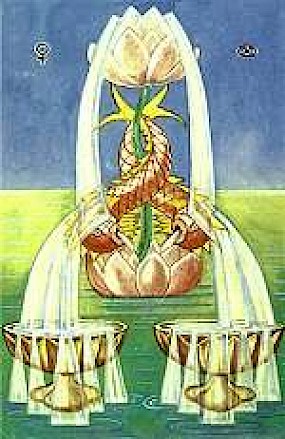
And here we have the Lord of Love, a card of bliss, deep joyous love reciprocated fully and with great enthusiasm, a card of reconciliations and new growth! Here we see harmonious and contented exchanges of emotion, which vibrate with an ecstatic undercurrent of passion and heat.
Because this card is a reflective and receptive one, there’s an issue that people sometimes forget when reading it – to be truly loved, deeply treasured, valued highly by others, we must first and foremost strive to feel those things for ourselves. When we work toward loving ourselves, we hold our inner nature in high regard, treating it with deference and proper respect. When we see ourselves in that light, other people cannot help but respond to our personal sense of value.
Furthermore, when we work to love ourselves, we release so many areas of self-doubt and uncertainty that we become infused by a new energy – and this we can lavish on others. The Two of Cups is about engaging in a caring and tender fashion with our own needs, first and foremost.
It isn’t so much about achieving self-love, as about, in every single day of our lives, striving towards self-love. That action leads us into a positive, self-supportive and accepting approach to life. And also, when we stop wasting energy telling ourselves what’s wrong with us, we have lots more energy to enjoy being who we are.
When this card comes up in a reading, if it relates to the inner journey, then it tells you to put your attention in the moment, to leave the past behind, and to let yourself be free to enjoy everything that comes your way.
If it relates to outer events, it may point to a forthcoming reconciliation in a relationship where there has been pain and disappointment – this need not be a love affair, it can cover many different types of loving relationship.
It might point up a new relationship which has recently begun and which will grow into a deep and lasting friendship or affair.
And finally, it may reassure you that the meaningful relationship in your life will strengthen and grow, developing into exactly what you need it to be!!
The news that thousands of Burning Man festival goers were told to conserve food and water after torrential rains left them trapped by impassable mud in the Nevada desert led some to chortle about a “Lord of the Flies” scenario for the annual gathering popular with tech lords and moguls.
Alas, I have to spoil the hate-the-tech-rich revelries. No matter how this mess is resolved — and many there seem to be coping — the common belief that civilization is but a thin veneer that will fall apart when authority disappears is not only false, the false belief itself is harmful.
Rutger Bregman, who wrote a book called “Humankind: A Hopeful History,” had read “Lord of the Flies” as a teenager like many, and didn’t doubt its terrible implication about human nature. However, Bregman got curious about whether there were any real-life cases of boys of that age getting stranded on an island.
Bregman learned of one that played out very differently,
In 1965, six boys from 13 to 16, bored in their school in Tonga, in Polynesia, impulsively stole a boat and sailed out, but became helplessly adrift after their sail and rudder broke. They were stranded on an island for more than a year. Instead of descending into cruel anarchy, though, they stayed alive through cooperation. When one of them broke his leg, they took care of him.
Some of the most memorable weeks of my life were spent helping out with rescues and aid in the aftermath of the 1999 earthquake in Turkey that killed thousands of people. The epicenter was my childhood hometown, so I was very familiar with the place, and I rushed to help, unsure of what I would find. Instead of the chaos and looting that was rumored, the people had been mostly sharing everything with one another. Intrigued, I dived into the sociology of disasters and found that this was the common trajectory after similar misfortune.
One of the most egregious recent examples of this involved rumors of conditions after Hurricane Katrina in the Superdome in New Orleans — where tens of thousands of people unable to evacuate earlier had gathered. The police chief told Oprah Winfreythat babies were being raped. The mayor said, “They have people standing out there, have been in that frickin’ Superdome for five days watching dead bodies, watching hooligans killing people, raping people.” There were reports that rescue helicopters were being shot at.
The reality was that even as the situation deteriorated in the Superdome, as Rebecca Solnit’s book documents, many people kept each other alive, especially taking care of the elderly and the frail under very stressful conditions.
But the demonization of the overwhelmingly Black population of New Orleans fueled true ugliness: Some aid was delayed and resources diverted to prevent “looting,” and refugees from the city trying to escape on foot were shot at by residents in the mostly white suburbs.
What about the terrible side of humanity: the wars, the genocides? And what about survival of the fittest?
In his book “Blueprint: The Evolutionary Origins of a Good Society,” Nicholas Christakis, a sociologist as well as a physician, explains that people are cooperative and social animals, not lone wolves. Humans have survived not because they were the animals with the sharpest claws and strongest muscles, but because they had smarts and they had one another.
Christakis looked at shipwrecks from 1500 to 1900 and found that survivors often managed by cooperation and that violence and ugliness was far from the norm.
This is not a rosy-eyed view that ignores the terrible aspects of human behavior. Groups can also be organized politically and socially against each other. That’s the basis of wars and genocides. But far from being elements of true human nature that are revealed once the thin veneer of civilization is worn off, such atrocities are organized through the institutions of civilization: through politics and culture and militaries and sustained political campaigns of dehumanization.
The institutions of civilization can also be enlisted to resist this dehumanization. The European Union may not be perfect, but it has helped to largely suppress the sorts of conflicts that wracked the continent for centuries.
I would venture that many of the thousands trapped in the Nevada mud are mostly banding together, sharing shelter, food and water.
If tech luminaries and rich folks are among those suffering in the mire, instead of gloating about their travail, let’s hope this experience reinforces for them the importance of pulling together as a society.
We can help them along by passing laws that make tax havens illegal, create a more equitable tax structure and a strong international framework for stopping the laundering of gains of corruption, force technology and other companies to deal with the harms of their inventions and overcome the current situation where profits are private but the fallout can be societal.
Human nature isn’t an obstacle to a good society, but it needs help from laws and institutions, not thick mud, to let the better angels have a chance.
The Times is committed to publishing a diversity of letters to the editor. We’d like to hear what you think about this or any of our articles. Here are some tips. And here’s our email: letters@nytimes.com.
Zeynep Tufekci (@zeynep) is a professor of sociology and public affairs at Princeton University, the author of “Twitter and Tear Gas: The Power and Fragility of Networked Protest” and a New York Times Opinion columnist. @zeynep • Facebook