The Pisces Full Moon opens wide the brain’s dream and fantasy portals and we may notice the mind’s deeper, inner content all the more. As dreams become increasingly graphic and surreal, we may perceive interesting connections, adding wisdom to everyday encounters. The nonsensicalness may be a secret message to decode once information is linked together.
We may dream about stretches of water or the sea, symbolizing our emotions, for instance, especially if we feel afraid or overwhelmed in that setting. The seaside is also associated with joyous holidays and exhilarating activities, so context matters. But by taking a moment to reflect on dream details, we could draw insight on a significant issue or find an answer to a problem.
In this lunation, the Moon conjoins Saturn, the planet associated with concrete reality. As a relevant example of this curious mix, I recently dreamt of a summer holiday scene in a hot country. On a paved promenade by the sea, I could get a boat to a pretty nearby area — a little island with lush, green palms. But there was a long wait for the next boat back, so I decided to swim — probably not practical, given that I was fully dressed and carrying a small backpack — but dreams are like that! In any case, I got on with swimming, but noticed I seemed to be a long way from the shore, and felt rather panicky and out of my depth. Then I noticed a line of white rocks in the sea, and realized as soon as I reached them that I could walk to the promenade in no time at all. (No worry factor in the dream about them being slippery!) Back on dry land, my only concern was that I didn’t have my backpack anymore, which contained my credit card and iPhone. I felt scared and concerned that my husband would worry when he couldn’t contact me. In this small journey, it seemed as though I had lost my sense of safety — and maybe also my identity.
I reflected on the dream and realized it linked with some spiritual work I had been doing in fully forgiving events and people from my past, including my ancestral line, which also involved being willing to forget — a strong Pisces theme. I was also aware that it involved letting the ego go, which can feel very threatening when our sense of identity has been built through our experiences. Yet, if I were to heal pain and illness associated with holding onto traumatic memories, this was the needed work, requiring some sort of sacrifice — also a Pisces theme. I think it’s no coincidence that an infection on my toe (Pisces rules the feet) magically cleared up whilst experiencing this ancestral clearing work and the sea dream. Perhaps I could trust the natural cycles of life, rather than grip grimly to my ego’s fears in Saturnine fashion!
Note Saturn’s retrograde status, powerfully drawing on past influences, including family experiences as embodied in the Sun and Moon (traditionally, father and mother lines in a family).
The Moon’s rulers are Neptune, planet of the sea and all things hazy, illusory, and surreal; and Jupiter, which allows far more expansion than limiting Saturn. In Jupiter, we find a new freedom and some forwards motion, as it is not retrograde. Jupiter widely sextile the Moon acts like a beacon from a nearby lighthouse — guiding us safely to the shore of whatever challenging situation we face.
This article is from the Mountain Astrologer by Diana McMahon Collis
On August 31st, 2023 we have a Full Moon at 7° Pisces.
Full Moons in Pisces always bring existential themes into focus. There is something about the last sign of the zodiac that hungers for answers.
Pisces is the sign number 12. It has seen it all, done it all. Pisces knows that we are all part of the same ocean of oneness, and that a butterfly flapping its wings in the Amazon can cause a tornado in Texas days, years, or decades later.
There is some sweet serenity about Pisces – some call it “complacency”, others “deep knowing”. The primary driver, the reason why Pisces does – or doesn’t do – something, is unconditional love.
Of course, you may know a Pisces – or several – that are anything but unconditional love.
There are 2 fundamental Piscean archetypes – Jesus and Judas (different cultures have their own versions of these Piscean archetypes).
Jesus is a symbol of the Age Of Pisces. He is known for virtues like unconditional love and sacrifice. Judas was the 12th apostle. His name is often used synonymously with betrayal or treason.
Jesus and Judas are the 2 ends of the Piscean spectrum. But there’s a common theme to all the Pisces archetypes: sacrifice.
When we work with Pisces energy, we often feel that there are greater forces at play, and that we are just a tool, or a channeling medium, that we are here to fulfill some sort of prophecy.
There is an important distinction between sacrifice and letting go. We let go of negative beliefs. We let go of what’s rotten, or no longer useful.
Sacrifice is different. We don’t sacrifice our negative beliefs. When we say we sacrifice something, we are sacrificing something of value. Sacrifice is an act of offering, of using something for its intrinsic value, to reach a higher state of consciousness, or to achieve some greater good.
Pisces Vs Virgo
Each Full Moon is a conundrum. The Moon is opposite the Sun.
How do we reconcile the opposing energies on the same axis?
Planets in opposition have a lot in common: they share the same modality, and the same polarity. The signs in opposition have the same goal – but they have very different approaches to reaching that goal.
Virgo is Earth, Pisces is water. Virgo is common sense. Pisces is feeling its way in. Virgo is “I have a plan”. Pisces is “I have a dream”. Virgo wants to do things right. Pisces wants to do the right thing.
This back and forth dance will eventually create a playing field where new possibilities are created.
The Aspects – Full Moon Conjunct Saturn
The Full Moon is conjunct Saturn at 3° Pisces.
Saturn and Pisces (with its ruling planets Jupiter and Neptune) couldn’t be more different.
In the next 2 years, Saturn is slowly applying to a conjunction to Neptune. This particular Full Moon in Pisces will thus give us a taste of the type of energies we will be working with going forward.
This Full Moon in the last sign of the zodiac will raise important questions about our legacy in this world. Superficial goals are no longer valued. We long for something deeper, something more meaningful.
The Full Moon in Pisces will raise questions around sacrifice: what do you need to sacrifice to achieve your soul’s mission in this life?
Sacrifice doesn’t have to be the equivalent of Jesus on the cross. Every single one of us sacrifices time and resources to function in society, or to reach some sort of goal.
We work hard to provide for ourselves and our families. We exercise when we don’t necessarily feel like it, to stay fit and healthy. We spend our weekends studying instead of watching Netflix.
But this Full Moon will take this question further. What is that ultimate goal that is worth sacrificing for?
What is THAT goal, that mission, that goes beyond getting a paycheck, or losing some pounds?
This is an important distinction because our Piscean mission is not our everyday goal – it’s our ultimate purpose in this lifetime.
In the Mesopotamian myth Enuma Elish, Marduk used the body of the slain goddess Tiamat to create the world.
There are many similar creation myths around the world where a god, or a human – sacrifices someone – a goddess, a wife, a child, or someone loved – in order to create humanity, or a church, or some other Piscean ideal.
All these myths speak of something fundamental about how our psyche and the world “work”.
There is a reason why Pisces follows two Saturn-ruled signs – Capricorn and Aquarius. After we spend a lifetime building a material legacy, we get to Pisces, and we are asked to leave it behind – for a promise of something greater.
We know we tap into our Piscean mission when the goal, that drive, that thing that motivates us is no longer about us – it is about contributing to something far greater than ourselves.
Sacrifice is never easy – we’ve spent so much time and energy building that structure – but it’s the inevitable next step in our development.
The Full Moon in Pisces will not necessarily ask you to leave your job, give away your possessions and go to the convent.
It will require you to sacrifice something of value so you can fulfill your higher mission. This sacrifice isn’t about letting go of what you value; instead, it’s about using that Saturn resource you worked hard for, to build the spiritual altar of your higher self.
You know, life is a funny thing. One moment you’re just going about your day, minding your own business, and then — bam! — you’re hit with a moment so eerily familiar, so uncannily coincidental, that it feels like the universe is playing tricks on you. I remember the first time I felt that way, the feeling almost knocked me off my feet.
“We often dream about people from whom we receive a letter by the next post. I have ascertained on several occasions that at the moment when the dream occurred the letter was already lying in the post-office of the addressee.” ― C.G. Jung, Synchronicity: An Acausal Connecting Principle
I was just a kid then, thumbing through a dusty old book about Carl Jung, the Swiss psychiatrist. He was a man of deep thoughts, a man who spent his life investigating the strange connections between our mind and the world around us. He had a word for these weird coincidences, those moments where it feels like there’s something more going on — he called it “synchronicity.”
“We put thirty spokes together and call it a wheel; But it is on the space where there is nothing that the utility of the wheel depends. We turn clay to make a vessel; But it is on the space where there is nothing that the utility of the vessel depends. We pierce doors and windows to make a house; And it is on these spaces where there is nothing that the utility of the house depends. Therefore just as we take advantage of what is, we should recognize the utility of what is not.” ― C.G. Jung, Synchronicity: An Acausal Connecting Principle
“Synchronicity,” the book said, was “the coincidence in time of two or more causally unrelated events which have the same meaning.” In simple terms, it’s when two things happen that seem related, but there’s no logical connection between them. Like dreaming about an old friend, and then bumping into them in the supermarket the next day. Or having a thought about learning to play the guitar, and then out of the blue, someone gifts you one.
Jung believed these weren’t just random happenings, but rather a peek into a deeper, hidden layer of reality where our minds and the world around us intertwined in the most unexpected ways. He thought that these synchronicities, these meaningful coincidences, were a result of our personal thoughts and feelings interacting with the collective unconscious — a wellspring of universal images and themes that we all share deep in our psyche.
“I do believe in an everyday sort of magic — the inexplicable connectedness we sometimes experience with places, people, works of art and the like; the eerie appropriateness of moments of synchronicity; the whispered voice, the hidden presence, when we think we’re alone.” ― Charles de Lint
I remember one story in the book that really made me pause. It was about a patient of Jung’s, who was describing a dream about a scarab beetle. Just as she was speaking, a golden scarab beetle — a creature not often seen in Europe — tapped on the window of the room. Jung opened the window, and the beetle flew in. The timing was so uncanny, so meaningful, it couldn’t be dismissed as mere chance.
As I read through the book, I felt my heart pounding. The world, according to Jung, was so much more interconnected than we usually perceive. Everything, every person, every thought, every event, was part of a grand, unfolding pattern. He urged us to pay attention to these synchronicities, to not dismiss them as just coincidences, but view them as a guide, a compass pointing us towards our true selves, our purpose in life.
“Because the eye gazes but can catch no glimpse of it, It is called elusive. Because the ear listens but cannot hear it, It is called the rarefied. Because the hand feels for it but cannot find it, It is called the infinitesimal. … These are called the shapeless shapes, Forms without form, Vague semblances. Go towards them, and you can see no front; Go after them, and you see no rear.” ― C.G. Jung, Synchronicity: An Acausal Connecting Principle
Jung’s writings stirred something deep within me. I remember feeling a sense of wonder, a sense of awe at the universe. I felt like I was being lifted from the mundane, materialistic world into a realm where everything had meaning, everything was connected.
Decades have passed since then, and science has made great strides — quantum physics, consciousness research, you name it. But even with all these advancements, we still have a long way to go in understanding the profound phenomenon of synchronicity that Jung illuminated.
“Naturally, every age thinks that all ages before it were prejudiced, and today we think this more than ever and are just as wrong as all previous ages that thought so. How often have we not seen the truth condemned! It is sad but unfortunately true that man learns nothing from history.” ― Carl Jung, Synchronicity: An Acausal Connecting Principle
So, my friend, next time you encounter a coincidence that’s too strange to be a mere chance, don’t just brush it off. Pay attention, look for the hidden meaning, the mysterious connection between your inner world and the world around you.
Because, who knows? You might just find a doorway to a world alive with cosmic meaning. After all, we all hold the key to unlocking the secrets of synchronicity. And maybe, just maybe, we need Jung’s wisdom now more than ever to light our path ahead.
Ewafa May 17, 2015 8:41 – Ike’s warning about the “unwarranted influence… by the Military-Industrial Complex”. Speech date: January 17, 1961 All other versions of this video that I have seen have scratchy audio or bad video, so I decided to put together this one with the best quality of both. [Edit Dec15,2019: reordering of text in the description, with the timejump link now presented at the beginning.]
Technologist Yat Siu believes the “open metaverse” — a decentralized version of the internet also known as web3 — is laying the foundation for a freer, fairer, more prosperous society. In a future-focused talk, he explores the transformative possibilities of web3, from enabling digital ownership and the creator economy to providing a much-needed update to capitalism.
Yat Siu is a veteran technology entrepreneur and digital property rights advocate who believes web3 and digital property rights are the key to a fairer, more prosperous and democratic internet.
When I was in my teens and early twenties, I’d sometimes run out to meet the Burlington Northern trains as they made their slow progress through the Colorado town of Fort Collins. Because the tracks ran down the center of a busy street, the train came through at a crawl. It was easy to swing aboard one of the freight cars and ride for a mile or two, then jump down on the edge of town where the engines dug in and the train accelerated.
If I mentioned the train to my friends, they thought my attraction had to do with that ride. They were wrong.
What I really loved about the Burlington Northern was standing in the glare of its headlight and then feeling the basso profundo thrum of its engines as it passed me by. The throbbing diesels washed the air with vibrations, made my bones quake, and sent shivers through the ground. That was what kept me coming back to the tracks: the sound, the shaking. When I’d grab on to a freight car ladder to ride behind the engines, it wasn’t so much for the thrill of the ride as for the nearness to the source of that sound.
A similar power had washed through me years earlier at Florida’s Fort Lauderdale airport. Night after summer night, I had gone to stand just outside the runway fence and watch the jets take off. It was the sound I loved then, too, the energy that bathed me, that made me vibrate in sympathy with the roaring engines. One night a cop came by and, before telling me to move along, asked me why I was doing this. What was the attraction of standing in the path of umpteen tons of rolling steel?
I couldn’t tell him that the rumble of the engines almost seemed to speak to me. I doubt he’d have found satisfaction in that explanation.
He might have figured that I was exhibiting a case of adolescent hormonal madness, a common malady. Teens are loaded with undirected energy, and sound can sometimes help them to direct it. Electric guitars and an explosive beat can channel and drain off some of that animal excitement. Jet engines, perhaps, were my Jimi Hendrix.
But that wasn’t it. Something deeper was going on. I didn’t have the words for it then — and now that I do, I’m reluctant to use them. It all sounds a bit preposterous. I haven’t even outgrown my obsession, so I can’t look on it with bemused distance. But here it is, in all seriousness: at the end of the runway or the edge of the railroad tracks, I hear an echo of godhead. I experience the sublime.
It embarrasses me to say that. After all, we’re supposed to be awed by nature. We’re supposed to find the sublime in waves crashing on a rocky shore or the silence of snowy fields, not railway and airport noise. I’m afraid of being lumped with those Victorians who thought smokestacks beautiful because they expressed man’s dominion over nature.
I’m not without my connections to the land. I love the curve of sandstone and the vanilla scent of ponderosa pine. An hour of lying on my back and watching clouds restores me. I have my secret chants for the animals I meet, recognizing my relation to them.
But nothing goes to my core like a jet turbine or a diesel-electric locomotive.
If there were a spiritual analogue to political correctness, I would obviously fail any test for it. How can I see the divine in engines that burn fossil fuels? How can I say that a walk to the railroad yard is a pilgrimage, that I hear epiphanies in the roar of engines made by General Electric?
I can’t win any points from engineers, either. The sound that I love, the vibrations that dance in my bones are merely, from an engineering perspective, an unintended byproduct, an inefficiency; and my reaction to it is pure emotion, not the admiration of a reasoning mind.
But that emotion is strong. It’s the feeling of standing in the shadow of something immense and powerful, even loving. Against all reason, those roaring engines make me feel comforted and loved, as I sometimes feel at the height of a violent thunderstorm. Here I am, the sound says. Here I am, surrounding you, overwhelming you. Here I am.
And when that sound penetrates my bones, when I feel it up and down my spine, I don’t stop to think about whether engine noise is or isn’t an absurd source of reassurance and passion. I don’t wonder for long at the precise sources of the presence I’m experiencing. I don’t try to analyze whether what I love is a product of the machine or merely speaks through the machine. I just answer as I’m moved to answer:
prouts Oct 15, 2021 #sproutsDietrich Bonhoeffer argued that stupid people are more dangerous than evil ones. This is because while we can protest against or fight evil people, against stupid ones we are defenseless — reasons fall on dead ears. Bonhoeffer’s famous text, which we slightly edited for this video, serves any free society as a warning of what can happen when certain people gain too much power. #stupidity#sprouts SUPPORT us to hear more about inspirational figures like Bonhoeffer. https://bit.ly/3xiypQ6 DOWNLOAD video without ads and background music ?: https://sproutsschools.com/video-less… SIGN UP to our mailing list and never miss a new video from us ?: http://eepurl.com/dNU4BQ SOURCES and teaching resources ?: https://sproutsschools.com/bonhoeffer… VISIT our website https://www.sproutsschools.com
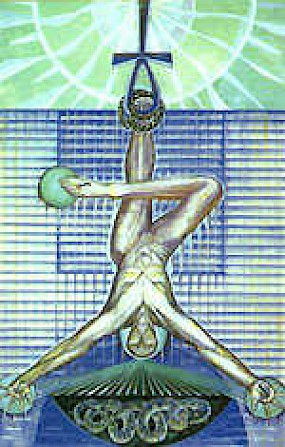
The Hanged Man is numbered twelve and is depicted as a figure, usually male, hanging upside down from a tree or branch. He often has his hands behind his back, as though tied (though as you can see the Thoth interpretation moves away from this aspect of apparent helpnessness). Usually one leg is tucked behind the other to form a triangle shape. Strangely though, he tends to look quite happy and content with his situation.
Not a very popular card, the Hanged Man deals with sacrifice, delays and waiting – and also being bogged down and helplessness. We sacrifice every time we make a choice – reading this web page means you have sacrificed reading the alternatives. Since sacrifice can mean giving up one thing of value for another thing of equal or greater value, this card can easily be seen as representing the natural and normal function of disposing of something that no longer suits its purpose as well as its replacement will.
The Hanged Man is totally vulnerable, his attitude is “whatever will be, will be”. He accepts everything that happens with equanimity and courage – he is, after all, simply giving in to his destiny. He can sometimes represent the person who has waited too long, who is perhaps scared to change. We should endure with strength and inner peace, but also be courageous enough to take action when destiny calls.
There are five hindrances, according to Buddhist philosophy, that block wisdom. Each influences happiness and fosters suffering. You will reduce your karma and increase contentment if you purge or curtail them.
We often become more sage-like when we examine our lives, particularly our thoughts and behaviors. When we recognize the benefits of handling challenges such as difficult emotions and thought patterns, wisdom increases, widening the path so we can better traverse life without stumbling.
The hindrances include sensual desire, ill will, sloth and torpor, restlessness and worry, and doubt. The fourth hindrance, restlessness, and worry, affects us all and can create poor mental health. If you’ve ever fretted late at night about a problem or agonized over an adverse event, you know how detrimental worrying is to well-being.
Many of us use the phrase “don’t worry” with ease. We tell people we care about to stop worrying because we dislike seeing them suffer when they are anxious. Sometimes, though, our instructions are easier to utter than follow.
According to Buddhism, restlessness is uddhacca or agitation, which means to shake. It refers to a wandering mind. For example, you are restless and unable to focus when your mind flits from one idea to another.
I recall being restless and anxious once when I had a fever. I tossed and turned, unable to lie still or gain peace of mind. Whether we toss and turn physically or mentally, our well-being is compromised. We need to stop our bodies or thoughts from racing.
If you engage with the fourth hindrance, your scattered thoughts make you anxious and are likely to produce remorse. For instance, you may worry you’ve said something that will offend someone. As a result, perhaps you’ll imagine the individual might reject you or tell people you are unkind.
If you’re sensitive about how others see you (and who isn’t?), your heart will sink after you’ve said something you regret. Your comment may have been misunderstood, and now somebody judges you harshly and is offended. Being misinterpreted feels dreadful, and you might beat yourself up because you could have explained yourself more clearly.
Worry can create remorse when you are anxious about the future, imagining many challenges in your path that you don’t know how to handle. As a result, you regret agreeing to attend an event that bothers you or getting involved in circumstances you can’t control. Then again, you may feel forced into troubling situations.
Some of my greatest worries when I was young stemmed from family dramas instigated by other people. Even from the sidelines, I would fret, hoping everyone would get along. As the family peacemaker, I felt obliged to attempt to smooth away the creases in close relationships and make everything better. But it’s not always advisable to step into complex scenarios. Sometimes, letting those who make their beds lie in them is wiser.
Restlessness and worry create stress and stop you from focusing on tasks. They might also cause you to endure sleeplessness and narrow your perspective, so you don’t see the complete picture regarding circumstances. The fourth hindrance is a standard block to meditation, too, since many people experience worries when they sit to meditate in a distraction-free environment.
Often, people want to meditate because they wish to stop worrying. As soon as they sit still, their anxiety streams since it’s got room to flow. The way to handle the deluge is to observe it rushing by, letting it move as though on a conveyor belt. Just because your worries are on the belt doesn’t mean you must gather them and accept them as yours. However, it takes practice to get to the point when you can witness your thoughts, and worrying can block your meditation.
Why people worry
Scientists believe worry is a normal part of being human and developed to aid survival. For example, your ancestors benefited from considering potential mishaps, such as the likelihood of predator attacks. Now, people entertain different worries (whether their friends like them and how successful they are), but they still experience their concerns as serious threats.
You may worry and be restless if you imagine you’ve strayed from your moral compass. One way to reduce concerns is to be mindful of your everyday actions and practice loving kindness. Sometimes, people might misperceive your intentions, but at least you’ll know you acted within your ethical guidelines and need not experience remorse.
At times when I’ve regretted saying something that was misinterpreted, I’ve reminded myself that I can’t control how others perceive what I tell them. Then, I understand it’s best to let go of worry. People will see you through their level of understanding rather than as you see yourself; whether you worry or not won’t change that.
It’s usual to worry now and then. However, if your mind is restless and you worry too often, you could regularly fall into a fight-or-flight state and suffer stress-related conditions. You will also focus on the past or future rather than the present.
I’ve met many people in a stuck state through my work in mental health and socially. Going over the past and worrying constantly kept them from the present moment (where their circumstances had improved).
How to reduce restlessness and worry
· Stay present
· Note restlessness in the body
· Focus on breathing
· Practice self-forgiveness and learn from experiences
Unless you’re in the middle of a challenge, an argument perhaps, the present moment is a refuge. It’s where you can rest and stop worrying because your concerns don’t exist here.
Most people worry less when they stay present. However, your mind may wander to past events you perceive as adverse when you are restless.
You could think about events that didn’t go to plan or consider what may happen in the future, and if you’re remorseful, you regret saying or doing something. Or perhaps you regret not saying or doing something. As a result, you experience aversion, guilt, and shame.
When restlessness and worry threaten to steal your peace of mind, bring your attention to the present. Use your senses to help you hone in on the moment. For example, note what you can smell, see, hear, touch, and taste.
You can also pay attention to what you do, being mindful of your physical movements as you stretch your arms to wash your car or note the warm water on your skin as you shower.
Physical restlessness
I remember twitching and rolling in bed during my fever, which exhausted me. It wasn’t only the heat that caused me anxiety; it was continual physical movement. When you exercise, you may feel exhilarated. But you are on edge when you toss and turn due to an illness, stress, or another adverse reason. Your mind imagines you’re in a battle dodging bullets. And in some ways, you are since you’re fighting with your urge to move or your thoughts that make you jittery.
Resisting worries can worsen the situation, causing you to pour attention into your concerns. So, instead, acknowledge the fourth hindrance without putting up a fight. Observe your experience, recognizing how it affects you physically.
Does it create tension in your jaw? Or tight knots in your stomach? If so, breathe into the area and relax, releasing strain and increasing calmness.
If you are restless but not focusing on a particular worry, notice where you experience agitation in your body. Is there unease high in your chest? Or maybe you have palpitations? Breathe into these areas without aversion to your restlessness, and it will ease.
Sometimes, my body responds to stress, while my mind is much more Buddha-like. Unlike a real Buddha who is balanced, this signals I’m overriding my concerns with intellectual wisdom rather than applying sagacity. Listening to my body and checking in with my breath helps me align all parts of me with calmness.
When you are restless and worried, your mind and body are in a state of tension. But you can generate peacefulness by breathing like you do when you are more tranquil, low down in your belly.
Take deep breaths as if pulling them into your stomach. Be sure to do so comfortably rather than forcefully, and inhale and exhale slowly. Continue to follow your breath with your awareness, and troubling thoughts will fade as you relax.
Self-forgiveness and learning
Looking at the past, I see I could have made better choices. But I understand I did my best. I’m different now. Wiser. It’s impossible to time travel and use my current wisdom in the past. So, I’m left with the understanding that I did what I thought was right then, and my decisions made me who I am today, smarter and more sage-like.
When beset by remorse that makes your mind spin, recall that you can only ever act with the knowledge and understanding you have at any given moment. Sometimes, you might make unwise decisions or do regrettable things because you’re experiencing a learning curve. Mistakes can teach you how to improve your life and do better next time.
You might also remember that, according to Buddhism, karma takes care of your life lessons, offering opportunities to address imbalances and gain wisdom through experiences. You are not alone. Everyone makes blunders. It is essential to acknowledge them and use them to aid personal growth.
Once you do so, self-forgiveness becomes easier. Perceiving you recognize your gaffes and understand how to embark on self-improvement will help you let go of remorse and embrace positivity.
Positive solutions
Knowing I’m constantly learning and growing reduces my worries. Challenges and mistakes are part of knowledge-gathering because they help me. The moment I recognize this, instead of panicking about and expanding them, I let them fade and concentrate on improving.
Restlessness and worry create a sense of helplessness when you focus on what you dislike about your actions. However, you can develop a positive frame of mind by finding solutions to problems.
For example, rather than worry about whether a friend is upset with you and ponder the potential fallout, consider how to improve circumstances. Perhaps you can contact her and determine whether you’ve made an incorrect assumption. If she is upset, you can think about how to make amends.
Sometimes, you can’t alter circumstances, yet you can reframe them and think about them differently. A positive solution in such a situation is to consider how to behave differently if a similar event occurs and to expand self-knowledge, noting what caused your behavior.
The fourth hindrance, restlessness and worry, can block wisdom and create stress. But you can use it to further self-understanding and personal growth. Acceptance and self-examination, rather than ponderance on aversion, result in greater understanding.
When the fourth hindrance blocks your ability to focus and relax, drop resistance, allow the experience, and transform its energy into awareness until it leaves.
Routine can be a beautiful thing. As a matter of fact, it was developing a healthy and productive routine that got me out of butcher work and into a PhD program.
But routine, like most things, cuts both ways.
Routine can also bring complacency if performed for too long without re-evaluation. It can put blinders on that grow at a fingernail’s-pace over time, causing you to lose sight of what’s important, or blind you from the possibility of considering new activities or perspectives worth adding to your day-to-day routine in place of something that’s overstayed its welcome.
Being too deep in a routine can lower your head closer and closer to your work desk over time to the point that you forget to come up for air. With your head down and your hands hard at work, it becomes increasingly difficult to see anything else. New ideas and new perspective — both incredibly valuable to any line of work — fly over our heads without us even noticing.
This is why you need disruption.
I write about Thoreau a lot. Most importantly, I greatly admire Thoreau because he dared to live against the grain in a way that was productive and had lasting influence on American cultural heritage. But the reason I find great pleasure in writing about him from a scholarly perspective is because a) his work is wildly misunderstood by even those who teach it to impressionable high schoolers, and b) this rampant misunderstanding of his work and thought leaves an abundance of opportunities for me to try and do my part, as many incredible scholars before me such as Jane Bennett and Branka Arsic have before me, in maintaining a just understanding of his work.
One of these misunderstandings is the core tenet of Walden. Too many believe, often because their overworked and under-appreciated English teachers taught them, that Thoreau wanted everyone to give up their lives for good and live in cabins of the wood in a state of perpetual primitivism. (If I were more cynical, I would believe Walden is taught this way to make it comically easy to critique him and discredit him, because the last thing the system wants is for people to second-guess their well-enculturated consumerist tendencies, but I digress.)
Among the easiest quips folks throw Thoreau’s way is: “he wants us to live ultra-individualist lives in cabins, but had his mom do his laundry.”
There are so many things wrong with this criticism that betray a severe lack of understanding of Thoreau and his personal life (or even basic sympathy for a man’s relationship with his mother). But when you consider that he also left the cabin on several occasions to fulfill his duties as a staunch abolitionist, working to repeal fugitive laws and to help runaway slaves establish themselves, suddenly things are more grey to critics. Now, they don’t know what to make of this contradiction. How can he want us to give up everything we own and live in the woods forever, but also want us to be politically active in the pursuit of social justice in modern life? This is because this contradiction only relies on a misunderstanding of Walden’s lessons.
Thoreau never wanted us to abandon modernity to live in cabins in a romanticized pastoral setting, and especially didn’t want people abandoning political responsibilities of social justice.
So what did he want? What was the moral of Walden?
Thoreau critique in academia seems to have, for the moment, landed on two main ideas. The first is that Thoreau as a literalist believed you can’t understand what a home is unless you build one, what nature is unless you live in it, food unless you grow and harvest it, etc. this is further explored in Branka Arsic’s Bird Relics. More relevant to the topic at hand however, in Jane Bennett’s work, she argues that Thoreau believed the only way to see clearly one’s personal situation more clearly, to “trim the fat” as it were, is to temporarily remove yourself from the rut and routine of modern life in order to gain a new perspective and make changes according to what you find when you strip your life to the bare essentials.
But is this necessary to make improvements to your life? Do you really need to screw off into the woods for two years and build a cabin from scratch for clarity while hoeing beans? This would be an unreasonable request of someone who works full time and has bills to pay, but luckily, there are much less extreme ways to disrupt your life but still experience the benefits of a new perspective far from your day-to-day routine. Thoreau merely went to incredible ends to make his point, so we didn’t have to.
Much to the chagrin of my overworked colleagues who believe I “shouldn’t have the time”, I make it a point to grab a campsite in Rocky Mountain park or Roosevelt National Forest at least a couple times a month during the semester to a) free me from the infinite distractions found in a one-bedroom apartment and write in peace to the white noise of the mountains and b) to remind myself that life passes by too fast to keep my head buried in emails and books without pause. Even more audacious, is that I go fishing in the mornings before the work day starts as the perspective offered from fly fishing gives me the clarity and slowness needed to make it through grad life without significant adverse mental health effects. (I have to drive my wife to the bakery at 5 in the morning for work, so I’m up anyway. Make the best of your situation, right?)
At the campsites, I bring my laptop to write without internet. This is where my best writing comes out. And, the amount of times my muscle memory drives me to click into facebook or youtube from my browser while I write is downright comical and always reinforces to me how much I need disruption of this nature.
Now, as a married, stipend-ed PhD student without kids who lives two blocks from the campus I work at in Boulder, Colorado of all places, I understand that I am an outlier in terms of opportunities for disruption of a transcendental nature. But in truth, those of us who have the time and means to read an article on Medium, for the most part, have unprecedented opportunities for “getting away” for a weekend.
And by “getting away”, I do not mean just spatially relocating yourself for a few days.
True disruption of a transcendental nature requires us to strip away as much of the fat as we can from our lives. A weekend trip to an AirBnB or a resort with full-access internet only one click away from takeout is not really disrupting much. There’s very little keeping you from checking your emails, or itching at your neck looking for that next sweet fix of a red notification bubble. There’s nothing stopping you from doom-scrolling. You’re just doing more of the same, but somewhere else.
A weekend campsite getaway, on the other hand, comes with a lot of conditions.
You have to set up your own shelter
You probably won’t have service
Even if you do, you’re gonna run out of charge pretty quick (If you brought enough backup battery to fuel a whole night of entertainment on your phone, then you refused to disrupt before you even left the driveway.)
You have to prep your own food without the luxuries of a typical kitchen
If you want heat and comfort, you’re going to have to put the time into tending a fire.
Noise pollution is nonexistent. You might actually find yourself silently alone with your thoughts while staring at your fire. Speaking from experience — this is terrifying, but we need it.
The reason these trips into the wilderness are so valuable to me, so much so that I still do them religiously in spite of the fact that screwing off into the woods for a night regularly makes me look like a lazy, unmotivated loafer of a PhD student to my colleagues is because of how much I’ve come to appreciate the art of disruption and use it to better myself as a writer, educator, husband, and friend. Without disruption, I would be swallowed whole with the never-ending pointless email chains and busy work that swarms like black flies. At the most basic — I disrupt myself while I can, until the inevitable day comes when I can’t, and I lose myself forever to the void of the mundane and the modern.
But for now, I continue this ritual. Every time I return home from a night in the Rockies, I feel as though I’ve learned something important about myself, my perspective, my habits, and my routine. Through the simple act of taking the opportunities you can to forcible disrupt and remove yourself from the rut of your own routine to see your own life from a different perspective, I can near guarantee you that you will make a concerted effort more often to pick yourself up, and drop into a situation in which you can not rely on your routine or subconscious to guide you through the days.
For you, it might not even be camping. I only use it because I’m a firm believer that forcibly placing yourself into the outdoors for extended periods of time is crucial to your wellbeing. For many, even just a day of hiking interspersed with quiet moments on a rock or stump is enough.
Regardless of the how, I implore you to find more opportunities to disrupt your own life in a meaningful way. You might find that the different perspective leads you to an answer you didn’t know you were searching for.
Consciousness, spirituality, biography, sexuality, androgyny, futurism, space, the arts, science, astrology, democracy, humor, books, movies and more