THE D.C. BOARDING HOUSE THAT MOVED THE NEEDLE ON SLAVERY

Where Abolitionists and Congressmen—Including Lincoln—Dined, Debated, and Became Bedfellows

Abraham Lincoln was a guest at Ann Spriggs’ Washington, D.C. boarding house—where abolitionists slept, ate, and discussed how to bring slavery to an end. Illustration by Jay Hambidge, from The Boys’ Life of Abraham Lincoln by Helen Nicolay (1906). Courtesy of the Internet Archive.

by BENNETT PARTEN | JULY 31, 2023 (ZocaloPublicSquare.org)

In the early 1840s, where the steps of the Library of Congress now stand, a group of American abolitionists gathered in a modest boardinghouse to plot the destruction of slavery.

The house belonged to a relatively obscure Washingtonian, a widow named Ann Sprigg. In those days, boardinghouses like Sprigg’s were fixtures of the capital landscape—where congressmen, senators, government officials, and the like tended to live during legislative sessions. Quarters were often cramped. Men rented a room—or just a bed, or even half of a bed—and communed in shared bathrooms and living spaces, with the day’s debates sometimes carrying over to the dinner table. Many houses developed reputations as being favored by certain factions, turning them into political clubs as much as living quarters.

In 1841, Ann Sprigg’s house came to be known as the “abolition house.” Three anti-slavery Whig congressmen—Seth M. Gates, a New Yorker, William Slade, a Vermonter, and Joshua Giddings, an Ohioan—moved in alongside two prominent abolitionists, Theodore Dwight Weld and Joshua Leavitt. Leavitt—a wealthy New Yorker who shared a Sprigg House bed with Weld—quickly set about convincing the representatives to work alongside the wider abolition movement as an anti-slavery lobby. The group became the brain trust behind the first significant congressional campaign to combat slavery from the nation’s capital.

The brain trust’s goal was straightforward: to develop a caucus within the legislature, a lobby to influence the legislature, or at the very least an argument that would challenge the power of slavery and slaveholders in the American government. But it was also radical, representing a major sea change in American history, and ultimately a turning point in slavery’s demise. Up until this point, the anti-slavery movement had largely eschewed politics. Led by William Lloyd Garrison and his followers, the early abolitionists focused strictly on changing hearts and minds—what they called “moralsuasion”—not changing votes. Garrison once even burned copies of the U.S. Constitution (which he called “a Covenant with Death and an Agreement with Hell!”) on stage—a flaming, charred reflection of the fact that he preferred challenging slaveholder power from outside the halls of power.

It was there at the dining room table that anti-slavery politicos put together a strategy for combatting slavery within the halls of Congress, a change that thrust anti-slavery activism away from the fringe and placed it right in the heart of American politics.

By the time the brain trust moved into the Sprigg House, however, the movement had started to splinter, with more abolitionists taking up the banner of political activism. A year prior, one group of abolitionists broke with Garrison by forming their own political party. Known as the Liberty Party, it was the first ever expressly anti-slavery party in American history, though it never registered more than a blip on the national political radar. As a result, many anti-slavery Whigs like Giddings and Slade opted to remain Whigs, where they could challenge slavery within the existing two-party structure.

This shift within the anti-slavery movement was partly a result of recognizing that as of the late 1830s and early 1840s, slavery’s defenders clearly had the upper hand, especially in the United States Congress. In fact, so great was slaveholder influence in the nation’s capital that in 1836 the U.S. House of Representatives passed a series of resolutions that became known as the “Gag Rule.” At the time, constituents would send petitions to their legislators to read on the house floor; the Gag Rule barred the reading of the many anti-slavery petitions congressmen received, which left slavery virtually unchallenged in Congress.

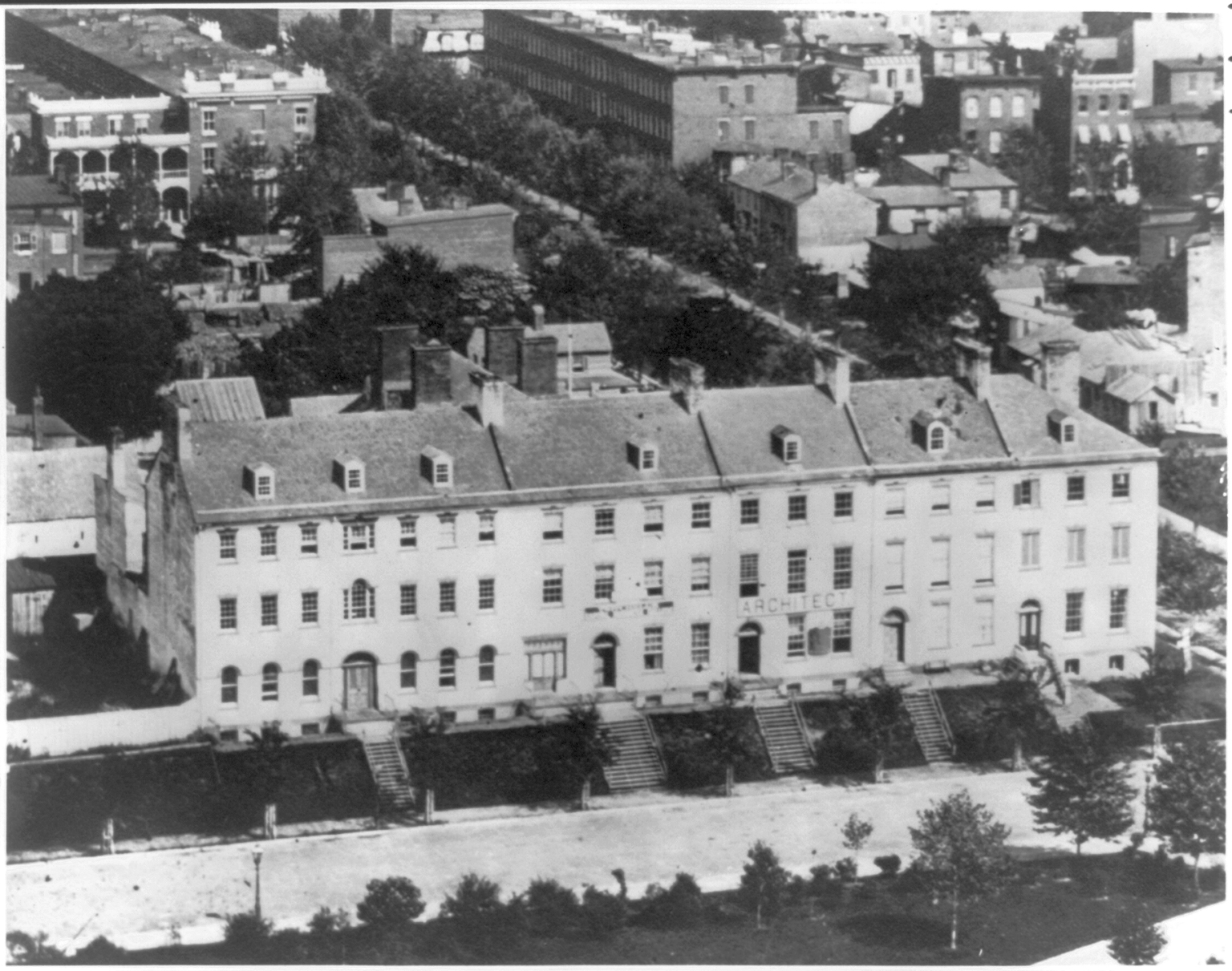
Carroll Row, which included Ann Spriggs’ boarding house, was located at the site of present-day Library of Congress. Courtesy of Library of Congress.

The first task of the boarders in the Sprigg House was to repeal the Gag Rule. Weld and Leavitt helped prepare anti-slavery speeches and advised the congressmen on strategy, forming what Giddings described as an informal “select committee.” They soon found a key ally in president-turned-congressman John Quincy Adams. Though Adams never lived in the Sprigg House, he spent hours there conferring with the boarders. Finally, on December 3, 1844, thanks in no small part to plans hatched at the Sprigg House, Congress repealed the Gag Rule, galvanizing anti-slavery politicians across the country. Many of them later became “Conscience Whigs,” a faction within the Whig Party that opposed slavery, in opposition to their rivals, the pro-slavery “Cotton Whigs.”

While not as radical as many of his “Conscience Whig” colleagues Abraham Lincoln was himself an anti-slavery Whig, and this is perhaps what drew him to the Sprigg House when he moved to Washington, D.C. in 1847 as a little-known congressman from Illinois. For the next two years, it was where he slept, ate, and debated his fellow boarders on the major political topics of the day, including the Mexican-American War, the annexation of Texas, and the possible expansion of slavery into the West. Though the other members of the brain trust had moved on by then, Lincoln’s fellow Midwesterner in the House, Giddings, still lodged there, and the two most certainly dined together when in session.

Lincoln spent only a single term in Congress, but his time at the Sprigg House was clearly a formative experience, if not also a fond memory for him. When he returned to Washington more than a decade later, this time as president of a fractured nation, he looked in on Ann Sprigg, who had since moved houses and fallen on hard times. When Lincoln learned that she needed help, he got this “most estimable widow lady” a job working as a clerk in the Treasury Department, a position that allowed her to support her family through the war.

Ann Sprigg died in 1870, and her boardinghouse—and the entire block of row houses on which it stood—was demolished in 1887 to build the Library of Congress. Since then, the story of this old D.C. boarding house and the woman who ran it has been largely forgotten. The history of the anti-slavery movement has often focused on bigger, more prominent figures and emphasized the work of activists based in New England or New York and not necessarily a slaveholding city like Washington, D.C.

Yet for the better part of a decade, Ann Sprigg’s abolition house formed the nucleus of a new political attack against slavery. It was there at the dining room table that anti-slavery politicos put together a strategy for combatting slavery within the halls of Congress, a change that thrust anti-slavery activism away from the fringe and placed it right in the heart of American politics.

BENNETT PARTENis an assistant professor of history at Georgia Southern University. He lives in Savannah, Georgia.
‘Denying our humanity’: how Santa Monica decimated a thriving Black community

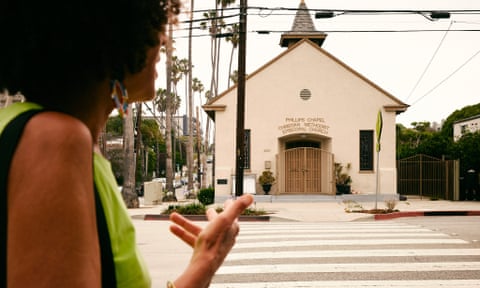
Alison Rose Jefferson showing the Phillips Chapel CME Church.

Alison Rose Jefferson showing the Phillips Chapel CME church. Photograph: Julien James/The Guardian

African Americans helped build the iconic beach town, historian Alison Rose Jefferson details as California weighs reparations

by Sam Levin in Santa Monica with photographs by Julien James

Mon 31 Jul 2023 21.49 BST (TheGuardian.com)

At Shutters on the Beach, a luxury hotel in Santa Monica, guests staying in $1,500-a-night rooms can get pristine views of white-sand shores and the Pacific Ocean, hot stone massages, afternoons filled with live jazz and fresh seafood dinners.

Few visitors, however, will know that 100 years ago, the site was at the center of a painful turning point for Santa Monica’s Black community.

In 1922, Black businessmen Charles S Darden and Norman O Houston had secured an agreement to purchase the land Shutters now stands on. They were planning to develop a “first-class resort”, complete with a bathhouse, dance hall and amusement center, one they hoped would become a national tourist destination for Black Americans.

It didn’t take long for Santa Monica’s white residents to rally in opposition. The Protective League, a citizens’ group with “a membership of 1,000 Caucasians” that aimed to “eliminate all objectionable features” from the California beach town, lobbied officials to deny the men construction permits and ensure the site was zoned for residential use only. The officials complied.

Three years later, the site became a beach club for white residents.

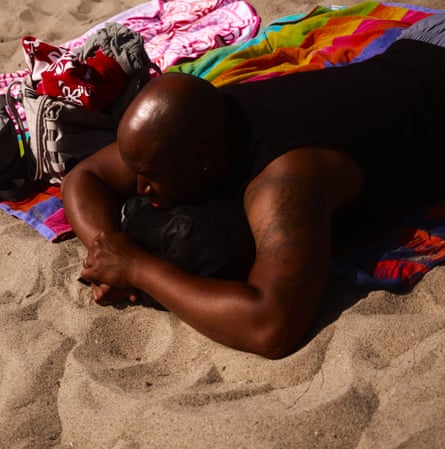
A beachgoer sunbathing in Santa Monica.

Many people are unaware that Santa Monica, the coastal enclave now known for its beaches, star residents and hot real estate, was once home to a thriving Black community. The city was at the heart of the dreams of Black entrepreneurs, who had migrated west with their families hoping to flee prejudice and find fortune.

“Everybody saw Santa Monica as the new place of leisure in the early 20th century, and Black folks got in where they could afford to buy land,” said Dr Alison Rose Jefferson, a historian and third-generation Los Angeles resident who has long documented African American history in the Golden state.

Over time, racist policies stripped away the community’s access to the coast, forcing many families out. Today the city is predominantly white and the history of the Black experience in the city was hidden for many people.

But as California weighs an ambitious, first-in-the-nation reparations proposal for Black residents, there’s renewed attention for these forgotten histories and fresh discussions about how the government and other institutions can make amends for generations of discrimination.

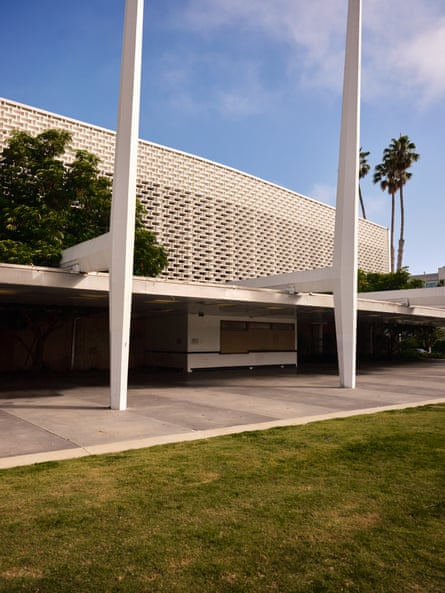
A glimpse of the unused civic center on Pico & Main St, once a site of African American community and businesses, before the city seized them through eminent domain to pave the way for the Santa Monica Civic Center.

“Excluding Black folks from community development impacted not only our economic resources, but also our quality of life,” said Jefferson while standing in front of the would-be Black resort plot on a surprisingly cool morning last week.

“Black folks were trying to just be, and recreation was part of that. We needed relaxation and ways to reinvigorate ourselves just like white folks. This was denying our humanity.”

Jefferson has researched the history of Santa Monica for decades, documenting the challenges and triumphs of community building by Black entrepreneurs and families along the beach. Her work will be on display in Black California Dreamin’: Claiming Space at America’s Leisure Frontier, an exhibit opening next month at the California African American Museum in LA.

A beach community rises

Our first stop on a tour through Santa Monica’s historic neighborhoods was the corner of 4th and Bay street, where the Phillips Chapel Christian Methodist Episcopal church stands on a palm tree-lined street.

“Think of dropping a pebble in a pond and seeing the waves go out. This church was the pebble and the waves were where African Americans settled,” Jefferson said.

The church was established there in 1908 and became the epicenter of Santa Monica’s Ocean Park neighborhood, at one point visited by the poet Langston Hughes.

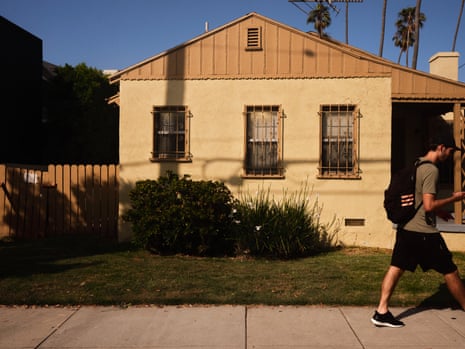
A pedestrian walks past a home
A pedestrian walks past a home owned by the Phillips Chapel CME church on the corner of 4th & Bay St in Santa Monica, California.

“This land, four blocks from the beach? It’s the epitome of why people were moving to California, for this beautiful landscape and better life opportunities.”

Black Americans migrated from US southern states to Santa Monica in the late 1800s, establishing neighborhood clusters alongside white people, Chinese and Japanese communities, new Mexican immigrants, Californios (Hispanic people who’d lived in the state before it came under US control) and Jewish residents. Jefferson’s family came to LA from Montgomery, Alabama, in 1925, her grandfather one of the few Black physicians in LA.

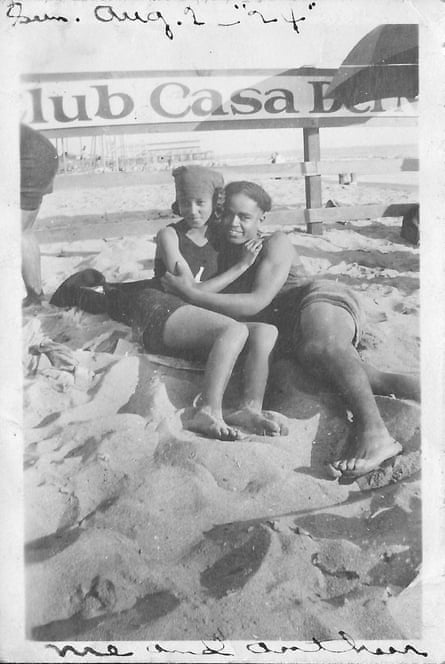
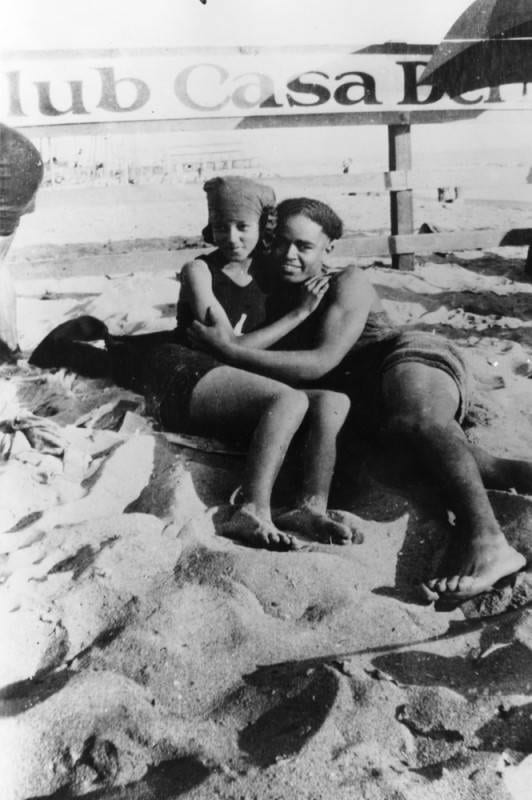
Verna Deckard Lewis (later Williams) and Arthur Lewis in front of the Casa del Mar beach club fence, Santa Monica, California, on 2 August 1924.
Verna Deckard Lewis (later Williams) and Arthur Lewis in front of the Casa del Mar beach club fence, Santa Monica, California, on 2 August 1924. Photograph: Verna Deckard L Williams Collection; courtesy Arthur and Elizabeth Lewis

The Stouts, the Gordons, the McCarrolls – Jefferson rattled off names of prominent Santa Monica families who first bought homes near the church. A few had vegetable gardens and chickens in their yards. Locked out of many professions, Black entrepreneurs opened barber shops and salons, trucking businesses, boarding houses, mortuaries and other small enterprises, she said.

As white residents and merchants found ways to block Black residents from clubs and beach areas (in violation of unenforced civil rights laws), a Black beach began to emerge in one area near the church. The Bay Street Beach, which white residents pejoratively referred to as “the Inkwell”, along with La Bonita, a Black-owned bathhouse and lodge, were advertised in national African American travel guides, starting around the 1930s, Jefferson said.

There was a popular nightclub down the street, which thrived until 1922 when white residents petitioned the city to pass a “blanket ban on dance halls” in the area. “Black folks were just having too much fun,” Jefferson said. She cherishes a photo from that decade of two Black newlyweds smiling on the beach in front of a sign for a whites-only club: “They were staking out their territory, saying this is our place and we’re having a good time, even if they were being excluded from that zone.”

Some efforts at exclusion and displacement, however, were too great to overcome.

Houses burned down

In the 1950s, governments across the US began decimating Black neighborhoods through “eminent domain”, seizing private land for public projects. The construction of freeways and other public facilities and infrastructure tore through Black historical enclaves in cities such as Miami, Nashville, Montgomery, New Orleans, Kansas City and Oakland.

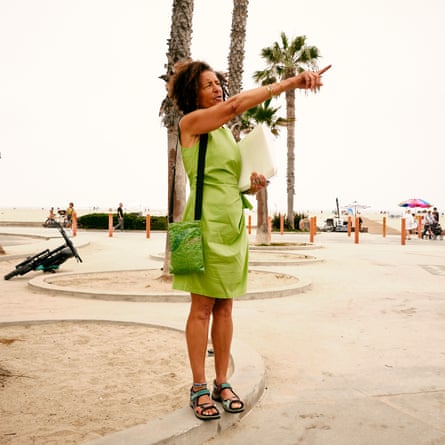
Woman in green dress pointing
Historian Alison Rose Jefferson at Santa Monica Beach.

In Santa Monica, the Interstate 10 freeway displaced an estimated 600 predominantly Black families. One house destroyed had belonged to Nick Gabaldón, the first documented Black and Mexican American surfer in Santa Monica, and “a symbol for all African Americans striving for self-fulfillment and to take advantage of everything the California Dream had to offer”, Jefferson said. Families were dispersed to areas they could afford – far from the beach.

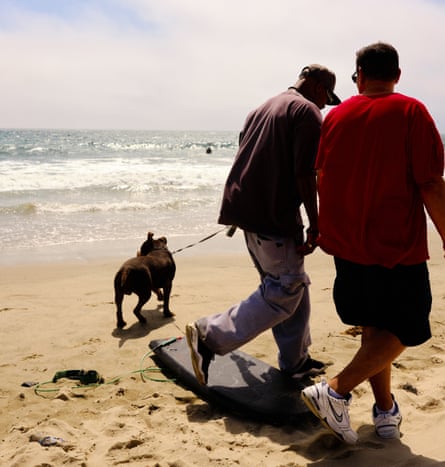
Two men and their dog walking along the shore at Santa Monica Beach.

In 1957, three decades after Darden and Houston’s resort proposal was blocked, entrepreneur Silas White had his own plans for a beach club. The Ebony Beach Club would be a membership-based recreation and entertainment venue in a long-vacant building, down the street from the historic church. The project had the support of Nat King Cole, but two months before it was set to open, the city voted to seize the land to build a parking lot for a new “civic auditorium”, a project that ultimately razed the Black neighborhood known as Belmar Triangle. In some instances, the city burned down homes considered “blighted” and then publicized photos of the torched structures to further justify the taking of land in the area, Jefferson said.

“Everybody was furious. It certainly hurt,” said Cristyne Lawson, 88, who grew up in the neighborhood and was close with White’s family. “Imagine a Black beach house in Santa Monica. No, they weren’t going to let that happen.”

Before his land was taken, White put up a large banner that accused the city of using eminent domain “for racial discrimination”. His supporters protested at city hall.

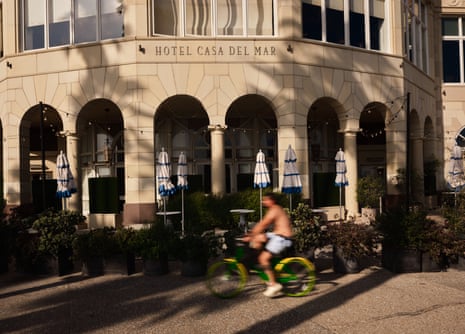
Luxury Hotel Casa del Mar sits by the historic beach where Black residents gathered in the early 1900s.

There were other battles over civil rights. In 1920, a lawsuit challenged off-duty sheriffs who shot a Black man accused of stepping on private property at the beach. One resident refused to move out of the white section of a movie theater in the 1940s, launching a legal battle that desegregated cinemas. A major Sears store faced large protests over hiring discrimination in 1947.

Lawson, who today lives a block away from her childhood home, said she has mostly fond memories of her upbringing in the 40s and 50s. Her mother was a musician and father the city’s second Black councilman in the 70s: “There were all kinds of people who lived here … it was the only area where Black people had access to a beach from where they lived.” She remembers dance instructors refusing to teach her ballet as a child, but she ended up studying with a Black ballerina and became a renowned dancer and college dean.

She said she’d love to see thriving establishments for Black residents in Santa Monica today, but is not sure that’ll ever happen: “We were like a little country town when I grew up here. Now, it’s become one of the most expensive places to live.”

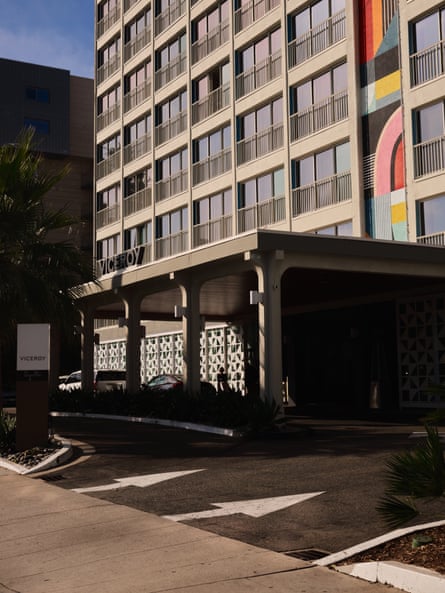
The Viceroy Hotel in Santa Monica. The property was previously owned by Silas White, a Black entrepreneur and founder of the Ebony Beach Club.

‘We’re our own changemakers’

In June, California released its 1,080-page reparations report outlining more than a century of discrimination against Black Californians since enslavement, including through housing segregation, environmental racism, an unjust legal system and mental and physical harm and neglect.

The commission that drew up the report also put forward recommendations as to how descendants of enslaved people and free Black residents in the US before 1900 could be compensated for past harms. The state legislature will now consider the proposal.

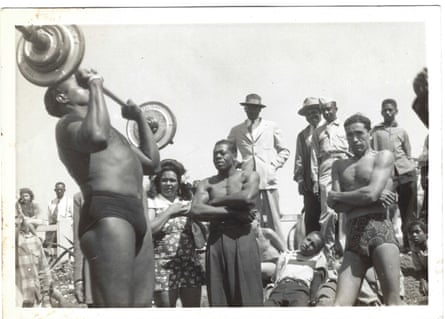
John “Johnnie” Rucker and friends at the beach near Bay Street, Santa Monica, participating in the Black bodybuilding culture of the era, circa 1945–50
John ‘Johnnie’ Rucker and friends at the beach near Bay Street, Santa Monica, participating in the Black bodybuilding culture of the era, circa 1945–50 Photograph: Courtesy Konrad Rucker

Meanwhile, there have been some small-scale attempts to start to compensate families. Last year, LA county returned beachfront land just south of Santa Monica to descendants of a Black family who had valuable property seized by eminent domain in the 1920s. In 2021, the city of Santa Monica also launched a “right to return” affordable housing program for families displaced by the 1950s freeway, but reports in April suggest only 11 applicants were deemed eligible.

Jefferson points out that the displaced families were homeowners: “So why can’t they be owners now? Why can’t they be helped to buy homes?”

Men enjoying fresh fruit from the fruit cart at Santa Monica beach by the Hotel Casa del Mar
Men enjoying fresh fruit from the fruit cart at Santa Monica beach by the Hotel Casa del Mar.

Reparations, Jefferson says, should involve broader efforts to make Santa Monica affordable and beaches more accessible. The process starts with documenting the history, which Jefferson has done in her book on Black leisure sites in California’s Jim Crow era, a Santa Monica essay and with commemorative signs and a public art project in the Belmar neighborhood.

Walking past her panels showing joyful archival photos of African American families in the early 1900s, she says, “Hopefully this helps Black folks realize the contribution we made … that although we have been victimized and discriminated against, we’ve also been our own changemakers. And hopefully it helps white folks realize they weren’t the only ones here.”

  • This article was amended on 31 July 2023 to correct the names of some of the early Black settlers in Santa Monica and to note they had vegetable gardens, not farms.

The Donkey and the Meaning of Eternity: Nobel-Winning Spanish Poet Juan Ramón Jiménez’s Love Letter to Life

By Maria Popova (themarginalian.org)

Beneath our anxious quickenings, beneath our fanged fears, beneath the rusted armors of conviction, tenderness is what we long for — tenderness to salve our bruising contact with reality, to warm us awake from the frozen stupor of near-living.

Tenderness is what permeates Platero and I (public library) by the Nobel-winning Spanish poet Juan Ramón Jiménez (December 23, 1881–May 29, 1958) — part love letter to his beloved donkey, part journal of ecstatic delight in nature and humanity, part fairy tale for the lonely.

Healer on a Donkey by Niko Pirosmani, early 1900s.

Living in his birthplace of Moguer — a small town in rural Andalusia — Jiménez began composing this uncommon posy of prose poems in 1907. Although it spans less than a year in his life with Platero, it took him a decade to publish it.

At its heart is a simple truth: What and whom we love is a lens to focus our love of life itself.

The tenderness with which Jiménez regards Platero — whom he addresses by name over and over, like an incantation of love — is the tenderness of living with wonder and fragility. He celebrates Platero’s “big gleaming eyes, of a gentle firmness, in which the sun shines”; he reverences him as “friend to the old man and the child, to the stream and the butterfly, to the sun and the dog, to the flower and the moon, patient and pensive, melancholy and lovable, the Marcus Aurelius of the meadows.” He beckons him: “Come with me. I’ll teach you the flowers and the stars.”

And so he does:

Look, Platero, so many roses are falling everywhere: blue, pink, white, colorless roses… You’d think the sky was crumbling into roses… You’d think that from the seven galleries of Paradise roses were being thrown onto the earth… Platero, it seems, while the Angelus is ringing, that this life of ours is losing its everyday strength, and that a different strength from within, loftier, more constant, and purer, is causing everything, as if in fountain jets of grace… Your eyes, which you can’t see, Platero, and which you are mildly raising skyward, are two beautiful roses.

Together, poet and donkey traverse the Andalusian countryside in a state of rapturous harmony with each other and the living world:

Through the low-lying roads of summer, draped with tender honeysuckle, how sweetly we go! I read, or sing, or recite poetry to the sky. Platero nibbles the sparse grass of the shady banks, the dusty blossoms of the mallows, the yellow sorrel. He halts more than he walks. I let him.

[…]

Every so often Platero stops eating and looks at me. Every so often I stop reading and look at Platero.

There are echoes of Whitman in Jiménez’s exultations:

Before us are the fields, already green. Facing the immense, clear sky, of a blazing indigo, my eyes — so far from my ears! — open nobly, welcoming in its calm that indescribable placidity, that harmonious, divine serenity which dwells in the limitlessness of the horizon.

Art by Ryōji Arai from Every Color of Light

This longing for the infinite accompanies the young man and the old donkey as they cross the hills and valleys on their daily pilgrimages:

The evening extends beyond its normal limits, and the hour, infected with eternity, is infinite, peaceful, unfathomable.

Again and again, Platero’s presence magnifies the poet’s relishing of beauty, deepens his contact with the eternal:

I remain in ecstasy before the twilight. Platero, his black eyes scarlet with sunset, walks gently to a puddle of crimson, pink, and violet waters; he softly immerses his lips into the mirrors, which seem to liquefy as he touches them.

Punctuating these ecstasies are the inevitable spells of melancholy stemming from the fact that the price of being awake to life is being also awake to mortality. Aware that this enchanted life with his beloved Platero is only for the time being, Jiménez reaches into the sorrow of the future to consecrate it with joy:

Platero. I shall bury you at the foot of the large, round pine in the orchard at La Piña, which you like so much. You will remain alongside cheerful, serene life. The little boys will play and the little girls will sew beside you on their little low chairs. You will get to hear the verses that the solitude will inspire in me. You’ll hear the older girls singing when they wash clothes in the orange grove, and the sound of the waterwheel will be a joy and a solace to your eternal peace. And all year long the goldfinches, greenfinches, and vireos, in the perennial freshness of the treetop, will create for you a small musical ceiling between your tranquil slumber and Moguer’s infinite, ever-blue sky.

I read these pages thinking how everything we polish with attention becomes a mirror. So too the donkey becomes a mirror for the poet’s own soul:

Every so often Platero stops drinking and raises his head, like me, like the women in Millet’s paintings, to the stars, with a soft, infinite yearning.

Art by Ryōji Arai from Every Color of Light

Emanating from these vignettes is a reminder that the art of poetry, like the art of living, is a matter of the quality of attention we pay to things — a living affirmation of Simone Weil’s insistence that “attention, taken to its highest degree, is the same thing as prayer.” Jiménez exults:

What a morning! The sun poses its silver-and-gold cheerfulness on the earth; butterflies of a hundred colors play everywhere, among the flowers, through the house (now inside, now out), on the fountain. All over, the countryside opens up into crackings and creakings, into a boiling of healthy new life.

It’s as if we were inside a huge honeycomb of light which was also the interior of an immense, flaming-hot rose.

One clear blue morning, the poet and the donkey come upon a gang of “treacherous boys” who have spread a net to catch birds from the nearby pinewood. Overcome by compassion for Platero’s “brethren of the sky,” Jiménez sets out to warn the birds in a scene that, once again, ends with the infinite sympathy that flows between him and his donkey:

I mounted Platero and urged him onward with my legs, and at a sharp trot we ascended to the pinewood. When we arrived below the shady leafy cupola, I clapped my hands, sang, and shouted. Platero, catching the mood, brayed roughly a couple of times. And the deep, resonant echoes replied, as if from the depths of a large well. The birds flew away to another pinewood, singing.

Platero, amid the distant curses of the violent little boys, was brushing his big shaggy head against my heart, thanking me until he hurt my chest.

Art by Spanish artist Roc Riera Rojas from a rare edition of Don Quixote

Jiménez’s bright sympathy with living things extends beyond the world of animals. It is in these bonds of sympathy, of interbeing, that he finds the portal to the eternal:

Whenever I halt, Platero, I seem to be halting beneath the pine of La Corona… spreading green plentitude below the broad blue sky with white clouds… How strong I always feel when I rest beneath its memory! When I grew up, it was the only thing that didn’t cease to be big, the only thing that became bigger all the time. When they cut off that bough which the hurricane had broken, I thought a limb of my own had been pulled out; and at times, when some pain seizes on me unexpectedly, I imagine that it hurts the pine of La Corona.

[…]

The word “great” befits it as it does the sea, the sky, and my heart. In its shade many generations have rested, looking at the clouds, for centuries, as if on the water, beneath the sky, and in the nostalgia of my heart. When my thoughts wander freely and the arbitrary images settle whenever they wish, or in those moments when there are things that are seen as if by second sight, apart from that which is distinctly perceived, the pine of La Corona, transfigured into some picture of eternity, comes to my mind, more rustling and more gigantic yet, amid my doubts, beckoning me to repose in its peace, as if it were the true and eternal terminus of my journey through life.

Trees figure amply in Jiménez’s poetic imagination:

This tree, Platero, this acacia which I planted myself, a green flame that went on growing, spring after spring, and which now covers us with its abundant free-growing foliage, shot through with the setting sun, was the best support of my poetry as long as I lived in this house, now shut. Any one of its boughs, adorned with emerald in April or gold in October, cooled my brow if I just looked at it a moment, like the purest hand of a Muse.

Art by Art Young from Trees at Night, 1924. (Available as a print.)

Pulsating beneath all the vignettes is a deep sense of the poet’s unbroken solitude — even in the company of his donkey, even in his absolute presence with the living world. On a late-summer Sunday, reading Omar Khayyam under a pine tree “full of birds that don’t fly away” while the rest of town goes to church, he writes:

In the silence between two peals, the inner seething of the September morning acquires presence and resonance. The black-and-gold wasps fly around the grapevine laden with healthy bunches of muscat, and the butterflies, which are confusedly mingled with the flowers, seem to be renewed, in a metamorphosis of bright colors, as they flutter about. The solitude is like a great thought of light.

It is in this wakeful solitude amid nature that he finds what so longs for — beauty, serenity, eternity:

How beautiful the countryside is on these holidays when everyone abandons it! At most, in a young vineyard, in an orchard, some old man may be leaning against an unripe vine, above the pure stream… And one’s soul, Platero, feels like the true queen of what it possesses by virtue of its feelings, of the large healthy body of nature, which, when respected, gives the man who deserves it the submissive spectacle of its resplendent, eternal beauty.

Alongside Jiménez’s reverence of the eternal is his elegy for the passage of time, for the aching beauty of our mortal transience. When autumn comes, he writes:

Platero, the sun is already starting to feel too lazy to get out of its sheets, and the farmers are up earlier than he is… On the broad, moist path the yellow trees, sure that they’ll be green again, brightly light our rapid journey on both sides, like soft bonfires of clear gold.

[…]

These are the instants in which life is entirely contained in the departing gold…. Beauty makes eternal this fleeting moment without heartbeat, as if everlastingly dead while still alive.

Over and over, Jiménez syncopates between exultation and lament:

See how the setting sun, manifesting itself large and scarlet, as a visible god, draws to itself the ecstasy of all things and, in the strip of sea behind Huelva, sinks into the absolute silence that the world — that is, Moguer, its countryside, you, and I, Platero — pay to it in homage.

Over and over, he returns to the elemental truth of being, found in every flower and in every star — that to be alive just this moment, any moment, is enough, is eternity:

Platero, Platero! I’d give my whole life and I’d long for you to want to give yours, in exchange for the purity of this deep January night, lonely bright, and firm.

When Platero does eventually give his life, the poet meets his death with the same largehearted longing for the eternal that lives in everything ephemeral. Visiting Platero’s grave with the village children that had so loved him, he writes:

“Platero, my friend!” I said to the earth. “If, as I believe, you are now in a meadow in heaven, carrying adolescent angels on your shaggy back, can you perhaps have forgotten me? Platero, tell me: do you still remember me?”

And, as if in reply to my question, a weightless white butterfly, which I had never seen before, fluttered persistently, like a soul, from iris to iris.

The closing pages become part rhapsody and part requiem, concentrating and consecrating the tenderness that had scored the poet’s life with his donkey:

Sweet trotting Platero, my little donkey who carried my soul so often — only my soul! — over those low-lying roads of prickly pears, mallows, and honeysuckles; to you I dedicate this book which speaks of you, now that you can understand it.

Art by Ivan Bilibin, 1906. (Available as a print and as stationery cards.)

Couple the soul-slaking Platero and I with the bittersweet story of Civilón — the real-life Spanish bull who inspired the beloved children’s book Ferdinand.

Aquarius Full Moon, August 1, 2023

Wendy Cicchetti

Aquarius Full Moon

The Aquarius Full Moon presses us to work out where our principles lie and to pledge that we stand by them. In the case of trying to break a habit, we may soon realize how attached we’ve become to certain ways and rituals, and the requirement to adjust our usual behaviors could require us to work through mental or emotional baggage. For this, we should not expect fast results or a quick turnaround: planets in fixed signs show us that time and a persistent approach are needed.

Adding tension to the Full Moon is a set of squares from Sun and Moon to Jupiter in Taurus. Once again, zodiac sign fixity is underscored: we might feel caught between a rock and a hard place! Seeking compromise helps alleviate the intensity. Remember, whilst stress can seem invisible at times, it can also be clearly felt in the body or experienced in the environment, emerging in accidents, illnesses, or flare-ups, for example.

We can do ourselves a favor and avoid chronic stress if we take steps to make life easier and more manageable as we go. How this occurs will differ from person to person, but the Moon’s dispositors offer clues. With Saturn, it’s about knowing our limits and setting fair boundaries. With Uranus, maybe it’s choosing a different course of action or finding the right moment and doing something on another day.

There is also a simple, effective strategy for observing how Jupiter’s abundance can be both a blessing and a problem in our lives! Do you tend to seize too many new opportunities at once? Try using the grounding quality of Jupiter in Taurus as a reminder that there’s a limit to what we can fit in, and strive to take tangible action to assess and manage obligations more realistically, such as consulting your calendar or diary and plotting out specific hours for set tasks.

Achieving objectivity by distancing oneself from any matter and finding a clearer perspective is one of the great Aquarian strengths. In some instances, simply building in breathing space is going to be helpful. Indeed, we might even earmark time for breathing exercises, which help us to regulate energy. Practicing yogic breathwork could be a key to making subtle, regular adjustments in our routine, making each day’s tasks more approachable.

Bear in mind, no matter what strategies we aim to put in place, Jupiter could test our resolve. This is a planet that values freedom and it’s inclined, at times, to take liberties! But, if we seek it, we can find that precious middle ground, particularly by appreciating that a little flexibility, in the right context, could be a good thing. It’s perhaps only a problem if we go “all in,” without stopping to consider whether our choices and actions are wise. For if we pay no heed at all, we could just as easily become entrenched and struggle.

Something else to observe in this lunation is that Saturn opposes Mercury, suggesting arguments over boundaries and limits. Maybe we don’t like being offered fewer options or being told “no” — yet, the minimalist option could well be the right one for us!

A square of Uranus in Taurus to Venus in Leo, lodged in fixed signs, presents us with conflict. Here, we have something of a contradiction, because fixed signs tend to emphasize loyalty, whilst the square between Uranus and Venus is decidedly fidgety! So perhaps we agree to disagree in certain instances, and allow a modicum of choice, despite someone else’s insistence that their opinion reflects the official line. All in all, there’s some jostling, whilst a little give-and-take seems to be the key to managing mixed energies.

This article is from the Mountain Astrologer by Diana McMahon Collis