Printed Farms is is currently building a horse stable, a horse walker, and a manure shed that will cost a total of $3.3 million.
Printed Farms is building and 3D printing a $3.3 million luxury horse barn, horse walker, and manure shed.
When complete in August, the horse barn will be the world’s largest 3D-printed building.
This barn will house multimillion-dollar prized horses in the “Disney World for horses,” Wellington, Florida.
Insider recommends waking up with Morning Brew, a daily newsletter.Email address
By clicking “Sign Up,” you also agree to marketing emails from both Insider and Morning Brew; and you accept Insider’s Terms and Privacy Policy. Click here for Morning Brew’s privacy policy.
The next world’s largest 3D-printed building isn’t going to be a home, school, or office. Instead, it’s going to be a luxury horse barn in Wellington, Florida set to be completed in August.
If you’ve been following the 3D printing construction industry, startup Printed Farms’ decision to develop a horse facility may seem like a random idea. After all, proponents of the tech say one of its main benefits could be its ability to quickly alleviate the (human, not horse) housing crisis.
But for those who know the startup’s founder Jim Ritter, it’s an unsurprising endeavor: This horsey project is the perfect marriage between Ritter’s company and his previous passions.
Before diving into the construction-tech world, Ritter was already in the horse industry developing and renting out multimillion-dollar stables.
He founded Printed Farms in 2019. In 2020 and 2021, his startup printed projects like a tractor shed and a home.
Printed Farms is based in the same village where the luxury barn is now being built: Wellington, Florida.
Wellington is a wealthy suburb about a 30-minute drive from West Palm Beach, Florida. Emphasis on “wealthy” — the median listing price of homes is at nearly $1 million according to data from Realtor.com.
If you aren’t deep in the equestrian world, you might not be familiar with Wellington.
But if you are, you may know of the small town’s glitzy and horsey reputation. As Ritter says, “Wellington is the Disney World for horses.”
These aren’t your average horseback riders.
“Most horse people don’t work or spend money at the level of Wellington,” he said. “It’s the top of the horse sport.”
The larger facility Printed Farms is now building in this prestigious location will include three units: a horse barn, a horse walker, and a manure shed.
Only the 13-foot-tall wall systems were printed for this project.
Most of what’s left are the finishing touches like plumbing, dirt around the landscaping, and stuccoing.
Printed Farms ran into several issues throughout the construction process, although most were out of its control.
Ritter initially ordered another printer to supplement his COBOD. But this printer was delayed by nine months and didn’t arrive in time, slowing the build time. Then, hurricane season hit. Then, inflation and difficulties with supplying its initial concrete mix further delayed the building timeline.
This string of bad luck turned what could have been a two to three-month project into a nine-month process.
And it didn’t help that two people on his four to seven-person crew suddenly couldn’t work because of unrelated medical problems.
Proponents of 3D printing construction believe the tech can generally build homes cheaper, quicker, and safer while using less materials and physical labor.
In this luxury horse barn project, using a printer did save some cash.
Ritter says traditional builders constructing this style of barn would have charged between $200 to $250 a square foot.
His team charged around $200 a square foot which he says is low “because for what we build, most people would’ve charged $250.”
The building is “almost” flood and hurricane-resistant, Ritter says. It could have been fully resistant if they had included a cement roof but the buyers opted for roof trusses instead.
This concrete construction and a higher level of durability compared to traditional construction could make building and investing in this new tech worth the risk.
“If you’re getting a concrete building that can withstand climate events so you don’t have to rebuild after such an event, why not spend that money?” he said.
With how durable Ritter says this concrete printing material is, these horses could be living out the rest of their lives in this 3D-printed barn.
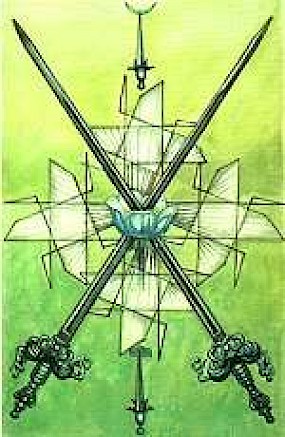
The Lord of Peace is a friendly Sword, which comes as something of a relief when we have spent so much time dealing with his more belligerent cousins. However it must be noted that the card often comes up to indicate that a conflict has been resolved or a breach healed, so there will have been trouble earlier on.
It indicates that a painful and difficult situation is being reconciled. Friendships are rebuilt, old wounds are healed. However in this context it is very important to look carefully at the cards which follow it, for there is often a feeling that a relationship will never be quite the same again as it was before the conflict or quarrel. If the Four of Swords comes up nearby, this is a clear indication that one should remain cautious and thoughtful, not giving too much in the way of trust, for some time. If the Moon was up in the reading, we would be forced to consider the possibility that all is not as it seems.
At an inner level, the Two of Swords really comes into its own, for it marks the period of tranquillity and calmness that can arise when we have finally made difficult decisions, and acted upon them. Often it will come up to show that, now we have got to grips with our confusion, we can rest and recover.
The card will also come up to show that we have let go of old fears or anxieties that were holding us back. It’s a still card indicating a time to rest and recuperate.
PODCAST: From Einstein’s initial disbelief and Bell’s test to the 2022 Nobel Prizes, quantum entanglement has matured into a pillar of physics. Physicist Nicolas Gisin explains why it took so many decades.
Adam Levy: What does quantum physics tell us about the nature of reality? Could distant particles hold an influence over each other? And is the universe really spooky? I’m Adam Levy, and this is Knowable.
This season we’re investigating just how and when ideas in science develop. Each episode looks at how one text changed the way we think, and in this episode we are looking at one text — in fact, one phrase — that’s stayed with physics for some 80 years: “spooky action at a distance.”
This is Einstein’s memorable choice of words for something that he felt was deeply wrong with the emerging ideas of quantum physics. In this episode, we’ll take a look at what Einstein found too spooky to accept, and the Northern Irish physicist John Stewart Bell, who devised a way to finally test the universe and find out whether Einstein’s skepticism was well-founded.
But before we get to that, we need to talk about the revolution that was taking place in physics in the early 20th century. It became increasingly clear that the universe didn’t work how physicists had classically described it.
Classical physics describes the world with deterministic laws which govern waves such as light and particles like electrons, but this couldn’t describe a host of phenomena that experiments had unveiled. And so this classical view of the universe was gradually being replaced by quantum mechanics, which described bizarre properties of the very small.
Nicolas Gisin: At the beginning, it was really what people call wave-particle duality.
Adam Levy: This is Nicolas Gisin, at the University of Geneva, who has worked his entire career on applied physics and quantum physics, having spent decades reflecting on quantum physics applications to communication.
OK, but wave-particle duality?
Nicolas Gisin: So you have a particle, an electron, or an atom, and all these particles will sometimes behave like a particle, so like a little billiard ball, but sometimes [they] will behave like a wave. And so this dual nature of these particles was really what kicked off everything, all quantum science, let’s say. Until the ’60s that was, and probably even later, that was really the main concern.
Adam Levy: The notion that the building blocks of the universe weren’t either waves or particles, but somehow behaved as both, turned physics on its head. But while this may have been the main concern, it was far from the only concern about the strange implications of quantum physics.
Quantum physics predicts that particles can become entangled. This suggests that two or more particles can be brought together and become fundamentally linked so that even when they’re separated, even by great distances, it’s no longer possible to describe them independently of each other. And observing one apparently affects observations of the other.
Nicolas Gisin: Entanglement has the following implication: If I now measure or do something on the first particle, somehow the second one gets affected, or the second one “shivers.”
Adam Levy: Such an idea challenged the core of Einstein’s idea of the universe, that messages could only travel through the universe at the speed of light or slower, and so no object could instantaneously influence an object separated from it. But here was quantum physics suggesting that measuring one entangled particle could cause immediate effects, or shivers, on the other.
Nicolas Gisin: Yeah. So Einstein, like many people at that time, realized that if now you do measure on one side, it has a kind of effect on the other one. One of these particles could be, let’s say, in Geneva where I’m sitting, and the other particle could be, I don’t know, in the US somewhere at a far distance, and nevertheless, these particles have this property of entanglement so that you cannot describe them just separately. And Einstein just couldn’t believe it, so he concluded entanglement is impossible.
Adam Levy: Einstein actually in 1947 wrote a letter to Max Born in which he nicknamed what we’re talking about, this non-locality, a “spooky action at a distance.” This phrase is still used to this day, but at the time, was Einstein kind of out there on his own in rebelling against these ideas, or was there a real active discussion among physicists at large?
Nicolas Gisin: Yeah. So I think Einstein several times was very accurate and inventive in coming [up] with sentences like, “God does not play dice,” or, “spooky action at a distance.” So this “spooky action at a distance” really reflects this idea that you touch the particle here in Geneva and the one in the US is shivering. So there is a kind of action at a distance. And Einstein said, “This is a spooky, it cannot really be a real one. It has to be a spooky action.”
At that time, I would say, surprisingly, physicists didn’t pay much attention to that … the very, very vast majority of physicists at that time did not at all pay attention to these questions and issues. It was also at that time impossible to turn it into, let’s say, an experiment. And some people were even thinking that this is really pure philosophy and has no physical consequences. We’ll see later that these people were completely wrong, but that was the dominant view.
Adam Levy: It wasn’t until actually after Einstein’s death, [that] in 1964 John Stewart Bell proposed a test that could potentially settle the matter. What’s the essence of this test, which we now call the Bell test?
Nicolas Gisin: So imagine now that you have your two particles, they are maximally entangled, very highly entangled, and for the sake of the explanation, think of them as coins. And so you get two possible results. If you toss your coin, it can be heads or tails. Now if you throw them the same way on both sides, the two coins, they will always both end up either both heads or both tails.
Adam Levy: This is the spookiness that quantum physics predicts, and Einstein found so unbelievable. The idea that if two particles are entangled and you separate them, you’ll get the same result if you measure a property of both of them, like being guaranteed to get the same result when tossing two separate coins. It’s as if both particles instantaneously agree to both show heads, for example.
But there could be a non-spooky explanation. What if, before you separated them, the particles made a secret plan deciding what they’d show for the coin toss. Then there’d be no quantum entanglement, just the particles putting their plans into action.
Proof of quantum entanglement has come in a handful of experiments completed in the half century since John Stewart Bell first devised a way to test just how spooky it is. Bell, a theoretical physicist, is shown here at CERN in a 1982 photo.CREDIT: CERN
Nicolas Gisin: Also, this genius idea of John Bell was to change a little bit the way of tossing the coins. So let’s say now one coin is tossed the usual way, but the other one is tossed a little bit differently.
Adam Levy: In other words, what if we measure the two particles but in subtly different ways? Will they both then still agree with each other, metaphorically both showing heads, for example?
John Stewart Bell, a theoretical particle physicist who found time to work on quantum theory on the side, realized that these slightly different coin tosses could settle the matter, deciding whether the particles really were entangled or if Einstein was right to reject this quantum spookiness. If Einstein was indeed correct that there was no entanglement, and instead the particles had agreed a secret plan in advance, there was a limit, an upper bound, to how often the two particles could have the same result if physicists repeated the coin toss experiment many times.
Nicolas Gisin: While with quantum mechanics, you can violate that bound, so the bound is what we call a Bell inequality.
Adam Levy: So if quantum physics were right, and the particles really were entangled and there really was “spooky action at a distance” going on, when repeating the experiment, you’d end up with both particles showing heads together or both showing tails together more often.
That’s because the particles really would be linked, and so really able to instantaneously influence the result of each other’s coin toss experiment. In other words, this Bell test was a way to test which was right: the quantum prediction of entanglement, or Einstein and his skepticism of such bizarre behavior.
Nicolas Gisin: So this is really what Bell proposed, and turned this entire discussion into a potential experiment.
Adam Levy: Now, Bell didn’t actually carry out his own test, he proposed it. But when did someone actually come along and make an experiment that could apparently show where the particles were indeed entangled in this spooky way?
Nicolas Gisin: Yeah. So John Bell was a theorist and he didn’t know how to do the experiment. We had to wait almost 10 years, into the ’70s, to have the first experimental demonstration of achieving this large probability of identical results when you measure slightly different measurements, and this was done by John Clauser.
Adam Levy: John Clauser’s approach to the Bell test was to manipulate calcium atoms to create two apparently entangled photons, particles of light. These photons could then be tested with those metaphorical, slightly different, coin tosses, which in this case meant measuring the direction of the light’s polarization, which direction the wave was wiggling. Clauser could then see how often the two photons produced the same result. And indeed, the experiment showed a violation of the Bell inequality, indicating that the photons really were entangled. Einstein’s assumption appeared to be wrong.
Nicolas Gisin: And this was an absolutely marvelous result. The problem of John Clauser…. Actually, he had two problems.
First, there was another guy at the other side of the American coast who also did the experiment just a bit after John Clauser, but he found a different result. So obviously one of them was wrong, but how do you know which one was wrong?
Moreover, in the ’70s it was still believed that all that is not serious physics, and John Clauser actually was never promoted in any university to any professorship. So his career was actually damaged, strongly damaged, by having been the first to perform a Bell test.
And then came another experiment, but that was now already in the ’80s. So each time, you see, it’s almost 10 years, one after the other.
And that third experiment was carried out in Paris, in France, by Alain Aspect and his coworkers. And they made an experiment — much higher quality, a much better experiment, also it took longer. And they kind of settled the question in favor of quantum mechanics. Hence, entanglement is certainly a real feature of nature and not only a theory.
Adam Levy: So settled in favor of quantum mechanics and against Einstein’s disbelief. These experiments suggested that, “spooky action at a distance,” was a real phenomenon. But I understand that that wasn’t case closed, that there still were some loose ends that needed to be tidied up, which are often referred to as loopholes.
In particular, the idea that instead of having instantaneous influence on each other’s coin tosses, the particles could somehow have a trick up their sleeve allowing them to still make a plan in advance and somehow cheat the test. Physicists call this possible particle trickery local variables. Can you explain efforts to close such loopholes and determine for sure that entanglement is a real feature of nature?
Nicolas Gisin: The major loophole in Alain Aspect’s experiment was that to carry out this experiment you need to produce these photon pairs.
OK, you don’t send them to Geneva and to the US, but you send them to the two ends of a big laboratory which is about 10 meters long. So the photons were 10 meters apart, and then you have to measure them.
However, in the real experiment, when you perform these measurements, the most frequent outcome is that you don’t get any results, just because the photon got lost on its way, or also the detectors are not a hundred percent efficient, so the detector very often just doesn’t see the photon. A photon is — it’s very easy to lose it or not to detect it. So indeed you could now imagine that these hypothetical local variables would decide when the photon gets detected and when the photon would not get detected. You could explain the results of the experiments, although everything would be guided and driven by local variables.
So this was something that still had to be tested. And this additional test came actually only in 2015, so almost 30 years after Alain Aspect. It took a long time to have good enough single-photon detectors.
Adam Levy: And this test effectively used a combination of photons and electrons to get around this problem of detection, also allowing the measurements to be carried out on an entangled pair separated by over a kilometer. And since then, there’ve been a host of other Bell tests closing other types of loopholes, and pushing the limits of the field, using everything from satellites to computer games.
But isn’t all this checking for loopholes a bit paranoid of physicists to think that somehow the particles are conspiring to trick the test, and make us think they’re behaving in a spooky way?
Nicolas Gisin: It is certainly paranoiac. However, the result of a Bell inequality violation means that this feature of quantum theory is not just a feature of a theory, it’s a feature of nature. So it changes the worldview that physics presents us. And so this is such a major change, it’s such a conceptual revolution, that it makes sense to pay attention, even to this hypothetical local variable that would decide when the photon should get detected or not.
So I think it makes sense really to go down to the bottom, remembering that actually physics is just an experimental science and it’s not enough just to contemplate the theory, you have also to really do the experiment. So I think it made a lot of sense, but I agree that almost no one, I think also none of the experimentalists, none of them believed that they would falsify quantum mechanics. Nevertheless, it made sense to do it.
The Knowable Magazine Podcast from Annual Reviews explores the limits to what’s knowable — and how thinking about big questions in science and technology evolves over time. Listen now!
Adam Levy: Now, has this all been theoretical, or has learning about the quantum world in this way and how to do these experiments led to any applications for the more mundane everyday world?
Nicolas Gisin: Indeed. So when it started with Einstein, that was kind of purely philosophy, then John Bell turned it into a possible experiment, John Clauser made the first experiment, Alain Aspect the first, let’s say, really conclusive experiment. And then suddenly in the ’90s — so [in the] 1990s, people realized that actually this kind of very abstract thinking had practical consequences, because indeed, if you get between the two particles always, or almost always, the same result, and this result is random, so you get randomness at a distance. And nonlocal randomness is very close to being just a cryptographic key.
Cryptographic key, you can think of it as a password. What is a password? It has to be the same on both sides, let’s say on your side and Amazon, or your bank, whatever, whoever you want to talk to in a confidential way. And it has to be random.
So here we have it already. Moreover, something that we also now understand in physics, with this theory of entanglement, is that if two particles are very highly entangled, then they cannot be entangled with anything else. They cannot be entangled with a third particle.
And consequently, that also guarantees the confidentiality. So if you and the bank are entangled, you can obtain the same random password on both sides. Moreover, you can be sure that there is no one else who has a copy of that password, and that’s then just exactly what you want. And so cryptography is actually very close in spirit to the violation of a Bell inequality.
But this was a complete revolution, suddenly realizing that these strange quantum correlations, Bell inequalities, potential or absence of local variables, actually are cryptographic keys. So they are very useful in an information-based society like ours.
Adam Levy: So the 2022 Nobel Prize for Physics was actually awarded for work to realize the Bell test. What is the significance of this acknowledgement of this work with this honor?
Nicolas Gisin: Well, this Nobel Prize of 2022, I think is not only a recognition to the three laureates [John Clauser, Alain Aspect and Anton Zeilinger], it is also a recognition that this entire field, which was so much dismissed during so many decades, is now recognized at the highest level. I have to say that the Nobel Committee made a huge mistake not to give a prize, the Nobel Prize, to John Bell. He should have got it, but he passed away too early, or let’s say that the Nobel Committee was too slow, or whatever.
So I’m personally very happy with this prize, because again, of course it goes to these three individuals, but beyond these three individuals it really recognizes a field that was criticized so heavily. And the best illustration is John Clauser, who was the first, who did a good Bell test and never could even get a position in any university. So much of these activities were dismissed, until 50 years later he got the Nobel Prize. So that’s really remarkable, I don’t know how often it happened that any field in science gets dismissed for such a long time, for really many decades.
When I started myself, I mean, it was impossible to work in this field except, let’s say, after 9 o’clock in the evening — you could not make a living out of that. And now the Nobel Committee recognizes it. That’s nice.
Adam Levy: Is it now case closed? Can we now say with certainty that the universe really is spooky and that there are no loopholes, no conspiring particles to trick us in these Bell tests?
Nicolas Gisin: Yes, except that I wouldn’t use the word “spooky,” I think that there’s nothing spooky here, but on the contrary, this is very, very real. I mean, this is now done routinely in the labs, you have even students doing that, those exercises in the lab. So it is something extremely well-established.
Adam Levy: How do you feel about how far we’ve come in our understanding of quantum behavior in the last, well, I guess in the last hundred years, really?
Nicolas Gisin: I would say in the last 30 years essentially, because for me it really started, the understanding started really with this understanding that these nonlocal quantum correlations produces naturally cryptographic keys, so something useful. And you can see the change.
Initially everything was about wave-particle duality, and nowadays almost no one talks about wave-particle duality. People are talking about entanglement. Entanglement is really what changes, what makes quantum mechanics so particular. While today, I think there’s no paper in the field, there is no book in the field, there is no lecture that doesn’t mention entanglement. So entanglement is at last understood as being the essence of quantum mechanics.
Adam Levy: And indeed, today, entanglement, this, “action at a distance,” that Einstein found so inconceivable is at the heart of many of our quantum technologies, whether that’s new forms of encryption, ensuring secret and safe communication between you and your bank, or the long-running quest to build a quantum computer with real-world applications. And to this day, it’s common to find physicists and journalists alike referring to quantum entanglement as quantum spookiness.
It took a long time for physicists to reflect on Einstein’s complaints about quantum physics, and even longer to prove him wrong, and show that entanglement is a fundamental way of how our universe works, with some kind of synchrony between separated particles. But today’s physicists are wasting no time at all putting “spooky action at a distance” into action.
Thank you for listening to this episode of the Knowable Magazine podcast. To learn more, you can find a copy of the transcript, along with links to the related papers at knowablemagazine.org/podcast. You’ll also find a link to sign up for the Knowable Magazine newsletter. We hope that you’ll subscribe so that you can always stay in the know.
This is the last episode of this season, but check out our previous seasons to learn about everything from understanding dreams to the hunt for planets beyond our solar system. And make sure you’re subscribed so you don’t miss what we’ve got coming next.
If you enjoyed listening to this episode, you can help others find it and enjoy it too by sharing it with friends and family or by leaving us a five-star review.
This show is produced by Knowable Magazine, a journalistic publication that seeks to make scientific knowledge accessible to all. Knowable is published by Annual Reviews, a nonprofit publisher dedicated to synthesizing and integrating knowledge for the progress of science and the benefit of society.
This episode was written and produced by me, Adam Levy, with editorial contributions from Eva Emerson and Rosie Mestel. Thank you to my cohost, Charlotte Stoddart. And a special thank you to Nicolas Gisin for speaking with us.
Adam Levy is an atmospheric physicist who realized they preferred talking about science to researching it. They spent over three years cohosting the Nature Podcast, and cover the breadth of science with a focus on climate change. Twitter: @ClimateAdam.
Director Christopher Nolan (center) stands behind actor Cillian Murphy (far right) on the set of “Oppenheimer.”Universal Pictures
Although President Harry Truman, the man who made the final decision to drop the world’s first atomic weapon on Hiroshima, appears for only a few minutes in “Oppenheimer,” his scene is a memorable one. (Minor spoilers ahead, if you want to go into “Oppenheimer” completely blind.)
In it, Cillian Murphy’s J. Robert Oppenheimer meets with Truman in the Oval Office after the bomb is dropped. Truman, played by Gary Oldman, is initially excited to meet the man in charge of the Manhattan Project, but his delight soon turns to anger when a nervous Oppenheimer says he feels he has “blood on my hands.” The meeting ends with Truman coldly offering his handkerchief and calling Oppenheimer a “crybaby” as they part ways.
But is that what actually happened when Oppenheimer met the president?
Remarkably, it really did go that poorly. In the weeks after Hiroshima, the reality of how the world had changed weighed heavily on Oppenheimer. On the recommendation of an acquaintance, Oppenheimer asked for a meeting with Truman. On Oct. 25, 1945, Truman was introduced for the very first time to the man who had headed the Manhattan Project.
The meeting was convivial at first, but the tone shifted when Truman asked Oppenheimer when he thought the Soviet Union would have its first nuclear weapon. Oppenheimer replied that he didn’t know. “Never!” Truman boisterously responded.
Reporters gathered in the Oval Office on Aug. 14, 1945, to listen to President Harry Truman’s announcement that World War II was over. Historical/Corbis via Getty Images
This did not go over well with Oppenheimer, who was sure that scientists in other countries could certainly figure out what the Americans had. (Neither Oppenheimer nor Truman yet knew that spies at Los Alamos had already given the Soviets the critical information they needed for their nuclear weapons program.) Flustered, Oppenheimer then made a mistake.
“Mr. President,” he said, “I feel I have blood on my hands.”
Oppenheimer’s biographers in “American Prometheus” recounted how Truman would later retell the incident: “Over the years, Truman embellished the story. By one account, he replied, ‘Never mind, it’ll all come out in the wash.’ In yet another version, he pulled his handkerchief from his breast pocket and offered it to Oppenheimer, saying, ‘Well, here, would you like to wipe your hands?’”
Ultimately, “American Prometheus” posits the most likely response Truman gave to Oppenheimer was a bit less dramatic. “I told him the blood was on my hands — to let me worry about that,” Truman allegedly said to a colleague.
However it went down, the exchange destroyed any collegiality the men might have formed. Truman stood up to signal the meeting was over, and Oppie walked out defeated. “Blood on his hands, dammit, he hasn’t half as much blood on his hands as I have,” Truman was overheard saying afterward. “You just don’t go around bellyaching about it.”
“I don’t want to see that son of a bitch in this office ever again,” Truman reportedly told Secretary of State Dean Acheson. In a letter to Acheson the next year, Truman referred to Oppenheimer as a “cry-baby scientist.”
FILE: Dr. J. Robert Oppenheimer is shown at his study in Princeton University’s Institute for Advanced Study, Princeton, N.J., Dec. 15, 1957.John Rooney
The failure was not just an interpersonal one. Oppenheimer “had the opportunity to impress the one man who possessed the power to help him return the nuclear genie to the bottle,” wrote Oppenheimer’s biographers, “and he had utterly failed.”
Instead, Truman and the presidents to come would rely on the advice of Ernest Lawrence and Edward Teller (played by Josh Hartnett and Benny Safdie in “Oppenheimer,” respectively). Unlike Oppenheimer, who came to believe the government should stay out of scientific study, these two Manhattan Project physicists believed in the union of government and nuclear weapons research. In partnership with the Truman administration, Lawrence and Teller continued nuclear weapons development under the oversight of the U.S. government.
Shown at the White House in 1957 are, from left to right, Dr. Ernest O. Lawrence; Atomic Energy Commission Chairman Lewis Strauss; Dr. Edward Teller, “father of the H-bomb”; and Dr. Mark Mills.Bettmann/Bettmann Archive
While Oppenheimer cautioned against the creation of the H-bomb, Teller went on to become the so-called “father of the hydrogen bomb,” a weapon far more destructive than the ones dropped on Japan.
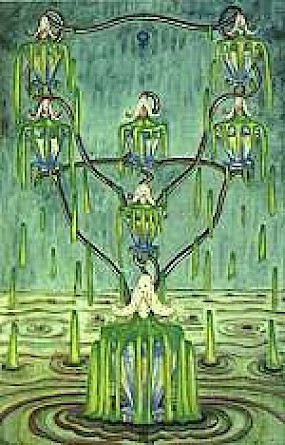
The Lord of Debauch is a deceptive card and can bring in some difficult influences when it’s about. We will always be tempted to do things that we will later regret, and we will find ourselves weak-willed when it comes to choosing what we know is the right course of action.
For instance, we might be faced with some sort of sexual temptation. This kind of situation can arise whether or not we are committed to another person – a one-night stand can have as many complications for the single as it can for the person in a partnership. Such an offer, when marked by the Seven of Cups, is going to have consequences that far outweigh the pleasure that might be fleetingly gained.
And again, the Lord of Debauch might come up to indicate that we are placed in a situation where we can make easy money, or obtain things in an inappropriate and unethical fashion – though it would not cover actual theft. But, for example, buying stolen property, or engaging in trickery to obtain money and possessions would come up here.
We might find ourselves showered with apparently great opportunities and have no idea which of them is valid and which is not – then we become children gazing in wonder at the treasure chest of jewels and wondering which one to take first! Perhaps the answer is that if we don’t know what to choose, we should consider leaving them all alone!!
And finally, the most serious influence that can be indicated by this card is the challenge to our ethical code. We may be faced with something that goes against our principles, and yet still be tempted to take advantage of it, or to do something that we will later think was sneaky, unkind, immoral and nasty.
The Seven of Cups is always indicative of a temptation which will cost much more than it gives, if we fall for it.
“The experience of being aware – Awareness’s awareness of itself – is an utterly unique experience. All other experience is known by something other than itself. It is mediated through the mind. However, awareness’s knowledge of itself does not take place through the mind. It knows itself by itself.“
–Rupert Spira
Rupert Spira (born March 13, 1960) is an English spiritual teacher, philosopher and author of the Direct Path based in Oxford, UK. Wikipedia
In my tribute to Tony Bennett yesterday, I mentioned that you could fill an article with stories of his generosity and kindness. And, true enough, those stories started showing up on social media yesterday almost immediately after news of Bennett’s death went public—I read dozens of them.
Most of them are from people who had little or no influence in the entertainment business. Many of them were just fans who had crossed paths with a famous singer. But Bennett went out of his way to treat each one with respect and generosity of heart.
For example, read this or this or this or this or this or this or this or this. Few of the stories are dramatic—just simple acts of human decency. But they are rare in any sphere of society nowadays, and especially among show business superstars.
But today I want to focus on Tony Bennett’s music, and just a small part of—namely, his collaborations with leading jazz artists.
The Honest Broker is a reader-supported guide to music, books, media & culture. Both free and paid subscriptions are available. If you want to support my work, the best way is by taking out a paid subscription.
If you want to appreciate the artistry of singer Tony Bennett, where do you even begin? There are so many places to drop your needle in this haystack of barnburning albums.
But it’s a great problem to have.
The numbers alone are dazzling. According to discographers, Tony Bennett released 61 studio albums, 83 singles, 11 live recordings, and more than 30 compilation albums. Bennett was nominated for a Grammy on 41 occasions, and walked away with the prize almost half the time—with 19 of those statuettes sitting on his shelf. He had 24 songs reach the top 40 on the charts.
I note that most of this happened during an era when his manner of singing, rooted in old songs and a distinctive jazz sensibility, was considered out-of-style and out-of-touch with contemporary trends. In fact, his biggest successes happened during the period in which rock music was the dominant force in commercial music.
Tony Bennett performs with Duke Ellington at the 1966 Grammy Awards (Getty Images)
Bennett’s career straddled genres, and he could genuinely sing in any context. Over the years, he laid down tracks with a ridiculous range of stars—performing with Paul McCartney, Willie Nelson, Stevie Wonder, Aretha Franklin, Elton John, Sting, Bono, and dozens of other legends and near-legends.
I won’t even try to assess that work today. Maybe I will revisit it on another occasion. But I will make one observation here: No matter what setting he was in, Bennett not only delivered the goods but he also demonstrated tremendous skill in bringing out the best in others.
His jazz-oriented recordings are more manageable. I actually wish there were more of these—because, for most of his career, record label execs preferred showcasing Bennett in more commercial projects. But the jazz tracks that did get recorded are glorious. Those two albums with Bill Evans are exquisite, and are especially well known. But there are other examples that deserve more attention from fans.
Let’s take a look at this music.
Tony Bennett with Stan Getz and Herbie Hancock, “Out of This World”
Something amazing happened on May 25, 1964, at least if you’re a jazz fan. On that day, Tony Bennett walked into a New York studio with Stan Getz, Herbie Hancock, Ron Carter, and Elvin Jones. Just thinking about it makes my heart palpitate.
But here’s the rub: they only recorded one track. Later that year, that same ensemble returned to the studio, and recorded three more songs.
In other words, they never had enough music to release an entire album—which makes me moan and groan, because this would have been one of the classic jazz vocal albums of the century. At least we have a taste of this music to savor.
Tony Bennett and Duke Ellington: “Love Scene/Solitude”
Why didn’t they make a studio album together? It’s a crying shame—because Duke Ellington and Tony Bennett were on the same wave length and seemed to have a strong personal connection. Ellington even became friends with Bennett’s mother, and would frequently send Tony new songs along with a dozen roses.
“A bunch of flowers arrived at my house, and I would say ‘Duke is at it again,’” the singer later recalled. They appeared together on TV on multiple occasions, and even did a 25-city tour on the same program (with Bennett insisting that Ellington get top billing—just as he had done with Count Basie when he sang with that band). But all we have are some short video clips. This one is choice.
Tony Bennett and Bill Evans, “But Beautiful”
Both Tony Bennett and Bill Evans shared the unfortunate distinction of getting dropped by Columbia Records in the early 1970s. That label made many lamentable decisions back then—in their wisdom, the Columbia honchos also dumped Keith Jarrett, Ornette Coleman, and Charles Mingus. In this instance, Bennett and Evans joined forces in the mid-1970s for two of the most moving duet albums in the history of jazz singing. That’s more than my opinion—this music is cherished by almost everybody who has heard it.
Tony Bennett and Bill Evans, “You Must Believe in Spring”
A year after recording The Tony Bennett/Bill Evans Album, released by Fantasy in 1975. the two artists returned to the studio to record Together Again for Bennett’s own Improv Records label. The album was subsequently released on Concord, and the Bennett/Evans duets here are just as magical as the first time around. My hunch is that this collaboration helped lay the foundation for Bennett’s career revival—where he focused more on jazz standards and sought out accompanying musicians of the highest caliber. Evans, for his part, never made a subsequent album with a vocalist.
Honestly, this was not an obvious pairing back in the day, and both players had to stretch and adapt in this uncharacteristic setting. But the results speak for themselves. This is music for the ages.
Tony Bennett with Dave Brubeck, “That Old Black Magic”
More than a decade before the Bennett-Evans project, the singer engaged in another unexpected meeting-of-minds with a famous jazz pianist. On August 28, 1962, both Bennett and Dave Brubeck were booked to play the Sylvan Theater on the grounds of the Washington Monument. Each artist performed separately and then they decided to attempt some songs together—without any rehearsal or much planning.
Tapes of the concert were long believed lost until an archivist tracked them down a half-century later. These musicians were at peak levels of fame back then—Brubeck was still riding high on the gold record (and eventually double platinum) success of Time Out, and Bennett was climbing the charts with “I Left My Heart in San Francisco.” I even have a hunch that Brubeck tossed in a quote from “The Trolley Song” during “That Old Black Magic” as humorous nod to that other Bay Area song.
Tony Bennett with Count Basie, “Lullaby of Broadway”
Whoever set up this project is a savvy matchmaker. Both Basie and Bennett were specialists in relaxed swing, knowing when to push and when to lay back. They could have made a dozen albums together, and fans would still clamor for more. A lot of credit goes to Columbia honcho Mitch Miller, who brought these musicians into a studio in 1958 after an attempt to record them in concert failed due to technical difficulties. By the way, Bennett returned the favor by appearing with Basie on the latter’s label Roulette a few months after. But they never joined forces live in the studio again.
Tony Bennett with Dexter Gordon, “All of My Life”
We are fortunate that both Tony Bennett and Dexter Gordon were under contract to the Columbia label in the mid-1980s. Gordon had just achieved a career milestone with his Oscar nomination for his performance in the film Round Midnight. Bennett, for his part, had only recently resigned with Columbia, after more than a decade separation, and was about to enjoy a second act to his career that few singers will ever match. They only collaborated on two tracks, but this was a star-crossed pairing by any measure.
Tony Bennett and Dizzy Gillespie, “Russian Lullaby”
You probably don’t think of Tony Bennett as a bebop singer, but here he floats effortlessly in a fast tempo alongside Dizzy Gillespie. Dizzy is famous for his speed and high notes, but Bennett delivers on both those counts too—check out his bravura coda. Once again, I wish this duo had made an entire album together with more flashy songs of this sort. The two did enjoy an onstage reunion for Dizzy’s 75th birthday performances at the Blue Note—maybe somebody will track down and release recordings of those proceedings.
Tony Bennett and Wynton Marsalis, “Mood Indigo”
People partied for many reasons in 1999, but for jazz fans it was also the centenary of Duke Ellington, the most beloved big band leader of them all. Tony Bennett used this as an excuse to release Bennett Sings Ellington: Hot & Cool, and invited Wynton Marsalis to share in the festivities. On this particular track, Bennett takes it cool, while Marsalis opts for the hot, moaning and growling on trumpet in exactly the way Ellington liked it.
Tony Bennett and Amy Winehouse, “Body and Soul”
I’ve gone on record claiming that Amy Winehouse was one of the finest jazz singers of her generation, and this track offers irrefutable evidence. Her phrasing is straight out of the Billie Holiday playbook. But Bennett is just as persuasive here, and he shows that he can shine without distracting in the slightest from his vocal partner. The fact that they achieve all this on a song that has been performed and recorded thousands of times before makes this achievement all the more impressive.
Tony Bennett with Phil Woods, “Being Alive”
Jazz altoist Phil Woods shows up on five tracks from Tony Bennett’s 2004 album The Art of Romance, which won a Grammy for traditional pop vocal album. This track also boasts an arrangement by Johnny Mandel and a song by Stephen Sondheim. In my world, that’s as good a roster as the 1998 Yankees. Woods is so charged up, he even takes two solos.
Tony Bennett and Bill Charlap, “The Way You Look Tonight”
Tony Bennett returned to the jazz piano format for his 2015 album The Silver Lining: The Songs of Jerome Kern, drawing on the considerable talents of Bill Charlap. The resulting album is one of my favorite late career offerings in the Bennett’s discography—this was the music I was listening to the night before Bennett’s death. The singer was almost 90 years old when he recorded this, but his interpretive skill shines on every phrase. Grammy voters apparently agreed, giving The Silver Lining an award for Traditional Pop Vocal Album.
Only Boys Aloud Jul 4, 2023 Only Boys Aloud sing Seasons of Love from the musical Rent. Performed live in St. David’s Hall, Cardiff. Music and Lyrics by Jonathan Larson Arranged by Tim Rhys-Evans
Consciousness, sexuality, androgyny, futurism, space, the arts, science, astrology, democracy, humor, books, movies and more

 Morning Brew, a daily newsletter.Email address