
Talking Art Encyclopedia • Apr 7, 2023 Carl Gustav Jung is regarded as one of the pioneers of modern psychology, having made significant discoveries about the depths of the human psyche. In this face to face interview from 1959, Jung candidly discusses his views on human psychology and nature. The interview’s approximately half hour length provides Jung with ample opportunity to expound on his thoughts in great detail. In this rare interview, Jung touches on topics such as the importance of individual differences, the role of archetypes and the unconscious, as well as religion and mysticism. For anyone interested in hearing Carl Jung’s profound musings, we highly recommend not missing out on this extraordinary interview.
Monthly Archives: April 2023
Tarot Card for April 19: The Three of Swords
The Three of Swords
I doubt that anybody feels comfortable when they pull this card in a reading. The Lord of Sorrow almost always indicates some sort of disruption which will cause pain and uncertainty. Such disruption leads to loss of balance and disharmony.
At worst, the Three of Swords will indicate loss or separation. In order to determine how serious this is liable to be, you need to consider the cards surrounding this one. With Death, or the Tower, the loss is liable to be of a serious and deeply distressing nature.
With cards like the Seven of Disks, you’d expect to find unexpected changes in the working situation – redundancy for instance. With Cups, the impact will probably be felt in the emotional area. Wands could indicate loss or damage to your inner nature – a big blow to the self-esteem, as one example.
However, sometimes, particularly when the Lord of Sorrow is not badly aspected by the cards around it, there’s another more complex reason for its appearance. This card will always come up during a period of unhappiness, confusion or disturbance. There will be doubt (especially of the self), inability to make decisions, sometimes ill-health which wears you down and makes you feel that you cannot cope.
And often during times like this, there are choices and decisions to be made, which you feel too uncertain to tackle. Yet the fact that you are unable to make your decisions perhaps prolongs a difficult or unsatisfactory situation, adding to your anxiety and worry.
To identify this as a meaning for the card, look for cards indicating weariness and apathy – Seven of Swords, Five of Disks, the Moon etc – and the absence of other ‘bad’ cards. If you feel that the Three of Swords is indicating that you are too untrusting and insecure to make important decisions, first and foremost, agree to give yourself a break!
Let things develop on their own for a while. Rest and allow yourself time to build up your energies. Then you will stop feeling quite so inadequate, and will be able to make the choices which will shape the next phase of your life.
And if the Lord of Sorrow brings grief and sadness into your life, try hard to look forward in the reading to the start of the recovery period, in order to give yourself something positive to hold onto. Sometimes this card will appear to mark a shocking unexpected event which, whilst painful, is not as awful as it might first appear. It helps a little to know when the tide is going to begin to turn in your favour.
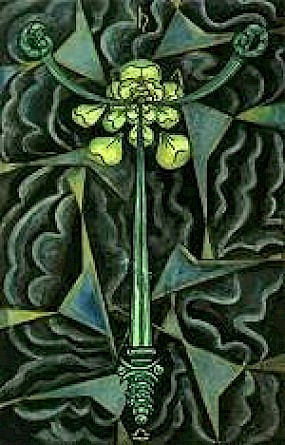
(via angelpaths.com and Alan Blackman)
A Tech Industry Pioneer Sees a Way for the U.S. to Lead in Advanced Chips

Ivan Sutherland played a key role in foundational computer technologies. Now he sees a path for America to claim the mantle in “superconducting” chips.
Ivan Sutherland was instrumental in helping to create today’s dominant approach to making computer chips.Credit…Will Matsuda for The New York Times

By John Markoff
John Markoff has written about the technology industry since the 1990s.
- April 19, 2023 (NYTimes.com)
It has been six decades since Ivan Sutherland created Sketchpad, a software system that foretold the future of interactive and graphical computing. In the 1970s, he played a role in rallying the computer industry to build a new type of microchip with hundreds of thousands of circuits that would become the foundation of today’s semiconductor industry.
Now Dr. Sutherland, who is 84, believes the United States is failing at a crucial time to consider alternative chip-making technologies that would allow the country to reclaim the lead in building the most advanced computers.
By relying on supercooled electronic circuits that switch without electrical resistance and as a consequence generate no excess heat at higher speeds, computer designers will be able to circumvent the greatest technological barrier to faster machines, he claims.
“The nation that best seizes the superconducting digital circuit opportunity will enjoy computing superiority for decades to come,” he and a colleague recently wrote in an essay that circulated among technologists and government officials.
Dr. Sutherland’s insights are significant partly because decades ago he was instrumental in helping to create today’s dominant approach to making computer chips.

In the 1970s, Dr. Sutherland, who was chairman of the computer science department at the California Institute of Technology, and his brother Bert Sutherland, then a research manager at a division of Xerox called the Palo Alto Research Center, introduced the computer scientist Lynn Conway to the physicist Carver Mead.
They pioneered a design based on a type of transistor, known as complementary metal-oxide semiconductor, or CMOS, which was invented in the United States. It made it possible to manufacture the microchips used by personal computers, video games and the vast array of business, consumer and military products.
Now Dr. Sutherland is arguing that an alternative technology that predates CMOS, and has had many false starts, should be given another look. Superconducting electronics was pioneered at the Massachusetts Institute of Technology in the 1950s and then pursued by IBM in the 1970s before being largely abandoned. At one point, it even made an odd international detour before returning to the United States.
ImageIt has been six decades since Dr. Sutherland created Sketchpad, a software system that foretold the future of interactive and graphical computing.Credit…via Ivan Sutherland
In 1987, Mikhail Gorbachev, the last Soviet leader, read an article in the Russian newspaper Pravda describing an astounding advance in low-temperature computing made by Fujitsu, the Japanese microelectronics giant.
The Global Race for Computer Chips
- Tit for Tat: In a seeming stroke of retaliation over Washington’s campaign to sever China’s access to high-end chips, Beijing announced a cybersecurity review of Micron Technology, a U.S. chip maker.
- A Hefty Price: The global competition to attract semiconductor companies is expected to cost Germany billions in government subsidies. Some wonder if it’s a good use of money.
- CHIPS Act: The sprawling new program for the semiconductor industry is foremost about national security, but it will try to advance other priorities as well. Here’s what the program aims to do and how it will work.
- Federal Aid: The policy conditions the Biden administration has attached to $40 billion in new subsidies for U.S. chip makers is a bet on the power of the federal government to transform private industry.
Mr. Gorbachev was intrigued. Wasn’t this an area, he wanted to know, where the Soviet Union could excel? The task of giving a five-minute briefing to the Soviet Politburo eventually fell to Konstantin Likharev, a young associate professor of physics at Moscow State University.
When he read the article, however, Dr. Likharev realized that the Pravda reporter had misread the news release and claimed the Fujitsu superconducting memory chip was five orders of magnitude faster than it was.
Dr. Likharev explained the error, but he noted that the field still held promise.
That set off a chain of events through which Dr. Likharev’s tiny lab was granted several million dollars in research support, making it possible for him to build a small team of researchers and, eventually, after the fall of the Berlin Wall, relocate to the United States. Dr. Likharev took a physics position at Stony Brook University in New York and helped start Hypres, a digital superconductor company that still exists.
The story might have ended there. But it appears that the elusive technology may be gaining momentum once more because the costs of modern chip making have become immense. A new semiconductor factory costs $10 billion to $20 billion and takes up to five years to complete.
Dr. Sutherland argues that rather than pushing on more expensive technology that is yielding diminishing efficiencies, the United States should consider training a generation of young engineers capable of thinking outside the box.
Superconductor-based computing systems, where electrical resistance in the switches and wires falls to zero, might solve the cooling challenge that increasingly bedevils the world’s data centers.
How Did Ivan Sutherland Help Create Modern Computing?

During the 1960s and 1970s, Ivan Sutherland played key roles in computing.
Go to original article: https://www.nytimes.com/2023/04/19/technology/ivan-sutherland-superconducting-chips.html
CMOS chip making is dominated by Taiwanese and South Korean companies. The United States is now planning to spend almost one-third of a trillion dollars of private and public money in an effort to rebuild the nation’s chip industry and regain its global dominance.
Dr. Sutherland is joined by others in the industry who believe that CMOS manufacturing is hitting fundamental limits that will make the cost of progress intolerable.
“I think we can say with some assurance that we’re going to have to radically change the way we design computers because we really are approaching the limits of what is possible with our current technology based on silicon,” said Jonathan Koomey, a specialist in large-scale computing energy requirements.
As it has shrunk the size of transistors to the size of just hundreds or thousands of atoms, the semiconductor industry has been increasingly bedeviled with a variety of technical challenges.
Modern microprocessor chips also suffer from what engineers describe as “dark silicon.” If all the billions of transistors on a modern microprocessor chip are used simultaneously, the heat they create will melt the chip. Consequently, entire sections of modern chips are shut down and only some of the transistors are working at any time — making them far less efficient.
Dr. Sutherland said the United States should consider alternative technologies for national security reasons. The advantages of a superconducting computing technology might first be useful in the highly competitive market for cellular base stations, the specialized computers inside cellphone towers that process wireless signals, he suggested. China has become a dominant force in the market for the current 5G technology, but next-generation 6G chips would benefit from both the extreme speed and significantly lower power requirement of superconducting processors, he said.
ImageDr. Sutherland holding one of the several thousand modules from TX-2, which, at the time of his 1963 Ph.D. project, was the world’s most powerful computer.Credit…Will Matsuda for The New York Times
ImageDr. Sutherland’s design made it possible to manufacture the microchips used by personal computers, video games and the vast array of business, consumer and military products.Credit…Will Matsuda for The New York Times
Other industry executives agree. “Ivan is right that the power problem is the big issue,” said John L. Hennessy, an electrical engineer who is the chairman of Alphabet and a former president of Stanford. He said there were only two ways to solve the problem — either by gaining efficiency with new design, which is unlikely for general purpose computers, or by creating a new technology that is not bound by existing rules.
One such opportunity might be to fashion new computer designs that mimic the human brain, which is a marvel of low-power computing efficiency. Artificial intelligence research in a field known as neuromorphic computing has previously used conventional silicon manufacturing.
“There is really the potential of creating the equivalent of the human brain using superconducting technology,” said Elie Track, chief technology officer of Hypres, the superconducting company. Compared with quantum computing technology, which is still in early experimental stages, “this is something that can be done now, but regrettably the funding agencies haven’t paid attention to it,” he said.
The time for superconducting computing may not yet have arrived, partly because every time that the CMOS world seems about to hit a final obstacle, clever engineering has surmounted it.
In 2019, a team of researchers at M.I.T. led by Max Shulaker announced that it had built a microprocessor from carbon nanotubes that promised 10 times the energy efficiency of today’s silicon chips. Dr. Shulaker is working with Analog Devices, a semiconductor maker in Wilmington, Mass., to commercialize a hybrid version of the technology.
“More and more, I believe you cannot beat silicon,” he said. “It’s a moving target, and it’s really good at what it does.”
But as silicon is nearing atomic limits, alternative approaches once again appear promising. Mark Horowitz, a Stanford computer scientist who has helped start several Silicon Valley companies, said he was unwilling to discount Dr. Sutherland’s passion for superconducting electronics.
“People who’ve changed the course of history are always slightly crazy, you know, but sometimes they’re crazy right,” he said.
(Contributed by Michael Kelly, H.W.)
The Convergence of Science and Spirituality | Donald Hoffman & Rupert Spira
Rupert Spira Mar 26, 2023 • #rupertspira #nonduality In the latest Rupert Spira Podcast episode Simon Mundie moderates a fascinating discussion on science and spirituality with Rupert and cognitive scientist Donald Hoffman. The conversation includes topics such as: Why is the concept of space-time is doomed? How close are we to a theory of everything? Does the perennial philosophy need an upgrade? Can maths describe reality? Why does the one localise? and Is science finally catching up with what the great spiritual traditions have been telling us for centuries? You can follow Donald Hoffman on Twitter @donalddhoffman You follow Simon Mundie on Twitter and Instagram @simonmundie Timestamps: 0:00 The Case Against Reality 3:00 The Hard Problem Of Consciousness 9:52 Why Are Most Scientists Materialists? 12:54 Who Is Qualified To Make Observations About The Nature Of Reality? 15:29 The Hard Problem Of Matter 20:33 No-One Has Ever Found Matter 25:10 Space-Time Is Doomed 32:48 Quantum Theory Is Not Fundamental Either 34:03 Why Is The Fact That Space-Time Is Doomed Not On The News? 40:57 The Real Meaning Of The Word Illusion 47:40 Exploring Other Dimensions 57:14 What Are Conscious Agents? 1:04:06 One Consciousness 1:07:32 Infinite Infinities 1:12:19 Why Does The One Localise? 1:15:46 Could There Be A ‘why’ On The Relative Level? 1:23:48 Interface Theory 1:36:05 A Theory Of Everything 1:41:06 A Convergence Of Science And Spirituality 1:49:46 The Implications Of The Perennial Philosophy 1:55:51 Let Go Of Thought 2:01:08 Seeing Through The Illusion Of The Separate Self 2:10:08 Thoughts, Fears And Beliefs 2:14:46 Walking The Talk
Aries Solar Eclipse, April 19, 2023
Wendy Cicchetti
Aries Solar Eclipse New Moon
The Aries solar eclipse is a total eclipse, meaning that the Sun is entirely obscured by the Moon for a while. It’ll be as though someone put the light out in the sky! The eclipse won’t be viewable in all parts of the world, either partially or entirely, due to location or visibility, but eclipse symbolism remains relevant astrologically. Unlike a lunar eclipse when the Sun and Moon oppose one another, during a solar eclipse, the Sun and Moon appear aligned in the same spot. This means there’s a jostling of position in Aries alone, showing a concentration of energy.
What does it mean when the Moon seems to have the upper hand over the Sun for a moment in time? It could be that emotional factors rule the day, with normal logic cast to one side — or just literally, not visible within our consciousness.
Aries is known for immediate and, sometimes, volatile responses, given rulership by fiery Mars. Decisions made from an emotional stance may be particularly extreme under an eclipse. Normally, we tend not to react from this place. But something may be revealed that triggers an intense response. Whether we view it as a “good” or “bad” response may depend on the situation.
For example, when our response is quick and we overreact to a relationship issue, are we in touch with all the information needed to make a wise decision and take the best action? Would it be better to step back for a moment and gather more facts before acting impulsively? Or contrarily, have we steadily waited for certain results, only to find another scenario unfolding and this is now the final straw? Some situations do require decisive action when enough is enough.
A sense of urgency prompted by this eclipse may cause a project to feel deeply important, underlined by the Sun and Moon in the anaretic degree of Aries — like a “last-minute” situation and we feel strongly motivated to get on the boat/plane/waiting list before it’s too late! Forewarned is forearmed during eclipse season. Remember, we do have choices. And if we need an extra push for the chance to make something positive happen, the eclipse energy could support our initiative.
The current lunation doesn’t just show hidden or overlooked factors through the eclipse itself, however. Several important planetary aspects are out-of-sign, making them easily overlooked. For example, Saturn at 4° Pisces sextiles the eclipse, whilst Pluto squares it from 0° Aquarius. It’s easier to notice aspects such as this if we think about what it would be like if the Sun and Moon were just one degree further on, placed at 0° Taurus, instead of 29° Aries. But the dissociate connections cannot be ignored and have their own symbolic significance.
For instance, it may be that someone seems to be presenting themselves one way whilst we saw them behave differently in another light. Perhaps we have to decide which version is genuine — or most meaningful to us. This aspect may also coincide with somebody turning out to be less solid and helpful than we imagined, or more stuck in their ways than we thought could be possible. As such, this appears to be a turning point in time, and we adjust our focus to see things as they really are. Once we do, making choices for the future will almost certainly seem easier!
That said, dealing with the stark reality of things that we imagined to be otherwise, might feel quite painful. The dissociate Moon–Pluto aspect suggests a wrangling process, where we need to handle internal arguments before we reach a point of peace. But it will be worth it, as a much deeper understanding of ourselves, others, and the situations we face is likely to emerge.
This article is from the Mountain Astrologer by Diana McMahon Collis
Thoughtful Food
 An old Cherokee told his grandson, “My son, there is a battle between two wolves inside us all.”
Richard Wright on starving from a lack of self-realization

Word-Built World: craic

craic
PRONUNCIATION: (krak, pronounced as the word crack)
MEANING: noun: Good times involving pleasant company, enjoyable conversation, etc.
ETYMOLOGY: From Irish craic. It was a borrowing from English crack, respelled as craic, and then reborrowed into English. Earliest documented use: 1972.
USAGE: “‘Unbelievable golf course, brilliant craic, and stoked to record my best major finish with a T16,’ Ryan Fox said on his Instagram account.”
Fox Signs off with a Flourish; Dominion Post (Wellington, New Zealand); Jul 23, 2019.
Wordsmith (wsmith@wordsmith.org)
Lenin on capitalists

“The Capitalists will sell us the rope with which we will hang them.”
― Vladimir Ilich Lenin
Vladimir Ilyich Ulyanov, better known as Vladimir Lenin (April 22, 1870 – January 21, 1924), was a Russian revolutionary, politician, and political theorist. He served as the first and founding head of government of Soviet Russia from 1917 to 1924 and of the Soviet Union from 1922 to 1924. Wikipedia
Book: “Not Too Late: Changing the Climate Story from Despair to Possibility”

Not Too Late: Changing the Climate Story from Despair to Possibility
Rebecca Solnit (Editor), Thelma Young Lutunatabua (Editor)
An energizing case for hope about the climate comes from Rebecca Solnit, called the voice of the resistance by the New York Times, and climate activist Thelma Young Lutunatabua, along with a chorus of voices calling on us to rise to the moment.
Not Too Late is the book for anyone who is despondent, defeatist, or unsure about climate change and seeking answers. As the contributors to this volume make clear, the future will be decided by whether we act in the present–and we must act to counter institutional inertia, fossil fuel interests, and political obduracy.
These dispatches from the climate movement around the world feature the voices of organizers like Guam-based lawyer and writer Julian Aguon; climate scientists like Dr. Jacquelyn Gill and Dr. Edward Carr; poets like Marshall Islands activist Kathy Jetnil-Kijner; and longtime organizers like The Tyranny of Oil author Antonia Juhasz.
Guided by Rebecca Solnit’s typical clear-eyed wisdom and enriched by photographs and quotes, Not Too Late leads readers from discouragement to possibilities, from climate despair to climate hope.
(Goodreads.com)