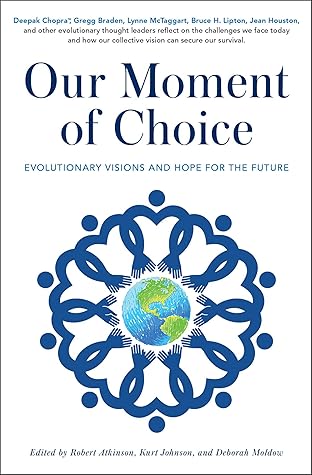
This timely and compelling anthology is a rousing call-to-action for all of us to help transform the world into a just, peaceful, and thriving one—featuring creative and practical solutions to the many crises facing humanity today.
Humanity is currently facing a series of interconnected emergencies that threaten our very survival—from climate change to economic inequality and beyond. And yet, at the same time, a global shift towards harnessing our collective power to create a life-affirming future is flourishing.
Featuring entries by forty-two cutting-edge thinkers, such as Deepak Chopra, Lynne McTaggart, and more, Our Moment of Choice provides eye-opening and inspirational visions for a unified, peaceful, and thriving world. The time has come for all humanity to be united in purpose. This is our collective moment of choice, upon which our future depends.
The four lectures that make up this little volume were presented in October 1949, the last month of G.I. Gurdjieff’s life, and originally published in this form in 1973, when John Bennett was researching his major work, “Gurdjieff: Making a New World”. The four lectures have been augmented with an Introduction and an Appendix consisting of the transcript of the Inaugural Address of The International Academy for Continuous Education, given on October 14th, 1972
This is a guidebook on world control and management, a program that Wells believed should be orchestrated (and would be successful) through what he called the “Open Conspiracy”. This conspiracy is fully outlined in this work and is designed to be run by many separate organizations working together, as opposed to being run by just one group. Is this required reading for the world’s most powerful people? Maybe it is. Or maybe it should be. Wells was a visionary and genius whose work should be paid attention to. Chapters include The Idea of the Open Conspiracy, We Have to Clear and Clean Up Our Minds, The Revolution in Education, Religion in the New World, What Mankind Has to Do, Modern Forces Antagonistic to the Open Conspiracy, The Resistances of the Less Industrialized Peoples to the Drive of the Open Conspiracy, The Open Conspiracy Begins as a Movement of Discussion, Explanation and Propaganda, Development of the Activities of the Open Conspiracy, Human Life in the Coming World Community, and more.
MOT MEDIA In this conversation, I speak with lawyer, artist, and author James Tunney. We cover many things, but the conversation focus practically on technology and spirituality. James Tunney Website: https://www.jamestunney.com/ Consider supporting the channel via Paypal or Cashapp. Paypal: https://www.paypal.me/luisacevedo2 Cashapp: $luisacevedo27 If you enjoyed the show be sure to like, share, comment, and subscribe. There will be a new episode every Monday.
Perhaps you think that different kinds of love are possible. Perhaps you think there is a kind of love for this, a kind for that; a way of loving one, another way of loving still another. Love is one. It has no separate parts and no degrees; no kinds nor levels, no divergencies and no distinctions. It is like itself, unchanged throughout. It never alters with a person or a circumstance. It is the Heart of God, and also of His Son.
Love’s meaning is obscure to anyone who thinks that love can change. He does not see that changing love must be impossible. And thus he thinks that he can love at times, and hate at other times. He also thinks that love can be bestowed on one, and yet remain itself although it is withheld from others. To believe these things of love is not to understand it. If it could make such distinctions, it would have to judge between the righteous and the sinner, and perceive the Son of God in separate parts.
Love cannot judge. As it is one itself, it looks on all as one. Its meaning lies in oneness. And it must elude the mind that thinks of it as partial or in part. There is no love but God’s, and all of love is His. There is no other principle that rules where love is not. Love is a law without an opposite. Its wholeness is the power holding everything as one, the link between the Father and the Son which holds Them both forever as the same.
No course whose purpose is to teach you to remember what you really are could fail to emphasize that there can never be a difference in what you really are and what love is. Love’s meaning is your own, and shared by God Himself. For what you are is what He is. There is no love but His, and what He is, is everything there is. There is no limit placed upon Himself, and so are you unlimited as well.
No law the world obeys can help you grasp love’s meaning. What the world believes was made to hide love’s meaning, and to keep it dark and secret. There is not one principle the world upholds but violates the truth of what love is, and what you are as well.
Seek not within the world to find your Self. Love is not found in darkness and in death. Yet it is perfectly apparent to the eyes that see and ears that hear love’s Voice. Today we practice making free your mind of all the laws you think you must obey; of all the limits under which you live, and all the changes that you think are part of human destiny. Today we take the largest single step this course requests in your advance towards its established goal.
If you achieve the faintest glimmering of what love means today, you have advanced in distance without measure and in time beyond the count of years to your release. Let us together, then, be glad to give some time to God today, and understand there is no better use for time than this.
For fifteen minutes twice today escape from every law in which you now believe. Open your mind and rest. The world that seems to hold you prisoner can be escaped by anyone who does not hold it dear. Withdraw all value you have placed upon its meager offerings and senseless gifts, and let the gift of God replace them all.
Call to your Father, certain that His Voice will answer. He Himself has promised this. And He Himself will place a spark of truth within your mind wherever you give up a false belief, a dark illusion of your own reality and what love means. He will shine through your idle thoughts today, and help you understand the truth of love. In loving gentleness He will abide with you, as you allow His Voice to teach love’s meaning to your clean and open mind. And He will bless the lesson with His Love.
Today the legion of the future years of waiting for salvation disappears before the timelessness of what you learn. Let us give thanks today that we are spared a future like the past. Today we leave the past behind us, nevermore to be remembered. And we raise our eyes upon a different present, where a future dawns unlike the past in every attribute.
The world in infancy is newly born. And we will watch it grow in health and strength, to shed its blessing upon all who come to learn to cast aside the world they thought was made in hate to be love’s enemy. Now are they all made free, along with us. Now are they all our brothers in God’s Love.
We will remember them throughout the day, because we cannot leave a part of us outside our love if we would know our Self. At least three times an hour think of one who makes the journey with you, and who came to learn what you must learn. And as he comes to mind, give him this message from your Self:
I bless you, brother, with the Love of God, which I would share with you. For I would learn the joyous lesson that there is no love but God’s and yours and mine and everyone’s.
MSNBC meanwhile kept us all festive by reminding us, with regard to the now-infamous Pilgrims, that “Instead of bringing stuffing and biscuits, those settlers brought genocide and violence”:
Where’s all this headed? In the space of a generation America has gone from being a country brimming with undeserved over-confidence, to one whose intellectual culture has turned into an agonizing, apparently interminable run of performative self-flagellation.
Whether or not to enjoy Thanksgiving is not the hard part of the American citizen’s test. Thanksgiving is awesome. Everything about it, from the mashed potatoes to the demented relatives to the pumpkin pies to the farts, is top-drawer holiday enjoyment. The only logical complaint about modern Thanksgiving involves forcing the poor Detroit Lions to play a marquee role every year. I think we can all agree that whole situation is a net minus, especially for them, no matter how funny the first fifteen minutes of those games usually are.
But the historical self-mortification has gotten out of hand. American exceptionalism used to mean 300 million yahoos being so convinced they were a unique force for good in the world that history before 1776 was irrelevant. We’re now living through the moronic inverse: America is such a unique evil, we’re told, so much the standard-bearer for the oppression of innocent peoples everywhere, that human suffering before 1776 is hardly worth mentioning. Or before 1492, as it were, since a lot of the current fashion stems from our pseudo-intellectual class being unable suddenly to handle the revelations of one decades-old book.
In the opening pages of Howard Zinn’s A People’s History of the United States, we read the log of Christopher Columbus, who recounts the first meeting of Europeans with the native Arawaks of the Bahamas:
They do not bear arms, and do not know them, for I showed them a sword, they took it and cut themselves out of ignorance… With fifty men we could subjugate them all and make them do whatever we want.
Zinn’s Columbus is a genocidal monster who not only massacred natives from Hispaniola to Haiti, and sold women and children by the thousands for “sex and labor,” but was so personally petty that he stole the reward of the poor sailor on his own ship who spotted land first, by claiming the feat himself. It’s hard to read Zinn’s account, which includes horrifying details like Indians murdering their own children to spare them the tortures of life under Spaniards, and not have a second thought or ten about the legend of the “discovery of America.”
I found A People’s History a fascinating and enjoyable read when I first read it in college, but that was when it was a ballsy, quasi-forbidden counterfactual to official narrative, not anyone’s idea of the actual “History of the United States.” The national idea of historical reflection back then was Forrest Gump, literally a two-hour shrug. Because of that, the book made sense then. Decades later, in the middle of a reverse cultural mania that devours it as gospel, Zinn’s book reads like the rantings of a mental patient.
After he finishes his tale of Columbus’s rampage through sinless indigenous cultures, Zinn contrasts it with the fables Americans of the time were all taught in school, in which “there is no bloodshed” upon the his arrival. He goes on to torch as an example the work of Harvard historian Samuel Eliot Morrison, whose Christopher Columbus, Mariner contains only a passing reference to the “cruel policy initiated by Columbus… [that] resulted in complete genocide.”
It takes stones to write an entire book about a major historical figure and include as a throwaway line, “And by the way, he committed genocide.” Incredibly, Zinn manages to be just as bad, if not worse. Of course A People’s History was designed to be the missing case for the prosecution, a chronicle of everything the Morrisons of the world left out, but his version of five hundred years of history contains just two characters, pure villains and pure victims. You’ve heard of Alien versus Predator; the People’s History could have been titled Hitlers and Baby Seals.
All his Europeans from Columbus on down are more or less indistinguishably monstrous, and even Abraham Lincoln and FDR are almost interchangeable capitalist tools, at most to be congratulated for being unenthusiastic oppressors. (The book in this sense reads a lot like the 1619 Project). A People’s History after its release in 1980 was often described as “radical,” but the radicalism wasn’t in the subject matter, but its maniacal sorting of humanity into two simplistic piles. Decades before it was fashionable, Zinn sketched out an intersectional construct that flattened much of humanity into a single interconnected mass of one-dimensional victimhood, “centering” the matrix of America’s oppressed:
The history of any country, presented as the history of a family, conceals fierce conflicts of interest (sometimes exploding, most often repressed) between conquerors and conquered, masters and slaves, capitalists and workers, dominators and dominated in race and sex. And in such a world of conflict, a world of victims and executioners, it is the job of thinking people, as Albert Camus suggested, not to be on the side of the executioners.
Thus, in that inevitable taking of sides which comes from selection and emphasis in history, I prefer to try to tell the story of the discovery of America from the viewpoint of the Arawaks, of the Constitution from the standpoint of the slaves, of Andrew Jackson as seen by the Cherokees…
No matter how interesting a book he or she is able to write, any author who admits to looking out at the world and seeing only “victims and executioners” needs psychological help. Unfortunately, Zinn in this respect turned out to be a pioneer, presaging a generation of comic-book thinkers who understand things in binary terms, forever preoccupied with cramming people in neat categories of oppressors and oppressed.
Such mental habits are the fashion now and will definitely put you in a bind on Thanksgiving. How can I eat turkey and stuffing with a smile, when Columbus massacred the Arawaks? When the English forced the Wampanoags off their land and made many convert to Christianity? When Lincoln told Horace Greeley, “If I could save the Union without freeing any slave, I would do it”?
How? Maybe because you’re more than three years old, and don’t need fairy tales to be real in order to enjoy dinner with family and a football game?
We don’t ask Russians how they can sit around the yelochka every New Year and open presents knowing that Ivan the Terrible used to roast prisoners in giant frying pans, or how they can smoke Belomorkanal cigarettes knowing the real White Sea canal is filled with the bones of slave laborers. I think even most MSNBC anchors would agree, that would be stupid. But we do this to ourselves all the time now, and every year it gets worse.
All this is just a come-down from the high of Reagan-era exceptionalism. The drug has worn off and we’re realizing, in the cold light of sobriety, that we suck every bit as much as other nations. So we’re swinging, as all people with hangovers do, to an opposite extreme.
We’ve lost touch with our real story, which is about us, not the centuries-old adventures of toffs in wigs. The Founding Fathers may have been scum, but they didn’t just steal a continent from the indigenous residents, they stole one from a British King, which is, come on, hilarious. These revolutionaries — Kurt Vonnegut called them “Sea Pirates” — then drew up a document sanctifying their own pursuit of obscene wealth, flying flags that were strikingly like “Let’s Go Brandon” in sentiment while reveling in the horror they inspired in aristocrats all over Europe. Then, in a move that secured their heist while providing the manpower they needed for expansion, they started opening their doors to castoffs, screwups, and cultists from other countries.
Almost none of us are related to Pilgrims or Founders. Nearly all of us descended from those subsequent waves of weirdos and refugees who came from all over, some not by choice, and forged the real character of our stolen nation. Many of our ancestors had their hands forced elsewhere, from Jews in the Pale fleeing pogroms to Irish escaping famines to Armenians running from Ottoman genocides. Once they got here, they happily planted Sea Pirate flags on their front doors and set about inventing everything from cat litter to alternating current, while mostly refraining from murdering one another. It was an insane setup, but they made the whole thing work, which is a pretty amazing story even figuring in the horribleness, and really what we’re celebrating every November. You have to reduce the American experience to a few ridiculously grim variables, and remove everything from movies to rock n’ roll to monster dunks, to spend today sulking.
Years ago, during a time in my life when I’d fled the United States to St. Petersburg, Russia with no intention of returning, my best friend was a Swiss named Daniel, with whom I’d studied at a Soviet University. Like all people from his country, Daniel was a polyglot. He spoke perfect English and Russian, but hanging out with him was disorienting, because he’d be talking like a mechanic from Baltimore and suddenly forget the word for washing machine and start miming a spin cycle. It took getting used to, but it was funny — we laughed a lot. On Thanksgiving one year, I told him I was going to the consulate for dinner. “Thanksgiving,” he said. “That’s the one where you killed all the Indians, right?”
“Not me personally, but yes.”
“Bring back leftovers,” he answered. I went to the consulate, which of course spared no expense in laying out a fantastic spread, but spent most of the day shooting baskets in a back lot with a group of black Marine guards. On the way out I stole a haul of turkey and cranberry sauce, which Daniel and I devoured with a bottle of vodka later that night, in one of the best Thanksgivings of my life. This holiday is about friends and family. Enjoy them today, don’t listen to the haters, and go Lions.
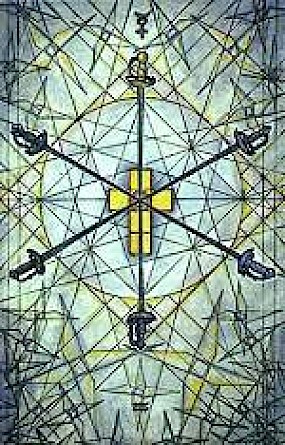
The Lord of Science appears in a reading when we have passed through a stormy or difficult time, and into the safety of a sheltered harbour, where we can recuperate, and consider the difficulties which have arisen around us.
Often we will have passed through a period of dreadful confusion – and frequently a time of emotional suffering. But this card indicates that, at least for the moment, pressure has eased, and we can try to sort out what we really feel. Frequently we need first to rest until we feel refreshed, but eventually we will be required to assess events and make new decisions for our future.
Because we will find ourselves seeing things more clearly, difficult and demanding decisions will be easier to make. We will find ourselves with a more clear overview of the issues we are facing. And we will be able to make choices which bring us peace of mind and happiness.
Expect to find greater objectivity, clarity and new perspectives as a result of the 6 of Swords. This is a card that indicates a healthy balance between the emotions and the intellect, where we can think through even delicate situations, with detached impartiality.
The Prophets Isaiah and Ezekiel dined with me, and I asked them how they dared so roundly to assert that God spake to them; and whether they did not think at the time, that they would be misunderstood, & so be the cause of imposition. Isaiah answer’d. ‘I saw no God, nor heard any, in a finite organical perception; but my senses discover’d the infinite in every thing, and as I was then perswaded, & remain confirm’d, that the voice of honest indignation is the voice of God, I cared not for consequences but wrote.’ Then I asked: ‘does a firm perswasion that a thing is so, make it so?’ He replied: ‘All poets believe that it does, & in ages of imagination this firm perswasion removed mountains; but many are not capable of a firm perswasion of any thing.’ Then Ezekiel said. ‘The philosophy of the east taught the first principles of human perception: some nations held one principle for the origin & some another; we of Israel taught that the Poetic Genius (as you now call it) was the first principle and all the others merely derivative, which was the cause of our despising the Priests & Philosophers of other countries, and prophecying that all Gods would at last be proved to originate in ours & to be the tributaries of the Poetic Genius; it was this that our great poet King David desired so fervently & invokes so pathetic’ly, saying by this he conquers enemies & governs kingdoms; and we so loved our God. that we cursed in his name all the deities of surrounding nations, and asserted that they had rebelled; from these opinions the vulgar came to think that all nations would at last be subject to the jews.’
‘This’ said he, ‘like all firm perswasions, is come to pass; for all nations believe the jews’ code and worship the jews’ god, and what greater subjection can be?’ I heard this with some wonder, & must confess my own conviction. After dinner I ask’d Isaiah to favour the world with his lost works; he said none of equal value was lost. Ezekiel said the same of his. I also asked Isaiah what made him go naked and barefoot three years? he answer’d, ‘the same that made our friend Diogenes the Grecian.’ I then asked Ezekiel why he eat dung, & lay so long on his right & left side? he answer’d, ‘the desire of raising other men into a perception of the infinite; this the North American tribes practise, & is he honest who resists his genius or conscience. only for the sake of present ease or gratification?’
The ancient tradition that the world will be consumed in fire at the end of six thousand years is true, as I have heard from Hell. For the cherub with his flaming sword is hereby commanded to leave his guard at the tree of life, and when he does, the whole creation will be consumed and appear infinite and holy whereas it now appears finite & corrupt. This will come to pass by an improvement of sensual enjoyment. But first the notion that man has a body distinct from his soul is to be expunged; this I shall do, by printing in the infernal method, by corrosives, which in Hell are salutary and medicinal, melting apparent surfaces away, and displaying the infinite which was hid. If the doors of perception were cleansed every thing would appear to man as it is, infinite. For man has closed himself up, till he sees all things thro’ narow chinks of his cavern.
(itu.dk)
Consciousness, spirituality, biography, sexuality, androgyny, futurism, space, the arts, science, astrology, democracy, humor, books, movies and more