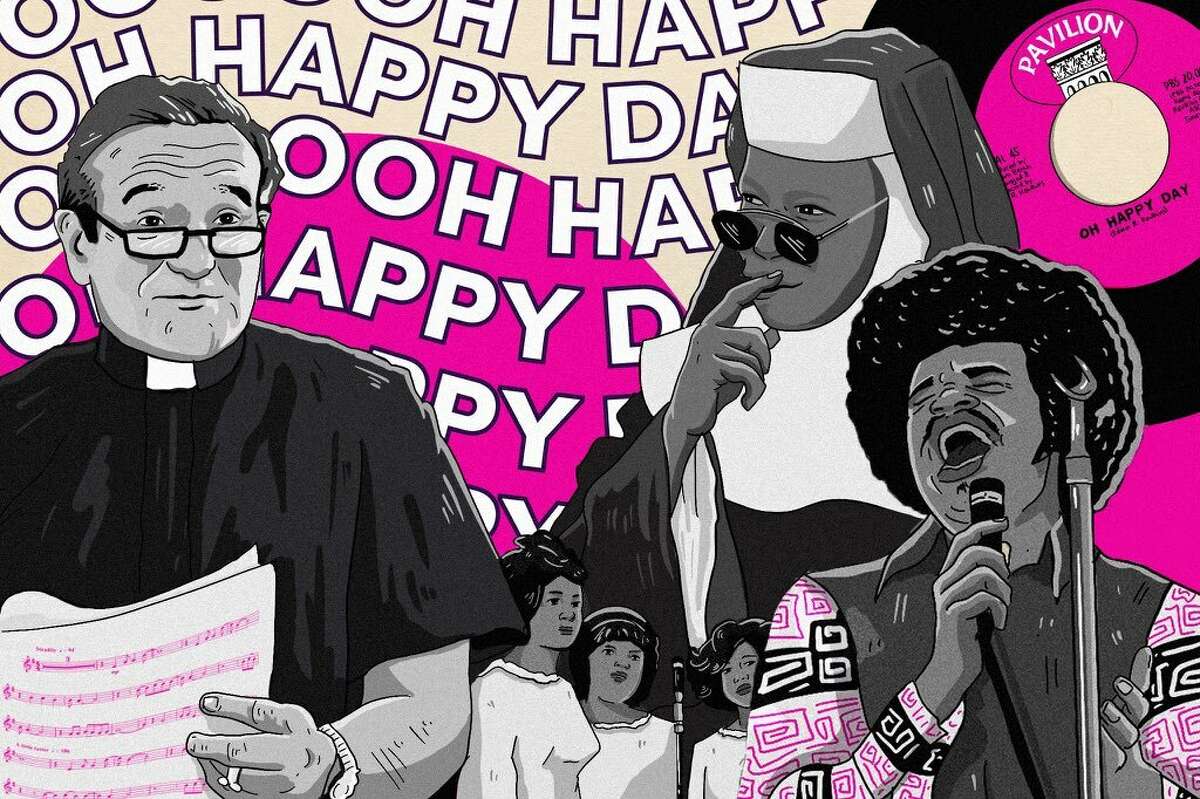
“Oh Happy Day” by the Edwin Hawkins Singers has been featured in films like “License to Wed” starring Robin Williams and “Sister Act 2.”Andy Andersen / SFGATE
An hour into “Sister Act 2,” Whoopi Goldberg leads a choir of students who look like they’d rather be anywhere than onstage. A young Lauryn Hill and a dozen teenagers mumble along to what sounds like a stuffy hymn. Then, inspired by Grammy nominee Ryan Toby, the choir suddenly turns joyous, belting out a stomping rendition of “Oh Happy Day.”
The performance inspires Goldberg to enter the choir into an all-state competition, which naturally receives pushback from the stuffy father of the parish… the same reaction that church elders had to the song when it was first released by Oakland-based choir leader Edwin Hawkins in 1967.
Hearing the song today, it can be hard to understand how it could ever be considered controversial. Based on a mid-18th century hymn that stems from Acts 8:35, the lyrics about Jesus washing sins away are literally textbook gospel. It has become a pop culture staple, appearing not only in “Sister Act 2,” but serving as the soundtrack for Robin Williams presiding over a beach wedding in “License to Wed,” the intro church scene in “Nutty Professor 2” and the closing credits for Spike Lee’s “BlacKkKlansman.” Artists who’ve covered the song include Elvis Presley, Spiritualized and Quincy Jones, to name of a few of the 126, listed on Secondhand Songs. George Harrison cited it as an influence for “My Sweet Lord.”
“Oh Happy Day” sounds infectious and celebratory, the type of praise song that makes you want to get up and dance. Which was exactly the problem.
“When ‘Oh Happy Day’ broke, the church was upset about it,” choir member Adrienne Kryor recounted in the documentary “Summer of Soul,” which features footage of Edwin Hawkins Singers performing at the Harlem Cultural Center. “We were part of the Pentecostal movement. You didn’t drink, you didn’t dance, you didn’t go to clubs. So we were persecuted. It was very humiliating, but we felt like the world needed ‘Happy Day.’”
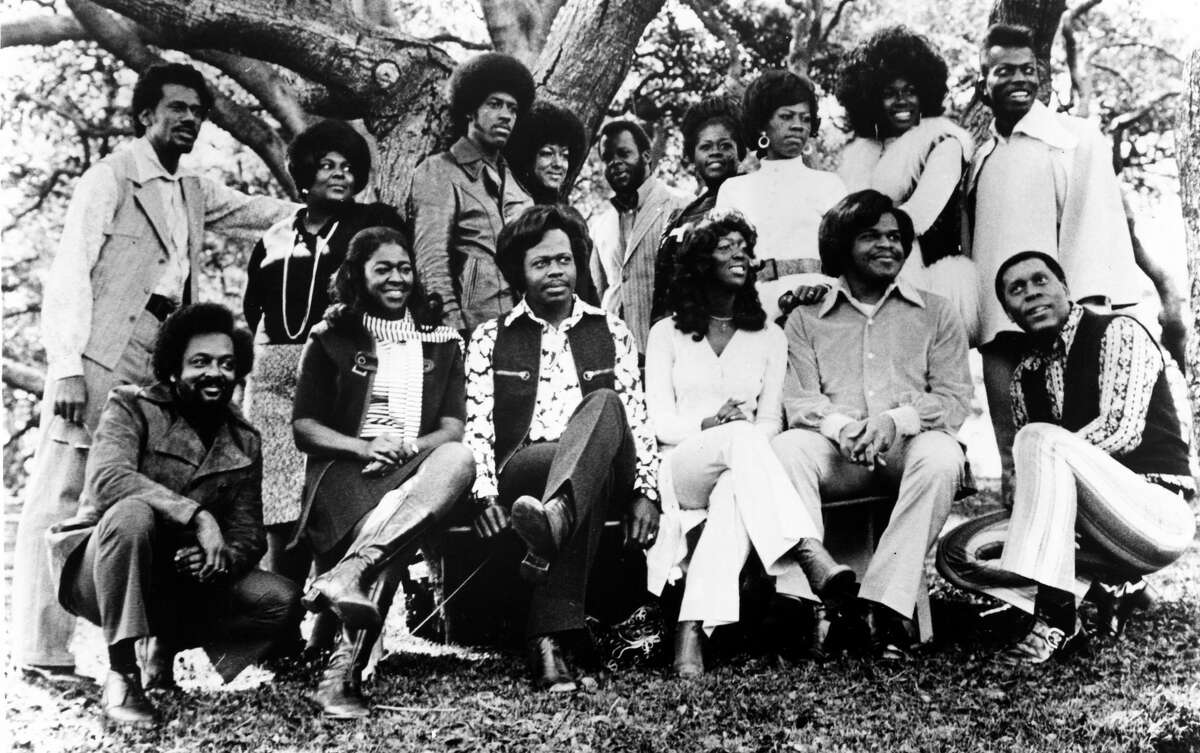
Members of the gospel group “The Edwin Hawkins Singers” pose for a portrait circa 1975. Michael Ochs Archives/Getty Images
“[Church leaders] were thinking it was too jazzy. And to see people actually dancing to the music, not the sacred dance but doing the secular dance to music… Some people in the Black community didn’t like that. They really ostracized Edwin Hawkins and his group for doing it,” Dr. Joyce Jackson, associate professor of African & African American Studies at Louisiana State University, told NPR.
Born in Oakland in 1943, Edwin Hawkins started his music career at a young age, growing up in the Campbell Village public housing complex. His parents encouraged him to sing to keep him out of trouble. He sang alongside his siblings in local churches, and by age five, he was playing piano at the Church of God in Christ. He formed the Northern California State Youth Choir when he was 16 and hosted a gospel radio show as well, absorbing a wide array of musical influences.
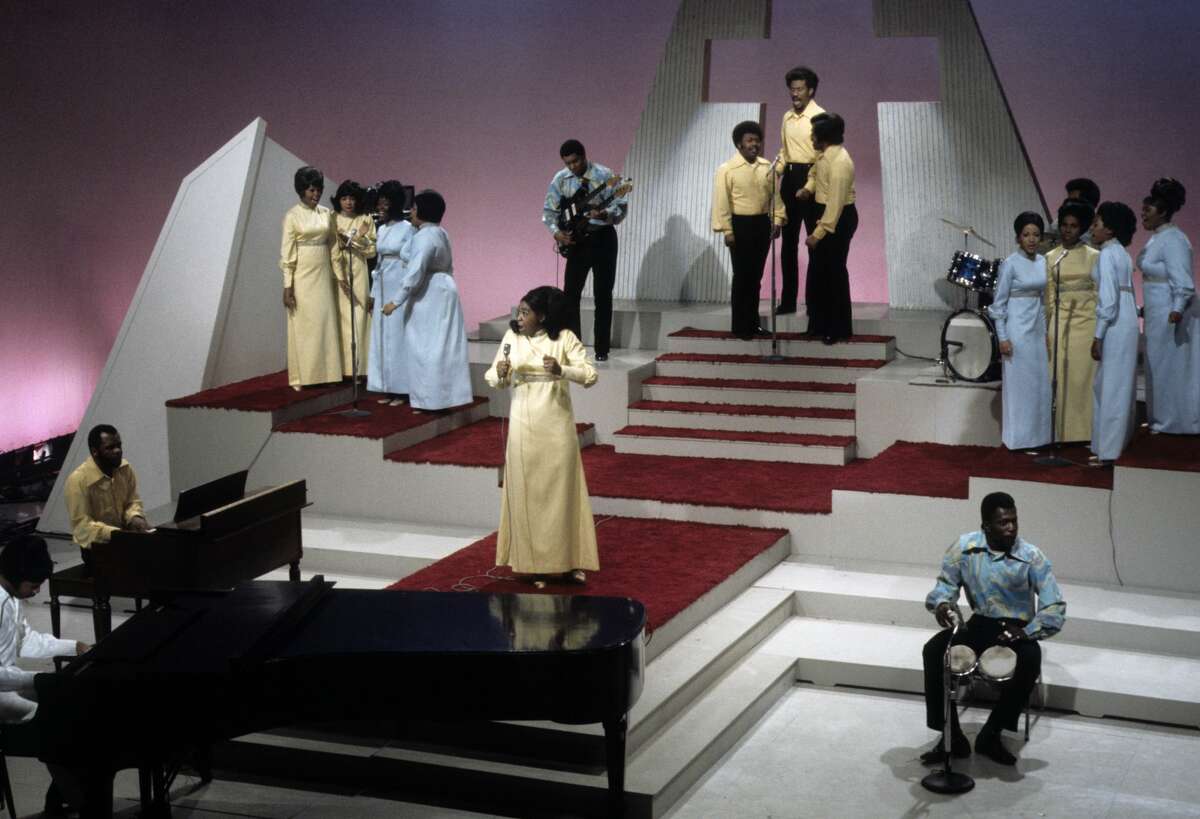
The Edwin Hawkins Singers appear on “The Johnny Cash Show” on February 24, 1971.ABC Photo Archives/Walt Disney Television via Getty
“I heard everything growing up,” Edwin Hawkins said in an interview at the Grammy Awards. “In the house my aunt listened to pop music, Perry Como, Nat King Cole, all those people. We heard all kinds of music, including gospel, that happened to be our favorite. When it was time for me to rearrange and create, I was hearing these different harmonies from these different genres of music, and there developed the sound of Edwin Hawkins.”
The group recorded “Oh Happy Day” as part of an album entitled “Let Us Go Into the House of the Lord” using a two-track tape machine lent to Hawkins by a friend. The album was intended primarily as a fundraiser for the church and to help the group attend a state choir competition (in a coincidental parallel to “Sister Act 2”). But when underground Bay Area rock radio station KSAN began spinning the song, it became an unlikely local hit, then landed on national radio, charting as high as number four on the US Billboard Hot 100 despite a petition from local pastors to have it pulled from the airwaves. Internationally, the song reached number one in France and Germany.
A 1969 San Francisco Chronicle profile of Dorothy Morrison, one of the breakout stars of the Edwin Hawkins Singers, summed up the popularity of the song best, declaring that if you don’t know “Oh Happy Day,” then “you are simply not with it.” (SFGATE and the San Francisco Chronicle are both owned by Hearst but operate independently of one another.)
The Edwin Hawkins Singers toured internationally, performing at rock festivals where they were often the only gospel group, opening for massive audiences like at The Isley Brothers’ 1969 performance at Yankee Stadium. The group also had a five-week run at Caesars Palace in Las Vegas. Their album went on to sell more than seven million copies and won a Grammy for best soul gospel performance, buoyed by the soulful pop sheen and funky exclamations of “good god,” inspired by James Brown.
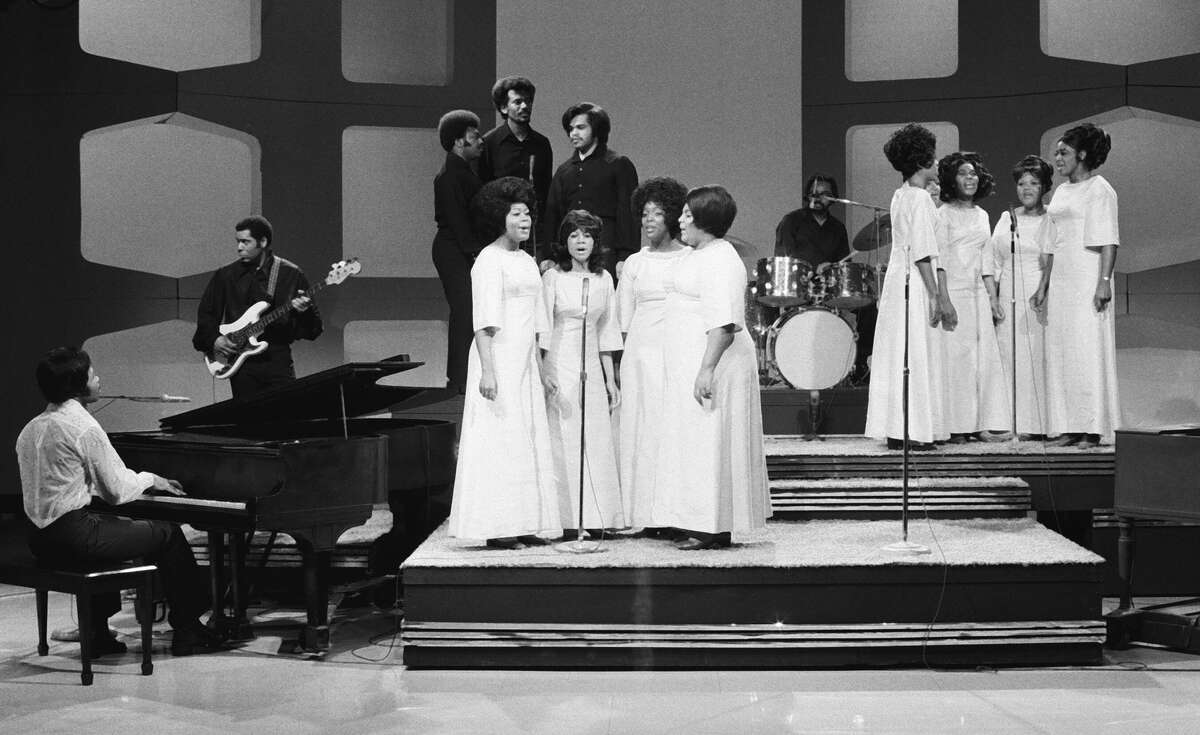
The Edwin Hawkins Singers performing on an episode of “The Tonight Show Starring Johnny Carson” on February 10, 1971.NBC/NBCU Photo Bank/NBCUniversal via
“Edwin Hawkins revolutionized what it meant to be a gospel artist,” said Stephen Kallao, contributing host of World Café on NPR. He fused contemporary sounds, a Latin groove, synthesizers and a soul influenced lead vocal performance to create a new model for gospel music.”
Hawkins told the Washington Post in 1979 that his group was ridiculed by established churches in the Bay Area, and he wasn’t sure if they feared the group’s influence or considered them something of a cult movement. Although demonized, Hawkins still saw the song as a way of evangelizing to audiences.
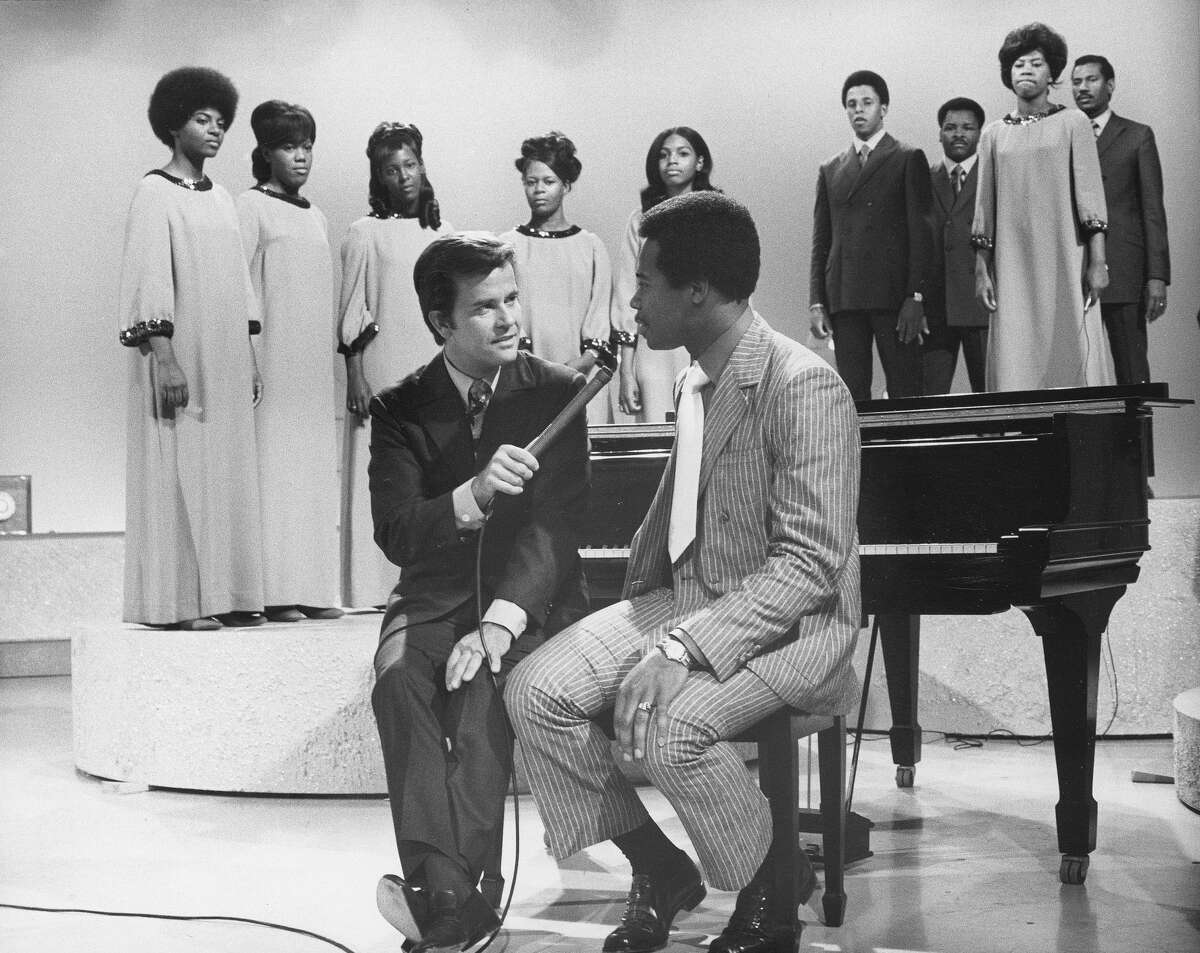
The Edwin Hawkins singers on “American Bandstand” interviewed by Dick Clark on September 5, 1969. ABC Photo Archives/Walt Disney Television via Getty
“With the situation of the world today, a lot of people don’t believe in God anymore. They don’t go to church, especially our youth,” says Hawkins in a radio interview from 1969. “It’s really messed up and confused. They don’t know who to turn to or which way to go so they’re trying this or that and not finding satisfaction. I feel like with young people, such as our group, instead of us trying to take the gospel to them by preaching to them, we’re taking the gospel to them with contemporary songs, new beats, new rhythms and something they can feel and express themselves in.”
Hawkins never had another major crossover success, but his steady gospel output over the course of his career led to 19 Grammy nominations and three more wins. In addition to sharing the gospel through music, Hawkins worked in an official church capacity, helping his younger brother Walter start Love Center Ministries, which still operates in Oakland off SR 185 near 104th Avenue (officially renamed Walter Hawkins Way). Edwin eventually took over preaching duties at Love Center in 2010 after his brother’s death from pancreatic cancer. Eight years later, the same disease would take Edwin’s life, yet his music will always live on and continues to inspire the next generation of gospel artists.
“What makes gospel music is the message. Not whether it’s hip-hop or contemporary or country, but the message of the song,” said Hawkins.
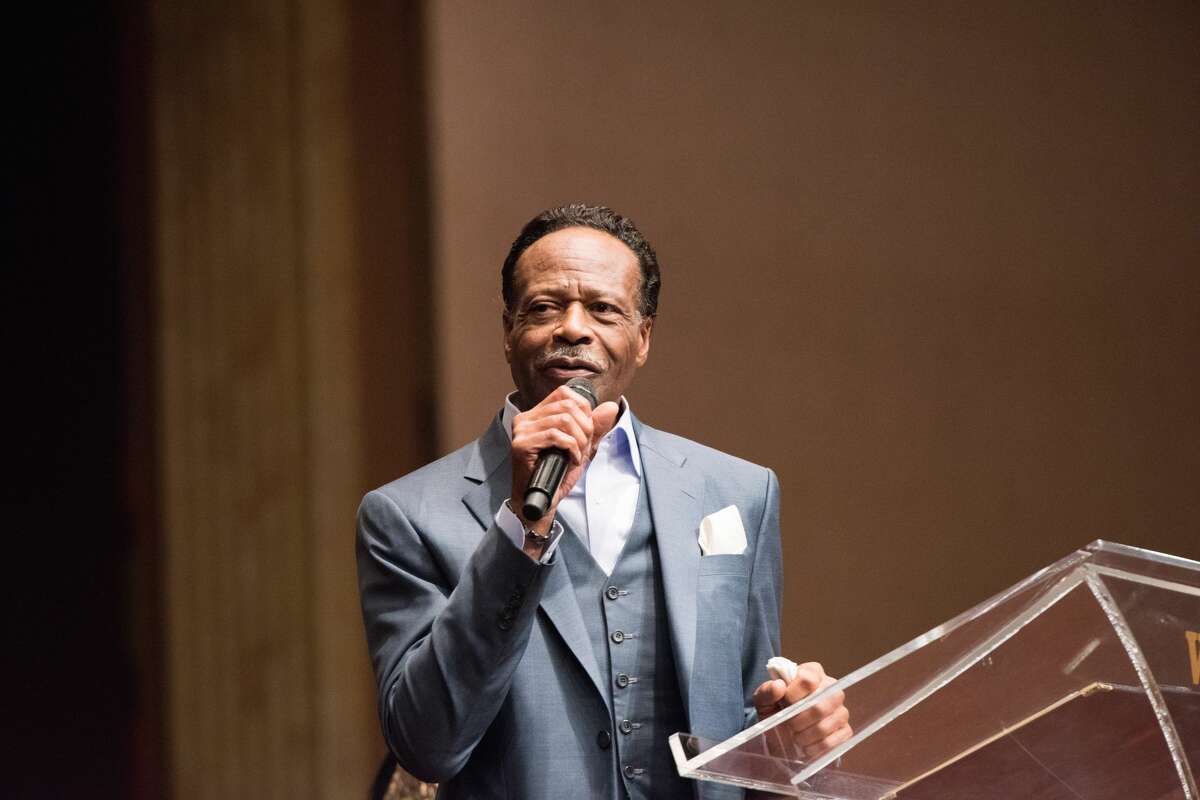
Gospel singer Edwin Hawkins speaks at the Andrae Crouch Memorial Celebration Of Life Event at West Angeles Church of God and Christ on January 21, 2015 in Los Angeles, California.Earl Gibson III/Getty Images
Dan Gentile is the culture editor at SFGATE. He moved to San Francisco from Austin, TX where he worked as a vinyl DJ and freelance writer covering food and music. His writing has been featured in Texas Monthly, American Way, Rolling Stone, Roads & Kingdoms, VICE, Thrillist and more.
“Across the morning sky, all the birds are leaving,” Nina Simone sang in 1969. “How can they know that it’s time to go?”
A decade earlier, a young Swiss psychologist traversed the Atlantc to begin a new life in America. Watching the migratory geese from the salt-stained railings of her own migratory vessel, she wrote in her journal: “How do these geese know when to fly to the sun? Who tells them the seasons? How do we, humans, know when it is time to move on?” Elisabeth Kübler-Ross would go on to revolutionize our understanding of what it means and what it takes to move on through her epoch-making 1969 model of the five stages of grief.
While the death of a loved one can make the notion of moving on unfathomable at first, it also makes it, by definition, inevitable — there is no other recourse, for such loss is unambiguous and irreversible. But there is a species of grief, spawned of a type of loss that is more ambiguous and elastic, that muddles the notion of moving on into an impassable and disorienting swamp: the cyclical grief of loving someone on the grounds of their highest nature and watching them fall short of it over and over, in damaging and hurtful ways, which you excuse over and over, because of their impassioned apologies and vows of reform, or because of the partly noble, partly naïve notion that a truly magnanimous person is one who always has the breadth of spirit to forgive — a notion rooted in a basic misapprehension of what forgiveness really means.
To move on from such relationships is one of life’s most difficult, triumphant feats of maturity — largely because we enter them and stay in them for reasons that far predate the particular person or situation, reasons rooted in our earliest attachments, those formative relationships in which perpetual optimism is both part of a child’s natural innocence and a necessary survival strategy for the helplessness of being in the care of a damaged and damaging adult.
Those dynamics — and how to break them with dignity, mindfulness, and emotional maturity — is what the soulful philosophical writer and School of Life founder Alain de Botton examines in one of his animated essays exploring the beautiful complexity of human relationships:
Because the unwillingness to walk away from a hurtful person is rooted in the belief that people change, the predicament gnaws at the fundaments of human nature and our ongoing effort to better understand what we are made of. Because relationships are the most fertile crucible of growth and transformation, because decades of research into psychology and the science of limbic revision have demonstrated that “who we are and who we become depends, in part, on whom we love,” this wager we place on the prospect of change is a transcendently optimistic belief. It is also a dangerous belief, for optimism can often metastasize into willful blindness. (To say nothing of the counterpoint possibility that, across a span of time and unfaced trauma, people can change for the worse, their good qualities eroded, for instance, by the twin metastasis of addiction and unhappiness feeding each other as they destroy their host.)
Mary McCarthy captured the optimism in asking her friend Hannah Arendt: “What’s the use of falling in love if you both remain inertly as-you-were?” Arendt captured the danger in cautioning her against the “crooked corkscrews of the heart” that keep us in painful relationships — a phrase she borrowed from her poet-friend W.H. Auden, who struggled with the paradox himself, oscillating between the aspiration to be “the more loving one” and the lucid awareness that false enchantment can poison a life with its toxic staying power.
De Botton explores the bipolar pull of the can-people-change question in another animated essay that illuminates the logical fallacies into which emotion drags us:
As Natalie Rose Richardson searches for her great-grandfather’s grave in a historically segregated cemetery, she confronts the American notion of paradise and the walls erected to protect it.
A CORNER LESS KEMPT
I AM VISITING my great-grandfather’s grave. It is in Fort Wayne, Indiana, the city where my father grew up and where his mother still lives and works—behind the reception desk at FairHaven Funeral Home. I have come from Chicago to stay with my grandparents for a blazing week in late July, during which I will turn sixteen. The quiet local pool, cloaked by an assisted-living community, is closed Sundays. There is nothing else to do but visit the dead.
The cemetery, Lindenwood, is a sprawling 175 acres, a short drive from my grandparents’ subdivision. It is one of the largest cemeteries in the state, a vast orchard of stones. My grandmother and I walk leisurely through the cemetery, fulfilling the British landscape architects’ original intent for Lindenwood: that it be “parklike” and “picturesque” to the living, a model of eighteenth-century English principles. The dead wave us on below. We spend an hour wandering the pristine landscape and furrowing our brows over the map, on which my grandmother has written my great-grandfather’s burial section and plot number.
We do this to satiate the curiosity of my grandmother, who has been archiving my family’s ancestral records for the past three years. I know nothing about my great-grandfather but his name: Henry Richardson.
We arrive at a corner of the cemetery that is less kempt, devoid of lindens and sunken in the landscape, a place where rainwater and slush would collect. Unlike the acres behind us with gravestones and mausoleums of varied shapes, sizes, and colors, here there are only flat, gray stones scattered crudely in rows. Some of the rows house large, grassy gaps between the stones. I think of a mouth with missing teeth. Some stones have names and dates, and others are blank, as forlorn looking as the cinder blocks back in my parents’ yard.
My grandmother’s eyes narrow.
“I think,” she says quietly, “this must have been the ‘Colored’ section.” I bite my lip.
We wander the plot in silence. I read the names of every marked stone in every row, and then I read them again. I inspect every unmarked stone for markings that would not be immediately recognizable. The unruly grass pricks my ankles. Henry is nowhere we can read him.
ALMOST A DECADE LATER, I am in graduate school in Chicago writing an essay on my family’s history of interracial marriage. I find myself inexplicably piqued by my memory at Lindenwood, though I have not returned since I was first there at sixteen.
I dip a toe into the water: I call Lindenwood’s cemetery office. I explain to the peppy-voiced woman who answers that I am a graduate student researching my family history and I want to know whether the Colored section of Lindenwood exists. I am overly deferential, wary of confrontation, 160 miles away yet afraid of insulting the woman with truth.
“Goodness! I personally don’t know the answer—” Her chirpy voice is a bright curtain stretched taut across a dark room. “I’ll speak with our director and call you back. What is the section and plot number again?”
Later that day I discover a voice mail on my phone. It is the same woman’s voice. She says that if I choose to visit, she’ll give me some materials on Lindenwood that she’s assembled, including a map on which she’s located Henry’s section and plot number. She makes no mention of the absent gravestone or indiscernible plot.
“As for your question about the Colored section…” She pauses as though looking for her notes. “I spoke to our director and found out, yes, there was one; it was section 13, Paradise.”
I frown. Henry is buried in section 14.
She chirps on. “And in the ’50s, um, I guess they added another: Paradise Extended.”
THE PREVAILING CONDITIONS
THE WORD “PARADISE” is likely surprising in its derivation: from the Old Iranian term for “walled enclosure.”
At first this is troubling to me, if not alarming. I consider the white-sand beach that is America’s current commercial image of paradise, and I struggle to understand how—if we started at a “walled enclosure”—we arrived here. I think of walls, which make me think of closed doors and that old story I heard growing up: “there’s no room at the inn.” And when I think of there being no room in paradise, I imagine an exclusive resort beach overcrowded with sunburned, scantily clad people, a raucous crowd like Lollapalooza’s, where only those chosen ones who shelled out for expensive tickets have earned their place within.
What do we mean when we speak of paradise? Do we know—have we always known—that when we speak of paradise, we are summoning an ideology of barriers?
On further reflection, it seems almost obviously so. Most ancient and present conceptions of paradise exclude particular immoral or unworthy people: pariahs, the marginalized, the evil, the tainted. The white-sand beach is not accessible to everyone—if it were, would we not all be on it? Paradise, as we euphemize it now, is a place other than where we are, a place walled off from our earthly, quotidian struggles, accessible only once we’ve done something to earn our place there.
But who builds the walls of paradise? Who decides what and who will lie within—and, perhaps more importantly, outside?
“What constitutes paradise,” the landscape architect Ian H. Thompson writes, “has always depended on the prevailing conditions.”
LANDSCAPE ARCHITECTURE—a niche field consisting of craftspeople dogged by persistent misconceptions about their work—does not feature prominently in our dialogues about politics, though perhaps it should. Ian H. Thompson’s surprisingly lively Introduction to Landscape Architecture makes a strong case for the social and cultural roles that landscape architecture has played in our world since the first historical records of gardens and agricultural systems. Landscape architects are involved in the decisions of nearly every earthly space we inhabit, from community gardens to parks, industrial sites, motorways, dams, farms, refuse centers, cities, suburbs, and cemeteries. It is a field that considers how we ought to interact with our geography—a question steeped in both cultural theory and on-the-ground practices.
Because they are associated with death and the afterlife, it is easy to forget that cemeteries are politically relevant extensions of our living world.
Landscape architects generally agree on the following definition of “landscape,” used by the annual European Landscape Convention, which draws landscape architects from across the globe: “an area, as perceived by people, whose character is the result of the action and interaction of natural and/or human factors.” Landscape is perceived by people, an idea of the mind that to some degree is up for interpretation. Land has character: a moral ethic, a capacity to be lacking in integrity or piety, kindness or civility. It is an interaction of geographical and human factors, an interplay of geography with cultural and sociohistorical values. It is complex, it is fraught. Notably, this definition is consistent with other, more political uses of the word—as in a nation’s “moral landscape,” or a community’s “ideological landscape.”
The word “paradise” is frequently cited by landscape architects (it already appears three times in the first chapter of Thompson’s book). Thompson explains this by noting that landscape architecture, given its preoccupations with aesthetics and pleasure, is linked to “ancient dreams of paradise.” Steeped in the literal and metaphorical, landscape architecture is a field that marries our cultural conceptions of paradise with the geographies we inhabit.
But like every marriage, it is not a simple union; it is not without its history. “Landscape planning,” Thompson writes, “does not begin with a blank slate.” Our geographic landscape, just like our ideological one, is a multilayered record. Architects have a word for this: “palimpsest,” which expresses the notion that even if a landscape is altered, traces of its history will remain.
CEMETERIES ARE PARTICULAR, strange landscapes. Many of us feel closer to the land in cemeteries than in any other common space. Here we watch the bodies of our loved ones lowered into plots cut from the earth. We plant flora near the stones of the dead, imagining their spirits rising liquidly through the roots and inhabiting the blossoms. Many of us choose to believe that our loved ones’ bodies will decompose in soil—marry with the earth—when, in fact, modern cemeteries are catacomb fortresses, underground stone grids as organized and unsentimental as city blocks.
Cemetery landscapes epitomize what most landscape architects agree is the root objective of their practice: to create paradise on Earth. The cemetery is a geography on which many of us impose ideas of heaven itself—our dead “resting in peace,” rising smokelike from their graves to a paradisiacal afterlife.
It is also a space that, generally speaking, we do not today associate with segregation. If there are borders in our cemeteries, they are the gauzy borders between the living and the dead. If there are fences, they are the wrought iron shields that guard the dead’s sacred space from our irreverent human life.
Even in past eras of more apparent national segregation, the segregation of cemeteries was often overlooked in broader political dialogues of civil rights and integration. For much of the twentieth century, cemeteries were not considered “public accommodations” by our federal courts and as such were not subject to civil rights protections. Even after they were technically integrated—as a by-product of a 1948 Supreme Court decision regarding land rights—cemeteries remained rigidly segregated along lines of race and religion. Because they are associated with death and the afterlife, it is easy to forget that cemeteries are politically relevant extensions of our living world.
While public spaces have grown more integrated since the mid-twentieth century, many cemeteries continue to lag behind. One keen example: in 2016, a chain-link fence that had racially segregated a cemetery in Waco, Texas, since its founding in the 1800s was removed by city order. Until only about a decade ago, this same cemetery was tended by two separate sets of caretakers—White and Black—who did not cross the chain-link border.
ARTHUR PAULISON, executive director of Lindenwood Cemetery in 1977, penned integrationist descriptions of Lindenwood in his petition to the National Register of Historic Places, which I find archived as a pdf online. He wrote:
As an extension of naturalistic picturesque philosophy, Lindenwood exemplifies the principles of the landscape lawn cemetery. This park-like area departed from the traditional burial ground by eliminating hedges, fences, vaults, artificial materials, or anything that might appear as an obstruction in the landscape. Lindenwood in the picturesque tradition not only exhibits smooth expanses of unbroken lawn but also integrates open spaces with timbered areas…
Paulison’s description summons to mind an Eden for the living and the dead, in which there are no man-made divisions and even disparate topographies are integrated to form a world that is, above all, picturesque. The word “picturesque” appears throughout the document, as do “garden” and “gazebo.” Nowhere in Paulison’s portrait of Lindenwood’s field of dying is there mention of color lines—it is a picturesque example of the era’s racial astigmatism. Lindenwood was, for Paulison, a 175-acre paradise that illustrated the art of integration within a segregated nation.
As it turns out, the word “picturesque,” coined by architects and artists, has a different original definition than simply “pretty.” It originated as an artistic style. At the time of Lindenwood’s opening in 1860—the same year a clean-shaven Lincoln would be elected president and the country would dissolve toward civil war—the picturesque concept was spreading across America from Europe as a staunch reaction against neoclassicism, which emphasized order and formality. One encyclopedia defines “picturesque” as “an aesthetic quality” that is marked by a pleasing variety of “interesting textures” and—critically—“irregularity, asymmetry.”
LINDENWOOD IS—like most American cemeteries—history’s chessboard of the dead. Color-segregated squares, like buried with like. Burial grounds are political, historically segregated extensions of American public spaces. Until recently, to enter a cemetery was to experience, as one Pennsylvania State University geography professor put it, the “spatial segregation of the American dead.” Historian Gary Laderman asserts in his book The Sacred Remains: “The cosmology of American political life is saturated with death and the bones of the dead.” Our burial grounds are monuments of fixed political ideologies.
Some corpses are commemorated in stone. Others lie namelessly in less-sacred corners of history.
In turn, cemeteries memorialize our exclusionist notions of paradise. It is one reason why cemeteries are so expensive. The median American burial costs almost $8,000—not accounting for cemetery fees, monuments, or markers, or miscellaneous expenses like obituaries and flowers—the price of buying one’s ticket to paradise. In some cases, there are even waiting lists for particularly desirable cemeteries; hordes of people wish to be buried alongside esteemed society names, to live forever in an exclusive, paradisiacal zip code. What’s more, cemeteries quite literally hold our blood ancestors, illustrating the ways in which we all are born from, and entrenched within, these exclusionist cultural landscapes.
But mine is a failed metaphor—for unlike the squares on a chessboard, our segregated burial grounds are starkly asymmetrical. They are evidence that certain corpses were granted access to “picturesque” plots, land, and burial arrangements that other corpses were not. Some corpses are commemorated in stone. Others lie namelessly in less-sacred corners of history. Where some entombed remains have for centuries been crowned by marble and guarded by wrought iron fences, others are only just now being uncovered—from where they were buried beneath bodegas, New York City high-rises, entire towns, tourist ports. In 2019 in Tallahassee, Florida, a cemetery of formerly enslaved people was discovered beneath the fairway of Capital City Country Club’s golf course—the emerald grounds of which were formerly a five-hundred-acre plantation. The ravaging and overtaking of Native peoples’ burial grounds has become so ubiquitously accepted that the “Indian burial ground” trope is now a popularized plot point in mystery novels and Hollywood films.
What American cemeteries and burial grounds illustrate is the fallacy that everyone can “earn” a place in paradise. Many people in history and the present—like my great-grandfather, Henry—were never granted the right to “earn” their place within our nation’s broader cultural ideal. Rather, the very conditions of their birth—“on the other side of the fence,” so to speak—foreclosed the possibility of their ever reaching it.
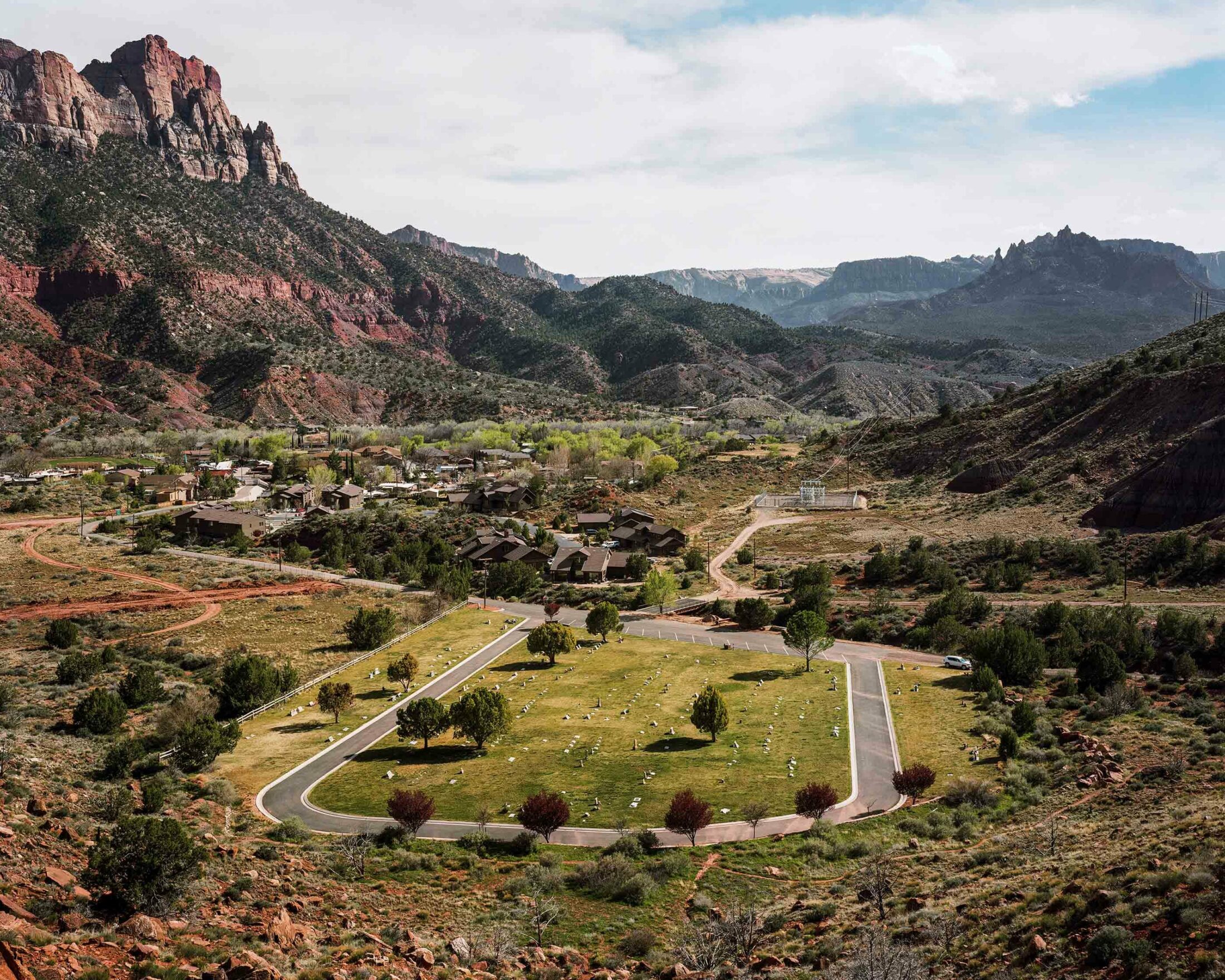
Paradise Road, Hurricane, UtahPhoto by Eliot Dudik
SEARCHING FOR PARADISE
I AM LOOKING at a photograph of Paradise Road. It is, according to the title, in Hurricane, Utah, and a congregation of mountains dominate the background of the image, their rock faces the color of a wound. Beneath the mountains is a tiny subdivision of identical homes and the dark, blank stares of their identical windows. In the foreground, in the center of the frame, is a cemetery. Almost identical in shape and size to the cluster of homes, it appears to us as a strange, inverted mirror of the subdivision. The lawns of the cemetery are flat and, unlike the native red-rock shrubbery elsewhere in the frame, unnaturally green. Pale rows of gravestones scar the ground. Paradise Road separates the cemetery from the subdivision—a neat, paved separation of living and dead. And where it touches the edge of the cemetery, Paradise Road makes one single loop around it—an unmarred border of cement that appears to both shelter the cemetery within it and hold the surrounding landscape at bay. The road seems to say, without saying: Here is the border of paradise.
The photograph is from a series called Paradise Road by the American artist Eliot Dudik. In 2013, Dudik began a road trip around America in search of all the roads called Paradise Road. The resulting exhibition, which features people, landscapes, and objects that Dudik encountered along the many different Paradise Roads, is a kaleidoscopic and jarring accumulation of scenes. In Paradise Road, San Diego, California, a man in a sweat-damp tank and loose jeans stands before a couple of beat-up cars parked on an empty plot alongside a dirt road. He squints upward toward the sun. On either side and behind him are hip-high brick walls, two of which appear unfinished. In Paradise Road, Baytown, Texas, one man sits in a folding chair on a suburban front lawn with a barber’s smock around his neck, while another stands behind him, razor in hand. And in the aerial shot Paradise Road, Edgemont, South Dakota, Paradise Road begins in the foreground as the pale dirt driveway of a modest white house before it crosses beneath a wire fence into a vast field, where it fades like a dream to nothingness.
“Personally, this dream seems to continually shift as new desires, obstacles, and realities become apparent,” Dudik is quoted as saying in one NPR article. The project began after the recession in 2008, when ideas about the American Dream were at the forefront of the national imagination. “In many ways, the United States is a changed landscape since then,” Dudik says, “but in far too many ways, it hasn’t changed at all.”
His photographs beg the question: Does paradise really exist?
What I am asking now is: Do we even want it to?
IT IS DIFFICULT to speak of paradise. Much like the language of American racism, the language of paradise is a rocky and precarious landscape, one that I wish to tread lightly through yet also thoroughly excavate. The meaning of paradise has been appropriated and manipulated by people in power throughout history to engender fear and loyalty. To build faith, to oppress.
That we have come to euphemize “paradise” as the platonic, virtuous ideal—that our language has slipped from speaking explicitly of borders to speaking of what’s most desirable—is simply proof of our exclusionist American ethic. Inherent in our notion of the ideal are walls of separation.
It is also difficult to speak of segregation, American racism, and paradise in the same sentence. This is, however, the point. The terrible truth is that paradise was—is—enacted at Lindenwood. Sections 13 and 14, where Henry is buried, are a kind of paradise: they are walled enclosures, gardens that nod, however troublingly, to a particular moral ethic. The problems of which I speak arise when particular, powerful groups with harmful agendas are the ones who define and decide a culture’s borders of paradise. We are lazy, cruel architects, prone to error and discrimination. Toni Morrison writes in her novel Paradise: “How exquisitely human was the wish for permanent happiness, and how thin human imagination became trying to achieve it.”
“I HAVE NEVER been particularly interested in slavery,” Wendy S. Walters begins her essay “Lonely in America,” the opening essay of her book Multiply/Divide; “perhaps because it is such an obvious fact of my family’s history.” Walters’s essay probes the troubling fact that a slave cemetery was discovered beneath the cobblestones of her New England town. In the piece, she attempts to illuminate some of the contradictions about American identities and aspirations.
Paradise is a palimpsest: a landscape on which we are constantly rewriting new cultural meanings atop the old; shadowed yet still visible.
“There’s … a lot of pain in history and present context of America,” Walters is quoted as saying in one literary review. “Multiply/Divide, for me, is an attempt to figure out where the pain is located in these historical moments and historical records that we are familiar with.”
Like Walters, I do not wish to simply point out a “buried” history of America—I accept it as a premise. That some people’s histories are lauded while others’ are intentionally neglected and erased is not a nuanced discovery in America. My true desire is to gather, interpret, and analyze the very ideas that led to these histories getting buried. One of these ideas, as I see it, is paradise.
It is not possible to bury the past without traces remaining aboveground, in the present.
I SUPPOSE THERE IS no place on Earth that could not definitionally be called paradise—no place that is not, in explicit or implicit terms, a walled enclosure of sorts. The word itself is a curtain stretched thin over time, expanding unintelligibly, obscuring a truth that lies buried beyond.
History, too, is a curtain, dark and thick. A curtain we stretch across uncomfortable truths.
Paradise Extended, where my great-grandfather Henry is buried, now summons to my mind the almost-laughable image of Paradise undergoing renovations. Walls knocked down and flooring cut, construction crews overseeing—all for a new addition. A larger, more capacious Paradise suitable for a growing family of inhabitants. In other words, Paradise Extended brings attention to the fact that “paradise” is a word under construction. It calls to mind what the palimpsest illustrates—that we can cross out and add on extended meanings of the word through time. Paradise is a palimpsest: a landscape on which we are constantly rewriting new cultural meanings atop the old; shadowed yet still visible.
PALIMPSEST
THE POET CHARLES WRIGHT writes in his book Black Zodiac:
Memory is a cemetery
I’ve visited once or twice, white
                                                          ubiquitous and the set-aside
Everywhere under foot …1
I am unsure why that day at Lindenwood remains so clear in my memory even now. I feel a strange and overwhelming urge to return to Lindenwood Cemetery—to be the one to chisel a stone, to vandalize the garden’s cruel dominion. I am “in search of lost time,” like Proust’s narrator, who was dragged into memory by a madeleine and Tilia blossom tea—tea derived, I discover, from flowers of the linden tree. I think that if I can only carve Henry’s name, I can write my history. It is all we can do to recall the forgotten dead.
THAT I FEEL so strongly about a name etched onto a grave—chiseled into stone—is, if anything, only evidence of my own bias for writing. It is a bias toward literature, toward language, a written record. To write is to memorialize. The self, the world, an era’s preoccupations. It is a means of endowing people’s lives with words that will live beyond them.
To write into history is to know a palimpsest intimately. It is to reconcile the notion that parts of the record have been written atop others. To discern where our cultural record has been rewritten and obscured. Most of my ancestral narratives have been written over by others—forced out of history’s borders. To write into my history is to become familiar with the cruel landscape of a particular American palimpsest, to struggle with and against it.
Now, almost a decade later, I type Henry’s name and his birth and death years into the Find a Grave online database, ashamed to hope that we were wrong all those years ago and that his name has been archived in stone all this time. The error message mocks me: a red exclamation point punctuated with the message “No matches found.” This notion reinforces the larger tragedy in the search for my ancestors: that what I hope to find of them is nowhere. What lives in my imagination is not in reality matched. The names they wore, the legacy they left, were no match for history’s discriminating slate. The search for knowledge of my predecessors has largely turned up blanks; their story remains highly debatable, an unmarked stone I try in vain again and again to read.
MORRISON WRITES in her novel Paradise:
But can’t you even imagine what it must feel like to have a true home? I don’t mean heaven. I mean a real earthly home. Not some fortress you bought and built up and have to keep everybody locked in or out.… Not some place you went to and invaded and slaughtered people to get. Not some place you claimed, snatched because you got the guns. Not some place you stole from the people living there, but your own home, where if you go back past your great-great-grandparents, past theirs, and theirs, past the whole of Western history … back when God said Good! Good!—there, right there where you know your own people were born and lived and died.
Home is discoverable only when we abandon paradise.
I AM WRITING from Lindenwood Cemetery, where I am standing for the first time since my first visit almost a decade ago.
It is summer: a brutally hot day. The shadows play across the graves, same as they have for over a century. In my hand I hold a map of the cemetery on which section 14 is highlighted in fluorescent yellow, a false beacon. Below, the dead wave me on in silence. I don’t wander. I don’t spend an hour searching the rows of marble and granite, as I once did.
This time I know where I am going—where to find my story.
For many of us, the past year has disrupted deeply ingrained habits. Some people report exercising less, others are drinking more. As we look forward to life returning to some semblance of normal, it’s worth considering what scientists have learned about how to create good habits and break bad ones.
Habits are like shortcuts — they’re things we can do quickly and without thinking because we’ve done them so often they’ve become automatic, says behavioral scientist Katy Milkman of the University of Pennsylvania.
One important feature of habits is that they’re triggered by cues in our surroundings, says Wendy Wood, a social psychologist at the University of Southern California whose research focuses on how we form and change habits. The trigger could be a time of day, a particular place or a different activity. Getting out of bed each morning and shuffling to the kitchen, for example, might trigger you to scoop some beans into a grinder and go through the motions of making coffee. Habitual behaviors generally offer a reward — in this case, a freshly brewed cup.
In an ideal world, good habits such as exercising, healthy eating and reading would be as easy to acquire as brewing coffee. Unfortunately, that’s frequently not the case. “Oftentimes, the things that are immediately rewarding in our environment are not the things that meet our long-term goals,” Wood says. “We haven’t managed to organize the environment in a way that allows us to easily form good habits.”
So, how might we go about doing that? Knowable talked to an array of behavioral scientists to learn more.
The pandemic introduced new public health behaviors, such as mask wearing and social distancing, and people continue to grapple with adopting behaviors to meet individual goals, whether exercising more or eating better. Two experts weigh in on the science of behavioral change, both personal and pandemic-related.
Timing matters
We’ve long been told by society that the new year is the perfect time to make a fresh start. Milkman agrees, but she points out that the year is filled with additional opportunities — such as birthdays, holidays and even ordinary Mondays. Her research has shown that people are more likely to visit the gym around fresh-start dates like these.
Because changing habits means disrupting your routine, it can be more effective to add new behaviors or remove unwanted ones when other big changes are happening, adds Wood — such as when you move, change jobs or go on vacation. During the pandemic, for example, many people got into the habit of cooking more at home and therefore eating healthier, she says.
But a fresh start alone isn’t enough. The majority of New Year’s resolutions don’t succeed, after all. “Most stuff requires more than a single moment of motivation,” Milkman says.
Timing is important for making good behavior stick. “The rewards for habit formation need to be immediate,” says Wood, who coauthored a paper on the science of habits in the Annual Review of Psychology. That’s because dopamine, a neurotransmitter that plays a key role in reinforcing behaviors in the brain’s reward pathway, operates on a time frame of seconds.
Unfortunately, many desirable behaviors don’t have immediate rewards. For example, if you take up running for the first time, it will likely be difficult and painful for the first week or two, and the benefits won’t be apparent so quickly. This lack of immediate gratification can be de-motivating. On the other hand, sitting on the couch and watching a movie brings an immediate reward — so it’s easier to make a habit of it.
Given dopamine’s short timeline, Wood says strategies that rely on long-term rewards, like paying people weekly or monthly if they exercise more, don’t build habits. They’re not tapping into the brain’s habit-learning mechanisms. So you need a different strategy. Milkman, for example, used to allow herself to listen to her Harry Potter audiobooks only when she was at the gym. That way, exercising gave her the immediate gratification of hearing the next chapter of a compelling book and helped her build the workout habit.
Immediate rewards can help reinforce a new habit. A Harry Potter fan, for example, might listen to the audiobooks while exercising as an in-the-moment reward for working out.CREDIT: BRYAN SATALINO
The initial change of integrating a new behavior into your routine is the hardest, says Elliot Berkman, a psychologist specializing in addiction, goal-setting and motivation at the University of Oregon. “It does often feel contrived and forced.” But he advises that people should take that weird, uncomfortable feeling as a sign that they’re developing a habit.
Consistent but flexible
Consistency is important when establishing new habits, researchers say, but there is also a danger of being too rigid. Milkman and her research collaborator, economist John Beshears of the Harvard School of Business, learned this lesson when they worked with Google on how to get the company’s employees to exercise more at the on-site gym. In her new book How to Change, she describes a study in which she and Beshears split 2,500 employees into two groups: one that received a reward if they went to the fitness center every day at the same time for a month and another that received a reward for working out every day, regardless of the time of day.
Milkman hypothesized that the group with stricter guidelines would build stronger habits. That’s not what happened. In reality, when people in that group weren’t able to go at their designated time, they ended up not going at all. Those in the other group just found another time. Forty weeks later, people in the group that had more flexibility were still exercising more often than the others.
Start small, be prepared
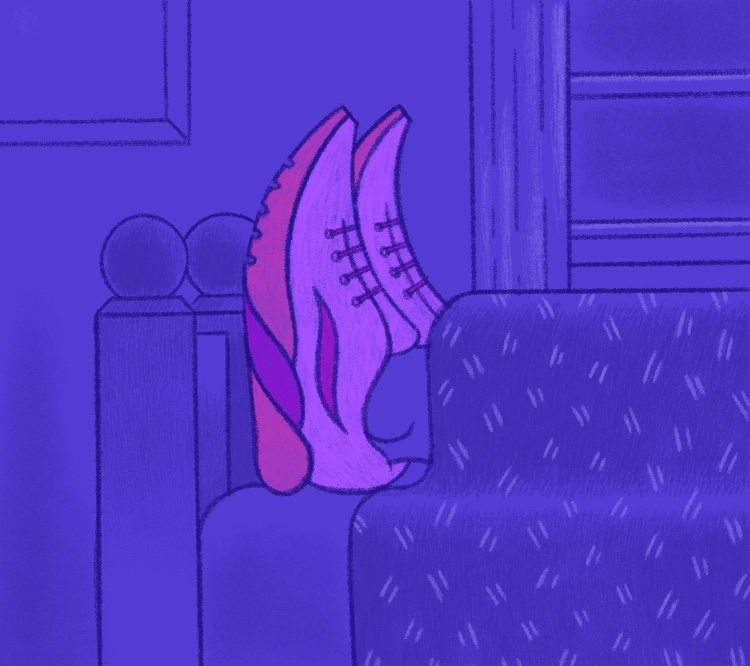
A new habit needs to begin with smaller steps, says Alan Stacy, who studies health habits and addiction at Claremont Graduate University in California and coauthored a paper on addiction in the Annual Review of Clinical Psychology. With running, for example, Stacy suggests that the first step might be to find a time — waking up 20 minutes earlier or using part of your lunch break. The next step might be to set up cues that keep leading you in the right direction, such as putting on your running shoes before having your morning coffee so you’re all ready to go and less likely to abandon your plan. (Or go a step further, and sleep in your running clothes, as Wood has done in order to “remove friction” from her desired goal.)
Preparation can make it easier to follow through with healthy habits. Don’t want to sleep in your running shoes? Consider putting them on before your morning coffee so you are ready to go.CREDIT: BRYAN SATALINO
Stacy’s research on promoting healthy habits such as condom use among drug users also illustrates the importance of preparation. In one study, enrollees in an educational program for drug offenders received basic information about the health benefits of condoms. Roughly a third of them also did exercises on a computer that presented them with choices for handling various situations, such as whether to put condoms in their pocket or purse before going to a party or bar. Then the computer program prompted them to visualize what they would do if they ended up leaving home without condoms and asked them to describe the steps they would take in their own words.
Compared with participants who only got the health information, those who did this additional exercise and practice steps reported more frequent condom use when the researchers checked in on them three months later. “People need to get ready for the behavior,” Stacy says. Breaking the behavior down into smaller steps and tying it into a concrete chain of activity can help reinforce it.
Breaking a habit
Most of us know which behaviors are beneficial and which are detrimental. So why do we still do things we know are bad for us? This was the question that drew Stacy to this area of research. Growing up, his father was addicted to alcohol and later, when Stacy worked as a musician, he saw people overusing alcohol and drugs despite knowing the consequences. “I was always interested in why people do things when they have the knowledge,” he says.
Some of the strategies that researchers recommend for creating habits, such as preparation, can also help people break them. Stacy and his team are developing an app to help people with drug, cigarette or alcohol addictions choose alternative behaviors they can plan in advance. Being around other smokers, for example, can trigger the urge to smoke. The app presents alternatives such as walking away to get a coffee instead. Stacy and his colleagues are currently testing the idea that rehearsing these alternatives beforehand with the app, which gives feedback about progress, will help people become more likely to actually do them when the situation arises.
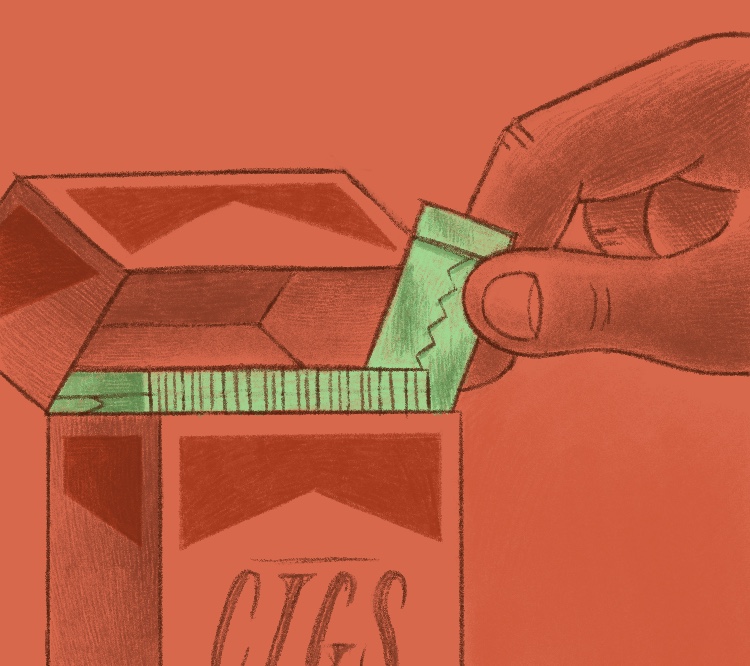
Instead of trying to simply eliminate a bad habit, Berkman recommends replacing one behavior with another. For example, one study found that having a healthier snack helped participants replace their habitual snack. “It’s much easier to say, ‘When I have an urge for a cigarette, I’ll do this behavior instead’ than ‘When I have an urge for a cigarette, I’ll just not smoke.’” This might mean chewing gum or drinking tea instead. The replacement behavior should offer an immediate reward and, ideally, shouldn’t replace one bad habit with another.
To break a bad habit, substituting a healthier alternative is often easier than quitting cold turkey.CREDIT: BRYAN SATALINO
Understanding the motivations and triggers for a habit can also help to break it. Berkman and his team are working on a project to see if smokers trying to quit using nicotine replacement therapy are further helped by thinking about all the ways that cigarettes are embedded in their lives. “It gets built into your whole world,” Berkman says. For one person, smoking may be a way to take a break from work. So helping that person find another way to serve that same function — maybe taking 10 minutes every couple of hours to chat with a friend or read a magazine — gives them other ways to fill the need of having a break. For another person, the physical aspect of holding something in their hand might be more important, and so replacing smoking with an activity like knitting could help.
Wood suggests trying to take time to think instead of acting on autopilot — say reflexively pouring a second glass of wine after finishing the first. People tend to fall back on their habits when they’re distracted or feel pressed for time, she says. But when they have a few moments to think about their actions, they can make better decisions.
Keep trying
How long does it take to make a new habit or truly break an old one? Unfortunately, there’s no magic number, says Benjamin Gardner, a social and health psychologist at Cambridge University. Studies of habit formation generally suggest a timeframe that ranges from a couple of weeks to a couple of months.
People often assume you either have a habit or you don’t, Gardner says. “But it varies on a continuum.” And even once you have formed a habit, it is always possible to backslide. The good news, however, is that it’s easier to rebuild that good habit than to create one from scratch — how easy depends on how strong the habit was to begin with. Gardner compares the process to water finding its path again: Even if it’s been dry for a while, you can still see the remnants of the trench.
The Covid-19 vaccines and our ability to go, at least somewhat, back to our pre-pandemic way of life is yet another life-changing event. This new chapter could be a good opportunity for making changes — creating good habits and trying to break some bad ones. It won’t necessarily be easy, but by harnessing strategies like making fresh starts, building in immediate rewards and replacing unwanted behaviors with desired ones, it might not be as hard as we fear.
Stephanie Parker is a writer living in Switzerland. Her best habit is a daily yoga practice and her worst is mindlessly watching hours of Netflix. You can follow her on twitter @sparkersays and see more of her work at stephaniedparker.com.
“I don’t want to live, I want to love first and live incidentally.”
–ZELDA FITZGERALD
Born this week in 1900
Zelda Fitzgerald (July 24, 1900 – March 10, 1948) was an American socialite, novelist, and painter. Born in Montgomery, Alabama, she was noted for her beauty and high spirits, and was dubbed by her husband F. Scott Fitzgerald as “the first American flapper”. She and Scott became emblems of the Jazz Age, for which they are still celebrated. Wikipedia
We all know that where the rubber meets the road on the spiritual path is amidst the challenges and complexities of living our daily lives.
From our intimate relationships to our workplaces, from making big decisions to navigating conflicts, the real fruits of our spiritual practice emerge in the day-to-day.
But how exactly can we bring spiritual practice—and spiritual awakening—into our daily lives?
Is it enough just to meditate once a day and hope that the meditation carries over into the rest of our activities?
Or are there potent spiritual practices that we can do off the meditation cushion and amidst the dynamism and swirl of daily living?
As you probably know, I am very passionate about the power of meditation and other contemplative, inner practices.
But through my work with tens of thousands of seekers over the past decade, I’ve come to believe that for our spiritual practice to be truly transformational, we need to find a way to bring it into every moment of our lives, until everything we do is infused with the energy and wisdom of enlightenment.
For many of us, our first association with the idea of spiritual practice is meditation. So, naturally, when we try to bring spirituality into our daily life, we experiment with trying to extend meditative awareness throughout our day.
If you meditate, chances are you’ve experienced some degree of inner peace, expanded awareness or clarity and then tried to carry that meditative state with you while going through your daily life. And you probably discovered that trying to stay in meditation amidst the activities of daily living doesn’t really work. Or, at least, it doesn’t work very well. Here’s why:
In meditation, you have the luxury of simply sitting still, doing nothing and then allowing yourself to engage in subtle practices of opening your consciousness to something deeper.
But in daily life, you’re moving. You’re engaged. Things are happening, quickly. Reality is occurring, and you’re right in the middle of it. In the midst of all this chaos, it’s not really advisable—or even possible—to slow everything down the way we do in meditation so that you can simply pay attention to the deeper layers of consciousness.
So although there can be benefits to trying to stay calmer and more centered throughout our day, if we want to live deeply engaged and creative lives, these practices aren’t enough to truly infuse our lives with the energy of spiritual awakening. They don’t teach us how to actually bring spirit into the world through our own actions.
Instead of trying to maintain meditative awareness in the midst of our busy lives, I advocate what I call “awakened life practices.” These complement our meditation practices, but they’re not actually about meditation at all. They’re about engaged spiritual practice. They’re about turning every moment of our daily life, or at least a significant portion of it, into a domain of spiritual practice. That means practicing being free and awake as we go through all the ups and downs of life.
Think about it. We all spend the vast majority of our time engaged with the activities of life. We’re out living our lives, taking care of our responsibilities, engaging with other people, creating projects, etc. So, if we can turn all of life into an active spiritual practice, we can expand our spiritual practice period from meditating 30 to 60 minutes a day to potentially practicing up to 10, 12, or even 16 hours a day. It’s possible to turn every waking hour into a kind of practice that we do as we’re doing everything else.
This domain of awakened life practice is really where our spiritual awakening gets put to the test. It’s almost a cliché in spiritual circles that a person goes away on the retreat or workshop, has a really powerful experience, and comes back feeling very opened up.
Then when they have to go to work and re-engage with their family and responsibilities, the profound experience evaporates and they go back to being the person they were, almost overnight. They get depressed because they feel that their awakening didn’t last. Nothing stuck. They think, “I’m back to where I was, so what good was it anyway?”
You can avoid this common spiritual collapse by learning how to consciously practice living your life in a way that’s an expression of awakened consciousness, that’s aligned with your true nature. If you can do this, you’ll find that you can stabilize your awakening and sustain it through the tests and the challenges you face in your life.
Awakened life practice, in essence, means living our life as a conscious expression of the natural, enlightened attributes or postures of our true nature. We learn to practice awakened living by studying the nature of awakened consciousness. We look at how awakened consciousness manifests—its qualities and natural dispositions—and then we build practices to apply those dimensions directly in our lives. We want to become an expression of the dynamic, engaged dimension of awakening.
Awakened consciousness manifests in different ways in our lives. And there are many postures or orientations that we can take to practice awakened living. I’ll be exploring several of these orientations in-depth in future articles, but I want to give you a taste of what I’m talking about here.
One of the most common meditation postures, and one that’s a big part of how I approach the practice, is learning to simply let everything be as it is. When practiced in earnest, this practice of simply being leads to an experience of radical contentment. In this experience, we become deeply content with what is.
This doesn’t mean that we don’t want to change things in the world, but on a fundamental, existential level we are at peace with reality. We are allowing life to happen without fighting it, resisting it, or trying to change it. It’s a way of practicing a posture of contentment, whether or not you feel particularly content in any moment.
But there’s an active, engaged version of this posture as well. And it’s not about just letting things happen in the world without reacting or interfering or trying to change things. The truth is that life tends to need our intervention. We have to participate in the unfolding life process, which means dynamically steering our lives and actively contributing our energies to the many situations in which we find ourselves each day.
When you’re practicing radical contentment in the midst of your life, it takes several forms. First, letting everything be means stepping into a kind of fluidity in how you relate to your life, to your experience, and to others. When you choose to accept reality as it is, you stop getting in the way of the natural flow of life. Your intuition kicks in and you begin to respond more accurately and appropriately. You’re not just letting things happen to you. Sometimes you have to step in and change course or stop a certain momentum. But you’re not holding on to anything too tightly or swimming against the natural current of the moment.
Second, when you’re practicing letting things be in daily life, you stop avoiding or denying the way things are. Because you’ve made a fundamental choice to face reality as it is, you no longer avoid difficult subjects or truths. You are leaning into the way things are, striving to see your life and life in general, exactly as it is, without distortions. This gives you an unusual freedom from bias and opens the door to a radical clarity and wisdom.
Finally, the active practice of letting everything be gives birth to a deep kind of vulnerability. When you are deeply content, you let your defenses down and stop the game of constantly trying to protect yourself. This allows for a profound vulnerability with yourself and others.
Another meditation practice I teach is taking the position of not knowing, or letting go of the need to know anything, which opens us to a deep place of innocence and humility. This practice has many dimensions: letting go of your mind, not holding onto concepts, not needing to know. In meditation, because we don’t have to do anything other than sit still, we can take a very absolute stance on this point. We can fully disengage with our minds and thoughts.
But if you want to experience the power of “not-knowing” in your daily life, you need a different approach than you took in meditation. We can’t just completely disengage from our thoughts while we’re going through our day. In life, we engage with concepts all the time. We think about issues. We solve problems and create things. We’re very engaged with the mind. So the awakened life version of not-knowing is really about giving up the emotional need for certainty. We practice not holding on to knowing, not needing to know, being open to what we don’t know.
What does life look like when we no longer need to know? We’re no longer personally, or egoically, identified with knowing, or being “the one who knows.” This leads to a kind of humility, open-mindedness, and interest. We’re humble in the face of life and how big and how complex it is. We don’t grasp onto overly simple solutions, nor do we hold onto ideas just to feel safe and secure in an insecure world. We’re more interested in what we don’t know than what we do know.
Paradoxically, this fundamental posture of not-knowing—of receptivity and open, innocent interest—actually enables us to see everything more clearly, to have better judgement, to find more creative solutions to problems. Our willingness to not know ultimately transforms our knowing and connects us with a profound source of wisdom that informs every aspect of our lives.
These are just two examples of what it means to bring spiritual practice off the meditation cushion and into your daily life in a way that is aligned with the nature of awakening itself. These awakened life practices are powerful because they reflect the natural emergence of awakened consciousness in the world. They reflect how your true nature wants to show up and engage with the world in every moment. In that sense, these postures represent the intersection of enlightenment and life
When done consistently, awakened life practice is an opportunity to turn every moment of your day into a spiritual practice and to ultimately transform your entire life into a spiritual experience.
Columbia Maison Française00:20 Introduction by Shanny Peer, Director of the Maison Française 05:35 Introduction by Alice Kaplan, Professor of Yale University 11:50 Reading of ‘The Human Crisis’ by Viggo Mortensen 56:50 Discussion with Viggo Mortensen, Alice Kaplan and Souleymane Bachir Diagne On April 28, 2016 a reading by Viggo Mortensen of a speech by Albert Camus, and roundtable discussion with Viggo Mortensen, Alice Kaplan and Souleymane Bachir Diagne Albert Camus originally delivered this lecture on “La Crise de l’homme” on March 28, 1946, to a very full house at the McMillin Academic Theatre at Columbia University, on his first and only trip to the United States. 70 years later, to celebrate Camus’s visit to New York and Columbia, his lecture will be delivered in a dramatic reading by the actor Viggo Mortensen, in a version newly translated into English by Alice Kaplan. The event will be introduced by Shanny Peer and by Alice Kaplan, who will share new research from her forthcoming book, Looking for the Stranger: Albert Camus and the Life of a Literary Classic, to bring alive Camus’ U.S. visit and provide a context for his lecture. After the reading, Bachir Diagne and Alice Kaplan will be joined by Viggo Mortensen for a panel discussion about Albert Camus’ influence, his impressions of the U.S., and his reception in this country as a leading voice of the postwar generation of French intellectuals. Participants: Viggo Mortensen has consistently earned acclaim for his work in a wide range of films. Some of these include Jauja, Loin des hommes, The Two Faces of January, A Dangerous Method, The Road, Eastern Promises, Appaloosa, A History of Violence, and The Lord of the Rings trilogy. He has received various nominations and awards from groups including the Screen Actors Guild, the American Academy of Motion Picture Arts and Sciences, the Hollywood Foreign Press Association, and the British Academy of Film and Television Arts. Apart from acting in movies and plays, Mortensen is a poet, photographer, and painter. He founded and is the editor of Perceval Press, an independent publishing house specializing in poetry, photography, painting, and critical writing. Souleymane Bachir Diagne is Professor of Philosophy and French and Chair, Department of French, Columbia University. Alice Kaplan is the John M. Musser Professor of French and chair of the Department of French at Yale University. This event is organized in partnership with The Albert Camus Estate and is part of a series of events taking place in New York on the theme of “Camus : A Stranger in the City” (March 26 – April 19 / @camusnyc2016) commemorating the 70th year anniversary of Camus’ visit to the United States. If you want to see the Q&A with Viggo Mortensen about the movie Far from Men, a video is available here: https://youtu.be/GE3Ux2on5B0?t=2m20s Columbia Maison Française website: http://maisonfrancaise.org/ Follow us on FB: https://www.facebook.com/columbia.mai… Twitter and Instagram: Columbia_MF
Being raised in the middle of the Bible belt where deeply racist ideas were common, I believed without question that black people were inferior to me. I was led to believe they were lazy and just above the category of animal. I graduated high school without ever having known a black person, but I was assured my mental capacities far exceeded those of all people with black skin. I think most of society assumes it was these attributes that allowed us to make slaves of black people. But every bit of this is a lie.
Sentiment had to be cultivated to accept slavery. Gomes Eanes de Zurara is credited with writing the first “recorded history of anti-Black racist ideas…” with The Chronicle of the Discovery and Conquest of Guinea, in 1453. Not only was this the beginning of the demonization of black people, but before this, race did not even exist. It was invented for the same reason blacks were demonized – financial gain. The creation of race created a whole new power of control – the kind of control that produces financial wealth. “Race creates new forms of power: the power to categorize and judge, elevate and downgrade, include and exclude.“ (Ibram X. Kendi: How Racism Relies on Arbitrary Hierarchies). That power was necessary to perpetrate and control the slave industry.
During John Biewen’s podcast, The Invention of Race, he says, “The Portuguese writer (Gomes Eanes de Zurara – the very author of the first anti-black racist ideas), who, commissioned by the slave-trading leaders of his country, literally invented blackness, and therefore whiteness, in the 1450s, according to Kendi (historian), the Enlightenment scientist who first divided humanity into five “races” and coined “Caucasian.” John Punch, a black runaway indentured servant in 17th-century Virginia whose capture and sentencing to lifelong servitude marked the first official sanctioning of chattel slavery, and the first time a black person was treated differently from a white person in the law, in colonial America.” You can’t feel pain if you don’t know what “no pain” feels like. You can see light because of darkness or shades thereof. That is how our world is made visible and/or knowable – because of contrasts. The moment blackness was invented, whiteness was born. You can’t have one without the other.
To be clear, black people were never inferior in any way. It was a lie deliberately concocted to leech the humanity out of our viewpoint of them and get us to view them as things. A stone is a thing. You kick it out of your way without the slightest thought for its feelings, its past or its hopes and dreams. To further convince us of the thingness of this people, it was also assumed them to be spiritually inferior, even to the extreme of saying they had no souls. That was the clincher – beings without souls are things or animals and it didn’t matter how we treated them. God does not care about them.
One big misconception about slavery is that the term “slavery” applies only to the black race. But up until the 1450s, most slaves were white. In fact, the very name slave comes from the term Slav, who where the preferred slaves before they learned to defend themselves better. Slavs were a northern people. They were white. As they became harder to subdue, slave traders looked to Africa.
All seems to be forgotten about Netherland’s role in the slave trade. The Dutch slave trade was one of the better organized, therefore, more profitable operations. It was centered in Amsterdam and the city province of Zeeland: Middelburg. The Company responsible for the slave trade became one of the world’s most successful trading companies “The Dutch West India Company” (Nederlandse Westindische Compagnie or WIC).
The remnants of slavery are not easily apparent today in Amsterdam. The obscure history of the slave trade in the Netherlands is due, in part, to shame amongst the Dutch people, even more so because this ‘aspect’ brought Amsterdam much of the wealth still visible in those beautiful 17th and 18th-century luxury Canal Houses in Amsterdam. The Netherlands is no different than any other country – national history focuses on its heroes and victories and prefers to leave out the unpleasant sides.
However, this is changing with the intervention of NINsee (National Institute of Dutch slavery history and heritage). They have mapped and listed places around Amsterdam left by the slave trade, like the Royal Palace on the Dam, where the plantation owners united and became a guild called the Society of Surinam. This guild held their meetings at the West-India House, headquarters of the WIC. On NINsee’s list are the names and backgrounds of some of the cruelest slaveholders and slave merchants in the business along with collected slave accounts and stories of slaves who came to Amsterdam with their owners to work in the Amsterdam household.
Although the Dutch took slave trade and slavery to a whole new mass-scale-level with black Africans, the use and trading of slaves of all races and genders were already common in Africa and the Middle East before the Europeans entered the scene.
All of this stopped due to the official abolishment of slavery in the Netherlands in 1863 stemming from ‘Anti-slavery’ sentiments in the country.
Racism was invented for a very specific purpose and like good little robots, we have adopted those racist ideas as our own, probably beyond the inventor’s wildest dream. We were forced into seeing all people of color as black, even though they represent as many different shades and colors as there could possibly be. We see all non-colored people (which really, there is no such thing) as white. But every soul standing, sitting or lying down is a mix. We miss all the subtleties and nuances by characterizing everything as either/or.
There is a spiritual process that goes something like this: Before I consciously get set on a spiritual path, my ideas are pretty much characterized as black/white, good/bad. I see stark categories of people, things, events, etc. Then something happens that shakes me loose from my slumber and fills me with spiritual hunger. I begin to search and I find a thread. I follow this thread until I find the people who can help me. As I learn spiritual ideas and practices, life in many ways becomes more complicated. Instead of black/white macro categories, I begin to see the micro categories that make up the macro. I begin to see subtlety and nuances until the old categories no longer fit. And finally, I stop seeing my categories at all as real people come into view, or rather the uniqueness of persons. As long as you see life and people through your categories, you are not in touch with reality.
We can see those subtleties at work in the way that today’s youth have ascribed their identities to way more categories than simply male/female or gay/straight. In the same vein, we need to realize that no one is simply, “black” or “white” or any one race. We are all mixed. As Calvin Harris, H.W., M. (my instructor in a mentor’s workshop class) said, “We just need to call everyone ‘mixed’”. So, if it’s simplicity you want, what can be more simple then just one category to describe everyone, ——– “Mixed” or how about, “Human Being”.