Book: “The Quest of the Historical Jesus”

The Quest of the Historical Jesus

The Quest of the Historical Jesus

by Albert SchweitzerIrwin Hood Hoover (Translator), Francis Crawford Burkitt (Preface)

n this broad survey of the efforts to establish, amend, or deny the historical Jesus, Albert Schweitzer presents the history of a debate about what mattered most to millions of people: If God had entered human history, what could history tell about it? Throughout the course of this heated and prolonged dispute, one retelling of the life of Jesus followed another, enjoying — in Schweitzer’s phrase — “the immortality of revised editions.” Lesser writers might consider differences of opinion as signs of a hopeless enterprise, but Schweitzer instead finds immense value in the differences. Approaches and conclusions may differ, he concludes, but the quest for the historical Jesus has provided ample testimony to the importance of the effort and the rewards of the experience.

(Goodreads.com)

Hans Christian Anderson on miracles

“The whole world is a series of miracles, but we’re so used to seeing them that we call them ordinary things.”

—Hans Christian Anderson

Hans Christian Andersen (April 2, 1805 – August 4, 1875), in Denmark, was a Danish author. Although a prolific writer of plays, travelogues, novels, and poems, he is best remembered for his fairy tales. Wikipedia

The divine Dante

The divine Dante | Aeon

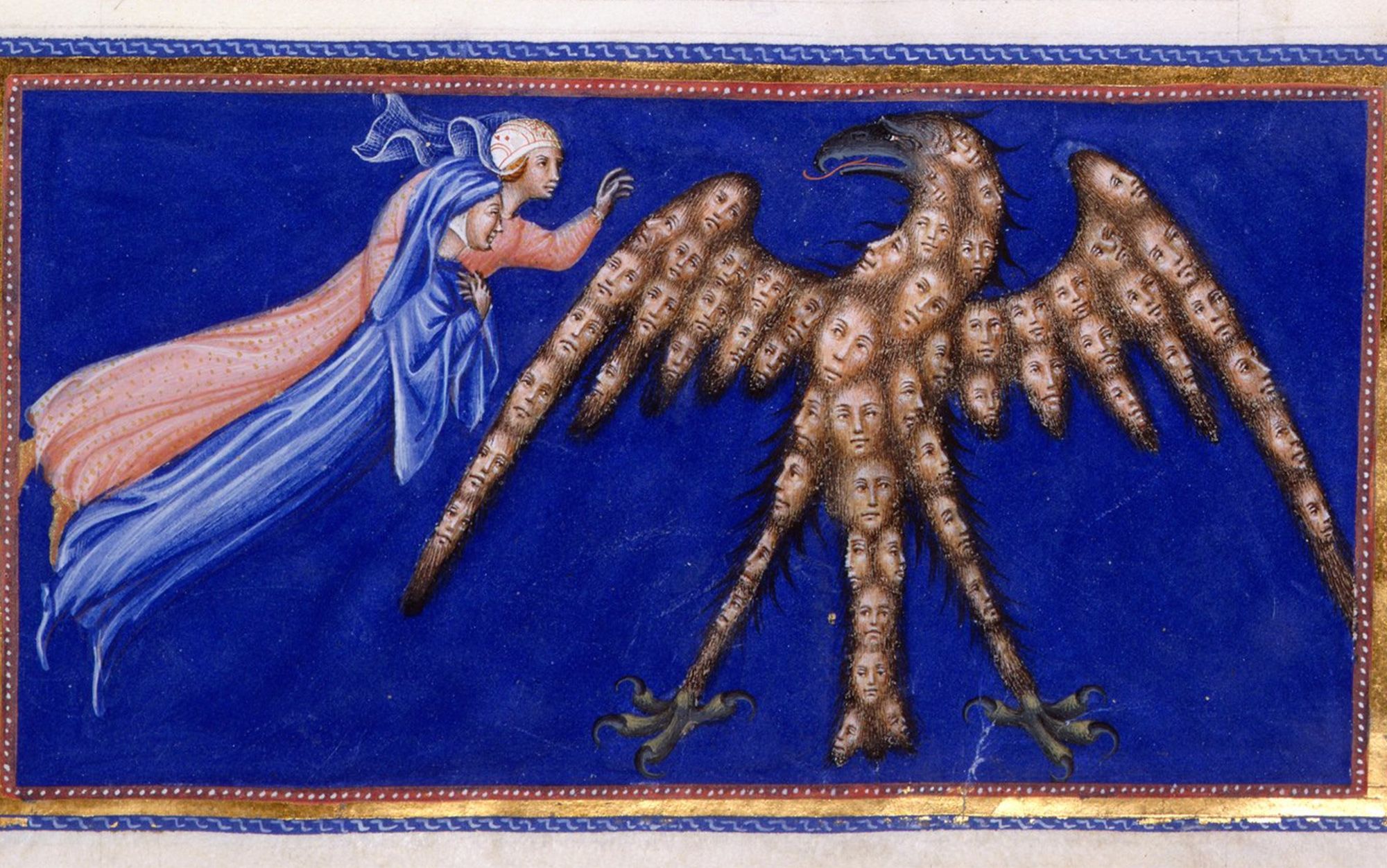
At 700, Dante’s Divine Comedy is as modern as ever – a lesson in spiritual intelligence that makes us better at being aliveDetail of a miniature of Dante and Beatrice before the eagle of Justice from Dante’s Divina Commedia, illustrated by Giovanni di Paolo (c1444-50). Courtesy the Trustees of the British Library, Yates Thompson MS 36. f162

Mark Vernon is a psychotherapist and writer, and works with the research group Perspectiva. He has a PhD in ancient Greek philosophy, and degrees in theology and physics. He is the author of A Secret History of Christianity: Jesus, the Last Inkling, and the Evolution of Consciousness (2019) and Dante’s Divine Comedy: A Guide for the Spiritual Journey (forthcoming, September 2021). He lives in London.4,000 words

Edited by Marina Benjamin

20 July 2021 (aeon.co)

Aeon for Friends

FIND OUT MORE

Dante Alighieri was early in recognising that our age has a problem. He was the first writer to use the word moderno, in Italian, and the difficulty he spotted with the modern mind is its limited capacity to relate to the whole of reality, particularly the spiritual aspects. This might sound surprising, given that his masterpiece, the Divine Comedy, is often described as one of the most brilliant creations of the medieval imagination. It is taken to be a genius expression of a discarded worldview, not the modern one, from an era in which everything was taken to be connected to the supreme reality called God. But Dante was born in a time of troubling transition. He realised that this cosmic vision was being challenged, and he didn’t seek to reject it or restore it, but to remake it.

The scale of this ambition partly explains why he wrote his three-part narrative journey – through hell (Inferno), purgatory (Purgatorio) and paradise (Paradiso) – in Italian, for a mass audience, not just the Latin-reading literati. The Divine Comedy was an instant hit. Hundreds of early manuscripts of the work survive, and people were soon demanding public readings of it. And it has continued to excite the imaginations of more recent poets, from T S Eliot to Clive James, as well as artists from William Blake to my favourite contemporary illustrator, Monika Beisner. Dante takes you somewhere you didn’t previously know. He does that because his epic verse is a self-conscious response to a shifting consciousness with which, in many ways – particularly when it comes to meaning – we are still wrestling.

Dante’s hometown was at the epicentre of the move from the medieval to the modern. Florence was flush with new money as a result of the boom of the 13th century, fed by innovative forms of banking and commerce that seeded capitalism and revolutionised society. It was a crucible of the Renaissance, nurturing artists such as Giotto, who pioneered the painting of individuals with inner lives that we recognise as our own. Dante almost certainly knew Giotto, and he also absorbed the meaning of spiritual movements causing earthquakes across the religious landscape, from the voluntary poverty of the Franciscans, who challenged the exorbitant wealth and power of the church, to the spiritual liberty of the Beguines, a movement of many thousands of women across Europe who claimed social and religious independence so that they could focus their lives on God.

That said, it was not until Dante was halfway through his life that he realised how profoundly significant these various developments were. Born into an old Florentine family, he first became involved in the tumult of politics, which saw the balance of power swing continually between factions representing the papacy and those favouring the empire. He held a number of civic posts, at one point serving as one of the six priors who governed the city. But then, in 1301, Florence was torn apart by the squabbles and warfare, and Dante found himself on the wrong side. He was forced into exile.

Banishment seemed ruinous for the poet who had already established his name as a master of the ‘sweet new style’, because he could no longer widely mingle with native speakers of his beloved dialect. He lost his possessions and contact with his family, too, and knew the bitter pain of walking ‘the stairs of others’ homes’, as he describes the isolation that was to last the rest of his life. But the astonishing verse that he began in or after 1308, and completed the year before his death in 1321, is not only an account of collapse and recovery following a devastating midlife crisis. It is a tale of transfiguration.

The Divine Comedy can be read in numerous ways. Its 14,000 lines explore what is most wonderful and depraved about humanity. They popularised his new verse form, the terza rima, and became seminal in the making of modern Italian. They are also an exploration of the highest aspirations of love. The trembling of the vital spirit that dwells in the secret chamber of the heart, as Dante called it, shook him to the core after a youthful, chaste encounter with a young woman who was probably Beatrice ‘Bice’ di Folco Portinari, the daughter of a successful merchant. She died young at the age of 24, in 1290, but her smile left an undying impression on Dante’s soul. He felt it was a sign, and what he found when he followed its lead is fundamental.

It took him on a pilgrimage through the three domains of the afterlife, as they have been imagined by many within Christianity and other traditions such as Islam. For Dante, hell is a place and state of mind in which people are trapped. They believe they have been condemned – though, as Dante comes to see, their problem is subtler than simply finding themselves cursed by a capricious divine judge. At heart, they’ve lost their capacity to change because their mistaken and foul habits have become so ingrained.

Purgatory is a zone of change. It works not by purging what’s deemed impure but, rather, by purging whatever blocks a soul from knowing more of life, particularly as it manifests in spiritual forms. Dante depicts this second realm as a mountain that leads to freedom as the souls climb. They gain clearer desires and deeper understandings that point them in increasingly expansive directions. It makes them capable of paradise, the last and most difficult leg of the journey. To enter this realm, Dante says he and they must ‘transhumanise’. It is an example of one of his many neologisms – in this case, capturing the way in which human apprehensions must surpass everyday preoccupations and perceptions if they are to appreciate the nature of the cosmos and beyond, in all its fulness.

This brings us to the heart of why Dante still matters today. He stresses ways of knowing about life based on experiencing and undergoing, as opposed to studying or inspecting. They bring an understanding that isn’t about accumulating information and sorting data but trusting feeling and following insights. They cultivate an intuitive openness that leads to union: it is knowing in the sense that ‘Adam knew Eve’, as you can read in older translations of the Bible, which doesn’t just mean that they were acquainted with one another, but that they made love. Dante tells us that to navigate realms of space and time, and to be aware of eternal domains of existence, we must consent to, and be able to be infused by, their varying qualities. I say ‘we’ because Dante explicitly writes for us who were to come, as well as for his peers. When reading him, he urges us to follow him.

Spiritual intelligence is not about highbrow abstractions nor emotional intelligence

I am thinking here of the type of nous that fosters spiritual intelligence, partly because I am one of an interdisciplinary group, set up by the International Society for Science and Religion, seeking better to articulate this mode of knowing, and also because spiritual intelligence has already been applied to the Florentine’s work. The Dante scholar and biographer John Took uses it to express the consciousness that arises with ‘the most complete kind of self-confrontationself-reconfiguration and self-transcendence’. In his book Why Dante Matters (2020), Took explains how Dante encourages this first-person illumination by crafting images, dialogues and stories that can provoke the emergence of otherwise unknown types of understanding. Dante knew that pictures guide, conversations catalyse and narratives think. Spiritual intelligence is not about highbrow abstractions, as if entering paradise were about becoming a good analytical philosopher; nor emotional intelligence and the capacity to learn from experience. Rather, it incorporates these elements to reveal its core perception: that becoming familiar with what Iris Murdoch in The Sovereignty of Good (1970) called the ‘fabric of being’ means becoming alert to the ways in which we resonate with it.

The Divine Comedy launches with images that recognise this. (I will be quoting from two translations here: one by Mark Musa for Penguin Classics, which is more accessible; and another by Robert Hollander and Jean Hollander, which has more of a poetic lilt. Both translations keep the three-line grouping of Dante’s terza rima without attempting the rhyme, which is only ever partly successful in English.) Consider Dante’s waking up in a dark wood, as the poem begins. Immediately, the scene tells us something key. The air is bitter. The shadows are frightening. Dante is aware that something has gone very wrong. But his crisis is simultaneously a moment of opportunity, which we know because the moment of unravelling comes at the start of what he calls a commedia, a tale that will end in delight. The question is not whether that will happen, but how?

The opening promises an answer for those who will share the participative adventure. It insists on an active engagement on the part of the reader with what is about to unfold. It presses not just for our interest in the events to be related, but for our interior transformation as we struggle with them and, thereby, make them our own. Stay close as we navigate these domains, Dante advises, not least as becoming lost and confused is part of the trip. In that spirit, consider some of the key steps along this path as it takes us below, then up, and finally above.

Crucial issues quickly become clear in the first phase, the Inferno. It could be summarised as being exposed to false and limited ways of knowing. Take one of the most celebrated encounters Dante has, when he meets the lovers Francesca da Rimini and Paolo Malatesta. Francesca tells him how she fell for Paolo:

Love, that excuses no one loved from loving,
seized me so strongly with delight in him
that, as you see, he never leaves my side.

She is being tossed about by the winds of hell as she speaks, mirroring the storms of passion she felt in life, but her account evokes our sympathy: who has not been there, or wanted to be so joined? Why is this desire deemed bad?

The reason is that their hope never to be parted collapsed their lives into a cosmos of two. They drew together, and became each other’s obsession. Dante will himself be told later that he became obsessed with Beatrice. ‘Too fixed!’ he will hear called out to him when he was at risk of turning her into an idol. The wider suggestion is that, while falling in love brings intimations of paradise, trying desperately to sustain the excitement is ultimately imprisoning. In an age such as ours, which idealises romance, perhaps because of the fear that such intensity is the best that life might offer, it is hard to trust that there is more. It is even harder to trust that more will come with letting go.

Another facet of this clinging to life emerges as Dante and his companion, Virgil, descend into lower circles of hell. They meet souls perpetually seeking revenge for perceived wrongs and others who cannot imagine any way of living other than deceit, theft, pimping and pilfering. Dante is, in effect, in agreement with Friedrich Nietzsche, who in Ecce Homo (1888) pithily remarked that human beings become what they are. If you use others, you will, eventually, consume yourself.

However, as he and Virgil continue down, Dante starts to understand something else. A key insight comes when he reflects on the way these tragic souls experience time. They are shaped by old practices and bad habits because they have forgotten that there can be a present in which things might be different. Dante sees that these figures are destined to live lives on repeat because the past dominates their minds and stops any novelty or freshness appearing. The point is underlined when the companions reach the floor of hell. It is not fiery and hot, but frozen and cold. Everything is still, locked in ice.

In purgatory, there are no encounters that aren’t opportunities for expansion

The hold that the past has on souls starts to shift when Dante and Virgil begin the climb up Mount Purgatory. Here the individuals know something that is beyond the ken of souls in hellish states of mind: that vices need not be vises. A relative freedom is born when it is seen how it’s possible not to be bound by mistakes and flaws, hate and fear. And it is a question of this kind of knowing that is a type of seeing – the remarkable ability of the conscious mind to grasp, intuit and develop, when it has the space to do so. That brings release because the individual becomes more open to possibilities that are breathed into them by the wider currents of life, to which they had been closed off. Dante realises that the souls they meet and converse with on the mountain are growing, and they explain how they are becoming capable of appreciating more of life around and about them. They are learning to trust and discern what can be called the imagination and, with that, comes another key capacity, co-creativity.

This is living well as an art, a to and fro of making and being made. It is underlined by the artists whom Dante meets during the climb. Poets, in particular, address him, as you might expect, given that he is a poet. In purgatory, there are no encounters that aren’t opportunities for expansion. They tell him that, during their mortal lives, they often didn’t really know what they were writing about, though they felt the allure of what they were writing about, and that they are learning to close that gap now.

It is a process of embodiment that comes to a head for Dante when he meets Beatrice on purgatory’s summit – a moment that could be expected to be full of love and celebration. What unadulterated delight might he find in seeing her smile once more, now in a realm beyond death? Only, she doesn’t greet him fondly. Far from it. She lambasts him over two excruciating cantos.

Beatrice reproaches him because he had treated her like a god, longing only for her face, and not seeing that her beauty might be, for him, an awakening. Again, there is this theme of how every instant can become an invitation to step into more, if the right energy can be detected, collaborated with, and ridden. When coupled to such discernment, love is known as a spiritual path, not a romantic ideal. It is not primarily about a mutual exchange of empathy and pleasure but an increase of sight. It is not about being understood but understanding.

She longs for him to know more. If their meeting in the afterlife had been merely a reunion, he would have been lost in a dream of a past that had never existed. Instead, her steely resolve to not let that happen, though it causes distress, enables him to embrace another aspect of his transformation.

It is enabled by exercising his free will – a crucial issue that Dante discusses at some length. Spiritual intelligence understands that free will is not a naive notion of unimpeded action or unrestrained expression, but is about utilising what psychologists call intention: the ability deliberately to turn the mind’s eye towards this or that object or idea, as opposed to unthinkingly reacting to whatever insists we notice it. Realising that we can make such interior choices typically takes practice, which is why self-reflection is a focus in many spiritual exercises, such as confession and meditation. With it, Dante is ready for the transhumanising experience of paradise; but first, let us take stock.

Various features of spiritual intelligence have emerged. It sees that crises can be befriended as turning-points; that images and stories are truth-bearing; that participative knowing requires personal transformation; and that freedom is not about fewer constraints but detecting otherwise hidden horizons.

For Dante, these realisations have occurred because he confronted facets of himself when he met the souls in hell, and opened up as he shared with the souls who were embracing the purgatorial state of mind. He has seen how life’s breakdowns make for breakthroughs, and he is now ready for the third phase, transhumanising – although, immediately, he detects how this is not about moving beyond in the sense of escape, but by going still deeper into, which is why paradise is the toughest leg of the journey.

A way of grappling with what that means is to consider how Dante’s awareness of time shifts once more. That happens with another round of profound challenges to his assumptions: like purgatory but more so, paradise works by intensifying problems, not offering quick resolutions, because the aim is to comprehend, not be spoon-fed. A good case in point brings up the particularly difficult issue of suffering, and arises with the first soul he meets in the lowest heaven, Piccarda Donati.

She was the sister of one of his childhood friends, Forese Donati, and Dante is not surprised to meet her in paradise, as she was a beautiful soul on earth. However, he is surprised to meet her so soon and not in a higher heaven, nearer to God. His surprise turns to shock when Piccarda explains that she was abused during her mortal life. Another brother, Corso, who was a warmonger, forcibly removed her from the convent of the Poor Clares that she had joined, and married her off in an attempt to secure an advantageous alliance. The abduction meant that she broke her vows, which is why she appears to Dante in a lower heaven.

Dante is outraged at this news. His moral intelligence jumps to the conclusion that the injustice she suffered on earth has been repeated in heaven. She had no choice in the matter of her exit from the convent, he protests. Is she not being unfairly punished?

However, much as Beatrice had done at the top of Mount Purgatory, Piccarda is ratcheting up the tension so that Dante might see further. Descents come before ascents. More can emerge at the point that other forms of intelligence are surpassed – now, with Piccarda, Dante’s moral sensibilities in particular are engaged.

The sea can be said to be humble because of how it befriends, without reserve

She explains that her removal from the cloister revealed a truth that she might not have otherwise seen: she could let go of the future she had planned for herself and discover what she had in no way anticipated. Looking back, she no longer feels violated by the injustice and suffering of being forced, because she realises that her fate revealed the possibility of knowing a deeper, utterly resilient joy. She can welcome what occurred because, by saying ‘yes’ to events, she is made capable of including and transcending anything that might happen. She is not only free of the past and living in the present, but can appreciate life sub specie aeternitatis – from the highest, eternal perspective down.

The psychotherapist Donald Winnicott was on to the same dynamic when he remarked in 1947 that it is only after knowing the full ferocity of hate that the imperturbable nature of love can be trusted. Truth and Reconciliation Commissions, such as were held in South Africa, trust it too, because they know that when darkness is exposed to the light, new options spontaneously present themselves. It can sound highly offensive to ears attuned to the damage abuse can do, and is readily misunderstood. But Piccarda is not implying that the virtuous soul must embrace suffering; she is not teaching religious masochism. Neither is she condoning abuse: her manipulative brother will be confronted by the significance of his actions, Dante learns.

Rather, Piccarda is carving out an alternative way of facing tragedy. It is not as the ancient Greeks portrayed it, awaiting a deus ex machina that puts things right. Nor is it as Nietzsche said, when he remarked that the things that don’t destroy us make us stronger. Rather, Piccarda is saying that there is a way of looking at the world that can always detect goodness, regardless of the evils that are present, and moreover can find the means consciously to align with it.

Human beings can access this mode of perception when they trust the value of virtues. These personal habits and traits, which can be embodied in institutions and societies as well, guide us towards what is good by enabling us increasingly to participate in what is good, as it is found, often surprisingly, within and around us.

To put it another way, Dante sees that virtues disclose more of reality. The virtue of humility is central in this increase, although it needs to be understood properly because it is not about self-abnegation or about putting yourself last. Rather, it is about an unbounded receptivity so as to be filled with more. One image Dante uses likens humility to the sea because the sea’s lowest place means that everything flows into it. The sea can, therefore, be said to be humble because of how it befriends, without reserve. Similarly, the properly humble person grows. They are open to all things and so know of all things, whether good or ill: because they are not attached to one thing more than another, they are connected to all things, and thereby gain ad infinitum.

This brings us to the culmination of the Divine Comedy, which comes in the final section, the Paradiso, as Dante becomes aware of the domain outside of space and time called the Empyrean. He conveys an experience of commingling with the living pulse he now knows to be the fabric of being, and freely, joyfully co-creating with everyone in it – ‘turning with the love that moves the sun and the other stars’, as the renowned last line celebrates. In another doubly lovely metaphor, given that he is an author, Dante describes his experience of this knowledge with the image of

all things bound in a single book by love
of which creation is the scattered pages.

Love’s intelligence knows how and why all that exists is as many reflections of the ever-present origin and divine light. This is the understanding that your being and my being and all being is one being.

A part reflects the whole because its life can only be yet another buzzing expression of life itself

Nowadays, it would be called a non-dual experience of the basic nature of reality, as articulated in the Indian philosophy of Advaita Vedanta, or the realisation that everything shares the divine face, as the Sufis express it. In the Christian tradition, the German theologian Meister Eckhart, a direct contemporary of Dante’s, pointed to the same perception again when he said: ‘My eye and God’s eye is one eye, and one sight, and one knowledge, and one love.’

Dante realises that, as he becomes more fully himself, which is to penetrate the shadows and be more transparent to life’s light, he finds himself perfectly integrating with all that is around him, not by merger but by resonance and harmony. He doesn’t lose himself in others, which would offend the truth that the individual matters, as is rightly discerned by the modern mind, but instead recognises himself in God, as everyone else does. He knows the fractal consciousness of spiritual intelligence: how a part reflects the whole because its life can only be yet another buzzing expression of life itself, in a dancing, radiating unity.

The vision is tremendous and simple, and is a gloriously articulated reflection on everyday human consciousness. We are aware and can be aware of being aware. And this is Dante’s message for now: in a way, all we have to do to rediscover the essence of our intelligence, and the capacity to relate to the whole of reality – particularly in its spiritual aspects – is turn towards our felt experience, and examine what we find. There is presence and freedom, intention and imagination, truth in stories and transformations of time. To grow in this sense is to get better at being alive.

To read more about how to live, visit Psyche, a digital magazine from Aeon that illuminates the human condition through psychology, philosophical understanding and the arts.

Stories and literatureSpiritualityMetaphysics

The Higher Pantheism

“Closer is He than breathing, and nearer than hands and feet.”

–Alfred Lord Tennyson

Alfred Tennyson, 1st Baron Tennyson (August 6, 1809 – October 6, 1892) was a British poet. He was the Poet Laureate during much of Queen Victoria’s reign and remains one of the most popular British poets. In 1829, Tennyson was awarded the Chancellor’s Gold Medal at Cambridge for one of his first pieces, “Timbuktu”.Wikipedia

Chris Hedges “American Sadism”

mediasanctuary Please support The Sanctuary for Independent Media! For more information and to donate, visit: https://www.mediasanctuary.org Author, activist, teacher and dissident Chris Hedges spoke at The Sanctuary for Independent Media in Troy NY on June 27, 2021. In this talk Chris speaks about sadism, which he says: -Now defines nearly every cultural, social and political experience in the United States. -Is expressed in the greed of an oligarchic elite that has seen its wealth increase during the pandemic by $1.1 trillion while the country has suffered the sharpest rise in its poverty rate in more than 50 years. -Is expressed in extra-judicial killings by police in cities such as Minneapolis. -Is expressed in our complicity in Israel’s wholesale killing of unarmed Palestinians, the humanitarian crisis engendered by the war in Yemen and our reigns of terror in Afghanistan, Iraq and Syria. -Is expressed in the torture in our prisons and black sites. -Is expressed in the separation of children from their undocumented parents, where they are held as if they were dogs in a kennel. Chris Hedges goes on to say that… The historian Johan Huizinga, writing about the twilight of the Middle Ages, argued that as things fall apart sadism is embraced as a way to cope with the hostility of an indifferent universe. No longer bound to a common purpose, a ruptured society retreats into the cult of the self. It celebrates, as do corporations on Wall Street or mass culture through reality television shows, the classic traits of psychopaths: superficial charm, grandiosity and self-importance; a need for constant stimulation; a penchant for lying, deception and manipulation; and the incapacity for remorse or guilt. Get what you can, as fast as you can, before someone else gets it. This is the state of nature, the “war of all against all,” Thomas Hobbes saw as the consequence of social collapse, a world in which life becomes “solitary, poor, nasty, brutish, and short.” And this sadism, as Friedrich Nietzsche understood, fuels a perverted, sadistic pleasure.the cultural and social forces that have given rise to extremism in the United States. Meghan Marohn moderates a Q&A following the talk. Become a Sanctuary Sustainer! Set up a regular contribution of any amount at: https://connect.clickandpledge.com/w/… Cameras – Eleanor Goldsmith, Jill Malouf, Elizabeth Press, Claire Hutchinson Audio – Troy Pohl Director – Branda Miller Production – Steve Pierce Post production – Alexandra Shablovsky

Self-Encounter class on July 31

SELF ENCOUNTER CLASS
Saturday, July 31
Rick Thomas, H.W., M.
“In the process of letting go,
you will lose many things from the past,
but you will find yourself.
– Deepak Chopra
 

ACCEPTING FORBIDDEN, HIDDEN EMOTIONSWe have grown accustomed to looking the other way when a strong emotion comes up for us that is difficult to get past, perhaps wishing it would just go away instead of working through to accept, understand and release it. 
 
SELF-ENCOUNTER is a Five-Step technique that is an adjunct to Releasing the Hidden Splendour.  The aim is to confront the past as we do in Releasing the Hidden Splendour and put it in its place, so that it does not contaminate our present. We accomplish this through Self-Observation and the use of this technique to uncover the origin of self-defeating attitudes. Only then are we released to live the present more fully, enable ourselves to grow into a richer future and make use of our potential.  
 
This will be a participatory class with live material and student interaction along with lessons from Thane’s recorded class.

More Info or Register Here

Class Details

Saturday, July 31 – class begins at 9:00 am PT and runs to 5 pm PT.

There will be breaks of 15 min. between lessons
and a 45 min. meal break.

Dark Matter: A non-Standard model

Driven by our mission to share knowledge, we work hard to publish ambitious thinking, deeply felt writing and fine filmmaking each week, always free to everyone, wherever they are across the globe.

A non-Standard model | Aeon

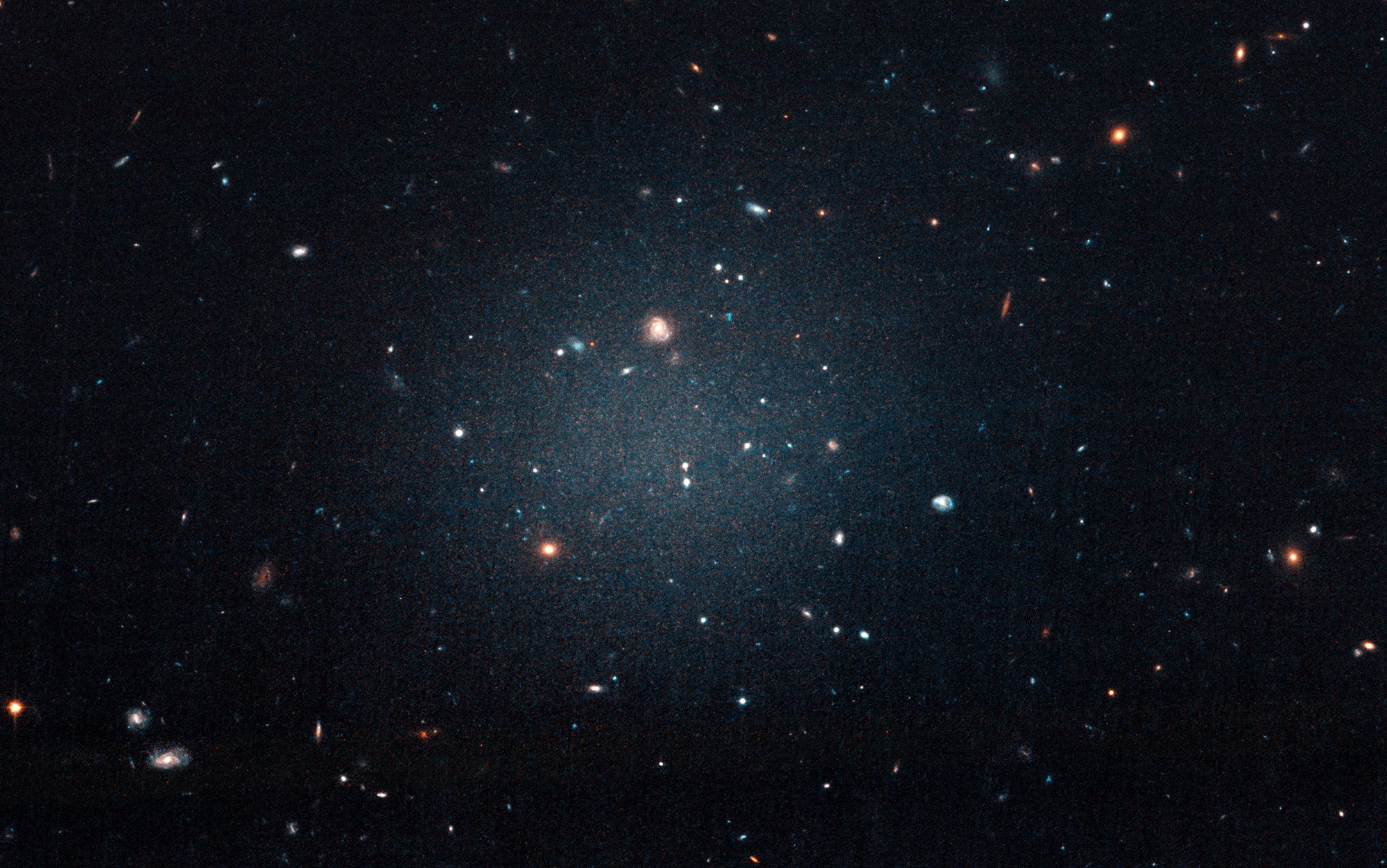
Most cosmologists say dark matter must exist. So far, it’s nowhere to be found. A widely scorned rival theory explains whyCalled NGC 1052-DF2, this ‘ghostly’ galaxy seems to contain at most 1/400th of the amount of dark matter that astronomers had expected. It is as large as the Milky Way, but contains only 1/200th the number of stars. Photo courtesy NASA, ESA, and P van Dokkum (Yale University)David Merritt

is a former professor of physics at the Rochester Institute of Technology in New York. His books include Dynamics and Evolution of Galactic Nuclei (2013) and A Philosophical Approach to MOND (2020).

Edited by Sam Dresser

19 July 2021 (aeon.co)

Aeon for Friends

FIND OUT MORE

The standard theory of cosmology is called the Lambda cold dark matter (ΛCDM) model. As that name suggests, the theory postulates the existence of dark matter – a mysterious substance that (according to the theorists) comprises the bulk of the matter in the Universe. It is widely embraced. Every cosmologist working today was educated in the Standard Model tradition, and virtually all of them take the existence of dark matter for granted. In the words of the Nobel Prize winner P J E Peebles: ‘The evidence for the dark matter of the hot Big Bang cosmology is about as good as it gets in natural science.’

There is one problem, however. For four decades and counting, scientists have failed to detect the dark matter particles in terrestrial laboratories. You might think this would have generated some doubts about the standard cosmological model, but all indications are to the contrary. According to the 2014 edition of the prestigious Review of Particle Physics: ‘The concordance model [of cosmology] is now well established, and there seems little room left for any dramatic revision of this paradigm.’ Still, shouldn’t the lack of experimental confirmation at least give us pause?

In fact, there are competing cosmological theories, and not all of them contain dark matter. The most successful competitor is called modified Newtonian dynamics (MOND). Observations that are explained under the Standard Model by invoking dark matter are explained under MOND by postulating a modification to the theory of gravity. If scientists had confirmed the existence of the dark particles, there would be little motivation to explore such theories as MOND. But given the absence of any detections, the existence of a viable alternative theory that lacks dark matter invites us to ask: does dark matter really exist?

Philosophers of science are fascinated by such situations, and it is easy to see why. The traditional way of assessing the truth or falsity of a theory is by testing its predictions. If a prediction is confirmed, we tend to believe the theory; if it is refuted, we tend not to believe it. And so, if two theories are equally capable of explaining the observations, there would seem to be no way to decide between them.

What is a poor scientist to do? How is she to decide? It turns out that the philosophers have some suggestions. They point out that scientific theories can achieve correspondence with the facts in two very different ways. The ‘bad’ way is via post-hoc accommodation: the theory is adjusted, or augmented, to bring it in line with each new piece of data as it becomes available. The ‘good’ way is via prior prediction: the theory correctly predicts facts in advance of their discovery, without – and this is crucial – any adjustments to the original theory.

It is probably safe to say that no theory gets everything exactly right on the first try. But philosophers are nearly unanimous in arguing that successful, prior prediction of a fact assigns a greater warrant for belief in the predicting theory than post-hoc accommodation of that fact. For instance, the philosopher of science Peter Lipton wrote:

When data need to be accommodated … the scientist knows the answer she must get, and she does whatever it takes to get it … In the case of prediction, by contrast, there is no motive for fudging, since the scientist does not know the right answer in advance … As a result, if the prediction turns out to have been correct, it provides stronger reason to believe the theory that generated it.

Some philosophers go so far as to argue that the only data that can lend any support to a theory are data that were predicted in advance of experimental confirmation; in the words of the philosopher Imre Lakatos, ‘the only relevant evidence is the evidence anticipated by a theory’. Since only one (at most) of these two cosmological theories can be correct, you might expect that only one of them (at most) manages to achieve correspondence with the facts in the preferred way. That expectation turns out to be exactly correct. And (spoiler alert!) it is not the Standard Model that is the favoured theory according to the philosophers’ criterion. It’s MOND.

Dark matter was a response to an anomaly that arose, in the late 1970s, from observations of spiral galaxies such as our Milky Way. The speed at which stars and gas clouds orbit about the centre of a galaxy should be predictable given the observed distribution of matter in the galaxy. The assumption here is that the gravitational force from the observed matter (stars, gas) is responsible for maintaining the stars in their circular orbits, just as the Sun’s gravity maintains the planets in their orbits. But this prediction was decisively contradicted by the observations. It was found that, sufficiently far from the centre of every spiral galaxy, orbital speeds are always higher than predicted. This anomaly needed to be accounted for.

Cosmologists had a solution. They postulated that every galaxy is embedded in a ‘dark matter halo’, a roughly spherical cloud composed of some substance that generates just the right amount of extra gravity needed to explain the high orbital speeds. Since we do not observe this matter directly, it must consist of some kind of elementary particle that does not interact with electromagnetic radiation (that includes light, but also radio waves, gamma rays etc). No particle was known at the time to have the requisite properties, nor have particle physicists yet found evidence in their laboratory experiments for such a particle, in spite of looking very hard since the early 1980s. The cosmologists had their solution to the rotation-curve anomaly, but they lacked the hard data to back it up.

Milgrom took seriously the possibility that the theory of gravity might simply be wrong

In 1983, an alternative explanation for the rotation-curve anomaly was proposed by Mordehai Milgrom, a physicist at the Weizmann Institute of Science in Israel. Milgrom noticed that the anomalous data had two striking regularities that were not accounted for by the dark matter hypothesis. First: orbital speeds are not simply larger than predicted. In every galaxy, the orbital speed rises as one moves away from the centre and then remains at a high value as far out as observations permit. Astronomers call this property ‘asymptotic flatness of the rotation curve’. Second: the anomalously high orbital speeds invariably appear in regions of space where accelerations due to gravity drop below a certain characteristic, and very small, value. That is: one can predict, in any galaxy, exactly where the motions will begin to deviate from Newtonian dynamics.

This characteristic acceleration value, which Milgrom dubbed a0, is much lower than the acceleration due to the Sun’s gravity anywhere in our solar system. So, by measuring orbital speeds in the outskirts of spiral galaxies, astronomers were testing gravitational theory in a way that had never been done before. Milgrom knew that there were many instances in the history of science where the need for a new theory became apparent only when an existing theory was tested in a new way. And so he took seriously the possibility that the theory of gravity might simply be wrong.

In three papers published in 1983, Milgrom proposed a simple modification to Isaac Newton’s laws that relate gravitational force to acceleration. (Albert Einstein’s theory reduces to Newton’s simpler theory in the regime of galaxies.) He showed that his modification correctly predicts the asymptotic flatness of orbital rotation curves.

Milgrom was careful to acknowledge that he had designed his hypothesis in order to produce that known result. But his theory also predicted that the effective gravitational force was computable given the observed distribution of normal matter alone – not just in the case of ultra-low accelerations, but everywhere. And when astronomers tested this bold prediction, they found that it was correct. Milgrom’s hypothesis correctly predicts the rotation curve of every galaxy that has been tested in this way. And it does so without postulating the presence of dark matter.

Note the stark difference between the way in which the two theories explain the anomalous rotation-curve data. The standard cosmological model executes an ad-hoc manoeuvre: it simply postulates the existence of whatever amount and distribution of dark matter are required to reconcile the observed stellar motions with Newton’s laws. Whereas Milgrom’s hypothesis correctly predicts orbital speeds given the observed distribution of normal matter alone. No Standard Model theorist has ever come up with an algorithm that is capable of doing anything as impressive as that.

Many philosophers would argue that this predictive success of Milgrom’s theory gives us a warrant for believing that his theory – as opposed to the Standard Model – is correct. But the story does not end there. Milgrom’s theory makes a number of other novel predictions that have been confirmed by observational astronomers. Doing justice to all of these would take a book (and, in fact, I’ve recently written such a book), but I will mention one example here. Milgrom’s theory predicts that a galaxy’s total mass in normal (non-dark) matter, which astrophysicists like to call the ‘baryonic mass’, is proportional to the fourth power of the rotation speed measured far from the galaxy’s centre. This novel prediction also turned out to be correct. (For obscure historical reasons, Milgrom’s predicted relation is nowadays called the ‘baryonic Tully-Fisher relation’, or BTFR.)

Astrophysics is rife with correlations between observed quantities, but exact relations such as the BTFR are unheard of: they are the sort of thing one associates with a high-level theory (think: the ideal gas law of statistical thermodynamics), not with a messy discipline like astrophysics.

What would a Standard Model cosmologist predict for a relation such as the BTFR? The simple answer is: nothing. Their theory contains no prescription for relating a galaxy’s baryonic mass to its asymptotic rotation speed. But astrophysicists are diligent and clever, and they have come up with a way to try to accommodate relations like the BTFR under the ΛCDM model. Their scheme is to carry out large-scale computer simulations of the formation and evolution of galaxies, starting from uniform initial conditions in the early Universe. The simulated galaxies can then be ‘observed’ and their properties tabulated. The earliest attempts of this sort yielded nothing very similar to Milgrom’s predicted relation. But in the decades since then, theorists have come up with more-or-less plausible mechanisms for linking the normal and dark matter in their simulated galaxies, in such a way that they can obtain something approximating the BTFR. The currently favoured mechanism, called ‘feedback’, is based on the (reasonable) idea that some of the gas that would otherwise form into stars is pushed out from the dark halo by the stars themselves, via stellar winds or supernova explosions. If the ‘feedback prescription’ is chosen carefully enough, just the right amount of gas can be ejected, from dark halos of each size, to yield the correct relation.

Standard Model theorists have not yet succeeded in reproducing the BFTR via their simulations. But let’s suppose that, one day, they do succeed. Would that success lend support to their cosmological theory, in the same way that the successful ab initio prediction of the relation by Milgrom lends support to his hypothesis?

The issue is not that the rival theory is too complicated; it is that the Standard Model is too simple

Philosophers of science have an answer: a resounding ‘no’. John Worrall, for instance, writes that ‘when one theory has accounted for a set of facts by parameter-adjustment, while a rival accounts for the same facts directly and without contrivance, then the rival does, but the first does not, derive support from those facts.’ On this view, it doesn’t matter whether the parameters being adjusted are meant to represent actual physical processes (such as feedback) or not. The fact that Milgrom’s hypothesis correctly predicts the relation ‘without contrivance’ means that it ‘wins’: it is the sole hypothesis that derives support from those data.

Now, the preference on the part of philosophers for scientific theories that predict in advance previously unknown laws or relations is quite in line with the preference that scientists themselves have expressed, over and over again, going back centuries. For instance, Gottfried Wilhelm Leibniz wrote in 1678: ‘Those hypotheses deserve the highest praise … by whose aid predictions can be made, even about phenomena or observations which have not been tested before.’ And so the question naturally arises: why have most cosmologists been so dismissive of MOND, given that MOND exhibits the very quality that scientists prize so highly?

Up until a few years ago, this disdainful attitude was defensible. One of the most touted successes of the standard cosmological model is its ability to reproduce (‘accommodate’ would be a better word) the so-called cosmic microwave background (CMB) spectrum – the statistical properties of temperature fluctuations in the CMB, the Universe-filling radiation that was produced soon after the Big Bang. Milgrom’s theory did not originally do this, at least not as well as the Standard Model. But that situation has now changed. Just last year, two theorists in the Czech Republic, Constantinos Skordis and Tom Złośnik, showed that there exist fully relativistic versions of Milgrom’s hypothesis that are perfectly capable of reproducing the CMB data without dark matter. This relativistic version of MOND, which they call RMOND, incorporates an additional field that mimics the behaviour of particle dark matter on the largest cosmological scales, and yields Milgromian dynamics on the scale of galaxies.

Prior to this success, a number of Standard Model cosmologists had gone on record to say that fitting the CMB data was the single thing that MOND needed to do in order to be taken seriously. For instance, the cosmologist Ruth Durrer told The Atlantic: ‘A theory must do really well to agree with [the CMB] data. This is the bottleneck.’ Now that this bottleneck no longer exists, has the Standard Model community embraced the RMOND theory as a bona fide competitor to theirs?

Not so much. An argument that is making the rounds nowadays goes something like this: ‘Yes, [R]MOND works, but it is so much more complicated than our theory, which just invokes one thing – dark matter – to explain the observations.’ This criticism misses the mark. The issue is not that RMOND is too complicated; it is that the dark matter of the Standard Model is too simple. Milgromian theorists have understood for a long time that there is just no way that a formless entity such as dark matter can spontaneously rearrange itself – and keep rearranging itself – so as to produce the striking regularities that we observe in the kinematics of nearby galaxies. Skordis and Złośnik achieve this by postulating an almost minimal (it seems to me) modification to Einstein’s theory. I can hardly imagine that any truly successful theory could be much simpler than theirs.

Like almost all scientific theories, both MOND and the Standard Model are faced with anomalies: data that seem difficult to explain. In the case of MOND, I am aware of just one important anomaly: it has to do with the observed dynamics of galaxy clusters. The ΛCDM model is in a seemingly worse state. That theory fails to adequately explain any of MOND’s successful new predictions, and, in addition, Standard Model theorists have identified at least half a dozen puzzles that are (in my opinion) as least as problematic for their theory as the galaxy cluster anomaly is for MOND. My point here is not that one should judge the two theories by cataloguing their failures. Rather, the novel predictive successes of MOND give us a warrant for believing (at least provisionally) that this theory is correct, and therefore that it is worth the effort to try and solve the existing puzzles.

The argument from predictive success is a good reason to favour MOND over the standard cosmological model. But one can hope for more: for what Karl Popper called a ‘crucial experiment’: an experimental or observational result that decisively favours one theory over the other. For instance, Einstein’s theory implies something called the strong equivalence principle (SEP): that the internal dynamics of a system (such as a galaxy) that is freely moving in an external gravitational field should not depend on the external field strength. Milgrom’s theory violates the SEP, and in fact it has recently been claimed, based on observations of galaxies, that the SEP is violated. That result, if confirmed, would rule out Einstein’s theory of gravity while at the same time confirming a prediction of Milgrom’s theory.

A decisive result in favour of the ΛCDM model would be a laboratory detection of dark matter particles. Standard Model cosmologists are aware of this, and since the early 1980s a number of sophisticated (and very expensive) detectors have been in operation that were specially designed to record the presence of the particles. About half a dozen such experiments are currently active; the sensitivity of state-of-the-art detectors is about 10 million times that of the earliest experiments. But no event has yet been observed that can reasonably be interpreted as the track of a dark matter particle.

Of course, the failure to detect the dark matter particles is expected under MOND. Does this negative experimental result constitute evidence in support of MOND? Most scientists would probably say ‘no’; as Carl Sagan said (about something completely different): ‘Absence of evidence is not evidence of absence.’ And, in fact, Standard Model cosmologists routinely argue that the persistent failure to detect the particles can be accounted for by assuming that the particles, even if present, undergo negligibly weak interactions with the normal matter in their detectors.

The same postulates that remove the need for dark matter lead to novel predictions that have been confirmed

I think the philosophers might disagree. Paul Feyerabend argued that an ambiguous experimental result could sometimes be interpreted as an effective refutation of the theory being tested, even if scientists were clever enough to ‘explain away’ the apparent failure. The necessary condition, he said, was the existence of an alternative theory that naturally explained the result:

The reason why a refutation through alternatives is stronger is easily seen. The direct case is ‘open’, in the sense that a different explanation of the apparent failure of the theory … might seem to be possible. The presence of an alternative [theory] makes this attitude much more difficult, if not impossible, for we possess now not only the appearance of failure … but also an explanation, on the basis of a successful theory, of why failure actually occurred.

By successful alternative theory, Feyerabend meant a theory that both explained the negative experimental result, and that also generated new, testable predictions. The confirmation of those new predictions, he argued, constituted an effective refutation of the original theory. MOND amply meets Feyerabend’s criteria for the alternative theory, since the same postulates that remove the need for dark matter lead (as we have seen) to a number of novel predictions that have been observationally confirmed.

Feyerabend was arguing here, as he often did, for a methodological rule that is nowadays called the ‘principle of proliferation’: the thesis that judgments about the performance of a theory are much sounder if there exist alternative theories with which a comparison can be made. If no one had ever hit upon a theory, such as MOND, that explains cosmological data without dark matter, the failure of experimental physicists to detect the dark matter particles could reasonably be ascribed to some combination of poorly understood phenomena (‘Dreckeffekte’ – garbage effects – was Feyerabend’s sarcastic term in German). But the existence of a theory such as MOND forces scientists to take seriously the possibility that their experimental failure constitutes a falsification of their theory in favour of MOND.

If Feyerabend were alive today, I am certain that he would be delighted at the fact that there are two viable contenders for the correct theory of cosmology. I think he would be intrigued to learn that one, and only one, of these two theories has repeatedly been found to ‘anticipate the data’ – to make surprising predictions that turned out to be correct. And I think he would urge cosmologists to put their effort into identifying crucial experiments that could decisively favour one theory over the other.

At the same time, I am equally certain that Feyerabend would be critical of the manner in which Milgrom’s theory has been treated by the larger scientific community. Textbooks and review articles on cosmology rarely mention MOND at all, and, when they do, it is almost always in dismissive terms. And while I cannot quote statistics, it is pretty clear that winning a research grant, or publishing a scientific paper, or getting tenure, is harder (all else being equal) for Milgromian researchers than for Standard Model scientists.

I honestly don’t know whether this troubling state of affairs reflects a general ignorance about MOND, or whether some darker psychological mechanism is at work. But I hope that scientists and educators can begin creating an environment in which the next generation of cosmologists will feel comfortable exploring alternative theories of cosmology.

This Essay was made possible through the support of a grant to Aeon from the John Templeton Foundation. The opinions expressed in this publication are those of the author and do not necessarily reflect the views of the Foundation. Funders to Aeon Magazine are not involved in editorial decision-making.

CosmologyPhysicsPhilosophy of science

Want to know, even if it hurts? You must be a truth masochist

Want to know, even if it hurts? You must be a truth masochist | Psyche

Photo by Patrick Zachmann/Magnum

Daniel Callcutis a freelance writer and philosopher. He is a former SIAS Fellow at Yale Law School. He has taught and published on a wide range of topics including the philosophy of love, the nature of value, media ethics, and the philosophy of psychiatry. He is the editor of Reading Bernard Williams (2008). He lives in Lincolnshire, United Kingdom.

Edited by Nigel Warburton

July 19, 2021 (psyche.co)

You and your other half, let’s imagine, live apart. One day, texting, you learn that one of their workmates has ‘drunk too much’ and has ended up staying at your partner’s place overnight. The colleague is someone you know your partner has a serious crush on. Let’s suppose, too, that you’ve never fully clarified how things stand in terms of sex outside the relationship: monogamy is often tacitly assumed but you two haven’t made it explicit. The next time you get together, the colleague’s name and midweek visit isn’t mentioned. Perhaps they got it on, perhaps they didn’t. You climb into your car to leave, and think to yourself: I’m really happy not to know.

Knowledge is so often assumed to be a good thing, particularly by philosophers, that we don’t think enough about when it makes sense to not want it. Perhaps you’re a parent and want to give your children space: you might be glad to not know all that they do when out of your sight. Perhaps you want to reconcile politically with a group that’s committed violence: it might be easier to move on if you deliberately spare yourself all the details of what they’ve done. There are, in fact, a variety of reasons why one might reasonably choose ignorance. One of the most obvious is to avoid needless pain.

Most of us care about other people and the world at large, and that makes us vulnerable to bad news. That’s life. Nonetheless, it’s good to be self-aware about when we’re self-punishingly seeking painful or depressing knowledge about ourselves or the world, and returning again and again to such knowledge. It’s easy to become what I shall call a truth masochist.

Turn first to what’s perhaps a more familiar idea, namely that people can be sadistic with the truth. You can be cruel but correct in telling someone that you’re bored with her, or unkind to remind friends about an embarrassing night out, or some clothes or haircut that really didn’t suit them. In other words, just because a statement is true, it doesn’t follow that it’s not rude or inappropriate. Sometimes very rationalistic people have a hard time understanding this point: they think that saying the truth can never be wrong. But this belief, on the face of it, seems refuted by the kind of everyday examples I’ve just given. It can be sadistic to point out to an obviously miserably self-conscious child that he has eczema on his face, or that his friends haven’t turned up. The truth can’t be wrong in the sense of factually incorrect: that doesn’t mean it’s never wrong to say it.

The desire for understanding can become entangled with the attractions of suffering

Sadists take pleasure in causing pain, masochists find pleasure in receiving it, and their coming together can famously lead to sexual fun. People can worry about this, especially for the person on the receiving end. But if there’s understandable concern for a person who gets pleasure from feeling pain, then it’s worth remembering how mundane and widespread such an experience is. Isn’t the cyclist a masochist as she digs in, grits her teeth, and makes it to the top of the hill? Consider too the popular taste for ever-hotter chilli sauce, or indeed a writer who enjoys agonising over the search for the right phrase. Masochism, in other words, is a common phenomenon.

That’s not to say, however, that it should never cause alarm. Just as sexual sadomasochism can span the spectrum from fun to abuse, so can masochism with the truth. If telling the truth no matter what can be cruel, then wanting to know the truth no matter what can be unkind to oneself. We all probably know a person or two who, not for professional reasons, has spent a bit too much time following every twist and turn of the news about COVID-19. There’s even a perfect word, doomscrolling, for those who, especially on Twitter, take in large volumes of negative news at once. Many of us are prone to the under-recognised behaviour of truth masochism, in which we receive a perverse pleasure in punishing ourselves with depressing information.

We each have our knowledge niches. Some people study law or medicine, others learn about fishing or fashion labels. You could call the subject matters we’re drawn to our knowledge directions or knowrientations. You might be someone with the kind of temperament that inclines you to explore the darker realities of existence with the same passion that some people love sad songs. There are times when life forces us to face difficult truths, and the capacity to recognise and respond to hard and inconvenient truths can be heroic. But it’s also valuable to see the potentially harmful ways that the desire for understanding can become entangled with the attractions of suffering.

Some forms of mental health counselling, ironically given their therapeutic aims, can present obvious dangers in this regard. Psychotherapy sessions, without astute guidance, can become a means to emphasise negative aspects of oneself or to marinate in one’s worse moments. The narrative structure of psychodynamic therapy, moreover, risks producing a true but bleakly edited narrative of a patient’s life story. This can strengthen rather than counter an individual’s self-punishing dispositions. Counselling if not careful can be, as the Viennese satirist Karl Kraus mordantly observed about psychoanalysis, the disease that mistakes itself for the cure.

You can start out romantically candid and end up woundingly honest

There’s also reason to worry when truth sadists and truth masochists come together. Remember how one person can be cruel to another though nonetheless speaking the truth. Imagine a case where a husband is constantly pointing out to his wife her worse traits, the things that she’s got wrong, her unstable family members, and the times she’s made a fool of herself. Sometimes, in abusive situations such as this, the individual on the receiving end can be already prone to self-punishment, and as a result one person’s sadism and one person’s masochism become a toxic mix. Couples so frequently act in cruel ways to one another that the late psychologist and relationship counsellor David Schnarch termed the behaviour ‘normal marital sadism’. My point is that this can include sadomasochistic use of the truth.

Every romantic relationship tends to develop its own ethic. Some people are drawn to a kind of radical honesty in which everything is shared. This ideal can spring from a number of sources, including the appealing thought that true love involves really knowing one another, warts and all. ‘Love is,’ wrote the philosopher and novelist Iris Murdoch in 1959, ‘the extremely difficult realisation that something other than oneself is real.’ Free-spoken relationships can, especially at the beginning, enjoy an exhilarating risk-taking intimacy. But a considerable danger is that, over time, the truth-sharing can take on the undesirable toxic character I’ve just described, in which one person is abusing the other, or where both lovers are knocking lumps out of one another with the truth. You can start out romantically candid and end up woundingly honest.

The idea that the truth is always good for you is rather like the idea that what is natural is always good for you: a beguiling but ultimately dangerous myth. The cosmos is, ultimately, just not that benign. Sometimes it simply makes sense to avoid the truth. If your son was abducted and brutally murdered, then it’s not unreasonable to want to not know all the horrifying details of his last moments. Indeed, it would make sense if, afterwards, you choose to leave the room when certain topics come up, or that you can’t bear hearing from another grieving parent about their missing child. The same response can make sense when someone wants to share secrets with you that would put you in an awkward or compromising situation. You can be prudently self-protective in thinking I don’t want to know.

Is your desire to not know, in a given case, sane-minded good sense or foolish evasion? There’s no formula for working out the right answer. Sometimes, clearly, you should want to know the truth, no matter how uncomfortable or distressing. If your daughter calls for urgent help, then you want to know what’s going on. Wisdom consists in what’s perhaps the ultimate ability in life: correctly discerning the situation you’re in. And you can’t do that without at least some grasp of the truth. This is not, therefore, a plea for general ignorance. You need to be in a position of knowledge in order to know those occasions when it is smart to turn your back on it.

Why COP26 is our best chance for a greener future

Alok Sharma|Countdown (ted.com)

Something powerful is happening around the world. The issue of climate change has moved from the margins to the mainstream, says Alok Sharma, the President-Designate of COP26, the United Nations climate conference set to take place in November 2021 in Glasgow, Scotland. He unpacks what this shift means for the world economy and the accelerating “green industrial revolution” — and lays out the urgent actions that need to happen in order to limit global temperature rise.

ABOUT THE SPEAKER

Alok Sharma · President-Designate of COP26Alok Sharma is a British politician, Cabinet Minister and President-Designate of COP26, the 26th United Nations Climate Change Conference.