
Let’s Talk Religion Meister Eckhart is an influential, and often surprising, Christian theologian/philosopher/mystics whose writings & sermons have both inspired future thinkers in the catholic church, but also been condemned by the pope as heretical. Sources/Further Reading: McGinn, Bernard (2003). “The Mystical Thought of Meister Eckhart: The Man from Whom God Hid Nothing”. Independent Publishers Group. McGinn, Bernard (1992). “Meister Eckhart: Teacher and Preacher”. Classics of Western Spirituality Series. Paulist Press International, U.S. McGinn, Bernard (1981). “Meister Eckhart: The Essential Sermons, Commentaries, Treatises and Defense”. Classics of Western Spirituality Series. Paulist Press International, U.S. ————- Videos used: Guy with free stock footage: https://www.youtube.com/watch?v=n72Ur… Freestocks: https://www.youtube.com/watch?v=32hQR…https://www.youtube.com/watch?v=Faow3…
Monthly Archives: July 2021
Marianne Williamson on “American Exceptionalism”
Harvard Divinity School Internationally acclaimed spiritual leader, Marianne Williamson, shares her insight on the creation of a beloved community through the use of political and ethical externalization. This lecture was delivered at Harvard Divinity School on October 14, 2015. Learn more about Harvard Divinity School and its mission to illuminate, engage, and serve at www.hds.harvard.edu.
Top rooster announces the dawn
Lower-ranking birds wait to crow until the top rooster has had his say

By Susan Milius
August 24, 2015 at 6:00 am (sciencenewsforstudents.org)
Cock-a-doodle-don’t? A new study finds that roosters low in the pecking order of a small group won’t sound off until the top ranked male first crows his morning cock-a-doodle-doo’s.
In the chicken world, the top-ranked bird in a social group gets first dibs — a chance to peck up food and other resources. Lower-ranking birds in this pecking order must wait their turn to eat. A study now finds that they also wait to crow. And they often sound off in order of their rank, from high to low, reports Tsuyoshi Shimmura. He’s a biologist at Nagoya University in Japan.
The team he worked with published its new findings July 23 in Scientific Reports.
Two years ago, Shimmura and one of his colleagues found that the timing of roosters’ pre-dawn crowing is controlled by their internal body clock. Called a circadian clock, it provides an internal sense of the local day-night cycle. Shimmura says his findings now reveal that lower-status roosters let social rank override their biological clocks.
Explainer: Our bodies’ internal clocks
That study shows that signaling and other behaviors can be closely tied to where animals rank in their society’s hierarchy , says Jennifer Foote. She’s a behavioral ecologist at Algoma University in Sault Ste. Marie, Canada. Her work focuses on dawn choruses, the natural burst of song that erupts from many wild birds at daybreak.
The rooster study grew out of a chance observation, Shimmura says. He and his colleagues had been searching for genes that underpin the vocalizations — those calls an animal makes without first having to learn them. A rooster’s cock-a-doodle-doo is one example. The gene project required listening to a lot of crowing. And that’s what revealed the hierarchy of sound-offs.
Shimmura’s team first put four roosters into a cage inside a soundproofed room. This blocked any outside cues from stimulating the chickens. The birds then challenged and pecked each other until some hierarchy among them emerged. Then the researchers prepared to observe early morning crow-offs. For that, they moved the birds into separate cages within the same room. Males of course don’t crow just to wake people up. The roosters have their own bird reason, perhaps to shout out that they’re staking claim to some territory and in charge.
At the end of the observation period, the top-ranking rooster almost always ruled dawn wake-up calls. If the researchers then removed this top bird from the group, the second-ranked rooster now stepped up and started crowing first.
Bart Kempenaers is a behavioral ecologist. He works at the Max Planck Institute for Ornithology in Seewiesen, Germany. He is not convinced that results with caged roosters would always translate to natural settings, such as a barnyard. Being in close quarters might encourage birds lower in the pecking order “to be very subordinate,” says Kempenaers.
Other research also hints that there’s some kind of order to dawn bird choruses in the wild. Kempenaers’s group has studied small, active European birds called blue tits. In 2006, his group found that older males start singing earlier than do males in their first breeding season. (Artificial light at night prompted earlier song in both young and old, however.)
A 1997 study from Queens University in Kingston, Canada, found similar results. It showed that higher-ranking male chickadees start singing earlier, and sing longer, than low-ranking birds. That report concluded that how early and how zestful male singing is might help the female listeners decide winners from losers among these possible mates.
Power Words
(for more about Power Words, click here)
behavior The way a person or other organism acts towards others, or conducts itself.
behavioral ecologist A scientist who studies animal behavior in a natural setting.
biological clock A mechanism present in all life forms that controls when various functions such as metabolic signals, sleep cycles or photosynthesis should occur.
circadian Adjective for something that recurs naturally on a roughly 24-hour cycle. Biological functions such as body temperature and sleeping/waking times that operate on a roughly 24-hour cycle.
crow The characteristic loud cry of a rooster.
dominance hierarchy A system in which a community of people or animals offer privileges to some members on the basis of their power or status.
hierarchy The ranking or organization of things or individuals — one above the other — based on their perceived importance, authority or status. Colloquially, among animals within a community, this might be referred to as their pecking order.
pecking order A system in which people, animals or objects are ranked in order according to their power, status, or importance; a dominance hierarchy. It gets its name for the order in which chickens allow members of its community to peck for — dine on — food.
ranking An ordering of things or individuals based on some scale or agree-upon values; a hierarchy.
rooster An adult male chicken.
signaling behavior A behavior by an animal that communicates information.
social order or social rank The system of values, practices, institutions and rules that guide the behaviors of an integrated group of people or animals.
subordinate Someone or something that is lower in rank, based on power, importance, value or some other characteristic.
vocalization Vocal sounds that an animal intentionally makes to communicate information.
CITATIONS
S. Ornes. “Full moon shortchanges sleep.” Science News for Students. August 1, 2013.
A.L. Mascarelli. “Respecting the body’s clocks.”Science News for Students. July 11, 2013.
A.L. Mascarelli. “Explainer: Our bodies’ internal clocks.”Science News for Students. June 14, 2013.
S. Milius. Streetlights turn young duds into studs. Science News. Vol. 178, October 9, 2010, p. 11.
Original Journal Source: T. Shimmura, S. Ohashi and T. Yoshimura. The highest-ranking rooster has priority to announce the break of dawn. Scientific Reports. Vol. 5, published online July 23, 2015. doi: 10.1038/srep11683.
Original Journal Source: T. Shimmura and T. Yoshimura. Circadian clock determines the timing of rooster crowing. Current Biology. Vol. 23, March 18, 2013. doi: 10.1016/j.cub.2013.02.015.

About Susan Milius
Susan Milius is the life sciences writer at Science News, covering organismal biology and evolution, and has a special passion for plants, fungi and invertebrates. She studied biology and English literature.
Moon Wobble peaks on August 30
 |
| MoonWobble August 2021 |
| Click here to see the chart: Moon_Wobble_August_2021.pdf *** General suggestions / observations *** • This cycle is based on empirical data meaning enough data was observed and recorded to make it possible to suggest attitudes and reactions. Keep in mind that we all have free will and thus results will vary from one individual to another. • The graph shows the energy high at the beginning of the cycle (not unlike any other astrological aspect) followed by a slow down before it gets strong and again this reflects years of tracking and noting feedback from our many students. • If you are making a decision during this time you might want to let it set for a day or two then check your decision again to see if it still makes sense. However, you can feel into the ebb and flow and find good times to work on self emotionally in both the low and high points. Impatience, emotion and acts without thinking are common. • With practice you can feel when the energy is there to help bring completion to tasks, goals and projects you may be working on. Aloha, The Prosperos Copyright © 2021 The Prosperos, All rights reserved. Our mailing address is: The Prosperos P.O. Box 4969 Culver City, CA 90231 |
Aquarius Full Moon on July 23, 2021

The Full Moon occurs within the first few degrees of Aquarius, showing a new area of experience opening, even if it relates to the closing of a chapter — which is the usual significance of this point in the lunar cycle. Something may be coming to a premature end. The Moon in Aquarius tends to offer the potential for contradiction, where we have expectations of systems working out in methodical ways, yet we may be faced with situations becoming a little haphazard. The Moon is applying to a conjunction with Saturn — outside of a typical 8° orb, but nonetheless closing in. Various limitations are called forth, with a lesson on how to cope with something getting shut down before it can really begin.
The spirit of Aquarius, a fixed sign, tends to dislike enforced change. Its modern co-rulership by Uranus brings a strong association of freewheeling into the mix; however, given the Moon–Saturn conjunction in Aquarius, Saturn’s traditional rulership stands out in this lunation. So, we may have to give in to the plain practicalities of a given change — like it or not. For example, the absence of hoped-for funds may curtail our ambitions. Any unwelcome “no” we receive is being presented because, under the current circumstances, a positive answer just cannot be offered.
Before we let Saturn’s restrictions sour the mood too much, though, remember that, psychologically, it is easier to deal with a measure of certainty than with the lack of it. The Moon’s separating sextile to Neptune reminds us that dreams float away if we don’t pin them down to reality. Likewise, worry can set in, if we don’t know exactly what we’re facing. Once we have some clarity, we can at least make more positive plans. We get the contours of a situation and, even if it contains unwelcome limitations, we can learn how best to operate within them. Doing so may actually help us become more productive!
It might not be obvious at first glance, but the Moon is also conjunct Pluto, still in Capricorn. This out-of-sign conjunction could be a helpful planetary combination, especially with Pluto retrograde, echoing a theme of getting rid of redundancies. The Moon’s involvement prompts us to assess what our true needs are. If we need physical space, this is the perfect time for that promised clear-out! If we need to shift psychological clutter, instead, that’s also an open option. Perhaps we can finally let go of attitudes to someone, or something, that have been keeping us stuck in an unhelpful holding pattern.
Rather fortuitously, the Moon–Pluto combination could also help something move out of our lives in a natural way, perhaps through the introduction of a new element or person — one way in which the out-of-sign aspect could play itself out. We might be able to “jump ship” to another situation, and thus let go of the past more easily. Alternatively, the retrograde “pull” of Pluto may represent resistance: someone or something with a strong interest in trying to keep a scenario in place. Yet, the Moon’s impending conjunction with Saturn suggests that we let the impetus of the new carry us forward, if we really do want to pull away. The fluid nature of air, wrapped up in the fixed nature of Aquarius, allows for a willful uprooting to take place. The resolve is there for us, should we need to use it!
Another out-of-sign conjunction is involved here: Venus in Virgo and Mars in late Leo (the Sun’s sign) both oppose Jupiter in early Pisces. Planets linked in late and early degrees emphasize the closing of a chapter, referenced above, and the opening of another shortly thereafter.
This article is from the Mountain Astrologer, written by Diana Collis.
We’re all teenagers now
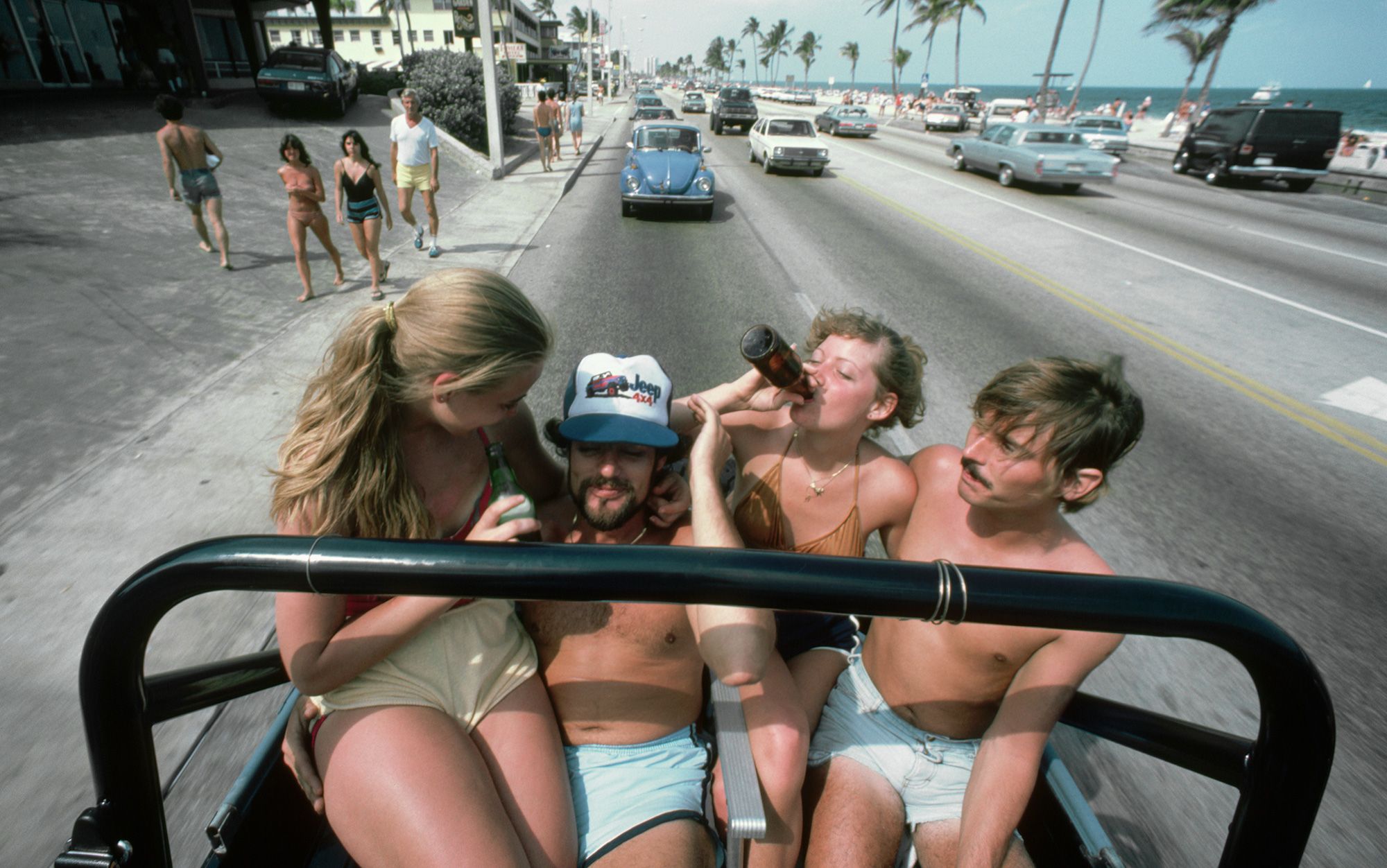
Adolescence isn’t a time of life so much as a frame of mind. Liberating yet damaging, it’s transformed the US and the worldFort Lauderdale, Florida, March 1982. Photo by Kevin Fleming/Corbis/Getty
Paul Howe is professor of political science at the University of New Brunswick in Fredericton, Canada. He is the author of Teen Spirit: How Adolescence Transformed the Adult World (2020).
Edited by Pam Weintraub
22 July 2021 (aeon.co)
Aeon for Friends
Most of us are familiar with the law of unintended consequences. In the 1920s, Prohibition put a halt to the legal production and sale of alcohol in the United States only to generate a new set of social ills connected to bootlegging and wider criminal activity. More recently, mainstream news media outlets, in pursuit of ratings and advertising dollars, lavished attention on an outlandish, orange-hued candidate when he first announced his run for president in 2015, and inadvertently helped to pave his way to the White House – oops. Aiding and abetting his campaign was a communications tool – social media – originally designed to bring people together and create community, but which now seems to serve more as a vehicle of division and discord.
A different development has been seen as an unqualified boon: the mass expansion, over the past century, of public education. In place of a narrowly educated elite and the minimally schooled masses, we now have a society where the vast majority possess knowledge and skills necessary for success in various dimensions of their lives, including work, community engagement, democratic participation and more. Some might fall short of their potential, but the general impact is clear: extending greater educational opportunity to one and all has provided untold benefits for both individuals and society at large over the long haul.
The latest work from Robert Putnam, the pre-eminent scholar of social change in the modern US, illustrates the common wisdom on the matter. His book The Upswing (co-authored with the social entrepreneur Shaylyn Romney Garrett) sets the stage by describing the social strife of the Gilded Age, the final decades of the 19th century when rapid industrialisation and technological change generated social dislocation, inequality, civic discord and political corruption. In response to this troubled state of affairs, the Progressive movement sprang into being, bringing a new community spirit to society’s problems, along with a series of pragmatic solutions. One signal achievement was the establishment of the modern public high school, an innovation that began in the US West and Midwest and spread quickly throughout the country. Enrolment at the secondary level among those aged 14 to 17 leapt from about 15 per cent in 1910 to 70 per cent by 1940.
In Putnam’s account, the clearest benefit of educating Americans to a higher level was unparalleled economic growth and upward social mobility for the newly educated lower classes – positive effects that unfolded over the first half of the 20th century and made the US a more prosperous and egalitarian society. These benefits were part and parcel of a more general upswing that encompassed rising levels of social trust, community engagement, political cooperation, and a stronger societal emphasis on ‘we’ than ‘I’.
But it did not last. For reasons not entirely clear, the 1960s saw individualism resurfacing as the dominant mindset of Americans and the ethos of US society, turning the upswing into a downswing that has continued to the present day and lies at the heart of many contemporary social and political problems.
Hidden in this puzzling arc of social change is another unintended consequence. Universal secondary education not only elevated Americans by spreading relevant knowledge and skills to the masses. It also gave rise to a more complex social and cultural transformation, as the adolescent period became pivotal in shaping who we are. The fact is that high school is, and always has been, about more than just education. In the late 1950s, the sociologist James Coleman investigated student life in 10 US high schools, seeking to learn more about adolescents and their orientation towards schooling. In The Adolescent Society: The Social Life of the Teenager and Its Impact on Education (1961), he reported that it was the social, not the educational, dimension of the high-school experience that was paramount to teens. Cloistered together in the high-school setting, teenagers occupied a separate and distinct social space largely immune from adult influence. Coleman warned that:
The child of high-school age is ‘cut off’ from the rest of society, forced inward toward his own age group, made to carry out his whole social life with others his own age. With his fellows, he comes to constitute a small society, one that has most of its important interactions within itself, and maintains only a few threads of connection with the outside adult society.
The emergence of a segregated teenage realm occurred well before Coleman put his finger on the problem. In their classic study of the mid-1920s, the sociologists Robert and Helen Lynd described the high school in ‘Middletown’ (later revealed to be Muncie, Indiana) as ‘a fairly complete social cosmos in itself … [a] city within a city [where] the social life of the intermediate generation centres … taking over more and more of [their] waking life.’
Life beyond the classroom reinforced the pattern: a national survey from around the same time found that the average urban teenager spent four to six nights a week socialising with peers rather than enjoying quiet nights at home with the family. With the advent of modern high school, the day-to-day life of teenagers was transformed, their coming-of-age experiences fundamentally altered. Adolescence became a kind of social crucible where teens were afforded the time and space to interact intensively with one another and develop by their own lights.
So while there was clear educational benefit gained from the reading, writing and arithmetic taking place in high-school classrooms across the land, a wider set of changes started to emanate from this new social configuration. The most visible was the emergence of a more sharply defined youth culture rooted in shared interests and passions that flourished more freely within adolescent society. Young people flocked to the movies like no other demographic, their enthusiasm for the silver screen and its celebrity icons helping to propel Hollywood to the forefront of popular culture. They latched on to new musical styles – jazz in the 1920s, swing in the 1930s – and embraced them as their own; devoured the new literary sensation of the times, comic books; and adopted common ways of dressing and personal styling as emblems of youth fashion. Embodied in these trends was a heightened emphasis on the fun and the frivolous side of life that would slowly reset societal standards as time went on.
Other changes were more subtle but equally portentous. Sociological studies conducted between the two world wars reveal a rapid liberalisation of attitudes towards practices such as betting, smoking and divorce, with rates of disapproval among youth declining by 20 to 35 percentage points in the space of just a single decade. In this same period, young people grew increasingly tolerant of social misdemeanours such as habitually failing to keep promises, using profane language, and keeping extra change mistakenly given by a store clerk – minor incivilities by today’s standards, but harbingers of a changing social landscape where the transgression of established norms was starting to become more common and accepted.
This rapid evolution in everyday behaviour reflected a deeper transformation: the character of rising generations, their values, temperament and traits, were being reshaped by the powerful influence of peers during the formative years of adolescence. Hedonistic desires were more openly expressed, pleasurable activities more freely pursued. Conscientiousness was downplayed, social norms treated with greater scepticism and disdain. Impulsiveness and emotionality were more commonly displayed, an open, adventurous spirit widely embraced.
What these diverse adolescent qualities amounted to were the building blocks of a nascent individualism that would reshape society profoundly as they came to full fruition over the course of the next few decades. Traits conducive to self-focused and self-directed thought and action were more deeply etched in teenagers and slowly altered the character of society at large as whole groups socialised in this manner moved forward to adulthood.
The effects of peer influence, this argument implies, run deeper than is commonly imagined, affecting not just superficial features of the self during the teenage years, but the kind of person we become. Important research from the personality psychologist Judith Rich Harris, synthesised in her seminal book, The Nurture Assumption (1998), backs up this idea. Harris reviewed the body of research on the nature versus nurture debate, finding it consistently showed environmental effects outside the home loomed larger than had previously been realised. And she presented evidence that peers are among the most critical of these external influences on personality development. These scientific findings, applied to social history, help explain why the rise of universal secondary schooling was such a consequential development, as teen immersion in a society of adolescent peers became a critical facet of personal development and catalyst of social change from the early 20th century onwards.
The 1960s youth cohort swerved from ‘we’ to ‘I’ thinking: do your own thing, live and let live, anything goes
As time rolled on, further reinforcement and amplification of these effects came in the form of intergenerational abetting and encouragement. When the teenagers of the 1920s and ’30s went on to have kids of their own in subsequent decades, they brought with them an adolescent-tinged perspective that influenced their own parenting practices, inclining them to give freer rein to their teenage offspring. The traits that parents (and indeed adults more generally) favoured in children shifted decisively over the long haul from obedience and propriety to independence and imagination, with the result that the expression and retention of adolescent qualities in postwar youth was stronger still.
That the spirit of the times was a-changin’ became more obvious in the 1960s when the youth cohort of that era expressed their adolescent rambunctiousness and exuberance with particular abandon and swerved even more strongly from ‘we’ to ‘I’ thinking: do your own thing, live and let live, anything goes. To most observers, then and now, it seemed like a dramatic turn of events, but the stage had been set by more subtle developments of the previous few decades that had seen successive generations of youth imbibing an individualistic mindset and manner from one another.
From this perspective, the 1960s looks more like a tipping point than a starting point: the moment when a process long on the runway took flight and suddenly became manifest to one and all.
Since then, the process has proceeded apace. Like earlier generations, the Baby Boomers of the 1960s retained much of their youthful orientation as they entered adulthood, losing the long hair and psychedelic attire, but retaining the mindset that had taken shape in their adolescent years. Slogans and behaviours that put ‘I’ before ‘we’ were absorbed into the wider culture, earning the 1970s the moniker of the ‘Me Decade’.
New generations were thoroughly imbued, absorbing the prevailing cultural assumptions ‘like a fish accepts water’, as the psychologist Jean Twenge put it in her book on the subject, Generation Me (2006). There are, of course, interesting debates around the distinctive character of more recent youth cohorts, including Millennials and Gen Z, groups known for their concern with the environment, social justice and human rights. Yet these recent shifts are relatively modest against the backdrop of a century of transformative social change.
As youthful ways of thinking and acting have slowly infiltrated adult society, we have arrived at a point where there is a much fainter demarcation line separating adults and teens. Film and TV have picked up on the theme in shows such as Arrested Development (2003-) and movies starring Adam Sandler that depict immature adults set in their adolescent ways who are either unaware or unconcerned (perhaps both) about this state of affairs. In one episode of the TV show Modern Family (2009-20), Phil collaborates on a video with his son Luke that involves gamely taking dozens of basketballs to the head in the hopes that one will ricochet into the basket and produce an awesome clip. He grins at the camera as he reveals his motivation: ‘I’ve always said that if my son thinks of me as one of his idiot friends then I’ve succeeded as a dad.’ Yes, it’s just TV, but it’s funny because it has the ring of truth about it.
The real world is also replete with examples of adults acting like adolescents in many aspects of their lives. The phrase ‘unintended consequences’ used at the beginning of this essay usually implies negative effects, but there are notable benefits as well. As a result of the gradual absorption of adolescent qualities, we’ve slowly chipped away at many rigidities of the adult world and grown more free-spirited, open and spontaneous – sometimes even downright goofy, like the aforementioned dad from Modern Family.
These youthful character traits have served to make us more accepting and generous in many respects. Rising tolerance towards marginalised groups can be partly attributed to this emergent youthful mindset – a process normally seen as originating with the dynamic social movements of the 1960s and ’70s, but which actually can be detected much earlier in the shifting attitudes of rising generations from the early 20th century onwards. Traits connected to openness have also made us more creative compared with a century ago – contributing to the long-term rise of what the urban theorist Richard Florida has called the ‘creative class’, people who value creativity and individuality in the workplace and other areas of their lives, and thereby contribute greatly to economic innovation and prosperity. The impact of adolescence on the adult world has played a major, and underappreciated, role in generating these vitally important liberating effects that have transformed life for the better over the long haul.
But there is an undeniable downside to the story as well. Many authors have traced the pernicious rise of impulsiveness, incivility and me-first brashness across different sectors of US life – social and cultural, economic and political. At the end of the 1970s, the historian Christopher Lasch wrote about a burgeoning ‘culture of narcissism’, a concern echoed more recently by Twenge and W Keith Campbell in The Narcissism Epidemic (2010). The cultural theorist Paul Roberts focuses on the problems of instant gratification and consumerism run amok in The Impulse Society (2014), while the political scientist Alan Wolfe decries the political immaturity of the current age in The Politics of Petulance (2018). This is but a small selection of a wider literature of lament; the common thread, on my reading, is that many of these problems across different spheres of contemporary life can be linked to the excesses of youth that have been absorbed by the adult world.
The consequences connected to the more troubling aspects of our adolescent character seized public attention more fully once Donald Trump became president in 2016. If his political positions divided Americans, it was his manifest character defects that were most troubling to critics. It was no coincidence that many arrived at the same diagnosis, that Trump’s instinctive reactions were more like those of a petulant child or angry teenager than a fully evolved adult. While such labels were sometimes applied for dramatic effect, professionals willing to venture an opinion generally agreed on the profound psychosocial shortcomings manifest in Trump’s personality and behaviour.
The founding philosophy and adolescent ethos together have proven a potent combination
The real problem, of course, is that he is not an isolated case. The tendencies Trump displayed – impulsiveness, belligerence, narcissism, a cavalier disregard for social norms – have grown all too common over time in society at large. One recent example is the stubborn refusal of many to wear masks during the COVID-19 pandemic, a political act on the surface, but at a deeper level a social phenomenon that could happen only in a society where many have lost touch with what it means to act like a mature adult in times of crisis and adversity. The larger social pattern helps explain how a man displaying symptoms of the same syndrome could gain the public support necessary to win the presidency once and nearly do it again.
While the Trump debacle rightly captured the world’s attention and raised important questions about the dearth of adult qualities in US public life, the influence of adolescence on the adult world is not solely an American phenomenon. In other places where schooling through most of the teenage years has become the norm, the same process of social transformation has been initiated, reshaping societies in similar ways. Adolescent ways have seeped into adult society, upending traditional social norms and conceptions of adulthood. The effects have been broadly liberating, yet sometimes damaging, as the rise of adolescent-infused habits and assumptions has opened up avenues of behaviour that sometimes run counter to the common good.
But while the trajectory of social change is similar, there is one important difference: the US was first out of the gate as the forerunner in establishing a system of universal secondary education. The US high-school movement preceded all others, with the large majority of teens enrolled by the late 1930s, compared with a select minority – generally less than 25 per cent – in other industrialised nations. Once secondary education was put in place, the transformative impact of adolescence was set in motion significantly earlier in the US than in other places.
Because of this, the US has advanced further down the road than most. It is in many ways the most adolescent of modern societies – a characterisation suggesting a different spin on the notion of American exceptionalism, or perhaps more accurately, an additional layer. Yes, the US was different from the outset due to its foundational event, a revolution rejecting monarchy and colonial subjugation, and the explicit articulation of a freedom-focused public philosophy – life, liberty and the pursuit of happiness. But the precise meaning and implications of that phrase are ambiguous and can take a country in many different directions depending on how it is interpreted and applied. Over the past century, the words have been infused, and the society imbued, with values reflecting the instincts and sensibilities of the young. The founding philosophy and adolescent ethos together have proven a potent combination, guiding the US towards an immoderate individualism – my life, my liberty, the pursuit of my personal happiness – that contributes greatly to many current-day social and political problems.
Progressive reformers had the best of intentions when they provided secondary schooling for one and all. But that educational project helped trigger a parallel social transformation that has undermined at least some of their good work. After a century, the world of adolescents has given rise to a world of adolescence. It is important to examine social history closely, and to unpack the deep sources of current problems, if we hope to set some of this straight and make the US – and the world – a better place.
Parts of this essay are adapted from ‘Teen Spirit: How Adolescence Transformed the Adult World’ (2020) by Paul Howe, published by Cornell University Press.
Prayer of Apology to African Americans | Marianne Williamson
Marianne Williamson Internationally acclaimed author, lecturer and activist Marianne Williamson gives weekly lectures based on A Course in Miracles, Live in New York City and via Livestream, on Tuesdays at 7:30pm ET. Go here to join live or via livestream: http://marianne.com/upcoming-events/
Thomas Jefferson on a just God
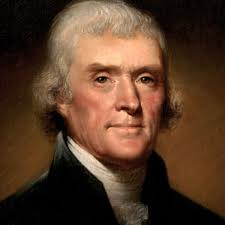
“I tremble for my country when I reflect that God is just: that his justice cannot sleep for ever.”
–Thomas Jefferson
Thomas Jefferson (April 13, 1743 – July 4, 1826) was an American statesman, diplomat, lawyer, architect, musician, philosopher, and Founding Father who served as the third president of the United States from 1801 to 1809.Wikipedia
Proclamation Appointing a National Fast Day Washington, D.C. March 30, 1863
| Senator James Harlan of Iowa, whose daughter later married President Lincoln’s son Robert, introduced this Resolution in the Senate on March 2, 1863. The Resolution asked President Lincoln to proclaim a national day of prayer and fasting. The Resolution was adopted on March 3, and signed by Lincoln on March 30, one month before the fast day was observed. |
By the President of the United States of America.
A Proclamation.
Whereas, the Senate of the United States, devoutly recognizing the Supreme Authority and just Government of Almighty God, in all the affairs of men and of nations, has, by a resolution, requested the President to designate and set apart a day for National prayer and humiliation.
And whereas it is the duty of nations as well as of men, to own their dependence upon the overruling power of God, to confess their sins and transgressions, in humble sorrow, yet with assured hope that genuine repentance will lead to mercy and pardon; and to recognize the sublime truth, announced in the Holy Scriptures and proven by all history, that those nations only are blessed whose God is the Lord.
And, insomuch as we know that, by His divine law, nations like individuals are subjected to punishments and chastisements in this world, may we not justly fear that the awful calamity of civil war, which now desolates the land, may be but a punishment, inflicted upon us, for our presumptuous sins, to the needful end of our national reformation as a whole People? We have been the recipients of the choicest bounties of Heaven. We have been preserved, these many years, in peace and prosperity. We have grown in numbers, wealth and power, as no other nation has ever grown. But we have forgotten God. We have forgotten the gracious hand which preserved us in peace, and multiplied and enriched and strengthened us; and we have vainly imagined, in the deceitfulness of our hearts, that all these blessings were produced by some superior wisdom and virtue of our own. Intoxicated with unbroken success, we have become too self-sufficient to feel the necessity of redeeming and preserving grace, too proud to pray to the God that made us!
It behooves us then, to humble ourselves before the offended Power, to confess our national sins, and to pray for clemency and forgiveness.
Now, therefore, in compliance with the request, and fully concurring in the views of the Senate, I do, by this my proclamation, designate and set apart Thursday, the 30th. day of April, 1863, as a day of national humiliation, fasting and prayer. And I do hereby request all the People to abstain, on that day, from their ordinary secular pursuits, and to unite, at their several places of public worship and their respective homes, in keeping the day holy to the Lord, and devoted to the humble discharge of the religious duties proper to that solemn occasion.
All this being done, in sincerity and truth, let us then rest humbly in the hope authorized by the Divine teachings, that the united cry of the Nation will be heard on high, and answered with blessings, no less than the pardon of our national sins, and the restoration of our now divided and suffering Country, to its former happy condition of unity and peace.
In witness whereof, I have hereunto set my hand and caused the seal of the United States to be affixed.
Done at the City of Washington, this thirtieth day of March, in the year of our Lord one thousand eight hundred and sixty-three, and of the Independence of the United States the eighty seventh.
By the President: Abraham Lincoln
William H. Seward, Secretary of State.
MLK’s “BELOVED COMMUNITY”
(thekingcenter.org)
“The Beloved Community” is a term that was first coined in the early days of the 20th Century by the philosopher-theologian Josiah Royce, who founded the Fellowship of Reconciliation. However, it was Dr. Martin Luther King, Jr., also a member of the Fellowship of Reconciliation, who popularized the term and invested it with a deeper meaning which has captured the imagination of people of goodwill all over the world.
For Dr. King, The Beloved Community was not a lofty utopian goal to be confused with the rapturous image of the Peaceable Kingdom, in which lions and lambs coexist in idyllic harmony. Rather, The Beloved Community was for him a realistic, achievable goal that could be attained by a critical mass of people committed to and trained in the philosophy and methods of nonviolence.
Dr. King’s Beloved Community is a global vision, in which all people can share in the wealth of the earth. In the Beloved Community, poverty, hunger and homelessness will not be tolerated because international standards of human decency will not allow it. Racism and all forms of discrimination, bigotry and prejudice will be replaced by an all-inclusive spirit of sisterhood and brotherhood. In the Beloved Community, international disputes will be resolved by peaceful conflict-resolution and reconciliation of adversaries, instead of military power. Love and trust will triumph over fear and hatred. Peace with justice will prevail over war and military conflict.
Dr. King’s Beloved Community was not devoid of interpersonal, group or international conflict. Instead he recognized that conflict was an inevitable part of human experience. But he believed that conflicts could be resolved peacefully and adversaries could be reconciled through a mutual, determined commitment to nonviolence. No conflict, he believed, need erupt in violence. And all conflicts in The Beloved Community should end with reconciliation of adversaries cooperating together in a spirit of friendship and goodwill.
As early as 1956, Dr. King spoke of The Beloved Community as the end goal of nonviolent boycotts. As he said in a speech at a victory rally following the announcement of a favorable U.S. Supreme Court Decision desegregating the seats on Montgomery’s busses, “the end is reconciliation; the end is redemption; the end is the creation of the Beloved Community. It is this type of spirit and this type of love that can transform opponents into friends. It is this type of understanding goodwill that will transform the deep gloom of the old age into the exuberant gladness of the new age. It is this love which will bring about miracles in the hearts of men.”
An ardent student of the teachings of Mohandas K. Gandhi, Dr. King was much impressed with the Mahatma’s befriending of his adversaries, most of whom professed profound admiration for Gandhi’s courage and intellect. Dr. King believed that the age-old tradition of hating one’s opponents was not only immoral, but bad strategy which perpetuated the cycle of revenge and retaliation. Only nonviolence, he believed, had the power to break the cycle of retributive violence and create lasting peace through reconciliation.
In a 1957 speech, Birth of A New Nation, Dr. King said, “The aftermath of nonviolence is the creation of the beloved community. The aftermath of nonviolence is redemption. The aftermath of nonviolence is reconciliation. The aftermath of violence is emptiness and bitterness.” A year later, in his first book Stride Toward Freedom, Dr. King reiterated the importance of nonviolence in attaining The Beloved Community. In other words, our ultimate goal is integration, which is genuine inter-group and inter-personal living. Only through nonviolence can this goal be attained, for the aftermath of nonviolence is reconciliation and the creation of the Beloved Community.
In his 1959 Sermon on Gandhi, Dr. King elaborated on the after-effects of choosing nonviolence over violence: “The aftermath of nonviolence is the creation of the beloved community, so that when the battle’s over, a new relationship comes into being between the oppressed and the oppressor.” In the same sermon, he contrasted violent versus nonviolent resistance to oppression. “The way of acquiescence leads to moral and spiritual suicide. The way of violence leads to bitterness in the survivors and brutality in the destroyers. But, the way of non-violence leads to redemption and the creation of the beloved community.”
The core value of the quest for Dr. King’s Beloved Community was agape love. Dr. King distinguished between three kinds of love: eros, “a sort of aesthetic or romantic love”; philia, “affection between friends” and agape, which he described as “understanding, redeeming goodwill for all,” an “overflowing love which is purely spontaneous, unmotivated, groundless and creative”…”the love of God operating in the human heart.” He said that “Agape does not begin by discriminating between worthy and unworthy people…It begins by loving others for their sakes” and “makes no distinction between a friend and enemy; it is directed toward both…Agape is love seeking to preserve and create community.”
In his 1963 sermon, Loving Your Enemies, published in his book, Strength to Love, Dr. King addressed the role of unconditional love in struggling for the beloved Community. ‘With every ounce of our energy we must continue to rid this nation of the incubus of segregation. But we shall not in the process relinquish our privilege and our obligation to love. While abhorring segregation, we shall love the segregationist. This is the only way to create the beloved community.”
One expression of agape love in Dr. King’s Beloved Community is justice, not for any one oppressed group, but for all people. As Dr. King often said, “Injustice anywhere is a threat to justice everywhere.” He felt that justice could not be parceled out to individuals or groups, but was the birthright of every human being in the Beloved Community. I have fought too long hard against segregated public accommodations to end up segregating my moral concerns,” he said. “Justice is indivisible.”
In a July 13, 1966 article in Christian Century Magazine, Dr. King affirmed the ultimate goal inherent in the quest for the Beloved Community: “I do not think of political power as an end. Neither do I think of economic power as an end. They are ingredients in the objective that we seek in life. And I think that end of that objective is a truly brotherly society, the creation of the beloved community”
In keeping with Dr. King’s teachings, The King Center embraces the conviction that the Beloved Community can be achieved through an unshakable commitment to nonviolence. We urge you to study Dr. King’s six principles and six steps of nonviolence, and make them a way life in your personal relationships, as well as a method for resolving social, economic and political conflicts, reconciling adversaries and advancing social change in your community, nation and world.