There are a few things that we all need: fresh air, water, food, shelter, love … and a safe place to pee. For trans people who don’t fit neatly into the gender binary, public restrooms are a major source of anxiety and the place where they are most likely to be questioned or harassed. In this poetically rhythmic talk, Ivan Coyote grapples with complex and intensely personal issues of gender identity and highlights the need for gender-neutral bathrooms in all public places.
This talk was presented to a local audience at TEDxVancouver, an independent event. TED’s editors chose to feature it for you.
ABOUT TEDX: TEDx was created in the spirit of TED’s mission, “ideas worth spreading.” It supports independent organizers who want to create a TED-like event in their own community.
About the talk: For a long time, Amrou Al-Kadhi struggled to negotiate the intersections between their queer and Islamic heritage. These identities felt completely polarized, as if their identity were founded on a tectonic fault at constant risk of rupture. Yet, it was the unlikely world of quantum physics that allowed Al-Kadhi to find the magic of contradictions — and to revel in their intersectional identity. Listen and subscribe to TEDx SHORTS and more podcasts from the TED Audio Collective at audiocollective.ted.com.
ABOUT THE SPEAKERS: Atossa Leoni is the host of the TEDx SHORTS. She is an actress and performer who has been working since childhood in film, television, theater and audiobooks, and she’s fluent in five languages.Amrou Al-Kadhi
Amrou Al-Kadhi is a writer, performer and filmmaker whose work explores queer intersectionality.
Sun conjunct Chiron represents the instinct of the human spirit to manifest itself and leave something immaterial behind. Our spirit seeking manifestation represents our “gift to the world”.
The Sun is our individuality, what makes us unique, our divine mission in this lifetime.
Chiron orbits between Saturn and Uranus, and is the link between the world as we know it (Saturn) and the mysteries and infinite possibilities of the heavens (Uranus).
Chiron is the archetype of the Wounded Healer because this process of moving from one realm (Saturn) to another (Uranus) requires a certain vulnerability and exposure. When you get out of your comfort zone (Saturn) something has to break.
Chiron’s orbit is very elliptical. Chiron can spend as little as one year and a half in some signs (Libra) and as long as 8 years in others (Aries). Chiron is a non-conformist and Chiron in your chart shows where you are a non-conformist, too (even if this lack of conformism makes you feel odd at times).
Sun conjunct Chiron is the compelling drive to push beyond your existing boundaries to find your true zone of genius.
The process of learning about your true self, the process of becoming who you are meant to be, cannot be an easy one. Hence the wound.
Let’s take the example of pearls. Do you know how they are made? A parasite tries to work its way into the oyster. As a defense mechanism, a fluid is used to stop the intruder. Layer upon layer of coating is deposited, until a lustrous pearl is formed.
The process takes years. For years and years, the mussel has to fight an endangering force. And after years of struggling, something amazingly beautiful emerges.
So many times we fail to see that it is our wound, our “handicap”, that is the source of our greatest gift.
The path to self-mastery always begins with embracing the wound. You cannot become a master if you don’t get in touch with the pain.
Chiron – the Link Between Heaven and Hell, the Conscious and the Unconscious
Ultimately, Chiron’s purpose is to restore wholeness. Sun conjunct Chiron will re-actualize all the Chironic themes in your life, asking you to (re)connect with the inner shaman.
The shaman’s role is to travel to hell, to heaven, and then back to earth.
In the same way, in his orbit, Chiron is the connecting link between the conscious archetypes represented by the planets visible to the naked eye (all planets up to Saturn), and the unconscious aspects represented by Uranus, Neptune and Pluto.
Chiron orbits between Saturn and Uranus and brings together these two worlds, connecting us with the whole universe.
Chiron And Your Greatest Gift
“Once upon a time there was a prince who wanted to stay forever young. Because no one in the court could help him figure out how, he made a decision to wander through the whole world to find that secret land where life is eternal.
The prince started to prepare for the journey. He went to his father’s stable to choose one fearless horse for his initiatic journey. For days and nights, he tried to find the right horse without success. No horse seemed to be strong enough for such a demanding endeavor.
Finally, when the prince loses all hope, he sees a thin, sick-looking, hungry horse, covered with sores. When he comes closer, the horse starts talking:
“If you want to fulfill your wish, you must ask your father for the sword, lance, bow, arrows, and garments he used to wear when he was young; AND you must take care of me and feed me with your own hands for six weeks and give me oats boiled in milk.”
So, feeding the hungry horse, wearing the father’s clothes and the prince’s desire to reach to “the other side” are the successful resources that bring eternal life.
The father’s clothes represent our genetic upbringing. In astrology, Chiron rules our genetic upbringing and DNA. We can only fulfill our mission when we build on our genetic heritage.
Sun Conjunct Chiron – Feed the Hungry Horse
What about the hungry horse? The horse represents the wound you choose to heal. The ‘handicap’ you choose to embrace. The undesirable side of yourself which if acknowledged, transforms into your greatest gift.
The horse represents those resources you choose to cultivate, even when there is no indication that you will ever succeed.
The man who unleashes the horse’s greatness and goes on an initiatic journey is a beautiful expression of Sun conjunct Chiron.
The horse is the wound (Chiron). The prince is the Sun, the spirit who unleashes the wound.
Sun conjunct Chiron represents the alchemical process of transforming the wound into a gift.
The hungry horse may get overlooked, or even despised, but he is in your stable for a reason. He has survived time and hardship because he has something to offer, and he can offer something no one else can, IF you take care of him.
The horse is a symbol for what is immortal, for what it cannot be destroyed, is what you leave behind for eternity, your contribution to the world, your legacy.
The hungry horse is that skill, that gift that only you have. It is your duty (Sun) to bring this gift (Chiron) to the highest possible form of manifestation.
Like any great piece of art, your skills and attributes will outlive you, to feed many more generations to come.
Who Wants to Live Forever?
“After a long trip, the prince finds what he is looking for, and reaches the land of eternal youth. Over there he marries a beautiful princess and lives a life of bliss.
He does not know how much time has passed, as he stays forever young. But one day he remembers his parents and the house where he grew up, and the longing for his family, for his roots, overwhelms him.
He decides to go back to see his parents and the people he grew up with one more time. On his way back home, he notices that everything has changed.
The forests have turned into cities and he could not recognize anything anymore. When he finally reaches the place where he grew up, he notices with sorrow that everything is now a ruin, and everyone in the court has been dead for a long time.
And then the horse tells him:
“I brought you here master, but now I will go back from where I came from”.
The man decides to stay there and lets nature take its course. Mortality finally catches up with him and he dies”
No human being is immortal, and sooner or later we will all turn to dust, but our gifts to the world (the horse) will always stay.
Our duty in this lifetime is to take notice of the hungry horses, to feed them and unleash their greatness.
Sun conjunct Chiron will ask you to pay attention to the wounded, hungry horses.
They might be hard to notice somewhere in the corner of your stable full of beautiful and healthy horses.
Take care of them and feed them with your “own hand” because it is only through them that you have the chance of eternal life.
Need a break from mindlessly scrolling through Twitter while commuting on BART? Grab a piece of flash fiction from any one of the rapid transit agency’s newly installed “Short Story Dispensers” — free of charge.
As mass transit begins to slowly recover from the pandemic — mind you: we’re not likely to see pre-pandemic levels of traffic on buses and passenger trains for some time — BART on Wednesday revealed it’s launching a test run of flash-fiction-dispensing machines in an effort to evoke some COVID-19-free nostalgia.
“Reading a book on the train is a tale-old tradition many BART riders partake in,” reads a tweet from the agency announcing the new pilot program. “To encourage reading for those even without a book, BART is piloting touchless [Short Edition] Short Story Dispensers, which print out short stories, at 4 BART stations.”
The futuristic machines —which are currently located at the Richmond, Fruitvale, and Pleasant Hill stations; one is also coming to Montgomery Street Station soon — each serve riders one- to five-minute-long short stories in a touchless manner; over 400 stories have since been served to readers over the past two days.
While these machines appear novel, this isn’t the first time they’ve graced the Bay Area. Filmmaker Francis Ford Coppola’s North Beach restaurant Café Zoetrope was first in the Bay Area (and country, for that matter) to install these literary vending machines — “anything that brings people together..which art can do, is clearly desirable,” Coppola had previously told BART.
“I read about it and thought it was a wonderful idea,” Coppola, who’s an investor in Short Edition, added. “Art dispensed by machine, and for free!”
BART staff, too, hopes to expand and create opportunities for Bay Area writers to be featured with their short stories in a bid to welcome back flocks of riders. For families keen on taking their young ones to snag a piece of flash fiction — the works of Franz Kafka and Joyce Carol Oates are among those presently available to read — don’t worry: all the stories are family-friendly and suitable for all ages.
The one-year pilot is sponsored by BART’s Communications Department and its Art Program; each story is printed on recycled paper and readers are encouraged to, themselves, dispose of the prints properly; due to the pandemic, it’s suggested that readers not share the physical stories with anyone not in their immediate circle or those not in their household to mitigate the risk of contracting COVID-19.
In modern America, it feels like you have an unlimited variety of entertainment and media options right at your fingertips.
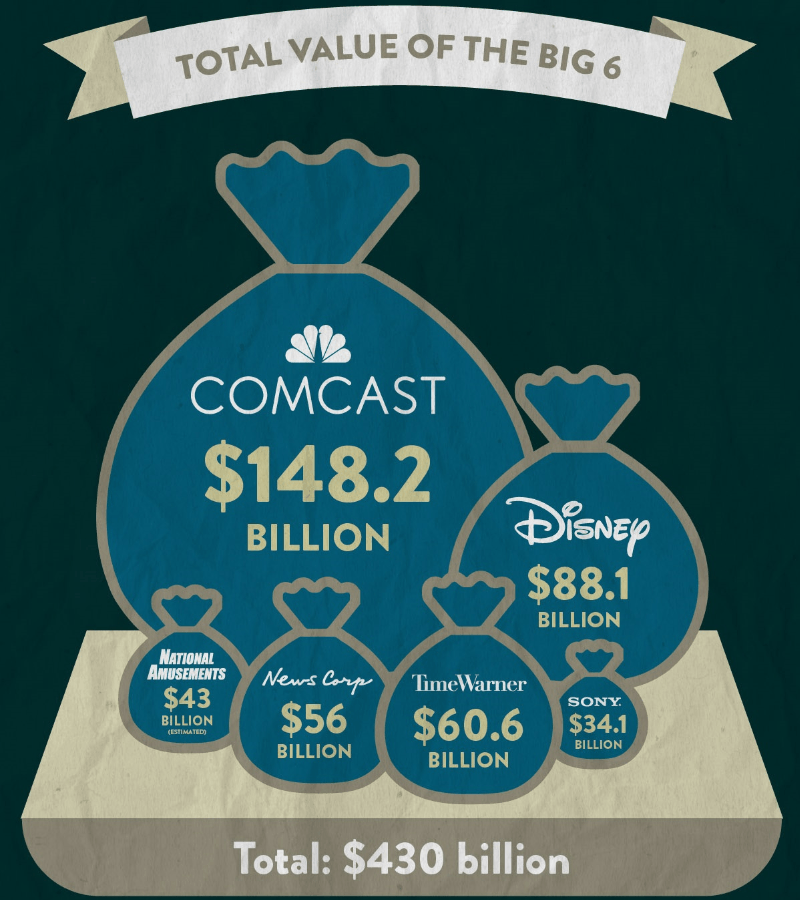
Television, film, and video game companies seem to come out of the woodwork in today’s startup-centric economy. Who knows what they’ll do next? But while it may seem like you have limitless options, most of the media you consume is owned by one of six companies. These six media companies are known as The Big 6.
While independent media outlets still exist (and there are a lot of them), the major outlets are almost all owned by these six conglomerates. To be clear, “media” in this context does not refer just to news outlets — it refers to any medium that controls the distribution of information. So here, “media” includes 24-hour news stations, newspapers, publishing houses, Internet utilities, and even video game developers.
With that in mind, let’s take a look at each of The Big 6, who control them, and what they own.
Media Conglomerate #1: National Amusements
Unless you’re directly involved in business and / or entertainment, you’ve probably never heard of National Amusements before.
The company owns movie theaters throughout the world — about 950 total — but it owns much more than just movie theaters.
NA’s huge collection of properties is staggering. Whether they own a company entirely, possess majority shares, or even own minority voting shares, the scope of NA’s reach is enormous for a company that’s known less than its subsidiaries.
To start our look at NA, let’s check out one of the biggest names in modern business — Sumner Redstone.
Head: Sumner Redstone
Sumner Redstone is the current owner of National Amusements and all of its properties. While his daughter Shari has the title of President, Sumner Redstone retains most of the control over the company.
NA was first founded by Sumner Redstone’s father Michael Redstone, making National Amusements one of the most powerful and successful corporate dynasties in the United States.
None of the Redstones publish their salaries. After all, National Amusements is a private company.
However, finance experts can guess at Sumner Redstone’s overall net worth.
His net worth refers to the total financial value of what Sumner Redstone owns, minus any outstanding debts.
As he nears his 94th birthday in 2017, Sumner Redstone (and his estate) is worth an estimated $4.6 billion, according to Forbes.While a decent amount of that value comes from his stake in National Amusements, much more of it comes from the companies that he owns.
TV and Film Assets
The most famous assets of National Amusements are almost all Viacom and CBS properties.
Combined, they make up the lion’s share of NA’s television and film acquisitions.Still, that’s only a portion of what NA owns.
Print Assets
National Amusements has a modest collection of print publishers, but they’re pretty well-known.
The most well-known is Simon and Schuster, which National Amusements acquired when it purchased Viacom in 1999.
Video Game Assets
Along with other entertainment assets, National Amusements controls CBS Games.
Since its acquisition, CBS Games has rebranded to CBS Interactive, which now controls well-known gaming websites that we’ll look at next.
Internet Assets
With CBS Interactive, National Amusements controls giant chunks of the video game news and sports news industries.
These brands include GameSpot, Metacritic, c|net, and 247-Sports.
Media Conglomerate #2: Disney
Disney is probably the most well-known media name on this list.
The company has a hand in just about every medium in the world from children’s cinema to sports.
When it comes to television and film, there’s a good chance you’re watching something owned by the Disney company — even if it doesn’t have Disney’s name.
Why?
They own so, so much.
Let’s start with the company’s leader.
Head: Bob Iger
Disney announced Bob Iger as CEO on March 13, 2005, following the departure of Michael Eisner.
Since then, Iger has run a campaign of mergers and acquisitions to expand Disney into an even greater media powerhouse, especially with the acquisition of Marvel ($4 billion) and Lucasfilm ($4 billion).
His published salary is $44.9 million. That breaks down to:
$1.73 million per paycheck
$172,692.32 per day
$21,586.54 per hour
Why does Iger make so much money?
He (technically) oversees all of the following companies.
TV and Film Assets
First, let’s look at the bread and butter of Disney — television, and film.
Considering they have theme parks built to their entertainment assets, it’s clear that Disney is best known for its TV and film properties.
There are so many different companies that you really just have to see it for yourself.
Print Assets
Disney’s print assets are a mix of proprietary publishers, Lucasfilm acquisitions, and Marvel properties.
The mix gives Disney a controlling interest in massive publishing niches, especially comic books, and science fiction novels.
Disney also owns ESPN, which has its own publishing arm for all things sports.
Video Game Assets
Finally, Disney owns a few video game assets.
They’re not huge, but they’re enough to keep Disney mildly competitive and up-to-date in the video game industry (especially mobile gaming).
GameStar, a subsidiary of Disney Interactive Studios, is one of the best-known video game developers bought by Disney.
Media Conglomerate #3: TimeWarner
At the time of publication (11/7/16), it’s possible that ATandT will soon buy TimeWarner for around $80 billion.
If that happens, ATandT will acquire everything below and more.
In the meantime, let’s take a more in-depth look at TimeWarner and what it owns.
Head: Jeff Bewkes
Jeff Bewkes is the CEO of TimeWarner. He makes $32.5 million per year.
As the head of TimeWarner, he’s responsible for all of the following companies.
TV and Film Assets
TimeWarner owns an incredible amount of television and film properties.
The most famous is probably Warner Brothers Animation Studios, which owns properties like Looney Tunes.
Along with that, TimeWarner has joint ventures in The CW and Hulu, along with ultra-niche TV programming for medical waiting rooms.
TimeWarner has also played a big role in comic book adaptations into movies, most notably with Batman.
Last, TimeWarner’s HBO branch achieved global renown with its runaway fantasy drama Game of Thrones, an adaptation of George R. R. Martin’s A Song of Ice and Fire.
Needless to say, TimeWarner’s television and film branches — including joint ventures like Hulu and CW — are doing pretty well these days.
Print Assets
On top of its incredible TV and movies, TimeWarner also controls several big-name print assets, including TIME (obviously).
Investments
TimeWarner has one of the most diverse investment portfolios of any media company.
Their investments act as controlling interests in lots of companies, some of which aren’t related to media.
But no matter what they are, each investment gives TimeWarner a stronger foothold in media.
Video Game Assets
As the owner of DC Comics, Looney Tunes, and tons of other fictional characters, it makes sense that TimeWarner owns a list of accomplished video game studios.
The most well-known is probably NetherRealm, which owns and publishes the controversial (and popular) Mortal Kombat series.
They also own Rocksteady, which is responsible for many of the latest Batman games.
Music Assets
TimeWarner doesn’t own a lot in music, but they have enough to ensure musical support for their other properties.
WaterTower Music might be the better-known business of the two enterprises, but Warner Music Group is still an essential part of the TimeWarner brand.
Internet Assets
Finally, TimeWarner is the first company on our list that also acts as an Internet service provider.
TimeWarner Cable is a major ISP in the United States, and it regularly competes with Comcast.
While its reputation differs from person to person, TimeWarner Cable is wildly profitable, and it’s become a major pillar of TimeWarner’s success.
Media Conglomerate #4: Comcast
Comcast is one of the few remaining Internet service providers in the United States. They also provide cable television and phone services to residential and business customers.
In 2013, Comcast expanded its reach into entertainment by purchasing NBC and pretty much all of its properties.
While most people know NBC as just a television station, it also has major stakes in media companies around the world.
That makes Comcast a major contender in global media, especially in the United States.
That may sound like a ridiculous figure to use with the term “only,” but under Roberts’ leadership, the company now earns $74.5 billion annually.
As a result, Roberts is compensated well. He earns $40.8 million per year, which works out to:
$1.57 million per paycheck
$156,923.04 per workday
$19,615.38 per hour
That salary may be exclusive to Comcast’s utilities subscriptions. But that’s not the only way the ISP megalith earns money.
TV and Film Assets
With the acquisition of NBC, Comcast expanded its repertoire of TV and film assets many times over.
TV programming from NBC, cinema from Universal Pictures, and next-gen publishers like AwesomenessTV are all integral to Comcast’s growth and sustainability over the next few decades.
Even their religious niche branch — Big Idea — plays an important part in Comcast’s continued success and increased competitiveness in the media world.
Internet Assets
Most famously, Comcast is known as an Internet provider.
It’s a direct competitor to TimeWarner Cable, and it’s the primary (or only) ISP in dozens of regions in the United States.
Ventures
Last, Comcast has a laundry list of ventures that it launched (or helped launch).
This gives Comcast an interest in dozens of seemingly-unrelated companies as an investor and potentially a future shareholder for the most successful branches.
Media Conglomerate #5: News Corp
News Corp is the media conglomerate best known for its line of Fox companies.
Those include Fox News, FX, and pretty much every other company with the name “Fox” in it.
The company generated more than $33 billion in 2012, and it controls a huge number of print products compared to other media conglomerates.
To get a better grasp of News Corp, let’s check out their CEO Rupert Murdoch.
Head: Rupert Murdoch
While News Corp underwent a split in 2013, Rupert Murdoch remains the head of most of News Corp’s current assets.
With a hand in television, film, music, and print, Murdoch is perhaps the most successful Australian entrepreneur to build an international empire.
As a result, Murdoch earns something to the tune of $22.3 million per year, which is roughly:
$857,692 per paycheck
$85,769.20 per workday
$10,721.15 per hour
So what do Murdoch and his world-famous News Corp control?
TV and Film Assets
News Corp owns the Fox brand, which means they control a borderline-unreasonable amount of media outlets via television and film.
There’s not much more to say about it — News Corp just owns a lot of outlets.
Music Assets
On top of TV and film, News Corp also owns a handful of music assets.
It’s not News Corps’s biggest branch, but it works for their needs, which is typically supporting the TV and film divisions with music (Fox Music).
Wireless Group PLC, on the other hand, is an Irish radio broadcast corporation — one of the biggest in the country.
Print Assets
News Corps’s foundational asset is print.
The company owns hundreds of national, regional, and local newspapers around the world.
The most famous is probably the Wall Street Journal, which fits the mold of News Corps’s focus on financial information.
News Corp also owns HarperCollins, which owns the Christian-niche Zondervan, making News Corp a major player in retail books as well.
Media Conglomerate #6: Sony
Sony is one of the oldest companies on this list since it was founded in 1946.
It also has one of the most recent CEO changes.
In 2012, Kazuo Hirai became CEO of the entire corporation, which might be the most well-known electronics brand on the planet.
But Sony is so much more than an electronics company. They have interests across almost all media industries, and Hirai has helped keep the company current and competitive.
Head: Kazuo Hirai
“Kaz” Hirai started work at Sony Music Entertainment Japan in 1984, and he’s been with the company ever since.
He climbed Sony’s corporate ladder quickly, eventually culminating with his CEO appointment on April 1, 2012.
Since then, Sony has had some problems, but it’s also had some successes. Most notably, Sony recently posted a 666% increase in profit as it launched a turnaround plan. The announcement came almost exactly four years after Hirai become CEO.
At 55, Hirai is one of the youngest leaders of a global conglomerate. But still, he clearly knows what he’s doing.
For his vision, Hirai earns about $4.9 million every year.
Compared to the other CEOs and presidents on this list, that’s pretty modest. But it’s still life-changing money for 99% of the world.
Hirai’s salary breaks down to:
$161,540.80 per paycheck
$16,154.08 per work day
$2019.23 per hour
Let’s check out the scope of Hirai’s responsibilities.
TV and Film Assets
Sony has a hand in dozens of television and cinema companies. Sony works in production, distribution, and just about every other phase of the television and film processes.
So it makes sense that Sony owns media outlets in lots of different countries, most notably Japan and the United States.
Music Assets
Sony’s music arm is well-known throughout the world.
Their music arms work in both support for their television and film production branches, but they also publish music from artists.
That’s enough money to give every American $1348.39.
These companies are probably here to stay for the next decades — or even centuries.
The only way they’ll disappear is if they’re bought by another megalithic company or run out of business by a major market shakeup that leaves them no time to adapt.
This phenomenon is called “too big to fail,” and it’s often applied to worldwide banks like Citi or Bank of America.
But it also applies here. These companies are profit engines that keep growing.
And when they can’t grow, they buy the smaller businesses that do.
Update: At the time of publication, AT&T is attempting to acquire TimeWarner for roughly $80 billion. The deal is still in negotiations, and the FCC may block it to prevent monopolization.
Do you publish your own media?
The beautiful part of the Internet is that every company has the ability to be its own media company — but maybe not on the same scale as TimeWarner.
Do you publish blogs? Videos? Articles? Graphics? Guides?
Whatever you post to your site, you’re in control of your company’s media. You may not be involved in a multi-billion dollar enterprise, but you still control your company’s publications.
How do you use media to your advantage? Let us know on Twitter or Facebook!
“Remain true to the earth, my brethren, with the power of your virtue! Let your bestowing love and your knowledge be devoted to be the meaning of the earth! . . . Let it not fly away from the earthly and beat against eternal walls with its wings. . . . Lead, like me, the flown-away virtue back to the earth—yes, back to body and life: that it may give to the earth its meaning, a human meaning!”
[A] mood of universal destruction and renewal…has set its mark on our age. This mood makes itself felt everywhere, politically, socially, and philosophically. We are living in what the Greeks called the kairos, the right moment for a “metamorphosis of the gods,” of the fundamental principles and symbols. This peculiarity of our time, which is certainly not of our conscious choosing, is the expression of the unconscious human within us who is changing. Coming generations will have to take account of this momentous transformation if humanity is not to destroy itself through the might of its own technology and science….So much is at stake and so much depends on the psychological constitution of the modern human.
The Esalen Institute, commonly called Esalen, is a non-profit American retreat center and intentional community in Big Sur, California, which focuses on humanisticalternative education.[2] The institute played a key role in the Human Potential Movement beginning in the 1960s. Its innovative use of encounter groups, a focus on the mind-body connection, and their ongoing experimentation in personal awareness introduced many ideas that later became mainstream.[3]
Price ran the institute until he was killed in a hiking accident in 1985. In 2012, the board hired professional executives to help raise money and keep the institute profitable. Until 2016, Esalen offered over 500 workshops yearly[7] in areas including personal growth, meditation, massage, Gestalt Practice, yoga, psychology, ecology, spirituality, and organic food.[8] In 2016, about 15,000 people attended its workshops.[9]
In February 2017, the institute was cut off when Highway 1 was closed by a mud slide on either side of the hot springs. It closed its doors, evacuated guests via helicopter, and was forced to lay off 90% of its staff through at least July, when they reopened with limited workshop offerings. It also decided to revamp its offerings to include topics more relevant to a younger generation.[9]
As of July 2017, due to the limited access resulting from the road closures, the hot springs are only open to Esalen guests.[9]
The grounds of the Esalen Institute were first home to a Native American tribe known as the Esselen, from whom the institute adopted its name.[10]Carbon dating tests of artifacts found on Esalen’s property have indicated a human presence as early as 2600 BCE.[11]
The location was homesteaded by Thomas Slate on September 9, 1882, when he filed a land patent under the Homestead Act of 1862.[12] The settlement became known as Slates Hot Springs. It was the first tourist-oriented business in Big Sur, frequented by people seeking relief from physical ailments. In 1910, the land was purchased by Henry Murphy,[13] a Salinas, California, physician. The official business name was “Big Sur Hot Springs” although it was more generally referred to as “Slate’s Hot Springs”.[14]View of the building on the bluff housing the hot springs
Founding
Stanford grads meet
Richard Price in 1968
Michael Murphy and Dick Price both attended Stanford University in the late 1940s and early 1950s.[15] Both had developed an interest in human psychology and earned degrees in the subject in 1952.[16] Price was influenced by a lecture he heard Aldous Huxley give in 1960 titled “Human Potentialities”. After graduating from Stanford, Price attended Harvard University to continue studying psychology. Murphy, meanwhile, traveled to Sri Aurobindo‘s ashram in India where he resided for several months[17] before returning to San Francisco.
Price’s parents involuntarily committed him to a mental hospital for a year, ending on November 26, 1957. He hated the experience and thought he would like to create an environment where people could explore new ideas and thoughts without judgment and influence from the outside world. In May 1960, Price returned to San Francisco and lived at the East-West House with Taoist teacher Gia-Fu Feng. That year he met fellow Stanford University graduate Michael Murphy at Haridas Chaudhuri’s Cultural Integration Fellowship where Murphy was in residence. They met at the suggestion of Frederic Spiegelberg, a Stanford professor of comparative religion and Indic studies, with whom both had studied.[18]
By then they had both dropped out of their graduate programs (Price at Harvard and Murphy at Stanford), and had served time in the military.[16] Their similar experiences and interests were the basis for the partnership that created Esalen.[16] Inspired by Buddhist practices, and based on his own understanding of Taoism, Price developed his teachings. He took what Fritz Perls had taught him and created a Gestalt Awareness process that is still taught and followed today. People all over the world follow the thought and healing practice created by Price in guidance,.[19][20]
Lease property
Price and Murphy wanted to create a venue where non-traditional workshops and lecturers could present their ideas free of the dogma associated with traditional education. The two began drawing up plans for a forum that would be open to ways of thinking beyond the constraints of mainstream academia while avoiding the dogma so often seen in groups organized around a single idea promoted by a charismatic leader. They envisioned offering a wide range of philosophies, religious disciplines and psychological techniques.[21]
In 1961, they went to look at property owned by the Murphy family at Slates Hot Springs in Big Sur.[22] It included a run-down hotel occupied in part by members of a Pentecostal church.[23] The property was patrolled by gun-toting Hunter S. Thompson. Gay men from San Francisco filled the baths on the weekends.[23]
Henry Murphy’s widow and Michael’s grandmother Vinnie “Bunnie” MacDonald Murphy, who owned the property, lived 62 miles (100 km) away in Salinas. She had previously refused to lease the property to anyone, even turning down an earlier request from Michael. She was afraid her grandson was going to “give the hotel to the Hindus,” Murphy later said. Not long after, Thompson attempted to visit the baths with friends and got into a fistfight after antagonizing some of the gay men present. The men almost tossed him over the cliff. Murphy’s father, a lawyer, finally persuaded his mother to allow her grandson to take over[23] and she agreed to lease the property to them in 1962.[24][25][26] The two men used capital that Price obtained from his father, who was a vice-president at Sears.[27] They incorporated their business as a non-profit named Esalen Institute in 1963.[28][29]
Develop counterculture workshops
Murphy and Price were assisted by Spiegelberg, Watts, Huxley and his wife Laura, as well as by Gerald Heard and Gregory Bateson. They modeled the concept of Esalen partially upon Trabuco College, founded by Heard as a quasi-monastic experiment in the mountains east of Irvine, California, and later donated to the Vedanta Society.[30] Their intent was to provide “a forum to bring together a wide variety of approaches to enhancement of the human potential… including experiential sessions involving encounter groups, sensory awakening, gestalt awareness training, related disciplines.”[31][32] They stated that they did not want to be viewed as a “cult” or a new church but that it was to be a center where people could explore the concepts that Price and Murphy were passionate about. The philosophy of Esalen lies in the idea that “the cosmos, the universe itself, the whole evolutionary unfoldment is what a lot of philosophers call slumbering spirit. The divine is incarnate in the world and is present in us and is trying to manifest,” according to Murphy.[16]
Alan Watts gave the first lecture at Esalen in January 1962.[33]Gia-fu Feng joined Price and Murphy,[34] along with Bob Breckenridge, Bob Nash, Alice and Jim Sellers, as the first Esalen staff members.[26] In the middle of that same year Abraham Maslow, a prominent humanistic psychologist, just happened to drive into the grounds and soon became an important figure at the institute.[35] In the fall of 1962, they published a catalog advertising workshops with such titles as “Individual and Cultural Definitions of Rationality,” “The Expanding Vision” and “Drug-Induced Mysticism”.[33] Their first seminar series in the fall of 1962 was “The Human Potentiality,” based on a lecture by Huxley.[3]
Fritz Perls residency
In 1964, Fritz Perls began what became a five-year long residency at Esalen, leaving a lasting influence. Perls offered many Gestalt therapy seminars at the institute until he left in July 1969.[36]Jim Simkin[37] and Perls led Gestalt training courses at Esalen. Simkin started a Gestalt training center[38] on property next door that was later incorporated into Esalen’s main campus.[39]
When Perls left Esalen he considered it to be “in crisis again”. He saw young people without any training leading encounter groups. And he feared that charlatans would take the lead.[40] However, Grogan[who?] claims that Perls’ practice at Esalen had been ethically “questionable”,[41] and according to Kripal, Perls insulted Abraham Maslow.[42]
Gestalt Practice developed
Dick Price became one of Perls’ closest students. Price managed the institute and developed his own form he called Gestalt Practice,[43] which he taught at Esalen until his death in a hiking accident in 1985.[44] Michael Murphy lived in the San Francisco Bay Area and wrote non-fiction books about Esalen-related topics, as well as several novels.[45]
Leads counterculture movement
Esalen gained popularity quickly and started to regularly publish catalogs full of programs. The facility was large enough to run multiple programs simultaneously, so Esalen created numerous resident teacher positions.[46] Murphy recruited Will Schutz, the well-known encounter group leader, to take up permanent residence at Esalen.[47] All this combined to firmly position Esalen in the nexus of the counterculture of the 1960s.[48]
The institute gained increased attention in 1966 when several magazines wrote about it. George Leonard published an article in Look magazine about the California scene which mentioned Esalen and included a picture of Murphy.[49]Time magazine published an article about Esalen in September 1967.[50]The New York Times Magazine published an article by Leo E. Litwak in late December.[51]Life also published an article about the resort.[52] These articles increased the media and the public’s awareness of the institute in the U.S. and abroad. Esalen responded by holding large-scale conferences in Midwestern and East Coast cities,[53] as well as in Europe. Esalen opened a satellite center in San Francisco that offered extensive programming until it closed in the mid-1970s for financial reasons.[54]
In 1998, Esalen launched the Center for Theory and Research to initiate new areas of practice and action which foster social change and realization of the human potential.[56] It is the research and development arm of Esalen Institute.[57] As of 2016, Michael Cornwall, who previously worked in the institutes’ Schizophrenia Research Project at Agnews State Hospital, was conducting workshops titled the Alternative Views and Approaches to Psychosis Initiative at Esalen. He was inviting leaders in the field of psychosis treatment to attend the workshops.[58]
Management changes
Esalen has been making changes to respond to internal and external factors.[59][60][61] Dick Price was the key leader of the institute until his sudden death in a hiking accident in late 1985 brought about many changes in personnel and programming.[62] Steven Donovan became president of the institute,[63] and Brian Lyke served as general manager.[62] Nancy Lunney became the director of programming,[64] and Dick Price’s son David Price served as general manager of Esalen beginning in the mid-1990s.[65]
The baths were destroyed in 1998 by severe weather and were rebuilt at great expense, but this caused severe institutional stress.[66] Afterward, Andy Nusbaum developed an economic plan to stabilize Esalen’s finances.[67]
In 2011, the institute commissioned the company Beyond the Leading Edge to conduct a Leadership Culture Survey to assess the quality of its leadership culture. The results were negative. The survey measured how well the leadership “builds quality relationships, fosters teamwork, collaborates, develops people, involves people in decision making and planning, and demonstrates a high level of interpersonal skill.” In the “relating dimension” the survey returned a score of 18%, compared to a desired 88%. It also produced strongly dissonant scores in measures of community welfare, relating with interpersonal intelligence, clearly communicating vision, and building a sense of personal worth within the community. It ranked management as overly compliant and lacking authenticity. However, the survey found that Esalen closely matched its overall goal for customer focus.[68]
Gordon Wheeler dramatically restructured Esalen management.[69] These changes prompted Christine Stewart Price, the widow of Dick Price, to withdraw from the institute, and found an organization named the Tribal Ground Circle with the intention to preserve Dick Price’s legacy.[70][71]
Early leaders and programs
Aldous Huxley
In the few years after its founding, many of the seminars[72] like “The Value of Psychotic Experience” attempted to challenge the status quo. There were even Esalen programs that questioned the movement of which Esalen itself was a part—for instance, “Spiritual and Therapeutic Tyranny: The Willingness To Submit”. There were also a series of encounter groups focused on racial prejudice.[73]
Early leaders included many well-known individuals, including Ansel Adams, Gia-fu Feng, Buckminster Fuller, Timothy Leary, Robert Nadeau, Linus Pauling, Carl Rogers, Virginia Satir, B.F. Skinner, and Arnold Toynbee. Rather than merely lecturing, many leaders experimented with what Huxley called the non-verbal humanities: the education of the body, the senses, and the emotions. Their intention was to help individuals develop awareness of their present flow of experience, to express this fully and accurately, and to listen to feedback. These “experiential” workshops were particularly well attended and were influential in shaping Esalen’s future course.[74]William Schutz at Esalen, circa 1987
Staff residency
Because of Esalen’s isolated location, its operational staff members have lived on site from the beginning and for many years collectively contributed to the character of the institute.[75] The community has been steeped in a form of Gestalt that pervades all aspects of daily life, including meeting structures, workplace practices, and individual language styles.[76] There is a preschool on site called the Gazebo, serving the children of staff, some program participants, and affiliated local residents.[77]
Bodywork has always been a significant part of the Esalen experience. In the late 1990s, the “EMBA” was organized as a semi-autonomous Esalen association for the regulation of Esalen massage practitioners.[78]









 EsalenLocation in California


