
Monthly Archives: August 2020
Conversations with Calvin
On child rearing
Two Wings Of THe Oligarch Party…
THE CENTER FOR RAY BRADBURY STUDIES DIRECTOR JONATHAN R. ELLER
Ray Bradbury’s Soul Is in Every Bookstore
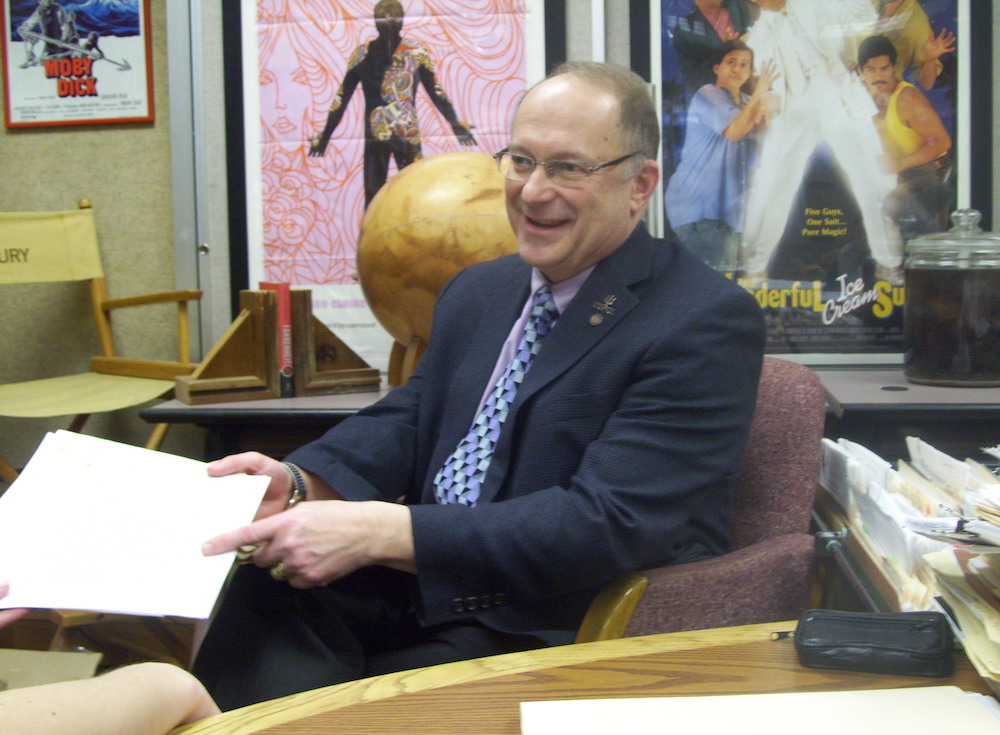
Jonathan R. Eller at the Center for Ray Bradbury Studies in 2016.
AUGUST 27, 2020 (zocalopublicsquare.org)
Jonathan R. Eller is the director of the Center for Ray Bradbury Studies at Indiana University. Before taking part in a Zócalo event asking “Are We Living in a World Ray Bradbury Tried to Prevent?,” Eller spoke in the green room about collecting books and coins, the humble dandelion, and the importance of believing in a better future.Q:
What was the first science fiction book you ever read?
A:
A science fiction novel called Slan. It was by the Canadian science fiction writer A. E. Van Vogt. That copy of Slan was actually my mother’s copy. She was in college in the mid-1940s, and she bought it when it came out.
I read it in ’60 or ’61. It’s a novel about the next evolutionary step for humanity where telepaths are involved and you can tell who they are because they have little antennae buried in their hair. But it’s really a novel about fear of otherness. So, what does the rest of the world do? They’re afraid of these advanced humans. Reading Van Vogt’s Slan at that age really set me up very quickly for moving onto Ray Bradbury, who had the same affinities to talking about how we deal with otherness, and how, sometimes, we don’t do a very good job with dealing with things that are different from our ourselves. It was a pretty heavy science fiction book to read for a kid, but it got me started.
Q:
What year, past or future, would you want to time travel to, and why?
A:
I would pick 100 years from today. That’s a Bradbury influence. He wrote a story called “The Toynbee Convector.” It’s about a rich man, a scientist, who builds a time machine and goes 100 years in the future. And when he comes back, he publicly says, OK, I’ve been to the future, here are the pictures to prove it. We make it. We’re OK. We’re going to have a wonderful future 100 years from now, because we get through all of this.
So the world is very happy. They celebrate this. But after 100 years pass, everybody gets ready to see the time traveler’s machine show up. If they see him arrive as a young man in his machine, they’ll know he really was there. Well, he doesn’t show up. And the time traveler, who’s still alive and old man now, just smiles, and says, you see, it worked. It was all a hoax. I faked the pictures. I just wanted people to believe that we would have a future. Because if you believe it, you will have it.
Q:
Do you have a favorite plant?
A:
When I was in high school, I was an Eagle Scout, and I worked on forestry projects and planting projects in the summertime. I have to say in spite of working with a lot of plants and trees, my favorite is the lowly backyard dandelion. I was told [that]—during the weeks every year when all the dandelions turn from bright yellow to that milky white seed color—if you look at bottles of dandelion wine during those same weeks, those bottles turn from clear to milky. So it’s sort of like they’re immortal in a way; they have some connection to the old world from which they were harvested years ago. I don’t know if this [story of the dandelion wine] is true, but I heard it, and like Ray Bradbury I’m very susceptible to the power of suggestion.
Q:
What relaxes you?
A:
All my life I’ve been a collector. Collecting old books and coins, especially foreign coins, these things are like gateways into history. I’ve always been a historian at heart. I’m a literary historian now in my life as an academic. But collecting coins and books are like time machines that have come out of the past, and they tell us things we didn’t know.
Q:
To reverse that question, what keeps you up at night?
A:
What keeps me up at night is probably the kind of thing that keeps a lot of people up at night … worrying about the world’s future. The wars never seem to end. I spent 20 years in the United States Air Force. We always felt the tensions would eventually subside; the world would finally learn to live together. And it looks like we still have more work to do. But I’m still hopeful. You have to be optimistic.
Q:
Where’s your favorite place to go in Indianapolis?
A:
The Barnes & Noble bookstore on the northside of Indianapolis where [my family] used to live was a favorite place for us to go.
I hope that [physical] bookstores will survive the pandemic and its consequences. Books are such a large part of our culture’s soul in this country. And Ray Bradbury’s soul is in every bookstore. He met his wife at a bookstore in Los Angeles. Fowler Brothers bookstore, which isn’t there anymore. She was a clerk at Fowler’s and the store manager asked her to keep an eye on this guy with an overcoat and briefcase who would come in the evenings to read books and magazines because he thought he was a thief. And so they watched each other watching each other and eventually started to talk to each other and that was the beginning of his romance that led to Ray Bradbury marrying Maggie McClure.
Q:
What’s the best advice you’ve ever received?
A:
Ray Bradbury once told me never to be afraid to ask for something. If you don’t ask, you’ll never know what’s possible, will you? I met Ray when I was still in the military in the 1980s and in the military there’s a time to ask questions, but most of the time, questions are not encouraged. Attention to duty is more important. So it was a bit of a mind shift for me, when he said, don’t be afraid to ask for something.
He also once said to me—this was almost 20 years ago, and I had been visiting with him, one spring or fall in Los Angeles. He’d be working on his stories, and I would be doing research in his office with his papers or in his library. At the end of the day we’d get ready for dinner and he’d say, how’d it go today? And I would give him a quick rundown: Well, I found this, I took notes on that. Overall, Ray, it was a good day. And he just looked at me and kind of blinked through his large, thick glasses and he said, “Every day is a good day, Jon.” And I never forgot that. Because in his mind, every day was a good day. You take the good with the bad, but it’s a wonderful thing having life on this planet, and he was always, in one way or another, grateful every day.
RAY BRADBURY’S MIRROR TO OUR WORLD
Democracy. Technology. The Media. The Science-Fiction Writer—Who Would’ve Turned 100 This Week—Has Never Been So Relevant
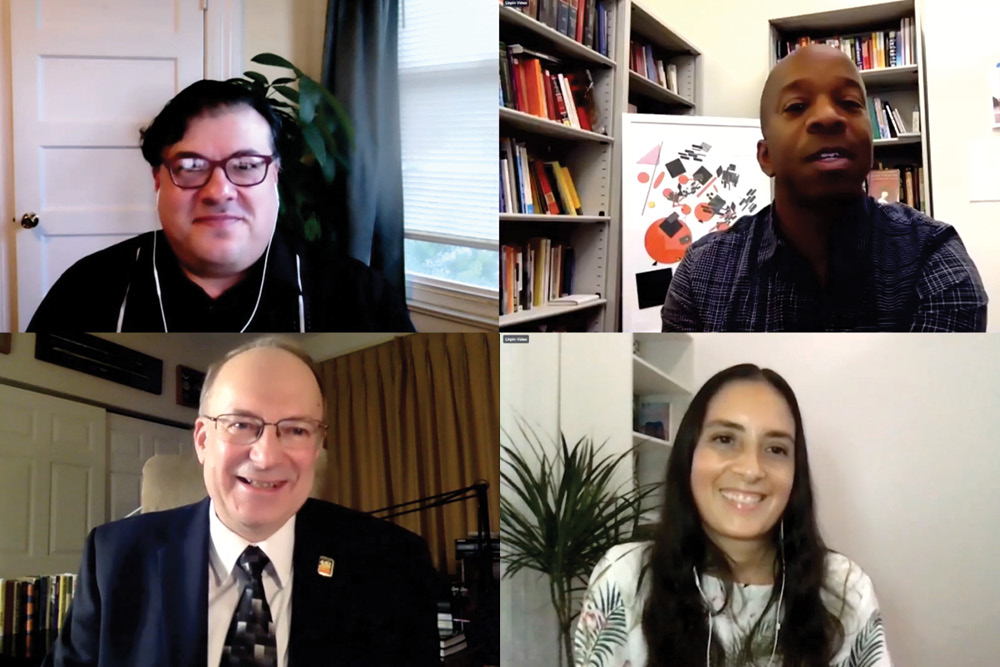
Panelists from “Are We Living in a World Ray Bradbury Tried to Prevent?” Composite shot taken from Youtube.
by JOE MATHEWS | AUGUST 28, 2020 (zocalopublicsquare.org)
Happy 100th birthday, Ray Bradbury. But did you have to be so right about our world?
There were no candles and no cake on the YouTube or Twitter livestreams during a virtual Zócalo/Fowler Museum at UCLA event with ZYZZYVA, held to honor the late writer’s August 22, 1920 birth. But a lively panel of writers and scholars delved into Bradbury’s literary visions of the future, and the insights and warnings they still provide for humanity.
“Ray would often say he wasn’t trying to predict the future,” said Bradbury’s friend, actor and director Joe Mantegna, who introduced the event. “He was trying to prevent it.”
That insight framed the conversation, titled, “Are We Living in a World Ray Bradbury Tried to Prevent?,” which focused on a selection of his classic works: his breakout 1950 short story collection, The Martian Chronicles, his 1953 classic novel, Fahrenheit 451, and finally, “The Veldt,” a short story that became part of his 1951 anthology, Illustrated Man.
Panelist Lilliam Rivera, an award-winning author of young adult and middle-grade books, recalled the indelible images of Mars and the colonies she discovered in The Martian Chronicles as a child. But when she re-read the book as an adult, she was struck by a broader message about the dangers of colonization here on Earth—one that made her rethink her own story.
“I was thinking of Puerto Rico, where my family was from,” said Rivera, who also noted similarities in the “moral clarity” and broad questions of Bradbury’s work and the books of some of today’s Latinx writers of speculative fiction, including Fernanda Melchor and Silvia Moreno-Garcia. “Reading The Martian Chronicles once again brought back those ideas about imperialism,” Rivera added.“The question Ray Bradbury has in his mind from the very beginning is: With the memory of what we’ve done to this world, will we go to Mars and do the same thing?” Eller said.
That prompted another panelist, Jonathan R. Eller, who directs the Center for Ray Bradbury Studies at Indiana University, to call the Mars of his friend Bradbury’s book “a mirror, not a crystal.”
“The question Ray Bradbury has in his mind from the very beginning is: With the memory of what we’ve done to this world, will we go to Mars and do the same thing?” Eller said.
“Ray was concerned [with] who we are going forward, when we’re living in an environment that is an illusion,” said Eller. Bradbury enjoyed technology, but was also suspicious of those who controlled it, in a way that rings true today.
“Ray Bradbury would ask the question implicitly, ‘Who watches the watchers?’” said Eller.
Those observations turned the conversation to the details of Fahrenheit 451. Oscar Villalon, the ZYZZYVA managing editor and moderator, noted that he had recently re-read the book for the first time since 1993.
“This time, it reads much less as speculative fiction,” Villalon said, noting the book depicts a society distracted by devices, where children kill for sport. “It’s also more brutal than I remember it … Nobody is really conscious of being alive in the book … It almost seems to be a meditation on all the ways that a democratic society declines into a spiritual collapse.”
That prompted another panelist, Michael Bennett, a professor at Arizona State University’s Center for Science and the Imagination, to marvel at how Bradbury created a book, read by millions in the 20th century, about how the destruction of books “marks the decline, the total implosion of civilization.”
Bradbury, Bennett noted, has been criticized for taking a child-like view of the world. “But the books are so rich and they have their fingers intensely pressed down on the pulse of so many things are important to society,” he said, “including efforts by baby authoritarians to clamp down our imaginations.”
As to the night’s title question—whether we’re living in a world Bradbury tried to prevent—Bennett said, “I’m solidly in the ‘yes’ camp.” He referred to the fact that the Zócalo event was taking place the same night that President Trump was giving his acceptance speech at the Republican National Convention.
Questions submitted by audience members in the YouTube chat room drew the panelists into a deeper discussion of Bradbury’s devotion to Los Angeles, where he spent most of his life. Having never gone to college, Bradbury educated himself in L.A.’s public libraries, Bennett noted, and even occasionally referred to himself as a librarian.
Audience members also asked about Bradbury’s views on everything from private space exploration to authoritarianism and media manipulation.
“With all the stories we’ve talked about this hour,” observed Rivera, near the evening’s end, “it’s like a checklist of what’s happening now.”
JOE MATHEWS writes the Connecting California column for Zócalo Public Square.
EDITOR: SARAH ROTHBARD
2021 Tokyo Fireworks
These fireworks were prepared by Tokyo ?? for the inauguration of the 2021 Olympic Games. As fireworks cannot be stored until 2021, Japan decided to share them with the world anyway. They were released yesterday. Here they are on the overture of William Tell by Gioacchino Rossini. (Original Japanese to English translation)
Questi fuochi d'artificio sono stati preparati da Tokyo ?? per l'inaugurazione dei Giochi Olimpici 2020. Poiché i fuochi d'artificio non possono essere conservati fino al 2021, il Giappone ha deciso di condividerli comunque con il mondo. Sono stati rilasciati ieri. Eccoli sull'overture del Guglielmo Tell di Gioacchino Rossini.Buona giornata a tutti.
Posted by Gabriele Turissini on Tuesday, August 18, 2020
Interview with Carl Jung
Book: “Dreams: God’s Forgotten Language”
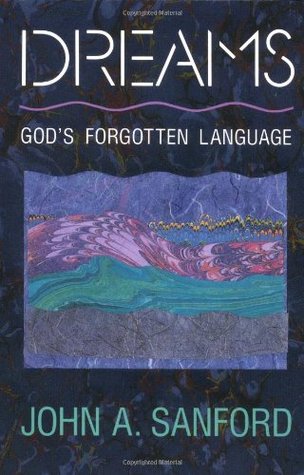
Dreams: God’s Forgotten Language
First published twenty years ago, this revised edition of John Sanford’s classic exploration of the psychological and spiritual significance of dreams draws on the work of C.G. Jung to show how dreams can help us find healing and wholeness and reconnect us to a living spiritual world.
Featuring a new preface by the author and using case histories from his own experience as a counselor, Dreams traces the role of dreams in the Bible, analyzing their nature and examining how Christians, through fear and the constraints of dogma, have come to reject the visions through which God speaks to humanity, making dreams — in Sanford’s words — “God’s forgotten language.”
(Goodreads.com)
Alexander Malofeev — S.Rachmaninoff. Piano Concerto No.2
Alexander Malofeev Rachmaninoff. Piano Concerto No.2 in C minor, Op.18 Soloist Alexandеr Malofeev (15 y.o.) Baltic Sea Philharmonic. Conductor Kristjan Järvi. August 2017 С.Рахманинов. Концерт № 2 для фортепиано с оркестром, Ор.18 Солист Александр Малофеев (15 лет) Филармонический оркестр Балтийского моря Дирижер Кристьян Ярви Август 2017