Parenting Doesn’t Matter

We’re all terrified we’re going to mess up our kids. The science says we probably won’t have much impact at all.

Slate|getpocket.com

  • Daniel Engber
a8294a5a-ce7f-48a1-a325-cb3a36ce81d5.gif

Illustrations by Natalie Matthews-Ramo.

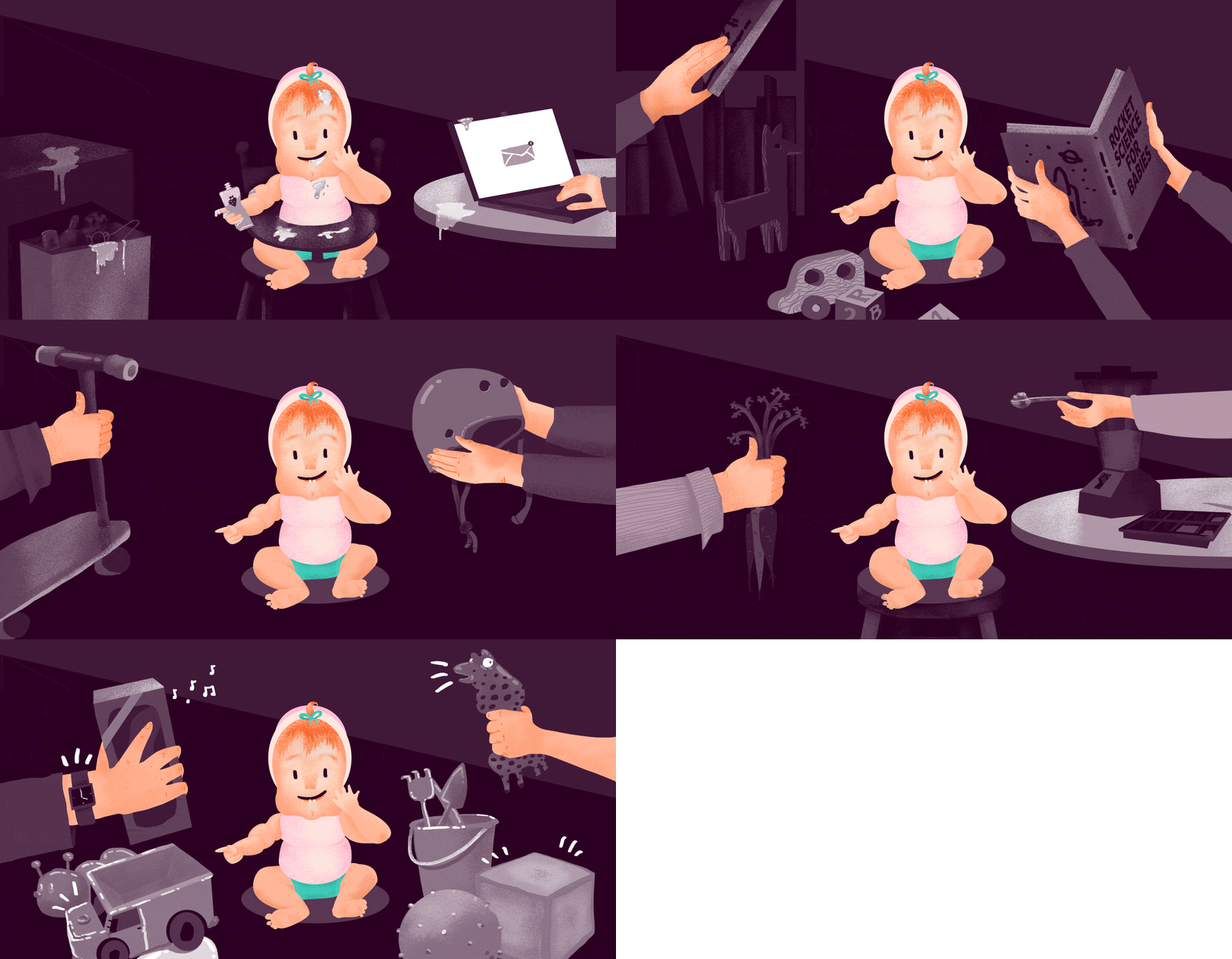
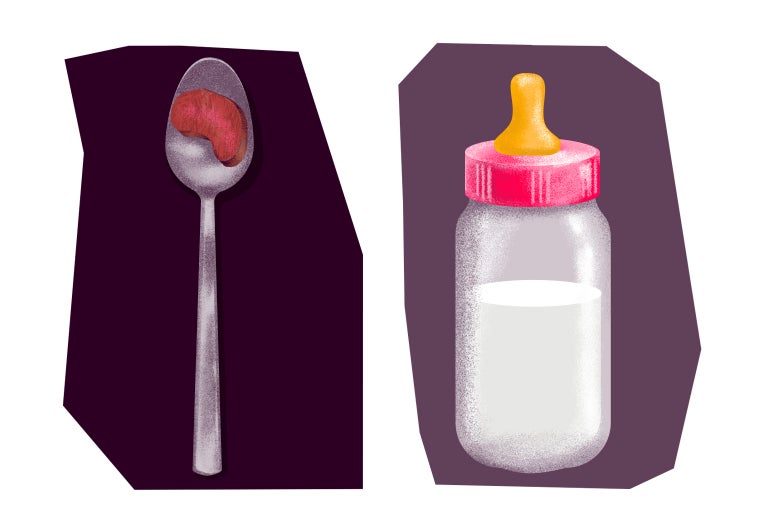
Here’s one way I might have screwed up my infant daughter: I let her go way too long without giving her solid food. At a four-month checkup, our pediatrician suggested it was time to change her diet. “You could even try a piece of steak,” she said. This seemed a little much. We’d planned to start with mashed-up peas or carrots or maybe Cream of Wheat; the thought of shoving London broil in her mouth put us off the whole idea for months. Every evening one of us would venture, “Maybe now’s the time to start with solid food?” And then every evening we’d agree to wait. It sounded like a lot of effort, to boil carrots or whatever, after having gotten through the day. Also, what if boiled carrots made her choke?

As this went on, we sometimes wondered if we might be lousy parents—so scared of messing up, and so averse to changing our routine, that we’d deprived our baby girl of steak. Then, one night, I fell into a reverie. We’d failed to give our daughter solids yet again that day, and I’d started on my standard stretch of self-recrimination: Would we ever wean our daughter? If we put it off until October, I thought, we’d miss the chance to give her cake for her first birthday. Then I tried to picture what would happen if we waited even longer. I imagined her in kindergarten, drinking from a bottle while the other kids had string cheese; then in middle school, as the Girl Who Never Learned to Chew; then as a businesswoman on the go, toting Nalgenes full of breast milk in her purse. The sillier these scenarios became, the more comforting I found them—and the more it seemed to me that nothing that we did as parents would really make a difference in the end. Of course our girl would try some mashed-up peas eventually. Of course she’d eat a piece of steak at some point between her six-month checkup and her Sweet 16. And that milestone would be attained even if we dragged our feet today, tomorrow, and all of next week, too.

My worries vanished: We weren’t lousy parents—just a bit hands-off, but that’s OK.

Soon I found myself applying the same exculpatory logic to many other tasks of early parenting.

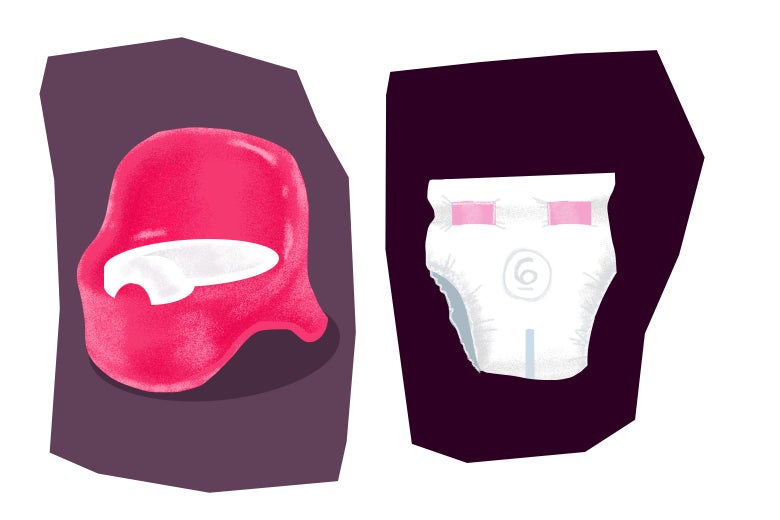
“Dan, should we get started on the potty training?”

“Eh, why bother? It’s not like she’ll be shitting in her pants at high-school graduation.”

Now, I sometimes fret that this idea has too much sway inside my head. Whenever we’re confronted with some new conundrum—what to do for preschool, for example, or how to handle toddler tantrums—I’m inclined to fall back on my blanket rule, my anti-principle of parenting: It’s not like she’ll be doing this forever, I’ll say. Everything will work out fine. Or else, I guess, everything won’t work out fine. But even then, would it really be our fault?

Not unless we’d acted like a pair of ogres: like if we really had stopped our girl from eating solid food for years or made her wear a diaper to her high-school graduation. But short of that, I can’t shake the intuition that any choices that we make as parents—or any choices that we fail to make—won’t matter in the long run. I’m glad to say my daughter has been eating lots of mush these days and isn’t drinking so much milk. This was bound to happen at some point just as she’s bound to poop into a toilet, regardless of the method we decide to use for teaching her, whether it’s the Brazelton approach, the three-day plan, or some other potty-training scheme I haven’t heard of yet. Other, more fundamental outcomes in her life—I mean aspects of our daughter’s character, her passions, and her long-term health—may be far less certain at this point. But if I’m honest, these feel just as unresponsive to our parenting.

I find that sort of comforting, but also sort of sad.
8b7a43c2-e3f9-4227-a277-fbe26e95a7d9.jpeg

* * *

Let’s talk about the weird-shit rule of parenting. It’s a principle that I just made up. Here’s the gist: Provided that you have the means to satisfy your child’s basic needs, and assuming that you aren’t acting in a way that’s flagrantly abusive, the only way to really change her life—to alter her nature, for better or worse—is to do some weird, outrageous shit. I don’t know exactly what that shit would be; I guess it could be pretending that your baby’s French, or depriving her of toys, or suspending her inside a window cage. (To be honest, even that shit might not be weird enough to make a difference in the long run.) But otherwise, in the absence of weird shit, the weird-shit rule stipulates that as long as you love your kids in more or less the way that normal parents do, and try your best to be benign, you’ll be pretty much irrelevant.

Parents tend to understand the weird-shit rule, yet parents also tend to think that they’re exceptions. They might be scared their shit is weird by accident, and that it’s messing up their kids in lots of little ways. Or else they might be proud of how their shit is so exceptional and weird the better way that makes a child more amazing. I’m here to say that both of these are fantasies. You’re almost certainly not a weirdo parent. Maybe you’ve pursued the most extreme attachment parenting, and your baby never leaves your side. That’s not weird enough to count as weirdo parenting. Perhaps you sleep-trained your kid before she could even lift her head? That also isn’t weird. What about cloth diapers? Sorry, pretty normal. Gave up on breast-feeding earlier than your perfect next-door neighbor? Doesn’t really matter. A total ban on screen time till the age of 5? A little odd, I guess, but also: not that weird!

No, when I say “weird shit,” I’m referring to the stuff you’d never dream of doing. It might be well-intentioned, at least according to some weirdo logic, but it’s also very, very far outside the norm. Weird shit would be insisting that your child only poops at certain times, or that she never hears a word beginning with the letter P. Weird shit would be depriving her of song, or telling her you’re ghosts. So I’m confident in saying that, chances are, your parenting is pretty normal—and your pretty normal parenting won’t, in the end, change all that much about your child’s future.

I’m proud to say my weird-shit rule is supported by the science of parentology. When behavioral geneticists study pairs of fraternal and identical twins, including those who grew up together or separately, and measure how they differ as adults, they tend to find very little impact from what they call the siblings’ “shared environment”—the set of factors that includes whatever aspects of their lives those kids might have in common if they lived together: things like their neighborhood or school, or their parents’ personalities, social class, and strategies for raising children.

If these factors are irrelevant, then what does affect a child’s future? Twin studies say a large proportion of the differences between children’s cognitive abilities, personalities, and chances of ending up with mental illness (among other long-term outcomes) can be explained solely by their DNA. And most of the rest appears to come from random chance, quirks in their biology, and specific non-parent-related life experiences: the teachers they had, or the friends they made along the way.

This has always been a strong result and was supported in the last few years by an omnibus analysis of almost 3,000 twin studies conducted between 1958 and 2012. It has, at times, been used to make some bold, bleak claims about what it means to raise a family. Twenty years ago, a panic over parenting swept across the media when developmental psychologist Judith Rich Harris put out a book, The Nurture Assumption, that claimed the links between parents’ actions and the outcomes of their kids were based on flimsy science. A raft of essays followed, addressing what appeared to be her central provocation: “Do Parents Matter?” A “modern-day cult of parenting” had taken hold, as Malcolm Gladwell put it at the time, but now it seemed as though it wasn’t doing any good. If it was, then wouldn’t major changes in parental methods—participation trophies and all that—have had transformative effects? Yet for Harris, the evidence seemed pretty clear: Parents changed; their kids did not.

This line of thinking thrives in certain academic circles, even as it so egregiously contradicts our sense of parenting as the most important job we’ll ever do (and undercuts a massive industry in parenting self-help). In a pair of recent essays for the online site Quillette, Saint Louis University behavioral geneticist Brian Boutwell said that Harris had it right. Quoting from her book, and referring to that big analysis of several thousand twin studies, he affirmed there’s little reason to believe that we can help determine our kids’ intelligence, personality, or mental health. We aren’t really “puppet masters” of our kids’ development, he argued, but rather something more important—their guardians and friends.

Boutwell does concede—as do all adherents to this theory—that parents can be cruel or kind, and that there are obviously many ways to screw up a little person’s life. If a child ends up inside a Romanian orphanage, for example, studies say that will change her for the worse. So might any approach to “parenting” that could be classified as physical, sexual, or emotional abuse. My weird-shit rule assumes a childhood that clears these very modest thresholds; it takes it as a given that a parent won’t behave in vicious, hateful ways.

In another sense, the rule applies only to those parents who possess some degree of privilege. A vast and terrible gap exists, of course, between the richest and the poorest families in the U.S., with obvious effects on children’s lives. It matters quite a bit to kids’ development when they have lead in their drinking water, or face a bloom of Legionella microbes, rampant air pollution, super-busted schools, and racism. These broad effects of bad environments may be minimized in twin studies, which sometimes draw from groups that lack diversity. Research done inside a welfare state like Norway, for example, or among middle-class families in Minnesota, capture just a narrow band of variation on these measures. It tends to overlook the kids who don’t have some minimal degree of health and safety.

Nor will these studies tend to show what happens when a parent acts in weird-shit ways—whether that environment is extra-bad or extra-good. When it comes to how, exactly, people choose to raise their kids—which toys they buy, which rules they set, how they nurture and communicate—the research only tests for ordinary differences across a given set of families, rather than the total range of possible decisions and behaviors. So when those studies tell us that a person’s style as a parent doesn’t really matter, they’re referring to gradations in the mostly-normal shit that parents do. They’re saying that parents aren’t so important, assuming their behavior falls within the standard bounds of their community. But if they were doing something very different—I mean, if they were off the reservation, parent-wise? Then it’s really hard to say.

The more I think about this science, the more it makes me think that parents ought to shake things up. Maybe if my wife and I were weird enough, we could move the needle for our daughter, even just a bit, and make her a happier, healthier woman. That’s just in the long view: How we act around the house would also have effects on her right now while she’s still a kid. If studies tell us that genetics wins out in the end for lots of traits and outcomes, they also say its influence is weakest—and ours is strongest—when our child is still young and less able to control her own environment. (That’s especially true for intelligence.)

But then I also know that any weird shit we dreamt up could also make things worse. We might follow the advice of Bringing Up Bébé: One American Woman Discovers the Wisdom of French Parenting and act as though we’re living in Bordeaux, on the theory that our daughter would grow up to be more patient, adventurous, and self-reliant. But what if the latest self-help fad turned out to be off the mark? What if it were weird but also really bad? What if we picked out the wrong book on Amazon and ended up with Bringing Up Bebeluş: One American Father Discovers the Wisdom of Romanian Orphanages?

That concern might be enough to put me back into my anti-parenting position: Let’s not try to rock the boat; we’ll do well enough just by virtue of our being normal people who adore their kid. But then again, that’s just for me; I know the stakes are higher for my wife. She’s the one who has to weigh the benefits of breast-feeding, then figure out when it’s time to stop. She’s the one who’s made to feel that moms must always maximize their nurturing potential, so they can love their kids in the best and most effective ways. I mean to say my laissez-faire approach to parenting isn’t just a function of my social class, but of my gender, too: It feels much easier for a dad to make pronouncements like, “Eh, it’s not like she’ll be pooping in her pants at high-school graduation.” Plus, one (not-yet-published) academic survey says that mothers tend to have a better intuition of how genetic factors influence a person’s personality, intelligence, mental health, and other traits.

So maybe this decision about the weirdness of our shit should be up to mom, instead of dad. But either way, it’s based on the belief that the weirdness of our shit is up to us. It takes it as a given that, by reading books and articles and Facebook-group advice, we might really learn to change the underlying structure of our interactions—that we’d have the strength to budge the shared environment we call our home. I’ve come to think this can’t be true. Maybe it’s a corollary to the weird-shit rule of parenting: Even if you want to be a more extreme and efficacious parent, you probably can’t.

That’s in part because genetics works on parents, too. If it’s true my daughter’s personality will largely be driven by her DNA, then the same is true for me and my partner. Our inclinations as her caregivers—the degree to which we’ll behave with warmth, or try to do the weird-shit things we read about online—will be a function of our heredity. In fact, a recent study of 22,000 Icelanders finds strong evidence for what researchers call “genetic nurture” effects. A person’s educational attainment can be explained, in part, by her parents’ genetic makeup—even when she did not inherit the parental genes in question.
c8132a20-8dac-438e-9df6-2c70ebca92cb.jpeg

My approach to raising children will also be a product of the culture I grew up in and an outgrowth of behaviors I observed (and experienced) when I was very young. Some of these behaviors can be changed: I was spanked, for example, when I misbehaved; our perfect daughter, were she ever to misbehave, would receive a time-out. Ours may be the nicer, better way to raise a kid—certainly it’s now standard in our community—but I don’t really think the spankings I received in the early 1980s, when that approach was commonplace, made me any more aggressive or unhappy as a grown-up. (They just hurt my little tushie!) So while this may be the sort of switch that one can choose to flip as modern parents, I can’t believe that it will transform very many children’s lives years down the line.

On top of that, I’m pretty sure that how I treat my daughter day-to-day has more to do with who she is than whom I’d like to be—it’s driven not only by my own innate qualities and sensibilities, but by hers. So far her disposition is, by all accounts, that of a lamb. This helps me to be an easygoing parent: No yelling, lots of tickling. But what if she were mischievous or mean? Then it’s likely that my wife and I would act in different ways—and not because we’d thought it through, read some books, and decided how to be.

I know that all the anxious time we’ve spent discussing solid food and punishment and potties will seem pointless in the long run (if not much sooner). But the immutability of parental shit suggests it won’t do much to change our family. It also makes it hard to figure how we could make our parenting any weirder—or any more straightforward—than it is already, than it would be if we chose to leave it unexamined. In that sense, I don’t think it really matters what we do, so long as we can stay within the normal bounds of loving, cruelty-free behavior. Like almost every other set of parents in the world, we’ll continue to make sure—as best we can—that our daughter is not malnourished, dosed with lead, victimized by violence, abandoned in her education, or otherwise subjected to gross abuse or deprivation. If we succeed in that, then she’s likely to be her, and we’re likely to be us, and there’s nothing else to say.

I know that makes it sound like I don’t believe in free will—that I don’t believe that parents can be good or bad by choice. I also worry that it lets me off the hook for smaller things that I should really try to do, like always putting down my phone when I’m playing with my daughter. This fatalism needn’t be deflating, though. After all, the point of putting down my phone is to make our time together now as rich and enjoyable as it can be, not to make my daughter better later on. Indeed, once I gave up on the notion that I could sculpt her personality, or even do that much to shape my own, it helped me see my loved ones in a different way. I could put aside the awful instrumentalism that runs through the literature of child-rearing. I could broaden out my focus to a different set of goals. “A good relationship is one in which each party cares about the other and derives happiness from making the other happy,” wrote Judith Rich Harris, the parenting skeptic, in 2006.

That sounds right to me.

Daniel Engber is a columnist for Slate.

This article was originally published on March 16, 2018, by Slate, and is republished here with permission.

Astronomers Detect Biggest Explosion Since the Big Bang

“We’ve seen outbursts in the centres of galaxies before but this one is really, really massive.”

VICTOR TANGERMANN FEBRUARY 27TH 2020 (futurism.com)

Researchers at the International Centre for Radio Astronomy Research have discovered the largest explosion ever observed in the universe since the Big Bang.

The explosion emanated from a supermassive black hole at the center of the Ophiuchus galaxy cluster some 390 million light-years from Earth.

“We’ve seen outbursts in the centres of galaxies before but this one is really, really massive,” Melanie Johnston-Hollitt, professor at the Curtin University node of the International Centre for Radio Astronomy Research and co-author of the paper uploaded to preprint archive arXiv earlier this month, said in a statement. “And we don’t know why it’s so big.”

To make the discovery, the researchers used four telescopes across the globe, including NASA’s Chandra X-ray Observatory and the European Space Agency’s XMM-Newton X-ray space observatory.

It was such a violent explosion that it literally cut a hole in the cluster plasma, the hot gas that surrounds black holes, as spotted through X-ray telescope observations of the cluster.

Simona Giacintucci, from the Naval Research Laboratory in Washington DC and lead author, compared the blast to the 1980 eruption of Mount St. Helens — one of the most violent volcanic eruptions in US history.

“The difference is that you could fit 15 Milky Way galaxies in a row into the crater this eruption punched into the cluster’s hot gas,” Giacintucci said in the statement.

The blast was not only gigantic, but also extremely slow.

“It happened very slowly — like an explosion in slow motion that took place over hundreds of millions of years,” Johnston-Hollitt explained.

Scientists at NASA were able to confirm the unprecedented blast. “The radio data fit inside the X-rays like a hand in a glove,” co-author Maxim Markevitch from NASA’s Goddard Space Flight Center said in the statement. “This is the clincher that tells us an eruption of unprecedented size occurred here.”

The discovery could open doors for further discoveries like it.

“It’s a bit like archaeology,” Johnston-Hollitt said. “We’ve been given the tools to dig deeper with low frequency radio telescopes so we should be able to find more outbursts like this now.”

The team is now looking to make further observations with twice the number of antennas, increasing sensitivity tenfold, according to Johnston-Hollitt.

READ MORE: Astronomers detect biggest explosion in the history of the Universe [International Centre for Radio Astronomy Research]

More on space explosions: Scientists Detect Huge Thermonuclear Blast in Deep Space

Child Doing Stations Of The Cross Reflects On Boredom Christ Must Have Felt During Crucifixion

February 28, 2020 (theonion.com)

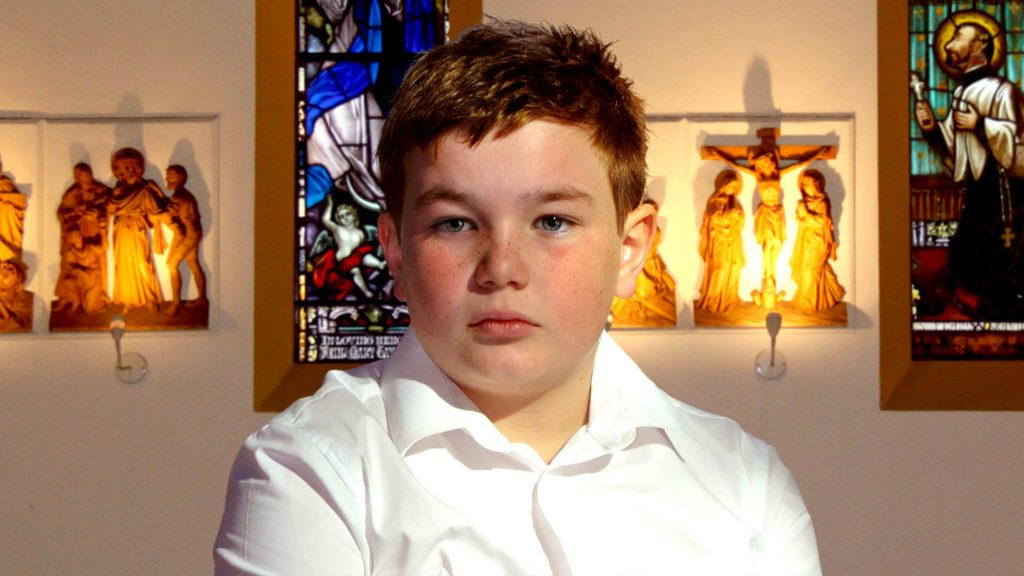
GREENVILLE, OH—Reaching a more profound understanding of what martyrdom really meant, local 12-year-old Charlie Ward reportedly took a moment Friday while doing the stations of the cross to reflect on the boredom Jesus Christ must have felt during the crucifixion. “At first, I wasn’t really paying attention, but as I slowly worked my way through all 14 stations, I began to realize just how mind-numbingly dull it must have been for Jesus to be crucified,” said Ward, confirming that the multi-part devotion had helped him comprehend Jesus’s rote and tedious experience of falling multiple times and encountering various people as he carried the heavy wooden cross. “It’s really moving to think that our Lord loves us so much that he was willing to shoulder this amount of insipid monotony. I know I’m going to remember it every time I make it through another grueling church service or Sunday school lesson.” At press time, Ward noted that finishing the stations of the cross had strengthened his resolve to do whatever he could to avoid the eternal torpor of Hell.

The Classic Novel That Saw Pleasure as a Path to Freedom

Kate Chopin in 1870.
Kate Chopin in 1870.Credit…Missouri History Museum

By Claire Vaye Watkins

  • Published Feb. 5, 2020 Updated Feb. 27, 2020 (NYTimes.com)

Early in “The Awakening” — Kate Chopin’s great feminist novel of identity and self-consciousness, which still throbs with relevance more than 120 years after its publication — the heroine’s husband picks a fight. He has spent the evening at a casino and now it’s approaching midnight, but the card game has left Léonce “in high spirits, and very talkative.” He wakes his wife to gossip but she answers him sleepily, “with little half utterances.” Spurned, and still intent on rousing her, Léonce manufactures a fever for their sleeping son. When Edna dares doubt this, Léonce calls her a bad mother. She springs out of bed to check, while Léonce — no longer worried, if he ever actually was — enjoys his cigar. Soon, Mr. Pontellier is fast asleep, but “Mrs. Pontellier was by that time thoroughly awake.”

Awake to what? After the fight, Edna moves out to the balcony and weeps profusely: “An indescribable oppression, which seemed to generate in some unfamiliar part of her consciousness, filled her whole being with a vague anguish.”

Whatever it is, it is indescribable, unfamiliar, vague. Yet also partly named: oppression, anguish. Edna edges into the uncharted territory of her own consciousness. She is beckoned — like Eve, like the women convened at Seneca Falls decades before, like Betty Friedan and Audre Lorde decades later, like Claudia Rankine today — to “use language to mark the unmarked.”

Awakening as a metaphor for accessing not only the unfamiliar part of one’s consciousness but the buried truth of our society has exploded into the mainstream thanks to the Black Lives Matter movement. On Jan. 9, 2016, in Baton Rouge — not so far from the novel’s setting of Grand Isle (or what’s left of Grand Isle after so many superstorms) — the activist DeRay Mckesson was arrested while protesting the extrajudicial execution of Alton Sterling by the police. Mckesson broadcast his arrest on Periscope, where viewers around the world watched him handcuffed by the police in a T-shirt reading “#StayWoke,” the millennial iteration of an adage that has bolstered the black community’s freedom fight since the black labor movement of the 1940s, as Kashana Cauley explored in The Believer. Historically, the phrase stay woke, Cauley wrote, “acknowledged that being black meant navigating the gaps between the accepted narrative of normality in America and our own lives.”

Innovative grammatical constructions like “stay woke” and “wokeness” powerfully evoke the ongoing struggle for justice embodied in Black Lives Matter and the movements that came before it, as well as those that followed, including the reinvigorated women’s movement and the swell of activism on the American left working for visibility, participation and self-determination of marginalized people at all levels of civic life. The echoes between this moment and the expanded consciousness represented by “The Awakening” reverberate so loudly they have been recently satirized by the poet Juliana Gray as “The Awokening.” At the risk of engaging in the kind of appropriation and dilution Cauley finds rightfully tiresome, today’s wokeness has a kindred spirit in “The Awakening.” Both emphasize omnipresent, if latent, wisdom.

Novels are neither recipes nor advice columns, yet it seems useful — at this moment when feminism yearns to outgrow its divisive metaphors, to correct for its hypocrisies and moral failings, and to resist cynical corporate co-opting that seeks to turn the movement into a marketing tool — to re-examine the transformation underway in a foundational book like “The Awakening.” Feminism endures when it embraces consciousness both within and without, becoming a cooperative struggle for justice across categories, what Kimberlé Crenshaw termed “intersectionality.” With this in mind, it seems to me urgent to read “The Awakening,” a bible of consciousness-raising for so many, and notice: What wakes us up?

In June 1899, a review of “The Awakening” in The Morning Times of Washington, D.C., concluded that “the agency of the ‘awakening’ is a man, Robert Le Brun.” In fact, as generations of readers have observed, the agent of Edna’s awakening is Edna herself: her body, her friends, her art, her time in nature. Edna’s awakening begins outdoors, an escape from the structures of patriarchy into the unbuilt landscapes of the sensual, sublime and the supernatural. Edna swims in the gulf, languishes in a hammock, escapes to the balcony, where “there was no sound abroad except the hooting of an old owl in the top of a water-oak, and the everlasting voice of the sea.”

She finds her own everlasting voice within spaces of sisterhood. Edna’s female friendships are fountains of encouragement for her artistic ambition, as well as sites of confession. Sitting by the sea with her uninhibited Creole friend, Madame Ratignolle, Edna can admit, if only to herself, her maternal ambivalence: “She was fond of her children in an uneven, impulsive way.” Edna knows she is “not a mother-woman” like her radiant and ever-pregnant friend, not “some sensuous Madonna.” If Edna is not a Madonna then by patriarchy’s binary she must be a whore. So be it, Edna all but says, flinging herself into a breathless flirtation with Robert.

But Robert is far from the sole object of Edna’s desire. Their liaison eschews monogamy in more ways than the obvious infidelity, taking as lovers the moon, the gulf and its spirits. In the moonlit sea Edna “walks for the first time alone, boldly and with overconfidence” into the gulf, where swimming alone is “as if some power of significant import had been given to control the working of her body and soul.” Solitude is essential to Edna’s realization that she has never truly had control of her body and soul. (The novel’s original title was “A Solitary Soul.”) Among Edna’s more defiant moments is when she refuses to budge from her hammock, despite paternalistic reprimand from both Robert and Léonce, who each insist on chaperoning, as if in shifts. Edna’s will blazes up even in this tiny, hanging room of her own, as Virginia Woolf would famously phrase it nearly 30 years later. Within the silent sanctuary of the hammock, gulf spirits whisper to Edna. By the next morning she has devised a way to be alone with Robert. Chopin’s novel of awakenings and unapologetic erotic trespass is in full swing.

Upon her return home to New Orleans, Edna trades the social minutiae expected of upper-crust Victorian white women — receiving callers and returning their calls — for painting, walking, gambling, dinner parties, brandy, anger, aloneness and sex. She shucks off tradition and patriarchal expectations in favor of art, music, nature and her bosom friends. These open her up, invite her to consider her self, her desires. One friend offers the tattoo-worthy wisdom that “the bird that would soar above the level plain of tradition and prejudice must have strong wings.” Is Edna such a bird? This is the novel’s central question, one it refuses to answer definitively. Chopin gives Edna the freedom to feel and yet not know herself. The women in the novel draw forth Edna’s intuition — they take the sensual and braid it with the intellectual. Eventually, the body and the mind are one for Edna.

“The Awakening” is a book that reads you. Chopin does not tell her readers what to think. Unlike Flaubert, Chopin declines to explicitly condemn her heroine. Critics were especially unsettled by this. Many interpreted Chopin’s refusal to judge Edna as the author’s oversight, and took it as an open invitation to do so themselves. This gendered knee-jerk critical stance that assumes less intentionality for works made by women is a phenomenon that persists today. Especially transgressive was Edna’s candor about her maternal ambivalence, the acuity with which Chopin articulated the fearsome dynamism of the mother’s bond with her children: “She would sometimes gather them passionately to her heart, she would sometimes forget them.” This scandalized — and continues to scandalize — readers because the freedom of temporarily forgetting your children is to find free space in your mind, for yourself, for painting, stories, ideas or orgasm. To forget your children and remember yourself was a revolutionary act and still is.

Edna Pontellier does what she wants with her body — she has good sex at least three times in the book. But the more revolutionary act is the desire that precedes the sex. Edna, awakened by the natural world, invited by art and sisterhood to be wholly alive, begins to notice what she wants, rather than what her male-dominated society wants her to want. Edna’s desire is the mechanism of her deprogramming. The heroine’s sensual experience is also spiritual, and political. Political intuition begins not in a classroom but far before, with bodily sensation, as Sara Ahmed argues in her incendiary manifesto “Living a Feminist Life”: “Feminism can begin with a body, a body in touch with a world.” A body in touch with a world feels oppression like a flame, and recoils. For gaslit people — women, nonbinary and queer people, people of color — people who exist in the gaps Cauley describes between the accepted narrative of American normal and their own experience, pleasure and sensation are not frivolous or narcissistic but an essential reorientation. The epiphany follows the urge. Feeling her own feelings, thinking her own thoughts, Edna recalibrates her compass to point not to the torture of patriarchy but to her own pleasure, a new north.

Like Edna, Kate Chopin did what she wanted with her mind, whatever the cost, and it cost her almost everything. In 1899 “The Awakening” earned her a piddling $102 in royalties, about $3,000 in today’s money. Shortly after its publication the now unequivocally classic novel fell out of print. Chopin’s next book contract was canceled. Chopin died at age 54 from a brain hemorrhage after a long, hot day spent at the St. Louis World’s Fair with her son. Her publishing career lasted about 14 years. And yet she established herself among the foremothers of 20th-century literature and feminist thought. She showed us that patriarchy’s prison can kill you slow or kill you fast, and how to feel your way out of it. She admired Guy de Maupassant as “a man who had escaped from tradition and authority,” and we will forever argue whether Edna is allowed this escape, whether she shows us not the way but a way to get free. As for Chopin, there is no doubt that she was free on the page, free to let her mind unfurl. None of this is accident or folly, not caprice nor diary. She knew what she was doing. She was swimming farther than she had ever swum before.

CLAIRE VAYE WATKINS is the author of the story collection “Battleborn” and the novel “Gold Fame Citrus.” This essay is adapted from her introduction to “The Awakening: And Other Stories,” forthcoming from Penguin Classics.

(Contributed by Michael Kelly, H.W.)

Bloom: A Touching Animated Short Film about Depression and What It Takes to Recover the Light of Being

By Maria Popova (brainpickings.org)

“Sometimes one has simply to endure a period of depression for what it may hold of illumination if one can live through it, attentive to what it exposes or demands,” the poet May Sarton wrote as she contemplated the cure for despair amid a dark season of the spirit. But what does it take to perch that precarious if in the direction of the light? When we are in that dark and hollow place, that place of leaden loneliness and isolation, when “the gray drizzle of horror induced by depression takes on the quality of physical pain,” as William Styron wrote in his classic account of the malady — an indiscriminate malady that savaged Keats and savaged Nietzsche and savaged Hansberry — what does it take to live through the horror and the hollowness to the other side, to look back and gasp disbelievingly, with the poet Jane Kenyon: “What hurt me so terribly… until this moment?”

During a recent dark season of the spirit, a dear friend buoyed me with the most wonderful, hope-giving, rehumanizing story: Some years earlier, when a colleague of hers — another physicist — was going through such a season of his own, she gave him an amaryllis bulb in a small pot; the effect it had on him was unexpected and profound, as the effect of uncalculated kindnesses always is — profound and far-reaching, the way a pebble of kindness ripples out widening circles of radiance. As the light slowly returned to his life, he decided to teach a class on the physics of animation. And so it is that one of his students, Emily Johnstone, came to make Bloom — a touching animated short film, drawing from the small personal gesture a universal metaphor for how we survive our densest private darknesses, consonant with Neil Gaiman’s insistence that “sometimes it only takes a stranger, in a dark place… to make us warm in the coldest season.”

24785ab0-3229-4a0d-bc15-95162ec3d69a.png

Complement with Tim Ferriss on how he survived suicidal depression and Tchaikovsky on depression and finding beauty amid the wreckage of the soul, then revisit “Having It Out with Melancholy” — Jane Kenyon’s stunning poem about life with and after depression.

Gender Is Over

Posted on February 20, 2020 by raisingmyrainbow

(Photo by Andrea Domjan)

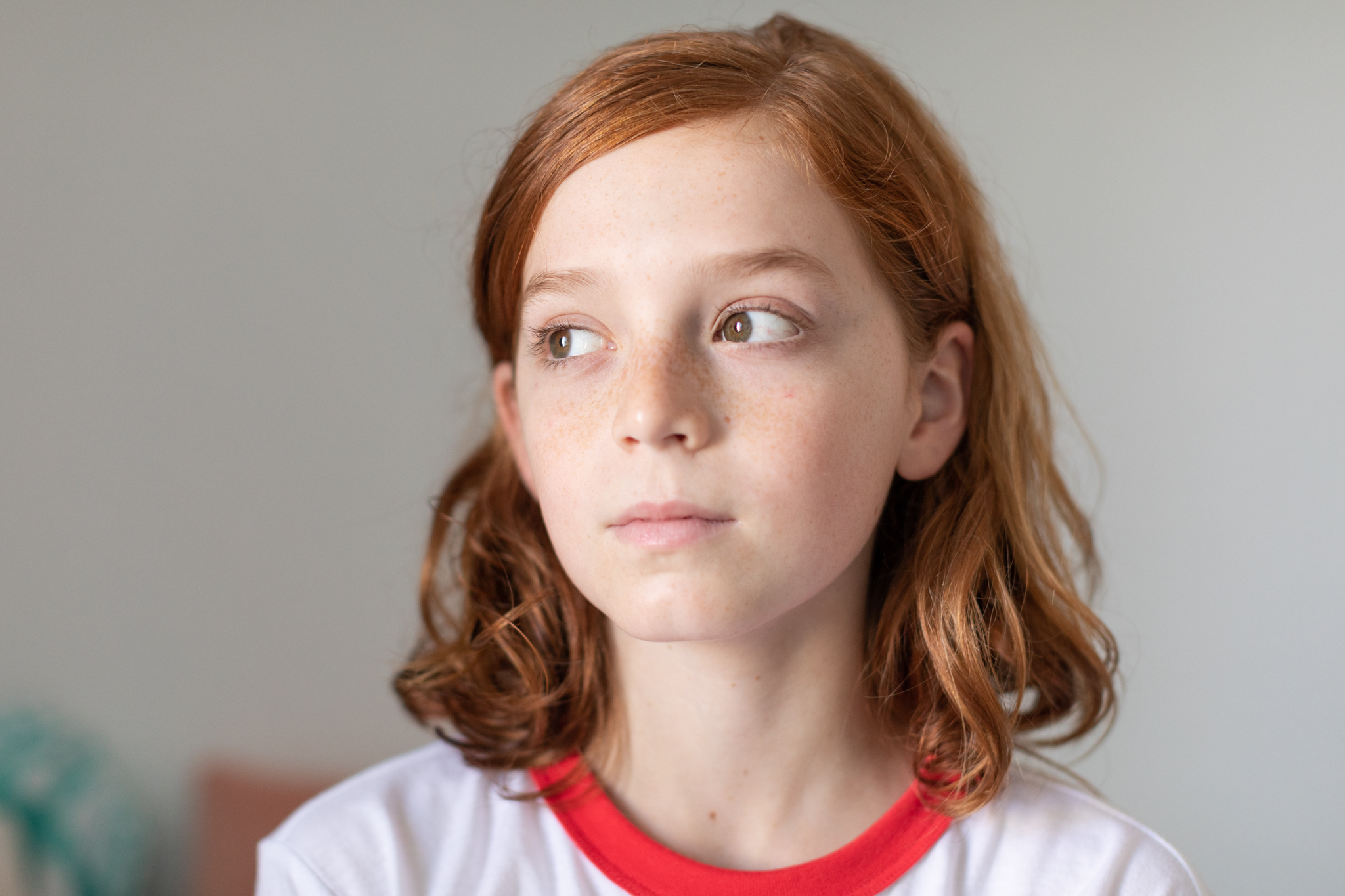
My name is C.J. and I’m 13 years old. I am a member of the LGBTQ community. My gender identity is male and my gender expression is female. That means that I’m awesome. Just kidding. It means that I was identified male at birth and I like my male body and I prefer male pronouns, but the way I dress and the things I like are considered feminine (whatever that means). Another way to describe me is gender nonconforming or gender creative.

For as long as I can remember, I’ve liked all the stuff in the “pink aisles.” I’ve always known I’m different. I’ve always known that I’m not a “typical boy.” And, I’ve never really cared that I’m different. There is no part of me – not even a single part – that wants to be a “typical boy.” The thought of having to play baseball or wear boys’ clothes makes me cringe with sadness. It makes me feel like I’d be forced to do something I don’t want to do. Kids shouldn’t be forced to be something or someone who they aren’t. Kids should be able to be themselves.

(Photo by Andrea Domjan)

When people call me a girl or misgender me I don’t really care. To me, gender is over. Gender is so last year. But when someone tells you their preferred pronouns, you should use those pronouns. Just like when they tell you their name and you use it.

When I was little, like five or six years old, I wanted to be a girl. I never felt like I was a girl or like I was supposed to be a girl. That means that I’m not transgender. I don’t feel like I’m in the wrong body. I feel like I’m in the right body. I’m just me.

I know transgender people who have transitioned. I’m happy for people who transition because it means they are being their authentic self, but transitioning isn’t for me.

My advice for younger kids like me is that it’s going to be okay. Just be yourself. People will learn to like you the way you are. You aren’t weird, you’re just different. And being different is awesome!

(Photo by Andrea Domjan)

My parents have always been supportive. They’ve always let me be who I am. My advice to parents who have a kid like me is they should let their kid be who they were born to be. It’s okay. There’s nothing wrong with your child. You need to learn to accept it, because you aren’t going to be able to change it. And, if you try to change it, you’re just making your child upset. You’re probably making yourself upset, too. And, your child might grow up to not love themselves. Everyone should love themselves.

I hate it when people say that my parents are forcing me to be the way I am. It’s seriously so stupid. How could my parents be forcing me to do things that I really, truly want to do? That makes no sense. I am being me. One hundred percent. And, at this point, I don’t care who sees me being me.

(Photo by Andrea Domjan)

I haven’t always felt that way. I’ve been bullied, badly, but I’ve always come out stronger. Bullies aren’t going to get me to stop being me.

I think it’s important for people – including bullies and haters – to see me because people need to see there are kids like me out there. Gender creative kids need to see other kids like themselves. The more people see people like me, the less “different” we are and the more they accept people like me. Besides, I’m not ashamed of who I am.

Some of my favorite things are doing makeup, hanging out with friends and watching Queer Eye with my family. When I grow up I want to be a makeup artist and maybe a stylist. I love making people feel beautiful.

(Photo by Andrea Domjan)

I also want to be an advocate for the LGBTQ and nonbinary communities. My mom says that if you are in a position to help other people, you should. So that’s what I do.

I helped make my elementary school the first school in the district to adopt a dress code that wasn’t gender specific. One year later, the dress code was used as a model at every elementary school in the district. That’s 26 schools!

Through meetings and email campaigns, I got my school district to stop sex/gender segregation in elementary school PE classes and to stop having special event dress codes that were illegal because they discriminated against gender creative students.

If I can see a way to make life better and easier for gender creative people, I always try to do it.

Being kind, sticking up for others and not being a jerk. That’s what life is all about.

(Submitted by Richard Burns, H.W., M.)

SUNDAY NIGHT TRANSLATION GROUP – 3/1/20

Translators:  Mike Zonta, Melissa Goodnight, Richard Branam, Hanz Bolen

SENSE TESTIMONY:  Emotions can overwhelm rationality and obscure our understanding of who we are.

5th Step Conclusions:

1)  My Self (Our Self) is All Emotion, All Truth, All Love, All Reason, All Rationality, All Being, All Understanding, unoverwhelming and unobscurable. OR: Truth is the Reason for Emotion. OR: Emotion is Reasonable and Reason is Emotional.

2) Infinite Consciousness is Being Itself always, and Knowing Itself all ways — every expression is sensibly affecting and motivationally effecting, It’s own absolute comprehension.

3)  Truth is the Invariably complex Psychical, Emotional Manifestations, this Omnipotently clear and evident Gnostic sensuousness, Being the Spiritual Shock of the Awesomeness and poetic Beauty: Quantified Enlightenment, Consciousness Aware Atmosphere, the active Breathe of the Androgynous Essence.

4) I Am vitally essential, fully able, always guiding, now, everything IAm.

All Translators are welcome to join this group.  See Weekly Groups page/tab.