“It’s amazing that the amount of news that happens in the world every day always just exactly fits the newspaper.”
— Jerry Seinfeld (upworthy.com)


We build in vain unless the LORD build with us.
Can you keep the City that the LORD keeps not with you?
A thousand policemen directing the traffic
Cannot tell you why you come or where you go.
A colony of cavies or a horde of active marmots
Build better than they that build without the LORD .
Shall we lift up our feet among perpetual ruins?
I have loved the beauty of Thy House, the peace of Thy sanctuary
I have swept the floors and garnished the altars.
Where there is no temple there shall be no homes,
Though you have shelters and institutions,
Precarious lodgings while the rent is paid,
Subsiding basements where the rat breeds
Or sanitary dwellings with numbered doors
Or a house a little better than your neighbour’s;
When the Stranger says: ” What is the meaning of this city?
Do you huddle close together because you love each other?”
What will you answer? ” We all dwell together
To make money from each other”? or ” This is a community”?
VIdeo & Article.
Bless You All,
Gwyllm
https://www.brainpickings.org/2018/11/28/willim-blake-poems-patti-smith/

Wendy Cicchetti
This Full Moon pits the serious and principled qualities of Aquarius against the Sun in playful, creative Leo. The spirited Sun has strong backup from nearby Venus in Leo, which emphasizes an almost childlike ganging-up of planets, reflecting two or more people who make up a tough force to contend with. This Leo stellium highlights celebration and, like the Kool & the Gang song says, there’s the sense of “a party goin’ on right here”!
The more sensible and adult Aquarius Moon seems at risk of being outnumbered, out on its own, making a serious point. Yet the Moon, Sun, and Venus are all in a t-square to asteroid Vesta in Taurus, suggesting that no single cosmic body among them has a huge advantage when it comes to harmony with others; there are tensions in each direction. The one arguable exception may be the Sun’s own disposition in Leo — its home sign and a fire sign at that — which indicates that it has some outreach to Jupiter in Sagittarius. Still, that trine is too wide from the usual 6° orb to mean that Jupiter’s blessings, fortune, and good luck can be taken for granted.
Mars and another asteroid, Juno, are caught up in the Leo stellium (3 planets next to each other). This may reflect developments on a larger scale, such as in politics. However, it can also apply in a more personal arena, where it will become clear that someone is determined to pull away, or that their energy is doing so and pulling someone else along with it. This could feel awkward for some of us, but it might work out for the best, overall — particularly if there seems to be no way at this time for everyone to see eye to eye. Finding peace, then, may be a matter of accepting the differences between us and agreeing to disagree. This makes more sense than to keep on resisting a change or trying to influence someone else’s views.
The two planets that co-rule Aquarius, Saturn and Uranus, each have a “loner” quality, apparently for quite different reasons: Saturn all too often behaves like the stern elder, whereas Uranus has a general air of just not fitting in with the mainstream. Paradoxically, if Saturn toes the line of tradition and wishes to repeat and reinforce recognized rituals and patterns of behavior, Uranus refuses to conform or just does not fit any mold. Still, there might be some common ground in both planets’ being considered equally unpopular forces to be reckoned with!
For all the challenges involved in being the strict adult (Saturn) or the social “oddball” (Uranus), there are times when the separateness or isolation shared by these two planets can have its benefits and offer a particular kind of strength. Given the square between Uranus and Mercury, this may relate to the space to think more clearly — and differently from others.
It could well be that an opportunity for isolation will arise, which allows for a new clarity around certain issues. As part of this dynamic, there may be a painful reality to face. And yet a new, Uranian-style plan of action could then emerge, allowing a sense of personal freedom that has not previously been present.
Written by Diana McMahon Collis for the Mountain Astrologer Magazine
|
|
— Whom must I announce to my Lord Duke?
|
The apartments of the helicoidal building will be shaped like slices of cake. One will be able to enlarge or reduce them by shifting movable partitions. The half-floor gradations avoid limiting the number of rooms, since the tenant can request the use of the adjacent section on either upper or lower levels. With this setup three four-room apartments can be transformed into one twelve-room apartment in less than six hours.
The nineteenth century was a watershed for western civilisation. It was, for Nietzsche, the beginning of a great crisis for mankind.
Secularism spread rapidly across Europe but there was nothing to fill the void that religion had left.
The sciences, that had been so preoccupied with physics and cosmology in the centuries before, had suddenly begun to systematise life itself. Halfway through the century, evolutionists broke the news that human beings were likely the descendants of apes.
It is against this backdrop that Nietzsche proclaimed: “God is Dead. We have killed Him.”
The upshot of this, according to Nietzsche, was nihilism: a spiritual sickness in which we have become bereft of purpose and meaning.
But Nietzsche is the great psychologist-philosopher, a man who had a profound understanding of what it was to be human. He believed he had the antidote for our psychological ills, both as individuals and as a civilisation.
When Nietzsche set about curing our ills he asked the most fundamental question:
What is driving us?
Firstly, to be driven is to change. Nietzsche believed that the idea of “becoming” should take precedence over the idea of “being”. In ancient Greece, two schools of thought emerged regarding the nature of the universe. While Parmenides believed change to be an illusion, Heraclitus of Ephesus reasoned that the only constant thing in the world is change.
“All entities move and nothing remain still […] You cannot step in the same river twice.”
To Heraclitus, the world is an “eternal fire”:
“ This world, which is the same for all, no one of gods or men has made. But it always was and will be: an ever-living fire, with measures of it kindling, and measures going out.”
We only have fragments of Heraclitus’s wisdom saved for posterity in the writings of later philosophers like Plato. What little there is of Heraclitus’ words impressed themselves immensely on Nietzsche.
The philosopher agreed with Heraclitus that the world is constantly changing and that fact is all that we can really be sure of.
While Heraclitus conceived of the fundamental substance of change to be fire, Nietzsche thought along more modern lines. The philosopher believed the fundamental engine of change to be “The Will to Power” (“Wille zur Macht”).
For Nietzsche, this fundamental driving force was the “unexhausted procreative will of life” in all things. In the 1880s when Nietzsche wrote most frequently about the Will to Power, a number of sciences and philosophies were emerging that sought a general principle of what actually drives people, or even living things as a whole.
Psychoanalysis gave us the pleasure principle, Evolutionism gave us survival, Utilitarianism gave us happiness, and Marxism gave us an overarching narrative of class struggle. All of these sciences or philosophies built an explanation of human behaviour on these basic principles.
One of Nietzsche’s most eminent influences, Arthur Schopenhauer, posited the idea of the “Will to Life” as the driving force of all living things. This was close to the idea of Darwinian evolution’s principle of natural selection. Power, according to these theories, was simply a means to survival.
But Nietzsche believed power to be the ends of all effort. This is explained by behaviour that contradicts survival instincts. Many organisms, particularly human beings, risk death to flourish.
Nietzsche broadly accepted the theory of evolution but disputed its purpose. At one point (in his book The Twilight of the Idols), he called himself the “anti-Darwin”, because he felt so strongly that self-preservation wasn’t man’s primary drive. Nietzsche wrote in Beyond Good and Evil:
“Physiologists should think twice before positioning the drive for self-preservation as the cardinal drive of an organic being. Above all, a living thing wants to discharge its strength — life itself is will to power: self-preservation is only one of the indirect and most infrequent consequences of this.”
Nietzsche went as far as claiming the Will to Power was a fundamental metaphysical truth about the universe, not just an explanation for the behaviour of people. “World is the will to power — and nothing besides!”
The idea of the Will to Power has been widely misunderstood. It is one of the most controversial aspects of Nietzsche’s philosophy. Many have assumed that the philosopher is applauding the characteristics of the brute or the sociopath.
Part of the reason for this is because the Nazis reinterpreted the idea to mean power as domination. The philosopher’s sister, Elizabeth, the custodian of his writings after his death, was a Nazi sympathiser and an anti-semite. (Nietzsche himself thought racism to be stupid and aligned himself with no political programme.)
The Nazis glorified the Aryan militarist and authoritarian at the apex of the racial hierarchy. This distortion of Nietzsche’s ideas stuck until the philosopher’s reputation was resuscitated in the 1960s.
In some passages, Nietzsche does indeed accommodate the idea that some “races” have acted as predators or “blond beasts” — by this Nietzsche was evoking the lion (with its characteristic blond mane) — in their preying of other peoples and cannot really be blamed for doing so.
This historical generalisation (that is admittedly unpalatable by today’s standards) was merely used to underscore the existence of the Will to Power. It was interpreted by the Nazis to mean the Aryan race as typified by northern European blond peoples.
The Nazi idea had little resemblance to what the philosopher meant. “Power” in the way Nietzsche used the word, on the whole, has more to do with growth than domination; more about power over the self than power over others.
Power is intrinsic to his idea of self-overcoming. The problem is that power does not drive us as individuals. Power as a general principle drives everything. That means that ideas and biological systems even at a cellular level have within them the Will to Power.
The human being is a zone of competing drives and ideas that often contradict one another. Here’s a very simple example: you may have the urge to eat that sugar-glazed doughnut with creme inside and chocolate sprinkles, but you also have the drive to keep your weight down.
Ideas are the same. We have many competing ideas in our psyche about morality or what the world is like. We often do things that we come to regret, and we change our minds constantly. This is why human beings are so complicated.
Nietzsche’s second step to Self-overcoming is to examine ourselves. We must ask ourselves two questions: What are all these competing drives in our psyche? And where did they come from?
One of Nietzsche’s most innovative contributions to philosophy was to look at the past in order to diagnose contemporary attitudes and dogmas of morality. He wrote The Genealogy of Morals to investigate the origins of Western values that he felt had caused a spiritual sickness in western society.
The principles of The Genealogy of Morals can be applied to your own belief system. If you examine your own history (and indeed history before you existed), you’ll find that your values are derivatives from the values of others.
“Direct self observation is not nearly sufficient for us to know ourselves: we need history, for the past flows on within us in a hundred waves.”
We cannot untangle ourselves from the past. Self-mastery requires us to understand how it has shaped our circumstances, our attitudes, beliefs and our values.
When we understand how enmeshed we are in the attitudes and beliefs handed down to us, we can begin to untangle ourselves and start to think about what we really value.
This would allow us to start to understand the conflicting drives within us. Nietzsche warns us that this is not an easy process, to peel away the layers of the psyche is to open old wounds and to experience hard truths.

But the Will to Power manifests itself in so many subtle ways, and it’s difficult to know what we should channel our power to.
Nietzsche believed that the universe has no inherent meaning. It is up to us as individuals to find meaning and purpose in an otherwise meaningless world. In short, you need passion.
You must have the need to be powerful, otherwise you will never become powerful. All those inherited and contradictory drives and your instincts will take precedence in your psyche. Nietzsche wrote in his philosophical novel Thus Spoke Zarathustra: “He who cannot obey himself will be commanded.”
But if you have passions, the Will to Power will be channelled into them. In other words: you can harness the Will to Power.
Your passions will lead you to obstacles and resistance, but that, to Nietzsche, is a good thing. Overcoming resistance is gaining strength. Just as lifting weights build muscle, the problems we face when we follow our passions will make us grow and flourish as individuals.
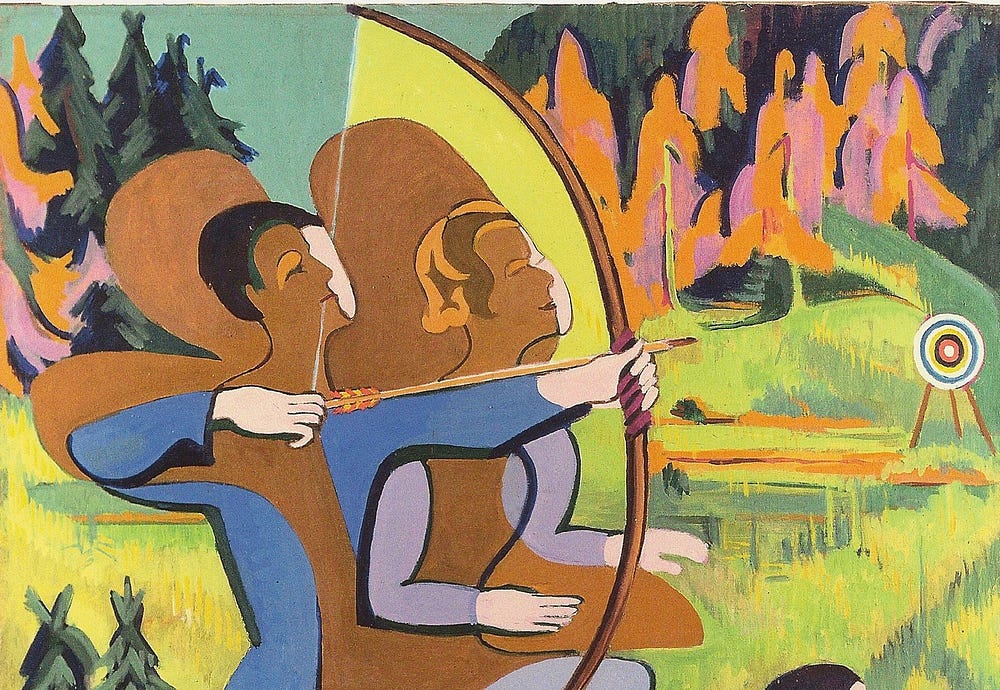
Heraclitus wrote that “there is harmony in the bending back, as in the bow or the lyre.” The tension of the bowstring is necessary to shoot the arrow, the lyre string to play the note. The opposition of forces — the effort — is required to create the effect. “All things come into being by a conflict of opposites,” Heraclitus wrote.
So what does the human being who has overcome their self look like? Nietzsche wrote a great deal about this. He presented his readers with an ideal. He set a goal of a greatness that humanity must somehow meet. That goal was the “Overman”.
Nietzsche introduces the idea of the Overman (Übermensch) in Thus Spoke Zarathustra (1886). The Overman is presented as an ideal human being that is not yet realised. (It’s worth noting that “mensch” does not specifically mean “man”, but “human being” and so the concept is not an exclusively male one).
Nietzsche draws from the science of evolution, comparing man to the potential Overman, as an “embarrassment” in the way the “ape is an embarrassment to man.” Mankind as a transitory phase:
“Man is a rope, tied between beast and overman–a rope over an abyss. What is great in man is that he is a bridge and not an end: what can be loved in man is that he is an overture and a going under.”
The Overman is not a physical evolution of man, but rather a spiritual evolution. The process is not determined and Nietzsche feared that the Overman’s time may not come if we do not have the courage for self-overcoming.
“one must still have chaos in oneself to be able to give birth to a dancing star. I say unto you: you still have chaos in yourselves. Alas, the time is coming when man will no longer give birth to a star. Alas, the time of the most despicable man is coming, he that is no longer able to despise himself.”
The “dancing star” the philosopher refers to is the Overman. He feared that the nihilism of the modern world was giving rise to what he called the “Last Man” the lazy nihilist who only seeks contentment. The Overman, in contrast, would risk everything to overcome himself.
Nietzsche mentioned a few in history who he felt came close to being Overmen. Napoleon and Goethe are examples he goes back to often. Napoleon was the amoral conquerer who risked his life (many times) for the glory of his own imperial state.
Goethe was the great polymath, one of the most accomplished writers in history, who also contributed enormously to scientific and philosophical fields.
Both these men were almost Overmen, but not quite. Perhaps the Overman is an impossible goal for a person like a utopia is for a place. The point of the Overman is to set in place an ideal that is opposed to the common ideals of moral virtue. To Nietzsche, these ideals are negative, they stop people from mastering their own selves.
Nietzsche found two causes of negativity that hold people back from embracing self-overcoming: self-preservation and the hope for a better life after death.
For Nietzsche, the promise of heaven as a reward for meek and humble behaviour in this life was a terrible waste. The earthly realm is our one shot at life and we must make the most of it. Self-overcoming — for whatever purpose we give ourselves — is the greater meaning of our lives. He wrote:
“The overman is the meaning of the earth. Let your will say: the overman shall be the meaning of the earth! I beseech you, my brothers, remain faithful to the earth, and do not believe those who speak to you of otherworldly hopes! Poison-mixers are they, whether they know it or not. Despisers of life are they, decaying and poisoned themselves, of whom the earth is weary: so let them go.”
If this is uncomfortable reading for some people, Nietzsche would reply that we should emanate goodness and positivity from who we are, not for a reward of eternal life. If we behave well for a reward, we’re not really behaving with integrity.
Self-preservation is also counter to self-overcoming. As has already been covered, the Will-to-Power transcends the Will-to-Survive. Many living things risk literally everything they have to grow.
Those who choose easy contentment and material happiness will never come close to achieving the exuberance of the Overman. The secret to finding true happiness, as far as Nietzsche presents it — to rejoice in one’s strength and exuberance — is to risk happiness.
As reckless as that sounds, it perhaps is the antidote to the modern epidemic of nihilism.
Thank you for reading, I hope you learned something new.
WRITTEN BY
Sometimes we find amazing things in places we least expect them, whether it’s true love, peace of mind, or, in your case, a pack of furious marauding cannibals.

You have no idea why you’ve been experiencing laughter, tears, a sudden desire for fried chicken, or an impulse to call the law offices of Marvin Falbaum, but it’s probably the TV.

Decent people everywhere will be shocked and appalled by the treatment you received and the conditions under which you were held, but it’s not like their jobs are any better.

You’ll find yourself curiously unfulfilled, if not a little frightened, when you finally learn the answer to the question of who watches the birdwatchers.
They may tell you you’re deluded and that you’ve lost your mind, but you know good and well that those jabbering, naysaying radiators in your apartment don’t know what they’re talking about.

The stars see nothing but pain and misfortune in your future, but you probably like that, huh? You sick fuck.

Your theory that your life eerily echoes the events in Casablanca is disrupted even further by the disparity in people’s emotional involvement with their endings.

It will seem as if everyone is avoiding you all week long, which will be odd considering that the engorged leech on your neck will be removed by Thursday.

Considering how easy it is to get them these days, you’re starting to regret choosing “hugs” over any number of things that rhyme with them.

You’ll feel a strange mixture of pride and terror when NASA announces it will replace the space shuttle with you in launches starting late next year.

Every marriage is like a little nation unto itself, and the failure of yours is a textbook example of how investment in education, the arts, and maybe a puppy are desirable goals for civilization.

Often it feels as if everything is too hard for you and that anything you try ends in failure, but take heart: Those feelings have to be wrong eventually.

THE HEAVENS—Admitting He would not even know what to talk about with His followers after spending two millennia apart, Christ announced Monday that He has called off plans for His return upon coming to the realization that He has been gone so long at this point that coming back “would just be weird.” “I’ve been putting off my return to the vale of tears for centuries, always telling myself I would corporeally appear sometime next year, but I feel like it would just be awkward if I showed up out of the blue,” said the Son of God, expressing concerns that people would be mad at Him for disappearing for such a long time without bothering to send the faithful a message confirming His love or compassion. “I once thought that when I reappeared it would be just like it was back in Judea, but I just don’t think that’s realistic anymore. There is just so much build-up that doing it right is frankly impossible—I didn’t see a single moral soul for 2,000 years, didn’t answer any of their prayers, didn’t give them any indication that I was even real. Who just drops off the face of the Earth like that and then expects everything to be okay when they come back for what is, at most, the last few decades of the human race?” Christ has since resolved to stop living in the past and instead focus on getting back out and dating again.
Everybody has felt schadenfreude to some certain degree. That little bit of joy at the expense of another person’s pain or failure. Some researchers have even suggested that there are certain types of schadenfreude. The many motivations behind the feeling helps to illustrate the diverse set of examples of schadenfreude.
Often schadenfreude stems from the dynamics of group identity, competition-based rivalries and a moral comeuppance, i.e. “to get what’s coming to you.” For example, when schadenfreude stems from group identity, you feel great when something bad happens to the opposing “team.”
Rivalry takes multiple forms and can be on a one-to-one basis with people you actually know, or even be based on a social rivalry with people you’ve never met. Finally, justice based schadenfreude is the joy felt when someone is punished after having done something morally reprehensible for quite some time and used to get away with it.
Envy is one of the root causes of much of schadenfreude. It’s only natural for individuals in a society to evaluate themselves based in relation to other people. As this is often the case, a notable figure’s misstep will lead many to swell with satisfaction — resulting in schadenfreude. We see this when people take pleasure in a celebrity’s downfall across the national media circuit.
Schadenfreude is quite present during highly-competitive situations. For example, a football player will feel a great sense of delight when the opposition’s star quarterback gets hurt in the middle of a game. Schadenfreude may be a fleeting emotion that turns into sympathy later — once the game is over, for instance. On the more extreme level, though, this motivation can spur a zero-sum game, a situation where the ultimate desire is the total failure of the other.
If taken too far, this emotion, in this instance, can be viewed as a negative way of building self-esteem. Say, for example, your neighbor buys a brand new sports car and drives it around to show it off. Then, the next day, you find out it’s been completely wrecked by a tree falling on it. You’d feel great because this “rival” of yours has been humbled.
Now you’re both on an equal social economic standing, again. Schadenfreude is common amongst these little kinds of rivalries. Rivals enjoy when the other person’s misfortune. The feeling is more pronounced than lofty social comparison-based schadenfreude because you’re not just a bystander.

Image source: Self-portrait, 1886, by Edvard Munch / Wikimedia Commons
The “tall poppy syndrome” is often referenced in the United Kingdom and Australia. It’s informally defined as “a perceived tendency to discredit or disparage those who have achieved notable wealth or prominence in public life.”
Cultures or people that resent high-status individuals feel good when misfortune is brought down upon them. Again, envy rears its head in this example. People covet either the talent, money, skill, or fame that envied person possesses. Many people’s moralistic compass points toward the ideal of attaining equal status which is similar for all people.
If an individual’s status gets too high, they may be targeted by the tall poppy syndrome. Then if they’re knocked back down to size, people will feel schadenfreude at their resulting downfall.
Justice-based schadenfreude is the least socially reprehensible form of the emotion. It’s the feeling that people get when some corrupt politician is exposed or con artist is found out.
Schadenfreude being tied to justice is one of the most prominent examples, as everyone shares in the delight when someone gets what they deserve. Sometimes justice based schadenfreude can border on the self-righteous. The justice felt is dependent on what the person feeling it observes as immoral or bad behavior. Once this person sees a “bad” behavior punished in some way, their sense of justice fills them with happiness. It’s like a karmic retribution tinged with schadenfreude.
The feeling is experienced here because people feel that fairness has been reestablished and righted from a previous wrong.