“The Art of Dying”: a valuable message from Bruce Lee about our ego.

In February 1971, a series called “Longstreet” was transmitted on ABC. Starring James Franciscus, the story accompanied Michael Longstreet, an investigator who recovered from an explosion that blinded him and eventually killed his wife. Longstreet then searches for the criminals who did this.

Bruce Lee appeared in four episodes of Longstreet. His role, whose character was named Li Tsung, was an instructor for Mike Longstreet (James Franciscus), and was meant to teach him a number of martial arts techniques for self-defense.

In one of the scenes, in addition to saying the well-known phrase “Be Water, My Friend”, Lee’s character asks Michael Longstreet when it will be his next fight. After discovering it that would be tomorrow, he tells to Longstreet:

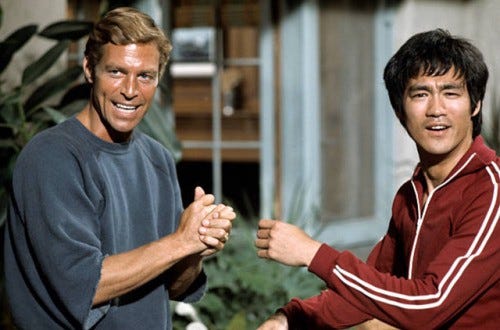
James Franciscus and Bruce Lee on the “Longstreet” (1971)

“Like everyone else, you want to learn the way to win, but never to accept the way to lose, to accept defeat, to learn to die is to be liberated from it. So when tomorrow comes, you must free your ambitious mind, and learn the art of dying.

But what did Bruce Lee mean by that?

From the term “The Art of Dying”, I will talk about 3 points to deepen the meaning of the phrase by explaining the philosophical views of Bruce Lee and his relationship with other philosophical authors who speak on this same topic, some of them being philosophers who influenced him during his life.


In his posthumous book, The Tao of Jeet Kune Do, published in 1975, Lee stated that his style of fighting, called Jeet Kune Do, sought to involve both the study of a set of martial arts techniques and the development of spirituality:

“The spirit is undoubtedly the controlling agent of our existence. This invisible center controls all movements in any external situation that appears.”

“The Art of Dying”, featured in the series Longstreet (1971), is not a literal idea. It is not a matter of dying physically, but of a metaphor whose central idea is to let our ego die.

Theo Fischer in “Wu Wei: The Art of Living the Tao”, says that the ego is the whole set of experiences, accumulations, analyzes, and memories that make up our view of ourselves. This ego carries all our prejudices, distortions and is formed by a limited and partial thought of reality, which prevents us from seeing it as it really is.

Fischer also said it:

For the sages death is not primarily the disintegration of the body. Death means the end of the ego, a process that the Tao person tries to accomplish even in life. When this artificial formation of the “I” disappears from our existence, we can live beyond our “I”, that is, the true life, because it results from a dimension that no longer depends on time.”

Fischer claims that the ego is harmful in our daily lives, as it pressures us to want to be something and make connections with expectations for the future. The death of the ego implies both being open to criticism and incorporating constant process of learning in order to develop our abilities and to let go of any nostalgic ideas about the past and ambitious about the future.

“It is the ego that stiffens against outside influences, and it is this” rigidity of the ego “that makes it impossible for us to accept everything that confronts us.”

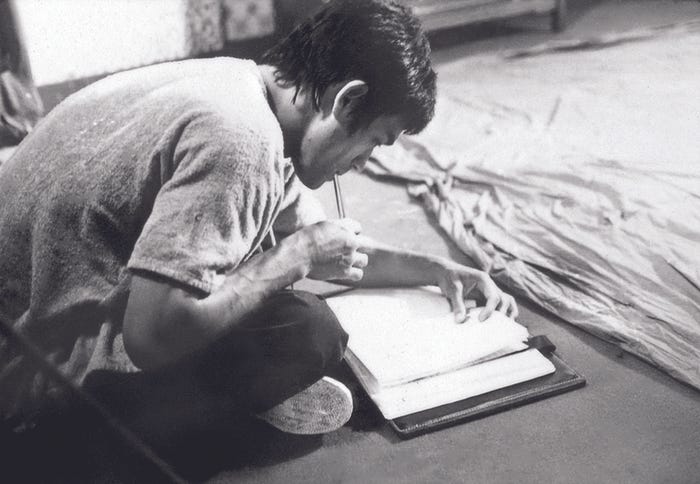
Lee applied these Zen ideas to martial arts. From the study of his book, The Tao of Jeet Kune Do, we can divide this idea of the Art of Dying into three points:

1. Die for the Ambition of Victory

Bruce Lee constantly asserted that one of the biggest mistakes a fighter can make is to anticipate the outcome of the fight:

“Do not think about winning or losing, do not think about pride and pain. (…) The biggest mistake is to anticipate the outcome of the fight. You should not think about whether it ends in victory or defeat. Let nature take its course, and your weapons will be used at the right time.“

Lee emphasized that in a fight, it is necessary to abandon any expectations regarding its results. A fighter should be devoid of anxiety about the results, but at the same time he can not afford to use enough intelligence and training to constantly improve himself. To let the ego die means to act like a “wooden puppet: he has no ego, he thinks of nothing, he is not greedy or attached to anything or anyone.”

“Do not establish anything in relation to yourself. Pass quickly, as something that does not exist, and be as quiet as purity. Those who win lose. Do not anticipate others, always follow them.“

Consequently, we must rid ourselves of our ambitious minds in order to enjoy our daily struggles in our daily lives without worrying about thinking in terms of victory or defeat, after all, “the fight against and favor is the worst disturbance of the mind,” Lee said. In that sense, letting the ego die means letting go of the protagonism of our own actions and focusing on “the act of realizing, not realizations.” After all, “there is no actor, but action. There is no experimenter, but the experiment“, he said.

Lee has classified six diseases that a fighter can have, and the first one is precisely this:

The six diseases:
1. The desire for victory;
2. The desire to resort to cunning techniques;
3. The desire to display all that has been learned;
4. The desire to terrify the enemy;
5. The desire to be passive;
6. The desire to get rid of any evil that can affect you.

In fact, not only is the desire for victory is a disease, according to Lee, but the desire itself is already a problem:

“Desiring is a bond. “Desiring not to desire” is also a bond. To be detached, then, means to be free, at the same time, of both, positive and negative. That is to be simultaneously “yes” and “no,” which is intellectually absurd. But not in Zen.”

2. Dying for the Techniques and Knowledge

The clarification of martial arts, for Lee, means forgetting about all that is known by knowledge. Knowledge is created from the past and the forgetting of knowledge implies in the fighter to reach a state of freedom in order to flow solely in the present moment, without any limitations:

“The skill and knowledge attained must be” forgotten “so that you can float comfortably in the void without blockages. Learning is important, but do not let yourself be enslaved. (…) Any technique, however valuable and desirable, becomes a disease when the mind becomes obsessed with it”.

There is a vast literature in taoist philosophy that looks to describe the importance of developing our ability to sense and deal with the unconscious through intuition to solve a number of problems in our daily lives, and in Jeet Kune Do is no different. Lee, while spoke the importance of the technique, emphasized that the fighter should not submit to or limit himself to it:

“In Jeet Kune Do, all techniques must be forgotten and the unconscious must be in charge of dealing with the situation. The technique will be displayed automatically or spontaneously. To move with totality, not to have technique, is to have all the techniques.”

Die, in this point, is more connected with the idea of the constant search for the student’s improvement from the forgetfulness of previous experiences and the development of the ability to empty the mind so that there is a new consciousness. Lao Zi said that “to be battered is to be renewed” and the Art of Dying is a form of rupture.

3. Dying to the Past and the Future

A person with an ego is attached to his distorted image, to the past and to the future. In this point, letting the ego die requires us to discard any past memories and future expectations so that we can flow freely in the present, the here and now.

Past and future are ideas coming from thought, therefore, artificial. The past is a set of memories from memory and the future is a thought formed from our anxiety and expectation. The present, so, is the only physical-temporal space in which we can act. Breaking the past that limits us and the future that awaits us results in consciousness only from this moment, after all, all time is concentrated in the now. “Yesterday is gone, and tomorrow is not yet”, said Osho.

Lee tells the character of James Franciscus that he “must free his ambitious mind.” Jiddu Krishnamurti, one of the leading references in the life of Bruce Lee, held this view:

Ambition in any form — by group, individual salvation or spiritual achievement — is a deferred action. Desire is always of the future; the desire to become something is the inaction of the present. Now is more important than tomorrow. All time is the now, and to understand the now is to be free of time. Becoming is the continuation of time, of pain. Becoming contains no being. Being is always in the present and being is the highest form of transformation. Becoming is only modified continuity and there is only radical transformation in the present, in being.“

“Jeet Kune Do teaches us not to look back after the course has been decided. He treats life and death indiscriminately. “ (…) To express yourself freely, you must forget yesterday. From the “old” you get security. “New”, you gain fluidity.

These are just a few philosophical ideas that Bruce Lee expressed in his films, books and television appearances but that went unnoticed by many people.

Bruce Lee graduated in Philosophy from the University of Washington in the 1960s. One of his undeniable merits was to bring and popularize to the West a series of teachings built from Eastern philosophy — mainly Taoist and Buddhist — and incorporate them into the martial arts.

Martial arts and sport are a great metaphor for our lives, and if we develop the ability to analyze them with care and attention, it will be possible to extract valuable lessons into our daily lives to deal with a series of complex daily problems that surround.

Nicolas Rufino dos Santos

WRITTEN BY

A forma de transcender o karma está no uso correto da mente e da vontade.

The Relative is the Absolute: Caverly Morgan


scienceandnonduality
Published on Aug 2, 2019

This is an excerpt of a longer video, available to our supporters on our website https://www.scienceandnonduality.com/…

Caverly Morgan reminds us that it’s easy to dismiss injustice, bias and cruelty in the name of transcendence, and asks us to consider whether our habit is to think of the awakened life as mine to have rather than ours to live.

For more information visit https://www.caverlymorgan.org

Science and Nonduality is a nonprofit organization, and we would love to have you as part of our community! Your support will be fully devoted to our mission: “To heal the schism between science and spirituality while forging a new understanding of what it means to be human—inspired by the mystics and grounded in modern science—while celebrating the mystery of life and the love that emanates from it!”

Overton window

From Wikipedia, the free encyclopedia

An illustration of the Overton Window, along with Treviño’s degrees of acceptance

The Overton window is the range of ideas tolerated in public discourse, also known as the window of discourse. The term is named after Joseph P. Overton, who stated that an idea’s political viability depends mainly on whether it falls within this range, rather than on politicians’ individual preferences.[1][2] According to Overton, the window contains the range of policies that a politician can recommend without appearing too extreme to gain or keep public office in the current climate of public opinion.

More at:  https://en.wikipedia.org/wiki/Overton_window

Biography: Aimee Semple McPherson

From Wikipedia, the free encyclopedia

Aimee Semple McPherson
LAPL ASM 1911 00024641.jpg

Sister Aimee (early 1920s)
Born
Aimee Elizabeth Kennedy

October 9, 1890

Died September 27, 1944 (aged 53)

Cause of death Accidental overdose
Resting place Forest Lawn Memorial Park Cemetery (Glendale)
Nationality Canadian
Known for Founding the Foursquare Church
Spouse(s) Robert Semple (1908–10; his death)
Harold McPherson (1912–21; divorced)
David Hutton (1931–34; divorced)
Children Roberta Semple (b. 1910)
Rolf McPherson (b. 1913)

Aimee Elizabeth Semple McPherson (née Kennedy; October 9, 1890 – September 27, 1944), also known as Sister Aimee or simply Sister, was a Canadian-American Pentecostal evangelist and media celebrity in the 1920s and 1930s,[1]famous for founding the Foursquare Church. McPherson has been noted as a pioneer in the use of modern media, because she used radio to draw on the growing appeal of popular entertainment in North America and incorporated other forms into her weekly sermons at Angelus Temple, one of the first megachurches.[2]

In her time she was the most publicized Protestant evangelist, surpassing Billy Sunday and her other predecessors.[3][4]She conducted public faith healing demonstrations before large crowds; testimonies conveyed tens of thousands of people healed.[5][6] McPherson’s articulation of the United States as a nation founded and sustained by divine inspirationcontinues to be echoed by many pastors in churches today.

News coverage sensationalized her misfortunes with family and church members; particularly inflaming accusations she had fabricated her reported kidnapping, turning it into a national spectacle.[7] McPherson’s preaching style, extensive charity work and ecumenical contributions were a major influence on Charismatic Christianity in the 20th century.[8][9]

Biography

Early life

McPherson was born Aimee Elizabeth Kennedy in the upstairs room of the family farmhouse outside the village of Salford, southeast of Ingersoll in Oxford CountyOntario, Canada, to James Morgan and Mildred Ona (Pearce) Kennedy (1871–1947).[10][11][12] She had early exposure to religion through her mother, Mildred (known as “Minnie”) who worked with the poor in Salvation Army soup kitchens.

As a child she would play “Salvation Army” with her classmates, and at home she would gather a congregation with her dolls, giving them a sermon.[13] As a teenager, McPherson strayed from her mother’s teachings by reading novels and going to movies and dances, activities which were strongly disapproved of by both the Salvation Army and the religion of her father, James Kennedy, a Methodist. Novels, though, made their way into the Methodist church library and with guilty delight, McPherson would read them. At the movies, she recognized some of her fellow Methodist church members. She learned too, at a local dance she attended, that her dancing partner was a Presbyterian minister. In high school, she was taught Charles Darwin‘s Theory of Evolution.[14][15] She began to quiz visiting preachers and local pastors about faith and science, but was unhappy with the answers she received.[16] She wrote to the Canadian newspaper, Family Herald and Weekly Star, questioning why taxpayer-funded public schools had courses, such as evolution, which undermined Christianity.[16] This was her first exposure to fame, as people nationwide responded to her letter.[16] While still in high school, after her Pentecostal conversion, McPherson began a crusade against the concept of evolution, beginning a lifelong passion.

Conversion

Robert and Aimee Semple (1910)

While attending a revival meeting in December 1907, Aimee met Robert James Semple, a Pentecostal missionary from Ireland. There, her faith crisis ended as she decided to dedicate her life to God and made the conversion to Pentecostalism as she witnessed the Holy Spirit moving powerfully.[16]

Marriage and family

At that same revival meeting, Aimee became enraptured not only by the message that Robert Semple gave, but also with Robert. She decided to dedicate her life to both God and Robert, and after a short courtship, they were married on August 12, 1908, in a Salvation Army ceremony, pledging never to allow their marriage to lessen their devotion to God, affection for comrades, or faithfulness in the Army. The pair’s notion of “Army” was very broad, encompassing much more than just the Salvation Army. Robert supported them as a foundry worker and preached at the local Pentecostal mission. Together, they studied the Bible, Aimee claiming Robert taught her all she knew; though other observers state she was far more knowledgeable than she let on. After a few months they moved to Chicago and became part of William Durham‘s Full Gospel Assembly. Durham earlier had visited the mission where the Azusa Street Revival was taking place, returned and applied its teachings. Under Durham’s tutelage, Aimee was discovered to have a unique ability in the interpretation of speaking in tongues, translating with stylistic eloquence.[17]

Aimee Semple and her second husband Harold McPherson. For a time Harold traveled with his wife Aimee in the “Gospel Car” as an itinerant preacher, helping her to set up tents for revival meetings.

After embarking on an evangelistic tour to China, both contracted malaria. Robert also contracted dysentery, of which he died in Hong Kong. Aimee recovered and gave birth to their daughter, Roberta Star Semple, as a 19-year-old widow. On board a ship returning to the United States, Aimee Semple started a Sunday school class, then held other services, as well, oftentimes mentioning her late husband in her sermons; almost all passengers attended.

Shortly after her recuperation in the United States, Semple joined her mother Minnie working with the Salvation Army. While in New York City, she met Harold Stewart McPherson, an accountant. They were married on May 5, 1912, moved to Providence, Rhode Island, and had a son, Rolf Potter Kennedy McPherson, in March 1913.

During this time, McPherson felt as though she denied her “calling” to go preach. After struggling with emotional distress and obsessive–compulsive disorder, she would fall to weep and pray.[18][19] She felt the call to preach tug at her even more strongly after the birth of Rolf. Then, in 1914, she fell seriously ill, and McPherson stated she again heard the persistent voice, asking her to go preach while in the holding room after a failed operation. McPherson accepted the voice’s challenge, and she suddenly opened her eyes and was able to turn over in bed without pain. One spring morning in 1915, her husband returned home from the night shift to discover McPherson had left him and taken the children. A few weeks later, a note was received inviting him to join her in evangelistic work.[20]

Aimee Semple McPherson and her third husband, David L. Hutton, enjoying their honeymoon breakfast. To avoid news publicity, they chartered a plane to Yuma, Arizona; and were married in a small ceremony. Hutton assisted in some of McPherson’s charity work before their divorce in 1934.

Her husband later followed McPherson to take her back home, though he changed his mind after he saw her preaching to a crowd. Describing his wife as “radiant, more lovely than he had ever seen her,” he joined her in evangelism. Their house in Providence was sold and he joined her in setting up tents for revival meetings and even did some preaching.[21]Throughout their journey, food and accommodations were uncertain, as they lived out of the “Gospel Car”. McPherson’s husband, in spite of his initial enthusiasm, wanted a life that was more stable and predictable. Eventually, he returned to Rhode Island and around 1918 filed for separation. He petitioned for divorce, citing abandonment; the divorce was granted in 1921.

McPherson married again on September 13, 1931, to actor and musician David Hutton, followed by much drama, after which she fainted and fractured her skull.[22] While McPherson was away in Europe to recover, she was angered to learn Hutton was billing himself as “Aimee’s man” in his cabaret singing act and was frequently photographed with scantily clad women. Hutton’s much-publicized personal scandals were damaging the Foursquare Gospel Church and their leader’s credibility with other churches.[23] McPherson and Hutton separated in 1933 and divorced on March 1, 1934. McPherson later publicly repented of the marriage, as wrong from the beginning, for both theological[24] and personal reasons[25] and therefore rejected nationally known gospel singer Homer Rodeheaver, a more appropriate suitor, when he eventually asked for her hand in 1935.[26][27]

Early career

While married to Robert Semple, the two moved to Chicago and became part of William Durham‘s Full Gospel Assembly. There, Aimee was discovered to have a unique ability in the interpretation of glossolalia, translating with stylistic eloquence the otherwise indecipherable utterances of speaking in tongues. Unable to find fulfillment as a housewife, in 1913, McPherson began evangelizing and holding tent revivals across the Sawdust Trail in the United States and Canada.

After her first successful visits, she had little difficulty with acceptance or attendance. Eager converts filled the pews of local churches which turned many recalcitrant ministers into her enthusiastic supporters. Frequently, she would start a revival meeting in a hall or church and then have to move to a larger building to accommodate the growing crowds. When no buildings were suitable, she set up a tent, which was often filled past capacity.

She wanted to create the enthusiasm a Pentecostal meeting could provide, with its “Amen Corner” and “Halleluiah Chorus”, but also to avoid its unbridled chaos as participants started shouting, trembling on the floor, and speaking in tongues, all at once. McPherson organized her meetings with the general public in mind and yet did not wish to quench any who suddenly came into “the Spirit”. To this, she set up a “tarry tent or room” away from the general area for any who suddenly started speaking in tongues or display any other Holy Ghost behavior by which the larger audience might be put off.[28]

In 1916, McPherson embarked on a tour of the Southern United States in her “Gospel Car”, and again later, in 1918, with her mother, Mildred Kennedy. Mildred was an important addition to McPherson’s ministry and managed everything, including the money, which gave them an unprecedented degree of financial security. Their vehicle was a 1912 Packard touring car emblazoned with religious slogans. Standing on the back seat of the convertible, McPherson preached sermons over a megaphone. On the road between sermons, she would sit in the back seat typing sermons and other religious materials. She first traveled up and down the eastern United States, then went to other parts of the country.

By 1917, she had started her own magazine, Bridal Call, for which she wrote many articles about women’s roles in religion; she portrayed the link between Christians and Jesus as a marriage bond. Along with taking seriously the religious role of women, the magazine contributed to transforming Pentecostalism from a movement into an ongoing American religious presence.[29]

While McPherson was traveling for her evangelical work, she arrived in Baltimore, where she was first “discovered” by the newspapers in 1919, after a day of conducting evangelistic services at the Lyric Opera House.[30] Baltimore became one of the pivotal points for her early career.[31] The crowds, in their religious ecstasy, were barely kept under control as they gave way to manifestations of “the Spirit”. Moreover, her alleged faith healings now became part of the public record, and attendees began to focus on that part of her ministry over all else. McPherson also considered the Baltimore Revival an important turning point, not only for her ministry, “but in the history of the outpouring of the Pentecostal power”.[32]

Career in Los Angeles

In late 1918, McPherson came to Los Angeles, a move many at the time were making for better opportunities. Minnie Kennedy, her mother, rented the largest hall they could find, the 3,500-seat Philharmonic Auditorium (known then as Temple Auditorium). People waited for hours to get in, and McPherson could hardly reach the pulpit without stepping on someone.[33] Afterwards, grateful attendees of her Los Angeles meetings built a home for her family and her, which included everything from the cellar to a canary bird.[34] At this time, Los Angeles had become a popular vacation spot. Rather than touring the United States to preach her sermons, McPherson stayed in Los Angeles, drawing audiences from a population which had soared from 100,000 in 1900 to 575,000 people in 1920, and often included many visitors.[35]

Wearied by constant traveling and having nowhere to raise a family, McPherson had settled in Los Angeles, where she maintained both a home and a church. McPherson believed that by creating a church in Los Angeles, her audience would come to her from all over the country. This, she felt, would allow her to plant seeds of the Gospel and tourists would take it home to their communities, still reaching the masses. For several years, she continued to travel and raise money for the construction of a large, domed church building at 1100 Glendale Blvd. in the Echo Park area of Los Angeles. The church would be named Angelus Temple, reflecting the Roman Catholic tradition of the Angelus bell, calling the faithful to prayer, as well as its reference to the angels.[36] Not wanting to take on debt, McPherson located a construction firm which would work with her as funds were raised “by faith”.[37] She started with $5,000.[38] The firm indicated it would be enough to carve out a hole for the foundation.

McPherson began a campaign in earnest and was able to mobilize diverse groups of people to help fund and build the new church. Various fundraising methods were used, such as selling chairs for Temple seating at US $25[39] apiece. In exchange, “chair-holders” got a miniature chair and encouragement to pray daily for the person who would eventually sit in that chair. Her approach worked to generate enthusiastic giving and to create a sense of ownership and family among the contributors.[40]

McPherson dedicating Angelus Temple in 1923.

Raising more money than she had hoped, McPherson altered the original plans, and built a “megachurch” that would draw many followers throughout the years. The endeavor cost contributors around $250,000[41] in actual money spent. However, this price was low for a structure of its size. Costs were kept down by donations of building materials and volunteer labor.[36] McPherson sometimes quipped when she first got to California, all she had was a car, ten dollars[42]and a tambourine.[36] Enrollment grew exceeding 10,000, and was advertised to be the largest single Christian congregation in the world.[43] According to church records, Angelus Temple received 40 million visitors within the first seven years.[44]

McPherson intended the Angelus Temple as both a place of worship and an ecumenical center for persons of all Christian faiths to meet and build alliances. A wide range of clergy and laypeople consisted of MethodistsBaptists, the Salvation ArmyPresbyteriansEpiscopaliansAdventistsQuakersRoman CatholicsMormons, and even secular civic leaders, who came to the Angelus Temple. They were welcomed and many made their way to her podium as guest speakers.[9] Eventually, even Rev. Robert P. Shuler, a once-robust McPherson critic, was featured as a guest preacher.[45]

Because Pentecostalism was not popular in the United States during the 1920s, McPherson avoided the label. She practiced speaking-in-tongues and faith healing within her services, but kept the former to a minimum in sermons to appease mainstream audiences. Discarded medical fittings from persons faith-healed during her services, which included crutches, wheelchairs, and other paraphernalia, were gathered for display in a museum area. As evidence of her early influence by the Salvation Army, McPherson adopted a theme of “lighthouses” for the satellite churches, referring to the parent church as the “Salvation Navy”. This was the beginning of McPherson working to plant Foursquare Gospel churches around the country.

More at:  https://en.wikipedia.org/wiki/Aimee_Semple_McPherson

SUNDAY NIGHT TRANSLATION GROUP – 8/4/19

Translators:  Mike Zonta, Hanz Bolen, Melissa Goodnight

SENSE TESTIMONY:  Absconding undermines rule of law and creates victims

5th Step Conclusions:

1)  
Truth, being lawful, predictable, repeatable, accountable, constant, un-underminable, all out in the open, always wins.

2)  One Infinite Consciousness is the limitless empowerment of universal accountability, that invincibly upholds and sustains the Perfect Truth — thus ensuring the wholeness/integrity of all expression that maintains in absolute accordance.

3)  The Truth I AM is the only Light, Value, Happiness, Well Being, The Only Power Knowing Presence there is, Expressing Always Everywhere Instantaneously, as Universal Integrity in Harmonious Agreement of Good/ Godness Identity. Truth Godness Wholeness is the only expression I Am, We Are.

All Translators are welcome to join this group.  See BB Upcoming Events.

A government of laws, not of men

From Wikipedia, the free encyclopedia

Mosaic representing both the judicial and legislative aspects of law. The woman on the throne holds a sword to chastise the guilty and a palm branch to reward the meritorious. Glory surrounds her head, and the aegis of Minerva signifies the armor of righteousness and wisdom.[1]

The rule of law is defined in the Oxford English Dictionary as: “The authority and influence of law in society, especially when viewed as a constraint on individual and institutional behavior; (hence) the principle whereby all members of a society (including those in government) are considered equally subject to publicly disclosed legal codes and processes.”[2] The phrase “the rule of law” refers to a political situation, not to any specific legal rule.

Use of the phrase can be traced to 16th-century Britain, and in the following century the Scottish theologian Samuel Rutherfordemployed it in arguing against the divine right of kings.[3] John Locke wrote that freedom in society means being subject only to laws made by a legislature that apply to everyone, with a person being otherwise free from both governmental and private restrictions upon liberty. “The rule of law” was further popularized in the 19th century by British jurist A. V. Dicey. However, the principle, if not the phrase itself, was recognized by ancient thinkers; for example, Aristotle wrote: “It is more proper that law should govern than any one of the citizens”.[4]

The rule of law implies that every person is subject to the law, including people who are lawmakers, law enforcement officials, and judges.[5] In this sense, it stands in contrast to a monarchy or oligarchy where the rulers are held above the law.[citation needed] Lack of the rule of law can be found in both democracies and monarchies, for example, because of neglect or ignorance of the law, and the rule of law is more apt to decay if a government has insufficient corrective mechanisms for restoring it.

History

Although credit for popularizing the expression “the rule of law” in modern times is usually given to A. V. Dicey,[6][7] development of the legal concept can be traced through history to many ancient civilizations, including ancient GreeceChinaMesopotamiaIndia, and Rome.[8]

Antiquity

In the West, the ancient Greeks initially regarded the best form of government as rule by the best men.[9] Plato advocated a benevolent monarchy ruled by an idealized philosopher king, who was above the law.[9] Plato nevertheless hoped that the best men would be good at respecting established laws, explaining that “Where the law is subject to some other authority and has none of its own, the collapse of the state, in my view, is not far off; but if law is the master of the government and the government is its slave, then the situation is full of promise and men enjoy all the blessings that the gods shower on a state.”[10] More than Plato attempted to do, Aristotle flatly opposed letting the highest officials wield power beyond guarding and serving the laws.[9] In other words, Aristotle advocated the rule of law:

It is more proper that law should govern than any one of the citizens: upon the same principle, if it is advantageous to place the supreme power in some particular persons, they should be appointed to be only guardians, and the servants of the laws.[4]

The Roman statesman Cicero is often cited as saying, roughly: “We are all servants of the laws in order to be free.”[11] During the Roman Republic, controversial magistrates might be put on trial when their terms of office expired. Under the Roman Empire, the sovereign was personally immune (legibus solutus), but those with grievances could sue the treasury.[6]

In China, members of the school of legalism during the 3rd century BC argued for using law as a tool of governance, but they promoted “rule by law” as opposed to “rule of law”, meaning that they placed the aristocrats and emperor above the law.[12] In contrast, the Huang–Lao school of Daoism rejected legal positivism in favor of a natural law that even the ruler would be subject to.[13]

There has recently been an effort to reevaluate the influence of the Bible on Western constitutional law. In the Old Testament, the book of Deuteronomy imposes certain restrictions on the king, regarding such matters as the numbers of wives he might take and of horses he might acquire (for his own use). According to Professor Bernard M. Levinson, “This legislation was so utopian in its own time that it seems never to have been implemented….”[14] The Deuteronomic social vision may have influenced opponents of the divine right of kings, including Bishop John Ponet in sixteenth-century England.[15]

Middle Ages

In Islamic jurisprudence rule of law was formulated in the seventh century, so that no official could claim to be above the law, not even the caliph.[16]

Alfred the Great, Anglo-Saxon king in the 9th century, reformed the law of his kingdom and assembled a law code (the Doom Book) which he grounded on biblical commandments. He held that the same law had to be applied to all persons, whether rich or poor, friends or enemies. This was likely inspired by Leviticus 19:15: “You shall do no iniquity in judgment. You shall not favor the wretched and you shall not defer to the rich. In righteousness you are to judge your fellow.”[17]

In 1215, Archbishop Stephen Langton gathered the Barons in England and forced King John and future sovereigns and magistrates back under the rule of law, preserving ancient liberties by Magna Carta in return for exacting taxes.[18][19] This foundation for a constitution was carried into the United States Constitution.

In 1481, during the reign of Ferdinand II of Aragon, the Constitució de l’Observança was approved by the General Court of Catalonia, establishing the submission of royal power (included its officers) to the laws of the Principality of Catalonia.[20]

Early modern period

The first known use of this English phrase occurred around AD 1500.[21] Another early example of the phrase “rule of law” is found in a petition to James I of England in 1610, from the House of Commons:

Amongst many other points of happiness and freedom which your majesty’s subjects of this kingdom have enjoyed under your royal progenitors, kings and queens of this realm, there is none which they have accounted more dear and precious than this, to be guided and governed by the certain rule of the law which giveth both to the head and members that which of right belongeth to them, and not by any uncertain or arbitrary form of government …[22]

In 1607, English Chief Justice Sir Edward Coke said in the Case of Prohibitions (according to his own report) “that the law was the golden met-wand and measure to try the causes of the subjects; and which protected His Majesty in safety and peace: with which the King was greatly offended, and said, that then he should be under the law, which was treason to affirm, as he said; to which I said, that Bracton saith, quod Rex non debet esse sub homine, sed sub Deo et lege (That the King ought not to be under any man but under God and the law.).”

Among the first modern authors to use the term and give the principle theoretical foundations was Samuel Rutherford in Lex, Rex (1644).[3] The title, Latin for “the law is king”, subverts the traditional formulation rex lex (“the king is law”).[23]James Harrington wrote in Oceana (1656), drawing principally on Aristotle’s Politics, that among forms of government an “Empire of Laws, and not of Men” was preferable to an “Empire of Men, and not of Laws”.[24]

More at:  https://en.wikipedia.org/wiki/Rule_of_law

Erich Fromm’s 6 Rules of Listening

Erich Fromm’s 6 Rules of Listening: The Great Humanistic Philosopher and Psychologist on the Art of Unselfish Understanding

“Understanding and loving are inseparable. If they are separate, it is a cerebral process and the door to essential understanding remains closed.”

Erich Fromm’s 6 Rules of Listening: The Great Humanistic Philosopher and Psychologist on the Art of Unselfish Understanding

“An experience makes its appearance only when it is being said,” wrote Hannah Arendt in reflecting on how language confers reality upon existence“And unless it is said it is, so to speak, non-existent.” But if an experience is spoken yet unheard, half of its reality is severed and a certain essential harmony is breached. The great physicist David Bohm knew this: “If we are to live in harmony with ourselves and with nature,” he wrote in his excellent and timely treatise on the paradox of communication“we need to be able to communicate freely in a creative movement in which no one permanently holds to or otherwise defends his own ideas.”

How to do that is what the influential humanistic philosopher and psychologist Erich Fromm (March 23, 1900–March 18, 1980) explored in a 1974 seminar in Switzerland, the 400-page transcript of which was eventually adapted into the posthumously published The Art of Listening (public library).

Erich Fromm

Listening, Fromm argues, is “is an art like the understanding of poetry” and, like any art, has its own rules and norms. Drawing on his half-century practice as a therapist, Fromm offers six such guidelines for mastering the art of unselfish understanding:

  1. The basic rule for practicing this art is the complete concentration of the listener.
  2. Nothing of importance must be on his mind, he must be optimally free from anxiety as well as from greed.
  3. He must possess a freely-working imagination which is sufficiently concrete to be expressed in words.
  4. He must be endowed with a capacity for empathy with another person and strong enough to feel the experience of the other as if it were his own.
  5. The condition for such empathy is a crucial facet of the capacity for love. To understand another means to love him — not in the erotic sense but in the sense of reaching out to him and of overcoming the fear of losing oneself.
  6. Understanding and loving are inseparable. If they are separate, it is a cerebral process and the door to essential understanding remains closed.

In the remainder of the The Art of Listening, Fromm goes on to detail the techniques, dynamics, and mindsets that make for an optimal listening relationship, in therapy and in life. Complement it with Ursula K. Le Guin on the magic of real human communication and Alain de Botton on what makes a good communicator, then revisit Fromm on the art of livingthe art of lovinghow to transcend the common laziness of optimism and pessimism, and the key to a sane society.

The Spirituality of Science

Evolutionary Biologist Lynn Margulis on the Spirituality of Science and the Interconnectedness of Life Across Time, Space, and Species

“The fact that we are connected through space and time shows that life is a unitary phenomenon, no matter how we express that fact.”

Evolutionary Biologist Lynn Margulis on the Spirituality of Science and the Interconnectedness of Life Across Time, Space, and Species

“Our origins are of the earth,” marine biologist Rachel Carson wrote in contemplating science and our spiritual bond with nature“And so there is in us a deeply seated response to the natural universe, which is part of our humanity.” In the same era, the anthropologist, philosopher of science, and poet Loren Eiseley — a great admirer of Carson’s — offered a consonant sentiment in his lovely meditation on reclaiming our sense of the miraculous in a mechanical age“We forget that nature itself is one vast miracle transcending the reality of night and nothingness. We forget that each one of us in his personal life repeats that miracle.”

The biological, geological, and ecological nature of that miracle is what evolutionary biologist Lynn Margulis (March 5, 1938–November 22, 2011) reflects on a generation later in a passage from Jonathan White’s wonderful interview collection Talking on the Water: Conversations about Nature and Creativity (public library), which also gave us Ursula K. Le Guin on art, storytelling, and the power of language to transform and redeem.

Lynn Margulis

Margulis is known as the co-creator of the Gaia hypothesis, which holds that all life interacts with its inorganic environment to form a complex, self-regulating, symbiotic system responsible for sustaining and propagating life on Earth. Through the Gaia lens, Margulis considers the intricate interleaving of life across time and space:

The past is all around us. Darwin’s biggest contribution was to show us that all individual organisms are connected through time. It doesn’t matter whether you compare kangaroos, bacteria, humans, or salamanders, we all have incredible chemical similarities…. [The pioneering Russian geochemist Vladimir] Vernadsky showed us that organisms are not only connected through time but also through space. The carbon dioxide we exhale as a waste product becomes the life-giving force for a plant; in turn, the oxygen waste of a plant gives us life. This exchange of gas is what the word spirit means. Spirituality is essentially the act of breathing. But the connection doesn’t stop at the exchange of gases in the atmosphere. We are also physically connected, and you can see evidence of this everywhere you look. Think of the protists that live in the hind-gut of the termite, or the fungi that live in the rootstock of trees and plants. The birds that flitter from tree to tree transport fungi spores throughout the environment. Their droppings host a community of insects and microorganisms. When rain falls on the droppings, spores are splashed back up on the tree, creating pockets for life to begin to grow again. This interdependence is an inexorable fact of life.

One of Beatrix Potter’s little-known, pioneering drawings of fungi

Two centuries after the polymathic naturalist Alexander von Humboldt insisted that “in this great chain of causes and effects, no single fact can be considered in isolation,” Margulis adds:

The fact that we are connected through space and time shows that life is a unitary phenomenon, no matter how we express that fact. We are not one living organism, but we constitute a single ecosystem with many differentiated parts. I don’t see this as a contradiction, because parts and wholes are nestled in each other.

Complement this particular portion of Talking on the Water with Terry Tempest Williams on our responsibility to the web of life, then revisit Carl Sagan, to whom Margulis was once married, on how chemistry illuminates our belonging to the universe.