
Democracy Now! was on the ground broadcasting live from the March For Our Lives in Washington, D.C. on March 24, 2018, a historic event created, inspired and led by students. The four-hour special program featured the voices of students and people of all ages who converged on the capital and over 800 other cities around the world to demand action on gun control.
Monthly Archives: March 2018
Quotes from the Great Sioux Indian Chief Standing Bear
Here are 10 quotes from the great Sioux Indian Chief – Standing Bear:
1) Praise, flattery, exaggerated manners and fine, high-sounding words were no part of Lakota politeness. Excessive manners were put down as insincere, and the constant talker was considered rude and thoughtless. Conversation was never begun at once, or in a hurried manner.
2) Children were taught that true politeness was to be defined in actions rather than in words. They were never allowed to pass between the fire and the older person or a visitor, to speak while others were speaking, or to make fun of a crippled or disfigured person. If a child thoughtlessly tried to do so, a parent, in a quiet voice, immediately set him right.
3) Silence was meaningful with the Lakota, and his granting a space of silence before talking was done in the practice of true politeness and regardful of the rule that ‘thought comes before speech.’…and in the midst of sorrow, sickness, death or misfortune of any kind, and in the presence of the notable and great, silence was the mark of respect… strict observance of this tenet of good behavior was the reason, no doubt, for his being given the false characterization by the white man of being a stoic. He has been judged to be dumb, stupid, indifferent, and unfeeling.
4) We did not think of the great open plains, the beautiful rolling hills, the winding streams with tangled growth, as ‘wild’. Only to the white man was nature a ‘wilderness’ and only to him was it ‘infested’ with ‘wild’ animals and ‘savage’ people. To us it was tame. Earth was bountiful and we were surrounded with the blessings of the Great Mystery.
5) With all creatures of the earth, sky and water was a real and active principle. In the animal and bird world there existed a brotherly feeling that kept the Lakota safe among them. And so close did some of the Lakotas come to their feathered and furred friends that in true brotherhood they spoke a common tongue.
6) This concept of life and its relations was humanizing and gave to the Lakota an abiding love. It filled his being with the joy and mystery of living; it gave him reverence for all life; it made a place for all things in the scheme of existence with equal importance to all.
7) It was good for the skin to touch the earth, and the old people liked to remove their moccasins and walk with bare feet on the sacred earth… the old Indian still sits upon the earth instead of propping himself up and away from its life giving forces. For him, to sit or lie upon the ground is to be able to think more deeply and to feel more keenly. He can see more clearly into the mysteries of life and come closer in kinship to other lives about him.
8) Everything was possessed of personality, only differing from us in form. Knowledge was inherent in all things. The world was a library and its books were the stones, leaves, grass, brooks, and the birds and animals that shared, alike with us, the storms and blessings of earth. We learned to do what only the student of nature learns, and that was to feel beauty. We never railed at the storms, the furious winds, and the biting frosts and snows. To do so intensified human futility, so whatever came we adjusted ourselves, by more effort and energy if necessary, but without complaint.
9) …the old Lakota was wise. He knew that a man’s heart, away from nature, becomes hard; he knew that lack of respect for growing, living things soon led to lack of respect for humans, too. So he kept his children close to nature’s softening influence.
10) Civilization has been thrust upon me… and it has not added one whit to my love for truth, honesty, and generosity.
9 Enneagram Types and Their Unique Core Wounds & Essential Qualities
TRANSLATION ADVENTURE – 3/25/18
Translators: Zoe Robinson, Alex Gambeau, Heather Williams
SENSE TESTIMONY: Blaming others leads to destructive behavior
5th Step Conclusions:
-
All Energy is One Constant, Whole, Complete, Indivisible Consciousness.
-
Truth being All there is, is Eternally responding to itself as Indestructible Soundness.
-
Truth is the I AM of One Being – the Infinite Consciousness of Wise Wisdom Now.
Philosophy Courses
Philosophy Courses
- A History of Philosophy – Free Online Course – Arthur Holmes, Wheaton College
- A Romp Through Ethics for Complete Beginners – Free Online Course – Marianne Talbot, Oxford University
- A Romp Through the Philosophy of Mind – Free Online Course – Marianne Talbot, Oxford
- Aesthetics & Philosophy of Art – Free iTunes Audio – Free Online Audio – James Grant, Oxford University
- Analytic Philosophy: Wilfrid Sellars – Free Online Audio – Robert Brandom, University of Pittsburgh
- Ancient and Medieval Philosophy – Free iTunes Video – David O’Connor, Notre Dame
- Ancient Philosophy – Free Online Audio – David Ebrey, UC Berkeley
- Ancient Philosophy – Free Online Audio – Richard Dien Winfield, University of Georgia
- Ancient Wisdom and Modern Love – Free iTunes Video – David O’Connor, Notre Dame
- Argument Diagramming – Free Web Course – Carnegie Mellon
- Aristotle: Ethics – Free Online Audio – Leo Strauss, U Chicago
- Aristotle: Rhetoric – Free Online Audio – Leo Strauss, U Chicago
- Authority & the Individual: Six BBC Lectures – Free Online Audio – Bertrand Russell, Cambridge
- Bioethics: An Introduction – Free iTunes Video – Free iTunes Audio – Free Online Audio + Video – Marianne Talbot, Oxford
- Contemporary Issues in Philosophy of Mind & Cognition – Free Online Video – Multiple Profs, IIT Bombay
- Cosmologies of Capitalism – Free Online Video – Alan Macfarlane, Cambridge
- Critical Reasoning for Beginners – Free Online Course – Marianne Talbot, Oxford
- Dark Matter of the Mind – Web video – Daniel Everett, Bentley University
- Death – Free Online Course – Shelly Kagan, Yale
- Deleuze: 8 cours de philosophie (in French) – Free Online Audio – Gilles Deleuze, (Université Paris-VII)
- Deleuze: Sur Spinoza (in French) – Free Online Audio – Gilles Deleuze, (Université Paris-VIII)
- Darwin and the Evolution of Thought – Free iTunes iOS Course – Clarence Mark Phillips, University of New Orleans
- David Hume’s Central Principles – Free iTunes Video – Free iTunes Audio – Free Online Video – Free Online Audio + Video – Peter Millican, Oxford
- Eight Philosophy Courses by Gilles Deleuze – Free Online Video – Gilles Deleuze, Université Paris-VIII
- Environmental Ethics (Syllabus) – Free iTunes iOS Course – C. Surprenant, U. of New Orleans
- Environmental Philosophy – Free iTunes Video – Kenneth Sayre, Notre Dame
- Epictetus’ Enchiridion – Ancient Philosophy & Peace of Mind – Web Site, Gregory Stadler
- Epistemology – Free Online Audio – Richard Dien Winfield, University of Georgia
- Ethics – Free iTunes Audio – Robert Stufflebeam, University of New Orleans
- Ethics – Free iTunes Audio – Ethics – Mark Clarence Phillips, U. of New Orleans
- Ethics, an Introduction – Free iTunes Audio – Robert Stufflebeam, University of New Orleans
- Existentialism – Free iTunes Audio – Mark Clarence Phillips, U. of New Orleans
- Existentialism in Literature & Film – Free Online Audio – Hubert Dreyfus, UC Berkeley
- Existentialism in Literature and Film – RSS Feed – Sean Dorrance Kelly, Harvard University
- Evidence and Ideology – Free Online Video – Nancy Cartwright, University of Durham
- Fear and Trembling in the 21st Century – Web video – Clare Carlisle, King’s College London
- Foundations of Modern Social Theory – Free Online Course – Iván Szelényi, Yale
- From Gods and Back – Free Online Audio – Hubert Dreyfus, UC Berkeley
- General Philosophy – Free Online Video – Free iTunes Video – Free Online Video + Audio – Peter Millican, Oxford University
- German Idealism and the 19th Century – Free iTunes Audio – Frank Schalow, University of New Orleans
- Gödel, Escher, Bach: A Mental Space Odyssey – Free Online Video – Justin Curry & Curran Kelleher, MIT
- Great Big Ideas – Free Online Video – Steven Pinker, Larry Summers, Michio Kaku, etc, Floating University
- Half Hour Hegel: The Complete Phenomenology of Spirit – Free Online Video – Gregory Sadler
- Hegel: The Philosophy of History – Free Online Audio – Leo Strauss, U Chicago
- Hegel’s Phenomenology of Spirit – Free Online Audio – JM Bernstein, New School
- Hegel’s Phenomenology of Spirit – Free Online Audio – Richard Dien Winfield, University of Georgia
- Hegel’s Philosophy of Right – Free Online Audio – Syllabus – Richard Dien Winfield, University of Georgia
- Hegel’s Science of Logic – Free Online Audio – Richard Dien Winfield, University of Georgia
- 20th Century Philosophy: Martin Heidegger – Free Online Video – Gregory Sadler
- Heidegger Meets Van Gogh: Art, Freedom and Technology – Web video – Simon Glendinning, London School of Economics
- Heidegger: Being and Time – RSS Feed – Web Site – Sean Dorrance Kelly, Harvard
- Heidegger’s Being & Time – Free Online Audio – Hubert Dreyfus, UC Berkeley
- Heidegger’s Being and Time, Division II – Free Online Audio – Hubert Dreyfus, UC Berkeley
- History of Ancient & Medieval Philosophy – Free iTunes Audio – Chris Surprenant, U. of New Orleans
- History of Christian Philosophy – Free Online Video – Daniel Bonevac, UT Austin
- History of Modern Philosophy – Free iTunes iOS Course – Mark Clarence Philips, U. of New Orleans
- History of Modern Philosophy – Free Online Video – John DePoe, Marywood University
- Hobbes: Leviathan and De Cive (1964) – Free iTunes Audio – Leo Strauss, U Chicago
- Ideas of the 20th Century – Free Online Video (MOOC version) – Syllabus – Daniel Bonevac, UT-Austin
- Introduction to Indian Philosophy – Free Online Video – Satya Sundar Sethy, IIT Madras
- Introduction to Logic – Free iTunes Audio – Robert Stufflebeam, University of New Orleans
- Introduction to Logic – Free Online Video – Dr. A.V. Ravishankar Sarma, IIT Kanpur
- Introduction to Philosophy – Free iTunes iOS Course – Mark Clarence Philips, U. of New Orleans
- Introduction to Philosophy – Free Online Video – Syllabus – Daniel Bonevac, UT-Austin
- Introduction to Philosophy – Free iTunes Video – Free Online Video – Daniel Kaufman, Missouri State
- Introduction to Philosophy – Free iTunes Audio – Robert Stufflebeam, University of New Orleans
- Introduction to Philosophy – Free Online Video – John Sanders, Rochester Institute of Technology
- Introduction to Philosophy of Science – Free Online Video – John Sanders, Rochester Institute of Technology
- Introduction to Political Philosophy – Free Online Course – Steven B. Smith, Yale
- Introduction to Political Philosophy (Partial) – Free Online Audio – Leo Strauss, U Chicago
- Introduction to Political Philosophy: Study of Aristotle’s Politics – Free Online Audio – Leo Strauss, U Chicago
- Introduction to Theory – Free iTunes Video – Multiple Professors, Wesleyan
- Justice: What’s the Right Thing to Do? – Free Online Course – Michael Sandel, Harvard
- Kant – Free Online Audio – Leo Strauss, U Chicago
- Kant: Political Philosophy – Free Online Audio – Leo Strauss, U Chicago
- Kant’s Critique of Judgment – Free Online Audio– JM Bernstein, New School
- Kant’s Critique of Pure Reason – Free iTunes Video – Free iTunes Audio – Free Online Video + Audio – Dan Robinson, Oxford
- Kant’s Critique of Pure Reason – Free Online Audio – Richard Dien Winfield, University of Georgia
- Kant’s Critique of Pure Reason – Free Online Audio – JM Bernstein, New School
- Later Heidegger – Free Online Audio – Sean Dorrance Kelly, Harvard
- Lecture Course in Ethical and Political Philosophy – Free Online Audio – Richard Dien Winfield, University of Georgia
- Lecture Course in Plato – Free Online Audio – Richard Dien Winfield, University of Georgia
- Life and Mind in Nature – Free Online Audio – Syllabus – Richard Dien Winfield, University of Georgia
- Kant’s Epistemology – Free iTunes Audio – Susan Stuart, University of Glasgow
- Knowledge and Rationality – Free Online Video – Corine Besson, University of Sussex
- Life, Meaning and Morality – Web video – Christopher Hamilton, King’s College, London
- Logic and Proofs – Free Web Course – Carnegie Mellon
- Machiavelli – Free Web Audio – Allan Bloom, U. Chicago
- Man, God, and Society in Western Literature – Free Online Audio – Hubert Dreyfus, UC Berkeley
- Marx’s Kapital: Volumes 1 and 2 – Free Online Course – David Harvey, CUNY
- Marxism – Free Online Video – Raymond Geuss, Cambridge University
- Marx, Nietzsche and Hegel’s Logic of Essence – Free Online Audio – Syllabus – Richard Dien Winfield, University of Georgia
- Medical Ethics – Free iTunes Audio – Frank Schalow, University of New Orleans
- Merleau-Ponty’s Phenomenology of Perception – Free Online Audio – Hubert Dreyfus, UC Berkeley
- Metaphysics – Free iTunes Audio – Robert Stufflebeam, University of New Orleans
- Minds, Morality and Agency – Web Video – Mark Rowlands, University of Miami
- Modern Political Philosophy – Free Online Audio – John Rawls, Harvard
- Montesquieu’s The Spirit of the Laws (1966) – Free Online Audio – Leo Strauss, U Chicago
- Natural Right – Free Online Video – Leo Strauss, U. Chicago
- Nietzsche – Free Online Video – Raymond Geuss, Cambridge University
- Nietzsche, Beyond Good and Evil – Free Online Audio – Leo Strauss, U Chicago
- Nietzsche and the Postmodern Condition – Free Online Video – Rick Roderick, Duke
- Nietzsche on Mind and Nature – Free iTunes Audio – Free iTunes Video – Free Online Audio & Video – Multiple Profs – Oxford
- On Romantic Love – Web Video – Berit Brogaard, University of Miami
- Philosophical Issues in Brain Science – Free Online Video – Web Site – Pawan Sinha and Alex Byrne, MIT
- Philosophy of Mental Illness – Free Online Audio – Richard Dien Winfield, University of Georgia
- Philosophical Problems – Free iTunes Audio – Jack Reynolds – La Trobe University – Australia
- Philosophy of Kant – Free iTunes Audio – Frank Schalow, University of New Orleans
- Philosophy of Plato – Free iTunes Audio – Chris Surprenant, University of New Orleans
- Philosophy of Religion – Free Online Video – Matt McCormick, Philosophy, at California State University, Sacramento.
- Philosophy and Human Values – Web Site – Rick Roderick, Duke
- Philosophy and the Science of Human Nature – Free Online Video – Free iTunes Audio– Course Materials – Tamar Gendler, Yale
- Philosophy in Film and Other Media – Free iTunes Video – Free Online Video – Free Video & Course Info – Irving Singer, MIT
- Philosophy for Beginners – Free Online Course – Marianne Talbot, Oxford
- Philosophy of Heidegger – Free iTunes iOS Course – Frank Schalow, U. of New Orleans
- Philosophy of Language – Free Online Audio – John Searle, UC Berkeley
- Philosophy of Law (Syllabus) – Free iTunes Audio – C. Surprenant, University of New Orleans
- Philosophy of Love in the Western World – Free iTunes Audio – Free Online Video – Web – Irving Singer, MIT
- Philosophy of Mind – Free Online Audio – John Searle, UC Berkeley
- Philosophy of Mind – Free iTunes i0s App – Robert Stufflebeam, University of New Orleans
- Philosophy of Nature (Science) – Free Audio Online – Syllabus – Richard Dien Winfield, University of Georgia
- Philosophy of the Natural Sciences – Free iTunes Video – Robert Stufflebeam, U of New Orleans
- Philosophy of Religion – Free iTunes Audio – Course Info + Free Online Audio – T. J. Mawson, Oxford
- Philosophy of Religion – Free iTunes iOS Course – Clarence Mark Phillips, U. of New Orleans
- Philosophy of Society – Free Online Audio – John Searle, UC Berkeley
- Plato – Free Online Audio – Richard Dien Winfield, University of Georgia
- Plato’s Apology of Socrates – Free Online Video – Allan Bloom, UChicago
- Plato Apology/Crito – Free Online Audio – Leo Strauss, U Chicago
- Plato: Gorgias – Free Online Audio – Leo Strauss, U Chicago.
- Plato: Laws – Free Online Audio – Leo Strauss, U Chicago.
- Plato: Meno – Free Online Audio – Leo Strauss, U Chicago
- Plato, Protagoras – Free Online Audio – Leo Strauss, U Chicago
- Plato’s Republic – Free Online Audio – Laurence Bloom, University of Georgia
- Plato’s Theaetetus – Free Online Audio – Daniel Bloom, University of Georgia
- Political, Economic and Social Thought – Free iTunes Audio – Free Online Audio – Charles Anderson, UW-Madison
- Political Philosophy: Ideas of the 20th Century (2013) – Free Online Video – Syllabus for 2015 version of the course – Daniel Bonevac, University of Texas – Austin
- Political Philosophy: Marx – Free Online Audio – Leo Strauss, U Chicago
- Political Philosophy: Rousseau – Free Online Audio – Leo Strauss, U Chicago
- Professional Ethics – Free Online Video – John Sanders, Rochester Institute of Technology
- Psychology of Will – Free Online Audio – Richard Dien Winfield, University of Georgia
- Realism in Perspective – Free Online Video – Michela Massimi
- Seventeenth Century Philosophy – Free Online Video – Syllabus – Anders Kraal, University of British Columbia
- Science and the Modern World – Free Online Video – David Harker, East Tennessee State University
- Science vs. Religion – Web Video – Mark Vernon, Journalist/Philosopher
- Social and Political Philosophy – Free Online Video – John Sanders, Rochester Institute of Technology
- Social and Political Philosophy (Economy) – Free Online Audio – Syllabus – Richard Dien Winfield, University of Georgia
- Social and Political Philosophy (Economy) – Free Online Audio – Syllabus – Richard Dien Winfield, University of Georgia
- Social Theory, the Humanities & Philosophy Now – Free Online Video – Roberto Mangabeira Unger, Harvard
- Socrates – Free Online Audio – Allan Bloom, U. Chicago
- Soren Kierkegaard – Free Online Video – Jon B. Stewart, University of Copenhagen
- Symbolic Logic – Free Online Video – John Sanders, Rochester Institute of Technology
- The Analytic Tradition – Free Online Video – Daniel Bonevac, UT Austin
- The Art of Living – Free Online Video – Team taught, Stanford
- The Black Man in the Cosmos (One lecture) – Free Online Audio – Sun Ra, UC Berkeley
- The Central Philosophy of Tibet – Free Online Audio – Robert Thurman, Columbia University
- The Examined Life – Free iTunes Audio – Greg Reihman, Lehigh University
- The Great War and Modern Philosophy – Free Online Video – Nicolas de Warren, KU Leuven University
- The History of Philosophy Without Any Gaps – Free Course in Multiple Formats – Peter Adamson, King’s College London
- The History of Western Social Theory – Free Online Video – Alan MacFarlane, Cambridge University
- The Human Compass – Web Video – Janne Teller
- The Meaning of Life – Web Video – Steve Fuller, University of Warwick
- The Moral Foundations of Politics – Free Online Video – Free iTunes Video – Free iTunes Audio – Course Materials – Ian Shapiro, Yale
- The Nature of Causation – Free Online Audio – Marianne Talbot, Oxford
- The Rational Mind – Free Online Audio – Richard Dien Winfield, University of Georgia
- The Origins of Political Science – Free Online Audio – Leo Strauss, U. Chicago
- The Origins of Political Science – Free Online Audio – Leo Strauss, UC Chicago
- The Philosophy of David Hume – Free iTunes Audio – Norva Lo, La Trobe University, Australia
- The Philosophy of Descartes – Free iTunes Audio – Andrew Brennan, La Trobe University, Australia
- The Secular and The Sacred – Free Online Audio – Sean Dorrance Kelly, Harvard
- The Self Under Siege – Free Online Video – Rick Roderick, Duke
- The Universe As We Find It – Free Online Video – John Heil, Washington University in St Louis
- Thucydides – Free Online Audio – Leo Strauss, U Chicago
- Truth & Subjectivity/The Culture Of The Self – Free Online Audio – Michel Foucault, UC Berkeley
- Unveiling Reality – Free Online Video – Bryan Roberts, London School of Economics
- Vico: Seminar in Political Philosophy – Free Online Audio – Leo Strauss, U Chicago
- Walter Kaufmann Lectures on Nietzsche, Kierkegaard and Sartre – Free Online Audio
- Why the World Does Not Exist – Web video – Markus Gabriel, Freiburg Institute of Advanced Study.
- Xenophon’s Oeconomicus – Free Online Audio – Leo Strauss, U Chicago
Emma Gonzalez on the Parkland High School Shooting
WATCH: Emma Gonzalez names the murdered Parkland victims and observes several minutes of silence in a 6-minute, 20-second speech that covered the same time it took the gunman to kill 17 people in her high school:
"Fight for your lives before it's someone else's job." pic.twitter.com/OrTfuTdSNn
— NBC News (@NBCNews) March 24, 2018
What Aries Has To Teach The Rest of Us: “I Think Therefore I Am”

Rene Descartes on the right chatting with Queen Christina of Sweden — Nils Forsberg (1842-1934) after Pierre-Louis Dumesnil the Younger (1698-1781)
I’m always interested in how obvious a person’s Sun sign can be — not from how they look but from how they are. So I wondered how philosophers’ Sun sign might show up. This is going to be an occasional series but clearly, it was right to start with Aries.
Aries learns best through direct experience — not through books or lessons. So when Aries, working well, can be more authentic and pure than the rest of us. But we all benefit when Aries passes on what they have learned.
When I began thinking about this series, I thought about Aries and how you would tackle it. You would start from the one thing you are absolutely certain about, yourself, and build from there, and then I thought, “That reminds me of the French philosopher René Descartes’ aphorism, “I think therefore I am”. I bet he was an Aries.” So I looked him up and found that, indeed, the father of modern philosophy was born under the sign of the Ram — indeed he has a massive stellium in Aries.
“I entirely abandoned the study of letters. Resolving to seek no knowledge other than that of which could be found in myself or else in the great book of the world, I spent the rest of my youth traveling, visiting courts and armies, mixing with people of diverse temperaments and ranks, gathering various experiences, testing myself in the situations which fortune offered me, and at all times reflecting upon whatever came my way so as to derive some profit from it.”
Every Aries should take note of this, because this is a true and powerful way to live out the energy of your Sun. Your life is an adventure and you are the hero.

His birthdata is adjusted for the calendrical change. Astrotheme lists his birth time as 2am. This is really a stunningly revolutionary chart and — if the time is right — most of the planets are in the house of “mind”.
Rene Descartes, was a self-taught genius whose work “First Principles in Philosophy” is the foundation stone of modern western thought, taught in philosophy 101 across the world. His influence in the study of mathematics is equally important. Do you remember plotting x and y co-ordinates on graphs and turning those into algebraic equations? That was Descartes fault too.
But it’s really his revolutionary and vital philosophy which interests me.
You need to remember that before Descartes, philosophers were inclined to bookish arguments over texts and their interpretation. Ancient writers such as Artistotle were read as if they were absolutely true. They discussed the Bible, the Greeks, the Romans — but rarely did they have a good response to the most basic questions — for example: how do I know what’s true? Or how do I know I exist?
In his famous Discourse on the Method, Descartes explains his sceptical thinking process. He is sitting by the fire, pondering the existence of God and he realises through logic that everything he thinks he knows, he can doubt, including the existence of himself and of God. After all, a demon could be making him think these thoughts.
Eventually, he realises that the only thing he really knows for certain is that he isthinking. And so he overturned 2000 years of philosophy by sitting by his fire one night and distilling his thinking down to one point.
His logic owes something to that methodical Taurus Moon-Venus and his critical thinking to the Saturn in Virgo, but his distillation of the argument, his use of his own self rather than referring to other people and his courage in disagreeing with everyone else are pure Aries.
(Submitted by Richard Burns, H.W., M.)
Trash in the Great Pacific Garbage Patch Has Quadrupled, Maybe Even 16-upled

A whopping 1.8 trillion pieces of plastic are afloat in the Great Pacific Garbage Patch.
Credit: The Ocean Cleanup Foundation
This story was updated March 22 at 2:44 p.m. EDT.
The Great Pacific Garbage Patch is getting denser. The enormous plastic soup floating in the vast North Pacific spans more than 617,000 square miles (1.6 million square kilometers), and its density is now between four and 16 times greater than previous estimates, scientists have found.
Researchers made the discovery by looking at the accumulation of plastic trash in the Pacific between California and Hawaii. They found that the patch has more than 87,000 tons (79,000 metric tons) of plastic in it. That equates to 1.8 trillion pieces of plastic, or roughly 250 pieces for every person on the planet, the researchers said.
The researchers also looked at the size of the plastics in the water. While debris larger than 2 inches (5 centimeters) across accounted for more than 75 percent of the total weight of the plastics, there were far more microplastics, which represented the majority of the 1.8 trillion pieces inside the patch, said Laurent Lebreton, the lead researcher of the Ocean Cleanup Foundation and the lead author of the study. The foundation aims to develop technologies that can extract the plastic from the garbage patch.

This floating garbage was too big to fit into the Manta Trawl, which was used to sample trash in the Great Pacific Garbage Patch.
Credit: The Ocean Cleanup Foundation
“Plastic pollution in the Great Pacific Garbage Patch is more severe than expected,” Lebreton told Live Science in an email, adding that the study results “are alarming and support the urgency of the situation and the necessity to take action rapidly.”
By air and sea
The Ocean Cleanup was founded by Dutch inventor Boyan Slat in 2013, when he was just 18 years old. The new study was paid for, in part, by a crowdfunding campaign in 2014 that raised more than $2 million, according to Slat, who is the study’s second author.
In addition to thanking their donors, the researchers also tipped their hats to Taylor Swift, a fisherman who helped construct the mega nets used during the first expedition and deployed onboard the RV Ocean Starr. Funnily enough, Swift owns the Taylor Swift gmail address, and “regularly receives love (and hate) letters in his mailbox,” for the singer, Lebreton said.
Once the foundation had the money and equipment, its scientists conducted reconnaissance missions into the Great Pacific Garbage Patch between 2015 and 2016 to get a more accurate picture of the plastic out there, Lebreton said. These missions included 652 net tows carried out by 18 vessels, as well as a reconnaissance trip on a C-130 Hercules aircraft

The RV Ocean Starr trawled two devices that allowed the team to sample medium-to-large objects in the Pacific Ocean area known as the Great Pacific Garbage Patch.
Credit: The Ocean Cleanup Foundation
After collecting water samples, “we also carried out laboratory experiments to quantify, characterize and understand physical properties of buoyant plastic collected at sea,” Lebreton said. “Finally, we developed a numerical model to supplement our field data, allowing us to provide more insights on the patch’s dynamics and composition.” [Infographic: Take a Tour from the Tallest Mountain to the Deepest Ocean Trench]
The results showed that plastics made up 99.9 percent of the debris in the patch. Fishing nets accounted for at least 46 percent of the plastic, the researchers found. Smaller items had broken into fragments, but researchers still managed to identify quite a few objects, including containers, bottles, lids, packaging straps and ropes. Fifty items even had discernable dates, including one from 1977, seven from the 1980s, 17 from the 1990s, 24 from the 2000s and one from 2010.
“Debris were predominantly made of hard, thick polyethylene and polypropylene fragments and derelict fishing gear,” Lebreton said.
Whose plastic is it?
The plastic in the patch comes from both land and marine sources, as well as from the 2011 Tohoku tsunami that hit Japan.

Discarded fishing gear (ghost nets) floats in the Great Pacific Garbage Patch.
Credit: The Ocean Cleanup Foundation
“On land, implementing better waste management practices and diverting consumption away from single-use plastics [such as water bottles] may help stem the tide of plastic at sea in the coming years,” Lebreton said. “In the ocean, developing better technologies for the fishing and aquaculture industries to retrieve lost gear may also help mitigate the problem.”
These plastics can harm marine life, which can get tangled up in the debris. Animals can even chow down on small bits of trash, which can lead to starvation because the plastic takes up room in their stomachs but offers no nutritional value. The plastics can also contaminate the animals with persistent organic pollutants (POPs), which were found in 84 percent of the ocean plastic collected by the trawls, Lebreton said.
Outside take

The fact that the garbage patch is growing is also supported by research coming out soon by Capt. Charles Moore, who discovered the Great Pacific Garbage Patch in 1997.
He noted that the large disparity in the density of the patch now compared with previous estimates — that is, four to 16 times higher than previously thought — is due to different methods researchers have used to calculate the patch’s innards in the past. Some researchers have looked at larger pieces of plastic, which led them to underestimate the density of the patch, he said. In contrast, others measured as many plastic bits as possible, especially the microplastic pieces, which gave a more realistic view of the patch’s magnitude, said Moore, who was not involved with the new study.
Despite these differences, the key point is that research shows the patch is getting denser as time marches on. “We are destroying [the oceans] with our trash,” Moore told Live Science.
The study was published online today (March 22) in the journal Scientific Reports.
Editor’s Note: This article has been updated to clarify that the garbage patch is getting denser, not larger in size.
Original article on Live Science.
Christ Sues Catholic Church For Unlicensed Use Of His Image
March 23, 2018 (theonion.com)

VATICAN CITY—Claiming the religion was infringing upon His personality rights, Jesus Christ, the Light of the World, sued the Catholic Church Friday for alleged unlicensed use of His image. “Today, I have filed a lawsuit against the Roman Catholic Church for its unlawful appropriation of my likeness in their branding and promotional material,” said Christ, who in the case of King of Kings and Lord of Lords v. Vatican will argue that He hasn’t seen a cent since the Church started profiting off His image approximately 2,000 years ago. “I never signed off on, nor do I endorse, the sentiments behind any of these candles, plates, statues, paintings—none of it. I don’t want to have my brand devalued by a bunch of people just trying to turn a quick buck by slapping a reproduction of my wounded body on a cross.” At press time, sources confirmed the Church was attempting to reduce its legal exposure by altering its depictions of Jesus so they would instead feature short hair and a neatly trimmed mustache.
Zurbarán’s Jacob and His Twelve Sons Reunite at The Frick
By , Epoch Times
March 15, 2018 10:08

Five of the 13 paintings in the exhibition, “Zurbarán’s Jacob and His Twelve Sons: Paintings from Auckland Castle” at The Frick Collection,” on view until April 12, 2018. (The Frick Collection)
NEW YORK—A mysterious and imposing family reunion is being exhibited at The Frick Collection with the Spanish Golden Age painter Francisco de Zurbarán taking center stage, while his fellow Andalusians Diego Velázquez and Bartolomé Esteban Murillo (both in the permanent collection) complement him on the sidelines. The exhibition “Zurbarán’s Jacob and His Twelve Sons: Paintings From Auckland Castle,” running until April 22, sports a series of 13 towering figures that wrap around the East Gallery. The original 13th painting is together with the rest of the series for the first time in over 260 years.
It’s an immersive experience relating to these legendary biblical figures (see virtual tour). They seem simultaneously remote and humble, yet uncannily present and commanding. At first glance, they look almost like playing cards—each wearing his own iconic outfit, playing off of one another. Taking a closer look, however, we see that the faces look quite realistic, with unique expressions and character.
“While the compositions were taken from prints [etchings], the faces were painted from life,” Susan Grace Galassi, senior curator at The Frick, explained in the East Gallery, packed with visitors, on Feb. 21. “I feel we are looking at contemporary Seville in these faces, and maybe even the members of Zurbarán’s workshop posed for the paintings,” she said.
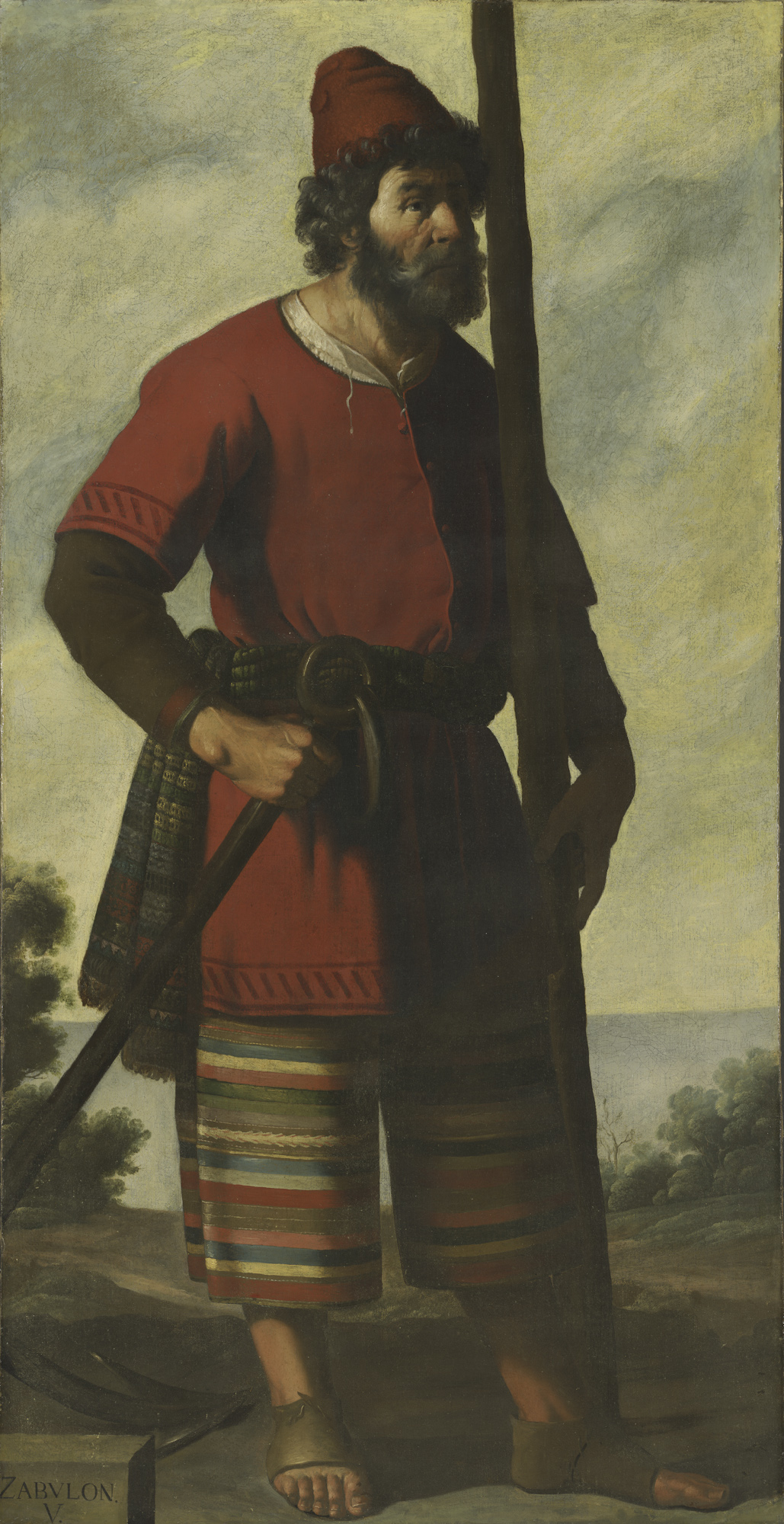
“Zebulun,” circa 1640–1645, by Francisco de Zurbarán (1598–1664). Oil on canvas, 78 1/2 inches by 40 1/2 inches. The striped fabric of Zebulun’s jaunty cropped pants has been connected with textiles from the Americas. (The Auckland Project/Zurbarán Trust/Robert LaPrelle)
Around 1630, Zurbarán was the hottest painter in Seville at a time when the Andalusian seaport was not only a flourishing artistic center but also the wealthiest city in Spain, bustling with activity as it monopolized trade with the New World. As a savvy businessman and manager, Zurbarán was receiving a steady flow of commissions for ecclesiastical institutions and palaces throughout Spain and the Spanish colonies.
Zurbarán’s apprenticeship in Seville overlapped with Velázquez’s for three years, and unlike his contemporaries who were trained in the theories and practices of the Italian Renaissance—especially in perspective—Zurbarán was the odd-man out. He was mostly self-taught and learned how to use the tools of the trade from an unknown artist, though it is known that he did assist Velázquez once on a royal commission.
Invited to Partake in Stories Within Stories
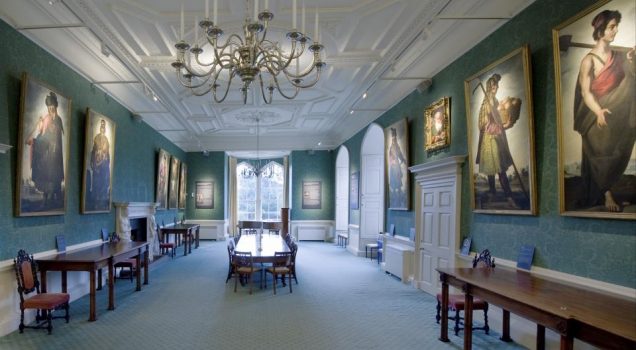
The massive seven-foot-tall figures of the “Jacob and His Twelve Sons” series dominate the pictorial space, filling the foreground. The minuscule landscapes behind them defy the rules of perspective, thus presenting the Old Testament figures larger than life.
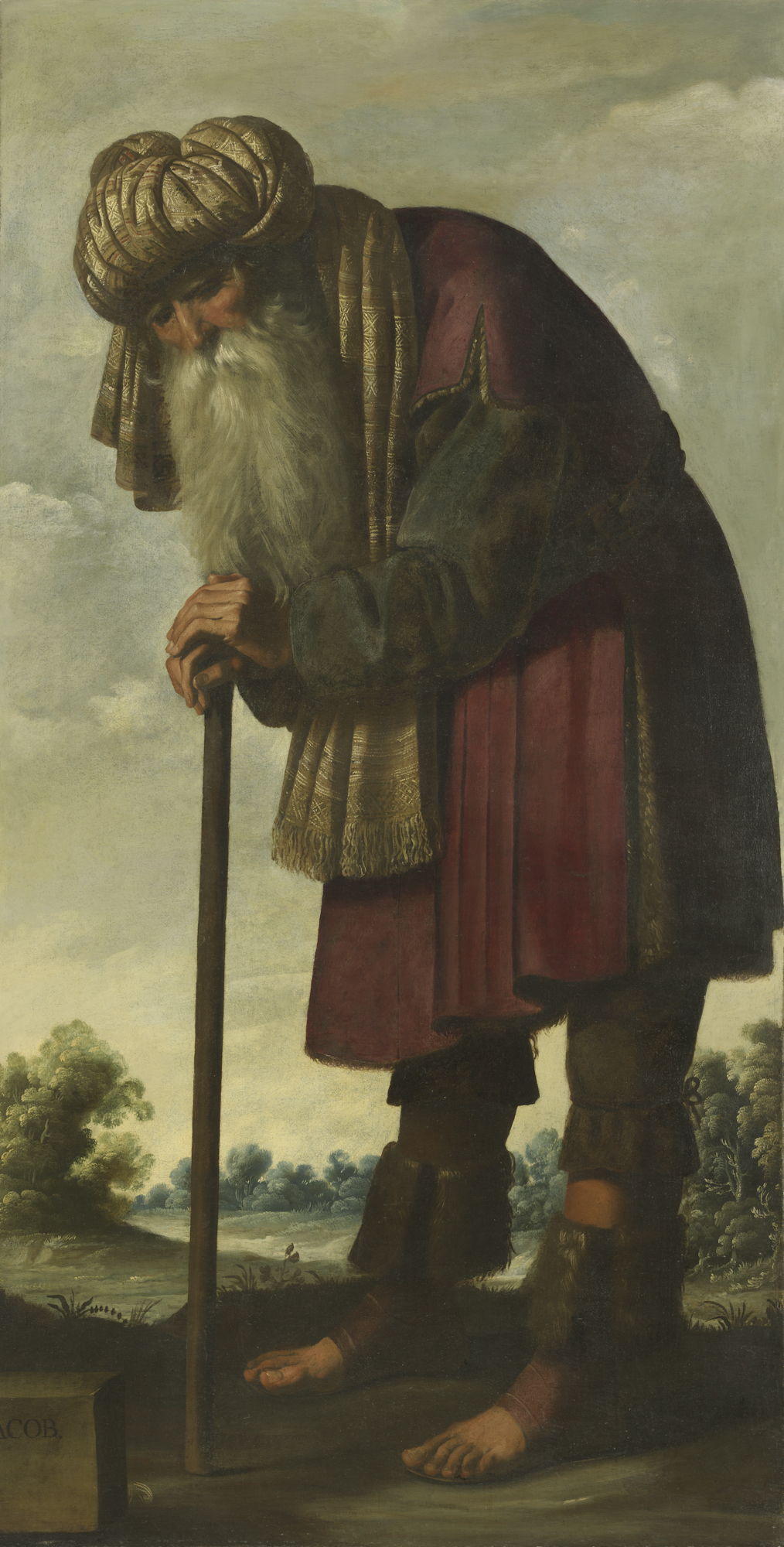
Renamed “Israel” (Genesis 32:28), Jacob is considered the ancestor of the Israelite nation and his sons the founders of the Twelve Tribes, as described in a poem in Genesis (Chapter 49). Galassi decided to arrange the paintings as they have been displayed in England’s Auckland Castle for more than 260 years, clockwise and in the order of the “blessings” in the poem, starting with Jacob:
“Gather around, that I may tell you what will happen to you in the days to come. Assemble and hear, O sons of Jacob; listen to Israel your father,” Galassi recited the poem.
“To me, it’s really more of a gathering that you as the viewer are invited to partake,” she said, surrounded by the paintings. “That is very characteristic of Baroque art—that the viewer plays a role and is included,” she said.
Jacob is depicted squinting and seems to be looking down at us as if to remind us of something. We don’t know if these “patriarchs,” as they are traditionally called, actually lived, but their legendary status can certainly be felt in the East Gallery of The Frick Collection. The initial reaction may be overwhelming upon being surrounded by them, but once you take some time to perceive them, their attributes make themselves known. They seem to speak to each other in this rare reunion.
Zurbarán chose to depict them in the context of Jacob’s proclamations as having been fulfilled. The blessings “often refer to earlier events in Genesis, so they are stories within stories,” Galassi said.
Divinity Over Human Folly
One of the most moving stories is that of Joseph, who was also chosen as the poster child of the exhibition. Zurbarán depicts him with an expression full of humanity and dressed in elaborate, sumptuous clothes. As the son of a haberdasher, Zurbarán was familiar with a wide variety of textiles and fabrics. “He was absolutely superb at representing fabrics, which play an iconographic role throughout [his paintings],” Galassi said.
“The level of detail in that painting [of Joseph] is phenomenal—if you work your way up from the toes, through every band of embroidery and fringe and beautiful laces and fur.” It shows Joseph’s significance, Galassi said.
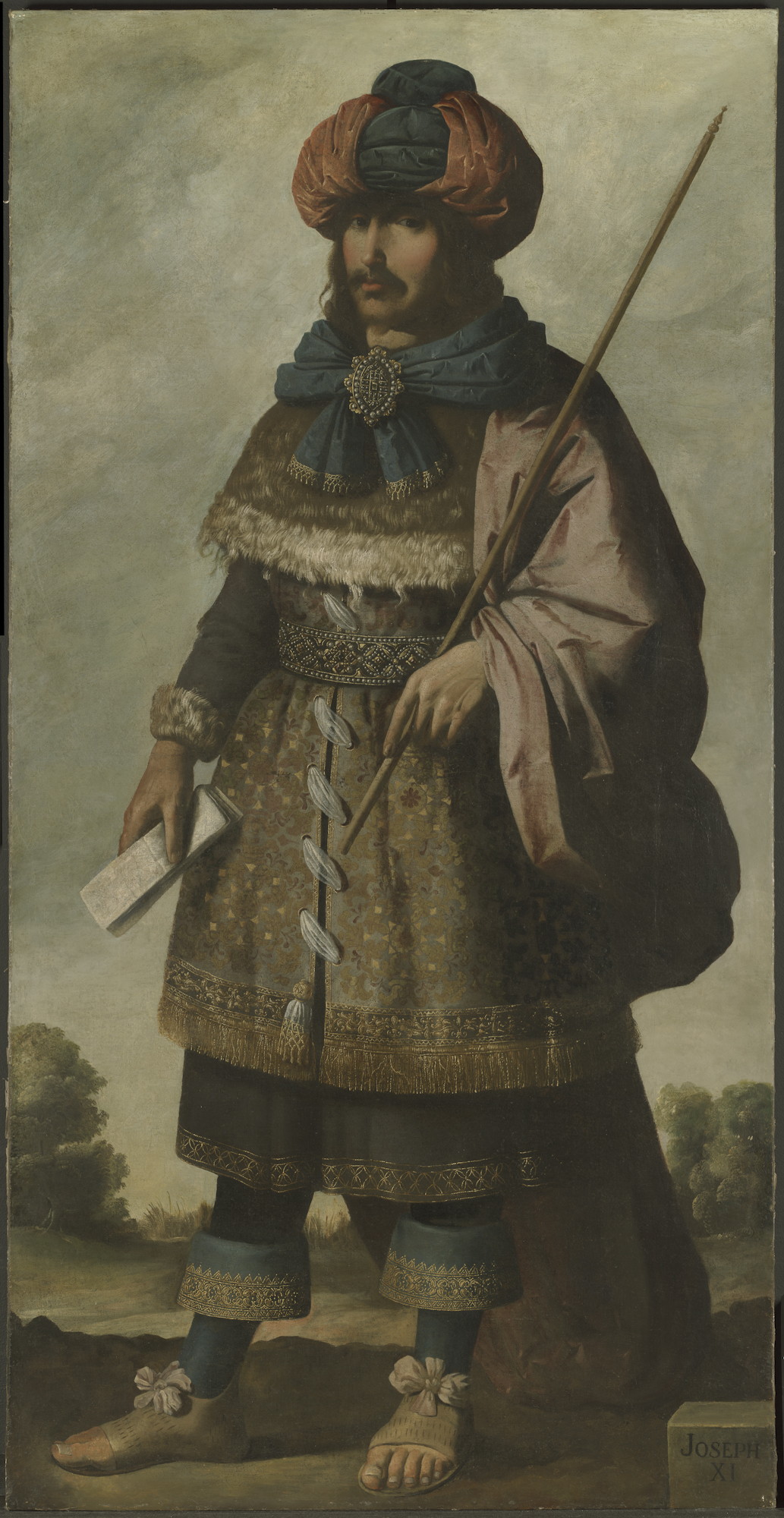
Joseph was the 11th and favorite son of Jacob’s. Out of jealousy, Joseph’s brothers conspired to sell him into slavery in Egypt. There, Joseph was falsely accused of rape and imprisoned. After his ability to interpret dreams aroused the interest of the pharaoh, Joseph became a great administrator and averted the effects of a major famine. Eventually, he invited his father Jacob and his 11 brothers to live in Egypt with him. But first, he put them through various ordeals to prove that they would not abandon Benjamin, the youngest, as they had abandoned him. He then assured them by saying: “Do not be distressed, or angry with yourselves, because you sold me here; for God sent me before you to preserve life … God sent me before you to preserve for you a remnant on earth, and to keep alive for you many survivors. So it was not you who sent me, but God” (Genesis 45:5, 7–8).
At the heart of Joseph’s story is acceptance of one’s fate, forgiveness, and the theme of divine providence overruling human wrongdoing.
A Silent Display for Tolerance
We do not know who commissioned Zurbarán to create the set of 13 paintings of Jacob and his sons, or for what reason. Perhaps they were intended as ephemeral figures to be carried in religious festival processions, or meant to line a refectory, a nave, or a cloister. They may have been commissioned by Spanish conquistadors or missionaries in the New World, who were claiming that the indigenous population of South America was descended from the Lost Tribes. The paintings could have provided a didactic means for converting the native population.
The general consensus is that the paintings never left the Old World, but were eventually imported to London in the early 18th century. The series was sold at auction in 1727–1728 to a Portuguese-Jewish merchant named James Mendez. Upon Mendez’s death, the bishop of Durham, Richard Trevor, was able to purchase all but one (“Benjamin”) of the 13 paintings at auction in 1756. “Benjamin” fell to another bidder. Trevor then commissioned the British painter Arthur Pond (baptized 1701–1798) to paint a copy of “Benjamin” to complete the set.
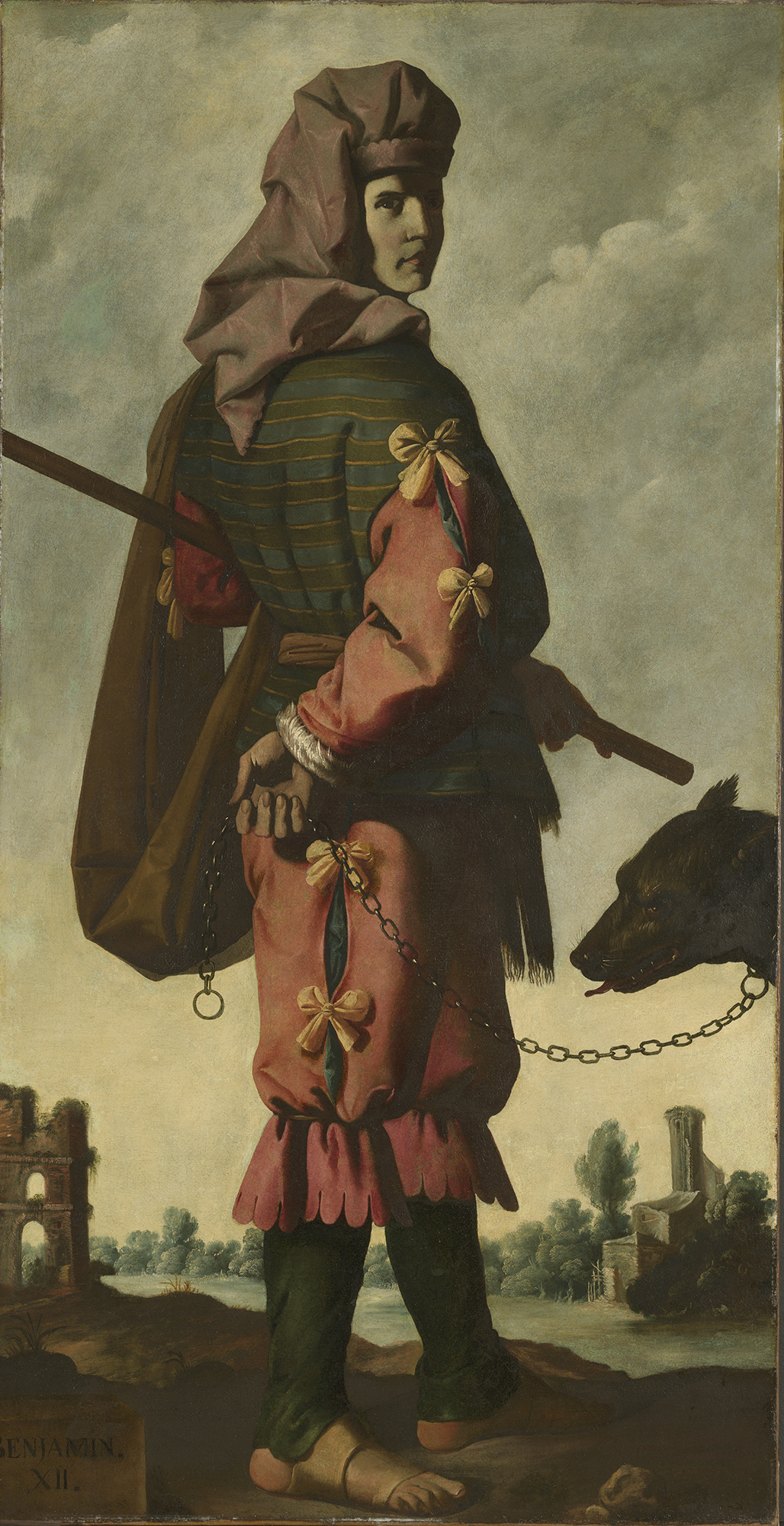
A supporter of religious tolerance toward both Jews and Catholics, Trevor strongly advocated for the Jewish Naturalization Bill that was passed in 1753. A year later, however, the bill was rescinded due to widespread protests. As he would entertain notable and possibly anti-Semitic guests, the 13 paintings of Jacob and his sons, wrapping around his dining room, served as a quiet yet powerful statement of tolerance.
If they were initially intended to be used for religious conversion in South America, it would be an interesting contrast to how they were later used as a means for promulgating religious tolerance in England. In any event, Zurbarán’s paintings of Jacob and his twelve sons continue to serve new circumstances—for fostering heritage.
The Holiness of Beauty
In 2012, a philanthropic financier and native of northeastern England, Jonathan Ruffer, saved Zurbarán’s series from being sold off by the Church of England Commission. By establishing a trust, Ruffer acquired the paintings and Auckland Castle to turn it into a world-class heritage center. The Auckland Project will include a Faith Museum (to explore the history of faith in the British Isles), a Spanish Gallery and Research Center, and a Mining Art Gallery (about the mining history in the region and artwork by coal miners), among other cultural interests.
“Auckland Castle extends the idea of seeking things bigger than ourselves to other avenues of inspiration. Art, music, gardens, nature, food, silences, walks and the patina of heritage will all be found here. These things we call ‘the holiness of beauty’ sitting in harmony with the beauty of holiness—and in tension with it.” Ruffer states his vision on the Auckland Project website.

Since Trevor first displayed Zurbarán’s series in the Long Dining Room at Auckland Castle more than 260 years ago, the paintings have not traveled to the United States—until now, for the current exhibition at The Frick and for last fall’s exhibition at the Meadows Museum in Dallas.
As Auckland Castle is undergoing renovation, The Auckland Project loaned its 12 paintings to the Meadows Museum and The Frick. The 13th painting, “Benjamin,” was lent by Lady Willoughby de Eresby of Grimsthorpe Castle in Bourne, Lincolnshire, to The Frick, which means that this is the only time the entire set of 13 has been reunited since before the paintings were sold at auction in 1727. After April 22, the paintings will return to their respective places, and The Frick’s exhibition will be remembered as an opportunity for taking part in a most unusual and exquisite family reunion.

Follow @milenejf on Instagram