
(Courtesy of Rob Brezsny)

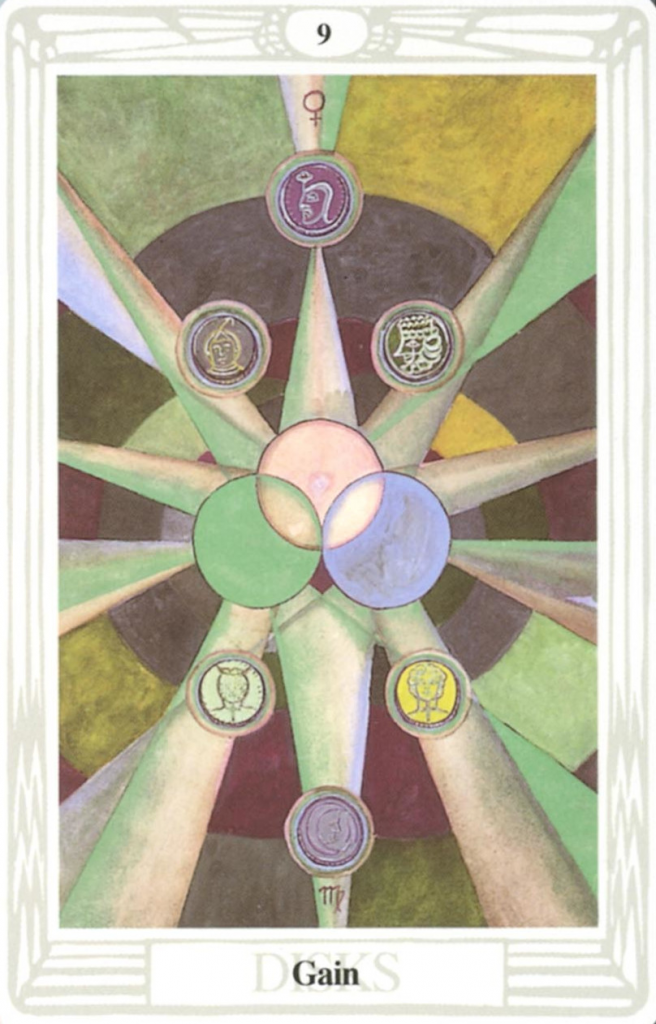
| The Nine of Disks The Lord of Gain is one of the cards which usually receives a hearty welcome when it comes up in a reading. At the mundane level it indicates the financial rewards which come from working diligently and dedicatedly on an important project, so it will often mark a stage of completion. In the workplace it will show that hard work is rewarded both by appreciation and an increase of salary. Sometimes it can indicate promotion (though rarely a total change of workplace) earned as a result of loyalty and attention to detail.As you’ll remember, Disks not only deal with our financial area, but also with day-to-day security in the family environment. So sometimes the Lord of Gain can come up to indicate consolidation and achievement at home. Perhaps an emotional conflict has finally been resolved, or a long-standing problem finally dealt with.At the spiritual level, this card talks a lot about the principle that what we give to life is what we get back. And here we have confirmation that we have lived as much as we are able in the moment, appreciating the things that come our way, and celebrating the bounty we have. As a result, more abundance flows in.The card rarely indicates windfalls, or unexpected sources of income. Here we have worked hard to create something rewarding, and the Lord of Gain indicates the results of our efforts. |


2 days ago (mitch-horowitz-nyc.medium.com)
How controversial is globe-spanning Russian occultist Madame H.P. Blavatsky (1831–1891), whose exploits and exotic claims enthralled Victorians and future generations?
Here’s a story from my publishing days. In 2012, at the corner of Penguin Random House focused on metaphysical literature, I issued an excellent biography of the nineteenth-century icon by historian Gary Lachman.
The book received wide praise — as well as scrutinizing and caustic coverage in arteries of mainstream culture, including Harper’s Magazine and The Paris Review. We had never sent them the book nor sought their attention.
I was surprised that bastions of lettered opinion dedicated significant space to a mystic traveler who died in 1891. Unremarkably, Blavatsky was depicted as a peddler of fake mysticism, manufactured mediumistic tricks, and charlatanry.
And that, mind you, is the duller end of the critics’ stick. The sharper one, pervasive online, calls her a purveyor of colonialism, genocide, and even a forerunner of Nazism.
Into the third decade of the twenty-first century, this figure of minor nobility who traversed the globe in search of esoteric wisdom, still attracts umbrage and debate — along with semi-devotional praise.
Who was she, really?
In a March 1970 historical profile in McCall’s magazine (!), Kurt Vonnegut — no friend to fluffy headed incense imbibers — wrote,
Madame Blavatsky has plenty of followers still. Her most important contribution to American intellectual history is this, it seems to me: She encouraged a lot of Yankees to suspect that spooky aspects of foreign religions might not be the claptrap scientists said they were…Many Americans, I find, are dimly aware that there was a Madame Blavatsky somewhere in our P. T. Barnum past. When I make them guess who she was and what she did, they commonly suppose that she was an outstanding quack among many quacks who pretended to talk to the dead. This response is ignorant and unfair.
Indeed, pursuing the story of Madame Blavatsky, often called H.P.B., means entering a “hall of magic mirrors,” as historian Victor A. Endersby titled his 1969 biography.
Love or hate her, or any perspective in between (and there are many), it is difficult to imagine our modern world without Madame Blavatsky and the Theosophical Society, the universalist occult movement she cofounded in 1875.

Indeed, an extraordinary range of cultural and social figures crisscross H.P.B.’s career and impact, from composers Igor Stravinsky and Alexander Scriabin to political leaders Mahatma Gandhi, Jawaharlal Nehru, and Henry A. Wallace to poets W.B. Yeats, George Russell (AE), and T.S. Eliot to artists Agnes Pelton, Hilma af Klint, Nicholas Roerich, Piet Mondrian, and Wassily Kandinsky to novelist L. Frank Baum (The Wonderful Wizard of Oz) to modern artists such as musician Todd Rundgren, filmmaker David Lynch, and Elvis Presley (an avid reader) to movements ranging across the alternative spiritual spectrum, including those adapting Eastern spirituality in the West and variants of Wicca and witchcraft.
No hot take or preferential reading of history plumb the legacy of the sphinx-like seeker or of Theosophy.
The answers, if they exist, entail turning the clock forward and backward, not once but several times, starting with Blavatsky’s earliest collaborators, including Theosophical Society cofounder and retired Civil War Colonel Henry Steel Olcott (1832–1907). It is with their partnership that we begin.

Inwinter 1877 there stood a squat, redbrick tenement on the West Side of Manhattan at Eighth Avenue and 47th Street, what is today considered Hell’s Kitchen or the Theater District. The five-story brick building still stands as an Econo Lodge, part of the discount hotel chain. But in winter of early 1877 it was a walkup dwelling.

On the second floor sat a cramped warren of rooms, which the New York press jokingly dubbed “the Lamasery” for the religious monasteries of Tibet. Within the Lamasery dwelt Blavatsky, who arrived in New York City in 1873.
She came, she explained, because she yearned to visit the birthplace of Spiritualism. More so, she felt that the free religious winds in the U.S. made the nation a propitious launch pad for her re-ignition of occult spirituality, whose influences had been receding since the close of the Renaissance. (There exist other theories, the most alluring of which I consider below.)
About a year after arriving, she met her roommate, Henry Steel Olcott, a retired staff colonel from the Civil War. During Henry’s twenties, he was considered a wunderkind of scientific agriculture. As an officer, he was among the first investigators of the Lincoln assassination. Henry later grew interested in Spiritualism and researched various mediumistic claims. His efforts led to an 1875 book, People from the Other World, an illustrated investigation.
The two met on a porch in Chittenden, Vermont, in 1874. Henry was on assignment for one of New York’s dailies to investigate a “ghost farm” run by two brothers, William and Horatio Eddy. The siblings claimed the ability to conjure ghostly phenomena and otherworldly spirits.
As Henry stepped onto the veranda the sunny midday of October 14, he encountered and chivalrously lit the cigarette of the commanding, imposing woman who arrived that day. She was oddly garbed in a puffy red shirt, known as a Garibaldi shirt. It was named for Italian revolutionary and Freemason Giuseppe Garibaldi (1807–1882) who popularized its style while fighting to unify a fragmented Italy into a single democratic republic.

Garibaldi’s struggles led him into military conflict with the Vatican, which until 1870 maintained its own militia. Although not widely remembered, Garibaldi was considered a dramatic, romantic, and idealistic revolutionary challenging Western Europe’s waning aristocracies.
Blavatsky told her new friend that she had fought at Garibaldi’s side — she lifted her shirt to reveal to a wide-eyed Henry bullet wounds from their campaigns. He was enthralled. They did not become lovers but, for a time, inseparable though fractious friends with a shared passion for the unseen.
Their vehicles were first the short-lived Miracle Club formed in May 1875 and soon after the Theosophical Society, which they founded in New York City that November. Henry installed the two of them in the cluster of rooms called the Lamasery in late summer or early fall of 1876.
One winter night at the Lamasery in 1877, Henry experienced perhaps the formative episode of his life. Madame Blavatsky had gone to sleep and he was seated alone in his room reading by the flicker of gas lamp. Henry was poring over explorer John Lloyd Stephens’ memoir of scouting Mayan ruins in Yucatan, with the only noise the hiss of steam heat. Reading and smoking, Henry was suddenly startled to attention. There appeared before him, with no footsteps, creaking floorboards, or sound of an opening door, a massively tall, turbaned man later identified as Master Morya, an adept from the East.
“All at once,” Henry wrote in his memoir Old Diary Leaves,
as I read with my shoulder a little turned from the door, there came a gleam of something white in the right-hand corner of my right eye; I turned my head, dropped my book in astonishment, and saw towering above me in his great stature an Oriental clad in white garments, and wearing a head cloth or turban of amber-striped fabric, hand-embroidered in yellow floss silk.
It was one of the “hidden masters” that Madame Blavatsky said had been tutoring her since adolescence — and from whom Henry had begun receiving letters during his efforts organizing an occult salon called the Miracle Club. The earliest missive, sent in May 1875, bore the injunction, TRY, the slogan of American occultist P.B. Randolph, soon to die from a self-inflicted gunshot wound.
Now, standing before Henry in resplendent white garb with a silk turban encircling his head, was this Eastern mystery teacher, Morya, who, Henry later recounted, reassured the acolyte that he was on the right path.
Morya encouraged him in his investigations, his close partnership with Madame Blavatsky — and something more: he told Henry that he wanted the pair to relocate to India, which was then under the yolk of colonial machinery. The Hindu religion was being eaten away by well- funded and military-backed missionary campaigns dispatched from England and Western Europe.

As proof of their encounter, and to persuade Henry he wasn’t dreaming, Morya removed his fehta or turban and left it on the table for the stunned onlooker. [1] With that, the adept vanished.
As it happened, about eighteen months later in December 1878, Henry and Madame Blavatsky did leave New York City for Bombay, now Mumbai, arriving in January.
The pair reestablished themselves in a nation then as unfamiliar to most Westerners as the surface of another planet. They had limited finances; no command over language, culture, or custom; few personal contacts; and both were well into middle age and not in robust health. Blavatsky was obese and had some difficulty getting around. Henry suffered from a gouty leg.
They uprooted themselves from the relative comforts of Victorian-era New York where reasonably well-established dwellers could have domestic servants, ice in their drinks, and enjoy a coal-heated and gaslit home. You could taxi around town in a horse and carriage, go to the theater, or take a train to Coney Island; restaurants abounded. Moreover, the couple were widely known personalities about town accustomed to jousting with the tabloid press.
In September 1877, Blavatsky had published her first book, Isis Unveiled, a sprawling work of occult philosophy and history. Henry was respected as a lawyer and journalist who had covered the execution of abolitionist John Brown and made some of the first arrests of suspected collaborators in Lincoln’s assassination. Although considered eccentric in their partnership in occult studies, they were eminent if notorious figures.

Leaving all that behind, they established themselves in the ancient nation where they and followers helped inaugurate the nascent Indian National Congress, the policymaking arm of the independence movement, the helm of which was later taken by Mahatma Gandhi.
The anti-colonial leader spoke admiringly of the influence that Blavatsky’s philosophy of religious universality had on him during his student years. Indeed, in a remarkably overlooked facet of twentieth-century history, Gandhi openly credited Theosophy with returning him to Hinduism and its holy book, the Bhagavad Gita, which became the guiding text of the leader’s life. Blavatsky’s Key to Theosophy, Gandhi wrote in his autobiography, “stimulated in me the desire to read books on Hinduism, and disabused me of the notion fostered by the missionaries that Hinduism was rife with superstition.” [2]
Theosophy, Gandhi later told biographer Louis Fischer, “is Hinduism at its best. Theosophy is the brotherhood of man.” [2]
Gandhi partnered (and sometimes feuded) with the Theosophical Society during India’s independence movement, crediting it with easing relations between Hindu and Muslim delegates to the Indian National Congress. So prominent was Theosophy in India’s political life that even the Congress’s founding in 1885 was instigated by an early Theosophist, A.O. Hume, a retired Anglo–Indian government secretary who said that he was acting under “advice and guidance of advanced initiates.” [4]

In 1973, Hume, seen as a founding light of the independence movement, appeared on a commemorative Indian postal stamp. In 1917, Blavatsky’s successor, Annie Besant, was elected president of the Congress, making the Theosophist the first woman and last European to hold the title.
For his part, Henry made speaking tours of India, Japan, Ceylon (now Sri Lanka), Burma (now Myanmar), and helped instigate a vast Buddhist revival. In Sri Lanka, an Anglican bishop groused in a letter home that “the Secretary of an obscure society” had been encouraging Buddhist monks, “hailing them as brothers in the march of intellect.” [5] Olcott used the missionaries’ own methods against them: He wrote The Buddhist Catechism — still read in Sri Lankan classrooms today — to codify the native faith as missionaries had the Christian one.
He successfully lobbied English authorities to permit the national celebration of Buddha’s birthday, during which worshippers rallied around an international Buddhist flag Olcott helped design. He raised money for schools and educational programs. The Buddhist revival ignited. Within twenty years of Olcott’s first visit, the number of Buddhist schools in the island nation grew from four to more than two hundred. [6]
In recognition, Henry’s death, February 17, 1907, is today nationally celebrated as “Olcott Day.” In 1967, Henry’s visage, too, was memorialized on a Sri Lankan postal stamp.

The notion of Westerners making a spiritual sojourn to India had not yet entered the Western psyche. Most Victorians did not see India as a fount of religious wisdom. Rather, the nation was widely considered a cultural boondocks that the British Empire used as a base for mercantilism and military command. It was not until decades later that writers like W. Somerset Maugham or Paul Brunton wrote about spiritual journeys to India — and nearly a century later that the Beatles visited in 1968, joining Maharishi Mahesh Yogi at his ashram in Rishikesh. The tracks for such journeys were laid by Blavatsky and Olcott.

What, if anything, happened that winter night in the gaslight of Henry’s room on the West Side of Manhattan? Did he invent the story? Did he imagine it?
I am hardly about to advocate for a mysterious turbaned man materializing in front of Henry. At the same time, I also reckon that the strange and outwardly spiraling history of this couple expands in directions that shouldn’t be possible. If the critics are right, Blavatsky and Olcott ought to be a forgotten novelty of the nineteenth century occult revival, their names an afterthought. And yet, what they and their closest colleagues created, widely acknowledged or not, was history itself.

This returns us to the question: who, in essence, was Madame Blavatsky? If asked seriously, such a query may never yield any complete answer.
Forensically, Blavatsky was born to minor Russian nobility in 1831, involved in a coerced and unhappy marriage (she later had another short-lived marriage in Philadelphia), and began to travel as a young woman.
Since girlhood, she reported dreams about figures from the East who wished to tutor and help her. As she entered her early twenties while touring England, Blavatsky said that she experienced her first encounter with a hidden master at the International Exhibition at Hyde Park’s Crystal Palace in 1851 — a hugely tall man who accompanied the royal Nepalese delegation.
There abound records and controversies around her traveling to Tibet, Egypt, Persia, and the Far East. She said she was guided in her studies and travels by the adept Morya and others such as Koot Hoomi (also spelled Kuthumi), Serapis Bey, and Tuitit Bey — flesh-and-blood beings who she maintained were unbound by certain dimensional or material realities and thus able to materialize at will.

Under tutelage to the masters, she spurred a spiritual revolution to save the Western world from domination by philosophical materialism, or belief that matter creates itself and nothing exists beyond flesh and bone, motor skill and cognition — that one’s psyche is an epiphenomenon of the brain, like bubbles in a glass of carbonated water, and when the water is gone, so are the bubbles. As seen, she said she was charged with rescuing the Eastern philosophies from dissolution under colonial rule.
Her stories of hidden masters of wisdom from Persia, the Himalayas, Egypt, and India, wielded an unusual effect on the West. Although earlier Transcendentalist thinkers, such as Ralph Waldo Emerson, Henry David Thoreau, and Bronson Alcott, were versed in some of the Vedic literature available to English speakers, and they wrote about such things in their journals, poetry, and essays, their work did not necessarily reach the everyday individual, the kind of person who hadn’t read British poet Edwin Arnold’s 1879 epic “The Light of Asia” on the life of Buddha.
Indeed, we have an overdeveloped sense of the availability of ancient or Eastern literature in translation prior to the late nineteenth century. In 1841, when Emerson published his first series of essays, there were probably just four or five copies of the Bhagavad Gita in English throughout all of America. One was in the library at Harvard, one was in Emerson’s personal library. Emerson lent his copy to Thoreau and some of his contemporaries. The remaining two or three, according to best estimates, were in private libraries. The first Latin and French translations of the Chinese ethical classic the Tao Te Ching were not available until 1838 and the first English version in 1868. (Catholic missionaries circulated partial Latin translations starting in 1788). I’ve noted elsewhere (see below) the paucity of Hermetic translations. Hence, it’s important to recall these limits.
It was the fantastical and theatrical quality of Madame Blavatsky, and the manner in which the press took to her, that began to spread the idea in the popular mind that there existed gurus, swamis, and masters of wisdom in the nations of the East, a world that many Americans barely knew existed, or if they thought of such places at all were likely to consider them holdouts of superstition and burlesque tribalism. Blavatsky’s stories of tutelage by these masters gave Westerners an alternate point of reference.

Hence, Americans were able to understand what it meant when the first gurus ventured West, such as Swami Vivekananda (1863–1902) who visited the Chicago World’s Fair in 1893 and spent the next two years touring America, speaking on karma, nonattachment, and reincarnation. [7] Or the monk Paramahansa Yogananda (1893–1952) who came to America in 1920 and taught Kriya Yoga, a practice encompassing both spiritual and physical techniques. When Maharishi Mahesh Yogi, founder of Transcendental Meditation, visited Southern California in 1959, modern Westerners had a way to contextualize him.
“In a tiny room on the fourth floor of the Central Y.M.C.A.,” wrote the Honolulu Star Bulletin on Maharishi’s stopover, “a remarkable man sits cross-legged on a deer’s pelt. His eyes remind you of the innocence of a puppy’s eyes. He has no money. He asks for nothing. His worldly possessions can be carried in one hand. Maharishi Mahesh Yogi is on a world odyssey . . . In the meantime, he sits quietly in room 424. He sleeps three hours a night, eats one vegetarian meal a day, and does not think of tomorrow.” [8]
This process expanded in the U.S. with the passage of the 1965 Immigration Act, which allowed greater Asian immigration, permitting entry to a new cohort of gurus and yogis, including Swami Prabhupada (1896–1977) that year. Again, when John, Paul, George, and Ringo visited Maharishi at Rishikesh in 1968, the notion of a Westerner sojourning East, and vice versa, had a touch of familiarity. That acclimation began largely through Madame Blavatsky.
Aside from her narrative about spiritual masters, Madame Blavatsky taught that there exists an occult philosophy, or “secret doctrine,” as she titled her vast cosmological opus in 1888.
This secret doctrine, in her telling, is a primeval “hierohistory,” using Henry Corbin’s term. [9] Renaissance thinkers embraced the concept of a prisca theologia or primeval theology antedating all else. Blavatsky conveyed a similar theme. This occult or secret doctrine was deeply, almost unthinkably, ancient and unknown. It was far older than all modern faiths and, in fact, underscored them.
What’s more, she taught that humanity itself is millennia upon millennia older than modern authorities understood. And, further, that humanity spans vast evolutionary cycles of development, through which it eventually evolves finer sensory abilities and exists under fewer restrictions of physical law. Blavatsky described this in terms of epochs of evolving “root races” — not races in the ethnic sense but pertaining to spiritual development.
In the fetid atmosphere of Darwinian misapplications, Blavatsky, on occasion, made racial generalizations that were at once conventional to the Victorian era and shabbily conceived, a subject of future controversies. This, along with Blavatsky’s use of the Vedic swastika and her timeworn references to ancient Asiatic races, including the Aryan, burnished a brutally simplistic shorthand, easily referenced within the character-limit of tweets, namely that H.P.B. was a progenitor of Nazism, a canard I explore elsewhere (see below).
Topick up with The Secret Doctrine, Blavatsky described seven root races, which span vast millennia, and are older than anything understood in terms of human history, some emanating from supposed “lost continents” of Atlantis and Lemuria. Each of these seven root races, in turn, divides into seven subraces, with humanity working its way up this scale of spiritual development.
She wrote that current humanity is the fifth subrace of the fifth root race and that the early twenty-first century would see emergence of the sixth sub-race. This developmental process requires 700 or 800 years. And another 25,000 years before commencement of the seventh subrace.
It is important to clarify that Blavatsky counted evolutionary cycles in millions of years. As Pablo Sender helpfully summarized in “The Dawn of Civilization: An Esoteric Account of the First Three Root Races” in Fall 2019 in Quest magazine:
According to The Secret Doctrine, the First Root Race, nonphysical beings lacking in consciousness, began to develop over 1.5 billion years ago. The first self-conscious humanity resembling what we know today was the Third Root Race, which started over 18 million years ago. The anthropological records, historic and even prehistoric, belong to our current Root Race, which is the fifth (out of seven).
Blavatsky’s cycles are correspondingly vast in nature to the Vedic cycle of yugas or world ages. The four recurrent cycles require 4,320,000 earth years to complete and then recommence.
Humanity’s current cycle of Kali Yuga — considered an era of conflict and spiritual degradation — began in 3,102 B.C. and concludes in 428,899 A.D., lasting 432,000 conventional years (a number with surprising congruences in other religious systems).

Using esoteric calendrics of his own, Traditionalist philosopher René Guénon (1886–1951) calculated stage four, the Kali Yuga, at a more compact 6,480 years, running 4,481 B.C. to 1999 A.D. This means that present humanity has returned to the first stage of Krita Yuga or the Golden Age: “But it is hard to imagine the author of The Reign of Quantity [Guénon] if he were living now, agreeing with that,” Joscelyn Godwin notes in Atlantis and the Cycles of Time (Inner Traditions, 2011).
Back to more graspable measures of time, Blavatsky wrote in 1888 that the current process of transformation from the fifth to sixth subrace would begin in the United States. “It is in America that the transformation will take place,” reads The Secret Doctrine, “and has already silently commenced.” Signposts in The Secret Doctrine and later interpretation by Blavatsky’s protege and successor, British political reformer Annie Besant, point to the change originating on the West Coast in California.

This warrants pausing over. In 1888, California was a place of orange groves, ranches, mines, desert climate, and seashore. Although the 1840s Gold Rush brought a wave of migrants, the coastal state remained, in essence, a ranch town and agricultural hub. It wasn’t until an economic boom brought on by the shipping industry around World War I that California began to develop into the economic powerhouse and migratory magnet it is today. People arrived for myriad reasons, including commerce and health, as the climate was considered a tonic. California not only became home to the nascent movie business but started to develop into the epicenter of alternative spirituality, which it has remained.
As with Central New York’s Burned-Over District, population flows presage religious innovation. Hence, the Southern California coast became the capital of everything radical and breakaway in spirituality.
None of that was especially foreseeable in 1888 when Blavatsky published The Secret Doctrine in which she wrote: “Occult Philosophy teaches that even now, under our very eyes, the new Race and races are preparing to be formed, and that it is in America that the transformation will take place, and has already silently commenced.” She specifically referenced humanity’s transformation from its current role as the fifth subrace of the fifth root race into a sixth subrace (again, seven subraces appear within each root race) in the Pacific Rim, a process that would unfold in “some few hundred years more.” As alluded, Besant interpreted the quoted passage referencing Southern California, which I consider accurate to Blavatsky’s outlook.
Inthe opening page of The Secret Doctrine, Madame Blavatsky tells the reader she is viewing and writing down stanzas of wisdom from The Book of Dzyan, a mythical Tibetan Buddhist text not known to physically exist. The author leaves open the question of whether she’s perusing a physical work or viewing its passages in a phenomenalistic or clairvoyant manner: “An Archaic Manuscript — a collection of palm leaves made impermeable to water, fire, and air, by some specific unknown process — is before the writer’s eye.”
Continue reading In the Hall of Magic Mirrors: Reckoning with Madame H.P. Blavatsky
Dec 25, 2023 (mitch-horowitz-nyc.medium.com)
One of the most seminally important and enigmatic spiritual figures of the twentieth century was Greek-Armenian philosopher G.I. Gurdjieff (1866–1949). His essential teaching is that man lives in a state of sleep — not metaphorically but actually.
Human existence, the teacher observed, is not only passed in sleep but man himself is in pieces, at the passive bidding of his three brains or centers: thinking, emotional, and physical, all of which function in disunity leaving a “man-machine” incapable of authentic activity.
“Man cannot do,” Gurdjieff said. He meant this in the fullest sense.
Nearly all of Gurdjieff’s statements — including his 1950 literary giant Beelzebub’s Tales to His Grandson — were intended to disrupt rote thought. He instructed that the magisterial allegory be read three times.
Author P.L. Travers, best known for the Mary Poppins books, noted aptly, “In Beelzebub’s Tales, soaring off into space, like a great, lumbering, flying cathedral, Gurdjieff gathered the fundamentals of his teaching.”
There is no neat summarizing the breadth of Gurdjieff’s system, which extended to sacred dances, self-observation, rigorous and challenging training and confrontation with obstacles, and what might be considered a cosmological-existential-spiritual psychology, explored by one of his greatest students, P.D. Ouspensky (1878–1947), who produced an invaluable record of his experiences with Gurdjieff, In Search of the Miraculous, posthumously published in 1949. A brief, though daunting, analysis also appears in Ouspensky’s The Psychology of Man’s Possible Evolution, published in 1950.

Appearing in Russia shortly before World War I, Gurdjieff assembled a remarkable circle of students, some of whom followed him in a harrowing escape across the continent amid the chaos and danger of war and revolution.
A sense of Gurdjieff’s relationship to his students and manner of teaching appears in an episode from Fritz Peters’ haunting and powerful 1964 memoir Boyhood with Gurdjieff.
In Peters’ book, the author recounts the commitment Gurdjieff exacted from Fritz at age eleven. The young adolescent met Gurdjieff in June 1924 when he was sent to spend the summer at the teacher’s school, the Prieuré, a communal estate in Fontainebleau-Avon outside of Paris.

Speaking to Fritz on a stone patio one day, Gurdjieff banged the table with his fist and asked, “Can you promise to do something for me?” The boy gave a firm, “Yes.” The teacher gestured to the estate’s vast expanse of lawns. “You see this grass?” he asked. “Yes,” Fritz said again. “I give you work. You must cut this grass, with machine, every week.”
Fritz agreed — but that wasn’t enough. Gurdjieff “struck the table with his fist for the second time. ‘You must promise on your God.’ His voice was deadly serious. ‘You must promise that you will do this thing no matter what happens.’” Fritz replied, “I promise.” Again, not enough. “Not just promise,” Gurdjieff said. “Must promise you will do no matter what happens, no matter who try stop you. Many things can happen in life.”
Fritz vowed again.
Very soon, in the lives of Fritz and his teacher, something seismic and upending did occur. Gurdjieff suffered a severe car accident and for several weeks laid in a near-coma recovering at the Prieuré.
Fritz, feeling that the whole thing seemed almost foreordained, honored his commitment to keep mowing the lawns. But he met with stern resistance. Several adults at the school insisted that the noise would disturb Gurdjieff’s convalescence and could even result in the master’s death.
Fritz recalled how unsparingly the promise had been extracted and how fully it had been given. He refused to relent. He kept mowing — no one physically stopped him. One day while Fritz was cutting the lawns, he spied the recovering master smile at him from his bedroom window.

One of the greatest benefits students receive from Gurdjieff’s teaching (to which I can personally attest) is how it punctures, immediately and sometimes devastatingly, one’s cherished images of self.
We in the modern West are suffused with contradictions. People are filled with puffed up views of themselves. They are also filled with the opposite. But take one person and give him or her an unfamiliar task at an inconvenient hour and you will see how powerful or special we are. Not very.
Gurdjieff constantly pushed people to surpass their limits of perceived strength. In his posthumous memoir, Meetings with Remarkable Men, the teacher described episodes from when he and a band of students fled civil war-torn Russia. In an epilogue, “The Material Question,” he addressed their need for money.
In the summer of 1922, after a dangerous flight across Eastern Europe, Gurdjieff and his students reached Paris with razor-thin resources. Procuring an estate, the Prieuré, to function as living quarters and school, Gurdjieff used every means possible to foster his circle’s financial survival.
“The work went well,” he wrote, “but the excessive pressure of these months, immediately following eight years of uninterrupted labours, fatigued me to such a point that my health was severely shaken, and despite all my desire and effort I could no longer maintain the same intensity.”
Seeking to restore his strength through a dramatic change in setting as well as fundraise for the institute, Gurdjieff devised a plan to tour America with forty-six students. The troupe would put on demonstrations of the sacred dances they practiced and present Gurdjieff’s lectures and ideas to the public. Although intended to attract donors, the ocean voyage and lodgings entailed significant upfront expenses. Last-minute adjustments and unforeseen costs consumed nearly all the teacher’s remaining resources.
“To set out on such a long journey with such a number of people,” he wrote, “and not have any reserve cash for an emergency was, of course, unthinkable.”
The trip itself, so meticulously prepped and planned for, faced collapse. “And then,” Gurdjieff wrote, “as has happened to me more than once in critical moments of my life, there occurred an entirely unexpected event.” He continued:
What occurred was one of those interventions that people who are capable of thinking consciously — in our times and particularly in past epochs — have always considered a sign of the just providence of the Higher Powers. As for me, I would say that it was the law-conformable result of a man’s unflinching perseverance in bringing all his manifestations into accordance with the principles he has consciously set himself in life for the attainment of a definite aim.
As Gurdjieff sat in his room pondering their troubles, his elderly mother entered. She had reached Paris just a few days earlier. His mother was part of the group fleeing Russia but she and others got stranded in the Caucasus. “It was only recently that I had succeeded,” Gurdjieff wrote, “after a great deal of trouble, in getting them to France.”
She handed her son a package, which she told him was a burden from which she desperately wished to be relieved. Gurdjieff opened the package to discover a forgotten brooch of significant value that he had given her back in Eastern Europe. He intended it as a barter item used to pass a border or secure food and shelter. He assumed it was long since sold or otherwise traded and never again thought of it. But there it was. At the precipice of ruin, they were saved.
“I almost jumped up and danced for joy,” he wrote. This was the lawful result of “unflinching perseverance.”
As with all Gurdjieff wrote and said, there is at the back of his statement a level of gravitas and lived experience that makes this teaching warranting of deep pause. Things that might appear homiletic in the mouth of a lesser figure took on life-and-death seriousness from this teacher.
Iclose this brief consideration with a statement of Ouspensky’s. It is not, perhaps, considered one of his most remarkable observations, but it is useful and instructive insofar as it demonstrates how his and Gurdjieff’s ideas cannot be contextualized within familiar categories.
Philosopher Jacob Needleman (1934–2022), a student of the Gurdjieff work, remarked, “It’s not like anything.”
Ouspensky made a valuable observation about the nature of a “positive attitude” in a talk reproduced in the posthumously published book, A Further Record: Extracts from Meetings 1928–1945. In its lowest and least useful iteration, Ouspensky told students,
. . . a positive attitude does not really mean a positive attitude, it simply means liking certain things. A really positive attitude is something quite different. Positive attitude can be defined better than positive emotion, because it refers to thinking. But a real positive attitude includes in itself understanding of the thing itself and understanding of the quality of the thing from the point of view, let us say, of evolution and those things that are obstacles. Things that are against, i.e., if they don’t help, they are not considered, they simply don’t exist, however big they may be externally. And by not seeing them, i.e., if they disappear, one can get rid of their influence. Only, again it is necessary to understand that not seeing wrong things does not mean indifference; it is something quite dif- ferent from indifference.
What the teacher is saying, albeit on a great scale, is that the individual must seek to understand forces that develop or erode his or her humanity, itself an immense question.
We are unconcerned with coordinates of good or bad, happy or sad, but rather with questions of developmental forces and what they mean to us.
This article is adapted from the author’s Modern Occultism (2023):

“Treats esoteric ideas & movements with an even-handed intellectual studiousness”-Washington Post | PEN Award-winning historian | Censored in China
1 day ago (deepakchopra.medium.com)

Is Your Brain an Illusion?
By Deepak Chopra, MD, FACP, FRCP
When told about the ancient Indian concept of Maya, which holds that the world is an illusion, most people both East and West shrug off the notion. If they ponder Maya at all, they relegate it to metaphysics, which is just as easy to disregard. But a century after the quantum revolution in physics, Maya is more relevant than ever, because its meaning pertains to something as intimate to us as our brain.
The mystery of the human brain is easily summarized: How does a watery mass of organic chemicals manage to think? I think there is an answer, which is given in my new book, Quantum Body. For a very long time, the mystery got no further than a famous quip: “What is mind? No matter. What is matter, never mind.” The quip refers to the impossibility of connecting the physical world with the non-physical domain of consciousness.
You are conscious, of which there is no doubt. Chemicals aren’t conscious, which is equally undeniable. The gap between these two statements is unbridgeable — until you consider the quantum. In the earliest days of the quantum revolution around 1900, a number of the theory’s greatest proponents traced consciousness to the quantum field. In a simple way, the quantum field provides the source for everything.
That it is the source of space, time, matter, and energy was posited then and holds true now. But “everything” must include the mind, and that was the rub. The mind isn’t quantum. No amount of data, measurement, and experimentation at the quantum level — or anywhere else — can explain what an experience is. The color of a rose expressed in wavelengths of light has nothing to do with seeing it as red.
The same is true of all five senses. Current research has traced smell, vision, and touch to quantum processes — your retina, for example, can register a single photon, the quantum particle associated with light. But photons are invisible. They become bright only through our perception.
To a neuroscientist, this fact solves the riddle of mind and brain. The brain allows us to see, and to perform every other mental process. Unfortunately, this is where Maya throws a monkey wrench into the machinery. There is no light in the brain, no brightness, no pictures, or anything but the firing of faint electrical charges and the exchange of ionized chemicals in the visual cortex.
Take away the light, brightness, and images, and the experience of seeing is gone. It stands to reason that your brain doesn’t see, and once this point is conceded, it is the opening edge of the wedge. If the brain doesn’t see, then it doesn’t possess any of the five senses. If that’s true, then the brain has no experience — and yet you do.
Maya exposes the fallacy that the brain is the same as the mind. Neuroscience would adamantly deny this, because the entire basis of brain science for 99% of neuroscientists, is that brain = mind. We are living in the golden age of fMRI and other brain imaging that can view brain activity as it occurs. Imaging has become so sophisticated that patterns of neural activity will soon be precise enough, we are told, that they can be linked to individual thoughts.
That seems to support the assumption that brain = mind, but it doesn’t. Imagine that a player piano, which plays music without a pianist, fell into the midst of a Stone Age tribe in New Guinea. They could be excused for believing that the piano understands music and is responsible for composing it (old-fashioned player pianos used paper rolls with inserted holes that triggered the instrument’s mechanism; modern ones operate electronically).
For all of its sophistication, neuroscience falls for the same illusion. It believes that the brain, since it has the machinery corresponding to thoughts, feelings, sensations, and images, must be composing our experience. The difference from a Stone Age tribe in New Guinea is that the player piano can be understood by unraveling its mechanics — the brain can’t.
But Maya and the quantum revolution have deeper ties. The elementary particles that constitute the first stage of creation aren’t like ordinary physical “things.” This was made clear by the great physicist Werner Heisenberg when he declared, “The atoms or elementary particles themselves are not real; they form a world of potentialities or possibilities rather than one of things or facts.”
Here is the vital link between mind and matter: both originate as possibilities, not things or facts. The next thought you have and the next word you utter exist beforehand only as possibilities. Therefore, you think and speak at that level all the time. The same holds true for an experience. You experience everything in the “real” world with all of its sights, sounds, smells, textures, and tastes, but that is pure illusion.
Experience begins in no specific location because the quantum field has no location in time and space. Your senses are quantum once you understand where they originate, not in the illusory physical world. Therefore, your brain, being a ting, is also illusory. Maya and quantum mechanics agree on this point.
Very quickly modern physics moved away from a theory of mind and set its course for physical experimentation, like all the other sciences. But this decision doesn’t invalidate Heisenberg’s insight. But where does this insight actually get you? Medicine needs to address maladies of the brain that correspond to depression, anxiety, and psychosis, not to mention brain tumors and other physical disorders. It seems pointless to say that medicine is being fooled by an illusion.
The reason it matters was summarized by another great quantum pioneer, Erwin Schrödinger, who was a great student of Vedic philosophy and particularly of its main documents, known as the Upanishads. “The Upanishads are the most comprehensive philosophical treatise ever written by man. They are based on an ancient idea, as old as Indian thought itself, that the most profound reality is One and that this One is identical with our own Self.”
In those words is the reason why the meeting up of Maya and the quantum field matters so much. It brings us close to understanding wholeness (the One) and seeing that wholeness is our basic nature. We are not body, mind, and spirit as if these are separate compartments. We do not have to achieve wholeness, because we are whole to begin with. The seamless joining of mind and brain is the answer, not the riddle. Once we start with wholeness as the most basic fact of existence, many old riddles are solved, and we can begin to live the mystery rather than be baffled by it.
DEEPAK CHOPRA MD, FACP, FRCP, founder of The Chopra Foundation, a non-profit entity for research on well-being and humanitarianism, and Chopra Global, a whole health company at the intersection of science and spirituality, is a world-renowned pioneer in integrative medicine and personal transformation. Chopra is a Clinical Professor of Family Medicine and Public Health at the University of California, San Diego, and serves as a senior scientist with Gallup Organization. He is the author of over 90 books translated into over forty-three languages, including numerous New York Times bestsellers. His 91st book, Total Meditation: Practices in Living the Awakened Life explores and reinterprets the physical, mental, emotional, relational, and spiritual benefits that the practice of meditation can bring. Chopra has been at the forefront of the meditation revolution for the last thirty years. His latest book, Quantum Body co-authored with physicist Jack Tuszynski, Ph.D., and endocrinologist Brian Fertig, M.D. TIME magazine has described Dr. Chopra as “one of the top 100 heroes and icons of the century.” www.deepakchopra.com
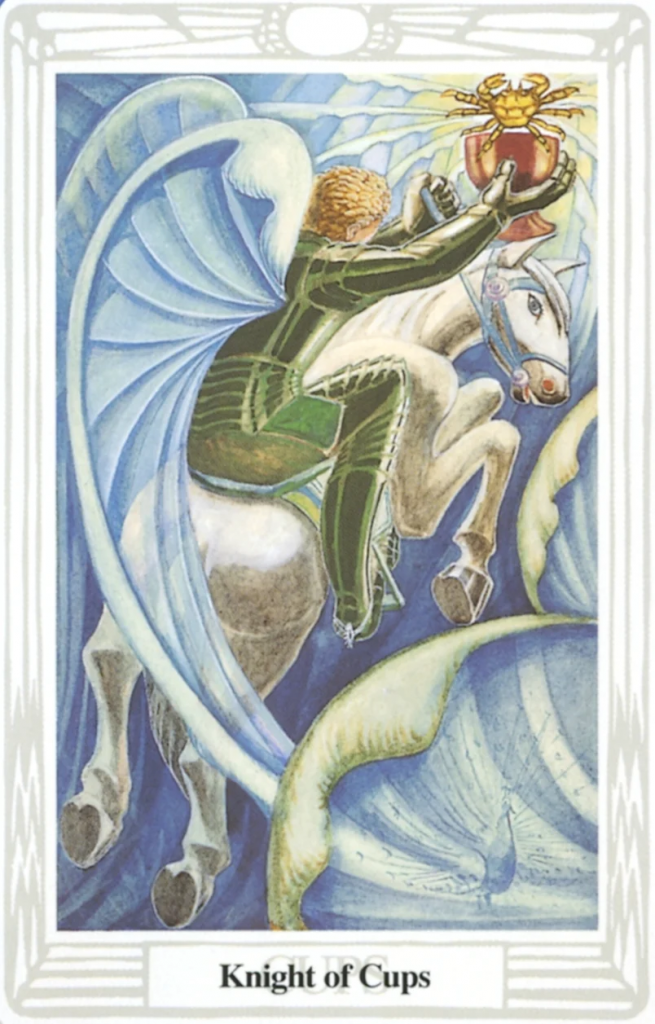
| The Knight of Cups This is the Lord of Waves and Water, often defined as the fiery aspect of water. As such, in many ways this card represents a contradiction. Most often when it appears, it will indicate an actual person who has influence. However sometimes it can also indicate a moodshift or a change of mode.Since the Suit of Cups is all about love and loving relationships, it’s easy to see how the Knight can be regarded as the lover of the cards. When representing a moodshift, the card can indicate the period where a man falls in love.When it represents a person he will be a complex and highly emotional being – creative and visionary, sensitive (and sometimes over-sensitive), romantic and intense. He will give the impression of being open and caring, though this is often misleading; the Knight of Cups is often subject to intense insecurity, needing constant re-assurance and attention.He is attracted and attractive to women, and enjoys basking in their company. He will often be very charming, with a silver tongue and a powerful personal agenda. He will rarely manage practical matters well, tending to place rather more importance on buying two dozen red roses, than paying the bills. At his worst, he can be inconstant, unfaithful and selfish.At his best, he is loving, generous with his emotions, supportive and tender. He can be capable of high levels of spiritual development, strong in intuition and warmly responsive. When he’s on form he is terrific company, having a good sense of humour and a keen interest in other people. He’s often an exciting and stimulating life partner and lover – but only at his best!You see – I said he was contradictory! |
In this collection of essays, poet Walt Whitman explores the state of democracy in America after the Civil War, offering his unique perspective on issues such as government, literature, and education. With his characteristic passion and eloquence, Whitman urges readers to embrace the democratic ideals that form the foundation of the American experiment. This work has been selected by scholars as being culturally important, and is part of the knowledge base of civilization as we know it. This work is in the “public domain in the United States of America, and possibly other nations. Within the United States, you may freely copy and distribute this work, as no entity (individual or corporate) has a copyright on the body of the work. Scholars believe, and we concur, that this work is important enough to be preserved, reproduced, and made generally available to the public. We appreciate your support of the preservation process, and thank you for being an important part of keeping this knowledge alive and relevant.
(Goodreads.com)
 The Buddha and a few disciples happened to pass a lake. Buddha stopped and asked one of his disciples to fetch some water because he was thirsty.