Is fascism on the rise in the United States? Some FrameLab readers have argued that we should be using the word “fascist” instead of “authoritarian,” “conservative” or “right-wing.”
They make a very good point. But what, exactly, is fascism? In “How Fascism Works: The Politics of Us and Them,” Yale University Professor Jason Stanley lists the ten main elements of fascism. We have summarized them below.
Key questions: Which of these elements do we see invading our politics today? Are all of the elements present, or only some? Is it time to use the “F” word to describe what has happened to the Republican Party? We look forward to reading your thoughts in the comments.
The 10 Elements of Fascism, from “How Fascism Works”:
1. The Mythic Past
Fascist politics invokes a glorified, mythological past that has supposedly been destroyed or undermined by liberal, foreign, or otherwise corrupting influences.
2. Propaganda
The use of propaganda to manipulate or control the public narrative is a hallmark of fascist politics. This often involves the use of misleading or blatantly false information to shape public perception.
3. Anti-intellectualism
Fascist movements often distrust intellectuals or the academic establishment, viewing them as part of the corrupt or degenerate elite, and as a threat to the “common sense” of the people.
4. Unreality
The creation of a disorienting, alternate reality through the repeated assertion of falsehoods, conspiracy theories, and the blurring of fact and opinion.
5. Hierarchy
The belief in a natural social hierarchy, as well as the supremacy of certain groups over others based on race, ethnicity, or nationality.
6. Victimhood
Fascists often position their in-group as the victims of an injustice perpetrated by out-groups, thereby justifying any action taken against these supposed enemies.
7. Law and Order
A strong emphasis on law and order, often as a pretext for suppressing political dissent and marginalizing minority groups.
8. Sexual Anxiety
The exploitation of sexual anxiety as a way to rally support for fascist causes, often through the control and subjugation of women’s bodies and the demonization of others’ sexual practices.
9. Sodom and Gomorrah
The portrayal of cosmopolitan or urban areas — cities — as places of moral decay, in contrast to the purity of the rural or traditional heartland.
10. “Arbeit Macht Frei”
The glorification of work and the stigmatization of those perceived as not contributing to the labor force, often used to target minority groups or the unemployed.
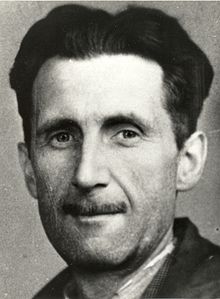
“Decades ago, George Orwell suggested that the best one-word description of a Fascist was ‘bully.’”
George Orwell
Eric Arthur Blair, better known by his pen name George Orwell (June 25, 1903 – January 21, 1950), was an English novelist, essayist, journalist, and critic. His work is characterised by lucid prose, social criticism, opposition to totalitarianism, and support of democratic socialism. Wikipedia
The biggest story about Trump’s indictments (including the one expected this week from Georgia) is that Trump is centering his entire presidential campaign on them — and along the way is seeking to meld his identity with those of his supporters, so they feel personally attacked by the prosecutions.
For Trump supporters, this is not rallying-around-the-flag. It’s not even rallying-around-a-former-president. It’s rallying-around-themselves — aligning their personal identities with Trump.
More than half of Republicans — including 77 percent of self-identified MAGA Republicans — say the indictments and investigations against Trump are an attack on people like them, according to a CBS News/YouGov poll taken soon after the most recent indictment.
Think of it this way: The indictments, Trump’s 2024 campaign, the grievances of millions of Americans against a system that has bullied them for years, and Trump’s pathological narcissism are all fusing into a single, unalterable, irrational mass movement.
“I am your justice, I am your retribution,” Trump said when announcing his campaign.
“I’m being indicted for you,” he said in June, after being charged with retaining government secrets.
“I AM BEING ARRESTED FOR YOU,” he posted in all caps on August 3, the day of his indictment for seeking to overthrow the 2020 election.
At a campaign event in New Hampshire last week, he claimed, “They want to silence me because I will never let them silence you.”
The philosopher Hannah Arendt has pointed out that the fascist leader fuses his identity with his followers, so that followers lose their capacities for independent thought.
As the fascist leader takes over the factual, psychological, and moral premises of the world his followers inhabit, the followers relinquish their freedoms. They suspend critical judgment. They become automatons.
Be warned. What Trump and much of the Republican Party have embarked upon is as dangerous to the future of our democracy, and to the rest of the world that looks to America for leadership, as was Trump’s attempted coup leading up to January 6, 2021.
We need to get the word out.
I recently shared with you what I consider the five core elements of fascism, and why fascism is different from authoritarianism. I argued that Trump and the Republican Party are moving rapidly toward fascism, and I urged the media to use the term “fascist” rather than “authoritarian” to describe what Trump and his GOP are up to.
The talented young people I work with at Inequality Media Civic Action have produced a powerful video that uses actual clips of Trump to make these points. I’m sharing it with you in hopes that you find it useful. Please share.
The Washington Postcalls Trump’s vision for a second term “authoritarian.” That vision includes mandatory stop-and-frisk. Deploying the military to fight street crime, break up gangs, and deport immigrants. Purging the federal workforce and charging leakers.
“In 2016, I declared I am your voice,” Trump said in a speech at the Conservative Political Action Conference and repeated at his first 2024 campaign rally in Waco, Texas. “Today, I add: I am your warrior. I am your justice. And for those who have been wronged and betrayed, I am your retribution.”
How do we describe what Trump wants for America? “Authoritarianism” isn’t adequate. It is “fascism.” Fascism stands for a coherent set of ideas different from — and more dangerous than — authoritarianism. To fight those ideas, it’s necessary to be aware of what they are and how they fit together.
1. The rejection of democracy, the rule of law, and equal rights under the law in favor of a strongman who interprets the popular will.
“The election was stolen.” (Trump, 2020)
“I am your justice. … I am your retribution.” (2023)
Authoritarians believe society needs strong leaders to maintain stability. They vest in a dictator the power to maintain social order through the use of force (armies, police, militia) and bureaucracy.
By contrast, fascists view strong leaders as the means of discovering what society needs. They regard the leader as the embodiment of society, the voice of the people.
2. The galvanizing of popular rage against cultural elites.
Authoritarians do not stir people up against establishment elites. They use or co-opt those elites in order to gain and maintain power.
By contrast, fascists galvanize public rage at presumed (or imaginary) cultural elites and use mass rage to gain and maintain power. They stir up grievances against those elites for supposedly displacing average people and seek revenge. In so doing, they create mass parties. They often encourage violence.
3. Nationalism based on a dominant “superior” race and historic bloodlines.
“Tremendous infectious disease is pouring across the border … The United States has become a dumping ground for Mexico and, in fact, for many other parts of the world.” (Trump, 2015)
“I think any Jewish people that vote for a Democrat, I think it shows either a total lack of knowledge or great disloyalty.” (2019)
“Getting critical race theory out of our schools is not just a matter of values, it’s also a matter of national survival … If we allow the Marxists and Communists and Socialists to teach our children to hate America, there will be no one left to defend our flag or to protect our great country or its freedom.” (2022)
Authoritarians see nationalism as a means of asserting the power of the state. They glorify the state. They want it to dominate other nations. They seek to protect or expand its geographic boundaries. They worry about foreign enemies encroaching on its territory.
By contrast, fascists see a nation as embodying what they consider a “superior” group — based on race, religion, and historic bloodlines. Nationalism is a means of asserting that superiority. They worry about disloyalty and sabotage from groups within the nation that don’t share the same race or bloodlines. These “others” are scapegoated, excluded or expelled, sometimes even killed.
Fascists believe schools and universities must teach values that extol the dominant race, religion, and bloodline. Schools should not teach inconvenient truths (such as America’s history of genocide and racism).
4. Extolling brute strength and heroic warriors.
“You’ll never take back our country with weakness, you have to show strength and you have to be strong. (Trump, January 6, 2021)
“I am your warrior.” (2023)
The goal of authoritarianism is to gain and maintain state power. For authoritarians, “strength” comes in the form of large armies and munitions.
By contrast, the ostensible goal of fascism is to strengthen society. Fascism’s method of accomplishing this is to reward those who win economically and physically and to denigrate or exterminate those who lose. Fascism depends on organized bullying — a form of social Darwinism.
For the fascist, war and violence are means of strengthening society by culling the weak and extolling heroic warriors.
5. Disdain of women and fear of non-standard forms of gender identity and sexual orientation.
“When you’re a star, they let you do it. You can do anything. Grab ‘em by the pussy. You can do anything.” (Trump, 2005)
“You have to treat ‘em like shit.” (1992)
I will “promote positive education about the nuclear family, the roles of mothers and fathers and celebrating, rather than erasing, the things that make men and women different.” (2023)
By contrast, fascism is organized around the particular hierarchy of male dominance. The fascist heroic warrior is male. Women are relegated to subservient roles.
In fascism, anything that challenges the traditional heroic male roles of protector, provider, and controller of the family is considered a threat to the social order. Fascism seeks to eliminate homosexuals, transgender, and queer people because they are thought to challenge or weaken the heroic male warrior.
***
These five elements of fascism reinforce each other.
Rejection of democracy in favor of a strongman depends on galvanizing popular rage.
Popular rage draws on a nationalism based on a supposed superior race or ethnicity.
That superior race or ethnicity is justified by a social Darwinist idea of strength and violence, as exemplified by heroic warriors.
Strength, violence, and the heroic warrior are centered on male power.
These five elements also find exact expression in Donald Trump and the White Christian National movement he is encouraging. It is also the direction most of the Republican Party is now heading.
These are not the elements of authoritarianism. They are the essential elements of fascism.
America’s mainstream media is by now comfortable talking and writing about Trump’s authoritarianism. In describing what he is seeking to impose on America, the media should be using the term “fascism.”
Consciousness, sexuality, androgyny, futurism, space, the arts, science, astrology, democracy, humor, books, movies and more