Carl Jung: The Second Half of Life

From “ego” to “self” can manifest as restlessness, a sense of emptiness, or questioning our life choices. It can be unsettling

Thomas Oppong

Thomas Oppong

Published in Personal Growth

Feb 14, 2024 (Medium.com)

Photo by Austin Ban on Unsplash

Life feels like a continuous forward motion — a progression towards an expected end. Between now and then, we go through phases. According to Carl Jung, the iconic Swiss psychiatrist, the first half of our lives is driven by the ego, the conscious self that interacts with the world. We try to fit in, pursue careers and build our lives around societal expectations. We acquire the skills and knowledge needed for life. We establish ourselves in society. Most people focus on outward expansion or pursue external goals. They lay firm foundations for their identities to evolve.

As we approach midlife, a natural turning point emerges. While life often unfolds in a linear narrative, Jung observed a distinct subtle shift midway through life. He called it the “second half of life — “ an inward search for our whole selves and meaning that transcends the superficialities of youth. The ego’s dominance wanes, and a new force emerges the “true self.” A deeper, archetypal aspect of the human psyche that represents our wholeness, our conscious and unconscious selves. It yearns for integration, reconciliation with our shadow aspects, and a connection to something larger than ourselves.

“The first half of life is devoted to forming a healthy ego, the second half is going inward and letting go of it,” says Jung.

People often experience it through existential questioning. External rewards feel less fulfilling, and a gnawing question arises: “Who am I, beyond the roles I play?” Jung observed it as a period of profound psychological transformation. For him, it was not a time of decline but of “flowering.” A stage of life where people turn inward and engage with their unconscious selves to become their “full” selves. “We cannot change anything unless we accept it,” he observes.

It feels like you’ve spent years climbing a mountain, driven by the desire to reach the peak. Now, standing at the summit, you realise the true beauty is not just in the view but in the journey itself. You begin to appreciate the hidden valleys, the rugged paths, and the lessons learned along the way. Central to Jung’s understanding of the second half of life is his concept of “individuation.” Unlike the “first half,” where we focus on externally driven goals and acquire an identity, the later phase is an integration process. People accept their “shadow” selves. The hidden aspects of themselves they ignored in the first half of life. The part society deemed unacceptable.

Jung thought acceptance of our darker selves was key to wholeness. “Until you make the unconscious conscious, it will direct your life and you will call it fate,” he said. Turning inward means facing the “archetypes,” the powerful universal elements embedded in our collective unconscious. The “self”, representing the totality of the psyche, becomes a central archetype we strive to integrate. It unlocks a sense of unity, purpose, and connection to something larger than ourselves.

“The meeting of two personalities is like the contact of two chemical substances: if there is any reaction, both are transformed,” Jung wrote.

He thought of the second half of life as a time for confronting our mortality. Pondering the finite nature of life compels us to re-evaluate what truly matters. That quick mental shift leads to a reprioritisation of values. A focus on deeper relationships and the pursuit of genuine meaning. Jung did not shy away from the challenges of this transition. Facing your shadow, confronting mortality, and integrating archetypes can be emotionally demanding. According to Jung, overcoming our ego’s dominance is a massive obstacle for many people. While it served its purpose in the first half of life, clinging to it rigidly in the second half hinders self-becoming.

The question is, how do we integrate Jung’s wisdom in real life? The first and most important step is recognising the shift in the many areas of your life.

Relationships can take on a different meaning. The need for external validation and approval transforms into a desire for deeper connection and intimacy. At work, external markers of success like promotions and salaries become less important than finding purpose and meaning. You may transition to careers that align with your values and inner purpose, even if it means sacrificing some material comfort. You define success on your own terms based on your deeper values, inner growth, and contribution to something larger than yourself that can bring deeper satisfaction and fulfilment. “Your visions will become clear only when you can look into your own heart. Who looks outside, dreams; who looks inside, awakes,” says Jung.

Many people focus on their spiritual growth in the second half of life. As Jung explored the archetypes of the collective unconscious, he observed the inherent human yearning for meaning and connection to something larger than ourselves. In the later years, the limitations of material pursuits become more evident. People engage in contemplative practices or connect with the mysteries of existence.

Jung’s concept of the second half of life isn’t a fixed narrative with guaranteed happy endings. It’s a messy process with its share of anxieties, losses, and disappointments.

The shift towards introspection is not always smooth. From “ego” to “self” can manifest as restlessness, a sense of emptiness, or questioning our life choices. It can be unsettling. “The most terrifying thing is to accept oneself completely,” Jung said. Unresolved conflicts, buried emotions, and hidden desires surface, often manifesting as stagnation, depression, or existential angst. But it presents an opportunity for profound transformation. “There’s no coming to consciousness without pain,” say Jung. Resisting change only prolongs the discomfort. Embrace the uncertainty and fluidity of the second half, which opens the door to self-discovery.

Make time for quiet reflections, journaling, or meditation to make the inward turn a success. Explore your emotions and recurring themes in your life. Seek a better understanding of your unconscious self, values, motivations, and fears. Revisit your assumptions about yourself, your relationships, and the world. Allow yourself to shed outdated identities. Don’t think of the second half of life as a decline but as an accumulation of experiences that shape your unique perspective. Share your wisdom and revel in the richness that comes with time.

Reconnect with activities, experiences, and personal projects that spark your soul, regardless of societal expectations. The reawakening can inject your life with meaning and purpose.

Seek connections that nourish your soul. Invest in deeper friendships, reconnect with estranged family, or join communities that share your values. In the first half, success often defines us. But in the second, pursuit meaning takes centre stage. Explore spirituality, volunteer your time or share in public. The second half of life is a chance to shed the masks and expectations, to finally embrace the “true” self and to leave the world a little brighter than you found it.

Let’s stay connected. Join over 70K curious subscribers who receive my best essays and free curated tools for smarter living. Join us and get a free ebook (A collection of essays on life, productivity, and happiness).

Thomas Oppong

Written by Thomas Oppong

·Writer for Personal Growth

Making the wisdom of great thinkers instantly accessible. As seen on Forbes, Inc. and Business Insider. For my popular essays, go here: https://thomasoppong.com

How to do laundry when you’re depressed

KC Davis | TEDxMileHigh • August 2022

Ever had a hard time doing daily household tasks — cooking, cleaning, laundry — and felt like a terrible person for struggling in the first place? Therapist KC Davis is here to flip that negative internalized script with a simple yet perspective-shifting fact that may change your approach to life. Learn a gentler, more practical approach to mental health as Davis shares hard-won wisdom and helpful shortcuts on how to get by when you feel like you’ve barely got it together.

About the speaker

KC Davis

Therapist and authorSee speaker profile

KC Davis offers a compassionate and practical approach to self and home care for those dealing with mental health, physical illness and hard seasons of life

The Day Dostoyevsky Discovered the Meaning of Life in a Dream

By Maria Popova (themarginalian.org)

One November night in the 1870s, legendary Russian writer Fyodor Dostoyevsky (November 11, 1821–February 9, 1881) discovered the meaning of life in a dream — or, at least, the protagonist in his final short story did. The piece, which first appeared in the altogether revelatory A Writer’s Diary (public library) under the title “The Dream of a Queer Fellow” and was later published separately as The Dream of a Ridiculous Man, explores themes similar to those in Dostoyevsky’s 1864 novel Notes from the Underground, considered the first true existential novel. True to Stephen King’s assertion that “good fiction is the truth inside the lie,” the story sheds light on Dostoyevsky’s personal spiritual and philosophical bents with extraordinary clarity — perhaps more so than any of his other published works. The contemplation at its heart falls somewhere between Tolstoy’s tussle with the meaning of life and Philip K. Dick’s hallucinatory exegesis.

Portrait of Fyodor Dostoyevsky by Vasily Perov, 1871

The story begins with the narrator wandering the streets of St. Petersburg on “a gloomy night, the gloomiest night you can conceive,” dwelling on how others have ridiculed him all his life and slipping into nihilism with the “terrible anguish” of believing that nothing matters. He peers into the glum sky, gazes at a lone little star, and contemplates suicide; two months earlier, despite his destitution, he had bought an “excellent revolver” with the same intention, but the gun had remained in his drawer since. Suddenly, as he is staring at the star, a little girl of about eight, wearing ragged clothes and clearly in distress, grabs him by the arm and inarticulately begs his help. But the protagonist, disenchanted with life, shoos her away and returns to the squalid room he shares with a drunken old captain, furnished with “a sofa covered in American cloth, a table with some books, two chairs and an easy-chair, old, incredibly old, but still an easy-chair.”

As he sinks into the easy-chair to think about ending his life, he finds himself haunted by the image of the little girl, leading him to question his nihilistic disposition. Dostoyevsky writes:

I knew for certain that I would shoot myself that night, but how long I would sit by the table — that I did not know. I should certainly have shot myself, but for that little girl.
You see: though it was all the same to me, I felt pain, for instance. If any one were to strike me, I should feel pain. Exactly the same in the moral sense: if anything very pitiful happened, I would feel pity, just as I did before everything in life became all the same to me. I had felt pity just before: surely, I would have helped a child without fail. Why did I not help the little girl, then? It was because of an idea that came into my mind then. When she was pulling at me and calling to me, suddenly a question arose before me, which I could not answer. The question was an idle one; but it made me angry. I was angry because of my conclusion, that if I had already made up my mind that I would put an end to myself to-night, then now more than ever before everything in the world should be all the same to me. Why was it that I felt it was not all the same to me, and pitied the little girl? I remember I pitied her very much: so much that I felt a pain that was even strange and incredible in my situation…

It seemed clear that if I was a man and not a cipher yet, and until I was changed into a cipher, then I was alive and therefore could suffer, be angry and feel shame for my actions. Very well. But if I were to kill myself, for instance, in two hours from now, what is the girl to me, and what have I to do with shame or with anything on earth? I am going to be a cipher, an absolute zero. Could my consciousness that I would soon absolutely cease to exist, and that therefore nothing would exist, have not the least influence on my feeling of pity for the girl or on my sense of shame for the vileness I had committed?

From the moral, he veers into the existential:

It became clear to me that life and the world, as it were, depended upon me. I might even say that the world had existed for me alone. I should shoot myself, and then there would be no world at all, for me at least. Not to mention that perhaps there will really be nothing for any one after me, and the whole world, as soon as my consciousness is extinguished, will also be extinguished like a phantom, as part of my consciousness only, and be utterly abolished, since perhaps all this world and all these men are myself alone.

Beholding “these new, thronging questions,” he plunges into a contemplation of what free will really means. In a passage that calls to mind John Cage’s famous aphorism on the meaning of life — “No why. Just here.” — and George Lucas’s assertion that “life is beyond reason,” Dostoyevsky suggests through his protagonist that what gives meaning to life is life itself:

One strange consideration suddenly presented itself to me. If I had previously lived on the moon or in Mars, and I had there been dishonored and disgraced so utterly that one can only imagine it sometimes in a dream or a nightmare, and if I afterwards found myself on earth and still preserved a consciousness of what I had done on the other planet, and if I knew besides that I would never by any chance return, then, if I were to look at the moon from the earth — would it be all the same to me or not? Would I feel any shame for my action or not? The questions were idle and useless, for the revolver was already lying before me, and I knew with all my being that this thing would happen for certain: but the questions excited me to rage. I could not die now, without having solved this first. In a word, that little girl saved me, for my questions made me postpone pulling the trigger.

Just as he ponders this, the protagonist slips into sleep in the easy-chair, but it’s a sleep that has the quality of wakeful dreaming. In one of many wonderful semi-asides, Dostoyevsky peers at the eternal question of why we have dreams:

Dreams are extraordinarily strange. One thing appears with terrifying clarity, with the details finely set like jewels, while you leap over another, as though you did not notice it at all — space and time, for instance. It seems that dreams are the work not of mind but of desire, not of the head but of the heart… In a dream things quite incomprehensible come to pass. For instance, my brother died five years ago. Sometimes I see him in a dream: he takes part in my affairs, and we are very excited, while I, all the time my dream goes on, know and remember perfectly that my brother is dead and buried. Why am I not surprised that he, though dead, is still near me and busied about me? Why does my mind allow all that?

In this strange state, the protagonist dreams that he takes his revolver and points it at his heart — not his head, where he had originally intended to shoot himself. After waiting a second or two, his dream-self pulls the trigger quickly. Then something remarkable happens:

I felt no pain, but it seemed to me that with the report, everything in me was convulsed, and everything suddenly extinguished. It was terribly black all about me. I became as though blind and numb, and I lay on my back on something hard. I could see nothing, neither could I make any sound. People were walking and making a noise about me: the captain’s bass voice, the landlady’s screams… Suddenly there was a break. I am being carried in a closed coffin. I feel the coffin swinging and I think about that, and suddenly for the first time the idea strikes me that I am dead, quite dead. I know it and do not doubt it; I cannot see nor move, yet at the same time I feel and think. But I am soon reconciled to that, and as usual in a dream I accept the reality without a question.

Now I am being buried in the earth. Every one leaves me and I am alone, quite alone. I do not stir… I lay there and — strange to say — I expected nothing, accepting without question that a dead man has nothing to expect. But it was damp. I do not know how long passed — an hour, a few days, or many days. Suddenly, on my left eye which was closed, a drop of water fell, which had leaked through the top of the grave. In a minute fell another, then a third, and so on, every minute. Suddenly, deep indignation kindled in my heart and suddenly in my heart I felt physical pain. ‘It’s my wound,’ I thought. ‘It’s where I shot myself. The bullet is there.’ And all the while the water dripped straight on to my closed eye. Suddenly, I cried out, not with a voice, for I was motionless, but with all my being, to the arbiter of all that was being done to me.

“Whosoever thou art, if thou art, and if there exists a purpose more intelligent than the things which are now taking place, let it be present here also. But if thou dost take vengeance upon me for my foolish suicide, then know, by the indecency and absurdity of further existence, that no torture whatever that may befall me, can ever be compared to the contempt which I will silently feel, even through millions of years of martyrdom.”

I cried out and was silent. Deep silence lasted a whole minute. One more drop even fell. But I knew and believed, infinitely and steadfastly, that in a moment everything would infallibly change. Suddenly, my grave opened. I do not know whether it had been uncovered and opened, but I was taken by some dark being unknown to me, and we found ourselves in space. Suddenly, I saw. It was deep night; never, never had such darkness been! We were borne through space and were already far from the earth. I asked nothing of him who led me. I was proud and waited. I assured myself that I was not afraid, and my heart melted with rapture at the thought that I was not afraid. I do not remember how long we rushed through space, and I cannot imagine it. It happened as always in a dream when you leap over space and time and the laws of life and mind, and you stop only there where your heart delights.

The 1845 depiction of a galaxy that inspired Van Gogh’s ‘The Starry Night,’ from Michael Benson’s Cosmigraphics: Picturing Space Through Time

Through the thick darkness, he sees a star — the same little star he had seen before shooing the girl away. As the dream continues, the protagonist describes a sort of transcendence akin to what is experienced during psychedelic drug trips or in deep meditation states:

Suddenly a familiar yet most overwhelming emotion shook me through. I saw our sun. I knew that it could not be our sun, which had begotten our earth, and that we were an infinite distance away, but somehow all through me I recognized that it was exactly the same sun as ours, its copy and double. A sweet and moving delight echoed rapturously through my soul. The dear power of light, of that same light which had given me birth, touched my heart and revived it, and I felt life, the old life, for the first time since my death.

He finds himself in another world, Earthlike in every respect, except “everything seemed to be bright with holiday, with a great and sacred triumph, finally achieved” — a world populated by “children of the sun,” happy people whose eyes “shone with a bright radiance” and whose faces “gleamed with wisdom, and with a certain consciousness, consummated in tranquility.” The protagonist exclaims:

Oh, instantly, at the first glimpse of their faces I understood everything, everything!

Conceding that “it was only a dream,” he nonetheless asserts that “the sensation of the love of those beautiful and innocent people” was very much real and something he carried into wakeful life on Earth. Awaking in his easy-chair at dawn, he exclaims anew with rekindled gratitude for life:

Oh, now — life, life! I lifted my hands and called upon the eternal truth, not called, but wept. Rapture, ineffable rapture exalted all my being. Yes, to live…

Dostoyevsky concludes with his protagonist’s reflection on the shared essence of life, our common conquest of happiness and kindness:

All are tending to one and the same goal, at least all aspire to the same goal, from the wise man to the lowest murderer, but only by different ways. It is an old truth, but there is this new in it: I cannot go far astray. I saw the truth. I saw and know that men could be beautiful and happy, without losing the capacity to live upon the earth. I will not, I cannot believe that evil is the normal condition of men… I saw the truth, I did not invent it with my mind. I saw, saw, and her living image filled my soul for ever. I saw her in such consummate perfection that I cannot possibly believe that she was not among men. How can I then go astray? … The living image of what I saw will be with me always, and will correct and guide me always. Oh, I am strong and fresh, I can go on, go on, even for a thousand years.

[…]

And it is so simple… The one thing is — love thy neighbor as thyself — that is the one thing. That is all, nothing else is needed. You will instantly find how to live.

A century later, Jack Kerouac would echo this in his own magnificent meditation on kindness and the “Golden Eternity.”

A Writer’s Diary is a beautiful read in its entirety. Complement it with Tolstoy on finding meaning in a meaningless world and Margaret Mead’s dreamed epiphany about why life is like blue jelly.

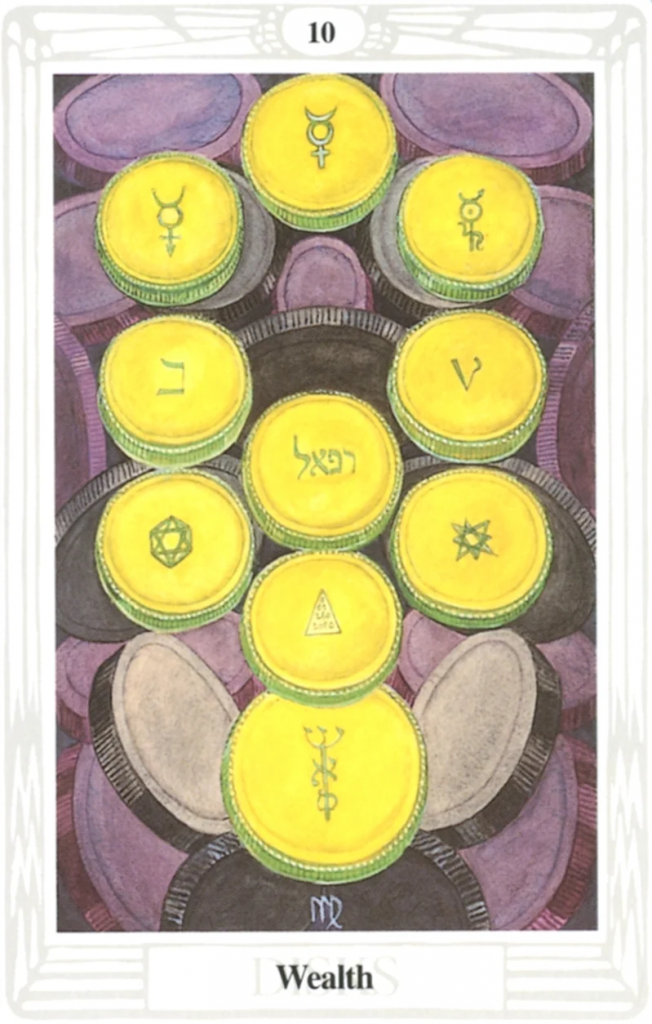
Tarot Card for March 14: The Ten of Disks

The Ten of Disks

The Lord of Wealth talks not only about material wealth and its appropriate use, but about the inner wealth and resources that we all have. This is a card that teaches us that the harvest we gather in our lives is the end result of all that we have put into living – and more importantly, how we have used the riches at our disposal.We make our own realities with every thought, every deed, every wish. And when we direct our energies positively we shall arrive – as a perfectly natural consequence – at the Ten of Disks. Of course, if we direct our energies negatively we’ll find ourselves with the Ten of Wands, or the Ten of Swords – neither of which are happy cards!There is a warning connected to this card though. When we have created sufficient wealth to make ourselves comfortable and contented, if we have a surplus, then we must make that surplus work. We cannot expect energy to flow freely in our lives if we hoard it, and try to hang on to it. This is as pointless as trying to save up the breeze so that it will blow on a stuffy day! There are some things in life you cannot clutch tight in the hand without crushing their value out of them.If this card comes up in an everyday reading, it re-assures that financial and material matters are proceeding well, and that there is no cause for concern.If it comes up in a more spiritually based reading, then we need to be applying the underlying principles to our lives – so in this case, we need to be letting our inner wealth show, in order to manifest that into our lives.

Free Will Astrology: Week of March 14, 2024

BY ROB BREZSNY | MARCH 12, 2024 (NewCity.com)

At Poon Hill in Nepal/Photo: Sylwia Bartyzel

ARIES (March 21-April 19): I will never advise you to dim the flame of your ambition or be shy about radiating your enthusiasm. For the next few weeks, though, I urge you to find ways to add sap, juice and nectar to your fiery energy. See if you can be less like a furnace and more like a sauna; less like a rumbling volcano and more like a tropical river. Practically speaking, this might mean being blithely tender and unpredictably heartful as you emanate your dazzling glow.

TAURUS (April 20-May 20): Some spiritual traditions tell us that the path to enlightenment and awakening is excruciatingly difficult. One teaching compares it to crossing a bridge that’s sharper than a sword, thinner than a hair, and hotter than fire. Ideas like these have no place in my personal philosophy. I believe enlightenment and awakening are available to anyone who conscientiously practices kindness and compassion. A seeker who consistently asks, “What is the most loving thing I can do?” will be rewarded with life-enhancing transformations. Now I invite you to do what I just did, Taurus. That is, re-evaluate a task or process that everyone (maybe even you) assumes is hard and complicated. Perform whatever tweaks are necessary to understand it as fun, natural and engaging.

GEMINI (May 21-June 20): Do you have a relative your parents never told you about? If so, you may find out about them soon. Do you have a secret you want to keep secret? If so, take extra caution to ensure it stays hidden. Is there a person you have had a covert crush on for a while? If so, they may discover your true feelings any minute now. Have you ever wondered if any secrets are being concealed from you? If so, probe gently for their revelation, and they just may leak out. Is there a lost treasure you have almost given up on finding? If so, revive your hopes.

CANCER (June 21-July 22): Cancerian poet Pablo Neruda wrote this to a lover: “I want to do with you what spring does with the cherry trees.” That sounds very romantic. What does it mean? Well, the arrival of spring brings warmer soil and air, longer hours of sunlight, and nurturing precipitation. The flowers of some cherry trees respond by blooming with explosive vigor. Some trees sprout upwards of 4,000 blossoms. Maybe Neruda was exaggerating for poetic effect, but if he truly wanted to rouse his lover to be like a burgeoning cherry tree, he’d have to deal with an overwhelming outpouring of lush beauty and rampant fertility. Could he have handled it? If I’m reading the upcoming astrological omens correctly, you Cancerians now have the power to inspire and welcome such lavishness. And yes, you can definitely handle it.

LEO (July 23-Aug. 22): Speaking on behalf of all non-Leos, I want to express our gratitude for the experiments you have been conducting. Your willingness to dig further than ever before into the mysterious depths is exciting. Please don’t be glum just because the results are still inconclusive and you feel a bit vulnerable. I’m confident you will ultimately generate fascinating outcomes that are valuable to us as well as you. Here’s a helpful tip: Give yourself permission to be even more daring and curious. Dig even deeper.

VIRGO (Aug. 23-Sept. 22): Unexpected mixtures are desirable, though they may initially feel odd. Unplanned and unheralded alliances will be lucky wild cards if you are willing to set aside your expectations. Best of all, I believe you will be extra adept at creating new forms of synergy and symbiosis, even as you enhance existing forms. Please capitalize on these marvelous openings, dear Virgo. Are there parts of your life that have been divided, and you would like to harmonize them? Now is a good time to try. Bridge-building will be your specialty for the foreseeable future.

LIBRA (Sept. 23-Oct. 22): Many of you Libras have a special talent for tuning into the needs and moods of other people. This potentially gives you the power to massage situations to serve the good of all. Are you using that power to its fullest? Could you do anything more to harness it? Here’s a related issue: Your talent for tuning into the needs and moods of others can give you the capacity to massage situations in service to your personal aims. Are you using that capacity to its fullest? Could you do anything more to harness it? Here’s one more variation on the theme: How adept are you at coordinating your service to the general good and your service to your personal aims? Can you do anything to enhance this skill? Now is an excellent time to try.

SCORPIO (Oct. 23-Nov. 21): Psychologist Carl Jung said, “One of the most difficult tasks people can perform is the invention of good games. And this cannot be done by people out of touch with their instinctive selves.” According to my astrological assessment, you will thrive in the coming weeks when you are playing good, interesting games. If you dream them up and instigate them yourself, so much the better. And what exactly do I mean by “games”? I’m referring to any organized form of play that rouses fun, entertainment and education. Playing should be one of your prime modes, Scorpio! As Jung notes, that will happen best if you are in close touch with your instinctual self—also known as your animal intelligence.

SAGITTARIUS (Nov. 22-Dec. 21): Can Sagittarians ever really find a home they are utterly satisfied with? Are they ever at peace with exactly who they are and content to be exactly where they are? Some astrologers suggest these are difficult luxuries for you Centaurs to accomplish. But I think differently. In my view, it’s your birthright to create sanctuaries for yourself that incorporate so much variety and expansiveness that you can feel like an adventurous explorer without necessarily having to wander all over the earth. Now is an excellent time to work on this noble project.

CAPRICORN (Dec. 22-Jan. 19): You picked Door #2 a while back. Was that the best choice? I’m not sure. Evidence is still ambiguous. As we await more conclusive information, I want you to know that Door #1 and Door #3 will soon be available for your consideration again. The fun fact is that you can try either of those doors without abandoning your activities in the area where Door #2 has led you. But it’s important to note that you can’t try both Door #1 and Door #3. You must choose one or the other. Proceed with care and nuance, Capricorn, but not with excessive caution. Your passwords are “daring sensitivity” and “discerning audacity.”

AQUARIUS (Jan. 20-Feb. 18): My second cousin has the same name as me and lives in Kosice, Slovakia. He’s a Slovakian-speaking chemical engineer who attended the Slovak University of Technology. Do we have anything in common besides our DNA and names? Well, we both love to tell stories. He and I are both big fans of the band Rising Appalachia. We have the same mischievous brand of humor. He has designed equipment and processes to manufacture products that use chemicals in creative ways, and I design oracles to arouse inspirations that change people’s brain chemistry. Now I invite you, Aquarius, to celebrate allies with whom you share key qualities despite being quite different. It’s a fine time to get maximum enjoyment and value from your connections with such people.

PISCES (Feb. 19-March 20): My Piscean friend Jeff Greenwald wrote the humorous but serious book “Shopping for Buddhas.” It’s the story of his adventures in Nepal as he traveled in quest of a statue to serve as a potent symbol for his spiritual yearning. I’m reminded of his search as I ruminate on your near future. I suspect you would benefit from an intense search for divine inspiration—either in the form of an iconic object, a pilgrimage to a holy sanctuary, or an inner journey to the source of your truth and love.

Homework: See a compendium of my Big-Picture Forecasts for you in 2024: tinyurl.com/BigPicture2024

Mirror

By Heather Williams, H.W., M. (with permission)

March 8, 2024 (TheProsperos.org)

MIRROR = to reflect; to resemble; a smooth surface that forms images by reflection

QUESTION: Have you practiced mirror work?

STORY: I learned to do mirror work when I worked with Louise Hay 1987-1999. This valuable practice helped me move forward through some challenges and I recommend that you try it. Mirror work is a spiritual practice of sitting calmly and looking at your own reflection in a mirror – without judgment – for about one or two minutes. As you look at your reflection you notice that you have little or big criticisms or judgments about your hair, your nose, your mouth, or something else. When these criticisms come to mind – you say: “Thank you for sharing” and then you return to looking without judgment. When you feel ready – say these words three times – to yourself: “I am willing to learn to love and accept you exactly as you are.” “I am willing to learn to love and accept you exactly as you are.” “I am willing to learn to love and accept you exactly as you are.”

QUOTES

The world is a great mirror. It reflects back to you what you are.” ~ Thomas Dreier

“Do you want to meet the love of your life? Look in the mirror.” ~Byron Katie; “Beauty is eternity gazing at itself in a mirror.” ~Khalil Gibran

“Everything in your life, every experience, every relationship is a mirror of the mental pattern that is going on inside of you.” ~ Louise Hay

EXERCISE

STOP.

Sit quietly. Assume an erect posture.

Sense the breath.

Sit calmly and find a mirror.

Gently look at your reflection. Pay attention to thoughts, judgments, feelings that pop up. Say: I am willing to learn to love and accept you exactly as you are. Repeat this 3 times.

Get your pen and paper and write words and draw lines expressing your experience. Move forward into your day loving and accepting yourself.

We Are Defining Love the Wrong Way

Getty Images

IDEAS

BY RABBI DAVID WOLPE

FEBRUARY 16, 2016 (Time.com)

Wolpe is the Max Webb Senior Rabbi of Sinai Temple in Los Angeles, the author of eight books and has been named one of the 50 most influential Jews in the world by the Jerusalem Post.

It is time to change the meaning of the word “love.”

The word is mostly used according to the first definition given in the dictionary: “an intense feeling of deep affection.” In other words, love is what one feels.

After years spent speaking with couples before, during and after marriage; and of talking to parents and children struggling with their relationships, I am convinced of the partiality of the definition. Love should be seen not as a feeling but as an enacted emotion. To love is to feel and act lovingly.

Too many women have told me, bruises visible on their faces, that the husbands who struck them love them. Since they see love as a feeling, the word hides the truth, which is that you do not love someone whom you repeatedly beat and abuse. You may have very strong feelings about them, you may even believe you cannot live without them, but you do not love them.

The first love mentioned in the Bible is not romantic love, but parental love (Genesis 22). When a child is born, the parent’s reaction to this person, who so recently did not exist, is to feel that “I would do anything for her.” In the doing is the love—the feeling is enacted. That is why we often hear the phrase “you don’t act like you love me.” We know in our bones that love is not a feeling alone, but a feeling that flows into the world in action.

Between human beings, love is a relational word. Yes, you can love things that do not love you back—the sky or a mountain or a painting or the game of chess. But the love of other people is directional. There is a lover and a beloved—you don’t just love, but you love at someone. And real love is not only about the feelings of the lover; it is not egotism. It is when one person believes in another person and shows it.

In Fiddler on the Roof, when Tevye asks Golde whether she loves him after a quarter century of marriage, her wry answer is exactly on point:

For twenty-five years I’ve washed your clothes
Cooked your meals, cleaned the house
Given you children, milked your cow
She asks then, “If that’s not love, what is?”

Of course it is possible to perform all sorts of duties for someone and feel little or nothing for them. Love is not about being hired help. Love is not an obligation done with a cold soul. But neither is it a passion that expresses itself in cruelty, or one that does not express itself at all. The feeling must be wedded to the deed.

We would have a healthier conception of love if we understood that love, like parenting or friendship, is a feeling that expresses itself in action. What we really feel is reflected in what we do. The poet’s song is dazzling and the passion powerful, but the deepest beauty of love is how it changes lives.

(Contributed by Steve Hines)

Consciousness, sexuality, androgyny, futurism, space, the arts, science, astrology, democracy, humor, books, movies and more