The universe intends that I be loved. All is planned for my greater good.
As the handwriting of God, the universe both self-organizes and self-corrects. Through love I am connected to a pattern of perfection. All problems in the world – from the subtle to the immense – derive from someone having lost connection to the love within their hearts.
Today I plant myself within love’s universe, that I may dwell within the miraculous matrix. As I align my thoughts and actions with love, I experience my greater good. I trust the universe to create through me ever-increasing dimensions of peace and joy.
I do not know how to control the universe, nor do I need to. The universe is controlled by love and love alone. Outside love’s embrace the world is chaos, but within it all is safe and secure. Today I choose the arms of love in which to rest my soul.
The universe intends that I be loved. All is planned for my greater good.
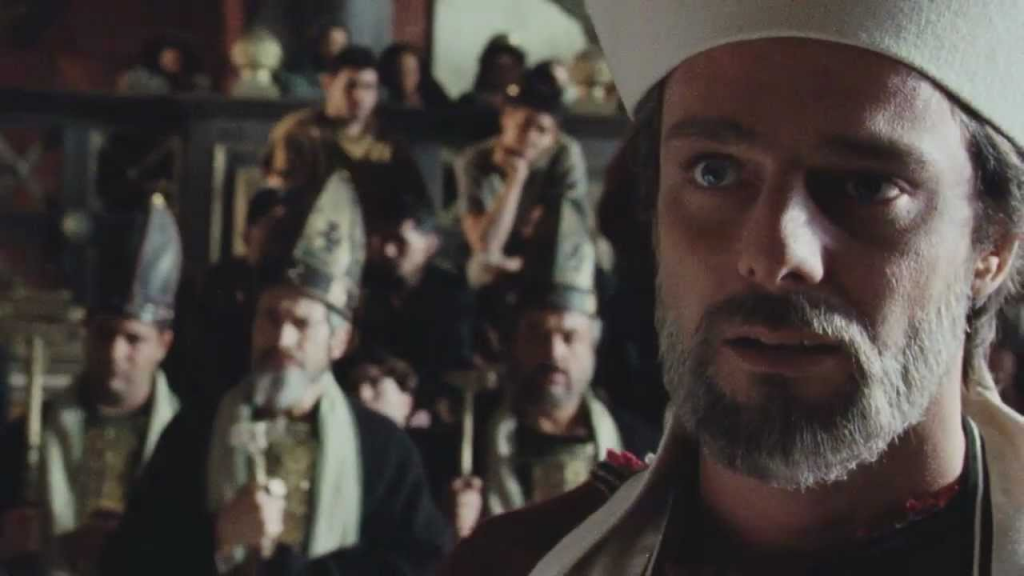
Saint Monica portrayed by actress Monica Guerritore in Restless Heart.
“We are already living an eternal life, my son.”
–St. Augustine’s mother, St. Monica in the movie Restless Heart
Monica (331 C.E. – August 27, 387 C.E.) was an early North African Christian saint and the mother of Augustine of Hippo. She is remembered and honored in the Catholic and Orthodox Churches, albeit on different feast days, for her … Wikipedia
“For this world shall pass away by transmutation [i.e., Translation], not by absolute destruction.“
–St. Augustine from City of God, Book XX
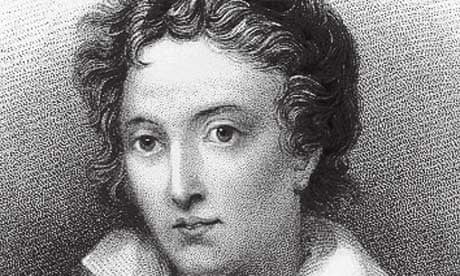
Augustine of Hippo, also known as Saint Augustine (November 13, 354 C.E. – August 28, 430 C.E), was a theologian and philosopher of Berber origin and the bishop of Hippo Regius in Numidia, Roman North Africa. Wikipedia
“Ambition, lustful, narcissistic—I was all of these things. God gave me a mother; she showed me that nothing in this material world is worthy of our ambition. God gave me a woman; she showed me that loving means renouncing oneself. God gave me a son; I started to believe that he was created in my image. God took him away from me to show me that he was created in his image. Ambitious, lustful, narcissistic—I was all these things, and still am, as we all are. As we all are. But not one of us is alone—ever. Not even when we are in desperation, bitterness, darkness. God is close to us. God is more brother than any brother… He is more friend than any friend… More lover than any lover…”
What would it be like to catch up to a beam of light? That was the question that the 16 year old Einstein asked himself. Ten years later, he would publish his answer: you cannot catch it at all.
That doesn’t stop physicists from trying to use Einstein’s theory to explain what a beam of light might “experience”. Unfortunately, they almost always get it wrong because they try to transfer our concept of time to light inappropriately.
There are different ways to think about time in physics. A dimension is “timelike” if it has a metric signature that is the opposite of your space dimensions. We define a dimension using a coordinate. Moving in a particular dimension means making a small displacement such that all but that coordinate stay the same. A metric, meanwhile, is a mathematical object that allows us to measure distances in multidimensional spaces with arbitrary coordinate systems.
You can see right away that it is possible to create coordinate systems where our concepts of time and space might be very complicated over long distances. For example, if I were to take a spacetime and define a hyperspherical coordinate system on it somewhat arbitrarily, there is no guarantee that any particular coordinate direction will align with my familiar concept of time. In such a system I would have three angles and a radial direction. If I were to define it such that time is in an angular dimension rather than the radial one, that might work for a small amount of time but eventually time which I perceive would deviate from that dimension. You could say this is just a bad choice of coordinates and you’d be right. Still, nevertheless, at any given point there will be a particular direction that is “timelike” in the sense that if I apply my metric to it, it will be negative (assuming we choose our signs so that timelike is negative and spacelike is positive which is often written -+++).
In the familiar four dimensions we normally work with there is only one dimension of time. That means that, for a given observer, there is a timelike Killing vector that defines time for them. A Killing vector is another useful mathematical object, and all it says is that if I displace a small amount in the direction of this Killing vector then all the other points get displaced such that they stay the same in relation to one another.
Wikimedia Commons.
The above is an example I copied from Wikipedia just for illustration purposes. In this case, the Killing vectors are the white arrows. If you move along these vectors, the circle rotates, so nothing changes.
If I have a particle moving through spacetime, it traces out a line called a world line. In this case, its Killing vector is simply in the direction of its motion in spacetime. If we are in the particle’s reference frame, meaning it is not moving at all from our perspective, then that vector would simply be in time alone.
Worldline in Einstein’s Special Relativity. Wikimedia Commons.
Another perspective on time is a little different and that has to do with the perception of time. Things don’t just move in time, they experience change in time. As far as we know, we never experience more than one moment of time simultaneously. That sense of experience of time is sometimes called a temporal dimension. It is not present in the theory of general relativity at all because in that theory time is treated like an ordinary dimension. Time is only special because it is timelike so it has a causal structure. That causal structure, however, doesn’t tell us anything about how time is experienced.
Our experience of time, the fact that time has an arrow and things flow from past to future, is only contained in one physical theory: thermodynamics (as well as its quantum equivalent). Yet, these theories are not fundamental but only look at how particles (or more generally what are called microstates) behave in large numbers. Fundamentally, there is no real explanation for the arrow of time.
Our dimension of time, the one we are familiar with, has both of these properties: it is timelike, and it is temporal.
I came across an idea for how to explain what time is like for light while playing around with a coordinate system called the Infalling (or in-going) Eddington-Finklestein coordinate system. This coordinate system was first written down by Sir Roger Penrose but he credited papers by Arthur Eddington and David Finklestein. The classic textbook on general relativity, Gravitation by Misner, Thorne, and Wheeler, affectionately known by those in the biz as “MTW” also used this name. It has stuck ever since.
This coordinate system was developed to look at black holes from the perspective of beams of light falling in. Thus, imagine you are riding a beam of light as if falls in.
In general relativity, a beam of light follows a null trajectory, meaning that if you calculate the length of its velocity vector in four dimensions, its length is zero. That may seem counter-intuitive, but, in spacetime, when computing distances, the square of the time component of the velocity has the opposite sign of the space components. If the length of the time component, the temporal speed, is equal to the spatial speed, you have a null trajectory. The only objects that have spatial and temporal speeds the correct sizes for this to happen are those going the speed of light. All such objects also, by definition, have no “rest mass”, meaning if we could ride those beams of light we would measure no mass.
Many science communicators, including professional physicists, attempt to explain what you would experience as a beam of light by imagining what happens as a massive object, such as yourself, accelerates closer and closer to the speed of light. From the perspective of someone watching you accelerate, you would appear to slow down more and more. Since this process continues indefinitely, it would seem that at the speed of light, which you can never reach, your clock would stop and you would no longer experience time.
This isn’t quite correct, however, because nothing with rest mass can have a null trajectory. As you approach the speed of light, rather, the length of your four-dimensional velocity stays the same, nonzero. As your spatial speed increases, instead, your temporal speed also increases to compensate. That is why you appear to slow down. At the speed of light, the lengths of these two speeds would be effectively infinite, so, yes, your clock might stop. (Your spatial and temporal speed become infinite rather than just equal to the speed of light because of its Lorentz factor, which gets multiplied by the two values to express the total velocity in spacetime.)
This means that you are not approaching anything like a null trajectory as you accelerate. For the beam of light, both temporal and spatial speed are finite and they are both, in the right units, the speed of light itself, not infinity.
Thus, while your clock does become infinitely slow to an outside observer as you approach the speed of light, light itself has a perfectly ordinary ticking clock that can never change. It never gets slower and never gets faster. It is always the same for all observers: exactly the speed of light. Yet, one cannot exist within the rest frame of light and so the one place where such a clock does not exist is there.
In other words, it is meaningless to talk about what a beam of light experiences because such a statement presumes a rest frame, and light doesn’t have one.
There is, however, a way in which light does not perceive the passage of time and we can understand that if we look at light falling into black holes.
Black holes put massive and massless objects on a more even playing field where we can compare the two and what happens as they approach the event horizon.
In our usual coordinate system for a black hole, which represents a distant, stationary observer, as an astronaut approaches the event horizon time slows down. If they have a clock with them sending out regular pulses back to the distant observer, the interval between the pulses would get longer and longer until they would effectively stop. We can know that because the time coordinate becomes infinite at the event horizon. We say there is a singularity there.
This singularity, at the event horizon, however, is not a real one but a coordinate singularity, and we can remove it with a new coordinate system.
When we change coordinate systems, however, we are changing our perspective. The infalling EF coordinates change that perspective to that of a light beam falling into the black hole.
In these coordinates, we have a new kind of time parameter, usually called v, which is a combination of our usual time and a radial coordinate called the tortoise coordinate. The tortoise coordinate goes to negative infinity as one approaches the event horizon of a black hole.
We now add together our old time coordinate and the tortoise coordinate and the infinities cancel each other out. (We can formalize this cancellation using the mathematical concept of limits.)
This new coordinate, v, when kept constant, represents the trajectory of a beam of light falling into the black hole.
Unfortunately, the picture of EF coordinates on Wikipedia is misleading, but you can look at the correct picture here in Figure 19.4. Essentially, the constant v lines lie on the edge of light cones as they turn in towards the black hole.
Now, suppose I want to take a spacetime in infalling EF coordinates and decompose it into space evolving in time rather than only individual trajectories. We call space at a given moment in time a spatial slice. These spatial slices evolve along lines where v is constant, meaning that the change in v from slice to slice is zero.
Since v stands in for our time coordinate here, it is clear that “time” isn’t changing from slice to slice. We still move forward from slice to slice from the perspective of a distant observer, but, from the perspective of an internal observer, there is no movement. The clock is always pointing to the same time from the beginning of the universe to the end.
This is the correct way to think about a beam of light. Rather than imagining a massive body accelerating to the speed of light, we simply imagine a coordinate system that is aligned with light trajectories.
It turns out that our intuition from special relativity is correct. Light has no experience of time at all. Every point along the beam has an independent existence as if it were in a separate universe from all the others.
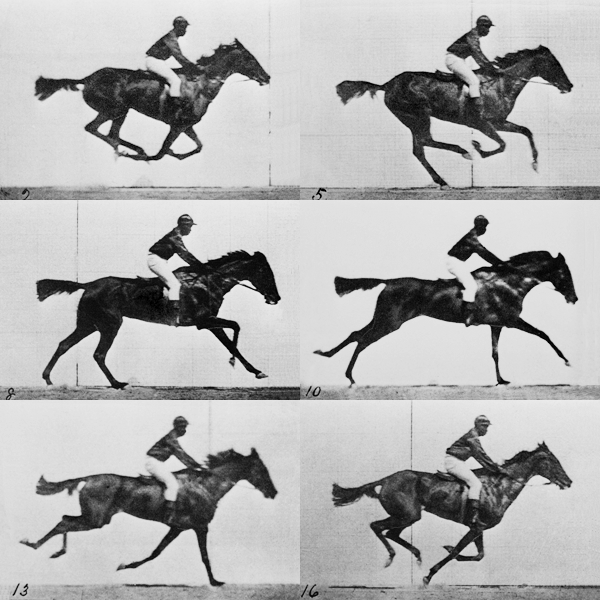
We can illustrate this with an analogy. For a massive body, you can imagine a flipbook with an animation. As you flip the book, you see a horse galloping.
The sequence is set to motion using these frames, originally taken from Eadweard Muybridge’s Human and Animal Locomotion series, (plate 626, thoroughbred bay mare “Annie G.” galloping) published 1887 by the University of Pennsylvania
To simulate this picture approaching the speed of light, you could insert more and more pages so the horse appears to gallop more and more slowly. At the speed of light, this stack becomes infinitely large. For a light beam, however, every page in the flipbook shows the same image of a horse. It isn’t infinitely large. It is just all the same.
Unlike the moving horse, where the difference between one page and the next has some meaning as an interval of time, the difference between one page and the next in the stationary flipbook has no meaning. You can have one page or an infinite number of pages. There is no meaningful definition of time. It has ceased to exist.
The other interesting feature of light falling into black holes is that, while they can fall in, they cannot emerge.
Thus, like time itself and like thermodynamics, entering a black hole has an “arrow”. It works in one direction but not the reverse. (This arrow is very closely related to thermodynamics in fact.)
Since the beam of light does not experience time passing, does that mean it is both inside and outside the black hole at the same “time”?
Not exactly, rather, every point along its trajectory is, in a sense, separate from every other point, as if each point were in its own universe. Whereas a massive body evolves in time from its perspective because it has a timelike Killing vector, a beam of light has no evolution from its own perspective (while it does from ours). Its worldline has a null Killing vector. For itself it is more like a string draped across space and time than a thing in motion. The irreversibility of its motion is only apparent from an observer following a timelike trajectory like us. For a beam of light, the past and future are all the same.
On March 25th, 2024 we have a Lunar Eclipse at 5° Libra.
The Lunar Eclipse in Libra is trine Pluto at 1° Aquarius, giving us an opportunity to delve deep into our relational dynamics and transform them for the better.
This is a South Node Eclipse. South Node eclipses bring karmic clearance. We tie the loose ends. We revisit the past. We finish what is unfinished.
Libra describes our relational patterns. The South Node eclipse in Libra will prompt us to reflect on past relationships, reconcile unresolved conflicts, and release any lingering attachments or baggage.
We all know that humans are social animals.
But why do we need people? Why are relationships so important?
In a one-on-one relationship – romantic, friendship, etc. – we attract what’s missing from ourselves, or what could help us understand ourselves better and grow into the best version of ourselves. The partner becomes a mirror reflecting back to us aspects of ourselves that we may not readily see.
We are particularly drawn to people whose wounds trigger ours, so that, by acting out those wounding dynamics, we can heal them together.
Lunar Eclipse In Libra – Games People Play
Our relationships are a reproduction of the relationships and relational patterns we witnessed in our first years of life: the relationships between our parents, caregivers, or family members.
We then unconsciously re-create these early dynamics in our adult relationships so we can ‘work them out’.
We play ‘games’ or enact patterns where we reproduce what we’ve learned in the first years of our lives. A ‘game’ as defined by psychologist Eric Berne, is a pattern of behavior involving two people. There is a series of interactions, followed by an emotional payoff.
These games are not about manipulation or power struggles; these ‘games’ are unconscious; we are not aware we are playing them.
We all play unconscious games – especially in relationships – by creating certain relational dynamics that re-enact the familiar scenarios and emotional responses we experienced in childhood.
The pull to repeat past relational dynamics witnessed early in life is very strong. Because of this familiarity and conditioning, we are pretty much wired to relate in certain ways, and attract certain types of people in our lives.
We may tell ourselves: my partner is nothing like my mother/father. I had an alcoholic partner, but my partner doesn’t drink. I’ve succeeded in breaking the cycle.
But if we go a bit deeper, we often find similar psychological drivers and relationship dynamics.
Yes, the partner may not drink alcohol, but they may still exhibit behaviors that mirror the underlying issues behind drinking: perhaps they struggle with self-confidence, or with managing their feelings. The underlying pattern is still there, even if the partner does not use alcohol to manage it.
The reason we attract people with a certain wound or psychological profile is precisely to recreate that early pattern in the hopes of understanding it and eventually healing it. By healing the unavailable parent/partner dynamic, we heal ourselves.
Generically speaking, there is nothing wrong with choosing partners who remind us of our parents. We are wired to do it so we can eventually elevate to the next level of awareness and understanding.
But the key word here is ‘awareness’.
If awareness is not present, we get caught in an endless loop of relational repetitions. Things may start out differently when we have a new partner, to eventually progress into the same type of relationship dynamics we experienced so many times before.
South Node Lunar Eclipse In Libra
There comes a time when you’ve had enough. “I’m just tired of this”.
The unconscious game has been played so many times that it has become conscious. “Ah, I’ve always been doing this, now I see it”. “I’m always reacting to this trigger in this way, which leads to a very specific outcome”. “Things finally click and make sense”.
There comes a time when we realize that dwelling in the past is a dead-end street. Ruminating on a million reasons why things are as they are becomes a futile exercise. There IS another way: we can leave the past where it belongs, and shift our focus on what we can change.
Letting go doesn’t invalidate our past. It doesn’t make our wounds less real. But it does open up space for growth and healing.
The South Node Eclipse in Libra on March 25th is the ideal time to release old relational patterns that no longer serve us.
How do we let go of the past? How do we move forward?
Chiron, Mercury, And North Node In Aries – Healing Our Identity Wound
The answer to a South Node eclipse can be found in the North Node.
The Moon and South Node are in Libra; the Sun, North Node, Mercury and Chiron are in Aries. What can Libra learn from Aries?
While Libra is very good at keeping peace (and everyone happy), Libra is not very good at asserting herself.
We call Aries “assertive” as if it’s a competitive, almost selfish-like quality. It’s as though the assumption is that if we go after what we want, someone else has to lose.
But that’s not what Aries is about. Aries is that kindle, that fire, that spark of life that just “is”. Aries’ relationship with themselves and the world at large is instinctual.
And there is deep wisdom in Aries’ instinct. Aries energy is so alive, so rooted in the present moment, that it immediately grasps the essence of a situation. And from that place of engagement and aliveness, it just “knows” what to do.
Libra energy, on the other hand, has a tendency to overthink. In their desire to maintain peace they may end up suppressing themselves or others: “You can’t say this”. “Don’t be so rude”.
While it’s true that there are some social norms to adhere to, at the same time, our instincts, feelings, and actions are 100% legitimate.
Every little thing about you as an individual is the truth, because you are TRUTH – you exist. Not listening to your inner knowing is invalidating your existence.
Listening to your Aries instinct is not synonymous, and does not justify selfishness, instant gratification, or harming others.
But you’ll likely find that when you are TRULY in touch with that part of you that is Aries, with that part of you that is alive, you’re not only validating yourself – but all the other human beings.
Judging and criticizing yourself is denying your right to ‘be’. Judging and criticizing others is denying their right to ‘be’.
When we are not happy with ourselves, or with the place we’re at in our life, we unconsciously reject, or find flaws in everyone else. Judgment is a symptom of an unhealed identity wound.
Chiron is conjunct Mercury and North Node in the next 5 weeks, offering us a unique opportunity to heal our identity wound – a wound we are all born with.
In the coming weeks, Mercury will be retrograding over Chiron and the North Node, helping us untangle past stories and rewrite our future. This time we can truly break the cycle of conditioning.
Chiron – Your Deepest Wound, Your Greatest Gift
Chiron – Your Deepest Wound, Your Greatest Gift is a 3-step framework that will help you get to the essence of your wound, break the repetitive cycle, and rewrite the story of your life.
The course is timed to take advantage of the powerful astrological backdrop of the moment:
We start with Module 1 “The Wounded Healer” on March 25th, 2024, at the Lunar Eclipse in Libra. In this module, we will untangle the story of your wound by analyzing Chiron’s placement in our natal chart, and understand how our wound is influenced by past conditioning.
Module 2 “The Shaman” becomes available on April 1st, 2024 when Mercury goes retrograde to conjunct Chiron and the North Node. In this module, we analyze transits from the past, and recollect past events and experiences (Mercury retrograde) that will help us understand the story of our wound in very specific, relatable terms.
On April 7th, 2024 (when Chiron is conjunct the Sun) we will engage in guided meditation that will help us find healing and integration.
Module 3, “The Alchemist” becomes available on April 8th, 2024, when we have a very powerful Solar Eclipse in Aries, conjunct Chiron.
In this module, we will come back to our natal chart, and this time, look at our Chiron story from the Alchemist lens. What is the wound trying to tell us? What is the higher purpose of our wound? What’s the gift behind the wound?
The registration for “Chiron – Your Deepest Wound, Your Greatest Gift” closes on March 24th, 2024 (on March 25th, 2025 we start).
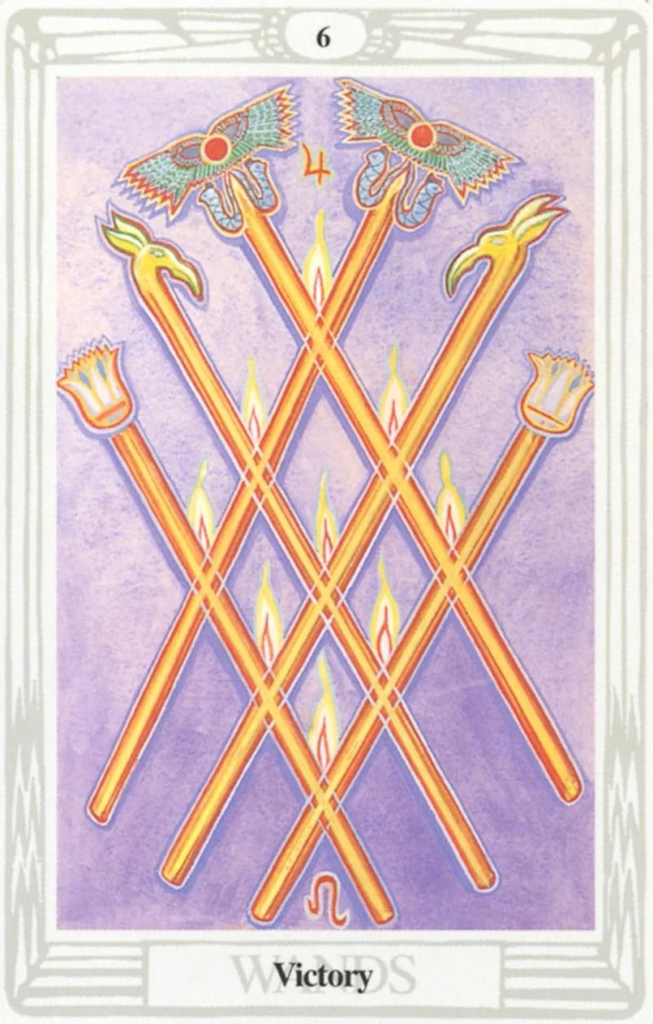
The Lord of Victory is a card of fight, competition and eventual victory. It applies to areas of our lives where we feel we have had to fight very hard to achieve our goals. It can apply to any area of our lives where we have had to contest our position strongly.So, for instance, it could indicate passing successfully through tough training courses; it could apply to spiritual development after a period of test and trial; it could show that we have managed to establish stable and harmonious relationships through hard work and tenderness; it could even indicate that we have finally managed to get our bank balances to match our desired level of spending after much difficulty!It’s a card which indicates that we have achieved both a point of balance and a moment of ascension during which we feel justifiably proud of ourselves, but maybe just a little overwhelmed by our final breakthrough into good fortune.There will always have been struggle before this card appears. We will have been striving – sometimes against frustratingly unhelpful influences – to grasp our dreams, our hopes, our ambitions, our needs. There will sometimes have been pain or confusion as a result of that struggle. But when this card comes up, we can relax a little, and enjoy the fruits of our labour.
Our very cells respond to the thoughts we think. With every word, silent or spoken, we influence the body’s functioning. We participate in the life of the universe itself. If my consciousness grows lighter, then so does everything within and around me. This means, of course, that with every thought, I can start to re-create my life. In saying yes to new beginnings, I begin to bring them forth.
Today I am open to a life reborn, arisen from the ashes of my wounded self and any limits born of circumstances that are no more. I am willing to be renewed and repaired by the spirit of God’s love. I am willing to forgive.
A boy fetches water from his family’s well to wash clothes in Lilongwe, Malawi on February 20, 2023 in an area that has been highly affected by a cholera outbreak due to scarce access of clean drinking water.
(Photo: Fredrik Lerneryd/AFP via Getty Images)
“When big corporations pollute or consume huge amounts of water, communities pay the price in empty wells, more costly water bills, and contaminated and undrinkable water sources,” one advocate said.
Only around a quarter of the most influential food and agricultural companies in the world have promised to reduce their water usage and decrease water pollution, Oxfam reported Thursday.
Oxfam’s analysis comes a day before the United Nations’ World Water Day on March 22. It points out that, according to U.N. figures, 2 billion people cannot reliably access safe drinking water, yet a full 70% of fresh water withdrawals go to agriculture.
“When big corporations pollute or consume huge amounts of water, communities pay the price in empty wells, more costly water bills, and contaminated and undrinkable water sources,” Oxfam France executive director Cécile Duflot said in a statement. “Less water means more hunger, more disease, and more people forced to leave their homes.”
“We clearly can’t rely on corporations’ goodwill to change their practices—governments must force them to clean up their act, and protect shared public goods over thirst for profit.”
Oxfam’s analysis was based on data on the 350 most influential food and agricultural companies from the World Benchmarking Alliance. These include agricultural companies like Bayer, Cargill, and Tyson; food and beverage makers like Nestlé, Coca-Cola, and PepsiCo; major retailers like Walmart, Kroger, and Carrefour; and restaurants like McDonald’s and Starbucks.
Oxfam found that only 28% of these companies had plans to reduce water use, and only 23% had plans to curb water pollution. At the same time, less than half of the companies—108 out of 350—even reported how much water they took from water-stressed locations.
Water scarcity is a major impediment to global well-being, with the climate crisis already exacerbating the problem. Currently, around half of all people on Earth experience severe water scarcity for at least one month each year, according to the Intergovernmental Panel on Climate Change. In northern Kenya, southern Ethiopia, and parts of Somalia, Oxfam found that as many as 90% of water boreholes had evaporated in 2023. Further, 1 in 5 people in the region did not have access to sufficient safe drinking water. World Weather Attribution concluded that the drought in the Horn of Africa was made more severe because of the climate crisis, and that similar droughts were 100 times more likely because of global heating.
Despite climate-driven extreme weather events that put increased strain on water resources, major companies have not changed their business models. For example, the bottling and re-selling of water is a common corporate practice that, according to the U.N., impedes the sustainable development goal (SDG6) of ensuring safe drinking water for all.
In May 2023, Oxfam pointed out, a drought in France’s department of Puy-de-Dôme prompted authorities to restrict the water use of its thousands of residents for two months. However, Danone-subsidiary the Société des Eaux de Volvic was still permitted to extract unrestricted amounts of groundwater during the drought for its bottling plant. That year, Danone amassed €881 million ($956 million) in profits and rewarded shareholders to the tune of €1,238 million ($1,344 million).
“We clearly can’t rely on corporations’ goodwill to change their practices—governments must force them to clean up their act, and protect shared public goods over thirst for profit,” Duflot said.
To ensure water justice, Oxfam said that governments should treat water as a human right; enforce consequences for companies when they violate environmental or human rights laws; and invest in water, sanitation, and hygiene services.
Our work is licensed under Creative Commons (CC BY-NC-ND 3.0). Feel free to republish and share widely.