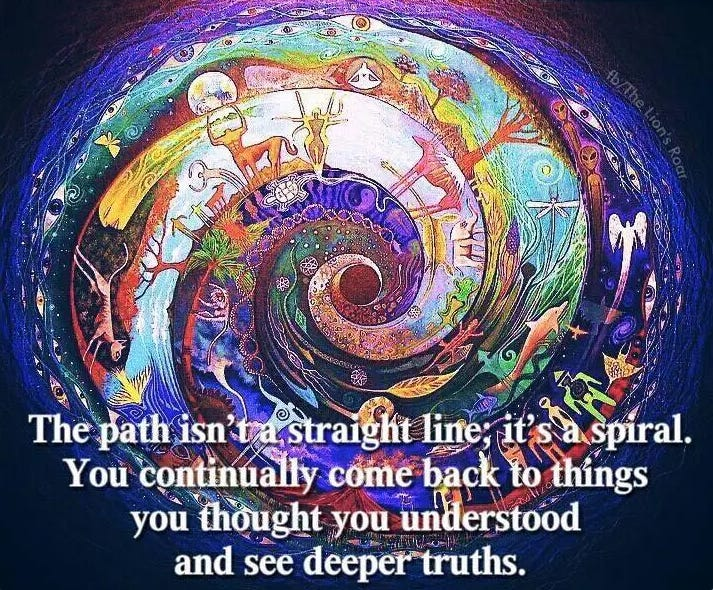
(Courtesy of Rob Brezsny)

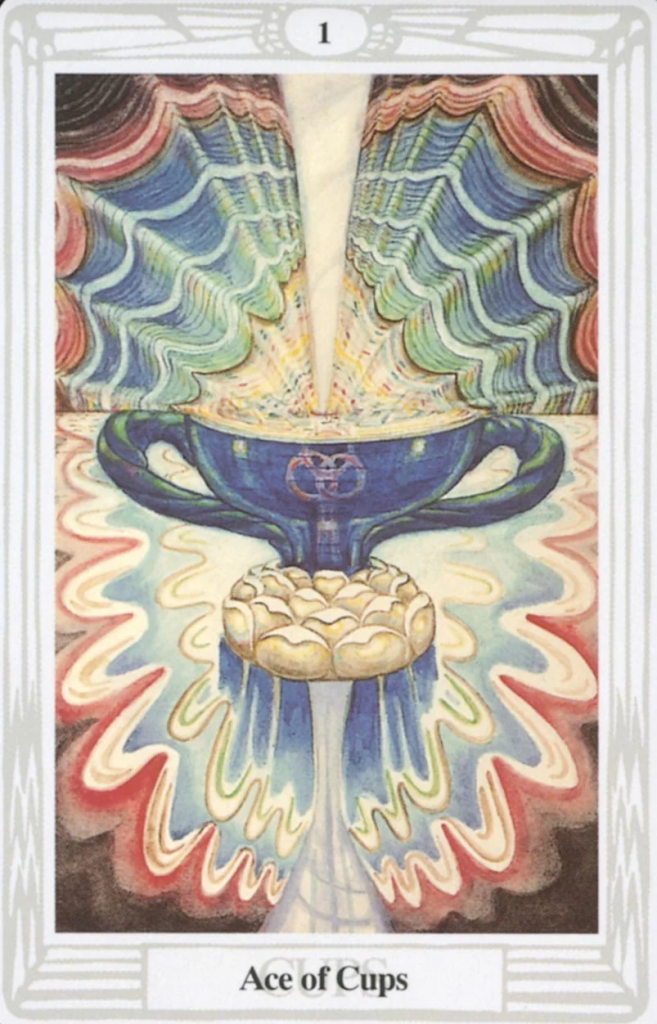
| The Ace of Cups The Ace of Cups represents the beginning of love, fertility and creativity. It is a card to inspire confidence and happiness. When it turns up a reading of an everyday nature it can indicate the start of a loving relationship (of either the romantic or friendship variety); it can represent the beginning of a project in which a great deal of loving energy is invested (rather like the beginning of angelpaths); or sometimes it can reveal conception – the beginning of a new life.If you are looking at the Ace of Cups indicating a new relationship, then there will also be people cards up. If it is a romantic relationship, expect to see other good Cups, and perhaps the Lovers. Friendship will be more indicated by Wand type good cards.The beginning of a project will normally have something like the Star or the Priestess, and Disks around it. These will help you to determine the viability of the project.Pregnancy will usually come up with other cards which also indicate pregnancy Princess of Disks, Ace of Wands, and possibly the Empress.But at a spiritual level the Ace of Cups is even more important. The chalice depicted on most versions of this card is taken to be the Holy Grail, or in pagan terms, the Cauldron of Kerridwyn – source of inspiration and granter of wishes and dreams.In this interpretation of the card then, we are examining a major spiritual step forward – a period where the deepest and most heartfelt spiritual desires of the querent come to the surface, and may be identified and pursued.When this card comes up with the Hierophant, The Sun, The Moon or sometimes with Death, we must see ourselves as entering into a major transformational period from which we will emerge totally changed by the power of the Universe. During periods such as these we touch the very essence of spiritual power, and hopefully, we succeed in growing toward it, and allowing a little more of its light within us. |
“What the schizophrenic drowns in the shaman swims in.” The difference is the absence of swimming lessons.
Brian Spittles
New Thinking • Apr 2, 2024 • Brian Spittles, PhD, is an academic researcher and member of the Emergent Phenomenology Research Consortium which aims to integrate clinical, scientific, and spiritual paradigms to improve therapeutic outcomes. His research includes consciousness studies, transpersonal psychology, psychosis, mental health recovery, quantum physics, mysticism, and indigenous knowledge/healing systems. He is author of Psychosis, Psychiatry, and Psychospiritual Considerations: Engaging and Better Understanding the Madness and Spiritual Emergence Nexus. The Emergent Phenomenology Research Consortium website is theeprc.org. Brian shares that the features of a spiritual emergency and psychospiritual emergence have much in common with what is known as psychosis and are frequently indistinguishable. Indigenous cultures view these experiences as normal and part of the mysteries of being human. 00:00:00 Introduction 00:03:50 Psychosis history 00:07:44 Discerning psychospiritual vs. psychopathological 00:14:06 Shamanism framework 00:18:46 Biological correlates 00:23:30 Stanley Dean: Metapsychiatry 00:28:47 Religious and spiritual values 00:40:50 Spiritual Emergency: Stanislav and Christina Grof 00:57:45 Beyond labels 01:00:50 Conclusion Edited subtitles for this video are available in English, French, German, Spanish, Italian, Portuguese, Russian, and Swedish. #spirituality#psychosis#mentalhealth#consciousness New Thinking Allowed CoHost, Emmy Vadnais, OTR/L, is a licensed occupational therapist, intuitive healer, and health coach based in St. Paul, Minnesota. She is the author of Intuitive Development: How to Trust Your Inner Knowing for Guidance With Relationships, Health, and Spirituality. Her website is https://emmyvadnais.com/ (Recorded on February 22, 2024)
JANUARY 7, 2012 (NPR.org)
HEARD ON WEEKEND EDITION SATURDAY
By Gloria Hillard
On the edge of downtown Los Angeles, Rae Marie Martinez looks for familiar landmarks. The 60-something grandmother turns in a slow circle and shakes her head. In 1957, she still had long braids and wore long dresses.
People made fun of her back then. “I remember they used to kick my heels all the way to school,” Martinez says.
Los Angeles County is home to the largest urban American Indian population — more than 160,000. In 1952, the federal government created the Urban Relocation Program, which encouraged American Indians to move off reservations and into cities such as Chicago, Denver and Los Angeles. They were lured by the hope of a better life, but for many, that promise was not realized.
“The boarding schools, relocation — I mean, everything that historically happened to American Indians — continues to impact them today,” Carrie Johnson says. Johnson is part of an effort to help those living with the consequences of the relocation program and build a new future for today’s urban American Indian youth.
‘So Much Had Been Promised’
Martinez was just 8 years old when her family traveled to California by car from the Colville Reservation in Washington state.
“Mom and Dad felt like they were making the right choice and decision in being part of the relocation program, because so much had been promised to them,” she says. Enlarge this image
Rae Marie Martinez moved to Los Angeles with her family when she was 8 years old. She once struggled with alcoholism and an abusive relationship, but now coordinates a domestic violence program for other American Indians.
Gloria Hillard/For NPR
The program, run by the Bureau of Indian Affairs, promised the newly arrived families temporary housing and job counseling. She and her five siblings moved into the projects. Her parents received $80 a week, but just for one month.
“I think just being homesick, being away from everything that was familiar to me … still makes me emotional,” Martinez says. She missed the tall trees and apple orchards of her reservation.
To fit in, she tried to become invisible. Her mother cut off her braids. In time, Martinez became silent and later succumbed to alcohol and an abusive relationship. It’s a story Johnson knows all too well.
“We see … unfortunately, all these high rates of problems within our community,” she says. “But I think on the positive side, what we’re seeing is the healing.”
Johnson is Dakota Sioux. She runs Seven Generations, a program for children and families at United American Indian Involvement. UAII is one of the largest service providers for L.A County’s widely scattered American Indians and Alaska Natives. Johnson’s program deals with what she calls the legacy of the relocation program — from assisting needy families to providing a number of mental and physical health services.
The Next Generation
In a large, florescent-lit room, boys in multicolored high-tops and girls with blankets that serve as shawls attend a drum and dance workshop. Enlarge this image
Serenity Wyatt, 8, and her mother, April Duenas, attend the 28th annual powwow held by California State University, Northridge.
Gloria Hillard/For NPR
“We hold a workshop, and they can look around and see other Indian youth who look just like them growing up here in Los Angeles,” says Ramon Enriquez, who grew up in L.A.’s Inglewood neighborhood not knowing any other American Indians. Now he’s the director of youth services at the UAII center.
“This is the face of American Indians today,” he says. “We’re living in the cities, we’re living where the jobs are, we’re living where the opportunities are.”
For many, the weekend powwows bridge the chasm between the city and the reservation. It’s where 8-year-old Serenity Wyatt can be found in a brightly colored, beaded dress.
“I come from the Apaches called Dine, and my favorite thing to do is dance,” she says. “I used to watch the dancers before I was even up on my feet. My mom used to take me out there.”
Giving Back
Serenity’s story is happier than Martinez’s, but now Martinez uses her experience to help others.
“By the grace of God, I’ve been able to celebrate, this year, 30 years of recovery from alcoholism, of abuse, of so much trauma,” she says, “the healing I’ve been able to experience and just being proud of who I am.”
Today, Martinez coordinates the domestic violence program for UAII, and her life is about to come full circle. Her reservation in Washington state is developing a domestic violence program and has asked for her help.

MAR 31, 2024 (WisdomSchool.com)

Turns out Nietzsche was right: what doesn’t kill us very often makes us stronger.
The first study to support this and give us insights into how to build our own resilience in the face of adversity was done decades ago on the Hawaiian island of Kauai. They looked at a group of children born in 1955 to sugarcane workers; all experienced profound poverty and most experienced various forms of abuse or neglect.
The study’s authors followed 698 of these children all the way into middle-life, measuring a variety of their psychological indicators, including their general emotional fragility and resilience.
What they found was that more of the children who experienced hard childhoods, as expected, grew up wounded and emotionally fragile than comparable kids who grew up in middle class families without poverty or abuse. But, surprising the scientists, they also found that more of the kids who grew up with challenges were resilient than “normal” kids, and for most in that cohort their resilience — their ability to deal with challenges and adversity as adults — was sturdier than that of normal kids.
In other words, if there’s a normal bell-curve distribution on the spectrum from fragile to resilient, the bell-curve becomes narrower in the middle in the face of privation and abuse. On the left side of the curve, more kids were fragile than among normal kids, but on the right side of the curve more kids were highly resilient than we see with kids who didn’t experience privation or abuse.
The Kauai Longitudinal Study was particularly ground-breaking in that it was the first that did a serious look at resilience over an extended period. It led to a relatively new field within the science of psychology: resilience.
They learned there are several variables that affected how the Kauai children responded to adversity and that predicted resilience.
The first was temperamental, and thus probably the result of genetics. The researchers found that the most resilient of the adults had been characterized by their mothers at age one as “active, affectionate, cuddly, good-natured, and easy to deal with.” By age two they were “cheerful, friendly, responsive, and sociable.” And by ten years old they read better and scored higher on problem-solving skill tests than either their peers from Kauai or middle-class kids of the same age.
The second variable was what the researchers called “protective factors in the family.” The most resilient children had formed a deep bond with at least one adult throughout their childhood. It wasn’t always a parent, but that person gave them a sense of stability even though other parts of their lives were going nuts.
The third variable was “protective factors in the community.” Teachers, pastors, mentors, coaches, etc., offered positive reinforcement and stability for these kids.
Perhaps the most important variable in acquiring and maintaining resilience is found in a relatively new field, narrative psychology, that emerged in part from these kinds of studies and has been heavily influenced by the work of NLP founders Bandler and Grinder.
It has to do with the stories we tell ourselves about who we are, where we stand in the world relative to others, and how much agency we have over our own lives. While we rarely consider our own internal stories, they are often the single most important variable in determining how we respond to the events of our lives.
And those responses based on our internal stories, in turn, often define the ultimate outcome of whatever situation or problem we find ourselves in the midst of.
When something bad happens, some people internalize the blame and further their own misery: “I knew this would happen: bad things always happen to me!” or “I did this to myself!” or “I shouldn’t have let this happen!”
Their stories are fundamentally victim stories, usually heavy with self-blame. Stories like this rarely are useful or productive, yet nonetheless many of us learned them as children (mostly in response to criticism from parents or adults, sometimes picking them up from peers) and our lives are run by them regardless of whether we’re 20, 50, or 80 years old.
Except when we use such stories to prevent ourselves from engaging in truly destructive or even illegal behavior, self-blame and victim stories are like an acid: over time they erode or burn away our self-esteem and our ability to experience resilience.
The kids in Kauai who were most wounded by their upbringings adopted stories telling themselves that their abuse was their own fault, that they “deserved it,” or that they completely or largely lacked any agency over their own lives and responses.
This is detailed extensively, for example, in John Tierney and Roy Baumeister’s book The Power of Bad: How the Negativity Effect Rules Us and How We Can Rule It. The book is all about the stories we tell ourselves and how to change them.
On the other hand, the kids who became the most resilient as adults told themselves that their abuse wasn’t their own responsibility or fault but, rather, was entirely the fault of the abuser. They had a positive form of “narrative coherence.”
Multiple studies done over the past few decades have found this variable — the stories we tell ourselves about who we are relative to the world — is the most important in determining people’s ability to deal with both adversity and opportunity. It even can affect how quickly we respond to disease or how we handle challenges like chemotherapy.
Decades ago, psychology researcher Marty Seligman did a famous experiment with dogs where he rang a bell and gave them a shock through their feet where they were standing. Dogs normally jump away from the shock, but about half of his dogs were restrained so they couldn’t jump away. After a few rounds of shocks, most simply gave up, enduring the shocks with a whimper but no longer trying to avoid the shock-pad, even when they were no longer restrained.
It’s a variation on the old story about how circus elephants are trained, and spawned an entirely new field and discipline in psychology: “learned helplessness.”
Seligman noticed, however, that the more he studied helplessness and depression in animals and humans, the more “grumpy” he became himself. One day he was weeding his home garden with his five-year-old daughter when she said to him, “If I can stop whining, you can stop being such a grouch!”
It woke Seligman up from his constant immersion in downer stories and stimulated him to study happy people, kicking off an entirely new field called “positive psychology.” What he learned, and details in his book Learned Optimism: How to Change Your Mind and Your Life.
In his book (and two others), Seligman tells how he developed a course to teach elementary school children how to be optimistic — to tell themselves positive and empowering stories about themselves and their place in the world — and how follow-up studies found that the kids who went through the course, in later years as teens and young adults, were half as likely to experience a major or significant depressive episode.
He also points out how we all experienced complete helplessness as babies, so the ability to feel helpless — and be hurt or even paralyzed by it — is built into the substrate of our emotional psychology. Thus, when some people look at the difficulties in their own lives, or even the challenges the world is facing, they default to being helpless, which usually leads to depression and sometimes even to suicide.
Instead, Seligman and others working in the field of positive psychology argue that we can all learn how to recalibrate our own internal stories from ones of helplessness and victimhood into ones of self-reliance and resilience.
Across the field — from NeuroLinguistic Programming to Positive Psychology to Narrative Psychology to Cognitive Behavioral Therapy — the great commandment is to begin noticing our own internal responses to things, the stories we tell ourselves about things that happen to us.
This is not as complicated as it may seem. Simply ask yourself, “Why am I reacting this way?” In most cases, you’ll discover that your own deep consciousness will hand you the story on which you based that response.
My old friend Rob Kall, a therapist who used to run an international brain conference where I often spoke or keynoted, has created an entire website at PostivePsychology.net. There are books and other websites devoted to this concept as well, and the message of most all of them is that we can rewrite the stories that run our lives and thus achieve a higher level of accomplishment, resilience, and, ultimately, happiness.
So, the next time you’re finding yourself down ask yourself: “What story am I using that is producing this feeling?” You may well be surprised, and that could lead to a healing you might not have even believed was possible.

Photo from closetprofessor.com
Now that New Orleans has officially disavowed its long homage to the Confederacy, you may be surprised when I tell you who will be turning in his grave.
The Southern states in the Civil War had fought for the same principles that now inspired his native Ireland in its struggle for independence from British rule, a distinguished visitor to New Orleans declared in 1882.
Oscar Wilde had a familial motive for drawing this dubious analogy, for his mother’s brother, John Elgee, had emigrated to Louisiana, where he prospered as a lawyer and judge. He soon embraced the mores of his new home, wound up owning a plantation worked by hundreds of slaves in Rapides Parish, and signed Louisiana’s Secession Ordinance in 1861. His son, Charles LeDoux Elgee, was a captain on the staff of Confederate Major General Richard Taylor. Both Elgees died before the end of the Civil War, but Wilde apparently prized the Confederate connections he had never met.
Although New Orleans had surrendered barely a year into the Civil War, once peace was restored, it enthusiastically embraced the myth of the Lost Cause as a noble defense of a superior civilization.
Wilde came to New Orleans in 1882, at the age of 27, in the course of a lecture tour that took him all over the United States and Canada. His literary triumphs, and subsequent disgrace and ruin, were some years in the future, although he had already achieved considerable renown as a wit and leader of the Aesthetic Movement.
Two years later, the statue of Robert E. Lee was to be hoisted onto to the lofty perch it occupied until 2017. That statue was the earliest of the four Confederate monuments that have now been purged from the streets of New Orleans.
Wilde declared that Jefferson Davis, former president of the Confederate States of America, was the American he most wanted to meet because “the principles for which the South went to war cannot suffer defeat.”
Wilde might have come close to getting his wish when he was not quite 16 years old and Davis visited Dublin, in 1870. Wilde’s mother invited him over, but Davis sent his regrets that he was unable to “pay his respects in person to the Sister of his friend, the late Judge Elgee.”
Davis did oblige Wilde with an invitation to spend a night in 1882 at Beauvoir, his home on the Mississippi Gulf Coast. The evening was quite a thrill for Davis’s daughter, Winnie, whose 18th birthday it was, but her father did not take to Wilde, evidently considering him to be too much of a fop. That was not an uncommon view of Wilde, who wore velvet jackets, satin breeches, black capes, buckled shoes and ruched shirts.
Anyone familiar with the book I co-authored on the history of New Orleans’s Confederate monuments, and the controversy that led to their removal, may wonder why Wilde was not mentioned in it. The answer is that I, probably in common with most people, never suspected that “The Importance of Being Earnest” was written by a Confederate sympathizer.
But that is what Wilde was. According to the Daily Picayune, he was able to persuade himself that the Confederacy and the Irish resistance were similarly committed to a “struggle for autonomy, self-government for a people.”
Email James Gill at gill504nola@gmail.com.
The Independent • Jun 3, 2020 A clip of Joe Biden blasting South Africa’s apartheid system has gone viral. The clip dates back to 23 July 1986, during a senate hearing involving Reagan’s then-Secretary of State, George Schultz. Mr Biden is seen passionately speaking out in support of the majority black population of South Africa, and against the oppressive apartheid regime.

Published in On The Couch
1 day ago (Medium.com)

Life lessons often come to us from unexpected places.
Sometimes by chance. Sometimes because we’re ready for them. Sometimes because we are reminded of something we already believed in.
One of those lessons dropped in my lap this week. At the end of an appointment with an osteopath, I’d asked if I could continue my normal sports activities.
He raise an eyebrow, then delivered his seven-word edit.
“Avoidance is not a strategy for anything.”
In my work as a psychologist, avoidance is a hovering presence.
That’s because it’s arguably the most common strategy for dealing with anything that causes stress or pain — or threatens to do so.
It is used to escape facing the truth — about relationships or jobs or health or finances or addictions.
It is used to get out of competitions or difficult conversations, or to say no to invitations, social activities and opportunities.
It is used to dodge making public speeches, taking a flight, leaving the house, or anything else that sparks fear.
Under the banner of procrastination, some use it to delay doing chores or tax returns, writing that novel/starting that business or going after other big goals or dreams.
Avoidance is used because it’s the path of least resistance.
It’s the easy road. Until it’s not.
Avoidance isn’t embedded into our DNA.
Yes, some people have temperaments that promote it — but it’s most frequently a learned behaviour.
Some people are born or raised in circumstances that don’t support their emotional development. Maybe they were exposed to trauma, challenging life events or chronic stress?
Maybe their parents expected them to glue on a happy face no matter what was going on? Maybe they were under pressure to present the facade of the perfect family? Maybe they were never given the space to express their tougher emotions? Or helped to understand their feelings?
And that learning shaped them.
To be fair, none of us are above a few avoidance tactics — especially when it comes to stacking the dishwasher, putting the rubbish out and doing boring life admin.
But it becomes a problem when it’s repeatedly used as a coping mechanism for dealing with difficult or traumatic emotions, situations, or responsibilities.
And when it creeps under the carpet — when it becomes a habit that stops you from addressing important issues and/or potentially shrinks your life — you need to step into the ring with it.
I’ve worked with lots of people who’ve come to this place.
They’ve been unable to face the truth of their circumstances — or perhaps it’s more accurate to say unable to face the painful feelings that the truth might stir up for them.
Like those who won’t step on the scales because they can’t deal with the reality of their weight. Or who won’t log into their bank account and face the mounting credit card debt.
There have been others too scared to date because of potential rejection or abandonment — or in denial about the toxicity of their relationships; others who work ridiculously long hours even when their minds and bodies are screaming for a break.
Others who avoid things to avoid things — refuse to do anything that will make them feel uncomfortable — or out of control.
I was left to painstakingly deal with the aftermath of my avoidance later in life, in therapy or through the lyrics of my songs. Alanis Morissette
I get it, life is hard — even brutal sometimes.
It makes perfect sense to cower away from things that stir up emotional discomfort. That make you feel vulnerable. That scare you.
But putting important things off? Bailing on things when they get hard? Hiding away from reality? Not giving your talent a chance to breathe — and fly?
Those tactics will confine you to a cage. And, no matter how gold the bars, it’s still a cage.
At some point, we all have to decide — cage or arena? Do I want to stay within the limits, keep doing what I know, or do I want to show up when I don’t know what’s going to happen?
Here’s how vulnerability researcher Brené Brown puts it:
“I want to be in the arena. I want to be brave with my life. And when we make the choice to dare greatly, we sign up to get our asses kicked. We can choose courage or we can choose comfort, but we can’t have both. Not at the same time. Vulnerability is not winning or losing; it’s having the courage to show up and be seen when we have no control over the outcome. Vulnerability is not weakness; it’s our greatest measure of courage….For me, if you’re not in the arena getting your ass kicked, I’m not interested in your feedback.”
But back to my osteopath, and his wise words.
Avoidance is a coping mechanism. It might (temporarily) protect you.
But it’s not a strategy to move your life forward. It won’t expose you to discomfort. It won’t make you stronger. It won’t allow you to be fully human.
Stepping into the arena — having the courage to show up — will.
Each fortnight I send out a free newsletter offering practical psychology tips and tools for personal growth and performance. Come join us!

·Editor for On The Couch
Clinical psychologist, author of 4 books. Editor of On the Couch: Practical psychology for health and happiness. karen@onthecouch.co.nz

| The Aeon The Aeon (or Judgement, Last Judgement, Atonement, Resurrection) is numbered twenty and often shows figures arising from graves in answer to the clarion call of an angel. The Thoth deck veers away from the Christian overtones and instead we see the goddess Nuit, a primal sky goddess from the beginning of creation. Her body is arched above our heads and curves to imply the ankh cross, a symbol of immortality and life. A child-like male figure stands within the ankh’s loop with his finger to his lips in the traditional mystical gesture of silence. A seated regal figure is behind him. Both figures are said to represent Horus, first as child and then as ruler.Horus was the son of Osiris and Isis. When his father was murdered by his brother Set, Horus was protected and raised by Isis. Horus’ ascension to manhood triggered a series of battles with Set, culminating in his assumption to the throne of Egypt. Set was sent away defeated and thus Horus is seen as a god of redemption.The Aeon forces us to acknowledge that our actions set up a chain of cause-and-effect for which we are solely responsible. Here we pass through the fire of purification, shedding dead and dying wood as we go. We judge ourselves frankly, forgive, and leave the past behind. And then we are free to step into the light.This is a card of healing, especially on an emotional level. It promises hope and happiness, along with a new sense of safeness, protection and recovery. We are at the place where miracles happen. |