Epictetus: The Calm Button

How to practice ataraxia

Thomas Oppong

Thomas Oppong

Published in Personal Growth

Nov 23, 2023 (Medium.com)

Illustration of Epictetus in Edward Ivie’s 1715/Public

No one can escape an emotional surge. But it’s what you do with it that determines who you are. Your approach to everything that irritates you defines your core emotional strength.

Epictetus, a Stoic philosopher who lived from 50 to 135 AD, had much to say about achieving a “monk level of calm.” For someone born into slavery, you wouldn’t expect him to write so much about staying calm.

Epictetus endured hardships from a young age. Yet, he emerged as a beacon of inner peace and resilience. His teachings are beautifully captured in his great work, The Enchiridion.

Despite his enslaved status, he showed a keen interest in intellectual pursuits, particularly philosophy. Epictetus studied under the Stoic philosopher Musonius Rufus.

Epictetus would later become a prominent Stoic philosopher himself. He is known for his teachings on ethics, self-control, resilience and the life-changing value of inner calm in times of chaos.

Despite his humble beginnings, he became an esteemed teacher, attracting students from all walks of life. His teachings resonated with people seeking guidance in a world of uncertainty and suffering.

Epictetus’ core philosophy is about the distinction between what we can control and what we cannot. “It is not events that disturb people, but rather their opinions about events,” he famously proclaimed.

He explains in “The Enchiridion of Epictetus”“Men are disturbed not by things, but by the views which they take of things. Thus death is nothing terrible, else it would have appeared so to Socrates. But the terror consists in our notion of death, that it is terrible. When, therefore, we are hindered, or disturbed, or grieved let us never impute it to others, but to ourselves; that is, to our own views. It is the action of an uninstructed person to reproach others for his own misfortunes; of one entering upon instruction, to reproach himself; and of one perfectly instructed, to reproach neither others or himself.”

Epictetus’ statement beautifully captures the wisdom of his teachings: our perception, not the external world, dictates our emotional state.

The calm life mindset

Imagine you’re stuck in traffic, running late for an important meeting. It’s frustrating, right? You’re sitting there, stuck, and getting all worked up. But that won’t make the traffic disappear.

Epictetus would say, don’t let the drivers’ actions ruin your serenity. Or the traffic you can’t influence. Instead, accept the situation, take a deep breath, and use the time to listen to music.

Or ponder a proactive action you could take when you finally make it to your meeting. Think about it. You can’t control that guy cutting you off in traffic or your colleague’s last-minute request.

But you can practice shifting your perspective. You’re stuck, but you’re also safe in your car, listening to something interesting, maybe even enjoying a moment of peace in the middle of a hectic day.

As the Stoics would say, “We cannot choose our external circumstances, but we can always choose how we respond to them.” So, don’t fume about their actions. Next time life throws traffic at you, channel your inner Stoic, embrace the moment, and remember: “We suffer more in imagination than in reality.”

You create unnecessary suffering for yourself when you choose to see events as negative or uncontrollable. However, the moment you shift focus to acceptance, you release yourself from the burden of worry and anxiety.

You assume “calm mode”. You stop trying to control external events or interpreting them in a way that makes you miserable.

He observed absolute emotional stability stems from accepting the limits of our influence. And focusing our energies on everything within our grasp — our own thoughts, perceptions, and actions.

It doesn’t mean we should suppress emotions or deny their existence. It means cultivating a conscious awareness of your thoughts and choosing how to respond to them. Epictetus observed many of our anxieties stem from irrational perceptions and self-imposed beliefs.

To assume a calm mindset, our task is to use our judgment as a guide to what is in our power. The wisdom to discern what you can control and cannot liberate you from the shackles of “uncontrollables.”

Epictetus’s teachings extend beyond merely accepting the uncontrollable; they empower us to cultivate inner peace when everything feels chaotic.

His wisdom invites us to challenge the validity of our thoughts and how we interpret life’s many experiences. Ask yourself if there is evidence to support your disturbing or distressing thoughts. Or if you are simply catastrophising.

Epictetus believed that our true freedom lies in our ability to govern our own thoughts and reactions rather than attempting to manipulate external circumstances.

Epictetus argued that a “detached perspective” changes everything in the face of setbacks. The end of all our emotional suffering lies in taming our urge to overthink things beyond our control.

Another Stoic philosopher, Marcus Aurelius, aptly stated, “You have power over your mind — not outside events. Realise this, and you will find strength in your power.”

The aim is “ataraxia”: a state of unwavering calm

If you wish to be calm, even in times of uncontrollable chaos, you must be free of the desire to dwell on the actions of others. And everything you can’t control, no matter how hard you try.

Epictetus thought freedom from emotional disturbance is not the absence of emotions but the ability to remain undisturbed by life’s ups and downs.

To achieve ataraxia, Epictetus advocated for a rigorous self-introspection. Scrutinise your judgements, thoughts and beliefs.

Identify those that are irrational or unhelpful. Start challenging your ingrained assumptions that consistently cause emotional pain. And cultivate a more rational perspective.

Stress, anxiety, and uncertainty are familiar words of our time. Epictetus’ wisdom can be your guide. You can find a new sense of calm if you dwell completely on your own actions and reactions.

Of course, it’s easier said than done. But it’s a practice we can cultivate over time. One way to do this is to remind ourselves of Epictetus’ quote:

“The chief task in life is simply this: to identify and separate matters so that I can say clearly to myself which are externals not under my control, and which have to do with the choices I actually control. Where then do I look for good and evil? Not to uncontrollable externals, but within myself to the choices that are my own…”

We can always stay calm, even in times of uncontrollable chaos. We can achieve emotional stability, no matter what life throws our way.

For more content like this, join over 70K curious subscribers who receive my best essays and free curated tools for smarter living. Join us and get a free ebook (A collection of essays on life, meaning and getting things done).

Thomas Oppong

Written by Thomas Oppong

·Writer for Personal Growth

Making the wisdom of great thinkers instantly accessible. As seen on Forbes, Inc. and Business Insider. For my popular essays, go here: https://thomasoppong.com

William Dement on dreaming

(Photo from sleepresearchsociety.org)

“Dreaming permits each and every one of us to be quietly and safely insane every night of our lives.”

― William Dement

William Charles Dement (July 29, 1928 – June 17, 2020) was an American sleep researcher and founder of the Sleep Research Center at Stanford University. He was a leading authority on sleep, sleep deprivation and the diagnosis and treatment of sleep disorders such as sleep apnea and narcolepsy. Wikipedia

Darkness in the Celestial Lighthouse: Virginia Woolf’s Arresting 1927 Account of a Total Solar Eclipse

By Maria Popova (themarginalian.org)

Two weeks after my fifteenth birthday, an otherworldly wave of darkness intercepted the sweltering August afternoon and plunged it into a surreal cool — the first total solar eclipse to sweep across Bulgaria since I was a small child. An hour earlier, the Moon’s shadow had swallowed the sun in southwest England for the first time since June 29, 1927.

On June 29, 1927, seven weeks after the publication of To the LighthouseVirginia Woolf (January 25, 1882–March 28, 1941) was smoking a cigar on a train carriage, traveling with her husband, her beloved teenage nephews, her great love turned lifelong friend Vita Sackville-West, and Vita’s husband. Woolf recorded what she saw and felt in vivid detail, with her uncommon gift for magnifying the smallest details of life into revelations about the largest questions of what it means to be human.

Virginia Woolf

Wedged in time between astronomer Maria Mitchell’s pioneering essay describing the 1869 total solar eclipse and Annie Dillard’s classic 1979 recollection of totality, Woolf’s account crowns the canon of eclipse literature with its exquisite limning of the world both exterior and interior in the midst of this celestial otherworldliness. It was later included in A Writer’s Diary (public library) — the indispensable posthumous volume that gave us Woolf on the creative benefits of keeping a diarythe consolations of growing olderthe relationship between loneliness and creativity, and what makes love last.

Writing a generation after Mabel Loomis Todd penned the world’s first popular book on the science and splendor of eclipses, Woolf begins at the beginning of the strangeness:

Before it got dark we kept looking at the sky; soft fleecy… Then we had another doze…; then here was a level crossing, at which were drawn up a long line of motor omnibuses and motors, all burning pale yellow lights. It was getting grey — still a fleecy mottled sky… All the fields were auburn with June grasses and red tasselled plants none coloured as yet, all pale. Pale and grey too were the little uncompromising Yorkshire farms. As we passed one, the farmer and his wife and sister came out, all tightly and tidily dressed in black, as if they were going to church. At another ugly square farm, two women were looking out of the upper windows. These had white blinds drawn down half across them. We were a train of 3 vast cars, one stopping to let the others go on; all very low and powerful; taking immensely steep hills… We got out and found ourselves very high, on a moor, boggy, heathery, with butts for grouse shooting. There were grass tracks here and there and people had already taken up positions. So we joined them, walking out to what seemed the highest point looking over Richmond. One light burned down there. Vales and moors stretched, slope after slope, round us. It was like the Haworth country. But over Richmond, where the sun was rising, was a soft grey cloud. We could see by a gold spot where the sun was. But it was early yet. We had to wait, stamping to keep warm… There were thin places in the clouds and some complete holes. The question was whether the sun would show through a cloud or through one of these hollow places when the time came. We began to get anxious. We saw rays coming through the bottom of the clouds. Then, for a moment, we saw the sun, sweeping — it seemed to be sailing at a great pace and clear in a gap; we had out our smoked glasses; we saw it crescent, burning red; next moment it had sailed fast into the cloud again; only the red streamers came from it; then only a golden haze, such as one has often seen. The moments were passing. We thought we were cheated; we looked at the sheep; they showed no fear; the setters were racing round; everyone was standing in long lines, rather dignified, looking out. I thought how we were like very old people, in the birth of the world — druids on Stonehenge; (this idea came more vividly in the first pale light though). At the back of us were great blue spaces in the cloud. These were still blue. But now the colour was going out. The clouds were turning pale; a reddish black colour. Down in the valley it was an extraordinary scrumble of red and black; there was the one light burning; all was cloud down there, and very beautiful, so delicately tinted. Nothing could be seen through the cloud. The 24 seconds were passing. Then one looked back again at the blue; and rapidly, very very quickly, all the colours faded; it became darker and darker as at the beginning of a violent storm; the light sank and sank; we kept saying this is the shadow; and we thought now it is over — this is the shadow; when suddenly the light went out.

Total eclipse of 1878, one of Étienne Léopold Trouvelot’s groundbreaking astronomical drawings. (Available as a print, as stationery cards, and as a face mask.)

In a sentiment Annie Dillard would echo half a century later in recounting how “the sun was going, and the world was wrong,” Woolf speaks to that profound, disquieting wrongness in which an eclipse washes our ordinary expectations of the world, our elemental givens of sensorial and perceptual reality:

We had fallen. It was extinct. There was no colour. The earth was dead. That was the astonishing moment; and the next when as if a ball had rebounded the cloud took colour on itself again, only a sparky ethereal colour and so the light came back. I had very strongly the feeling as the light went out of some vast obeisance; something kneeling down and suddenly raised up when the colours came. They came back astonishingly lightly and quickly and beautifully in the valley and over the hills — at first with a miraculous glittering and ethereality, later normally almost, but with a great sense of relief. It was like recovery. We had been much worse than we had expected. We had seen the world dead. This was within the power of nature.

My photographs of the 2017 total solar eclipse in Oregon. (Available as a print and as a face mask.)

In consonance with Rachel Carson’s assertion that “there is in us a deeply seated response to the natural universe, which is part of our humanity,” Woolf reflects on how such displays of nature’s might arrest us into an acute awareness of our fragile, complex humanity:

One felt very livid. Then — it was over till 1999. What remained was the sense of the comfort which we get used to, of plenty of light, and colour. This for some time seemed a definitely welcome thing. Yet when it became established all over the country, one rather missed the sense of its being a relief and a respite, which one had had when it came back after the darkness. How can I express the darkness? It was a sudden plunge, when one did not expect it; being at the mercy of the sky; our own nobility; the druids; Stonehenge; and the racing red dogs; all that was in one’s mind.

A Writer’s Diary is replete with Woolf’s stunning insight into phenomena across the full spectrum of existence. Complement this particular portion with Maria Mitchell’s guide to how to watch a solar eclipse, then revisit Woolf on the nature of memory and the existential value of illusion.

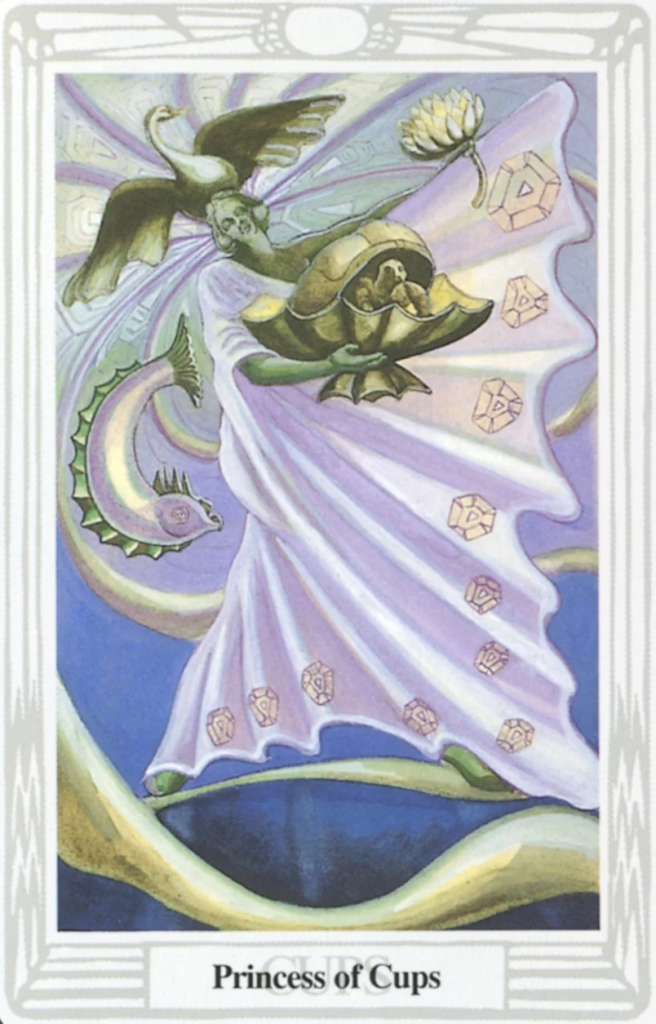
Tarot Card for April 4: The Princess of Cups

The Princess of Cups

If this card comes up to represent a person, she will be a gentle, romantic individual with high levels of intuition. The Princess of Cups is compassionate and caring, warm and responsive. She is at peace with her emotional nature, often highly creative and artistic. She has a certain fragility, particularly when coming into contact with the harsher realities of everyday life, and will not always cope well with conflict. In her world, tranquillity and harmony are highly valued.If, as often happens with the Princesses of the deck, the card comes up to represent a change in events, then the interpretation broadens out somewhat. For instance, the Princess of Cups will sometimes come up to indicate forthcoming pregnancy. The card also appears to indicate a woman falling in love.And if the card applies to a state of mind, then it will indicate heightened perception, and tells you to listen carefully to the voice of your own intuition, and to follow through on any ideas which arise from it.

Einstein on reality

“Reality is merely an illusion, albeit a very persistent one.”Albert Einstein (1879 – 1955)

German PhysicistIf you’ve enjoyed these quotes and have not yet taken our introductory class, *Philosophy Works, *please consider registering by clicking the button below.

This is our last week of registration.

Already taken *Philosophy Works*?

Please consider sharing this quote and information about our introductory class with friends, family, and anyone in your life who may be curious about The School of Practical Philosophy & Meditation.

Our Spring term begins the week of April 8, 2024, and all are welcome. We have a limited number of spots still available. This is our last term until the fall, so we hope to see you there.
 Register Now
AN OPPORTUNITY FOR DAILY REFLECTION BROUGHT TO YOU BY THE SCHOOL OF PRACTICAL PHILOSOPHY

7 Questions Inspired by Viktor Frankl That Will Instantly Shift Your Perspective on Life

Beyond suffering: finding freedom, meaning and purpose

Thomas Oppong

Thomas Oppong

Published in Personal Growth

Jan 5, 2024 (Medium.com)

Photo by Priscilla Du Preez on Unsplash

The great psychologist Viktor Frankl survived three concentration camps. He founded logotherapy, a form of therapy centred on finding meaning in life. Suffering stripped Frankl bare, leaving only the desperate search for meaning to stave off insanity.

He concluded that enduring the ordeal hinged on forging a reason to live, a purpose beyond the loss and despair.

Frankl doesn’t sell easy answers in his teachings.

But rather potent questions to ponder.

For example, “What is life asking of me?

“It is we ourselves who must answer the questions that life asks of us, and to those questions we can respond only by being responsible for our existence,” he says. In his book, Man’s Search for Meaning, he wrote a deeper explanation.

What life asks us to look beyond our immediate circumstances and personal desires. It prompts us to ponder the larger purpose and meaning in our lives. Frankl argued that responsibility is a key component of finding meaning in life.

Ultimately, man should not ask what the meaning of his life is, but rather must recognize that it is he who is asked. In a word, each man is questioned by life; and he can only answer to life by answering for his own life; to life he can only respond by being responsible,” — Viktor E. Frankl

When you ask what life asks of you, you confront the idea that you are not merely a passive recipient of circumstances but an active participant in your life. It’s a shift from passive to active living. That means you take ownership of your actions, choices, and their consequences.

Frankl believed that focusing on the responsibilities and opportunities in life is how we find purpose, even in the face of suffering and adversity.

When you ask yourself, “What is it that life is asking of me?” you are compelled to reflect on your values, goals and the bigger picture.

The reward?

A shift from a self-centred perspective to a more outward-focused one — an invitation to actively participate in your own life.

The questions below will force you to confront shadows you might prefer to ignore, to wrestle with your existential anxieties.

Deep questions is how I confront my existential void and reframe suffering. Use these meaningful life questions to transcend the many curveballs in life.

A life full of meaning and the unshakable conviction that even in the darkest times, you can choose your response in life.

Frankl inspired me to ask my own existential questions to gain clarity in life. I hope they help you answer concepts like responsibility in the face of suffering and the inherent freedom we possess even in the most dire circumstances.

They’ve helped me rewrite my relationship with life.

Prepare to introspect.

Beyond suffering: meaning and purpose

“Forces beyond your control can take away everything you possess except one thing, your freedom to choose how you will respond to the situation. You cannot control what happens to you in life, but you can always control what you will feel and do about what happens to you.” — Frankl

  1. Viktor Frankl believed that even the darkest experiences can hold seeds of potential growth. What lessons have you learned from your challenges that have made you stronger and more resilient?
  2. How can you approach suffering not as a roadblock but as a teacher? What wisdom can you extract from difficult experiences that can enrich your life and the lives of others?
  3. Imagine life without suffering. Would it be meaningful? Would it be truly human? How does the ability to overcome hardship shape who we are and what we value?
  4. Imagine waking up each day with a clear sense of purpose, your own personal “why.” What would that purpose be? How would it change your approach to life’s challenges?

Finding freedom

“It is not freedom from conditions, but it is freedom to take a stand toward the conditions.” — Frankl

  1. Even in the most confined circumstances, what freedoms can you still exercise? Freedom of thought, attitude, and how you respond to your situation?
  2. Despite everything life throws your way, your ability to choose your response remains constant. What choices will you make that align with your values, even in difficult situations?
  3. Can you identify personal values that transcend fleeting emotions or desires? What guiding principles or ideals do you want to anchor your life around, regardless of circumstance?

Viktor Frankl’s life questions and contemplations are transformative tools. It’s the secret to a profound understanding of your existence, values, and the meaningful contributions you can make.

Use them to see the world through a new lens, one where you are not a passive observer but an active participant in the direction of your life.

“What is the meaning of life?” is a big life question. It’s your job to answer with your mindset and actions.

If you enjoy learning about humanity’s greatest thinkers, you might like Perennial Learner tools/lessons for life. I break down concepts, principles, ancient wisdom and habits for levelling up. 70K subscribers receive my weekly essays.

Thomas Oppong

Written by Thomas Oppong

·Writer for Personal Growth

Making the wisdom of great thinkers instantly accessible. As seen on Forbes, Inc. and Business Insider. For my popular essays, go here: https://thomasoppong.com

New York Times Reports More Black Americans Moving To Africa To Escape U.S. Racism

The legacy of discrimination and racial pandemic prompted many of us to seek a new life abroad.

Quintessa L. Williams

Quintessa L. Williams

Published in The Daily Quinn

Mar 19, 2024 (thedailyquinn.com)

A panel from Jacob Lawrence’s 1940–41 “Migration Series” | Photo Courtesy of Afropunk

Black Americans have been trying to escape American racism — from segregation to heinous organized violence, such as lynchings — for generations. In America, we feel hyper-visible in ways that perhaps may not exist in other countries. This reality is all too routine and indicative of the recent report from the New York Times highlighting an increased number of Black Americans moving to Africa to escape American racism.

According to the Diaspora Affairs Office of Ghana, at least 1,500 African Americans moved to the country between 2019 and 2023. Despite potential concerns for newcomers — including a wave of extreme anti-L.G.B.T.Q. policies across the continent — Black Americans are still making the trip.

“Come home, build a life in Ghana. You do not have to stay…Africa is waiting for you.” — Barbara Gyasi, Ghana Tourism Minister

In a 2020 interview with USA Today, with more than a dozen expatriate Black Americans spread out across the globe from the Caribbean to West Africa, it became clear that for some, the death of George Floyd in Minneapolis provided fresh evidence that living outside the USA can be an exercise in self-preservation.

For other Black Americans who chose what amounts to a form of foreign exile, Floyd’s death and the ensuing protests confirmed that leaving may not mean a life free from racism and police brutality, but it at least feels somewhat more within reach.

“I don’t have to think of myself as a Black woman,” Lakeshia Ford, who lives in Ghana tells Kim Hjelmgaard from USA Today.

Ford said that although racism in the USA contributed to the decision, her move to Ghana was not a direct reaction to prejudice. She was equally intrigued by Ghanaian culture and what she saw as a growing economic success story rarely portrayed in the West, where Africa for many is synonymous with disease, poverty, and conflict.

“When I got here, I remember thinking: There’s wealthy Black people here. No one tells you that. I was really pissed off about it. I was also really intrigued,” she said.

Organizations like the Exodus Club have also been helping people in the African diaspora move to the continent since 2017. R.J. Mahdi, 38, a consultant for the group, moved from Ohio to Senegal 10 years ago.

Mr. Mahdi said he’d seen an increase in the number of Black Americans relocating to Africa in the past several years. “There are 10 times as many coming now as there were five or six years ago,” he said. By his estimate, demand for the Exodus Club’s services has grown at least 20 percent every year since its founding, when it had about 30 clients.

Mrs. Kirya-Ziraba, who is Jewish, said that when she moved to Uganda to join her husband, Israel Kirya, she went from being “a minority within a minority” to being surrounded by those who share her race and faith. Mrs. Kirya-Ziraba, who worked for a commercial real estate company in Texas, now runs Tikvah Chadasha Foundation, a nonprofit supporting Ugandan women and disabled children.

She and her husband live in Mbale, a small city home to the Abayudaya Jewish community, which has about 2,000 members.

In Uganda, she no longer faces “a thousand cuts” of racism, she said. For years she had made accommodations, big and small, to try to control other people’s perceptions: smiling to appear nonthreatening, buying nicer clothes to avoid being mistaken for a domestic worker, and straightening her hair to be seen as more professional.

She knew she had been acquiescing, but, she said, “I didn’t know the extent until I didn’t have to do any of that.”

The departure also indicates efforts to escape financial barriers imposed by structural racism, such as redlining and discriminatory mortgage lending practices in housing. Lending Tree recently reported that between 2019 and 2022, the median net worth for Black families skyrocketed by 58% to $44,100, while white families spiked by 30% to $284,310. Simply put, as Black wealth increased, — so did the racial wealth gap.

Racism and discrimination have historically shaped the experiences of Black homebuyers and owners in the United States, making it difficult for them to accumulate generational wealth.

Some of us are now seeking a change.

There is no official record of how many Black Americans have recently chosen to leave the United States, but based on personal accounts, there seems to have been an increase in interest in the topic since the racial justice protests of 2020.

It’s important to note, however, that moving to Africa may not be the perfect solution for everyone, as the trauma of racism and history of discrimination won’t disappear just with a change of location. It’s possible that moving could trigger old racial tensions.

While many of us consider whether to take flight, it’s unclear which double burden is worse: that of leaving, and possibly facing being ‘othered’ in the motherland or staying where we’re required to confront racism to survive.

Quintessa Williams is a Staff Writer for HBCU Buzz & EIC for The Daily Quinn, — a breaking news publication for African Americans. Williams is also a Contributing Journalist for The Root, MadameNoire, and Medium.

Quintessa L. Williams

Written by Quintessa L. Williams

·Editor for The Daily Quinn

Afra-American Journalist ??| #WEOC | Blacktivist | EIC of TDQ | Editor for Cultured & AfroSapiophile. Bylines in The Root, MadameNoire, ZORA, & Momentum.

The Astrology Of April 2024 – Jupiter Conjunct Uranus In Taurus

(Astrobutterfly.com)

To say April 2024 is an important month it’s an understatement. 

Unless you’ve been hiding under a rock – or you’re just starting out with astrology – you know that April 2024 is when Jupiter conjuncts Uranus in Taurus. The exact conjunction happens on April 20th-21st, 2024, but its influence is already building up and will be more strongly felt in the 2nd half of the month.

Before the Jupiter-Uranus conjunction, we have another significant astrological event: an intense Solar Eclipse in Aries.

This Eclipse is important for multiple reasons: it’s a Total Eclipse, which means it’s by default more intense than a partial Eclipse (the majority of Eclipses are partial). And it’s EXACTLY conjunct Chiron. We haven’t had such an intense Eclipse in a long time! 

The first half of the month is INTENSE to say the least. Mercury is retrograde, we have a Total Solar Eclipse, and Mars conjuncts Saturn, to name just a few. 

The 2nd half of the month, however, promises to be much more uplifting. On April 20-21st, 2024 we have Jupiter conjunct Uranus, on April 26th, 2024, Mercury goes direct, and at the end of the month, the planets of relationships, Venus and Mars, move into the sign of their domicile.

I really like the last week of April. For the first time in a long time, it feels that things are moving in a positive direction. 

But let’s take a look at the most important transits of the month:

April 5th, 2024 – Venus Enters Aries

On April 5th, 2024, Venus leaves Pisces and enters Aries

Perhaps the best quality of Venus in Aries is emotional honesty. When we tap into Venus in Aries’ boldness and aliveness with an open heart, we automatically connect with that part of us that is fearless and unapologetically authentic.

Venus in Aries is a great transit to practice emotional honesty with yourself and others. Emotional honesty isn’t about making demands, or making other people feel wrong. It’s our repressed emotions that eventually come out aggressively or self-righteous. 

April 8th, 2024 – New Moon And Solar Eclipse In Aries

On April 8th, 2024 we have a New Moon and Solar Eclipse at 19° Aries. The Eclipse is tightly conjunct Chiron (at 19° Aries). Just like a Phoenix, at the Solar Eclipse, we WILL rise from our wounds with a renewed sense of identity.  

The thoughts, emotions, flashbacks, events, or interactions that will surface at the time of the Eclipse will trigger our vulnerabilities and unprocessed pain, but if we stay there, we have a unique chance to rewrite the story of our wound to unlock its hidden potential.

April 10th, 2024 – Mars Conjunct Saturn in Pisces

On April 10th, 2024, Mars is conjunct Saturn at 14° Pisces. 

Mars wants to act NOW, but Saturn wants to do things LATER – not because he’s lazy (on the contrary) but because he wants to think things through and make sure something of lasting value is built. 

The Mars-Saturn conjunction may feel very frustrating – but it will also give us that extra push and determination to get things done, by finding a good compromise between impulse-driven action and practicality. 

April 15th, 2024 – Mercury Conjunct Chiron

April 15th, 2024, Mercury retrograde is conjunct Chiron at 18° Aries. This is the 2nd Mercury-Chiron transit in a series of 3 (the first was on March 20th, at 19° Aries, and the 3rd will be on May 7th, at 21° Aries). 

Mercury retrograde, with its introspective quality, gives us an opportunity to dig deeper into the root causes of our wound (Chiron) and reframe our understanding of ourselves.

Maybe our wound – and the story around it – is not really as permanent or defining as we once believed. Perhaps we can gain a clearer understanding. Perhaps we can rewrite the narrative.

April 19th, 2024 – Sun Enters Taurus

On April 19th, 2024, the Sun enters Taurus. Welcome to the Taurus season, a so-very-special season, particularly this year.

While Jupiter and Uranus in Taurus are now very close to each other, it’s Sun’s ingress into Taurus that will give the green light to tap into the archetypal energy of the sign.

Sun in Taurus will make it clearer for us what the Jupiter-Uranus conjunction means to us at a personal level.  

April 21st, 2024 – Jupiter Conjunct Uranus 

On April 20-21st, 2024, Jupiter is conjunct Uranus at 21° Taurus.

Jupiter conjunct Uranus is an exciting transit in itself. What’s not to be excited about? Jupiter is the great benefic, bringing opportunities for growth and expansion. Uranus is the planet of progress and surprises. 

We have a Jupiter-Uranus conjunction once every 13-14 years, and it’s the only time it happens in Taurus during our lifetime. Jupiter conjunct Uranus promises to bring a very exciting opportunity in the Taurus sector of your chart. 

There’s something magical about this transit. Uranus brings the excitement element, and Jupiter suggests that, while we may not anticipate what Uranus has in store for us, it is likely something positive. 

Of course, just because a transit looks great on paper, this doesn’t mean everyone will win the lotto. 

If you have planets or angles around 21° in Taurus (or Cancer, Virgo, Capricorn and Pisces), you will likely experience the positive manifestations of Jupiter conjunct Uranus. 

If instead, you have planets or angles around 21°in the other fixed signs, this powerful transit might challenge you at first. It’s not that the developments Jupiter and Uranus bring are not positive in essence, but it may not feel that way at first, because change is not always easy, especially for fixed signs. 

Whatever happens (or doesn’t) around the time of this conjunction, pay attention to any messages or downloads you receive. There WILL be opportunities – but you have to seize them, and say yes to them. 

April 23rd, 2024 – Full Moon In Scorpio

On April 23rd, 2024, we have a Full Moon at 4° Scorpio. This is an intense Full Moon square its ruler, Pluto (now at 2° Aquarius).  

The Full Moon in Scorpio is a great time to release emotional baggage that no longer serves us. The Pluto square however is anything but comfortable. Power struggles, hidden agendas, or subconscious desires may come to the surface.

Pluto will ask us to confront these heads on, however uncomfortable the process may be. Yet, it’s precisely through this process of facing our shadows that we can experience true self-awareness and empowerment. 

April 26th, 2024 – Mercury Goes Direct

On April 26th, 2024, Mercury stations direct at 15° Aries. This is a relief after a period of reflection and recalibration during a VERY intense Mercury retrograde.

Due to its station, Mercury has spent – and will continue to spend an unusual amount of time in the proximity of Chiron and the North Node.

Now that Mercury has turned direct, it’s time to reflect on the lessons learned and move forward with a clearer perspective. Once we have identified self-sabotaging patterns of thinking, we can now rewrite them with healthier and more empowering beliefs.

April 29th, 2024 – Mars Conjunct Neptune

On April 29th, 2024, Mars is conjunct Neptune at 28° Pisces. 

When Mars, the planet of personal will is conjunct Neptune, the planet of divine guidance and surrender, the message is: don’t force your way through.

Listen to subtle messages, watch for serendipities and find a higher purpose for your actions. When we’re open to receiving divine guidance, our actions have meaning and impact. 

April 29th, 2024 – Venus Enters Taurus

On April 29th, 2024, Venus enters Taurus, her domicile sign. We all know that when Venus is happy, everyone is happy. 

Venus in Taurus encourages us to slow down and savor the simple pleasures of life. As native Taurus Dave Gahan says “words are very unnecessary”. We’re wired to believe that to be happy (Venus) we have to have more, do more, get busy, or fill up the empty spaces. 

But Venus – the planet of happiness and contentment – doesn’t need any of these. Venus in Taurus is a reminder that happiness is not about doing – but about being. Simply sink into the present moment and enjoy the silence. 

April 30th, 2024 – Mars Enters Aries

Uh oh! On April 30th, 2024, Mars enters Aries. There’s no other planet that makes such a bold and triumphant transition from the dreamy waters of Pisces into the fiery realm of Aries. 

If you’ve been feeling a bit sluggish in the last few weeks when Mars was in Pisces, this will now change. 

In Aries, Mars does what he knows best: takes action. When Mars is in other signs, we always find reasons not to act. Mars in Taurus? “It takes too long”. Mars in Gemini? “I can’t focus”. Mars in Cancer? “What if it hurts other people’s feelings?” Mars in Leo?” What if I make a fool of myself?”. Mars in Virgo? “What if it’s not perfect?”. 

When Mars is in Aries, the time is now. We naturally connect with that part of our psyche that is always ready for action.

PS: In the coming weeks, I will write 2 reports: one about the Solar Eclipse in Aries, and another one about the Jupiter-Uranus conjunction in Taurus. Stay tuned!

Consciousness, sexuality, androgyny, futurism, space, the arts, science, astrology, democracy, humor, books, movies and more