Translation is a 5-step process of “straight thinking in the abstract.” The first step is an ontological statement of being beginning with the syllogism: “Truth is that which is so. That which is not truth is not so. Therefore Truth is all there is.” The second step is the sense testimony (what the senses tell us about anything). The third step is the argument between the absolute abstract nature of truth from the first step and the relative specific truth of experience from the second step. The fourth step is filtering out the conclusions you have arrived at in the third step. The fifth step is your overall conclusion.
The claims in a Translation may seem outrageous, but they are always (or should always) be based on self-evident syllogistic reasoning. Here is one Translation from this week.
1) Truth is that which is so. That which is not truth is not so. Therefore Truth is all that is. Truth being all is therefore total, therefore whole, therefore complete, therefore all-inclusive, therefore otherless, therefore sole, therefore one, therefore united, therefore harmonious, therefore orderly. I think therefore I am. Since I am and since truth is all that is, therefore I am Truth. Being truth, therefore I am all the attributes of Truth. Therefore I, being, am total, whole, complete, all-inclusive, otherless, sole, one, united, harmonious, orderly. I being Truth and I being mind, therefore Truth is Mind (Consciousness)
2) Right-wing people are conservative, traditional, authoritarian, hierarchical believers in meritocracy.
Word-tracking: Right-wing: conservative, conserve, observe, keep safe, authoritarian, hierarchical, meritocracy, watch over people: mortals afraid: fear of fighting/violence traditional: handing things down from one generation to the next authoritarian: author, inventor, causer hierarchical: sacred rule meritocracy: due reward, recognize, deserve deserve: serve well or zealously or fully or truthfully
3) Truth being one, there is nothing other than Truth which could endanger Truth, therefore Truth is safe. Since conservatives want to pass things down from one generation to the next, and since there are no generations in Truth, therefore Truth is untraditional. Since people are mortal and since Truth is immortal, that which is so about people is immortal. Truth being one, united and harmonious, there can be no fighting, no violence in Truth. Therefore Truth is nonviolent. Truth being all that is, there can be no cause outside of Truth (because there is nothing outside of Truth), therefore Truth is the only “authoritarian.” Truth being the only “authoritarian,” is therefore the only ruler and Truth being all, therefore Truth is the only ruler and the only ruled. Truth being whole, complete, perfect and sole, is therefore its own reward
4) Truth is safe. Truth is untraditional. That which is so about people is immortal. Truth is nonviolent. Truth is the only “authoritarian.” Truth is the only ruler and the only ruled. Truth is its own reward.
5) Truth, untraditional, nonviolent and safe, is its own ruler and its own reward.
The Onion • Dec 13, 2023 Michael Emery was a normal 10-year-old boy, until he began gaming. Now, his mother Rachel shares the story of how her son was radicalized by video games to run around and pick up coins, and warning other parents that their child could be next.
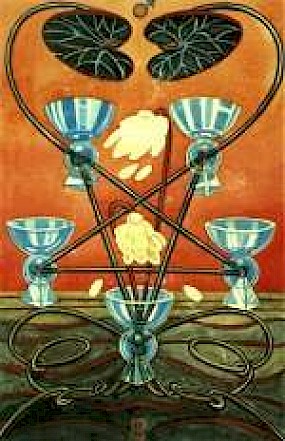
None of us feel too good when the Five of Cups, Lord of Disappointment, turns up in our readings. It almost always means that somebody somewhere is going to make us feel let down or sad about something. And often when that happens we can end up giving ourselves a hard time, and hurting ourselves unnecessarily.
But there’s one important thing to consider when we get disappointed – we feel that way because an expectation we had is not fulfilled, whether by ourselves or by somebody else. So if you get this card coming up often, it’s worth taking a good look at your expectations. Are they unrealistic? Are they geared to the abilities and characteristics of the person you hold them of? Or do you expect too much – this is an attitude we tend to apply most viciously to ourselves. Are you expecting more than you have a right to? Are you expecting things that the person in question -yourself or somebody else – is simply not able to provide? If the answer to any of the above is yes, then if you change your expectation, you’ll stop being disappointed.
When this card comes up, it warns us that either we have failed to resolved an old difficulty, or that – realistic or not – our expectations are about to be disappointed. Often this will happen in an emotional situation (because this is a Cup card) but can happen elsewhere in our lives too, because disappointment itself is an emotion and therefore belongs to Cups. Aside from locating where the problem lies, there’s rarely much that can be done except preparing ourselves to accept the inevitable consequence of being alive – into each life a little rain must fall etc.etc.
One thing that is always worth bearing in mind with a card like this is that the feelings which arise when it occurs often scare us into failing to take another risk, failing to make another effort, hiding away where we can’t be disappointed again. But then if we give in to those sort of feelings we’re expecting to be disappointed again, aren’t we? So maybe we need to think about the Nine of Wands when we see the Five of Cups, reminding ourselves of that inner reserve of strength and capability we can all release inside us!
In its earliest form (defined by Aristotle in his 350 BC book Prior Analytics), a deductive syllogism arises when two true premises (propositions or statements) validly imply a conclusion, or the main point that the argument aims to get across.[1] For example, knowing that all men are mortal (major premise) and that Socrates is a man (minor premise), we may validly conclude that Socrates is mortal. Syllogistic arguments are usually represented in a three-line form:
All men are mortal. Socrates is a man. Therefore, Socrates is mortal.[2]
In antiquity, two rival syllogistic theories existed: Aristotelian syllogism and Stoic syllogism.[3] From the Middle Ages onwards, categorical syllogism and syllogism were usually used interchangeably. This article is concerned only with this historical use. The syllogism was at the core of historical deductive reasoning, whereby facts are determined by combining existing statements, in contrast to inductive reasoning in which facts are determined by repeated observations.
Within some academic contexts, syllogism has been superseded by first-order predicate logic following the work of Gottlob Frege, in particular his Begriffsschrift (Concept Script; 1879). Syllogism, being a method of valid logical reasoning, will always be useful in most circumstances and for general-audience introductions to logic and clear-thinking.[4][5]
Aristotle defines the syllogism as “a discourse in which certain (specific) things having been supposed, something different from the things supposed results of necessity because these things are so.”[6] Despite this very general definition, in Prior Analytics Aristotle limits himself to categorical syllogisms that consist of three categorical propositions, including categorical modal syllogisms.[7]
The use of syllogisms as a tool for understanding can be dated back to the logical reasoning discussions of Aristotle. Before the mid-12th century, medieval logicians were only familiar with a portion of Aristotle’s works, including such titles as Categories and On Interpretation, works that contributed heavily to the prevailing Old Logic, or logica vetus. The onset of a New Logic, or logica nova, arose alongside the reappearance of Prior Analytics, the work in which Aristotle developed his theory of the syllogism.
Prior Analytics, upon rediscovery, was instantly regarded by logicians as “a closed and complete body of doctrine”, leaving very little for thinkers of the day to debate and reorganize. Aristotle’s theory on the syllogism for assertoric sentences was considered especially remarkable, with only small systematic changes occurring to the concept over time. This theory of the syllogism would not enter the context of the more comprehensive logic of consequence until logic began to be reworked in general in the mid-14th century by the likes of John Buridan.
Aristotle’s Prior Analytics did not, however, incorporate such a comprehensive theory on the modal syllogism—a syllogism that has at least one modalized premise, that is, a premise containing the modal words necessarily, possibly, or contingently. Aristotle’s terminology in this aspect of his theory was deemed vague and in many cases unclear, even contradicting some of his statements from On Interpretation. His original assertions on this specific component of the theory were left up to a considerable amount of conversation, resulting in a wide array of solutions put forth by commentators of the day. The system for modal syllogisms laid forth by Aristotle would ultimately be deemed unfit for practical use and would be replaced by new distinctions and new theories altogether.
DAN SIEGEL is a clinical professor of psychiatry at the UCLA School of Medicine and executive director of the Mindsight Institute. Here he speaks to UDAY KUMAR about creating a kinder, more compassionate world, the lyrics of Leonard Cohen, and the other pandemics that are worthy of our attention right now during Covid times.
Q: Hi Dan. For the longest time I have wanted to reach out to you. Especially in the current times in which we are living, people are seeking so much help. If you could talk a little bit about your work, I think that would be a good place to get started.
DS: You know, the notion of bringing science into how we live our individual lives, how we live as families and communities, how we live as nations, and how we live as a human family on Earth, offers the opportunity to think deeply across many different disciplines of science, and then ask the questions: Why are we here at all on the planet? While we’re here, what can we do to try and create a kinder, more compassionate world?
I think everything I’ve been doing professionally has been to take my background as a scientist, who’s also trained as a physician, and then think deeply in my particular field of psychiatry – how the mind develops – so as to ask questions like, “How has the human mind been shaped by modern culture?” and “How might that be affecting our relationships with each other, and also our relationships with the broader world of living beings, which you can simply call nature?”
So, if I have to summarize all that scientific exploration, it resonates with ancient spiritual teachings, even though that’s not my background. It would be that the human mind constructs categories and concepts, and then uses words and symbols to say things like, “Who are you?” “Who am I?” “What’s the Self ?” Our modern culture has created an atmosphere of knowledge that’s probably very different from how we originally evolved to live in community. In many ways, it has us living in isolation from one another – not just because we’re in a viral pandemic, but because there is a pandemic of misunderstanding of what the Self is.
If you ask almost anyone, anywhere in the world (I had the chance to do this in the olden days when we could travel), “Where is your Self?”, they will point to their body. Sometimes they point to their heart, sometimes they point to their head, but they’re pointing to their body. What I always find fascinating about that is that the “Self ” is the center of gravity of your identity, of your experience, and it also shapes your experience of belonging. If you think that the Self is only in your body, then you’re going to be very vulnerable to feeling disconnected, like an entity that can be separated from everything else.
That view of the separate Self, the “solo Self,” is a teaching of modern times. Sometimes it is very subtle, and sometimes it’s more extreme, especially with social media. In either case, it’s very toxic. I think the lie of the separate Self is making us feel alone and lonely. It’s making individuals and families somehow feel like they’re isolated. Then, in the larger community, there is an incredible sense of anxiety, depression, despair, and even increasing suicidality, that’s made worse with the viral pandemic. When you’re trying to live a life as if the Self is only in your body, then everything is revolving around you, as if you are a noun rather than an unfolding verb-like set of processes.
Even if you think about Heartfulness and the feeling of love, if you view the Self as a noun-like separate thing, you will think, “Well, are you going to love me, and am I going to love you?” rather than thinking there is a universal life force of love that comes through the heart, through the body, and connects us with other people, the planet, and nature. When you live that way, it’s very different. It’s more like candlelight. If you see someone whose candle wick is not lit, you lean over and light it; it doesn’t take anything away from the light of your flame. Instead, people live more like they are coins: “If I give you my coin, then I’m not going to have it anymore, so I’m not going to give it to you.
”There’s a big difference between seeing yourself as a verb-like unfolding event, like the flame of a candle, and seeing yourself as an entity, like a coin, in which case you say, “Well, I’m going to hold on to mine.” So it isn’t just, “Well, who cares if you think the Self is in the body,” because that makes you think you’re a noun, and you treat love like a commodity to hold like a coin rather than release like a flame.
Q: From a scientific viewpoint, you have arrived at the wisdom of spirituality. It’s a fascinating explanation for me, because I come from the other end of the spectrum where I have been taught that my Self is part of a larger universal Self. There are all these individual Selves, but there is uniformity because we are all connected with the same Source. And that aids the feeling of pervasive brotherhood, pervasive love. From that standpoint, love is more like, “I don’t love, but I become love.” It’s my state of being that I radiate. In Heartfulness, the whole idea is that this essence of love is what you experience in meditation, as a result of Transmission. At the end of the day, the loneliness and lack of connection people are feeling arise because of the inability to feel connected with one another. And I read a lot about that in your work.
You mentioned the pandemic, so I am tempted to ask: Amongst all the negatives we’ve heard from the pandemic, have you seen any positives, any green shoots? What should we take away from this time?
Our modern culture has created an atmosphere of knowledge that’s probably very different from how we originally evolved to live in community. In many ways, it has us living in isolation from one another – not just because we’re in a viral pandemic, but because there is a pandemic of misunderstanding of what the Self is.
DS: There’s a very powerful song by the songwriter and poet Leonard Cohen called Anthem. There’s a verse in that song that goes like this:
“Ring the bells that still can ring Forget your perfect offering There is a crack, a crack in everything That’s how the light gets in.”
What Cohen was offering us was the idea that there is no such thing as perfection; bringing the light, bringing the love in comes from the challenges we have. I think the pandemic has revealed many cracks. Now, how are we approaching this moment as a humanity, where a virus has gone around the world and shut down our human lives in many ways? There’s a concern over how we’re going to do it. The pandemic is ending lives and also ending livelihoods, and I’m sure we’ll have many surges to come.
I think the way we deal with the viral pandemic has to do with our cooperation. I was in the state of Texas at the moment when the governor said, “I’m going to remove all restrictions and regulations about mask-wearing, because you individual citizens should determine your own fate.” When I heard this, I thought it’s exactly speaking to what the United States of America has been accused of by anthropologists – the most individualistic place on the planet. That statement is such a violation of what a community needs to do in collaboration to realize that it isn’t just that your fate is in your own hands. No, it’s in our collective identity as a collective “we.” So, what you could call “linear thinking” rather than “systems thinking” from a scientific point of view is the vulnerability of the viral pandemic.
Those four pandemics – lack of cooperation in dealing with a viral pandemic, social injustice and racism, misinformation and polarization, and environmental destruction – are all either caused or made worse by the fifth pandemic, which is the pandemic of the separate Self.
There are several other pandemics that are worth mentioning. One is the pandemic of racism and social injustice, where people are mistreated for prejudicial notions of who’s the in-group and who’s the out-group or not even human. And so we see lots of murders of people of color in the United States. Let’s just name racism and social injustice as a pandemic all around the world.
Then there’s the pandemic of misinformation, and the polarization that’s happening in little bubbles of knowledge. That also comes from people having the very limited view of a separate Self, the solo Self. It’s true of racism, too, because you can have a solo Self that’s plural – “Only people with skin color like mine, beliefs like mine, nationalities like mine.”
We have to chart a new path forward, leaning on indigenous teachings and spiritual teachings, so that when we weave them together with science they teach us to be of service.
There’s a fourth pandemic of environmental destruction, where human identity has excessively differentiated itself from our place in nature. So, instead of the teachings you spoke about, of being a part of a larger whole, you think, “Oh, we’re humans, and we’re better than the rest of the species. Let’s treat Earth like a trash can. Who cares!”
So those four pandemics – lack of cooperation in dealing with a viral pandemic, social injustice and racism, misinformation and polarization, and environmental destruction – are all either caused or made worse by the fifth pandemic, which is the pandemic of the separate Self.
Of course, the viral pandemic is leading to so much suffering. It’s terrible. At the same time, it’s a crack in the system that we need to see not just as a crisis and an emergency, but also as an opportunity to reimagine our understanding of the mind, how the human mind has constructed a solo Self view of identity that restricts our belonging. We can use this as a moment to say, “We can’t continue with business as usual.” If we can shut down travel and all of the polluting so rapidly because of a viral pandemic, why not take that same approach to the other pandemics? Let’s name what the deep problem really is, which either makes it worse or makes it happen in the first place. It is the lie of the separate Self – the toxic, even lethal lie of the separate solo Self.
What is the good news? The human mind, which constructs identity, has created what Einstein called an optic delusion of consciousness and the sociobiologist E.O. Wilson calls an illusion. Whether it’s a psychotic belief or an erroneous belief, or a mistaken perception, either way it’s wrong. We need to listen to these scientists and say, “Okay, if it’s wrong, and we’ve been living a collective human life here on Earth with wrong beliefs and perceptions, why not take a deep breath during the pandemic and take this opportunity to realize the true nature of the Self, which is not just in the body. It’s actually an inner Self.”
But you also have a relational self that is connected to others, even people who don’t look like you, and other species. We’re a part of all of nature. So, as terrible as the pandemic is, it’s a moment of pause in which we can say, “We cannot go on with business as usual.” We have to chart a new path forward, leaning on indigenous teachings and spiritual teachings, so that when we weave them together with science they teach us to be of service.
We have spirituality, science, and service. And we can each contribute to that in many different ways. I think there needs to be a turning, which the great Joanna Macey (a beautiful teacher who is now 92) talks about as the Great Turning. What she means by that is a turning of the way we see how we’re conducting our lives so that it becomes regenerative of the world, and compassionate instead of just competitive. If you want to compete with something, let’s compete with the world’s challenges, so that when we beat the challenges everybody benefits.
Q: My teacher, Daaji, says that while survival of the fittest may apply in the overall scheme of survival, human beings evolve only through cooperation.
“Prior to his trial for war crimes, the master engineer of Nazi genocide SS Lieutenant Colonel Adolf Eichmann was certified as ‘normal’ by several psychiatrists–‘more normal, at any rate than I am,’ one of them was said to have exclaimed according to Hannah Arendt’s classic account. ‘Another,’ Arendt reported ‘had found that Eichmann’s whole psychological outlook, including his relationship with his wife and children, his mother and father, his brothers and sisters and friends, was ‘not only normal but most desirable.'”
Hannah Arendt, “Eichmann in Jerusalem–i,” New Yorker, February 16, 1963 quoted in The Myth of Normal by Gabor Maté
“Greta Thunberg, the teenage climate activist, describes her autism as her ‘superpower.’ ‘Many ignorant people still see it as an illness, or something negative,’ she said on Twitter. ‘When the haters go after your looks and differences, it means they have nowhere left to go. And then you know you are winning.’ Prior to her climate campaign, she divulged, she had ‘no energy, no friends and I didn’t speak to anyone. I just sat alone at home, with an eating disorder.”
“Greta Thunberg responds to Asperger’s Critics:’ “It’s a superpower..” by Alison Rourke, The Guardian, September 2, 2019 quoted in The Myth of Normal by Gabor Maté
“We live in a country in which words are mostly used to cover the sleeper, not to wake him up.
–James Baldwin
James Arthur Baldwin (August 2, 1924 – December 1, 1987) was an American writer and civil rights activist. He garnered acclaim for his work across several forms, including essays, novels, plays, and poems. Wikipedia
How ’bout getting off of these antibiotics? How ’bout stopping eating when I’m full up? How ’bout them transparent dangling carrots? How ’bout that ever elusive kudo?
Thank you India Thank you terror Thank you disillusionment Thank you frailty Thank you consequence Thank you thank you silence
How ’bout me not blaming you for everything? How ’bout me enjoying the moment for once? How ’bout how good it feels to finally forgive you? How ’bout grieving it all one at a time?
Thank you India Thank you terror Thank you disillusionment Thank you frailty Thank you consequence Thank you thank you silence
The moment I let go of it was the moment I got more than I could handle The moment I jumped off of it Was the moment I touched down
How ’bout no longer being masochistic? How ’bout remembering your divinity? How ’bout unabashedly bawling your eyes out? How ’bout not equating death with stopping?
Thank you India Thank you providence Thank you disillusionment Thank you nothingness Thank you clarity Thank you, thank you silence