Karma is a complex philosophical concept that cannot be depicted through a single image. However, certain symbols and visuals can help to convey its essence. These images are symbolic representations and may not capture the absolute depth of the concept of Karma.
We walk with our deeds, and Karma follows us like a visible or invisible shadow.
The concept is rooted in complex philosophical and spiritual traditions, and any visual representation should be approached with an understanding of its cultural significance and the perspectives of the traditions that hold it.
In simple terms, Karma is visualised as an act of the ripple effect on the water. This symbolises that every action creates a series of interconnected consequences.
The earliest appearance of the word “Karma” is found in the Rigveda. The Rigveda is one of the earliest and most sacred texts of ancient Indian literature and is considered one of the oldest texts known to humanity.
It is a collection of Sanskrit hymns composed by various spiritual poets/sages over a period. It is believed to have been composed over several centuries, with the oldest portions dating back to around 1500 BCE and the latest parts to around 1200 BCE.
Rigveda was transmitted orally for many generations before being eventually written down. The hymns are dedicated to various deities and natural forces and reflect the ancient period’s religious and cultural beliefs.
What is Karma?
The term “karma” is derived from the Sanskrit word. “Karma” means “action” or “deed.” In these belief systems,
Karma refers to the law of cause and effect, where every action, whether physical, mental, or emotional, has consequences.
Karma is a concept that originates from various Indian religions and philosophies, mainly Hinduism, Buddhism, Jainism, and Sikhism.
The fundamental principle of Karma is that the choices and actions a person makes in life will impact future experiences. Positive actions generate positive Karma, leading to beneficial outcomes and happiness in the future, while negative actions result in negative Karma, leading to suffering or challenges.
If the deed is good, then Karma is good, similar to the bright reflection on the water, and if the deed is terrible, then there is darkness or unhappiness in life. This is a simple and yet straightforward analogy.
The concept of Karma also incorporates the idea of reincarnation, where the soul goes through a cycle of birth, death, and rebirth (reincarnation). The accumulated Karma from past lives influences the circumstances and events of the present life.
The ‘afterlife or life after death’ is a mystery and another deep-rooted spiritual /metaphysical discussion. This is a secret to everyone during their lifetime.
Therefore, the philosophy behind rebirth is also faith.
However, the concept of suffering in the next life hinders a person from consciously making wrong actions in this life.
Karma is not just about rewards and punishments but also about learning and growth.
By experiencing the consequences of their actions, individuals could gain wisdom and spiritual development over the present life span (or multiple lifetimes, if any).
Karma is a central perception of life in many Eastern religions and philosophies. However, it may not be part of everyone’s belief in Western traditions and other worldviews.
Science works on the principle of observable, testable, and verifiable phenomena, and the concept of Karma falls far outside scientific explanation.
Therefore, it is essential to distinguish between beliefs rooted in faith, spirituality, or cultural traditions and those through scientific methods. The law of Karma is one of them.
As a physicist, I recognise the scientific explanation of Karma in simple words as an action and its equivalent reaction. This scientific enthusiasm drew me closer to theism from being an atheist.
In my early years in India, I could see the effect of this belief on people and how it made them conscious about their actions. (Sadly, many wrong activities do happen in countries where Karma is upheld).
The Bhagavad Gita is a sacred Hindu scripture and is part of the Indian epic, the Mahabharata. Its date of composition is believed to be around the 2nd century BCE.
Numerous scholars and philosophers have widely accepted it throughout history, inspiring countless people in their spiritual journey. It continues to be studied, recited, and revered by millions worldwide, making it a timeless and influential spiritual text. It is a dialogue between Prince Arjuna and Lord Krishna, who serves as his charioteer and spiritual guide.
According to Lord Krishna in the Bhagavad Gita,
The meaning of Karmais in the intention. The intention behind the action is what matters most.
Different individuals and cultures may interpret Karma in various ways, and its validity or relevance may vary from person to person based on their philosophical outlook.
Ultimately, the philosophy of Karma as a ‘Truth or Myth’ remains a matter of personal choice and faith, and your intellect can guide you.
The views in this article are personal, and I’m still a learner of the mystery of life.
Let us do good deeds and lead a peaceful life. Tara Desai
…..
A sad incident led me to write this article. A few days ago, I received a telephone call that shook my ground. My tremor was so intense that I couldn’t speak, and I didn’t hear anything after that…….
My 51-year-old, well-established nephew passed away from a massive heart attack.
I had to speak to my sister-in-law, whom I love most, but I didn’t know what and how…., She is the most revered and beloved woman in my life at par with my mother. I have seen her like an angel, but why did this tragedy happen to her? I didn’t know what to say.
A very spiritual woman who is exceptionally kind to everyone lost her soulmate (my brother) and elder son a few years ago, and the remaining son passed away, leaving her in a boundless ocean of grief for the rest of her life. It was an unexplainable tragedy.
I geared my courage….
I called, and she picked up the phone; a faint-calm voice uttered; Yes, it was god’s desire, and he had to go….
With her words, I trembled again…..
She continued….. maybe I had the wrong Karma in my ‘last life’, and I need to suffer now….
I have seen her like an angel, but why did this tragedy fall on her?
I do not know what she said….but it made me think deeply about the philosophy of Karma, although I strongly believe in it.
I love nature, sensitive literature, history, philosophy, travelling and scientific advances. I am a PhD in Nuclear Energy and always in search of knowledge.
Meditations is one of the most influential philosophical works to ever exist.
And what’s crazy is, the author had zero intentions of publishing it.
To be honest, I’m glad it was published.
Could you imagine where we’d be without the wisdom of this incredible man?
We’d certainly be a lot worse off.
To give a brief backstory, Marcus Aurelius was away on a campaign between 170 AD and 180 AD.
That’s right, this dude didn’t only rule the most powerful empire in the world, he also fought shoulder to shoulder with his fellow soldiers.
I believe the kids these days call this “built different”.
Anyway, whilst he was at war, he wrote a journal with the sole intention of improving himself.
The insights in this book are from a Roman Emperor during the peak of his powers.
At the time, he was the most powerful man on the planet with everything he could have ever wanted.
But instead of indulging in pleasures of the body and sinking into degeneracy, he decided to dive deeper into his mind and maximise his human potential.
Marcus Aurelius is a far cry from all of our modern leaders.
If he were to see the state of Western leaders today, he’d turn in his grave.
Nevertheless, it’s a blessing to have his lessons.
With that out of the way, let’s dive into 8 of his thought-provoking quotes.
“You have power over your mind — not outside events. Realise this, and you will find strength.”
This quote is a powerful reminder.
Things will often go wrong in life.
In many cases, these things will be out of your control.
Dwelling on the things out of your control is not intelligent.
You need to let it all go and focus on what you can control.
Understanding this fact about the world will allow you to find inner strength.
This quote also champions the idea of personal responsibility.
Instead of blaming others for their actions, stop.
You cannot control anyone else’s actions other than your own.
Therefore, it’s your duty to take responsibility for the mess.
Without you’re involvement, the bad thing never would have happened.
Fully internalising this mindset will allow you to take full control over your life.
2. “The happiness of your life depends upon the quality of your thoughts.”
Happy wife, happy life?
No.
Happy mind, happy life.
Don’t get me wrong, there’s nothing wrong with having a happy wife.
In fact, it’s a beautiful thing.
But you can’t rely on external things to provide you with happiness.
Instead, you must understand that happiness comes from within you.
Money won’t make you happy.
Attracting a beautiful woman won’t make you happy.
And sadly, even achieving your goals won’t necessarily make you happy.
For you to be happy, you need to have a healthy mind.
How do you have a healthy mind?
By having healthy thoughts.
Since your reality is created by the thoughts that you have, it makes sense to make them as positive as possible.
Because before any external achievements, it’s essential to be happy within yourself.
Wise words from the warrior emperor.
3. “Everything we hear is an opinion, not a fact. Everything we see is a perspective, not the truth.”
This saying is highly controversial.
It highlights the fact that we can never really know what’s true.
At least not entirely.
When you hear something being uttered by someone, it is not the truth.
It is merely their opinion of what is true.
Whether there is such a thing as objective truth or not, we as humans will never experience it.
We will only ever experience perceptions, because everything that comes out of someone’s mouth is just a perspective.
I hope this makes sense to you.
It makes sense to me, but I may not be doing a great job at explaining it.
Either way, this observation is killer.
And in my opinion, it’s even more relevant today than when Marcus Aurelius was alive.
Keep this quote in mind the next time you see someone pontificating about a subject.
Whether it be political, religious or cultural.
Always remember that what they’re preaching isn’t the truth.
It’s just their perspective.
4. “Waste no more time arguing about what a good man should be. Be one.”
There’s a lot of talk online about being a high value man, yet not a lot of meaningful actions to become one.
Guys these days seem to think watching entertainment is enough to make them high value.
Pathetic.
Either way, Emperor Aurelius is right.
Instead of debating over what makes a man good, spend more time trying to become one.
At the end of the day, words contain little value.
Actions will speak far louder than anyone screaming about how high value they are.
Also, we don’t need to overcomplicate something so simple.
A good man is someone who does good things.
A simple credo which I subscribe to goes as follows:
Be yourself.
Be good to yourself.
And be good to good people.
This 3 sentence bible was coined by a contemporary man of power named Marquett Davon Burton.
I believe he and Marcus Aurelius share many overlapping views on life.
If you want to be a good man, you can’t go wrong with that message.
5. “When you arise in the morning think of what a privilege it is to be alive, to think, to enjoy, to love …”
This quote speaks to the importance of gratitude.
When you lack gratitude, you become entitled and arrogant.
Instead of being thankful for the gift you’ve been given (life), you desire more and more.
More money.
More attention.
More sex.
More food.
More happiness.
Without gratitude, this quench for more will never be filled.
With gratitude, you can appreciate what you have and be thankful for the gift you’ve been given.
Nothing in life is promised.
I have a friend whose 18 year old nephew just died in a horrific motorbike accident.
Imagine having the audacity to complain about your living conditions when you’re fortunate enough to be alive and well.
Especially when you’re fortunate enough to have a roof over your head, access to food and a loving family.
It makes me sick to see such little awareness.
When you wake up and appreciate how fortunate you are to be alive, your perspective on life changes.
Instead of having to make a boatload of money, you get to make a boatload of money.
Instead of having to stick to a rigorous content creation schedule, you get to spend all day writing.
Practicing daily gratitude makes you aware that your life is a gift.
And once you realise this, you can finally start to live it.
Which neatly leads me to…
6. “It is not death that a man should fear, but he should fear never beginning to live.”
How many people are living with a crippling fear of death?
The answer is — quite a lot.
Think of all the people who are obnoxiously health conscious.
Think of all the people who live each day, worrying about when they’ll die.
Are these people really living?
Are they enjoying the fruits that life has to offer?
Of course not.
People like this aren’t only afraid of death.
They’re also afraid of everything in life which involves risk.
They’re terrified of exercise, lest a dumbbell falls on their head and cripples them.
They’re petrified of approaching a beautiful woman they deem to be perfect.
And they’re frightened of giving up their life of comfortable security in exchange for pursuing their dreams of freedom and fulfilment.
These people aren’t living.
They’re dying.
They’re just doing it really slowly.
Instead, these people need to reverse their fear.
These people need to think long and hard about what will happen if they keep doing the same things.
They keep passing on the things that bring them the most joy.
They keep walking past potential romantic partners and remain lonely.
They keep tolerating their boring job and accept that they’ll never become a boss.
When this shift in perspective occurs, a different fear sets in.
A fear of regret.
A fear of wasting the gift they’ve been given.
And a fear which will only become worse, the longer they wait.
This is the key to start living.
Stop fearing death.
Start fearing eternal regret.
7. “Our life is what our thoughts make it.”
This idea has been parroted by many self-help gurus in the modern age.
Figures such as James Allen, Jim Rohn and Brian Tracey.
I’m not disparaging these figures.
I’m merely pointing out that their teachings stem from the great Marcus Aurelius.
Who would deny this statement?
I see people who experience the exact same things yet come up with totally different conclusions.
One sees something terrible while the other sees a great lesson and an opportunity.
Once you understand that your thoughts dictate your life, you are free to change the way you think.
If you never understood this lesson to be true, you would remain a slave to your thoughts forever.
I learnt this lesson firsthand when I was 18.
At the time, I was a miserable person.
I was addicted to cannabis.
Addicted to pornography.
And also a political zealot.
My thoughts were nothing but garbage and this ended up negatively affecting my life.
Now, I do not have the same vices.
I don’t smoke weed.
I don’t jerk myself silly.
And I’m not a hateful leftist.
Instead, I see that my life is in my hands and that my thoughts have the power to shape my life.
Knowing that this is true, it makes sense to think positive thoughts.
Every bad thing that happens to me is a lesson.
Every unideal situation has a silver lining.
In essence, I am in control of my perspective.
I’m deeply thankful to Marcus Aurelius for sharing this lesson with the world.
And I’m also thankful for the modern synthesisers who keep his ideas alive through their works.
8. “The object of life is not to be on the side of the majority, but to escape finding oneself in the ranks of the insane.”
It’s almost eerie how true this statement is.
The man wrote this over 2000 years ago and it’s more relevant than ever.
It just goes to show that humanity doesn’t move in a straight line and people are yet to learn from civilizational mistakes.
What Marcus Aurelius is saying is simple, never trutst the majority.
If you’re on the side of the masses, you’re doing something wrong.
As a ruler of ancient Rome, he knew this better than anyone.
He keenly observed the behaviours of the masses and saw what they cared about.
Gladiator bouts.
Spectacles.
Mindless entertainment.
Bread and circuses.
All things which the masses today cherish beyond belief.
For you to live a life of meaning, you must move away from what the majority do.
Because if you look around, it’s clear that they’re not living a life worth aspiring for.
This was the same in Ancient Rome as it is today in Western Civilization.
For you to find true success in the world, you must detach yourself from the insane and march against the grain.
Thank you for reading this article.
I sure hope you’ve been able to gain something from it.
If you did, I’d appreciate it if you shared it with your friends.
Building infinite leverage one post at a time. Follow me for fascinating articles on: culture, marketing, life and anything that interests me. @godfrey_thegr8
In the first half of the 20th century the descendants of the Vikings did what we Americans have been hesitant to do. They waged a nonviolent revolution to take away the dominance of the economic elite.
In the U.S., even though the economic elite is okay with bringing climate emergencies to an increasing number of Americans, it maintains its control of both major parties. For the Nordics, overcoming elite control was a very big reach, but the Danes broke through in the 1920s and then the Swedes and Norwegians matched them in the 1930s. (Finns and Icelanders followed in the ‘50s.)
I personally experienced the payoff of a nonviolent revolution when as a young man I studied at a typically free Nordic university, in Oslo. Of my eleven books, the most pleasurable to write was Viking Economics, published in 2016 and still in use. When the book came out, an international association of Nordic economists invited me to keynote their conference, and I learned still more.
Few Americans seem to know that the 2023 World Happiness Report rates the people of Finland, Denmark, and Iceland as the top three countries in the world, with Sweden as sixth. The U.S. is fifteenth. The World Economic Forum’s measure of the gender gap among the nations puts Nordic countries in the top five, while the U.S. is 43rd. Racial Equity Rankings by US News and World Report puts the Nordics in the top ten. The United States? The U.S. comes in 73rd.
Yale University has created an Environmental Performance Index for rating national accomplishments. Four of the Nordics are in the top 10 while Norway follows at 20th. The U.S. is 43rd.
When an oligarchy is in charge, misery is widespread no matter how small and homogeneous you are!
In the 2022 Democracy Index rating, on a 10-point scale Nordics exceed 9.0. The U.S. is 7.85. In the 2019 rating of “best countries to raise a child,” the Nordics took the first four places, while the U.S. came in at 22nd.
Still, that was considerably better for the U.S. than the 2023 Global Peace Index: Nordic countries got the top two places while Sweden scored 28th. The U.S. scored 131st — down ten places since the Democracy Index of three years ago!
I could continue with rankings but you get the idea. For Americans, the full potential of our energy, smarts, creativity, and yearning for justice remain hobbled by the power of the economic elite and its political culture maintained through mainstream mass media and the two major political parties.
The Vikings used to be in bad shape
If such ratings existed before the 1920s, the Nordics also would have been caught under-performing. In fact, they were in such trouble that their people were emigrating to the U.S. in large numbers.
Some people believe the Nordics do well these days because they are small and relatively homogeneous. But in the Nordic “bad old days” they were smaller, and much more homogeneous. They performed poorly because their economic elites were running things. When an oligarchy is in charge, misery is widespread no matter how small and homogeneous you are!
What changed among the Nordics to generate today’s high ratings? Their people who didn’t leave figured out how to use nonviolent direct action campaigns to force their oligarchies to give up control.
But why not make a violent revolution?
To many Finns in 1918, armed struggle seemed the obvious choice. Their violent insurgency turned into civil war. The capitalists and conservatives crushed the socialist uprising: the result in that small population was at least 35,000 dead.
The Finnish people’s defeat delayed their movement’s eventual victory over the economic elite, which they finally achieved through nonviolent struggle. (Another of the many cases in history where violence failed to reach an objective, then nonviolent struggle succeeded.)
The Finnish direct action climaxed in the 1950s: a nationwide 10-day metalworkers’ strike was followed by a general strike of half a million workers, and at last the Finns could put themselves in the same league with their Scandinavian comrades.
While many Danes in the early 1920s were also tempted by violence, sufficient activists noted the failure of the Finnish violence and also became disillusioned with how their “next door leftists” in Germany were handling their struggle for revolution.
Danish radicals chose first to build on the credibility of the co-op movement and on their common-sense vision of what Denmark could look like if Danes took away the dominance of the economic elite. They then plunged into nonviolent campaigning. By 1924 the Danes obtained their first social democratic prime minister.
Impressed, Swedish workers and others followed this Danish recipe: create a clear vision of a new society, escalate community organizing (via co-ops + unions, in their case), and launch campaign after campaign of nonviolent struggle, through which the movement grows more massive.
By 1931 the Swedish economic elite was desperate to hold onto power. They used their government’s military and killed workers in a local but important strike. The labor movement responded to the killings by calling a national general strike, supported by middle-class progressives, and took power.
Norwegian workers and farmers, eager to learn from both Danes and Swedes, then upped their level of struggle. The Norwegians had a more radical vision than did the Swedes—Lenin even invited Norwegian Labor Party leaders to join Russian revolutionary meetings in Moscow. The labor movement increased the level of strike activity, aiming to end the elite’s ownership of the means of production.
By then, however, Norway was caught by the 1930s’ Great Depression. Norwegians in poverty were starving while still trying to maintain their strikes. Given the pain and hardship, the Labor Party decided not to continue the struggle to make a full-scale victory and instead to settle for social democracy, which was less expansive than their version of a new society.
The coalition of workers and farmers agreed to let the capitalists continue to own and manage their means of production, but required them to accept complete unionization, a high degree of regulation, huge taxes on large incomes and capital, and accept a large sector of co-ops as well as many municipally-owned and nationally-owned enterprises.
Most importantly, the Norwegian economic elite would have to give up their power to run the economy as a whole: big-picture decisions would be made by the working class and family farmers, through their dominance in parliament.
A growing number of mass strikes forced the Norwegian economic elite to surrender. The Labor Party—the most socialist of the Nordic workers parties—then basically ran the country for half a century.
Icelanders show Americans what we could do here
An observer might guess—since today’s Vikings have it so good—that their capacity for nonviolent struggle would have vanished through disuse. Wrong.
After decades of basic Icelander contentment with their social democracy, in 2008 Icelanders found most of the bankers—in league with the government—had become so corrupt that the country’s economy collapsed. Even the ATM’s no longer worked!
Icelanders quickly built a nonviolent direct action campaign powerful enough to oust the bankers and major party politicians alike. The media called it “the pots and pans revolution” because people massing outside parliament banged their kitchen pots so loud that the parliamentarians couldn’t debate!
The movement refused to allow Iceland to cooperate with the capitalist International Monetary Fund, whose job is to aid countries in bankruptcy. Instead, the movement itself rebuilt political and economic structures on a sound basis. (The women’s banks were uncorrupted and didn’t need to start over.)
When I later interviewed the rebellion’s leader at the key site of the struggle, I learned that 3% of Iceland’s population actively engaged in the direct action. I began to fantasize what ten million Americans (3 percent of the U.S. population) might do given a crisis—a climate disaster, for example—PLUS strategic nonviolent leadership.The Icelanders’ story raises this question: Will Americans and other activists prepare our vision and strategy now, for large-scale nonviolent struggle when a climate emergency or other crisis arrives that makes it possible?
Our work is licensed under Creative Commons (CC BY-NC-ND 3.0). Feel free to republish and share widely.
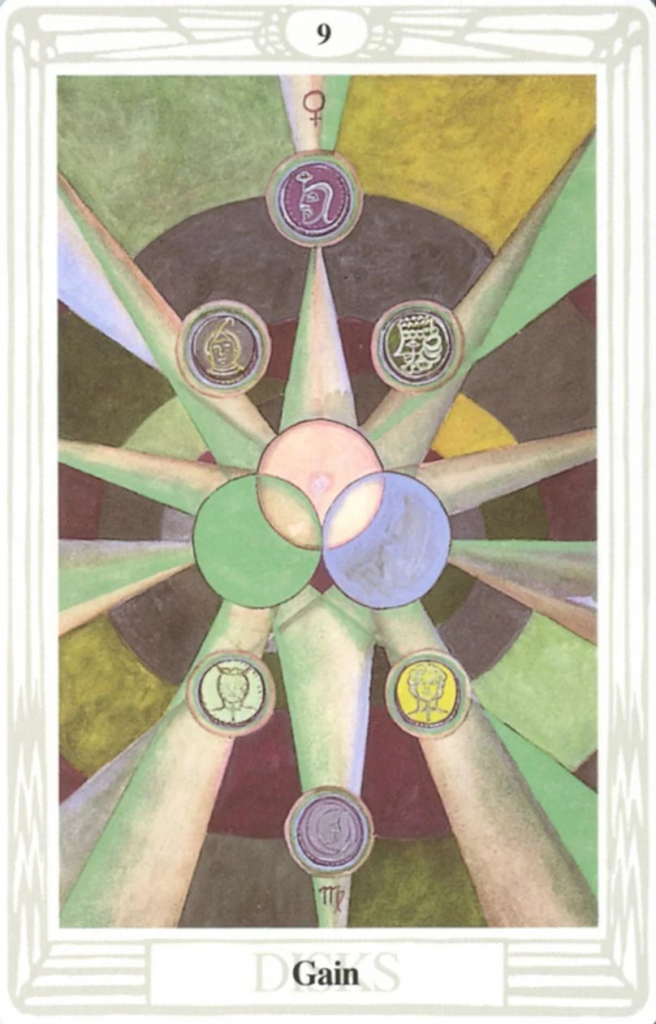
The Nine of Disks The Lord of Gain is one of the cards which usually receives a hearty welcome when it comes up in a reading. At the mundane level it indicates the financial rewards which come from working diligently and dedicatedly on an important project, so it will often mark a stage of completion. In the workplace it will show that hard work is rewarded both by appreciation and an increase of salary. Sometimes it can indicate promotion (though rarely a total change of workplace) earned as a result of loyalty and attention to detail.As you’ll remember, Disks not only deal with our financial area, but also with day-to-day security in the family environment. So sometimes the Lord of Gain can come up to indicate consolidation and achievement at home. Perhaps an emotional conflict has finally been resolved, or a long-standing problem finally dealt with.At the spiritual level, this card talks a lot about the principle that what we give to life is what we get back. And here we have confirmation that we have lived as much as we are able in the moment, appreciating the things that come our way, and celebrating the bounty we have. As a result, more abundance flows in.The card rarely indicates windfalls, or unexpected sources of income. Here we have worked hard to create something rewarding, and the Lord of Gain indicates the results of our efforts.
This is part of my unpublished book on Astrology, the second chapter of part 3. While taking a break from writing new material (see this article), I am using the opportunity to try to complete this project. (For what has preceded please see this list.) Following on from the previous chapter, where I established the relationship between Astrology and the Perennial Philosophy and the implications of this, here I explore the possibility of using Astrology as a means to reunify science and religion.
chapter 20: REUNIFICATION
“The most exalting fascination that has ever, up to now, inspired human thought and life, however, was that which seized the priestly watchers of the night skies of Mesopotamia about 3500 BC: the perception of a cosmic order, mathematically definable, with which the structure of society should be brought to accord… Not economics, in other words, but celestial mathematics were what inspired the religious forms, the arts, literatures, sciences, moral and social orders which in that period elevated mankind to the tasks of civilised life.
Today such thoughts and forms are of a crumbling past and the civilizations dependent on them in disarray and dissolution. Not only are societies no longer attuned to the courses of the planets; sociology and physics, politics and astronomy are no longer understood to be departments of a single science”. (Joseph Campbell, Myths to Live By¹).
That was how it used to be in the old days, when astrologers held positions of influence in court and government circles. It seems extremely unlikely that modern society will ever reinstate astrologers as advisers to kings, queens, and prime ministers, although one can live in hope. There was an occasion during Ronald Reagan’s presidency when a rumour* emerged that he was consulting astrologers before making decisions. Needless to say this was greeted with concern by the serious British media, and derision by the tabloids. I remember thinking that it was the only ray of hope in the make-up of an otherwise intellectually challenged president, that he might be seeking to understand the Divine Will; thank God he wasn’t making the decisions himself. (*See Gangof4’s response, where it is claimed that the rumour wasn’t true.)
Astrology would first have to be rehabilitated in the hearts and minds of the nations. The direction towards which I think we are heading ideologically as a planet, as suggested by the quantum physics revolution, is a unification of science and religion. There are different ways of looking at the role of Astrology in such a scenario. As one contributing factor, there might be a specific reunification between astronomy and Astrology. Others might see the reunification as being between Astrology and science itself. Some of the astrologers I have studied have expressed an interest in these directions, for example the Parkers: “The long awaited marriage between astrology and science may be about to take place”², and River/Gillespie: “Here we have chosen to tell astrology’s story without a rigid definition of the subject, to reconnect astronomy with astrology, science with magic, and the practical and political with the spiritual”³. The same sentiment has been expressed by the philosopher AugustSchlegel: “Astronomy will have to become astrology again”⁴.
That would be at a practical level, the understanding that the interpretation of the symbolism of celestial mechanics has implications for the lives of individuals and societies. However, at a deeper, metaphysical level Astrology can be seen as that higher place where science and religion meet. It was always meant to be “part of an ancient doctrine that at one time fused art, religion, philosophy and science into one internally consistent whole”⁵. I would therefore describe it as a philosophical/scientific enquiry into the ultimate nature of the cosmos. In that sense it hasalways been a higher form of science, because it has always known what much modern science refuses to acknowledge, that the universe is multi-layered. Thus Stephen Arroyo says: “To me, astrology is a cosmic science; using it is an art, but ultimately astrology is a science (his italics). But this cosmic science is so high in its essence, so vast, that very few people can reach that high level of consciousness where they can understand it thoroughly”⁶.
The purpose of these reunifications would therefore be to recreate an open-minded desire for knowledge in all areas and at all levels, a return by philosophy to its roots, in that in modern hands it has often become “merely a sterile word game used to perpetuate intellectual arrogance”⁷. To replace this wasteland Stephen Arroyo identifies Ancient Greek society as a model to which we can aspire: “When studying the history of Western civilization, we always find that the Greeks’ emphasis on science and reason is considered the crucial turning point in Western man’s intellectual and cultural development… However, the contribution of the Greeks was not limited to the discovery of certain natural laws active in the material world; it also extended into the realm of the individual’s inner life and growth. ‘Know thyself’ was the key idea underlying the development of Greek philosophy; and the word ‘philosophy’ (philosophia) literally means ‘love of wisdom’. Science for the Greeks was not merely the collection of data in the hope that certain correlations could be discovered. It was rather a systematic search for the essential truths underlying life and nature, and an attempt to discover not only natural laws but also the universal metaphysical laws of life itself. And, for the Greeks, ‘reason’ did not refer merely to the computer-like calculations of the logical mind, but rather to an inspired (or ‘inspirited’) combination of analysis and intuition founded upon ideals of elegance and symmetry”⁸.
Looking further afield, science in India, under the influence of the metaphysical standpoint of the Vedanta, understands that it is limited in what it can achieve, and there is no conflict between science and religion. Thus Robert Hand says: “It is possible with little or no compromise in one’s religious beliefs to be a modern scientist and a Hindu”⁹. The two go together because the task of both is seen as being to understand the multi-layered universe. In the West, however, science has set itself the task of understanding the physical universe, at best saying that the other dimensions are the concern of religions, more often denying their existence.
Other relevant examples would be:
the Kabbalah, which is the basis for (Zev ben Simon) Halevi’s astrology, described by him as a teaching system, a compendium of science, theology, philosophy, and psychology, thus all knowledge.
the medieval Arabian approach to physical science, described by Gauquelin as “a kind of vast astrology”¹⁰.
It is therefore clearly not impossible for science and religion to be united; we already have several useful models. Astrology is par excellence the discipline which can achieve it, and it is not surprising that many astrologers refer to its potential in this respect. Dennis Elwell, for example, speaks for many: “Astrology is the best and maybe the last hope of religion, because it offers a meeting-ground for the scientific and religious views of reality, reconciling many of their differences”¹¹.
John Addey, however, seems to have taken this to the level of a campaign. Discussing the scientists’ usual protest that the type of ideas which interest him are ‘religious’, and that it is therefore not their function to deal with them, he replies: “This is not true. It is the office of science to preserve, cultivate and expound truth, and every aspect of truth has its appropriate science, interior and spiritual aspects of truth no less than exterior and natural ones”. He then discusses the cultural problems which stem from the scientific attitude, and concludes: “What is needed is some kind of knowledge which will at least open men’s minds to the kind of solution which is required and the direction in which it is to be sought — and which can speak to both sides of the present impasse in terms which each can understand and acknowledge to be valid: to Science in terms of the quantitative analysis of scientific data; to Religion in the language of spiritual philosophy — the language of those timeless truths which the mystical philosopher has expounded from age to age. It is the writer’s conviction that astrology occupies, in this context, a unique position and is the science par excellence which is adapted to fulfil this reconciling role”¹².
What would the reunification actually consist of?
Quantum physics by itself is limited in what it can achieve. It does not have a theology, but does seem to lead scientists in a spiritual/mystical direction, (for example Capra, Bohm, Wolf, Pauli). In its search for the ultimate reality, it forces us to knock on the door of religion, even if it cannot provide the key. Thus Stephen Arroyo, noting that “researchers in psychology, with a few notable exceptions, continue to operate as if they were bio-chemists or reflex physicists”, says that quantum physics can rescue us from a psychology based on outdated physics¹³. (Insert. Since first writing this, I’ve also come across this quote from Werner Heisenberg: “The first gulp from the glass of natural sciences will turn you into an atheist, but at the bottom of the glass God is waiting for you”.)
The reciprocal benefit is explained by astrologer Dane Rudhyar as follows: “We claim… that science will have to use more and more psychological methods as it finds that atoms and universes behave more and more like personalities”¹⁴.
You may think that such comparisons between physics and psychology are mere analogies or metaphors. Luis Alvarado, however, makes a quite literal connection: “According to Edward Whitmont, the collective unconscious is the image-producing stratum of the psyche that contains the drives and emotions as psychic energy, or libido. Libido moves by way of fields: ‘A field is an energy pattern or configuration that becomes perceptible to the experienced observer only through the patternings of directly observable elements susceptible to its influence’. For instance, iron filings will form a pattern when exposed to a magnetic field. Archetypes can be conceived of as fields that give form to the drives and the emotions contained within the psyche. Archetypes, utilizing psychic energy or libido, order our life experiences in the same way a magnetic field orders iron filings”¹⁵.
Now it is time to suggest that Astrology can take both these disciplines forward. Thus Dennis Elwell says: “By showing what is really at work in human nature, astrology seems the most likely route whereby psychology will enter the age of the new physics. To date psychologists, secure in their own specialities, have been slow to understand the implications of what it means for humans to be living in a universe of unbroken wholeness. Physically it is recognised that our bodies are made of the same stuff of the universe, and that the laws of that physical universe apply. But when it comes to our minds, it is assumed that here the total universe withdraws, allowing other factors to enter into the little pockets it has vacated. Just as our bodies live in intimate association with the totality, so must our minds, our consciousness. Any other possibility would contravene the first law of being, that of interconnectedness”¹⁶.
Can Astrology also help scientists? By confining themselves strictly to the rules of their discipline, they consistently run into brick walls. I refer once more to the words of Toben/Wolf: “Mathematicians can describe the limits of space-time, but they can’t describe what is beyond, they only know there is a beyond”¹⁷. The reunification of science and religion offered by Astrology provides the opportunity to move towards an understanding of the higher levels. Scientists like Stephen Hawking seek a ‘grand unified theory’ of physics but want to achieve this on their own terms. Addressing the same issues I have just been discussing he says:
“Up to now, most scientists have been too occupied with the development of new theories that describe what the universe is to ask the question why. On the other hand, the people whose business it is to ask why (both his italics), the philosophers, have not been able to keep up with the advance of scientific theories. In the eighteenth century, philosophers considered the whole of human knowledge, including science, to be their field and discussed questions such as: Did the universe have a beginning? However, in the nineteenth and twentieth centuries, science became too technical and mathematical for the philosophers, or anyone else except a few specialists. Philosophers reduced the scope of their inquiries so much that Wittgenstein, the most famous philosopher of this century, said, ‘The sole remaining task for philosophy is the analysis of language’. What a comedown from the great tradition of philosophy from Aristotle to Kant!
“However, if we do discover a complete theory, it should in time be understandable in broad principle by everyone, not just a few scientists. Then we shall all, philosophers, scientists, and just ordinary people, be able to take part in the discussion of the question why it is that we and the universe exist. If we find the answer to that, it would be the ultimate triumph of human reason — for then we would know the mind of God”¹⁸.
Note that there is no mention here of anything that represents any kind of ‘religious’ attitude. Hawking hopes that through the use of human reason scientists will penetrate the mind of God (which we assume is a metaphor not to be taken literally in his case), and will then generously share these insights with the public.
In chapter 11 I discussed the fact that, despite there being strong evidence for the existence of organising principles, teleology etc., many scientists tend to ignore this and cling to their existing models. I noted there that Paul Davies, while sincerely wanting to know the answers, remains committed to seeking solutions through scientific avenues. It is not clear to me, however, what formulations science will achieve in relation to the archetypes, given their profoundly irrational nature. I suggest therefore that science, in order to make progress in its search, will have to turn to, that is to say unite with, Astrology and Analytical Psychology, which do know something about the archetypes. Here is Aniela Jaffé on the subject that the scientists I discussed in chapter 11 could not come to terms with: “Both psyche and matter are structured or arranged, in accordance with corresponding laws, by invisible formal factors”, the primordial images, also known as archetypes. She goes on to discuss the work of biologist Adolf Portmann, who concluded that there is “a ‘non-spatial abyss of mystery’ which opens out behind the living organism… He also hints that the ‘primal ground of unknown data’ lying behind biological events on the one hand, and the psychic hinterland, the unconscious, on the other, may be one and the sameirrepresentable mystery”¹⁹. Will scientists ever be able to formulate to their satisfaction laws about an “abyss of mystery”?
When they talk about a grand unified theory, scientists are primarily referring to a formulation which would incorporate four forces of nature: gravity, electromagnetism, and the weak and strong nuclear forces (although there is another consideration of combining general relativity [a classical theory] with the uncertainty principle [a quantum theory] ). It is not clear at which point in the evolution of the universe these forces came into being, but one possibility is that this occurred at the Big Bang.
In that the Big Bang ‘moment’ is usually referred to as a singularity, about which nothing can be said since at this point all laws of physics break down, one is tempted to feel that it is there that one is confronted directly by the nature of God, or in Qabalistic terminology Ayin or Ain Soph. These descriptions of the Big Bang singularity remind me of this statement by Luis Alvarado: “The Ain Soph, meaning ‘without end’, Limitless, is the well-spring of the universe, yet cannot be understood in terms of this universe… The Ain Soph is in effect, unknowable”. He also quotes Charles Poncé: “En-Sof, I would further suggest, is the meaning in creation, the limitless meaning which our scientists seek to discover in their attempts to unveil the origin of the universe. En-Sof is what they seek”²⁰.
Access to the understanding that Hawking is talking about is usually considered to be attained through mystical experience, not by thinking about it. We are therefore confronted by one of the perennial dilemmas of philosophy: which type of knowledge is better, theoretical concepts or direct experience? Hawking is attempting to discover the Grand Unified Theory, is searching for an understanding of God, and thinks that he can achieve this through the human analytical mind. (Although aspiring to the same scientific aim, Paul Davies is, perhaps wisely, more restrained about the meaning of such an achievement: “It is sometimes remarked that attaining this dazzling prize would represent the culmination of fundamental physics, for such a theory would be capable of explaining the behaviour and structure of all matter…” At this point I can almost hear the champagne corks popping! The celebrations may have to be somewhat muted, however, for he feels compelled to add “…in a reductionist way, of course”²¹.)
On the face of it he should be more cautious, since, according to Wolf/Toben, his own favourite language (mathematics) tells him that he cannot know what is beyond spacetime. I am even tempted to wonder whether the professor might benefit from some psychology classes, given by Anthony Stevens perhaps: “In other words, the archetypes which order our perceptions and ideas are themselves the product of an objective order which transcends both the human mind and the external world. At this supreme point physical science, psychology, and theology all coalesce”²².
What is the role of Astrology in this context? It is certainly not an experience of the transcendental, rather an activity of the mind, albeit one informed by a deeper understanding of irrational, transcendent factors. In chapter 9 I argued that astrological effects operate at the ‘boundary’ of the spacetime universe, entering it from outside. If that is true, then Astrology represents the limit of what the human mind is capable. It is a language of the archetypes; we can attempt to decipher the messages, but we can never see what sent them. Thus Astrology is arguably the best tool available to science for understanding what is beyond spacetime. (Compare Dane Rudhyar: “In its search for the ‘first Cause’ religion will use a method and a basis of thought not unlike those on which a revaluated astrology will be founded”²³, and John Addey: “The re-assimilation by science of the truths implicit in such results as those described earlier can have one end, and one end only: the reunification of the entire field of science so that all possible objects of knowledge, from the heights to the depths, from the innermost recesses of deity to the last and most transient of phenomena, are seen to coalesce in one perfect scheme of truth entire and seamless from first to last: all sciences rooted in the First Science; all causes in the First Cause; all lives in the First Life; all substances in the First Substance”²⁴.)
How will this reunification be achieved?
When there has been a big argument, and a reconciliation is desired, the two sides usually meet half way, and find a compromise position. It would certainly be desirable for science to make such a move. Its major task would be to force itself to give up its absolute dependence on the method that it has formulated. There would have to be:
1) much greater reliance on some current anathema: subjective impression, anecdotal evidence, intuition.
2) a willingness to incorporate irrational factors into their thinking.
Some astrologers show a strong interest in turning Astrology into something more like a materialistic science, in effect seeking a compromise. The most forceful expression I have found is this one by Jim Lewis: “It should proceed to look less like a religion and means to self-fulfilment and more like an objective science, adapting wave theory, gravitation, statistics, or some probably yet unnamed branch of psychology to justify itself to an increasing rigid and intolerant academic establishment”²⁵. Of the astrologers I discussed in chapter 2, the Parkers also spend considerable time trying to present Astrology in a form more acceptable to science.
Yet most of the others have no interest in appealing to materialistic science as it is:
Dane Rudhyar: “Attempts at making astrology an exact empirical science by basing it on measurements of actual influences and rays are, if not doomed to failure, at least bound to explain or prove only a fragment of the entire body of ideas which constitutes and has always constituted astrology. Whatever science may discover concerning cosmic radiations, we do not believe that the philosophy of astrology can or should ever be the same as that of an empirical science”²⁶.
Stephen Arroyo: “Instead of putting oneself at the mercy of incredibly limited assumptions and paradigms by forcing one’s mode of observation and expression to fit the ‘scientists’ mold, we should realize that their molds are not ‘objective’ as they pretend. Instead of forcing our way of thinking and expression into their molds, which is what a lot of astrologers are now trying to do, we should find our own way and not play into the hands of those with a very limited concept of life”²⁷.
Dennis Elwell: “Rather than attempt to bring the (phenomena astrology presents) within the fold of common sense, it is better to admit that astrology is a radically different way of looking at the world… Astrology..can claim to be an alternative reality, complete in itself, and credible within its own terms”²⁸.
Geoffrey Cornelius: “In our usual description of our subject, its foundation in a magical-religious inspiration has been obscured. The materialism and positivism of our opponents is the complement to a misleading materialism and positivism within astrology itself. If astrology in truth operates according to principles that do not belong in present-day science, then astrologers should not present the subject as if it is really a variant of science”²⁹.
They clearly believe that Astrology does not need to compromise with science in order to effect a reconciliation, and who can argue with them? If it is already the ‘truth’ it should not be afraid to hold its ground, and wait for science to catch up. To pursue the ‘argument’ analogy further, Astrology is the wronged party and it is therefore materialistic science that should apologise. It has very little to learn from science, but science needs to spend much time learning from Astrology. As Dennis Elwell says: “Mainstream science will eventually be obliged to embrace the astrological if it is to unify its picture of the universe”³⁰. The value of this highly desirable outcome will be diminished, if en route Astrology has to adapt itself in order to become more appealing to the other side. Here is Elwell again: “It is a popular delusion that as science advances, the beliefs of astrologers will become more and more discredited. The very reverse is happening… A growing number of discoveries leads us to think that the old astrologers must have been wiser than they knew” (p48).
On the same theme I especially like John Addey’s way with words: “How could scientists, as we have been accustomed to think of them, convert us to their way of thinking when they are no longer able to sustain their old beliefs themselves? We are not even in the position, as we have sometimes liked to think of ourselves, of a David pitting its strength against the Goliath of Modern Science. Science today — and I am speaking of the heart and core of the scientific world-view which has prevailed for the past 300-odd years — is not so much like a Goliath as like a great simpleton who is even now in the process of falling over his own bootlaces into the dust from which he will not rise again.
“I hope indeed that we shall become more scientific in our methods, but we certainly need not fear their philosophy (if one can call it that) when they themselves are already deserting that philosophy in order to rejoin the road which we have never left”³¹.
What specifically can science learn from Astrology?
In chapter 11 I argued on the basis of Paul Davies’s work that science might be unable to make further progress unless it accepts previously unacceptable ideas, for example teleology and organizing principles. Since these two factors are staring reluctant scientists in the face, and both of them are at the heart of Astrology and have been for thousands of years, it is clear not only that science has much to learn from Astrology, but also that materialistic science is a pretty slow learner. Here is Dennis Elwell on teleology: “Science, out of its concealed metaphysics, long ago set its face against any notion of intention, purpose, design, in the universe. Astrology may be destined to be the means whereby such teleological concepts are reintroduced into the mainstream of science’(p149). And John Addey on the archetypes: “Science is about to undergo a transformation in its thinking about first principles… Why (does) modern scientific thought (have) difficulty with the conception of a hierarchy of principles?… (The principles) are not abstractions; they are certainly not products of the human mind. Man can think of these principles because they are there (and because they are within man “as well as external to him); they are not there because man thinks of them” (p201).
Perhaps the following quotation says it best of all. I have referred several times to Wolf and Toben’s view that, while we can know that there is something outside spacetime, we cannot know what it is. It can hardly appear otherwise to science. However, Elwell here gives some hope that Astrology, even without being excessively mystical, might be the key which, in a manner comparable to science, can help science begin to unlock the mysteries of the spiritual realm: “What astrology does is allow us to take hold of that reality not so much at the experiential or intuitive level, but at the intellectual level, with concepts which are clear enough to be expressed and argued about. It supplies both the language and the methodology. Herein lies its relevance for science: it gives the bright light of reason access to areas hitherto only dimly apprehended” (p5). Perhaps there is hope for Stephen Hawking’s approach after all.
Science united with religion, Astrology united with astronomy, that was how it began in the ancient civilisations, for example Mesopotamia and Babylon, where the earliest star-studiers monitored the movements of the heavenly bodies, which eventually enabled them to construct accurate calendars and to predict eclipses. For some reason that we no longer understand it seemed self-evident to them that their findings could also be used to determine the ‘will of the gods’, in other words the evolution and destiny of their societies.
In the following period, even if astronomy and Astrology were not always considered a single discipline, they existed perfectly happily and peacefully alongside each other. This situation persisted for thousands of years, and included civilisations and cultural movements as diverse as the Vedantist tradition of India, the ancient Greeks, Romans, Egyptians, the Chinese and Japanese, the Arabs, the Maya and Incas, and the medieval Italian Renaissance. At this time, as Geoffrey Cornelius says: “The astrological world-view ‘intrudes everywhere’, entering into almost every area of inquiry and belief… The fundamental conception of a continuous pouring down of stellar influence was virtually unquestioned by critic and practitioner alike” (p1). And that seems to have included the great astronomers and mathematicians of the late Middle Ages! The standard account goes something like this: “The decline of astrology is generally attributed to the rediscovery of the heliocentric system by Copernicus, to Kepler’s laws, Newton’s mechanics… This account of the decline of astrology has become so general that it is no longer even questioned”³². To these three I would like to add the name of Galileo, who was responsible for the final triumph of the Copernican theory, and who is now remembered as much as the other three, if only for his famous trial.
West and Toonder, not having to scratch too deeply beneath the surface, offer a different picture. Let us see just how ‘scientific’ these figures were.
“Copernicus was led to his rediscovery of the heliocentric system by his study of Pythagorean ideas, with which he became acquainted in Italy, at the school begun by the theologian and mystic, Nicholas de Cusa”³³.
“Copernicus himself did not draw up horoscopes, but he had no difficulty in accepting the aid of a notorious astrologer, Rheticus, in completing and bringing out the first edition of his famous book DE REVOLUTIONIBUS ORBIUM CELESTIUM, which explained that the earth turned round the sun. Tycho Brahe combined a solicitude for precision and perfect objectivity in astronomy with classical astrological beliefs. As for Kepler, astrology was at least as dear to him as the laws of the stars’ motions which have made him immortal”³⁴.
“Galileo was a practising astrologer… and he nowhere intimates that he practised only to make a bit of money on the side, or that he privately repudiated the subject”³⁵.
Johann Kepler, discoverer of the elliptical orbits of the planets, and of the ratios between their distances, of the four names was the one whose allegiance to Astrology is the best documented. “He was… an intensely religious man, a Neo-Platonist… (Because he) was in permanent financial straits… he wrote astrological almanacs predicting events in the coming year, and cast personal horoscopes; both of which he regarded as a waste of time”. So, like most serious astrologers, he repudiated the trivial, fortune-telling side of Astrology. Yet this did not detract from his belief in the serious Astrology. It is interesting that he was converted to it after initial scepticism: “A most unfailing experience (as far as it can be expected in nature) of the excitement of sublunary natures by the conjunctions and aspects of the planets has instructed and compelled my unwilling belief”. Kepler repeatedly writes to friends of his intention to separate the ‘gems from the slag’. He issues ‘a warning to certain theologians, physicians and philosophers who rightly reject the superstitions of the astrologers, not to throw the baby out with the bathwater’. And declares: ‘nothing exists and nothing happens in the visible heavens that is not echoed in some hidden manner by the faculties of Earth and Nature: the faculties of the spirit of this world are affected in the same measure as heaven itself’ ”.
The authors conclude that “Kepler’s astronomical discoveries were part of his life’s work to find the literal, physical proof of the Pythagorean notion of the harmony of the spheres… Using rather complicated mathematics, Kepler tried to calculate the exact literal sounds emitted by the planets and contended that this music could only be ‘heard’ by the sun, which stood as the embodiment of the Divine Principle. And when he thought that he had found the key to it all, he exulted, believing he had re-discovered the secret of the Egyptians… These being his interests, it is quite understandable that he should chafe at having to cast horoscopes to finance his work… The astronomy Kepler praises was astronomy carried out in the name of Pythagoras… Kepler’s astronomy was not what a modern astronomer would call astronomy: it was astrology”³⁶.
If asked who was responsible for the greatest intellectual achievement by one person in the history of the planet, many people might reply Einstein, who single-handedly revolutionized the prevailing scientific worldview with his theories of Special and General Relativity. (Although no source is given for the reference, he is quoted by A.T. Mann as saying: “Astrology is a science in itself and contains an illuminating body of knowledge. It taught me many things and I am greatly indebted to it”³⁷.)
The person normally credited by scientists with this achievement, however, is Newton, for his groundbreaking work the Principia Mathematica. It has been claimed by others that this book demolished Astrology once and for all. Why they should have said this when the man responsible for this intellectual achievement did not claim his discoveries invalidated it, and himself was interested in Astrology is not clear. A favourite anecdote amongst astrologers is that Newton, when criticised by the astronomer Sir Edmund Halley for his sympathy for Astrology, is alleged to have retorted: “I have studied it, you sir have not”. Critics often claim that the story is apocryphal, saying that there is no independent confirmation. His interest in Astrology is confirmed, however, by Sir Harold Hartley who, reviewing The Mathematical Papers of Isaac Newton (in New Scientist, 11/5/67) said: “Newton’s last undergraduate year was the seminal period of his mathematics when his interest in astronomy and, on his own admission, astrology, needed a fair knowledge of contemporary mathematics for their proper understanding”³⁸. There is also a large section devoted to alchemy(!) in his unpublished papers. West/Toonder conclude that “over a long life more of his time was spent studying what would now be called ‘occultism’ than what would now be called ‘science’ ” (also p95).
Which modern scientist would dare call Copernicus, Galileo, Kepler, and Newton superstitious and gullible? Yet these are the men who are claimed to be the advance guard of the Age of Reason, the most anti-astrology period in the history of the planet. The reality is that those responsible for some of the most significant astronomical advances of the last 2,000 years, all took an interest in Astrology or closely related ideas seeing no conflict between the two. Then there was an extraordinary turnaround. As Geoffrey Cornelius puts it: “By the end of the eighteenth century astrology in any shape or form had been all but wiped out as a credible intellectual endeavour, its serious study confined to a small minority perceived as eccentrics” (p1). We are entitled to ask the question, if Astrology lived comfortably side by side with astronomy and science for thousands of years, that is if they were not in fact identical, and that this situation was accepted by some of the greatest minds, was the arrival of the Age of Reason a genuine advance, or is it just a passing trend, a fashion imposed upon us by over-rational scientists?
I hope you have enjoyed this article. I have written in the past about other topics, including spirituality, metaphysics, psychology, science, Christianity, and politics. All of those articles are on Medium, but the simplest way to see a guide to them is to visit my website (click here and here). My most recent articles, however, are only on Medium; for those please check out my lists.
I learned young that self-examination is one of the hardest things humans can do.
It takes a lot of effort to recognize and accept our faults.
I felt invincible when growing up. Many of us think that way.
What could go wrong when you’re 19?
Incredibly, my solace was partly the knowledge that I have my entire life ahead of me; therefore, why worry?
I took more chances than anyone I knew. I lived for the thrills. And came out the other side relatively unscathed.
Only later did I start questioning not only my life but also my purpose.
The thrills ceased to be what they once were, and I became increasingly disappointed in myself and everyone around me. I felt confused and anxious.
I was looking for something that I couldn’t name. Something that would satisfy my search for something I didn’t know where to find.
An old friend I grew up with turned me into the Krishna temple, as he was already a member, but I refused to adopt their methods. They required head-shaving and begging for alms in the streets, all dressed like Hindu monks.
But since the ideas were great, I decided it was something worth exploring. So, I went at it alone.
I started reading Eastern philosophy, the Vedas, The Mahabharata, and the Bhagavad Gita.
I met a guru while wondering who turned out to be the most educated man I’d ever encountered up to that point. As we started a conversation, I told him of my predicament.
He pointed out that it would be best to let go of whatever I identified my persona with, considering my inquiry.
“Just let it go,” he said.
“Become no one.”
“That’s your path.”
I tried to understand, but I couldn’t.
It was above my perception.
How could I do that?!?
He explained that I was already nobody.
I am nothing but a walking pretense.
All I do is repeat what someone else says. Nothing about me is original except 2 things.
So I asked, already semi-offended, “Well, what are they?”
He leaned forward and uttered, “That I can not tell you; you will have to find them yourself.”
“You are young and silly, thinking you are something or someone. You are nobody.”
“Let it go”.
I complained that that wasn’t true.
I affirmed that I have thoughts, ideas, and intentions. I stupidly added, “People recognize me for my gifts, my presence, all that makes me who I am.”
“You are a parrot, he continued. A boy like any other, except that you are curious, that’s all.”
I was stunned at his blatant honesty.
“You discover something, and you think it’s you. You hear something and believe you have created it yourself. And you repeat it as such.”
“But is it yours to claim?” He continued.
“Think. Who gave you your name? It wasn’t you. Who gave you an ID or a number? Not you.
“Did you school yourself? No, you went to a place of learning. Could you go after your own ideas? No, you followed others’ behaviors. And you settle for standards.”
“These are the results,”
“You are a carbon copy of millions like you, who follow the rules and think they have agency.”
“You don’t.”
He said that we, in this society, label ourselves compulsively. It’s demanded that we do. It’s been taught since birth that we must “become something important” to show our value.
“But you already ARE. You don’t have to ‘become’ anything. You are the essence of divinity itself. Just like everybody else.”
“They teach you that to be somebody, you must train, pay a fortune; the more degrees, the better, and don’t ask questions, or you’ll be singled out and mocked. It’s a game, a trick, and a trap.”
More confused than ever, I interrupted him to ask, “Why is it a trap?” Those degrees will help me with my future, better opportunities, and great jobs that pay well.
He smiled and said, “You see those people working at fast-food places? If you ask them, they’ll tell you they have all kinds of titles and degrees. And a massive amount of debt that will undoubtedly carry on until midlife or later. But in society’s eyes, they’ve become “somebody”.
“It’s a trap”, he concluded.
My head was spinning at that point. I needed to breathe badly.
The man was right. I was a fool.
“One good thing, though. You’re searching, which should tell you you’re yet to be born. Born into you.”
I wanted to argue, deny his words, shout, and show him he was wrong, but my brain stopped me.
I needed to digest what this wise man just told me carefully. I had enough presence to recognize that much.
I said goodbye, frustrated but refreshed. I wanted to find a place alone to meditate on his advice. Was he right? Why did the last thing he said resonate so much?
It was devastating to contemplate that I was a “walking lie”!
How could that be? I thought: So what if I was like everyone else? I liked that idea, but why does it matter?
And then it hit me. That’s the last thing I ever wanted, to be like the rest.
I returned to him to tell him that I always felt special, one of a kind, and appreciated.
“Special?” He asked
“Are you empty?”
Not knowing what he meant, I asked, confused, “Empty of what?”
“That’s another secret you have to find out for yourself.”
“Ok, just please, give me a hint,” I begged.
“I said you’re nobody, but you think that’s a bad thing.” He said
“It’s the opposite; it’s liberation, releasing all you believe you are.”
“What, “nothing”? Do you want me to be happy about realizing I’m nothing? I asked.
“I didn’t say ‘nothing.’ I said “nobody”.
“So, an empty nobody? Is that it?
His face suddenly illuminated like a full moon on the most transparent lake, and a smile crowned his expression.
His silent response was all I needed to see.
I walked away, comfortable that, finally, I had said the right thing.
Looking back to see if he was still there, he waved.
Much later in life, I found out what he hinted at by saying that I already had those 2 original traits. He implied I harbored a humble heart and an easygoing soul. He told me so, some 20 years later. Couldn’t believe he remembered.
I’ve always heard of enlightened masters who come into this realm to help humanity. We rarely pay attention and dismiss them as charlatans. Although there are many who fit that description, there are others who are the real thing. The latter have nothing to sell you for a cash payment.
I’ll always remember my first guru. And I didn’t even know his name.
Storytelling, true adventures and essays. I tame lions & sharks 🙂 Sailed from Argentina and I’ll change the world with my pen. https://renegvolpi.substack.com
It’s the Most Wonderful Time – for Self Observation!
The Prosperos invites you to experience the 12 Days of Christmas in a new way, through a specially designed practice of self observation.
This offer is completely free, but you need to register to receive the instructions on the practice.Want to learn more about the 12 Days of Christmas as 12 Days of Self Observation? Or even register right away?
To be human is to suffer from a peculiar congenital blindness: On the precipice of any great change, we can see with terrifying clarity the familiar firm footing we stand to lose, but we fill the abyss of the unfamiliar before us with dread at the potential loss rather than jubilation over the potential gain of gladnesses and gratifications we fail to envision because we haven’t yet experienced them. Emerson knew this when he contemplated our resistance to change and the key to true personal growth: “People wish to be settled; only as far as they are unsettled is there any hope for them.” Rilke, too, knew it when he considered how great upheavals bring us closer to ourselves: “That is at bottom the only courage that is demanded of us: to have courage for the most strange, the most singular and the most inexplicable that we may encounter.”
When faced with the most transformative experiences, we are ill-equipped to even begin to imagine the nature and magnitude of the transformation — but we must again and again challenge ourselves to transcend this elemental failure of the imagination if we are to reap the rewards of any transformative experience.
In Transformative Experience (public library), philosopher L.A. Paul illustrates this paradox and examines how we are to unbind ourselves from it in a simple, elegant thought experiment: If you were offered the chance to become a vampire — painlessly and without inflicting pain on others, gaining incredible superpowers in exchange for relinquishing your human existence, with all your friends having made the leap and loving it — would you do it?
The trouble is, in this situation, how could you possibly make an informed choice? For, after all, you cannot know what it is like to be a vampire until you are one. And if you can’t know what it’s like to be a vampire without becoming one, you can’t compare the character of the lived experience of what it is like to be you, right now, a mere human, to the character of the lived experience of what it would be like to be a vampire. This means that, if you want to make this choice by considering what you want your lived experience to be like in the future, you can’t do it rationally. At least, you can’t do it by weighing the competing options concerning what it would be like and choosing on this basis. And it seems awfully suspect to rely solely on the testimony of your vampire friends to make your choice, because, after all, they aren’t human any more, so their preferences are the ones vampires have, not the ones humans have.
This hypothetical situation, she points out, is an apt analogue for our most important life decisions:
When you find yourself facing a decision involving a new experience that is unlike any other experience you’ve had before, you can find yourself in a special sort of epistemic situation. In this sort of situation, you know very little about your possible future, in the same way that you are limited when you face a possible future as a vampire. And so, if you want to make the decision by thinking about what your lived experience would be like if you decided to undergo the experience, you have a problem… You find yourself facing a decision where you lack the information you need to make the decision the way you naturally want to make it — by assessing what the different possibilities would be like and choosing between them. The problem is pressing, because many of life’s big personal decisions are like this: they involve the choice to undergo a dramatically new experience that will change your life in important ways, and an essential part of your deliberation concerns what your future life will be like if you decide to undergo the change. But as it turns out, like the choice to become a vampire, many of these big decisions involve choices to have experiences that teach us things we cannot know about from any other source but the experience itself.
Our minds, lest we forget, are prone to misleading us — just as people’s confidence in their beliefs is not a measure of the quality of evidence upon which those beliefs are founded, the cost-benefit estimations we make of an as-yet unknown state reflect the suppositions drawn from our current state and not the actual features of the potential and wholly unfamiliar state. When faced with a choice on one side of which lies life as we know it and on the other a transformative experience, we can’t imagine what life on the other side would be like — what we are currently missing — until after we’ve undergone the transformation. (Interestingly, an intuitive awareness of this is at the root of the psychology of our fear of missing out.) Paul writes:
You know that undergoing the experience will change what it is like for you to live your life, and perhaps even change what it is like to be you, deeply and fundamentally.
In many ways, large and small, as we live our lives, we find ourselves confronted with a brute fact about how little we can know about our futures, just when it is most important to us that we do know. For many big life choices, we only learn what we need to know after we’ve done it, and we change ourselves in the process of doing it. I’ll argue that, in the end, the best response to this situation is to choose based on whether we want to discover who we’ll become.
North Pacific Giant Octopus by photographer Mark Laita from his project Sea
Unless you’ve had the relevant experiences, what it is like to be a person or an animal very different from yourself is, in a certain fundamental way, inaccessible to you. It isn’t that you can’t imagine something in place of the experience you haven’t had. It’s that this act of imagining isn’t enough to let you know what it is really like to be an octopus, or to be a slave, or to be blind. You need to have the experience itself to know what it is really like.
This brings out another, somewhat less familiar fact about the relationship between knowledge and experience: just as knowledge about the experience of one individual can be inaccessible to another individual, what you can know about yourself at one time can be inaccessible to you at another time.
Rupert Spira • Dec 15, 2023 • What is a human being and why is that different from pure being? When can something be considered to be conscious? And can this be verified experientially? Rupert explains that if you go to your experience of yourself now without referring to the past — if this was the first experience you had ever had — you would not know that you were a human being. We have the experience of ‘I am’ or of being. That is our primary experience. But we don’t have the experience of being a human being. When we say I am, we are not referring to a person’s experience of itself. We are referring to beings’ awareness of itself. The phrase ‘I am’ refers to the awareness of being, not the awareness of being a person.


















 The trouble is, in this situation, how could you possibly make an informed choice? For, after all, you cannot know what it is like to be a vampire until you are one. And if you can’t know what it’s like to be a vampire without becoming one, you can’t compare the character of the lived experience of what it is like to be you, right now, a mere human, to the character of the lived experience of what it would be like to be a vampire. This means that, if you want to make this choice by considering what you want your lived experience to be like in the future, you can’t do it rationally. At least, you can’t do it by weighing the competing options concerning what it would be like and choosing on this basis. And it seems awfully suspect to rely solely on the testimony of your vampire friends to make your choice, because, after all, they aren’t human any more, so their preferences are the ones vampires have, not the ones humans have.