Aldous Huxley’s Deep Reflection

Huxley was a very special kind of expert witness to his own unusual states of consciousness.
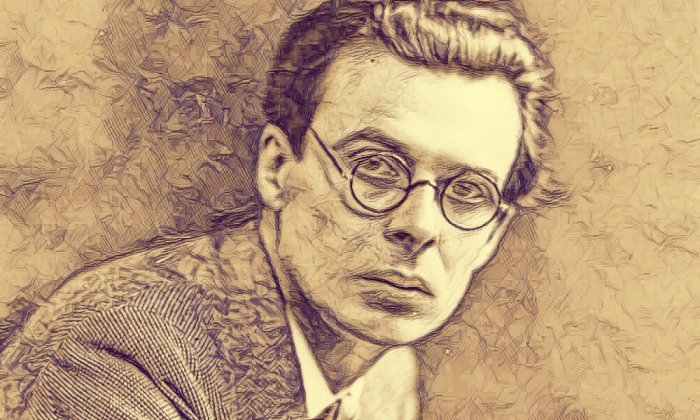
The British author Aldous Huxley (1894–1963). With the publication of “The Doors of Perception” in 1954, Huxley became an early exponent of drug-induced alterations of conscious states, a position he maintained and expounded upon toward the end of his life, as he lost his own visual capacity and the psychedelic movement embraced him warmly.

By: J. Allan Hobson

The following article is excerpted from J. Allan Hobson’s 2002 book “The Dream Drugstore: Chemically Altered States of Consciousness.” Hobson, a Harvard psychiatrist, pioneering sleep researcher, and prolific author, died in 2021.

Good descriptions of trance states are hard to come by. Because the very name “trance” has such spookily provocative connotations we are not tempted to learn about it. One consequence is that those of us who are not easily able to enter such altered states tend to be ignorant of what it actually feels like. We may even be fearful of the implied loss of control. The upshot is a tendency to discount the whole story as a fabrication, so we can remain safely and smugly skeptical. But if we continue to ignore trance, we miss the opportunity to learn from it and to better understand it.
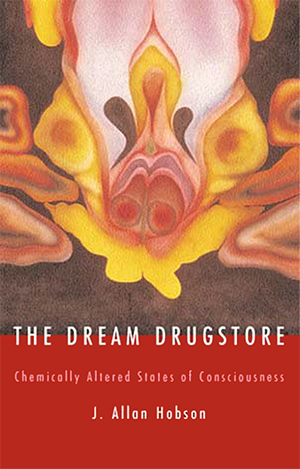
This article is excerpted from J. Allan Hobson’s book “The Dream Drugstore: Chemically Altered States of Consciousness

Aldous Huxley’s capacity to enter — at will — the dissociated state he called “deep reflection” is of value because Huxley was a painstaking self-observer. Anyone who cut his novelistic teeth (as I did) on such brilliant books as “Antic Hay” or “Point Counter Point” will share my admiration of Huxley’s wit, his literary elegance, and above all, his interest in interpersonal relationships. He is a very special kind of expert witness to his own unusual states of consciousness, which he actively cultivated in the service of his writing. Because Huxley’s interest in the vicissitudes of altered states extended to mysticism and to psychedelic drugs, he is an ideal contributor to our inquiry into the Dream Drugstore. One final point: Huxley was so open that he was willing to collaborate with the hypnosis expert Milton Erickson, despite having his own biases. Erickson’s involvement provides a valuable and welcome degree of objectivity.

Erickson met Huxley in his Los Angeles house in 1950, and they spent the day experimenting together and making extensive notes. Because Huxley’s own notes were lost in the tragic brush fire that later destroyed his home and library, we rely on Erickson’s for a description of Huxley’s deep reflection as a state

marked by physical relaxation with bowed head and closed eyes, a profound progressive psychological withdrawal from externalities but without any actual loss of physical realities nor any amnesias or loss of orientation, a “setting aside” of everything not pertinent and then a state of complete mental absorption in matters of interest to him. Yet, in that state of complete withdrawal and mental absorption, Huxley stated that he was free to pick up a fresh pencil to replace a dulled one to make “automatically” notations on his thoughts and to do all this without a recognizable realization on his part of what physical act he was performing. It was as if the physical act were “not an integral part of my thinking.” In no way did such physical activity seem to impinge upon, to slow, or to impede the train of thought so exclusively occupying my interest. It is associated but completely peripheral activity. … I might say activity barely contiguous to the periphery.

Huxley was able to enter his state of deep reflection in about five minutes. He simply “cast aside all anchors” of any type of awareness and thereby achieved an “orderly mental arrangement” that permitted his thoughts to flow freely as he wrote. When he demonstrated this, Erickson observed that Huxley was completely out of touch with his surroundings, a feature that was amply confirmed by Huxley’s wife, who often found him sitting in his chair oblivious to the world while his behavior was “automatic like a machine moving precisely and accurately.” It took him about two minutes to emerge, after which he described the “timeless, spaceless void” that he had left, and “a total absence of everything on the way there and on the way back and an expected meaningless some­ thing for which one awaits in a state of Nirvana since there is nothing more to do.”

Huxley could alter the features of the state by autosuggestion or upon Erickson’s instruction. He could see color or he could limit his descent to a lighter level and still retain contact with Erickson. But like subjects in the forbidden zone of lucid dreaming, Huxley tended to be pulled deeper or to exit when his concentration was interrupted by verbal or nonverbal commands. In other words, the introduction of volition, presumably mediated by the frontal cortex, acted in opposition to the trance state.
When he tried to induce auditory and visual hallucinations, Huxley found it difficult to remain in trance unless he built up the hallucinatory scenario by attaching the sound of music to the sense of rhythmic body movement. When Huxley moved the music up to the level of opera so that he could hear singing, he was observed by Erickson to be mumbling.

This constructive process, by which motor commands become the internal stimuli for sensory experience, is exactly what occurs in REM sleep dreaming when oculomotor and vestibular signals generate dream imagery. When this process was going on inside Huxley’s head, Erickson observed changes in Huxley’s head position and in his breathing pattern. By feeling his head turn from side to side Huxley was able to evolve a giant rose, three feet in diameter, from what was at first a barely visible rhythmically moving object.

Several other formal features of Huxley’s trance condition are of interest with respect to the analogy we have drawn with REM sleep dreaming. We first consider the relaxed posture, indicating a step on the path to cataplexy. In full-blown cataplexy, the assumption of a flaccid posture is associated with the inability to move on command and is thus similar to the active motor paralysis of REM sleep dreams. Anesthesia and amnesia were both present in Huxley’s trance, although they tended to be selective, and when Huxley attempted to make them global, his trance deepened. Time distortion, a distinctive component of the orientational instability of dreams, was a robust aspect of Huxley’s altered state.

A most dramatic finding was Huxley’s ability, in 65 percent of the trials, to give the correct page number when passages of his books were read to him.

A most dramatic finding was Huxley’s ability, in 65 percent of the trials, to give the correct page number when passages of his books were read to him. Huxley claimed that he could recall most of his writings at will, so that when he heard a passage he could then mentally read the antecedent and subsequent paragraphs, whereupon the page number “flashed” into his mind. This almost incredible feat of hypermnesia is paralleled in dreaming by the unbidden emergence of characters and incidents from the distant past; it contrasts, significantly, with the loss of recent memory capacity. It is as if the loss of the diminished capacity to record were complemented by or compensated for by an enhanced capacity to play back! The mechanism of this reciprocity must be explained both at the level of regional circuitry and at the level of neuromodulatory balance.

Even more incredible is the description of age regression, the final tour de force of the Erickson-Huxley encounter. I give a passage [included in Charles Tart’s 1969 book “Altered States of Consciousness”]to convey the claim directly and to let the reader decide what to make of it:

He turned back and noted that the infant was growing before his eyes, was creeping, sitting, standing, toddling, walking, playing, talking. In utter fascination he watched this growing child, sensed its subjective experiences of learning, of wanting, of feeling. He followed it in distorted time through a multitude of experiences as it passed from infancy to childhood to school days to early youth to teenage. He watched the child’s physical development, sensed its physical and subjective mental experiences, sympathized with it, empathized with it, thought and wondered and learned with it. He felt as one with it, as if it were he himself, and he continued to watch it until finally he realized that he had watched that infant grow to the maturity of 23 years. He stepped closer to see what the young man was looking at, and suddenly realized that the young man was Aldous Huxley himself, and that this Aldous Huxley was looking at another Aldous Huxley, obviously in his early fifties, just across the vestibule in which they both were standing; and that he, aged 52, was looking at himself, Aldous, aged 23. Then Aldous, aged 23 and Aldous aged 52, apparently realized simultaneously that they were looking at each other and the curious questions at once arose in the mind of each of them. For one the question was, “Is that my idea of what I’ll be like when I am 52?” and, “Is that really the way I appeared when I was 23?” Each was aware of the question in the other’s mind. Each found the question of “Extraordinarily fascinating interest” and each tried to determine which was the “actual reality” and which was the “mere subjective experience outwardly projected in hallucinatory form.”

The question of whether such experiences are “actual reality” or “mere subjective experience outwardly projected in hallucinatory form” is central to current debate that pits “veridical experience” against “false memory” and pits multiple personality against role-playing. Although Huxley’s apparently exceptional ability to enhance recall by altering the state of his brain and our own ability in dreams to relive early experience are clear evidence that memory is state dependent and can be altered, none of the evidence supports the now thoroughly discredited idea that every experience, thought, and feeling is recorded in the brain-mind forever and is therefore theoretically retrievable. And none of it counters the strong positive empirical evidence that memory is easily distorted or even fabricated in response to social demands.

What hypnosis now needs to advance as a science is the application of the scientific principles and techniques that other Huxleys developed, from Thomas Henry Huxley (1825-1895), who championed the theory of evolution as “Darwin’s Bulldog,” to Andrew Fielding Huxley (1917-2012), who advanced the ionic hypothesis of the nerve action potential and won the 1963 Nobel Prize for Physiology and Medicine, and Hugh Ensor Huxley (1924-2013), whose sliding filament theory of muscle contraction explained how chemical energy is converted to movement.

How, we wonder, would a PET scan of Aldous Huxley’s brain in deep reflection compare with the images collected in outwardly attentive waking, deep sleep, and that most easily obtained altered state of consciousness, REM sleep dreaming? My guess is that it would look more like REM than deep sleep or waking.


J. Allan Hobson was a Harvard psychiatrist who pioneered the first serious scientific alternative to Freud’s ideas about dreams. He was the author of close to two dozen books, including “The Dream Drugstore,” from which this article is excerpted.

(thereader.mitpress.mit.edu)

Science Slowly Accepts the Matrix of Consciousness

Author:     Stephan A. Schwartz
Source:     Explore – The Journal of Science and Healing
Publication Date:     23 December 2023 (used)
Link: Science Slowly Accepts the Matrix of Consciousness

In the midst of all the negative trends that are so shaping American culture at the moment there is what I consider to be not only an emerging positive trend, but one which is going to fundamentally change our society and all human societies. The matrix of consciousness is beginning to become an essential part of our view of the world It is going to take time but this is where we are headed. That’s good news as we end the year.

Koko The gorilla talking with a human friend about the pussy cat she is holding. Credit: BBC

For most of the Judaea-Christian epoch of history the view of most Western societies was that we, humanity, were separate from the rest of creation and had dominion over the earth, as if it were an exploitable bank account left us by a rich uncle. As the Bible frames it, “And God said, Let us make man in our image, after our likeness: and let them have dominion over the fish of the sea, and over the fowl of the air, and over the cattle, and over all the earth, and over every creeping thing that creepeth upon the earth.”1 And in a sense we have had dominion and done a very poor job of it, as the impending collapse of the ecosystems of earth, air, and water make clear.

French philosopher Rene´ Descartes in 1637, writing, “Cogito ergo sum. (“I think, therefore I am.”)2 set the tone of science when he said that only people can think; […]

Read the Full Article

AT THE END OF THE YEAR

by John O’Donahue

As this year draws to its end,

We give thanks

for the gifts it brought

And how they became inlaid within

Where neither time

nor tide can touch them.

The days when the veil lifted

And the soul could see delight;

When a quiver

caressed the heart

In the sheer exuberance

of being here…

We bless this year

for all we learned,

For all we loved and lost

And for the quiet way

it brought us

Nearer to our invisible destination.

(madalyn@astrolabe.biz)

Healing and Dying with Dale Borglum

New Thinking Allowed with Jeffrey Mishlove Dec 22, 2023 This video is a special release from the original Thinking Allowed series that ran on public television from 1986 until 2002. It was recorded in about 2002. It will remain public for only one week. Serious illness provides an opportunity for individuals to get in touch with the part of themselves that is not dependent upon social status, wealth or physical appearance. Dale Borglum, PhD, is founder and director of the Living/Dying Center in Fairfax, California. He suggests that healing is most possible when one does not deny the possibility of death. Now you can watch all of the programs from the original Thinking Allowed Video Collection, hosted by Jeffrey Mishlove. Subscribe to the new Streaming Channel (https://thinkingallowed.vhx.tv/) and watch more than 350 programs now, with more, previously unreleased titles added weekly. Free month of the classic Thinking Allowed streaming channel for New Thinking Allowed subscribers only. Use code THINKFREELY.

Words Cast Spells with Laurel Airica

Dec 21, 2023 Aubrey Marcus Podcas Dec 21, 2023 • Aubrey Marcus Podcast Do you want to become a SOURCEror of SPELLing? Laurel Airica is back on the show with a live episode from Arkadia, further sharing the magic of the English language. Known for revealing the spells contained within our spelling, this conversation with Laurel illuminates the secret codes within language that we are constantly speaking and receiving, and the infinite possibilities that come from deepening our conscious understanding of this patterning. You can learn more about Laurel Airica’s work at http://www.laurelairica.com/. Time Stamps: 00:00– Intro 1:18– Language As Mental Code 8:00– Secret Spells Of The English Language 13:00– The Convergence Of Consciousness & Culture 23:40– “Compersion” & The Sexual Revolution 32:15– Awakening To Your Coding 34:53– Taking Command Of The English Language 43:15– Words For God | “Profit” & “Success” 54:40– Sacred Pathwords & Alphabet Alchemy 1:03:53– The Word Gives Us Our Worldview 1:15:35– Ascension | A New Story 1:22:55– Anthem For Our Era- Speaking Beauty

Laurel Airica

The Hidden Spirituality of Bohm & Hiley

Gerald R. Baron

Gerald R. Baron

Dec 16, 2023 (gerald-baron.medium.com)

Photo by Alexandra Nicolae on Unsplash

This is the fifth (I think) and (likely) last post on the physics and metaphysics of David Bohm and Basil Hiley as expressed in their 1993 book The Undivided Universe. Here we look at spiritual interpretations of the ideas of active information and the implicate order.

In the last three posts in this series I’ve tried to explain as best I can, with my non-science and math mind, what David Bohm and Basil Hiley call their “ontological interpretation” of quantum mechanics. To understand the ontology — what is real in their view — about quantum physics we need to get out of our Cartesian framework of seeing everything in a kind of grid of time and space. That’s because the entity that makes things real is not located in time and space, and the order within it is nothing like the things we normally consider ordered. What lies beneath everything resides in “pre-space” and is something they call the implicate order. Implicate refers to enfolded. Everything that is unfolds from that implicate order including the entire mental and physical landscape. What is real unfolds, has some but limited stability, and then enfolds back into the underlying order.

Quantum fields or particles, and for that matter our thoughts, demonstrate an unlimited number of possibilities. A particle is in superposition or a cloud of possibilities until it is “collapsed” or settled into something with specific properties and identity. This to Bohm and Hiley is the quantum potential or information on all possibilities. When particles appear with specific properties such as path, momentum, etc., they become part of the external world which is called “explicate.” Entanglement as a mystery disappears because entangled particles are simply part of the same quantum potential which is limited by neither time nor space.

Thoughts are also explicate realities arising from the implicate order. These are influenced or guided by active information, which is that part of the quantum potential which is selected out of all possibilities to create the thoughts and particles of our world of experience. There is continual interchange between the physical and mental realms because in essence they are the same realm, both guided by active information which serves as a bridge. This is the undivided universe, the one thing — the implicate order.

This summary cannot do justice to the deep and rich ideas just in this one book. Bohm developed the active information and implicate order ideas from 1952 to his death in 1992 in many different books, including some written with Krishnamurti with whom he had a productive relationship beginning in 1959.

The elephant in the room

There is an elephant in the room in all this. If this is a new kind of order and this order determines all that is including our thoughts and minds and our relationship with the material world, where does this order come from? What is the source of order? What can we know or deduce from the appearance of this order that has produced not only the vastness of this remarkable universe, but the rationality of thoughts of creatures who appeared in its recent history to describe, comprehend and perhaps even co-create it?

Max Planck (1858–1947) preceded David Bohm by about 50 years. In many ways he was the father of quantum physics and therefore the one who set all these big questions in motions. While Bohm and Hiley are somewhat coy about the transcendental implications of their ideas, Planck was more direct in his speech in 1944 in Florence called “The Nature of Matter”:

As a man who has devoted his whole life to the most clear-headed science, to the study of matter, I can tell you as a result of my research about atoms this much: There is no matter as such. All matter originates and exists only by virtue of a force which brings the particle of an atom to vibration and holds this most minute solar system of the atom together. We must assume behind this force is the existence of a conscious and intelligent Mind. This Mind is the matrix of all matter.”

There it is. Bohm and Hiley are very accomplished physicists and their audience was not people like me interested in the link between science and faith but fellow physicists, mathematicians and maybe philosophers. Their work is focused on showing how their ontological interpretation can be worked with known physics and math. Yet, they do stray into the overtly metaphysical with this: (p. 323–324)

“What may be suggested further is that such participation goes on to a greater collective mind, and perhaps ultimately to some yet more comprehensive mind in principle capable of going indefinitely beyond even the human species as a whole.”

Because of our deeply embedded physicalist way of thinking, we seem able to assume rather blithely that order just appears. After all, we see the order in crystals forming and we assume that the complexity of life is the result of some as of yet unknown emergent property of just the right chemicals in just the right soup. Our answers always point back to the laws of physics which present the regularity (order) needed for our world to work. Even evolution whereby life competes with and wins against entropy is seen by some as a universal law undergirding not only biology but essentially everything.

Where does this order come from? We must either do as David Chalmers did in his book Reality+ and punt on this question, or admit that order cannot be random. Isn’t it the opposite of random? Disorder appears to be the bottom state which all reduce to and yet we see order and more order.

Meaning as structure

Harald Atmanspacher, a physicist and psychologist at Freiburg, Germany, has been a primary explainer of the dual aspect monism idea, particularly that of Wolfgang Pauli and Carl Jung. He coined their partnership on this concept the Pauli-Jung conjecture. His book, written with Dean Rickles, Dual Aspect Monism and the Deep Structure of Meaning dives deep into this idea dating back to ancient Greeks, through Spinoza and Russell to a number of physicists including Bohm and Hiley.

In an in depth analysis he shows how Pauli and Jung, Arthur Eddington, John Wheeler and Bohm and Hiley all essentially arrived at the same conclusions from quite different approaches. In particular John Wheeler’s ideas of meaning and pre-geometry combined with his participatory universe idea are reflected in the Bohm-Hiley view we have been studying. As the title of their book suggests, Atmanspacher and Rickles consider that all these various ideas about the underlying structure of reality — mind and matter — can be brought together through the concept of meaning.

But, what is meaning?

In the introduction to their book, Atmanspacher and Rickles explain the meaning of meaning in terms of reference and sense. Reference refers to connection of mental concepts to their physical referents (I think of a rock), and sense is:

“…used for the connection of both the mental and the physical with their underlying psychophysically neutral domain…”

That, of course, refers to the substrate of mind and matter which is the heart of dual aspect monism. Their understanding of meaning is largely focused on the deep connection between mind and matter. But they refer to the famous philosopher-psychologist (and teacher of Freud and Husserl) Franz Brentano. The concept of intentionality as taught by Brentano features into the concept of meaning: (p. 166)

“Within standard representational accounts in the philosophy of mind, meaning is usually expressed as a relationship between some mental representation and an objective external reality. Brentano (1874) coined the notion of intentionality for such a reference relation of aboutness, and Husserl (1900) developed it in more detail.”

Atmanspacher and Rickles get closer to our common understanding of meaning with this: (p. 154)

Prima facie, meaning is a relation linking something that means to something that is meant, so it must be expected to manifest itself in certain types of correlations.”

Meaning involves something happening between two or more parties that conveys something that is meaningful, something that changes things even in small ways. The idea of intentionality is crucial, it seems. Yelling “Fire!” in a crowded theater is meaningful. The meaning of that may vary from a desire to save lives, to a desire to cause needless pandemonium.

It seems obvious, at least intuitive, that meaning requires intelligence, consciousness and intention. If Atmanspacher and Rickles are right that the underlying structure that all the philosophers and scientists they quote claim exists is really about meaning, then it is about the underlying existence of something intelligent, conscious, and with intentions.

I understand credibility within the science and philosophy community makes it difficult or impossible to say, hey, beneath it all I think I discovered there is intelligence, consciousness and intentionality. That would almost be like yelling “Fire!” during a major science conflab. Yet, Bohm and Hiley come very close when they talk of a “collective mind” or “comprehensive mind” as quoted above. Wheeler comes close as well.

As we have seen even in some recent Medium writing, for some this is a dangerous conclusion which undermines the physicalist belief system. That’s enough for some to reject their entire argument, no matter the scientific and logical rigor of it.

Mind-stuff and the spiritual domain

It is Eddington who dares mention the elephant in the room. He provided the 1927 Gifford Lectures and published those as The Nature of the Physical World. Eddington was the primary early proponent and explainer of Einstein’s new relativity theories and empirically proved in 1919 the strange idea that warping spacetime meant that gravity would bend light. Although quantum physics was in its very early exciting pioneering days, he understood as few others what the implications were.

In his lectures he struggled to try to communicate to a mostly non-scientific audience just what the strange new world of quantum physics meant: (p. 12)

“The frank realisation that physical science is concerned with a world of shadows is one of the most significant of recent advances…It is difficult to school ourselves to treat the physical world as purely symbolic.”

He could not have been more clear in his conclusion: (p. 274)

“To put the conclusion crudely — the stuff of the world is mind-stuff.”

The “shadows”, “symbols” and “pointer-readings” that we somehow interpret as hard, physical reality are “attached to some unknown background,” Eddington says. This unknown background is mind-stuff, but what is that? He points out that attaching these shadows to something concrete is “silly.” Contemporary philosopher Galen Strawson quoted this comment to buttress his argument for physicalist panpsychism. But, panpsychism is not Eddington’s view. The mind-stuff or unknown background has a different source: (p. 278–279)

“The physical atom is, like everything else in physics, a schedule of pointer readings. The schedule is, we agree, attached to some unknown background. Why not then attach it to something of spiritual nature of which a prominent characteristic is thought. It seems rather silly to prefer to attach it to something of a so-called ‘concrete’ nature inconsistent with thought, and then to wonder where the thought comes from.”

Eddington might be surprised to see how this silly idea of attaching our thoughts to the “so-called concrete nature” of matter not only persists but dominates thinking today. Our thoughts, rather than arising from the “concrete” world of brain matter, reflect a spiritual world that is the foundation of all, Eddington says. This is also expressed even more explicitly: (p. 258)

“This view of the relation of the material to the spiritual world perhaps relieves to some extent a tension between science and religion. Physical science has seemed to occupy a domain of reality which is self-sufficient, pursuing its course independently of and indifferent to that which a voice within us asserts to be a higher reality.”

This comment is important in view of what is perhaps even more true of today than 1927. The loud, persistent voices of physicalism claiming that physical reality exists in its self-sufficiency drown out those voices within us that says there is Something More, there is a higher reality. Eddington lets that inner voice be heard. Despite the efforts by many to drown out the inner voice, there are strong indications that perhaps more and more are tiring of the physicalist persistence.

Eddington is not alone in suggesting that the substrate of mind and matter is of a spiritual nature. Pauli and Jung, according to Atmanspacher and Rickles, called it the Unus Mundus (one world) and considered it a placeholder for the divine. Hegel talked about the Absolute. As we’ve noted Bohm and Hiley suggest a cosmic or comprehensive mind, and consider that it is ultimate and undivided –– and beyond the reach of science. Wheeler was not overtly spiritual but Atmanspacher and Rickles see strong connection to the spiritual world in his thinking on pre-geometry: (p. 83)

“In each case, however, the subjective mental M and the objective physical P are bound together in a mutual embrace, coming from some deeper, psychophysically neutral reality PPN, called “pregeometry” by Wheeler and the “spiritual domain” by Eddington, who saw in this reality a role for mysticism.”

The implicate Spirit

As a more less traditional theist I look to find a connection between what has been considered in my tradition the two books of revelation: Holy Scripture and the book of the natural world. Both are considered ways of understanding ultimate reality and truth. If that is so, they should not conflict.

In some recent streams of theistic and Christian thought, fundamentalism for example, strict literalist interpretations of Holy Scripture definitely do conflict. Evidence for the age of the earth and the age of the universe is compelling in my mind, so those understandings or interpretations of scripture are considered in error by me and those who share my interest in consonance.

Theologian Ian Barbour (1923–2013) identified four ways in which science and religion can interact: conflict, independence, dialogue, and integration. My preference is integration. I reject the separate “magisterium” of Stephen Jay Gould, which is the independence option. But there are a couple of different ways of approaching integration: one through science and one through biblical revelation or theology. One starts from science and asks what science may teach us about spiritual realities. The other is the Augustinian approach reflected in Rene Descartes, the credu ut intelligam approach: “I believe so that I may understand.”

Physicists such as Bohm and Hiley, Eddington, Polkinghorne, Planck and many others arrived at the conclusion of cosmic unity, mind or spiritual reality through their understanding of science. They say go deep enough into science and mathematics and you come to something foundational, something ineffable, something intelligent, conscious and intentional.

I should say that the “intentional” part may not be acceptable to all those subscribing to the dual aspect monism idea of a unity underlying mind and matter. Bohm was strongly influenced by the Eastern religious thinker Krishnamurti likely reflected in the ideas of an undivided universe. Others, such as Heisenberg, Schrödinger, Capra and more have connected the mysterious realities of quantum physics to eastern thought. I have a hard time seeing how intelligence and consciousness operating out of the ineffable foundation beneath mind and matter could result in the universe and conscious beings today without intention. If there is an underlying structure of meaning as these ideas teach, then it must be as Brentano and Husserl thought that intentionality is essential.

Consider this comment by former atheist and Oxford philosopher Keith Ward from his book Personal Idealism: (p. 10)

“If some ultimate mind, which knows all possibilities, knows which are good, acts to realise some good states, and enjoys them, that would be a completely satisfactory explanation of why the cosmos exists. That is the hypothesis of God.”

The implicate order is or holds information in the form of the quantum potential. It “knows” all possibilities. It acts to realize those possibilities in mind and matter through active information. There is good reason to believe that the implicate order, as collective or comprehensive mind, also enjoys good states.

Is it God? Yes and no. God in the traditional theistic understanding of Abrahamic faiths stands outside of time and space but operates within it. God is transcendent and immanent in theological parlance. The very beginning of Genesis says that creation (the earth) was chaos — formless and empty. But the Spirit of God “hovered” over the chaos.

In my view that hovering Spirit is the implicate order. It is from that comprehensive mind of Spirit (intelligence, consciousness, intention) that all things that can be are held and that which is emerges. Thoughts and rocks. Feelings and galaxies. Qualia and quanta. These words, this laptop, the fire in my family room, are all enfolded in that Spirit and then unfolded in my experience. I am distinct as a self, and yet totally incorporated within that Spirit and with all things that emanate from it.

Spinoza equated God and nature, although in later writing it is understood he took more a panentheistic view than pantheistic. I’m guessing my suggestion here that God as the Source of Being stands outside of nature, yet is the ground of all things through the Spirit is a panentheistic view.

The Greek poet Aratas living in about 300 BCE said something truly profound. In an invocation to the god Zeus he said:

“In him we live, and move and have our being.”

It sounds familiar to Christian ears because it was repeated by Paul in a speech to the Athenian Greeks as quoted by the writer Luke in Acts 17. We cannot have our being in a concept of god or God in as limited a form as Zeus. But, the idea captures the meaning of Spirit as implicate order. We are in that order, arise from it in mind and in relation to all else that unfolds from it. We exist in, we have our being, as long as self persists. As we arise from it we return to it.

As far as that goes, that could be a Vedantan position as well as a theistic or Christian position. The question comes back to one of distinction and identity. When we are enfolded back into the reality of Spirit or the implicate order, are we who we are?

There is reason to contemplate that question.

Gerald R. Baron

Written by Gerald R. Baron

Dawdling at the intersection of faith, science, philosophy and theology.

Yin-Yang, the Law of the Universe

Navigate the intricate dance of Yin Yang

Amy Liu

Amy Liu

Published in The Taoist Online

Dec 11, 2023 (thetaoist.online)

Photo by Michael Ankes on Unsplash

The Yin-Yang principle is the most fundamental philosophy in Chinese culture, established several thousand years ago.

In the Chinese character Yin (阴), 月 stands for the moon, while Yang (阳) consists of 日, which represents the sun. Through the lens of Yin-Yang, the sun is Yang, the moon is Yin. Day is Yang, Night is Yin. Bright is Yang, Dark is Yin. Hot is Yang, Cold is Yin. Active is Yang, and Passive is Yin. Summer is Yang, Winter is Yin, etc. Yin and Yang are two facets of a single whole, capable of transforming into each other.

This principle symbolizes the opposite, complementary and interdependent forces or phenomena of the universe, a pattern evident throughout nature (

Patrick Stewart

). It is the underlying reason behind all phenomena and changes in the universe.

As stated in I Ching, the foundational text of Chinese philosophy: “一阴一阳之谓道”. It means the Tao is the interplay of Yin and Yang. While the true nature of Tao is difficult to define and beyond human language, its essence refers to the universe’s underlying order or flow, Cosmo’s magic force, the rhythm of the universe, and the natural pattern of things.

In my view, the Yin Yang concept also elegantly echoes da Vinci’s idea of simplicity.

“Simplicity is the ultimate sophistication”

Yin Yang philosophy has profoundly influenced various fields in China and some Asian countries, especially within Traditional Chinese Medicine (TCM). The emphasis on achieving Yin Yang balance for maintaining health is a fundamental concept in TCM, reflecting the compatibility and harmony of multiple organs, body and mind, different emotions, and nature and us. In fact, discerning the Yin or Yang of patient syndrome is crucial for a TCM doctor’s diagnosis and treatment plan.

Amazingly, the same principle finds reflection in modern physics as well. As the leading founder of quantum mechanics, Nobel Laurent Niels Bohr, designed his own coat of arms around the Yin-Yang symbol when awarded the Order of the Elephant, a prestigious Danish distinction in 1947. The motto accompanying the symbol stated “CONTRARIA SUNT COMPLEMENTA”, meaning “opposites are complementary”. The principle of complementarity he formulated is a cornerstone of quantum mechanics, enabling a fundamental understanding of the paradoxical features of quantum phenomena such as wave-particle duality.

Inspired by the Yin Yang principle, I previously wrote about my three frameworks for better sleep and how to gain clarity on work-life balance. The universal concept can be observed across many disciplines and aspects of life. Here are a few more examples.

祸 (Misfortune) vs 福 (Fortune): “祸兮福之所倚,福兮祸之所伏 ”. This is from Lao Tzu’s Tao De Jing. Lao Tzu, the ancient Chinese philosopher and the founder of Taoism, explained the idea that fortune and misfortune come in turns. They are often dependent upon each other, intertwined and interchangeable.

This is similar to the saying “When God closes a door, He opens a window.” Or the phrase “ 否(pi)极泰来”, originated from I Ching, which means bliss comes at the end of misfortune. In I Ching, when the order of the hexagonal symbol for 否 (misfortune) is reversed, it becomes the hexagonal symbol for 泰 (bliss). Likewise, the word for crisis in Chinese is 危机 (wēi jī), where 危 stands for danger and 机 for opportunity. It implies that danger and opportunity often go hand in hand and give rise to each other.

Solitary vs Social: Einstein once stated: “ Man is, at one and the same time, a solitary being and a social being.’’ Indeed, while social interaction can provide companionship and connection, solitude, on the other hand, can foster deep thinking, creativity, and better connection to the inner self. As Einstein also put it: “Be a loner. That gives you time to wonder, to search for the truth.” So, there is a fine balance- have alone time without feeling lonely.

While we aspire for independence, it’s also important to remain open to embracing help when needed.

Introvert vs Extrovert: I used to believe that being an introvert or extrovert is something we are born with until I heard the story of two female VPs: one mentioned that when she began her corporate career, she was an introvert, but over thirty years, she has become an extrovert. Another admitted she was an introvert at home but an extrovert at work. I can’t help but wonder: while there is a genetic component to personality, it could also evolve, influenced by environment and experience.

Moreover, even extrovert needs some downtime, and introvert could benefit from participating in social or group activities at times.

Strength vs Weakness: When it comes to self-improvement, there are two schools of thought in the corporate world: one emphasizes focusing on areas for improvement, as we often do; the other suggests paying attention to enhancing strength, given that weakness usually cannot surpass strengths, no matter how much effort we make. It’s worth noting though, that strength may transform into weakness when pushed to the limit. Sometimes, we can also find strength in weakness.

Take confidence and modesty for instance. We should be both confident and humble, without going to extremes that may lead to arrogance or appearing too humble which can be perceived as a lack of competency.

Yin-Yang inside the human body: The Yin-Yang footprint is also evident in numerous biological activities of the human body. Many self-regulated balances are constantly at work, regulating various physiological processes to keep internal states steady and balanced.

For instance, our breath involves the complementary actions of inhaling and exhaling, the heart functions by rhythmically contracting and relaxing to pump blood throughout the body efficiently, and the nervous system consists of sympathetic and parasympathetic nerves for complementary functions. Intriguingly, on an anatomical level, scientists found pleasure and pain originate from the same brain circuit. Ultimately, the brain seeks the balance of two classes of neurons responsible for pleasure and pain.

Yin-Yang is indeed the law of the universe, symbolizing the interplay and dynamic balance inherent in all aspects of existence. Let’s embrace its rhythm and learn to dance with it.

Thank you for reading. I write about culture and work-life learning, especially the ancient wisdom of Traditional Chinese Medicine for better living. Click here if you would like to be notified when I publish.

Amy Liu

Written by Amy Liu

·Writer for The Taoist Online

Technologist, culture collaborator, PhD, interested in spreading the word about green health & the ancient wisdom of TCM among other things.

How Einstein knew God

Tim Andersen, Ph.D.

Tim Andersen, Ph.D.

Published in The Infinite Universe

1 day ago (Medium.com)

CalTech Archives

Einstein spoke of God frequently when talking about the beauty and elegance of the universe. He said,

I’m not an atheist, and I don’t think I can call myself a pantheist… I believe in Spinoza’s God who reveals himself in the orderly harmony of what exists, not in a God who concerns himself with fates and actions of human beings

Spinoza was a 17th century Jewish philosopher living in what is now the Netherlands. He developed an extensive theology and theodicy of God as well as ethics and political theory.

Although Jewish, Spinoza’s was not the God of the Bible. He was formally thrown out of the Jewish community in fact. Instead, Spinoza proposed a God that was impersonal, infinite, and who lends His nature to all things that He creates.

Although this conception of God is seen as pantheistic, it is more appropriate to see his God as consisting of abstract order which gives birth to physical reality rather than equivalent to physical reality.

Spinoza did not believe one should regard God with worship and awe. His attitude is purely a rational approach to learn and understand. By understanding nature and the laws that govern it, a seeker after God comes to better understand Him.

It’s not surprising that, as a great scientist, Einstein believed God could be found in understanding of nature rather than in worship. Indeed, he said,

The human mind, no matter how highly trained, cannot grasp the universe. We are in the position of a little child, entering a huge library whose walls are covered to the ceiling with books in many different tongues. The child knows that someone must have written those books. It does not know who or how. It does not understand the languages in which they are written. The child notes a definite plan in the arrangement of the books, a mysterious order, which it does not comprehend, but only dimly suspects. That, it seems to me, is the attitude of the human mind, even the greatest and most cultured, toward God. We see a universe marvelously arranged, obeying certain laws, but we understand the laws only dimly. Our limited minds cannot grasp the mysterious force that sways the constellations.

Einstein believed, therefore, that science is discovering truths about reality and, in fact, science is the only way to discover them. Religions that claim to have revelation from God such as Christianity, Judaism, and Islam have no access to God at all.

As he he said about his coming of age, “[t]hrough the reading of popular scientific books I soon reached the conviction that much in the stories of the Bible could not be true.”

Hence, the God of the Bible is a human invention while the God of Spinoza, a God who impersonally lends his essence to reality and thereby creates the laws of physics, is true and real.

Although Spinoza was writing at the birth of the Enlightenment, his is a thoroughly modernist, scientistic position that many scientists hold today. For example, Frank Wilczek, physics Nobel Laureate, has stated he is effectively a “pantheist”, writing in his book, Fundamentals: Ten Keys to Reality:

In studying how the world works, we are studying how God works, and thereby learning what God is. In that spirit we can interpret the search for knowledge as a form of worship, and our discoveries as revelations.

Why do these rational-types believe in God at all? Why not be an atheist?

I think the answer is simple. Any God provides a kind of religious underpinning to one’s life, a sense of meaning which avoids the ultimate absurdity and nihilsm of atheism. This belief system is necessary since, as the great atheistic philosophers, Sartre, Camus, and Nietzsche, showed, a life without God is meaningless, absurd, and catastrophic for the human mind in particular and the human species in general.

Human beings will endure the worst suffering for meaning because fundamentally we know that our small, finite lives are of no consequence unless they are entwined in something eternal.

Unless you have your head stuck in the sand and are thoroughly apathetic about whether your life means anything or whether anything you do or love matters, you have to have God, even if that God does not resemble the one our ancestors believed in.

For Einstein and Spinoza, God did not need to be (1) personal or loving, (2) involved in or care about human affairs, or (3) good or evil.

Spinoza’s theology of good and evil, his theodicy, in fact, is that good and evil are relative to human desires, not God’s desires. Spinoza argued that God has no specific purpose or desires because he is perfect. A desire comes from a lack, and God lacks nothing, therefore he needs nothing. God has no purpose for reality, he is anti-teleological, because, again, he is perfect. He needs no purpose.

As Spinoza said, “[t]hings are not more or less perfect because they please or offend men’s senses, or because they are of use to, or are incompatible with, human nature.”

Spinoza is often called a moral relativist in the sense that he considered morality to be relative to what humans believe is right and wrong and has no absolute standard outside humanity.

Truthfully, however, Spinoza wasn’t a moral relativist. Instead, he believed in deriving morality from natural law, i.e., that one could discover the correct moral laws from nature and how human beings interact with one another. This is a form of moral realism and very in line with the thinking of quite a few scientists and philosophers today.

Spinoza’s theory about human beings is that the more we grow in knowledge and rational thinking, the more “good” we become in terms of our own needs. What we perceive as evil comes from ignorance about ourselves, others, and the world. A world made of perfectly rational beings, Spinoza believed, would be perfectly harmonious.

Now that we understand something about the kind of God Einstein believed in, we can ask if this God is “real” or, more correctly, is this an accurate portrayal of God?

I would argue that this portrayal of God, while perfectly logical, falls short of what people need or want from God. Moreover, there is little reason to put one’s faith in a conception of God embedded in and tied to natural law.

Anti-realist philosophers, for example, question our ability to understand nature and regard the natural world to be fundamentally incomprehensible. Anti-realism suggests that human beings are free to define reality how they see fit in the same sense that moral anti-realism allows us to define morality as we see fit.

The anti-realist stance, which began with Kant and progressed through the German idealist school to Heidegger, proposes that we have either no or limited access to reality.

If this is true, then Spinoza’s God, even if the true God, is cut off from human beings. Einstein’s library of books are all blank, waiting to be filled in and arranged by human beings.

It isn’t that we don’t live in the real world at all, but rather than the real world becomes so filtered by our subjective perceptions that we end up with a thoroughly personal view of it. An objective view of reality, by contrast, doesn’t exist.

Anti-realists point to the existence of idealized models, none of which can be confirmed but only falsified with more data. These models are all conjectures that have not yet failed. Their longevity does not lend them additional reality but indicates that the data that will cause them to fail has not yet been collected or applied. When that does happen, we will say they are “approximate models”.

In the end, they argue, all science is a construct of the human mind, like a novel that we are writing about the universe that we all agree is true because none of us can prove it false.

Someone can be anti-realist about physics but not about God, but not if they subscribe to the God of Einstein which is fundamentally realist.

On the other hand, one could, hypothetically, still believe in the God of Spinoza but believe that we are cut off from Him, i.e., God is inherent in the nature of reality, too bad we can’t know what reality actually is, but this is hardly the attitude Spinoza or Einstein took. It’s hard to see value in placing one’s faith in such a God.

More recent philosophers, starting in the early to mid-20th century with Wittgenstein and continuing with Derrida, have taken a stance against the realism versus anti-realism debate, suggesting that neither viewpoint can be supported because all truth is relative to language alone.

In other words, there is no such thing as “truth” outside of human words. When we say that Newton’s law is “true” because it explains how planets orbit and how rocks fall, it is simply a statement about human experience.

Furthermore, the formulation of Newton’s laws as well as other scientific laws such as Einstein’s theory of General Relativity are merely language games that we play to help people predict future data in order to accomplish necessary tasks (or get papers published or win grants or win prizes, etc.). All truth, therefore, reduces to human activity. It is the information that makes us go as a species.

Wittgenstein’s isn’t an anti-realist stance because he is silent about reality. Whether we are perceiving real things or not, we cannot say because language cannot talk about anything that isn’t other language. When we communicate about the real world, it is because we have learned how to use language. We have learned the rules of the game and apply those to our actions. There is no inherent meaning.

Each religion or spiritual practice has its own language game that it plays in the same way that science plays its language game.

We play the game that best meets what we naturally desire: meaning and beyond that God.

This doesn’t necessarily mean that all roads lead to God or all religions are equal any more than all roads lead to useful scientific theories. Likewise, it does not mean that life is a meaningless game. Rather, it means that what we do and what we believe is, in large part, part of the games we have learned to play. A baby knows none of these games (save very simple ones with which it is born such as how to nurse and cry). All these have to be learned.

The convergence of knowledge-making onto the scientific method and the convergence of meaning-making on values such as innate human dignity and love one’s neighbor as one’s self, forgiveness, justice and mercy is no accident. These games lead to the best human flourishing and sense of personal fulfillment. We are all too aware of both our ignorance and our moral inadequacy to play other games happily.

Still, if all that we do is just a game, does that mean that there is no God behind it all?

Perhaps it simply means that we find God not in words or theories but in the stillness of contemplation. Words prepare us for that encounter but the encounter is nonetheless beyond spoken language or marks on a page.

This is what the great mystics believed such as the author of the 14th century primer The Cloud of Unknowing, Saint Teresa of Avila’s the Interior Castle, and the works of the 6th century author now known as Pseudo-Dyonisus the Areopagite.

While a mystical understanding of God is opposed to a rationalist approach, we do know that Saint Thomas Aquinas, who wrote some of the most rational statements about God ever written in his Summa Theologicae and other works, nevertheless, abandoned it all after such an experience (Alban Butler’s “Lives of the Saints”):

On the feast of St. Nicholas [in 1273], St. Thomas Aquinas was celebrating Mass when he received a revelation that so affected him that he wrote and dictated no more, leaving his great work the ‘Summa Theologiae’ unfinished. To Brother Reginald’s (his secretary and friend) expostulations he replied, ‘The end of my labors has come. All that I have written appears to be as so much straw after the things that have been revealed to me.’ When later asked by Reginald to return to writing, Aquinas said, ‘I can write no more. I have seen things that make my writings like straw.’ … Aquinas died three months later while on his way to the ecumenical council of Lyons.

Which goes to show that perhaps the only way for us to know God is for God to reveal Himself to us, one way or another. Whether that is in the discovery of a new law of nature or a mystical encounter is not up to us. It is up to Him.

Spinoza, Baruch, The Complete Works, Samuel Shirley, translator (Indianapolis: Hackett Publishing, 2002).

Einstein, Albert (1949). “Notes for an Autobiography.” Saturday Review of Literature (Nov. 26): 9.

G. S. Viereck, Glimpses of the Great (Macauley, New York, 1930) p. 372–373.

Tim Andersen, Ph.D.

Written by Tim Andersen, Ph.D.

·Editor for The Infinite Universe

The Infinite Universe

1.2M views. Principal Research Scientist at Georgia Tech. The Infinite Universe (2020). andersenuniverse.comhttps://timandersen.substack.com/

Consciousness, sexuality, androgyny, futurism, space, the arts, science, astrology, democracy, humor, books, movies and more