Mamdani’s Magic

How a 34-year-old became the next mayor of New York City

Ken Klippenstein Nov 5, 2025

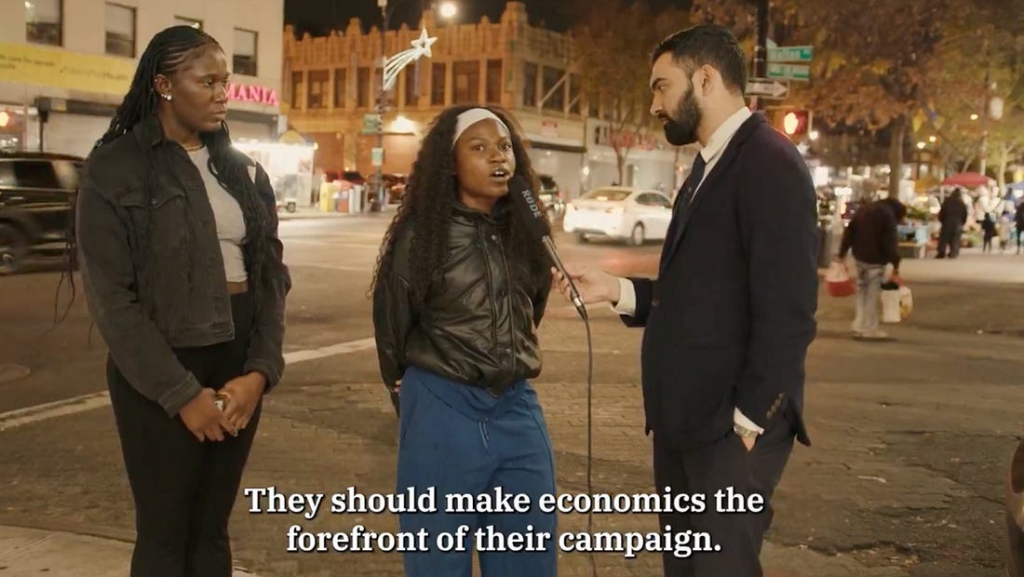
Mamdani interviews New Yorkers last November

Zohran Mamdani won by literally meeting people where they’re at — in bodegas, subway stations, busy sidewalks, even at the New York Marathon. He met people on the streets, not to pitch them, but to listen and learn. These conversations informed his successful campaign more than his charm, social media prowess or any of the other superficial explanations major media are offering.

The focus on ordinary people was evident from the very start of his campaign. Last November, in one of his first campaign videos, Mamdani interviewed random passerby in Queens and the Bronx, simply asking about their concerns. They identified the unglamorous but urgent day-to-day issues that would become the focus of his campaign: the cost of living, childcare, housing, and transportation.

The video stood out from usual campaign content in how little of it focused on the candidate. He didn’t “approve this message.” There were no gotchas, no fact checking his opponents, no issue-oriented rejoinders. Virtually every shot focused on the interviewee rather than Mamdani, whose face you could not even see at times. He just stood there, quietly listening to what people had to say.

People’s comments were insightful for anyone who cared to listen. They were the message.

“If you’re speaking the things that people want to hear about, I don’t care what color you are, I’ll vote for you,” as one woman told him.

Mamdani ran a hyper-local campaign that avoided the Washington approach favored by campaign advisors and consultants. He did not try to graft his election onto the national partisan environment, avoiding the usual soaring rhetoric about freedom and democracy, the soul of America, blah, blah, blah. During the primary debate when candidates were asked about what foreign country they would first visit as mayor, Mamdani stood out for being the only candidate who didn’t say Israel — or any country at all.

“I would stay in New York City,” Mamdani said. “My plans are to address New Yorkers across the five boroughs and focus on them.”

There was also none of the usual aversion to unscripted interactions with the public or on uncomfortable issues that is symptomatic of a distrust of the people. He said what he thought, even on hot button issues like Gaza, which stood out against a see of other politicians clearly terrified of addressing such matters. Mamdani respected voters enough to tell them the truth about himself, even things they might not want to hear. During one of the debates, when asked if he’d ever purchased anything at a cannabis shop, instead of the usual politician equivocation (“I smoked but didn’t inhale”), he smiled and told the truth: “I have.”

Mamdani would often quote former New York mayor Ed Koch’s saying, “If you agree with me on nine out of 12 issues, vote for me; if you agree with me on 12 out of 12 issues, see a psychiatrist.” This speaks to his trust that people are intelligent enough to handle disagreement, contrary to the typical politician approach of avoiding conflict at all costs, fence-sitting on contentious issues, and the like. (Consider Senate Minority Leader Chuck Schumer’s refusal yesterday to say which mayoral candidate he voted for.)

 Mamdani decried the lack of respect for voters in his victory speech last night. “You showed that when politics speaks to you without condescension, we can usher in a new era of leadership,” he said.

Another campaign video featured Mamdani speaking to Halal food truck vendors, virtually ubiquitous throughout the city. A pressing issue but one not obvious to people outside of New York (including myself) was why these Halal vendors’ food had suddenly become so expensive. City regulations and other forms of needless bureaucracy, he was told. He promised to get to the bottom of it. His enthusiasm about what might seem like a minor issue was endearing to people and signaled that he was paying attention.

Above all, Mamdani’s campaign was a rejection of what seems to have become the bunker strategy of others: where candidate hide from voters, limit interviews, and rule from “the room where it happens.”

“We’re outside, because New Yorkers deserve a mayor that they can see, they can hear, they can even yell at,” Mamdani said in a video recording of him running in the New York Marathon posted to social media.

As Mamdani sees it, facing the public, even if it might heckle you, is part of the job of being an elected official. Obvious as this may seem, it is a more genuine and humble attitude ofthe Washington national figures who believe that their role as philosopher kings is to reign over and above the public. It’s amazing anyone still thinks there’s some inherent dignity to elected office after Donald Trump, not after President Trump’s convictions (the legal ones, that is), or, say, his latest AI video depicting him manning a fighter jet dropping poop on No Kings protesters. Or Biden sundowning at the presidential debate last year (“We finally beat Medicare!”) Or eight sitting members of Congress having died in office since 2022.

Actual Trump post

Mamdani’s view of a politician’s job contrasts sharply with the political establishment’s zero tolerance attitude toward risk. Former Governor Andrew Cuomo is a living embodiment of this old school micromanage and control everything approach. Having reportedly decided years ago to never run in an election that he thought carried any real risk of losing (oops), his campaign reflected this risk aversion in spades.

While Mamdani was busy doing interviews with seemingly anyone who asked — including hostile ones on cable news shows obsessed with his views on Israel — Cuomo adopted the same bunker strategy as so many incumbent politicians. Forget about appearing in public. Cuomo would barely even do interviews with traditional media outlets during the primary. When local media fixture Brian Lehrer invited all nine major candidates in the primary race to a public debate, all but Cuomo accepted.

“Eight of them accepted and came on,” Lehrer told The New Yorker magazine. “The exception is Andrew Cuomo, because that’s his campaign strategy.”

Meanwhile, Mamdani was seemingly everywhere, on the streets, on all the major social media platforms, doing interviews with shows and podcasts big and small, friendly and hostile.

Social media, especially short video, certainly played an important role in Mamdani’s victory. But the reason so much of his content went viral was because of its focus on ordinary people. This point gets lost in a lot of the major media coverage, which is looking for any way it can downplay the profoundly important role of the public and of populism to Mamdani’s success.

The New York Times, which endorsed Cuomo, dubbed Mamdani a “TikTok Savant.” The implicit message here is that he had manufactured some kind of irresistible social media opium to hypnotize the impressionable masses into supporting him despite his views. It’s exactly the kind of condescension that Mamdani slammed in his victory speech.

All the production value in the world won’t make social media content viral if it lacks a compelling message. Cuomo learned this the hard way, when after losing the primary, he pivoted to short video content that quickly became a laughingstock on social media because of how scripted and empty it all was. Instead of Mamdani’s spontaneous interactions with ordinary people, Cuomo’s videos focused on himself: jumping a car, standing in front of a 1996 Ford Bronco, or just plain standing there while he talks at you.

Cuomo’s magic

Mamdani’s magic is his understanding that the masses are the message. His victory speech spotlighted everyday workers from warehouse workers to cooks, demanding that they be allowed to hold power, too:

“ For as long as we can remember, the working people of New York have been told by the wealthy and the well-connected, that power does not belong in their hands. Fingers bruised from lifting boxes on the warehouse floor. Palms callous from delivery. Bike handlebar knuckles scarred with kitchen burns.

These are not hands that have been allowed to hold power, and yet over the last 12 months you have dared to reach for something greater tonight. Against all odds, we have grasped it. The future is in our hands.”

Let’s see how the mainstream now tries to downplay Mamdani’s populism by labeling him a unicorn, as a “generational talent” that only comes along like a 100-year flood. Let’s see how he is compared to Obama, the implicit message being that he talks a good game but won’t be able to do much.

Let’s see how many billionaires are quoted in the papers versus how many falafel vendors.

FOX 4 Dallas-Fort Worth Nov 4, 2025 New York City mayor-elect Zohran Mamdani addresses a crowd of supporters shortly after the race was called for him. Mamdani quoted Eugene Debs and directed comments at President Trump.

Impressed by art: Manet and Morisot

(SFExaminer.com)

Artists Édouard Manet (1832–1883) and Berthe Morisot (1841–1895) were friends for 15 years and closer than anyone else in the Impressionist group. Read on to learn more about their artistic exchange and how itplanted the seed for modern art.
1. While Manet never actually joined the Impressionist group, Morisot was a founding member.Berthe Morisot, Reading, 1873. Oil on fabric, 18 1/8 x 28 1/4 in. (46 x 71.8 cm). Cleveland Museum of Art, Gift of the Hanna Fund, 1950.89 Though Manet is often called the father of the Impressionist movement, he never actually joined the group. Morisot did! Ignoring Manet’s advice, she took part in the Impressionists’ first group exhibition in 1874. She was the only woman to show work under her own name in that daring and experimental show. Morisot was among the group’s most faithful members, exhibiting in all but one of the eight official Impressionist exhibitions between 1874 and 1886.
2. Manet painted Morisot at least 10 times.
Édouard Manet, Berthe Morisot with a Bouquet of Violets, 1872. Oil on canvas, 21 7/8 x 15 15/16 in. (55.5 x 40.5 cm). Musée d’Orsay. © RMN-Grand Palais / Art Resource, NY
Manet’s portraits of Morisot are some of his most celebrated — The Balcony (1868–1869), Repose (1870), and Berthe Morisot with a Bouquet of Violets (1872) — but many of them remained in his studio until the end of his life. Just two were presented as gifts to their sitter: Berthe Morisot Reclining, an intimate, bust-length portrait cut down from its original full-length format, was signed, dated, and given to her in 1873. Berthe Morisot with a Fan was presented as a wedding present when Morisot married Manet’s brother in 1874.3. Manet and Morisot collected each other’s work.
Berthe Morisot, Before the Mirror, 1890, Oil on canvas, 21 5/8 x 18 1/8 in. (55 x 46 cm). Fondation Pierre Gianadda, Martigny, Suisse
Manet owned two of Morisot’s landscapes: The Harbor at Lorient (1869) and Hide-and-Seek (1873). She gradually amassed one of the most important collections of his paintings in the world, more than two dozen pictures. Living surrounded by these works allowed Morisot to continue her artistic conversation with Manet even after his death in 1883. Pictures by Manet sometimes appear on the walls in Morisot’s late paintings of her home. In Morisot’s Before the Mirror (1890), his painting Berthe Morisot Reclining is reflected in the mirror.4. While Morisot started out as Manet’s model and pupil, he later took inspiration from her work.
Édouard Manet, The Railway, 1872–1873. Oil on canvas, Framed: 36 3/4 x 43 7/8 in. (93.3 x 111.5 cm). National Gallery of Art, Washington, DC, gift of Horace Havemeyer in Memory of His Mother, Louisine W. Havemeyer, 1956.10.1
The story of their friendship has often been told through Manet’s early portraits of Morisot, but new scholarship reveals that, by the final years of his life, Manet increasingly followed Morisot’s example — her choice of subjects and colors, and even her rapid, fluttering brushstrokes. Manet began to borrow individual motifs and whole compositional ideas directly from Morisot’s work. One example is the image of a little girl with her back turned to the viewer, which appears again and again in Morisot’s pictures — including View of Paris from the Trocadero (1871–1873), Interior (1872)and In a Villa by the Sea (1874). Manet borrowed the concept for one of his most famous pictures, The Railway (1872–1873), where the little girl turns her back to observe a passing train, swallowed up by a cloud of steam.5. Together, they painted portraits of the four seasons.
(L) Berthe Morisot, Winter, 1880. Oil on canvas, 29 1/2 x 24 1/4 in. (74.93 x 61.6 cm). Dallas Museum of Art, gift of the Meadows Foundation, Incorporated, 1981.129. Image courtesy of Dallas Museum of Art; (R) Édouard Manet, Spring, 1881. Oil on canvas, 28 3/4 x 20 1/16 in. (73 x 51 cm). J. Paul Getty Museum, Los Angeles
Morisot painted two seasons, Summer (1878) and Winter (1880), imagined as elegant Parisian ladies: one framed by a rose garden in full bloom, the otherbundled up against the cold before a backdrop of bare trees. Manet saw and admired Morisot’s pictures, and soon painted the other two seasons,Spring and Autumn (both in 1881): one, a pert brunette in a flowered dress, the other, a glamorous blonde before a textile of fall-blooming chrysanthemums.Never before seen as a complete series, the four seasons are reunited for the first time in our exhibition.

Scientists Discover Oil Originally Buried Deep Underground By Early Humans Desperate To Shield Humanity From Its Consequences

Published: October 21, 2019 (TheOnion.com)

CAMBRIDGE, MA—In a stunning revelation that sheds light on the cultural practices of mankind’s early ancestors, a new study published Friday indicates that ancient humans buried crude oil deep underground in a desperate attempt to protect future generations from the grave threat it posed. “It appears that once they discovered petroleum released noxious gases when burned and produced a fuel that tribes would fight to the death to control, early Homo sapiens panicked and tried to seal the substance below the earth’s surface for all time,” said Harvard University anthropologist Benjamin Kessler, who described cave paintings in the Middle East, Europe, and Africa that depict tribesmen choking on clouds of black smoke and murdering one another while frantically pouring a black substance into a deep hole. “Despite their cognitive limitations, Paleolithic humans could reason well enough to understand this mysterious fuel was plunging their world into chaos, so they used their primitive stone tools and dug as far down as they could, often hiding their oil in remote, inhospitable locations such as deserts or the Arctic wilderness. Of course, they assumed no person would ever be foolhardy enough to unseal the unspeakable evil they had buried.” Kessler went on to stress that on hundreds of occasions over the past 50,000 years, a group of humans has failed to heed the warnings of their elders and dug up the hidden oil, causing the long-prophesied cycle of war, pollution, and reburial to play out all over again.

‘Giving back to the community that gave me a lot’: Local businesses provide discounted, free meals for SNAP recipients

SNAP_Violet Vance_staff.jpg
Supplemental Nutrition Assistance Program recipients receive discounts and free meals from local businesses.Violet Vance | Staff

Thirty-six days into the government shutdown — now the longest in U.S. history — two local businesses are dipping into their own funds to provide free and discounted food to the community for those with a Supplemental Nutrition Assistance Program, or SNAP, card.

Following the government shutdown in October, the Alameda County Board of Supervisors approved $10 million for food security funds, providing support to food banks and electronic benefit transfer, or EBT, distributors. However, many Americans lost SNAP benefits Nov. 1 when federal funding for the program halted.

When SNAP benefits ran out, HP Taco Truck, Monster PHO and Humbowl pulled from their own resources to give back to the community. 

Both HP Taco Truck and Humbowl moved to offer discounts after seeing other small businesses participating in similar programs, said John Tran, the owner of HP Taco Truck, and Eric Wright, the owner of Humbowl.

Tran, who grew up on welfare programs, is giving out free meals to anyone with a valid SNAP card. He said that his work is “giving back to the community that gave (him) a lot.”

Without any subsidies for these programs from the city or county, the cost of these discounts is coming from the business’s own pockets, according to Tran.

“Financial goal wise, no, it’s not a smart move, but my sense of duty to the community … is really important,” Tran said.

Wright, who owns Humbowl, agreed; he added that providing free and discounted meal options is about “making the world a better place.”

The “healthy fast food alternative” restaurant on College Avenue  is offering free bowls for children under 12 and a 25% discount for parents with a valid SNAP card, according to a release providing “General Food Information” from the City of Berkeley’s Health, Housing & Community Services Department. 

Wright made it apparent that these are not strict requirements and that Humbowl’s goal is to feed the community. Wright, who also has a personal connection to SNAP, said the program was able to benefit so many families in his community.

“I feel like it’s our job as a society to make sure that those in need get what they need, and being able to feed our children is arguably the most important thing we can do,” Wright said.

Both Wright and Tran said the community response has been very positive and that community members want to donate to the participating small businesses. They echoed similar sentiments: Although donations are appreciated, such donations were “not necessary.”

Wright said the best way to support the participating businesses is to write positive reviews and to shop locally to keep money in the community.

“If you notice, not a lot of corporations are giving out discounts and stuff like that. I mean, there’s a few … but like the other big boys, they’re not doing sh–,” Tran said. “I just want to let you know that at the end of the day, small business is what drives the community while corporate just takes away from it.”

In a time of crisis, The Prosperos Translates


Translation Saturday Meeting


November 8th

11:00 AM – 12:00 PM PST

Mike Zonta, H.W., M.

In a crisis — any crisis — The Prosperos offers Translation.  Translation Saturday Meetings is a weekly series of Translation presentations by veteran Translators, live and up to date on the issues of the day.

It is not a Translation workshop,  It is not a Translation class.  It is not a group Translation, though group participation is encouraged.

It is, however, restricted to those who have taken Translation class. So if you have never taken Translation class, check the calendar tab on The Prosperos website (TheProsperos.org) or get in touch with us and we will schedule a class.

– – – – – – – – – – – – – – – – -Dare to join us!!!- – – – – – – – – – – – – – – – – – – –

Here’s the link:  https://us02web.zoom.us/j/81749347119

For more info and link to join please Email Mike Zonta at:

zonta1111@aol.com

How Do You Know That You Love Somebody? Philosopher Martha Nussbaum’s Incompleteness Theorem of the Heart’s Truth, from Plato to Proust

By Maria Popova (themarginalian.org)

“The state of enchantment is one of certainty,” W.H. Auden wrote in his commonplace book. “When enchanted, we neither believe nor doubt nor deny: we know, even if, as in the case of a false enchantment, our knowledge is self-deception.” Nowhere is our capacity for enchantment, nor our capacity for self-deception, greater than in love — the region of human experience where the path to truth is most obstructed by the bramble of rationalization and where we are most likely to be kidnapped by our own delicious delusions. There, it is perennially difficult to know what we really want; difficult to distinguish between love and lust; difficult not to succumb to our perilous tendency to idealize; difficult to reconcile the closeness needed for intimacy with the psychological distance needed for desire.

How, then, do we really know that we love another person?

That’s what Martha Nussbaum, whom I continue to consider the most compelling philosopher of our time, examines in her 1990 book Love’s Knowledge: Essays on Philosophy and Literature (public library) — the sandbox in which Nussbaum worked out the ideas that would become, a decade later, her incisive treatise on the intelligence of emotions.

Martha Nussbaum

Devising a sort of incompleteness theorem of the heart’s truth, Nussbaum writes:

We deceive ourselves about love — about who; and how; and when; and whether. We also discover and correct our self-deceptions. The forces making for both deception and unmasking here are various and powerful: the unsurpassed danger, the urgent need for protection and self-sufficiency, the opposite and equal need for joy and communication and connection. Any of these can serve either truth or falsity, as the occasion demands. The difficulty then becomes: how in the midst of this confusion (and delight and pain) do we know what view of ourselves, what parts of ourselves, to trust? Which stories about the condition of the heart are the reliable ones and which the self-deceiving fictions? We find ourselves asking where, in this plurality of discordant voices with which we address ourselves on this topic of perennial self-interest, is the criterion of truth? (And what does it mean to look for a criterion here? Could that demand itself be a tool of self-deception?)


With an eye to Proust’s In Search of Lost Time and its central theme of how our intellect blinds us to the wisdom of the heart, Nussbaum contemplates the nature of those experiences “in which the self-protective tissue of rationalization is in a moment cut through, as if by a surgeon’s knife”: Proust’s protagonist, Marcel, has rationally convinced himself that he no longer loves his beloved, Albertine, but is jolted into confronting the falsity of that rationalization upon receiving news of her death; in the shock of his intense sorrow, he instantly gains the knowledge, far deeper and more sinewy than the intellect’s, that he did, in fact, love Albertine.

In a testament to Proust’s assertion that “the end of a book’s wisdom appears to us as merely the start of our own,” Nussbaum writes:

Proust tells us that the sort of knowledge of the heart we need in this case cannot be given us by the sciences of psychology, or, indeed, by any sort of scientific use of intellect. Knowledge of the heart must come from the heart — from and in its pains and longings, its emotional responses.

Art by Egon Schiele, 1913

Such a conception of love’s knowledge, to be sure, stands radically against the long intellectual tradition of rationalism stretching from Plato to Locke like an enormous string of reason that plays only one note, deaf to the symphonic complexity of the emotional universe. The Proustian view calls for a restoration of lost nuance. Pointing to “the pseudotruths of the intellect,” Nussbaum revisits Marcel’s predicament, wherein the intellect has imposed an illusory sense of order and structure upon the entropy of the emotions:

The shock of loss and the attendant welling up of pain show him that his theories were forms of self-deceptive rationalization — not only false about his condition but also manifestations and accomplices of a reflex to deny and close off one’s vulnerabilities that Proust finds to be very deep in all of human life. The primary and most ubiquitous form of this reflex is seen in the operations of habit, which makes the pain of our vulnerability tolerable to us by concealing need, concealing particularity (hence vulnerability to loss), concealing all the pain-inflicting features of the world — simply making us used to them, dead to their assaults. When we are used to them we do not feel them or long for them in the same way; we are no longer so painfully afflicted by our failure to control and possess them. Marcel has been able to conclude that he is not in love with Albertine, in part because he is used to her. His calm, methodical intellectual scrutiny is powerless to dislodge this “dream deity, so riveted to one’s being, its insignificant face so incrusted in one’s heart.” Indeed, it fails altogether to discern the all-important distinction between the face of habit and the true face of the heart.

Nussbaum considers how our over-reliance on the intellect for clarity about love produces instead a kind of myopia:

Intellect’s account of psychology lacks all sense of proportion and depth and importance… [Such a] cost-benefit analysis of the heart — the only comparative assessment of which intellect, by itself, is capable — is bound, Proust suggests, to miss differences of depth. Not only to miss them, but to impede their recognition. Cost-benefit analysis is a way of comforting oneself, of putting oneself in control by pretending that all losses can be made up by sufficient quantities of something else. This stratagem opposes the recognition of love — and, indeed, love itself.

[…]

To remove such powerful obstacles to truth, we require the instrument that is “the subtlest, most powerful, most appropriate for grasping the truth.” This instrument is given to us in suffering.

Half a century after Simone Weil made her compelling case for why suffering is a greater clarifying force than intellectual discipline, Nussbaum examines this antidote to the intellect’s self-delusion by quoting directly from Proust:

Our intelligence, however lucid, cannot perceive the elements that compose it and remain unsuspected so long as, from the volatile state in which they generally exist, a phenomenon capable of isolating them has not subjected them to the first stages of solidification. I had been mistaken in thinking that I could see clearly into my own heart. But this knowledge, which the shrewdest perceptions of the mind would not have given me, had now been brought to me, hard, glittering, strange, like a crystallised salt, by the abrupt reaction of pain.

Central to this method of truth-seeking is what Nussbaum calls catalepsis — “a condition of certainty and confidence from which nothing can dislodge us.” To be cataleptic — from the Greek katalēptikē, derived from the verb katalambanein, meaning “to apprehend,” “to firmly grasp” — is to have a firm grasp of reality. But, of course, the implied antinomy is that because reality is inherently slippery, either the firmness of such catalepsis or its conception of reality is false.

Noting the pre-Socratic Greek philosopher Zeno’s view that we gain knowledge of the heart’s truth through powerful impressions that come directly from reality, Nussbaum returns to Proust’s Marcel:

The impression [that he loves Albertine] comes upon Marcel unbidden, unannounced, uncontrolled… Surprise, vivid particularity, and extreme qualitative intensity are all characteristics that are systematically concealed by the workings of habit, the primary form of self-deception and self-concealment. What has these features must have escaped the workings of self-deception, must have come from reality itself.

We notice, finally, that the very painfulness of these impressions is essential to their cataleptic character. Our primary aim is to comfort ourselves, to assuage pain, to cover our wounds. Then what has the character of pain must have escaped these mechanisms of comfort and concealment; must, then, have come from the true unconcealed nature of our condition.

Detail from Musikalische Unterhaltung by Hans Makart, 1874.

And yet there exists another, more dimensional possibility. Nussbaum writes:

For the Stoic the cataleptic impression is not simply a route to knowing; it is knowing. It doesn’t point beyond itself to knowledge; it goes to constitute knowledge. (Science is a system made up of katalēpseis.) If we follow the analogy strictly, then, we find that knowledge of our love is not the fruit of the impression of suffering, a fruit that might in principle have been had apart form the suffering. The suffering itself is a piece of self-knowing. In responding to a loss with anguish, we are grasping our love. The love is not some separate fact about us that is signaled by the impression; the impression reveals the love by constituting it. Love is not a structure in the heart waiting to be discovered; it is embodied in, made up out of, experiences of suffering.

[…]

Marcel is brought, then, by and in the cataleptic impression, to an acknowledgment of his love. There are elements of both discovery and creation here, at both the particular and general levels… Before the suffering he was indeed self-deceived — both because he was denying a general structural feature of his humanity and because he was denying the particular readiness of his soul to feel hopeless love for Albertine. He was on a verge of a precipice and thought he was safely immured in his own rationality. But his case shows us as well how the successful denial of love is the (temporary) extinction and death of love, how self-deception can aim at and nearly achieve self-change.

We now see exactly how and why Marcel’s account of self-knowledge is no simple rival to the intellectual account. It tells us that the intellectual account was wrong: wrong about the content of the truth about Marcel, wrong about the methods appropriate for gaining this knowledge, wrong as well about what sort of experience in and of the person knowing is. And it tells us that to try to grasp love intellectually is a way of not suffering, not loving — a practical rival, a stratagem of flight.

Art by Salvador Dalí for a rare edition of Dante’s Divine Comedy

Noting the contrast between the mutuality of love and the asymmetry of infatuation — after all, Marcel’s confrontation of his feelings for Albertine doesn’t require her participation at all and can be conducted as a wholly solitary activity — Nussbaum adds:

What Marcel feels is a gap or lack in himself, an open wound, a blow to the heart, a hell inside himself. Is all of this really love of Albertine?

[…]

The heart and mind of another are unknowable, even unapproachable, except in fantasies and projections that are really elements of the knower’s own life, not the other’s.

Proust’s protagonist arrives at this conclusion himself:

I understood that my love was less a love for her than a love in me… It is the misfortune of beings to be for us nothing else but useful showcases for the contents of our own minds.

And yet this conclusion, Nussbaum argues, is but a form of self-protection — in denying one’s porousness to the other and instead painting love as a curious relationship with oneself, it bolsters the illusion of self-sufficiency as a hedge against the suffering which love entails. Such a conception is ultimately a form of self-delusion masking the true nature of love and what Nussbaum calls its “dangerous openness.” Reflecting on Proust’s ultimate revelation, she writes:

Love … is a permanent structural feature of our soul.

[…]

The alternations between love and its denial, suffering and denial of suffering … constitute the most essential and ubiquitous structural feature of the human heart. In suffering we know only suffering. We call our rationalizations false and delusive, and we do not see to what extent they express a mechanism that is regular and deep in our lives. But this means that in love itself we do not yet have full knowledge of love — for we do not grasp its limits and boundaries. Sea creatures cannot be said to know the sea in the way that a creature does who can survey and dwell in both sea and land, noticing how they bound and limit one another.

Love’s Knowledge is a revelatory read in its totality. Complement it with Adam Phillips on the interplay between frustration and satisfaction in love, Erich Fromm on mastering the art of loving, Alain de Botton on why our partners drive us mad, and Esther Perel on the central paradox of love, then revisit Nussbaum on anger and forgivenessagency and victimhoodthe intelligence of the emotions, and how to live with our human fragility.

Finding Magic in the Tragic with John Tsilimparis

New Thinking Allowed with Jeffrey Mishlove Nov 4, 2025 Psychology and Psychotherapy John Tsilimparis, MFT, is a psychotherapist, mental health consultant, and former adjunct professor at Pepperdine University and UCLA. John is in private practice and was a former staff therapist in the Department of Psychiatry at Cedars-Sinai Medical Center and in the Department of Addiction Medicine at Kaiser Permanente. He’s a member of the Advisory Board Committee for the mental health platform Wondermind. He is the author of Retrain Your Anxious Brain: Practical and Effective Tools to Conquer Anxiety and The Magic in the Tragic: Rewriting the Script on Grief and Discovering Happiness in our Darkest Days. His website is Johntsilimparis.com John describes how to transform difficult times into thriving by leaning into grief and emotional pain, rather than avoiding them. He emphasizes the role of aesthetics, inspiration, and creativity in healing. To strengthen emotional resilience, he encourages finding beauty in suffering, accessing intuition, and creating purpose in daily life. 00:00:00 Introduction 00:02:57 Universal themes of love and grief 00:10:48 John’s healing journey 00:17:52 Mental health, AI, and technology 00:26:37 Sadness, joy, inspiration, and creativity 00:41:43 Four pillars of spirituality 00:39:50 Three causes of anxiety 00:53:19 Accessing intuition 01:00:52 Creating your life and good karma 01:10:18 Conclusion New Thinking Allowed CoHost, Emmy Vadnais, OTR/L, is an intuitive healer and health coach based in St. Paul, Minnesota. She is the author of Intuitive Development: How to Trust Your Inner Knowing for Guidance With Relationships, Health, and Spirituality. Her website is https://emmyvadnais.com (Recorded on September 11, 2025)

What Jagger, My Cat, Taught Me About the Nature of Consciousness

A quiet evening turned into a revelation about consciousness, connection, and the mystery we share with every living being.

Thom Hartmann

Nov 05, 2025 (wisdomschool.com)

Share

A few nights ago, I was sitting quietly in the living room when our cat, Jagger, wandered in and sat on the couch a few feet away from me. He’s usually content to coexist, friendly but independent, as cats tend to be.

For no particular reason, I decided to try speaking his language. I made a soft “meow” sound, something between a greeting and an imitation, just to see what he would do. His ears twitched, and he lifted his head and looked straight at me.

I looked back.

For a long moment we just held each other’s gaze. There was something intense about it, something deliberate. His pupils widened slightly, his face perfectly still. I could feel the seconds stretching and could see his breathing slowing, so I tried to slow mine, too. After a while my eyes began to water, but I didn’t look away. It felt like we were trying to read each other’s minds, or maybe trying to remember a language we both once knew.

Then I remembered something I’d read years ago: that cats use slow blinking as a way of signaling trust and affection. In cat language, a long, slow blink says, “I’m not a threat.” It’s the feline version of a smile. So, while still holding his gaze, I slowly closed my eyes for a second, then slowly opened them again.

Jagger — equally slowly — blinked back.

It wasn’t just mimicry. It was deliberate. He slowly closed his eyes, opened them again, and kept watching me. In that instant, I felt something shift, something small but profound.

It wasn’t just that my cat recognized me or responded to me; it was that I’d met him in his own world, not as a human projecting thoughts onto an animal, but as another being, communicating through a shared field of awareness we both inhabit. It felt as if I’d touched the heart and soul of another living creature in a way that petting or hearing him purr never had.

That single blink felt like an exchange between equals, or perhaps between two waves on the same ocean. (Jagger generally isn’t an affectionate cat; he’s kind of a “scaredy cat” who gets up and walks away if you try to pet him more than a few seconds.)

I sat there for a long time afterward thinking about what had just happened. The line between “me” and “him” had blurred for a second. I could sense the living consciousness that animates him, the same spark that animates me. I’ve read about this idea for years—the notion that all life is conscious, that the universe itself may be made of consciousness—but I’d never felt it as directly as I did in that moment.

For most of human history this idea wasn’t considered strange. Ancient traditions saw consciousness not as a byproduct of the brain but as the fundamental fabric of reality. The ancient Egyptians revered cats because they saw them as guardians of the home and embodiments of divine awareness. The goddess Bastet, often depicted as a lioness or domestic cat, represented protection, fertility, and the life-giving warmth of the sun. Hindus, too, have long seen the divine in animal form. Every creature, from the elephant-headed Ganesha to Hanuman the monkey god, reflects aspects of consciousness itself taking shape.

Modern physics, in its own way, is beginning to circle back to this view. Quantum theory suggests that observation and consciousness are not just passive spectators of the universe but active participants in it. Some physicists even propose that consciousness could be a fundamental property of the cosmos, as essential as space, time, or energy. In that framework, my connection with Jagger wasn’t mystical at all: it was simply two localized expressions of consciousness briefly recognizing each other.

When I think about it that way, the whole experience becomes even more humbling. Jagger isn’t “just” a cat. He’s a point of awareness with his own perspective on existence, living within the same great field of being as I do. His gaze reminded me that the boundary between species—or between “higher” and “lower” forms of life—is mostly a human invention.

That stare and blink wasn’t something I could have planned. It wasn’t even something I could reproduce; I’ve tried since then, and while he’s friendly and skittery as ever, that particular depth of contact hasn’t happened again. Maybe that’s what makes it special. It arrived uninvited, like a brief opening in the curtain between worlds. It reminded me that communication isn’t always about words. Sometimes it’s about intention, attention, and presence.

When two beings share that kind of attention, something opens up that feels bigger than both of them. It’s as though the universe pauses for a heartbeat and recognizes itself.

Since that night, I’ve been thinking about how easy it is to forget that consciousness isn’t unique to humans. We share this planet with billions of other beings, each carrying their own form of awareness (a concept that has animated my lifelong vegetarianism). When we slow down enough to notice them—not as background, not as decoration, but as living expressions of the same mystery that looks through our own eyes—it changes the way we relate to the world.

That moment with Jagger wasn’t mystical in the sense of visions or voices, but it was deeply spiritual in its own quiet way. It reminded me that love and understanding aren’t limited to human relationships. They extend to every form of life we encounter, if we’re open enough to recognize them.

This little experience, which I haven’t yet been able to replicate, was a minor shock to my system and my understanding of my pet. Have you ever had such an experience? What did you learn from it? Leave your comments below, and please play the song:

https://wisdomschool.com/p/meeting-a-cat?utm_source=substack&publication_id=2038483&post_id=177134627&utm_medium=email&utm_content=share&utm_campaign=email-share&triggerShare=true&isFreemail=true&r=e0iq&triedRedirect=true

Consciousness, sexuality, androgyny, futurism, space, the arts, science, astrology, democracy, humor, books, movies and more