“I am the rest between two notes which are somehow always in discord.”
~ Rilke
René Karl Wilhelm Johann Josef Maria Rilke, known as Rainer Maria Rilke (December 4, 1875 – December 29, 1926), was an Austrian poet and novelist. Acclaimed as an idiosyncratic and expressive poet, he is widely recognized as a significant writer in the German language. Wikipedia
Sarah McBride watched her parents undergo a “beautiful transformation” after learning what it means to be trans. Now she hopes the country can do the same.
Representative Sarah McBride (D-DE) often wonders if her Republican colleagues forget that she has parents.
Would her fellow elected officials still ferociously and publicly demean her if they remembered that the two people who love her more than anything in the world had to hear the insults, too?
It’s easier for them to dehumanize her than to confront the real person behind the political pawn they have reduced her to, she told LGBTQ Nation. It’s why she thinks the same legislators who misgender her and call her slurs on the House floor avoid eye contact when they cross paths with her in Capitol hallways.
Engaging with her, she explained, “would remind them that not only am I a person, but by extension, I am a person with parents, who hurt when they see and when they read what some of my colleagues are saying and doing to me.”
Rep. McBride knew running for Congress would mean inviting more discrimination into her life, but she could not have predicted how much.
“I don’t think I anticipated entering Congress not only in a Republican trifecta with Donald Trump as president, but after an election where hundreds of millions of dollars would have been specifically spent on trans issues, and every conceivable issue in some way by the Republicans would seem to be brought back to trans issues.”
It used to be easier to protect her mom and dad from the transphobia she has long endured as a prominent figure in Delaware politics, but now that the GOP regularly turns its hatred of her into front-page news, hiding it is no longer possible
“It’s been hard for me to watch my parents have to grapple with that hate,” she said, “for it to essentially go from zero to one hundred since I had shielded them from so much of it before.”
It’s been an emotional whirlwind for her parents, too. David and Sally McBride worry every day for their daughter’s safety. But at the same time, they are filled with pride as they watch her accomplish her dreams.
“What I try to say to myself – and it’s not easy and I worry about her every day – but the role model that she is to other transgender people, kids and adults, is amazing,” Sally told LGBTQ Nation.
“My pride in Sarah,” David added, “includes the fact that she has the courage to do what she’s doing.”
Rep. McBride said her parents’ support has been critical to enduring the chaos. Her Democratic colleagues often ask her how she can keep doing this work, and her number one answer is her family.
“I lucked out in the parent lottery,” she said. “My parents remain two of my best friends… The love and support that I have from my family make it all bearable.”
Sally and David always agreed that the first rule of parenting is unconditional love. So when, in 2011, their then-21-year-old daughter told them she was trans, there was no question they would figure out how to support her.
But that didn’t make it easy.
Unconditional love didn’t stifle their waves of grief as they mourned the loss of the child they thought they had. It didn’t help them understand why she couldn’t just keep it all inside, and it didn’t stop an overwhelming sense of dread from taking root, warning them that somehow, this meant their lives were over.
Of course, now they know that could not have been further from the truth. For the next decade and a half, the McBrides would watch their daughter blaze a series of trails to ultimately become the country’s first out trans member of Congress. But on that day in 2011, when Rep. McBride first told her parents who she was, it felt impossible to envision a successful life for their daughter.
In short, they were scared.
The couple doesn’t shy away from these darker moments on their journey to becoming the fervent activists they are today. They want other parents of trans youth to know that it’s okay to experience a full range of emotions when their children come out. Acceptance, they explained, can coincide with heartache; support and unease don’t have to be mutually exclusive.
“Don’t expect perfection from yourself,” David said. “A lot of people, once they react a certain way, they don’t think they can change. It’s almost like they think, ‘Oh, if I change now, I’m going to be admitting I did something wrong.’”
Sally said that when Rep. McBride first came out, she “fell to the floor.”
“I thought I was losing a child. I think it’s important for parents to see that can be a reaction… You’re just expressing how you feel. But in the long run, the acceptance is going to make your child happier and healthier.”
Studies indeed show that suicidality significantly decreases for trans and nonbinary young people who are affirmed by loved ones. David learned this fact while consulting Google on the same day he learned his daughter was trans, and he knew right away it meant he’d be accepting – even if he didn’t yet know what that looked like.
He has since met many trans young people who have been disowned by their families, and he just can’t wrap his head around it.
“Why in the world would anyone want this outcome of being estranged from their own children?” he said. “How could there ever be a God that would want children and parents to be estranged?”
Rep. McBride emphasized that there’s an important distinction between well-intentioned people doing their best and “those who are committed to rejection and hate.”
“At no point would I ever have classified my parents as not accepting,” she said. “The difficult conversations we had and the reactions they had were not coming from a place of rejection or hatred. They were coming from a place of fear, and that fear was connected to their love for me.”
But just as knowing they’d accept their daughter didn’t make it easy for David and Sally, knowing her parents would eventually come around didn’t make it any less painful to help them get there.
It was hard to watch them experience devastation, Rep. McBride said. It was hard to answer their many, many questions, most of which she said centered around literally explaining what it means to be transgender and some of which would probably be categorized as “politically incorrect.”
Getting to a place of mutual understanding “required a level of grace between all three of us,” she said, “but that grace would actually quicken our journey.”
In allowing her parents that grace, she said she saw them undergo “the most beautiful transformation.”
“I saw my parents go from crawling into my bed the next morning, crying, begging me not to come out to anyone else… to being some of the fiercest, most compassionate, most dedicated, not only parents, but advocates for dignity and equality that I know.”
“It probably would have gotten there no matter what, but that transformation was without question facilitated, at least in speed, by our capacity as a family to just have these difficult conversations.”
This experience, she said, has helped shape her more patient approach to advocacy today, an approach that has earned the praise of some and angered others who believe she’s not pushing back hard enough against intolerance. But Rep. McBride has stood firm in her conviction that leaders in the movement for equality must be less absolutist and more willing to guide public opinion in the right direction.
“If I had responded to my parents with, ‘How dare you ask these questions?’ or ‘You’re a bigot for… making these comments’ or ‘It doesn’t matter, just get over it and accept me,’ I don’t know that our journey would have been the same,” she said.
“If we treat everyone who is not where we want them to be in their journey to understanding the full diversity of humanity as all committed to hatred, to rejection, to prejudice, then we are shooting ourselves in the foot in our capacity to foster change.”
Those with good intentions who are just scared of the unknown can be persuaded, she said, as long as we are willing to “walk with them on this journey in the same way that I had the chance to walk with my parents.”
She believes most Americans are like her mom and dad: “Good people with good intentions and good hearts.”
Rep. McBride’s historic entrance into Congress has coincided with one of the most vitriolic moments in trans history. As the Republican Party slides further into authoritarianism, trans people – even kids – have become the enemy around which to rally its base and distract the American public from its unconstitutional power grabs.
The party has ushered in an age in which leaders can degrade trans people for political clout, an age in which hateful language that may have once disqualified someone from even running for office can now help elevate them to even more prominent roles.
With the support of other anti-LGBTQ+ colleagues like Rep. Marjorie Taylor Greene (R-GA), anti-trans Rep. Nancy Mace (R-SC) made herself a household name by waging a vicious war against Rep. McBride before she was even sworn in, demanding trans women be barred from using women’s restrooms at the Capitol in anticipation of her tenure.
As Mace’s hate campaign gained more attention, her rhetoric grew more vile. Stooping to a level of cruelty that was once unimaginable from the mouth of a contemporary elected official, she posted hundreds of hateful comments about McBride, repeatedly misgendering and dehumanizing her, and at one point even started selling t-shirts to promote her bathroom ban. In one social media post, she bluntly declared herself a “proud transphobe.” Mace is now running for governor of South Carolina with her anti-trans views as the crux of her campaign.
As painful as it all is, Sally and David are working hard to see past the insults and focus on the difference their daughter is making.
“[Trans people] finally have a seat at the table,” Sally said. “And a lot of these congresspeople have never met a trans person, so here is someone who is a great communicator and really cares about her constituents. The genuineness she feels, the love she feels, wanting to do the best for her constituents is real, and it’s obvious.”
Rep. McBride said her parents have not only given her crucial emotional support but also helped her navigate the moment intellectually.
“We have never had in this country a first enter Congress when the identity that makes them a first is at the center of political controversy and the district that they represent is not predominantly or significantly made up of that identity,” she explained.
“My parents have been really critical partners in thinking through how to navigate his moment with strategy, with discipline, with compassion, and with principle in really difficult waters.”
She has, for example, spoken about the thought process behind her decision to comply with the GOP’s anti-trans bathroom ban at the Capitol, emphasizing that she refuses to let Republicans distract her from serving her constituents.
“Every single time we hear them say the word trans, look what they’re doing with their right hand,” she told Face the Nation last year. “Look at what they’re doing to pick the pocket of American workers, to fleece seniors by privatizing Social Security and Medicare. Look what they’re doing, undermining workers…. Every bit of time and energy that is used to divert the attention of federal government to go after trans people is time and energy that is not focused on addressing the cost of living for our constituents…. There is a real cost for the American worker every time they focus on this.”
When Rep. McBride first came out, David and Sally knew the only way their friends, family, and colleagues would embrace her was if they modeled what acceptance looks like. They began meeting with folks in small groups. At that time, not many people had even heard the word transgender, and it was up to them to make sure those around them understood what it meant.
“We knew there were going to be misconceptions and stereotypes,” Sally said. “We wanted to be able to control the dialogue… More than anything, I wanted [my friends] to ask me questions so I could dissolve the stereotypes, and that’s exactly what I did.” Eventually, Sally even started a support group for the parents of trans youth.
“It was important to show that we were proud of our daughter, how much courage it took to come out, and that we will do anything to make sure that she’s safe and happy.”
David said it’s remarkable how much more knowledgeable parents are today than he was back then. “I needed to understand intellectually,” he explained. “The problem I had with the whole transgender concept was I had been raised largely by the women’s liberation movement to believe there are no differences between men and women other than anatomy, and that any other psychological differences or personality characteristics were socially imprinted.”
“If that were true, I didn’t understand what was happening or why it was happening.”
In 2017, he had an “ah-ha” moment while watching Katie Couric’s documentary Gender Revolution, which spoke about intersex kids whose parents randomly selected a gender for them as infants and raised them as such.
“Those children, to a much higher extent than the general population, would come out and say you got it wrong,” he learned, “which meant there had to be something more than socialization or anatomy that was distinguishing gender.”
More parents today seem to have already grasped this concept, he said.
Due to the immense growth in visibility of trans people, even parents experiencing challenges in embracing their child’s identity are likely approaching it with a stronger foundation of knowledge and understanding than they would have a few decades ago.
Still, none were likely prepared to be thrust onto the front lines of a national war against their children’s existence, forced to march in front of statehouses, make impassioned pleas to school boards to let their kids pee in peace, drive hours across state lines for routine doctors’ appointments, and in some cases, flee the country.
But seemingly against all odds, the McBride family has hope.
“In the long run, most people are compassionate and have empathy,” David said, “and that will bear out. I hope things are at their worst right now, and they will get better.”
Progress often involves two steps forward and one step back, Rep. McBride said, acknowledging that right now we are in “a major step back.”
“But hopelessness,” she said, “is the greatest thing we can give the forces of hate in this moment.”
All three McBrides agreed that one of the most important things parents can do for their trans children right now is hold onto that hope for a better future.
“If you are a parent today, you remember a time when marriage bans were passing around the country,” said Rep. McBride, “and you are now raising a child at a time when something that seemed so impossible just 20 years ago that it was almost incomprehensible is now a reality.”
For those still figuring out how best to help their trans kids through this time, David put it simply: “The obvious answer,” he said, “is to love them.”
Subscribe to the LGBTQ Nation newsletter and be the first to know about the latest headlines shaping LGBTQ+ communities worldwide.
Molly Sprayregen is the Deputy Editor of LGBTQ Nation and has been reporting on queer stories for almost a decade. She has written for Them, Out, Forbes, Into, Huffington Post, and others. She has a BA in English and Creative Writing from the University of Pennsylvania and an MFA from Northwestern University.
There’s two kinds of magic – or two ways of understanding magic.
One is basically propaganda. Or hypnosis. You “psyche out” someone so they do or believe what you say. Or you even do it to yourself. You make up a ritual that gives you the confidence or subconscious intention to actually believe in something enough to take action, or even just subtly shift your behaviors, which then changes things.
The other kind of magic – the sort I never really believed in – is the magic where your thoughts or will somehow change physical reality. Like, magic magic.
I was trying to explain that difference to some students once in a propaganda course – like, between doing magick on someone and simply psyching them out enough so they believe magic is acting on them. Power of suggestion vs actual magic power.
And while I was explaining all that, there was this fly buzzing around the room. It was maybe twenty feet away from me, and I said “It would be like if I took my fingers like a little gun and just shot that fly dead.” And as I pretended to pull the trigger – I kid you not – the fly fell to the ground. Everybody freaked out. We all went over and looked at the fly down on the ground.
It was down on the floor, not moving. Then it wriggled to its feet, walked around a little, and flew up and out the open window.
it was as if to prove to me that the kind of real world, inexplicable, physical magic I don’t believe in is real. (I’m not saying it is real – just that the events conspired to make that point.) That the insight-related, propagandistic Jedi mind tricks and neurolinguistic programming are not the thing.
And if magic is real – the magic of love, intuition, what doulas do, or even the kinds of magic that science is finally learning to accept, like ESP and retrocausality and morphogenesis and remote viewing and God knows what those Unidentified Anomalous Phenomena are. If this stuff is real – or if even just the somatic, embodied connection between us all is real, then we owe it to one another to pause and process these things in our bodies. Not just our heads.
The Chris Hedges YouTube Channel Jul 16, 2025 The Chris Hedges Report Despite a strong desire from the public to get to the bottom of the Jeffrey Epstein case, which saw the trafficking and sexual exploitation of thousands of young girls, the cabal associated with Epstein continues its conspiracy to suppress the ugly truth of the ruling class. Support my independent journalism at Substack: https://chrishedges.substack.com/ Follow The Chris Hedges Report on social media: https://linktr.ee/chrishedges (0:00) Intro (4:36) Bondi’s misrelease (10:29) What we do know (17:21) Dershowitz (20:35) Trump (22:45) The Media’s silence (25:03) Epstein’s sweetheart deal (34:28) The beauty of being compromised (45:31) Why is this important? (54:23) Epstein’s death (57:46) Ghislaine Maxwell (1:01:53) Outro
“Spirituality does not require that you work hard toward achieving a result. It requires you to be fully present and willing to uncover and let go of any illusions that come between you and what is real.”
Adyashanti (b. 1962) American Spiritual Teacher
AN OPPORTUNITY FOR DAILY REFLECTION BROUGHT TO YOU BY THE SCHOOL OF PRACTICAL PHILOSOPHY
Pushing the boundaries of theory and practice, the author shows how psychedelic experience can take you beyond self-transformation into collective transformation, beyond the present into the future, revealing spirit and matter in perfect balance.
This research of the life stories of ten 21st Century spiritual healers is focused on the threads of their journeys that led them to this unusual line of work, and their descriptions of their inner experiences while they do their work. Their stories reveal their controversial beliefs in invisible dimensions and how and why they believe they interact within these dimensions to experience their own mental, emotional, and spiritual healing, and offer this to others.
With a professional therapy and teaching career spanning 20 years, Emmy has created the go-to community for occupational therapists who specialize in integrative health and wellness. Now, she brings her holistic expertise to teach you to easily utilize your intuition, lower emotional and physical stress and pain, and achieve your dreams and goals.
This picture of the Helix Nebula, also sometimes known as the Eye of God, combines images from two different space telescopes. This nebula is approximately 655 light years away in the constellation of Aquarius, making it one of the closest planetary nebula to the Earth. (Featured Image from New Thinking Allowed)
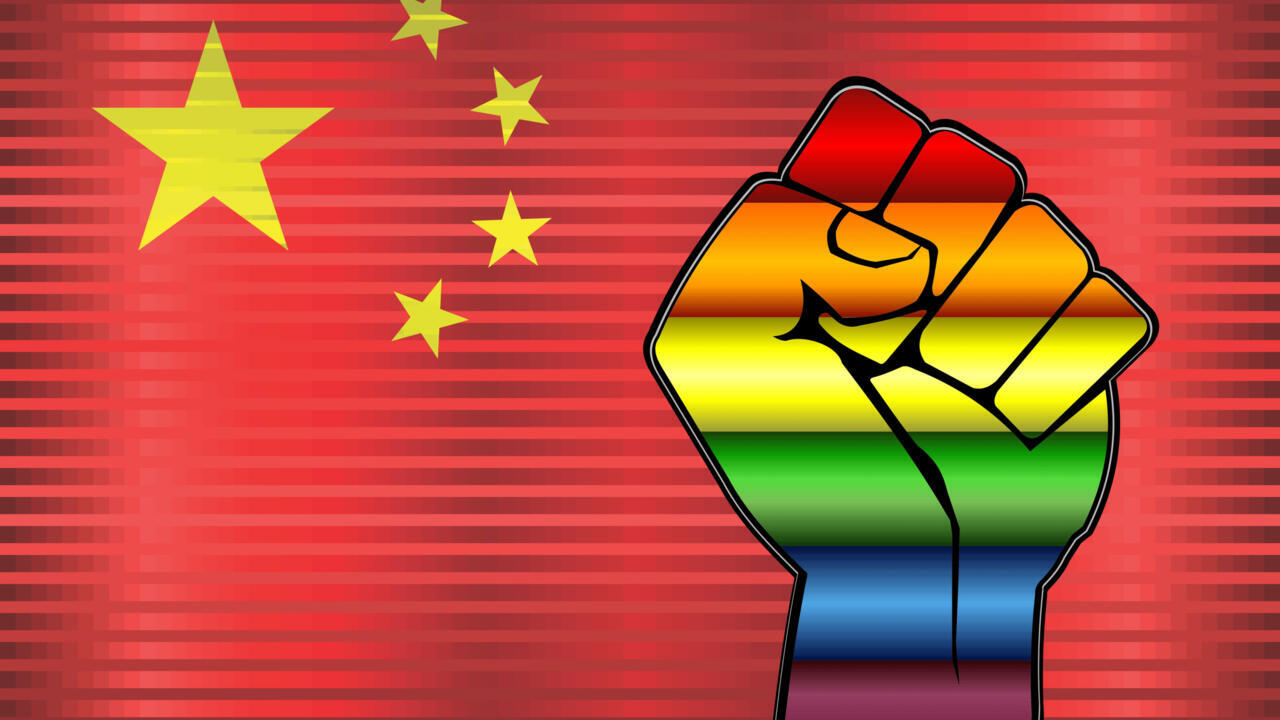
Apple this week confirmed it has removed two popular LGBT+ dating apps from its app store in China, at the authorities’ request. The decision is the latest in a series of policies that are shutting out China’s gay community.
When two dating apps, Blued and Finka, disappeared from the Apple AppStore in China on November 11, a whole world threatened to disappear.
The apps are two of the most popular among China’s LGBT+ community. Blued had been downloaded tens of millions of times, according to the BBC.
In taking them down, the authorities removed two major LGBT+ spaces, leaving little in their place.
“There are still some local apps available, but they are smaller, and they have limited circulation and popularity,” says Bao Hongwei, specialist in China’s queer culture at the University of Nottingham.
Apple said it removed the apps “based on an order from the Cyberspace Administration of China”.
‘A seismic change’
It is not the first time that the authorities have targeted gay dating apps. In 2022, the American app Grindr was retired in China.
The ban on Grindr could be put down to China’s wider dislike of Western apps, which are often accused of being vehicles for foreign influence. But removing Blued and Finka, which were both developed in China, represents a “seismic change in government attitudes towards homegrown LGBT apps”, says Hongwei.
“The Chinese government used to support the business of Blued,” Hongwei says. “The former Chinese Premier Li Keqiang, actually met with the CEO of Blued [in 2012] and it enjoyed a certain legitimacy.”
The disappearance of both Blued and Finka “will affect a lot of LGBT+ people’s lives very significantly”, Hongwei adds. “It sends a chilling and very clear message to ordinary LGBT+ people that they can’t pursue their own personal interests and desires.”
Erasing gay culture
Evidence of hardening attitudes towards the LGBT+ community in China has been increasing for some time.
Before targeting Blued and Finka, the Chinese authorities led a campaign against authors of the “Boy’s Love”, or Danmei, same-sex romance stories, some of which feature explicit love scenes between men.
Several Danmei writers, most of whom are female, have reported being arrested and questioned by the authorities, and in recent months two major Danmei sites have either shut down, or drastically reduced and toned down their content.
In September, a censored version of American-Australian horror film “Together” was released in China with a gay marriage scene digitally altered to show a heterosexual couple.
And in early 2024, China’s dominant social platform Weibo removed viral images of Chinese dancer and transgender icon Jin Xing waving a rainbow flag.
Despite being a high-profile and immensely popular celebrity in China for years, venues across the country dropped performances by her dance troupe without explanation in January 2025.
China decriminalised homosexuality in 1997 and officially recognised that it was not a mental illness in 2001.
For a long time, China adopted a policy of Three No’s towards homosexuality: no approval, no disapproval and no promotion.
This allowed for a period of “good years in the 2000s where more people were openly gay”, says Timothy Hildebrandt, specialist in social politics and sexuality in China at the London School of Economics.
Even so, gay and queer people in China have had to navigate murky legal waters in which their sexuality is legal, but they have no official protections.
For example, while gay marriage is not recognised, a court in 2016 agreed to hear the case of a man suing local authorities for refusing to register his union with his male partner – a first in China.
Today, “officially, those Three No’s are still in place, but we are seeing evidence that the space for LGBT+ communities is starting to shrink”, says Marc Lanteigne, associate professor of political science at the Arctic University of Norway.
Shanghai Pride shut down in 2020, and one year later the government shut down student LGBT+ accounts for “violating internet regulations”. Grindr disappeared in 2022, and in 2023 the Beijing LGBT Centre closed its doors after 15 years.
In June 2024, the Roxie, Shanghai’s last officially lesbian bar, was forced to close “under pressure from the authorities”.
“The authorities have been slowly chipping away at those spaces that were open previously,” says Hildebrandt.
With the closure of so many physical spaces, online networks had become “really the only places in which many members of the LGBT+ community could express their sexuality openly” he adds.
A collateral victim
Why is China’s LGBT+ community being targeted in this way? Rather than being specifically singled out, it is likely that it is a collateral victim of Xi Jinping’s notion of “common prosperity”.
Historically, common prosperity has meant an effort by the Chinese Communist Party to promote economic and social equality.
But in contemporary Chinese politics, “the Maoist principles about equality have more to do with uniformity,” says Hildebrandt. “You gain equality by being more like everybody else. You don’t gain equality by being diverse.”
In a bid to create greater conformity within the population, “there has been a push in China to reinforce traditional family values and, in some cases, traditional masculine values,” adds Lanteigne.
At the same time, China’s population growth and economy are slowing. “The current population growth couldn’t support economic growth,” explains Hongwei, meaning there has been a push to encourage heterosexual couples to have larger families to ensure an abundant future workforce.
In this context of wider policies to promote common prosperity, the LGBT+ community is not the only group facing repression, but it is an easy target.
Since the Covid pandemic, “the Chinese government has endorsed nationalist discourse and LGBT culture is seen as very politicised siding with Western ideologies”, says Hongwei.
“There’s the impression that LGBTQ communities are by default connected to the West and could be seen as destabilising forces,” adds Lanteigne.
Broader political and social forces may be at work, but the result is a real loss of liberty for gay and queer people in China. Hildebrandt says: “There is a real sense that it’s become a more difficult environment to be openly gay.”
This article was adapted from the original in French.
Those of us who have experienced the most – its good as well as its bad – have greater knowledge of the beasts of chaos and unruliness that threaten the earth today. We’ve learned the hard way that the darkness of the world is a reflection of the darkness inside us. We’ll learn to tame the beast of the world by taming it within ourselves.
When we’re young, we’re powerful in a physical sense. The strength of youth is not earned so much as given to you as a gift from nature. It serves a role that belongs specifically to the young: to procreate and build external structures that support material life.
Ralph Waldo Emerson said, “As I age my beauty steals inward.” And so does ours. But we’re responsibility for making it visible. We can still be beautiful, but in a different kind of way. And the beauty of age isn’t simply given to us, as it was in our youth; it has to be earned. And it is often earned as much through suffering as through joy. Our failures as well as our successes, if processed and alchemized into the stuff of true character, can ultimately strengthen rather than weaken us. Our physical muscles cannot help us carry the weight of the world’s emotional pain—only spiritual musculature, often built through accumulated repetitions of heartache, can do that. This isn’t a deficiency in nature’s plan, but an economy in nature’s plan. We weren’t being beaten down; we were being honed.
And if we’re willing to accept it, age endows us with a spiritual elixir. Having seen the darkness in ourselves and others, we’ve become more humble before the light. Having been brought out of darkness, we’ve developed a devotion to He Who delivered us. Having made serious mistakes, we know how much forgiveness matters. Having suffered, we feel more compassion for the suffering of others. They’re not just abstractions to us anymore; they are principles that have infused our flesh. And they are the very things that make us more beautiful. They were not our defeats but our victories. We are strong now in ways we could not have been before. And our strength is needed. We are entering a time when our internal strengths, more than our external ones, will be humanity’s most important sources of renewal and repair. Layers of false power have given way to something far more real.
Whatever powers we might lose with age are small compared to the powers we stand to gain. There’s a profound satisfaction in finally giving up something meaningless, for no other reason than that we did it to the max and now we’re ready to move on. Midlife is about surrendering things that no longer matter, not because our lives are in decline but because they’re on an incline. Traveling upward, we simply let go of some baggage. Maybe there’s more natural wisdom in what’s happening to us now than we think. Of all those things we can’t remember, is it possible that any of them are completely unimportant? Could it be that nature is demanding rather than just requesting that we simplify? The only way we can peacefully age is if we have respect for the demands of the experience.
It’s almost embarrassing to admit, but sometimes it’s a relief to get to finally slow down. You realize “slower” is not necessarily “worse than.” The speed of our former years was not as constructive as it appeared to be. Moving too fast, we often missed a lot. Many of us made big mistakes we might not have made if we hadn’t been moving through life so quickly.
I remember when I was young hearing Otis Redding sing, “Sitting here resting my bones . . . ,” and thinking, Who needs to rest their bones? Now of course I know. And when I first had the thought one day that I was just sitting there resting my bones, I panicked. I thought it was all over if my bones were tired! But then I realized something else, like a guilty secret: I was enjoying just sitting there. I wasn’t attending a Buddhist retreat trying to enjoy just sitting; I really was enjoying it! I was enjoying the kinetic experience of a rocking chair in a way I had never thought possible. (“Oh, these things are actually helpful! Who knew?”) I didn’t feel the need to get up, to go somewhere else, or to do anything at all. With less adrenaline came less distraction. I felt no need to justify my existence by achieving or performing a thing. And that’s when I realized, This is very different but it isn’t bad.
Sometimes what we appear to have lost is simply something it was time to leave behind. Perhaps our system just lets something go, our having moved through the experience and now needing it no more. A friend of mine was sitting once with two of his best friends, a couple he’d partied long and hard with during the l960s. At about ten in the evening the couple’s twenty-something daughter came home, saw them on the couch, and admonished them, “You guys are so boring! You never go out!” To which all three responded in unison, “We were out, and now we’re in.”
The mind is its own kind of dance floor. What a mature generation could do from our rocking chairs could literally rock the world. If in fact the highest, most creative work is the work of consciousness, then in slowing down we’re not doing less; we’re doing more. Having slowed down physically, we’re in a better space to rev up psychically. We are becoming contemplative. We are shifting from the outer to the inner not in order to begin our demise, but to reseed and regreen the consciousness of the planet. And that’s what is happening now: We’re going slower in order to go deeper, in order to go faster in the direction of urgently needed change.
New Thinking Allowed with Jeffrey Mishlove Nov 14, 2025 Biological Systems, Health and Healing This video is a special release from the original Thinking Allowed series that ran on public television from 1986 until 2002. It was recorded in about 1990. It will remain public for only one week. Scientist Russell Targ explains that remote viewing, or free-response clairvoyance, is probably the single most successful research approach in parapsychology. Targ suggests that the mind itself reaches to the far ends of the universe and it is this “non-local” quality, rather than any particular mechanism, that accounts for the remarkable data of parapsychology. Russell Targ is co-founder of the government sponsored remote viewing research program at SRI International. He is co-author of The Mind Race, Mind At Large, Mind Reach and Miracles of Mind. Now you can watch all of the programs from the original Thinking Allowed Video Collection, hosted by Jeffrey Mishlove. Subscribe to the new Streaming Channel (https://thinkingallowed.vhx.tv/) and watch more than 350 programs now, with more, previously unreleased titles added weekly. Free month of the classic Thinking Allowed streaming channel for New Thinking Allowed subscribers only. Use code THINKFREELY.
Consciousness, sexuality, androgyny, futurism, space, the arts, science, astrology, democracy, humor, books, movies and more


 Congresswoman-elect Sarah McBride hugs her parents, Sally and David, after delivering her victory speech to a room full of supporters at the Chase Center on the Riverfront on election night, Tuesday, Nov. 5, 2024. | © William Bretzger-Delaware News Journal / USA TODAY NETWORK via Imagn Images