For more than fifty years I have enjoyed a successful career in the emerging field of Genders-Special Medicine and Men’s Health. In a recent article, “Men’s Work: Why I Do What I Do,” I responded to a request by a colleague to answer these two questions:
Why Do What You Do?
What Do You Receive?
Like many colleagues I know in the “helping professions,” I developed an early interest in helping others when a family crisis turned my world upside down. When I was five years old my mid-life father took an overdose of sleeping pills after he had become increasingly depressed when he couldn’t find work to support his family. Though he didn’t die, our lives were never the same.
My father was committed to Camarillo State Mental Hospital, north of our home in Los Angeles. My uncle Harry visited my father every Sunday and I was charged by my mother to go with him. I was confused and scared and asked my mother why I had to go. She told me:
“Because your father needs you.”
She also thanked me for being her “Good Little Man,” a role that caused a great deal of stress, confusion, and unachievable demands I have made towards myself over the years.
I grew up wondering what happened to my father, when it would happen to me and what I could do to keep it from happening to other men and their families. My own healing journey and what I’ve learned is reflected in my most popular books and on-line courses:
The Irritable Male Syndrome: Understanding and Managing the 4 Key Causes of Depression and Aggression.
Looking for Love in All the Wrong Places: Overcoming Romantic and Sexual Addictions.
As a child thrust in the role of caregiver long before I was capable of helping anyone, I learned to sacrifice my own needs to care for others. The old adage: “It is better to give than receive,” seemed the most natural thing in the world. It has taken years of therapy, self-reflection, and support to learn that I had to give to myself before I really had anything I could give to others.
This truth came home to me when my wife and I were raising our two young children. As every parent knows, little ones require a huge amount of time, attention, love, and care. But if we don’t take care of ourselves we can easily become overwhelmed and burned out. I was forced into self-care when my doctor told me my stressful job would kill me if I didn’t get some regular exercise.
My wife told me our marriage wouldn’t survive if we didn’t have more time for each other away from the kids. She insisted on a Wednesday, date-night, that soon became sacrosanct. Over the years I have continued to find ways to give to others without short-changing myself.
Give First: The Power of Mentorship
In recent years I have been approached by experts in the field who had books or programs coming out and asked for my support in promoting their work. I turn down most requests as not being aligned with my expertise or where I don’t feel my help would significantly contribute to the field of men’s health.
I see part of my role as an elder in the field to offer support and mentorship to others. For those I felt were doing significantly good work in the field of Gender-Specific Medicine and Men’s Health and where I felt I had something significant to offer, we set up a time to talk. Here are a few of the people I felt would be helpful to do an on-line interview, write an article, and share it with my large community:
I don’t charge for the time I spend interviewing them, writing articles, and sharing them with my communities. I have been helped by others in the past and I enjoy helping where I can. But this isn’t just “Giving.” I always get something back. It may be from the person who I helped. It may be from someone else. The old saying “What goes around, comes around,” seems appropriate.
I recently came across a book, Give First: The Power of Mentorship by Brad Feld. Feld has been an early-stage entrepreneur and investor since 1987. He co-founded two venture capital firms and multiple companies including Techstars. His view of giving helped me make sense of what I had been doing for some time. He says:
“One of my deeply held beliefs to the secret success in life is to give before you get. In this approach, I am always willing to try to be helpful to someone without having a clear expectation of what is in it for me. If, over time, the relationship is one way (e.g., I’m giving, but getting nothing), I’ll often back off on my level of give because this belief doesn’t underlie a fundamentally altruistic approach.
“However, by investing time and energy up front without a specifically defined outcome, I have found that, over time, the rewards that come back to me exceed my wildest expectations.”
That was certainly true for me and I believe it is true for most colleagues I know who are successful in their careers and in their lives. Based on his work at Techstars (Techstars is a global startup accelerator and venture capital firm founded in 2006 and headquartered in New York City.) Brad Feld and his partner David Cohen developed “The Techstars Mentor Manifesto” with 18 practices that Feld elaborates in the book. Here are some of the points that particularly resonate with me and my work:
Be authentic — practice what you preach.
Be direct. Tell the truth, however hard.
Listen. (With your heart as well as your head).
Clearly commit to mentor or do not. Either is fine.
The best mentor relationships eventually become two-way.
Know what you don’t know. Say “I don’t know” when you don’t know. “I don’t know” is preferable to bravado.
Be optimistic.
Provide specific actionable advice; don’t be vague.
Andy Irons of Hawaii takes a bottom turn on a wave during the Boost Mobile Pro, Part of the Foster’s ASP Men’s World Surfing Tour on Sept. 18, 2005, at Lower Trestles in San Clemente, Calif.
Donald Miralle/Getty Images
For any child of the ’80s or ’90s, the word “dude” conjures up a specific vibe: a laid-back, California surfer-skater — perhaps drinking a white Russian — unbothered (or maybe unaware) of the pressing concerns of the world around him.
It was also a word that defied specificity — used as a greeting, an agreement, a commiseration or an exclamation.
“Dude” was everywhere.
But it wasn’t a new word back then — not even close. By the 1980s, the term “dude” had been around for at least 100 years. In this week’s Word of the Week, we explore the long and winding road “dude” took from New York City to the surfers in California.
Where did “dude” come from?
Circa 1880: A man being assisted by his servant in the mode of dressing.
Hulton Archive/Getty Images
The exact origin of the word has been difficult for linguists to pin down, but Gerald Cohen, a professor at Missouri University of Science and Technology, published a book on the topic in 2023 with two other language scholars. Cohen says it seems to have been coined in reaction to a particular fad among young men in New York City in the late 19th century. Think hipsters of the 1880s.
“They were young. They were vacuous. They were effeminate — and they were drawing a bit of attention from the humorists and the cartoonists,” Cohen told NPR.
He says this crowd had a certain way of dressing — usually over-the-top and fancy — and leaned into an Anglophile lifestyle that was often perceived by many as fake or trying-too-hard.
Eventually, these men became known as “dudes,” likely in reference to Yankee Doodle, who, as the old war song goes, was an unsophisticated American who “stuck a feather in his cap” in an attempt to parade as a kind of European “dandy” in high society.
Cohen and his colleagues spent more than 20 years trying to pinpoint the moment that reference was first made, combing over old newspaper archives and pop culture references from the time. They eventually found a poem published in a New York City newspaper titled “The Dude” written by a little-known poet named Robert Sale Hill, where he derides the fad.
Here are the final lines:
America can ill afford
To harbor such deformity,
And we would humbly thank the Lord
To spare us this enormity.
But, Cohen says, the poem had the opposite effect.
“It caused a social craze. All of a sudden ‘dude’ was appearing all over,” he says.
An 1883 article from the New York Times describes a “dudes’ picnic” where thousands of young people rushed to a park in Harlem at the promise of seeing men in “full dude dress.”
The Dude Ranch
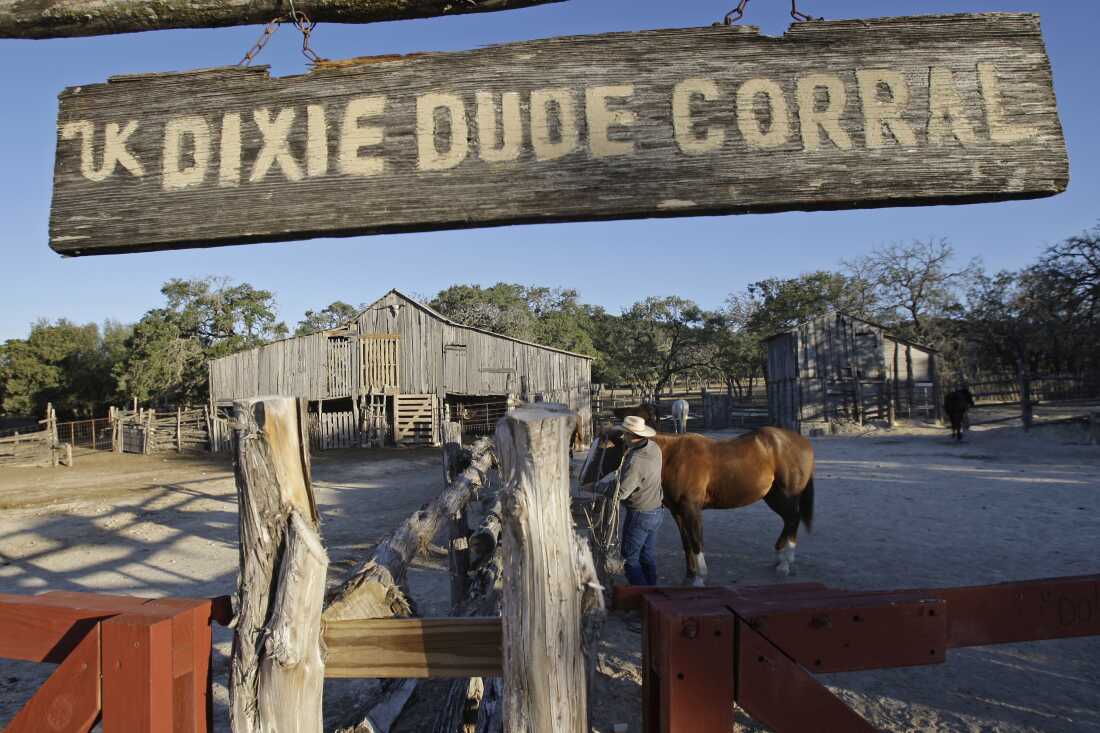
It was that over-the-top style of dress that brought about the term “dude ranch,” experts say. In the late 19th century, traveling out West and experiencing cowboy culture was trendy. People — mostly men — would come from East Coast cities like New York to ranches on vacation, often dressed in full cowboy attire, according to Bryce Albright, executive director of the National Dude Ranchers Association, an organization that has been around for almost 100 years.
“It was a very big dress up for those people, because that’s not something they owned, you know, before they decided to take this vacation,” says Albright. “And so it kind of turned into our trademark.”
Horses are prepared for a morning ride at the Dixie Dude Ranch near Bandera, Texas, Oct. 24, 2008.
Eric Gay/AP
Ranches started advertising themselves as “dude ranches” to attract visitors, and the name stuck. So did the attire.
“And even still, you see people show up that have brand new Wranglers, and button pearl snap shirts and fancy boots and cowboy hats that none of us could ever even think of affording. And it’s fun to see them get dressed up,” she says.
The shift to the everyman
In the mid-20th century, the term “dude” traveled further across the country, making its way to African American and Mexican American populations, says Scott Kiesling, a linguistics professor at University of Pittsburgh who has also studied the word. The term’s rise coincided with the zoot suit — also very flashy and full of fabric — and popular with men of color, he says.
He says originally, it seems they were called “dude” as more of a derogatory term.
Three Jamaican immigrants (left to right) John Hazel, a 21-year-old boxer, Harold Wilmot, 32, and John Richards, a 22-year-old carpenter, arriving at Tilbury on board the ex-troopship ‘Empire Windrush’, smartly dressed in zoot suits and trilby hats.
Douglas Miller/Getty Images/Hulton Archive
“And then what we think happened — which is what happens in a lot of these kinds of situations —[Mexican American and Black people] adopted it with each other, and it became this marker of solidarity and connection,” Kiesling says.
From there, it started to become less associated with fancy dress and more with masculinity, and other subgroups started to pick it up, particularly the surfers and skaters out in California — which is when Hollywood really got a hold of it in the 1980s and 90s.
Now, Kiesling says, the word, which began in reference to young men, has lost a lot of its gender connotation but is still meant to show familiarity with a person. Maybe you don’t use it with your boss or a stranger, but with your friends or acquaintances to show that you’re in the same group.
And don’t be fooled — even with the rise of “bro” (see NPR’s Word of the Week here), “dude” still reigns supreme, according to a recent survey Kiesling conducted.
“Dude is still used the most, I think people just don’t notice it as much,” he says.
Right now massive planetary energies are converging at a pivotal moment in planetary history. The Shadow knows this all too well, which is why it’s trying to distract with new militaristic machinations – don’t be fooled! What’s going on exactly? Let’s explore.Pivotal Juncture in Planetary History On August 9th, six planets will come into alignment to form a hexagon: Mercury, Venus, Jupiter, Uranus, Neptune and Saturn. This is taking place at what Openhand perceives as ‘another massive turn of the galactic cogs’. And it’s coming right when the planet needs it most – where a breakthrough of the Simulation needs to happen. It is happening!
We didn’t know this when planning, but the new Openhand Book AVALONIA is released that very day. Which will happen during the World Ascension Summit, which is coming right up. The planetary alignment signals most clearly that the Star Being Nations will be there in support.
The first camps were established in March 1933 immediately after Adolf Hitler became Chancellor of Germany. Following the 1934 purge of the SA, the concentration camps were run exclusively by the SS via the Concentration Camps Inspectorate and later the SS Main Economic and Administrative Office. Initially, most prisoners were members of the Communist Party of Germany, but as time went on different groups were arrested, including “habitual criminals”, “asocials“, and Jews. After the beginning of World War II, people from German-occupied Europe were imprisoned in the concentration camps. About 1.65 million people were registered prisoners in the camps, of whom about a million died during their imprisonment.[c] Most of the fatalities occurred during the second half of World War II, including at least a third of the 700,000 prisoners who were registered as of January 1945. Following Allied military victories, the camps were gradually liberated in 1944 and 1945, although hundreds of thousands of prisoners died in the death marches.
Museums commemorating the victims of the Nazi regime have been established at many of the former camps and the Nazi concentration camp system has become a universal symbol of violence and terror.
Background
Concentration camps are conventionally held to have been invented by the British during the Second Boer War, but historian Dan Stone argues that there were precedents in other countries and that camps were “the logical extension of phenomena that had long characterized colonial rule”.[4] Although the word “concentration camp” has acquired the connotation of murder because of the Nazi concentration camps, the British camps in South Africa did not involve systematic murder. The German Empire also established concentration camps during the Herero and Namaqua genocide (1904–1907); the death rate of these camps was 45 per cent, twice that of the British camps.[5]
Prisoners guarded by SA men line up in the yard of Oranienburg, 6 April 1933
On 30 January 1933, Adolf Hitler became chancellor of Germany after striking a backroom deal with the previous chancellor, Franz von Papen.[10] The Nazis had no plan for concentration camps prior to their seizure of power.[11] The concentration camp system arose in the following months due to the desire to suppress tens of thousands of Nazi opponents in Germany. The Reichstag fire in February 1933 was the pretext for mass arrests. The Reichstag Fire Decree eliminated the right to personal freedom enshrined in the Weimar Constitution and provided a legal basis for detention without trial.[10][12] The first camp was Nohra, established on 3 March 1933 in a school.[13]
The number of prisoners in 1933–1934 is difficult to determine; historian Jane Caplan estimated it at 50,000, with arrests perhaps exceeding 100,000.[13] Eighty per cent of prisoners were members of the Communist Party of Germany and ten per cent members of the Social Democratic Party of Germany.[14] Many prisoners were released in late 1933, and after a Christmas amnesty, there were only a few dozen camps left.[15] About 70 camps were established in 1933, in any convenient structure that could hold prisoners, including vacant factories, prisons, country estates, schools, workhouses, and castles.[13][12] There was no national system;[15] camps were operated by local police, SS, and SA, state interior ministries, or a combination of the above.[13][12] The early camps in 1933–1934 were heterogeneous and fundamentally differed from the post-1935 camps in organization, conditions, and the groups imprisoned.[16]
On 26 June 1933, Himmler appointed Theodor Eicke the second commandant of Dachau, which became the model followed by other camps. Eicke drafted the Disciplinary and Penal Code, a manual which specified draconian punishments for disobedient prisoners.[17] He also created a system of prisoner functionaries, which later developed into the camp elders, block elders, and kapo of later camps.[18] In May 1934, Lichtenburg was taken over by the SS from the Prussian bureaucracy, marking the beginning of a transition set in motion by Heinrich Himmler, then chief of the Gestapo (secret police).[19] Following the purge of the SA on 30 June 1934, in which Eicke took a leading role, the remaining SA-run camps were taken over by the SS.[14][20] In December 1934, Eicke was appointed the first inspector of the Concentration Camps Inspectorate (IKL); only camps managed by the IKL were designated “concentration camps”.[14]
In early 1934, the number of prisoners was still falling and it was uncertain if the system would continue to exist. By mid-1935, there were only five camps, holding 4,000 prisoners, and 13 employees at the central IKL office. At the same time, 100,000 people were imprisoned in German jails, a quarter of those for political offenses.[21] Believing Nazi Germany to be imperiled by internal enemies, Himmler called for a war against the “organized elements of sub-humanity”, including communists, socialists, Jews, Freemasons, and criminals. Himmler won Hitler’s backing and was appointed Chief of German Police on 17 June 1936.[22] Of the six SS camps operational as of mid-1936, only two (Dachau and Lichtenburg) still existed by 1938. In the place of the camps that closed down, Eicke opened new camps at Sachsenhausen (September 1936) and Buchenwald (July 1937). Unlike earlier camps, the newly opened camps were purpose-built, isolated from the population and the rule of law, enabling the SS to exert absolute power.[23] Prisoners, who previously wore civilian clothes, were forced to wear uniforms with Nazi concentration camp badges. The number of prisoners began to rise again, from 4,761 on 1 November 1936 to 7,750 by the end of 1937.[24]
Rapid expansion (1937–1939)
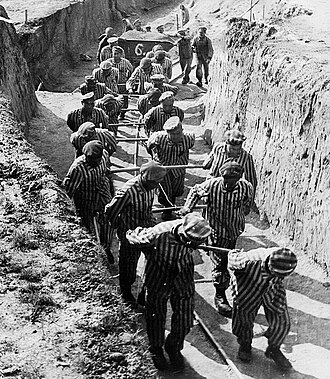
Forced labor at Sachsenhausen brickworks
By the end of June 1938, the prisoner population had expanded threefold in the previous six months, to 24,000 prisoners. The increase was fueled by arrests of those considered habitual criminals or asocials.[24] According to SS chief Heinrich Himmler, the “criminal” prisoners at concentration camps needed to be isolated from society because they had committed offenses of a sexual or violent nature. In fact, most of the criminal prisoners were working-class men who had resorted to petty theft to support their families.[25] Nazi raids of perceived asocials, including the arrest of 10,000 people in June 1938,[26] targeted homeless people and the mentally ill, as well as the unemployed.[27] Although the Nazis had previously targeted social outsiders, the influx of new prisoners meant that political prisoners became a minority.[26]
To house the new prisoners, three new camps were established: Flossenbürg (May 1938) near the Czechoslovak border, Mauthausen (August 1938) in territory annexed from Austria, and Ravensbrück (May 1939) the first purpose-built camp for female prisoners.[24] The mass arrests were partly motivated by economic factors. Recovery from the Great Depression lowered the unemployment rate, so “work-shy” elements would be arrested to keep others working harder. At the same time, Himmler was also focusing on exploiting prisoners’ labor within the camp system. Hitler’s architect, Albert Speer, had grand plans for creating monumental Nazi architecture. The SS company German Earth and Stone Works (DEST) was set up with funds from Speer’s agency for exploiting prisoner labour to extract building materials. Flossenbürg and Mauthausen had been built adjacent to quarries, and DEST also set up brickworks at Buchenwald and Sachsenhausen.[28][29]
Political prisoners were also arrested in larger numbers, including Jehovah’s Witnesses and German émigrés who returned home. Czech and Austrian anti-Nazis were arrested after the annexation of their countries in 1938 and 1939.[30] Jews were also increasingly targeted, with 2,000 Viennese Jews arrested after the Nazi annexation. After the Kristallnacht pogrom in November 1938, 26,000 Jewish men were deported to concentration camps following mass arrests, overwhelming the capacity of the system. These prisoners were subject to unprecedented abuse leading to hundreds of deaths – more people died at Dachau in the four months after Kristallnacht than in the previous five years. Most of the Jewish prisoners were soon released, often after promising to emigrate.[30][31]
World War II
At the end of August 1939, prisoners of Flossenbürg, Sachsenhausen, and other concentration camps were murdered as part of false flag attacks staged by Germany to justify the invasion of Poland.[32] During the war, the camps became increasingly brutal and lethal due to the plans of the Nazi leadership: most victims died in the second half of the war.[33] Five new camps were opened between the start of the war and the end of 1941: Neuengamme (early 1940), outside of Hamburg; Auschwitz (June 1940), which initially operated as a concentration camp for Polish resistance activists; Gross-Rosen (May 1941) in Silesia; and Natzweiler (May 1941) in territory annexed from France.[34][35] The first satellite camps were also established, administratively subordinated to one of the main camps.[34] The number of prisoners tripled from 21,000 in August 1939 to about 70,000 to 80,000 in early 1942.[35] This expansion was driven by the demand for forced labor and later the invasion of the Soviet Union; new camps were sent up near quarries (Natzweiler and Gross-Rosen) or brickworks (Neuengamme).[34][36]
Concentration camp prisoners at a Messerschmitt AG aircraft factory, probably 1943
In April 1941, the high command of the SS ordered the murder of ill and exhausted prisoners who could no longer work (especially those deemed racially inferior). Victims were selected by camp personnel or traveling doctors, and were removed from the camps to be murdered in euthanasia centers. By April 1942, when the operation finished, at least 6,000 and as many as 20,000 people had been killed[37][38] – the first act of systematic killing in the camp system.[39] Beginning in August 1941, selected Soviet prisoners of war were killed within the concentration camps, usually within a few days of their arrival. By mid-1942, when the operation finished, at least 34,000 Soviet prisoners had been murdered. At Auschwitz, the SS used Zyklon B to kill Soviet prisoners in improvised gas chambers.[40][37]
In 1942, the emphasis of the camps shifted to the war effort; by 1943, two-thirds of prisoners were employed by war industries.[41] The death rate skyrocketed with an estimated half of the 180,000 prisoners admitted between July and November 1942 dying by the end of that interval. Orders to reduce deaths in order to spare inmate productivity had little effect in practice.[42][43] During the second half of the war, Auschwitz swelled in size – fueled by the deportation of hundreds of thousands of Jews – and became the center of the camp system. It was the deadliest concentration camp and Jews sent there faced a virtual death sentence even if they were not immediately killed, as most were. In August 1943, 74,000 of the 224,000 registered prisoners in all SS concentration camps were in Auschwitz.[44] In 1943 and early 1944, additional concentration camps – Riga in Latvia, Kovno in Lithuania, Vaivara in Estonia, and Kraków-Plaszów in Poland – were converted from ghettos or labor camps; these camps were populated almost entirely by Jewish prisoners.[45][46] Along with the new main camps, many satellite camps were set up to more effectively leverage prisoner labor for the war effort.[47]
THE HEAVENS—Admitting He would not even know what to talk about with His followers after spending two millennia apart, Christ announced Monday that He has called off plans for His return upon coming to the realization that He has been gone so long at this point that coming back “would just be weird.” “I’ve been putting off my return to the vale of tears for centuries, always telling myself I would corporeally appear sometime next year, but I feel like it would just be awkward if I showed up out of the blue,” said the Son of God, expressing concerns that people would be mad at Him for disappearing for such a long time without bothering to send the faithful a message confirming His love or compassion. “I once thought that when I reappeared it would be just like it was back in Judea, but I just don’t think that’s realistic anymore. There is just so much build-up that doing it right is frankly impossible—I didn’t see a single moral soul for 2,000 years, didn’t answer any of their prayers, didn’t give them any indication that I was even real. Who just drops off the face of the Earth like that and then expects everything to be okay when they come back for what is, at most, the last few decades of the human race?” Christ has since resolved to stop living in the past and instead focus on getting back out and dating again.
CASPER, WY—A powerful, enduring grudge was ruined for local resident Roger Chilton Saturday following a profoundly earnest plea for forgiveness from longtime friend Peter Scotto. “I was looking forward to harboring this bitter resentment for at least another decade, goddamnit, and now he’s taken that away from me,” a deflated Chilton lamented, recalling how Scotto had selfishly revealed his innermost vulnerabilities during the deeply emotional apology. “The worst part is, he was completely and unequivocally remorseful, the bastard.” Chilton told reporters he was so upset over having to give up the grudge that he vowed never to forgive Scotto for such a brave and honest act.
The U.N., Doctors Without Borders, and other humanitarian groups are sounding the alarm on mass starvation throughout Gaza. The Onion takes a look at how the U.S. and Israeli-backed Gaza Humanitarian Fund is distributing aid.
STEP 1
Potential aid recipients identified through rifle scope
STEP 2
70-80 checkpoints
STEP 3
IDF soldiers wipe crumbs off their mouths
STEP 4
Palestinians in line asked if they want to film a short thank you video for Trump
STEP 5
Hungry children told to come back when they’ve developed viable two-state solution
New Thinking Aug 2, 2025 Peter B. Todd, MAPS, a psychotherapist with a Jungian orientation, is author of The Individuation of God: Integrating Science and Religion. He experienced clinical death, during cardiac surgery, in 2005, and was subsequently revived. He was also a gold medalist at the 1982 Gay Games in San Francisco. In this interview, rebooted from 2019, he reviews the outlines of what he believes could become a new theology, open to both mystical experience and modern science. He builds upon the evolutionary, process theology of Pierre Teilhard de Chardin. He also emphasizes the unification of particle physics and depth psychology — as revealed in the explorations of Carl G. Jung and Nobel laureate Wolfgang Pauli. Additionally he pays homage to the concept of the “implicate order” in the work of physicist David Bohm. New Thinking Allowed host, Jeffrey Mishlove, PhD, is author of The Roots of Consciousness, Psi Development Systems, and The PK Man. Between 1986 and 2002 he hosted and co-produced the original Thinking Allowed public television series. He is the recipient of the only doctoral diploma in “parapsychology” ever awarded by an accredited university (University of California, Berkeley, 1980). He is also the Grand Prize winner of the 2021 Bigelow Institute essay competition regarding the best evidence for survival of human consciousness after permanent bodily death. He currently serves as Co-Director of Parapsychology Education at the California Institute for Human Science. (Recorded on September 6, 2019)
“We don’t see things as they are, we see them as we are.”
― Anaïs Nin
Angela Anaïs Juana Antolina Rosa Edelmira Nin y Culmell (February 21, 1903 – January 14, 1977) was a French-born American diarist, essayist, novelist, and writer of short stories and erotica. Born to Cuban parents in France, Nin was the daughter of the composer Joaquín Nin and the classically trained singer Rosa Culmell. Wikipedia
Consciousness, spirituality, biography, sexuality, androgyny, futurism, space, the arts, science, astrology, democracy, humor, books, movies and more