Translation is a 5-step process of “straight thinking in the abstract” comparing and contrasting what seems to be truth with what you can syllogistically, axiomatically and mathematically (using word equations) prove is the truth. It is not an effort to change, alter or heal anything.
The claims in a Translation may seem outrageous, but they are always (or should always be) based on self-evident syllogistic reasoning. Here is one Translation from this week.
1) Truth is that which is so. That which is not truth is not so. Therefore Truth is all that is. Truth being all is therefore total, therefore whole, therefore entire. Truth being true is therefore right, therefore correct, therefore perfect, therefore sound, therefore undamaged. I think therefore I am. Since I am and since Truth is all that is, therefore I, being, am Truth. Since i, being, am Truth, therefore I, being, have all the attributes of Truth. Therefore i, being, am total, whole, entrre, true, correct, perfct, sound (sane), undamaged. Since I am mind (self-evident) and since I, being, am Truth, therefore Truth is Mind. (Two things being equal to a third thing are equal to each other.) Since Truth is Mind, therefore Mind has all the attributes fo Truth. Therefore Mind is total, whole, entrie, true, correct, perfect, sound, undamaged.
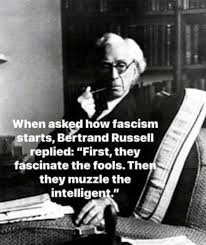
2) Only the people (not our leaders) can overcome fascism.
Word-tracking: people: mortals, humans, imperfect leader: to guide guide: to make known, to render knowable fascism: magic spell in which one ties up the victim, a bundle of authoritative rods, fascination, central control of private enterprise, repression of opposition, extreme nationalism spell: magic, supernatural, sorcerer, making impossible things happen charismatic: charm
3) Truth being all that is is therefore all that’s possible. Since Truth is all that is possible and since magic makes the impossible possible that would mean making untruth possible, and that’s not possible. Therefore magic is impossible. Since there is no magic, therefore nobody can be cast under a spell. Therefore there are no spells to be broken no fascism (fascination) to be undone. Since Truth is Mind, therefore Consciousness, therefore Knowing, and since leadership (guidance) is a rendering to Knowing, therefore leadership can only guide us to Truth. Since Truth is perfect and people are “only human,” therefore not Truth, therefore all is divinity OR Truth divines all.
4) Magic is impossible. There are no spells to be broken no fascism (fascination) to be undone. Leadership can only guide us to Truth. All is divinity OR Truth divines all.
5) Truth divines all.
Weekly Invitational Translation Group invites your participation. If you would like to submit a Translation on any subject, feel free to send your weekly Translation to zonta1111@aol.com and we will anonymously post it on the Bathtub Bulletin on Friday.
Fascism: probably akin to fascis, a magical, usually pejorative, spell. May originally have designated a magical operation in which one tied up the victim. Derivative fascinare, to cast a spell over, fascinatus, whence, to fascinate.
—Origins: A Short Etymological Dictionary of Modern English, by Eric Partridge
ARIES (March 21-April 19): The Tagalog word gigil refers to the urge to squeeze or pinch something adorable. It’s an ecstatic tension that verges on overflowing the container of decorum. In the coming weeks, you Aries could feel gigil for the whole world. Everything may seem almost too vivid, too raw, too marvelous, and altogether too much. I advise you to welcome these surges and allow them to enhance your perceptions. Laugh hard. Cry freely. Invite goosebumps. Please note: But don’t actually squeeze anyone without their permission.
TAURUS (April 20-May 20): In Japan’s Snow Country, artisans practice yuki-sarashi. It involves laying woven cloth on snow under sunlight to bleach, brighten, purify and soften the fibers through the effects of snow, sunlight, cold and ozone. Because this process doesn’t require harsh chemicals, it helps maintain the fabric’s strength and prevents it from yellowing over time. I propose you make yuki-sarashi a useful metaphor, Taurus. Something fragile and fine is ready to emerge, but it needs your gentle touch and natural methods. You are often grounded in the adept manipulation of raw material—what works, what holds, what can be relied on. But this burgeoning treasure needs maximum nuance and the blessings of sensitive care.
GEMINI (May 21-June 20): When African American dancer Josephine Baker arrived in Paris in 1925 at age nineteen, she was seeking refuge from her home country’s racism. Her electrifying performances soon made her a celebrity. Author Ernest Hemingway said she was “the most sensational woman anyone ever saw.” As she grew wealthy, she donated generously to French charities, hospitals and schools. Her compassionate works evolved further, too. During World War II, she worked as a spy for the French Resistance against the Nazi occupation. Later, she became a civil rights activist in the United States. Can you guess the astrological sign of this multi-faceted star? Gemini! I hope you will be inspired by her in the coming weeks. May you, too, use your natural gifts and stylish flair to serve the greater good. Look for opportunities to mentor, encourage and advocate for those lacking your advantages.
CANCER (June 21-July 22): When a glacier moves, it doesn’t rush. It presses forward incrementally, reshaping mountains, carving valleys and transporting boulders. In a metaphorical sense, Cancerian, you are now in glacier time. A slow, relentless, and ultimately magnificent process is afoot in your life. Others may not yet see the forward momentum. Even you may doubt it. But the shift is real and permanent. Trust the deep, inexorable push. Your soul is hauling whole landscapes into new configurations.
LEO (July 23-Aug. 22): In the Arctic, the sun shines for twenty-four hours a day during midsummer. There is no night, only the surreal glow of prolonged gold. The human body, confused by the unending day, may be confused about when to sleep. For some, this creates disorientation, and for others, a strange euphoria. In my astrological opinion, Leo, you have entered a metaphorical version of this solar dreamscape. Your creative powers are beaming like a relentless sun. There may be little darkness in sight. So how will you rest? How will you replenish under the glow of fervent possibility? Be wisely discerning with your energy. Don’t mistake illumination for invincibility. Bask in the light, yes, but protect your rhythms.
VIRGO (Aug. 23-Sept. 22): Now is an excellent time for you to swear sacred oaths. I suggest you get less comfortable with transitory arrangements and short-term promises. The near future will also be a ripe phase to make brave commitments that require you to go farther and deeper than you’ve dared to before. I recommend you forgo the cheap thrills of skipping along from one random moment to the next. Embrace a game plan. Finally, I urge you to cast magic spells on yourself that will release your unconscious mind from old fixations that subtly drain your power to fulfill your dreams. Please please please surrender trivial obsessions that distract you from your life’s key goals.
LIBRA (Sept. 23-Oct. 22): In West African traditions, griots are key figures in their communities. They serve as storytellers, oral historians, poets, genealogists and advisors. Their presence is often central to events like weddings, funerals and ceremonies. In the coming weeks, Libra, I hope that you will embrace a role that resembles the griot. Your ability to enhance and nurture your network is at a peak. You have extra power to weave together threads that have become frayed or unraveled. Given your potential potency as a social glue, I advise you to avoid gossip and instead favor wise, kind words that foster connection.
SCORPIO (Oct. 23-Nov. 21): The phrase “elegant sufficiency” is an old English expression meaning “just enough” or “a sufficient amount in a refined or tasteful way.” I am expanding it to also mean “the simplest solution that solves a problem completely without unnecessary complexity.” It’s your power phrase, Scorpio. What you need is not intricate perfection, but elegant sufficiency: enoughness. I suggest you welcome this gift with enthusiasm—not in a resigned way, but with a quiet triumph. Maybe your plan doesn’t need more bullet points. Maybe the relationship doesn’t require further analysis. Maybe your offering is already thorough. Allow yourself the sweet satisfaction of having just the right amount. What you have created may be more organically whole than you realize.
SAGITTARIUS (Nov. 22-Dec. 21): How do you become a maestro of desire? What must you do to honor your beautiful yearnings and cull your mediocre ones? What’s the magic that will help you fulfill your life’s purpose by trusting your deepest cravings? Here are some tips. First, jettison your inessential desires and cherish the precious yearnings that are crucial. Second, dispose of outmoded goals so you can make expansive space for robust goals that steer you away from the past and guide you toward the future. These are challenging tasks! The very good news is that the coming weeks can be a turning point in your quest to claim this birthright.
CAPRICORN (Dec. 22-Jan. 19): I’m writing a fairy tale about an ancient land whose queen regards poetry as essential to the public good. She often invites poets to perform for her and her court. When they finish a stirring passage, they bow—not to the queen or other observers, but to the silence they mined to access their inspiration; to the pregnant chaos from which the poem was born. The pause is a gesture of gratitude and acknowledgment. I invite you to partake in similar acts of appreciation, Capricorn. Bow toward the mysteries from which your blessings flow. Honor the quiet sources that keep you fertile. Praise the treasures in the dark that fuel your intense activities.
AQUARIUS (Jan. 20-Feb. 18): When I advise you to get naked, I’m not necessarily suggesting that you doff your clothes. What I primarily mean is the following: Shed the armor around your heart; strip off your defense mechanisms; discard knee pads you wear while kissing butt or paying excessive homage; recycle shoes, jackets, pants and opinions that don’t fit you; and discard pride-spawned obstacles that impede your communions with those you love.
PISCES (Feb. 19-March 20): The Finnish word sisu describes a radical, unglamorous persistence. Those who possess sisu can summon extraordinary determination, tenacity and resilience in the face of confusion or difficulty. It’s not about bravado or flair, but about soulful gutsiness. I suspect it’s time for you to draw on your sisu, Pisces. It will empower you to tap into reserves of strength that have previously been unavailable. You will activate potentials that have been half-dormant.
“If we could raise one generation with unconditional love, there would be no Hitlers [or Trumps].”
~ Elisabeth Kübler-Ross
Elisabeth Kübler-Ross (July 8, 1926 – Augsut 24, 2004) was a Swiss-American psychiatrist, a pioneer in near-death studies, author, and developer of the five stages of grief, also known as the “Kübler-Ross model”. In 1970, Kübler-Ross delivered the Ingersoll Lecture at Harvard University, focusing on her book, On Death and Dying. Wikipedia
WASHINGTON—Describing the shift as a troubling indicator for the health of the nation’s system of governance, watchdog group Freedom House published a report Wednesday downgrading the United States from a democracy to whatever political system lobsters have. “Persistent executive overreach and erosion of civil liberties mean that America now looks less like a traditional federal republic and much more like whatever political label you might apply to a writhing pile of lobsters on the ocean’s floor,” said policy expert Alan Beaumont, who stressed that declines in various democratic indices had reduced the country to a state closer to the underwater free-for-all that could be described as the crustacean’s political system. “Our nation already passed the tipping point where we might hope to match the deliberative bicameral legislative process of, say, shore crabs. At this juncture, there’s just too much scuttling in American politics to call it anything other than a flawed lobster republic.” Beaumont added that this reflected a broader national trend of democratic backsliding that left the government of places like El Salvador resembling whatever the hell barnacles are doing.
“Death is our friend precisely because it brings us into absolute and passionate presence with all that is here, that is natural, that is love,” Rilke wrote in contemplating the most difficult and rewarding existential art: befriending our own finitude. I have been sitting with Rilke, awash in the tidal waves of sorrow and love, in the wake of losing my beloved friend Emily Levine (October 23, 1944–February 3, 2019) — philosopher, comedian, universe-builder, beautiful soul — who made me fall in love with poetry long ago and without whom there would be no Universe in Verse and no Figuring. (Emily rightfully occupies the first line of the book’s acknowledgements.)
Emily Levine, January 2019. (Photograph: Maria Popova)
Ever since her terminal diagnosis in 2016, and up until just three weeks before her death, I have been taking Emily for what we came to call our “poetry retreats” — brief periodic respites by the ocean, where we would spend unhurried time in the company of a few other beloved women, reading poetry, cooking, conversing, and just being — with our joys, with our sorrows, with one another. Emily — the most erudite and intellectually voracious person I have ever known — introduced us to classics, many of which she knew by heart: Whitman, Eliot, Yeats, Plath, Rilke. But there was one contemporary poem she especially loved and read for us often: “You Can’t Have It All” by Barbara Ras, from her exquisite and exquisitely titled 1998 poetry collection Bite Every Sorrow (public library).
Now that Emily has returned her stardust to the universe she so cherished, and all the words seem too small to fill the void, poetry stands as the only mode of remembrance that can give shape and space to the amorphous largeness of feeling that is grief. In this sweetly lo-fi recording from one of our gatherings, punctuated by the sound of the ocean and the rustle of page-turning, Emily reads the poem that she, in the deepest sense, lived out and modeled for the rest of us with her largehearted life.
YOU CAN’T HAVE IT ALL
But you can have the fig tree and its fat leaves like clown hands gloved with green. You can have the touch of a single eleven-year-old finger on your cheek, waking you at one a.m. to say the hamster is back. You can have the purr of the cat and the soulful look of the black dog, the look that says, If I could I would bite every sorrow until it fled, and when it is August, you can have August and abundantly so. You can have love, though often it will be mysterious, like the white foam that bubbles up at the top of the bean pot over the red kidneys until you realize foam’s twin is blood. You can have the skin at the center between a man’s legs, so solid, so doll-like. You can have the life of the mind, glowing occasionally in priestly vestments, never admitting pettiness, never stooping to bribe the sullen guard who’ll tell you all roads narrow at the border. You can speak a foreign language, sometimes, and it can mean something. You can visit the marker on the grave where your father wept openly. You can’t bring back the dead, but you can have the words forgive and forget hold hands as if they meant to spend a lifetime together. And you can be grateful for makeup, the way it kisses your face, half spice, half amnesia, grateful for Mozart, his many notes racing one another towards joy, for towels sucking up the drops on your clean skin, and for deeper thirsts, for passion fruit, for saliva. You can have the dream, the dream of Egypt, the horses of Egypt and you riding in the hot sand. You can have your grandfather sitting on the side of your bed, at least for a while, you can have clouds and letters, the leaping of distances, and Indian food with yellow sauce like sunrise. You can’t count on grace to pick you out of a crowd but here is your friend to teach you how to high jump, how to throw yourself over the bar, backwards, until you learn about love, about sweet surrender, and here are periwinkles, buses that kneel, farms in the mind as real as Africa. And when adulthood fails you, you can still summon the memory of the black swan on the pond of your childhood, the rye bread with peanut butter and bananas your grandmother gave you while the rest of the family slept. There is the voice you can still summon at will, like your mother’s, it will always whisper, you can’t have it all, but there is this.
The second atomic bomb blast over Nagasaki in August 1945 has become known as “the forgotten bomb.” Less than five months later, the U.S. military staged an all-star football game on a killing field in Nagasaki, amid lingering radiation levels.. Why was the game played there? And why does the Nagasaki bombing provide so many lessons and warnings for us today as nuclear dangers proliferate?
New Thinking Aug 5, 2025 Philip A. Goff, PhD, is professor of philosophy at Durham University in the United Kingdom. He is author of Galileo’s Error: Foundations for a New Science of Consciousness and also Consciousness and Fundamental Reality. In this interview, rebooted from 2019, he describes the philosophical approach of addressing the many problems associated with consciousness through logical analysis. He maintains that strict materialism logically implies that consciousness does not exist. While many criticize dualism for failing to define how mind and matter can interact, he maintains that this is not necessarily a fatal flaw. He suggests that panpsychism, the view that the essence of the physical world is mental, avoids many of these problems. New Thinking Allowed host, Jeffrey Mishlove, PhD, is author of The Roots of Consciousness, Psi Development Systems, and The PK Man. Between 1986 and 2002 he hosted and co-produced the original Thinking Allowed public television series. He is the recipient of the only doctoral diploma in “Parapsychology” ever awarded by an accredited university (University of California, Berkeley, 1980). He is also the Grand Prize winner of the 2021 Bigelow Institute essay competition regarding the best evidence for survival of human consciousness after permanent bodily death. He currently serves as Co-Director of Parapsychology Education at the California Institute for Human Science. (Recorded on December 19, 2019)
The term “Man in the Mirror”, popularized by Michael Jackson’s 1988 song, can be unpacked from several different angles:
Estrangement from one’s identity – the “man” and the “I” are 2 separate figures, suggesting a disconnect between who we are and who we perceive ourselves to be
Narcissism – the urge to fixate on our reflection: not to understand ourselves, but to control how we’re seen
Psychological mirroring – “I’m starting with the man in the mirror” becomes an invitation for shadow integration. Instead of blaming the world, we turn inward and take ownership of what we see outside ourselves
In psychological terms, this dynamic is called projection – and it’s a little bit of all of the above.
It begins with separation – we reject something in ourselves – and, at best, ends with integration: recognizing that the mirror doesn’t reflect someone else, but parts of us we’ve disowned.
The real transformation lies in taking ownership of what we see – and what we’ve been avoiding.
It’s no longer just the ‘man,’ or the ‘woman,’ in the mirror – but the me in the mirror. We and our reflection, our shadow, are the very same person.
Mars in Libra – The “Mirror” Transit
On August 6th, 2025, Mars, the planet of “Me” enters Libra, the sign of the “Mirror”, facilitating this very encounter with the self, as seen through the mirroring process of projection.
Mars is in detriment in Libra, because the core nature of Mars – direct action, self-driven will, and personal assertion – clashes with Libra’s reflective style and focus on the “Other”.
Unlike Aries or Scorpio, in Libra, the Ego is not easy to affirm. The direct “me-first” approach is softened – or complicated – by the presence of others and the need to negotiate, mirror, or compromise.
However, if we’re talking about real growth – not the performance of confidence, but the hard-won strength that comes from shadow work – then there’s no better transit than Mars in Libra.
Mars in Libra asks us to look at ourselves in the relational mirror, and to ask:
What part of me is being reflected back by the other?’ How is that thing that triggers me about others, or the world, actually pointing me back to my own disowned traits?
And the most important question of them all – what does this whole dynamic reveal about who I truly am, and what I’m here to do?
Mars In Libra – The Aspects
As soon as it enters Libra, Mars applies a record number of aspects: an opposition to Saturn, a trine to Uranus, another opposition to Neptune, a trine to Pluto, and a sextile to Mercury – which are all in early degrees of their signs.
All these aspects are interconnected, forming a rare configuration called “Envelope” – a Mystic Rectangle with an added Minor Grand Trine.
An Envelope is a dynamic, highly integrated configuration suggesting a strong drive to act and make a difference.
In an Envelope, we have the tension of the oppositions pushing us to get out there and break through inertia, but also the harmony of the sextiles and trines to provide context, flow, and perspective.
We don’t just take any kind of action – we take deliberate, well-timed action that clicks into place like a puzzle piece in a larger design.
Mars in Libra, as the activating lever of the Envelope, helps us respond to what’s been building these past months with clarity and intention – so our actions actually land, and move us toward something that matters.
Mars In Libra – “Surpriiiiise!”
Mars’ ingress into Libra – with a flurry of aspects firing off at once – feels like walking into a surprise party:
You think you’re heading home for a quiet night… and suddenly the lights snap on, the crowd yells ‘Surprise!’, and you’re thrust into the center of a room buzzing with energy, noise, and eyes.
There’s the adrenaline, the rush of excitement laced with vulnerability and exposure. Mars isn’t quite sure whether to bask in the spotlight – or bolt.
But the lights are on, and all eyes are watching. There’s no slipping out the back door. Like it or not, Mars is in the thick of it – so the only way forward is to step up and ride the wave.
In the same way, Mars’ ingress into Libra acts as a spark – bringing the slower-moving transits to life.
If the Saturn-Neptune conjunction in Aries felt a bit hazy, and the Uranus/Neptune/Pluto minor triangle a bit abstract, Mars in Libra marks a ‘no turning back’ moment where it becomes crystal clear: the only way to embody a new reality is to actually participate in it.
Becoming thehero or the heroine of our journey begins with actually leaving the house – literally or metaphorically – and going to places we haven’t been before.
Mars is that push to step outside our comfort zone and confront the world, with all the fear, anticipation, and vulnerability that comes with it.
The stacked aspects, with all the pressure and intensity they bring, might actually be the jolt Mars needed. Remember the surprise party? Mars doesn’t have time to overthink or rehearse.
…when thrown into the middle of the action, Mars has this epiphany: when life just happens – when there’s no time to calculate, worry about how we’re perceived, or spiral into “what ifs” – that’s when something real kicks in.
When there’s no time to entertain thoughts like ‘I wonder how I come off’ ‘Am I too much?’ ‘What will people think?’ – we’re left with no other option but to feel fully alive – awake, engaged, and in direct contact with ourselves and the world.
Sometimes we need a surprise party – or an unexpected twist of fate – to shake us out of default mode and remind us how it feels to truly live – like, properly live.
Mars In Libra – The Me In The Mirror
And what we often find when we finally gather the courage to do things differently is that the most terrifying reflection is not other people’s judgment – it’s our own.
Mars is perhaps the most personal of the personal planets because it reveals what we actually do with our lives. At school, at work, in relationships, in front of a trial committee – we are never judged by what we felt or intended to do, but by what we actually end up doing. We are our actions. We are Mars.
The idea that we are the only ones responsible for our outcomes in life can be a hard pill to swallow for Mars – in pretty much any sign.
But Libra brings us face to face with the shadow: it holds up a mirror and reveals the parts of ourselves we’d rather not see – yet must reclaim if we really want to go to the next level.
Mars opposing the ‘Genesis Point’ of the zodiac – 0° Aries – marks a turning point. We are no longer spectators. Life is no longer some weird movie happening to us – it’s a stage where we’re called to step in, and take full ownership:
“I’m starting with the man in the mirror
I’m asking him to change his ways
And no message could have been any clearer
If you wanna make the world a better place
Take a look at yourself and then make a change”
Mars in Libra is a timeless reminder that the first step toward meaningful change is always internal.
… and it begins by asking the hard questions – the ones we dodge when we don’t want to face ourselves, when we drift from our purpose, or point fingers instead of taking ownership.
But on the other side of that discomfort waits something powerful: a soul-level clarity that brings us back to ourselves – and reminds us that the life we long for begins by facing and owning the person in the mirror.
August 2025 is a dynamic month marked by powerful Mars activations, Mercury stationing direct, and an auspicious Venus-Jupiter conjunction – to name just a few of the alignments.
The highlight transit of the month is Uranus sextiling Saturn and Neptune, activating the long-awaited Pluto-Uranus-Neptune minor triangle for the first time. The second half of August is set to benefit from this supportive and visionary influence.
In August, the planets align in a complex geometric dance, with multiple bodies aspecting each other and forming flowing patterns like Grand Trines, Mystic Rectangles, and Envelopes.
When we see this kind of interwoven activity – rather than isolated aspects – it signals a time of high coordination and synchronicity; the cosmic puzzle pieces are finally snapping into place.
If you’ve been working on a project or vision for a while, August may bring the breakthrough “things are finally falling into place” moment you’ve been waiting for.
But let’s take a look at the most important transits of the month:
August 1st, 2025 – Mercury Cazimi In Leo
On July 31st–August 1st, 2025, Mercury retrograde and the Sun meet at 9° Leo, marking the start of a new Mercury cycle. While Mercury is still retrograde, this in-the-heart-of-the-Sun alignment brings us an infusion of fresh, creative Mercury energy.
This is that phase in the Mercury cycle that mirrors the New Moon in the lunar cycle – we could call it a ‘New Mercury.’ It’s a great time to seed new ideas, intentions, or plans related to Mercury themes like a writing project, launching a blog, or pitching a proposal.
August 6th, 2025 – Mars Enters Libra
On August 6th, 2025, Mars enters Libra – and yes, we’ll feel this ingress pretty much right away!
Not only because Mars in Libra has a very different tone than Mars in Virgo, but also because as soon as he walks into Libra, Mars gets caught in a web of high-voltage aspects: grand trines, oppositions, and sextiles. Mars lights up like a Christmas tree.
If you’ve been feeling MIA lately, Mars in Libra is almost guaranteed to get your wheels turning!
August 9th, 2025 – Full Moon In Aquarius
On August 9th, 2025, we have a Full Moon at 16° Aquarius.
Aquarius Full Moons typically highlight the tension between individual expression and collective belonging – the classic me vs. the group, my desires vs. society’s expectations. They invite us to step outside ourselves and soften that Leo-style focus on ‘me and my truth’.
This Full Moon invites a broader view – one that balances Leo’s heart with Aquarius’ mind, helping us align our personal truth with a greater cause or community.
August 9th, 2025 – Mars Opposite Saturn and Uranus, Trine Uranus and Pluto
Mars in Libra is throwing a cosmic party! On August 8th, 2025, Mars at 1° Libra opposes Saturn and Neptune in Aries and trines Uranus in Gemini andPluto in Aquarius, forming a dynamic configuration called Envelope.
This alignment gives us just enough action, just enough perspective to read the room and make smart moves when timing is right.
Like in any party, you might get a bit of fun, a bit of drama, but most importantly, you gain access to a space where new energies and unexpected opportunities can emerge.
August 11th, 2025 – Mercury Goes Direct
On August 11th, 2025, Mercury goes direct at 4° Leo. This particular retrograde cycle has left many of us feeling more disoriented than usual – and there’s a reason for that.
In the part of the zodiac where it retrograded, Mercury had very few aspects to ground or guide it. For much of the retrograde, Mercury was literally unaspected.
When you combine Mercury’s usual retrograde fog with a lack of cosmic input, you get a confused, slightly lost Mercury in Leo – one that’s no longer receiving the attention, interest, or feedback it normally thrives on. Simply ‘being ourselves’ wasn’t quite landing.
However, this existential no-one-is-interested-in-what-I-say-or-think crisis has pushed Mercury to dig deeper and ask: What’s truly different about me? What do I stand for? What’s the real message underneath the layers of identity and performance?
Now that Mercury has turned direct – close enough to Pluto to gain depth and perspective – we have the chance to start again. This time, with a better understanding of what makes us special and the true value we bring to the world.
Maybe what we thought made us stand out was just surface-level – and what truly matters lies deeper. Or maybe it’s the same truth we’ve always known, but now we’re expressing it with more nuance, maturity, and authenticity.
August 12th, 2025 – Venus Conjunct Jupiter
On August 12th, 2025, Venus meets Jupiter at 14° Cancer.
This is the “fluffy pudding” of transits – or whatever your favorite comfort dessert might be. Jupiter is exalted in the fertile waters of Cancer, and Venus feels pretty much cozied up too.
Together, the 2 benefics give us a taste of abundance and a sense that anything is possible. Life suddenly feels like an overflowing fountain of potential.
“I was blind, but now I can see.” Opportunities are always around us, but we don’t always notice them. Sometimes we’re not in the right mindset, or emotionally tuned in enough to recognize what’s right in front of us.
Venus conjunct Jupiter brings that sweet spot – where our inner gifts and values (Venus) meet what the world is open to receiving (Jupiter).
Does this mean instant sunshine and rainbows? Not right away. Conjunctions are beginnings. This is when we plant the seed – the intention, the desire, the next storyline. The bloom will come later – however, it’s this moment of alignment that sets everything in motion.
August 12th, 2025 – Saturn Sextile Uranus
On August 12th, 2025, Saturn (at 1° Aries) sextiles Uranus (at 1° Gemini).
We are now in the last phase of the current Saturn-Uranus cycle, a cycle that began in the late ’80s – and this is where we start to see the rewards of our fight to reclaim a balanced, sustainable sense of freedom.
The Saturn-Uranus cycle is one of the longest planetary cycles (about 45 years), because building a world that is both reliable and adaptable takes time.
Saturn is the drive to find structure and create systems that work efficiently – with all the rings and limitations that naturally emerge from the process – while Uranus is the drive to outgrow these systems and find something better.
The freedom Uranus seeks is not the rebellion of a teenager pushing back just to prove their individuality.
It’s the leap of a humble master – someone who, through discipline and effort, has come to understand both the benefits and the limitations of structure – and is now ready to move into a space that sparks breakthrough without breaking what matters.
August 22nd, 2025 – Sun Enters Virgo
On August 22nd, 2025, the Sun enters Virgo. Happy birthday to all Virgos out there! Virgo season is when we get back to work, school, or whatever space where we show up to create value and be productive.
Holiday time is great, but let it stretch too long and even the most devoted party-lover will start craving something real – a return to structure, to progress, to doing something that actually matters.
Virgo season is that time of year when we reconnect with what gives us a sense of purpose.
August 23rd, 2025 – New Moon In Virgo
On August 23rd, 2025, we have a New Moon at 0° Virgo. The New Moon is square Uranus in Gemini, bringing friction between the 2 Mercury-ruled signs.
Virgo wants to fix problems, streamline systems, and deliver tangible results – but Uranus in Gemini throws a curveball, challenging her to rethink the approach.
Do we have all the data? Are those assumptions actually sound? Or is there a big elephant in the room, stomping around and waving its trunk?
This New Moon in Virgo is a metaphor for those “researchers have found that…” headlines – like “smoking is good for you” (then later: it’s not), or “margarine is better than butter” (also: it’s not).
This reflects the urge to act on incomplete information – a Virgo-style rush to be useful, even when the facts aren’t quite there yet.
A bit like offering unsolicited advice: well-meaning, but misaligned. That classic “I was just trying to help” energy – when the help being offered doesn’t quite match what’s really needed.
The New Moon in Virgo highlights the tension between our drive to be useful and the cognitive biases that cloud perception – helping us find that middle ground at the heart of Mercury’s true function: neutrality, discernment, and a willingness to keep asking questions.
August 25th, 2025 – Venus Enters Leo
Ladies and gentlemen, may I have ALL your attention? Lights, camera, action, drums… cheering, applause… On August 25th, 2025 Venus enters Leo!!!
This “Madonna/Jason Momoa” ingress will light up our desire to be seen, to shine, and to feel good in our creative self-expression.
This is a time to celebrate beauty, confidence, and the unapologetic joy of being who we are – loud, bold, and full of heart.
August 28th, 2025 – Uranus Sextile Neptune
August 2025 ends on an auspicious note, with Uranus (at 1° Gemini) applying a sextile to Neptune (at 1° Aries). The exact transit peaks on August 28th, but its influence has been building for a while.
And it doesn’t come alone – Saturn is in the mix too, sitting close to Neptune at 1° Aries. So this isn’t just a Uranus-Neptune alignment – it’s a triple play: Uranus, Saturn, and Neptune.
Back in the late ’80s, these 3 planets were also closely engaged, giving us a reference point for how these very different energies can blend.
This time, the tone is different: supportive (a sextile). We’re talking about taking bold steps forward (Uranus) to realize a vision (Neptune), and thanks to Saturn, grounding that vision in something real and lasting.
This is not your everyday “supportive transit.” This is a rare alignment where the universe quietly clicks into gear behind the scenes – opening a window for something long-dreamed to begin taking shape.
Uranus in Gemini sextile Neptune in Aries tosses the cosmic bouquet to those bold enough to catch it: the dreamers who dare to try.
Consciousness, spirituality, biography, sexuality, androgyny, futurism, space, the arts, science, astrology, democracy, humor, books, movies and more




 YOU CAN’T HAVE IT ALL


