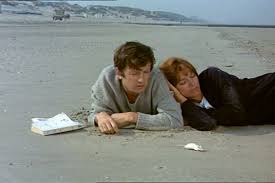
Man and woman from French file “Je t’aime, je t’aime” (1968)
Man: What’s wrong?
Woman: I’m terrified.
Man: You’re afraid?
Woman: No.
Man: Afraid and terrified are the same.
Woman: Afraid, you’re hot. Terrified, you’re cold.


“Die thou before thou diest, that so thou shalt not diest when thou dost come to die; else thou diest utterly.”
–Angelus Silesius (December 25, 1624 – July 9, 1677) was a German Catholic priest and physician, known as a mystic and religious poet. Wikipedia
Once on while Translation is a challenging practice, joined with new revelation’s of consciousness <3
Sense Testimony; My left side and specifically my left foot are causing me pain. Added by me; ( left foot, right wrist, and spinal column are causing me pain?)
Conclusion’s; 1) Truth, inclusive of all, stands alone, never abandoned, never left out, paid in full.
2) Truth characterized by it’s own majestic backbone being unrestrained energy flow harmoniously communicating total, whole, complete ecstatic movement innately omnipresence, omniscience, omnipotencey.

“Happiness is just a dog sunning itself on a rock. We’re not put on this earth to be happy. We’re here to experience great things.”
–Samuel Taylor Coleridge (October 21, 1772 – July 25, 1834) was an English poet, literary critic and philosopher who, with his friend William Wordsworth, was a founder of the Romantic Movement in England and a member of the Lake Poets. Wikipedia

A Famous Inventor, Picturing Life 100 Years from Now, Reveals an Astounding Scientific Venture Which He Believes Will Change the Course of History
by Nikola Tesla as told to George Sylvester Viereck (via pbs.org)
Editor’s Note: Nikola Tesla, now in his seventy-eighth year, has been called the father of radio, television, power transmission, the induction motor, and the robot, and the discoverer of the cosmic ray. Recently he has announced a heretofore unknown source of energy present everywhere in unlimited amounts, and he is now working upon a device which he believes will make war impracticable.
Tesla and Edison have often been represented as rivals. They were rivals, to a certain extent, in the battle between the alternating and direct current in which Tesla championed the former. He won; the great power plants at Niagara Falls and elsewhere are founded on the Tesla system. Otherwise the two men were merely opposites. Edison had a genius for practical inventions immediately applicable. Tesla, whose inventions were far ahead of the time, aroused antagonisms which delayed the fruition of his ideas for years.
However, great physicists like Kelvin and Crookes spoke of his inventions as marvelous. “Tesla,” said Professor A. E. Kennelly of Harvard University when the Edison medal was presented to the inventor, “set wheels going round all over the world. . . . What he showed was a revelation to science and art unto ail time.”
“Were we,” remarks B. A. Behrend, distinguished author and engineer, “to seize and to eliminate the results of Mr. Tesla’s work, the wheels of industry would cease to turn, our electric cars and trains would stop, our towns would be dark, our mills would be dead and idle.”
Forecasting is perilous. No man can look very far into the future. Progress and invention evolve in directions other than those anticipated. Such has been my experience, although I may flatter myself that many of the developments which I forecast have been verified by events in the first third of the twentieth century.
It seems that I have always been ahead of my time. I had to wait nineteen years before Niagara was harnessed by my system, fifteen years before the basic inventions for wireless which I gave to the world in 1893 were applied universally. I announced the cosmic ray and my theory of radio activity in 1896. One of my most important discoveries–terrestrial resonance–which is the foundation of wireless power transmission and which I announced in 1899, is not understood even today. Nearly two years after I had flashed an electric current around the globe, Edison, Steinmetz, Marconi, and others declared that it would not be possible to transmit even signals by wireless across the Atlantic. Having anticipated so many important developments, it is not without assurance that I attempt to predict what life is likely to be in the twenty-first century.
Life is and will ever remain an equation incapable of solution, but it contains certain known factors. We may definitely say that it is a movement even if we do not fully understand its nature. Movement implies a body which is being moved and a force which propels it against resistance. Man, in the large, is a mass urged on by a force. Hence the general laws governing movement in the realm of mechanics are applicable to humanity.
There are three ways by which the energy which determines human progress can be increased: First, we may increase the mass. This, in the case of humanity, would mean the improvement of living conditions, health, eugenics, etc. Second, we may reduce the frictional forces which impede progress, such as ignorance, insanity, and religious fanaticism. Third, we may multiply the energy of the human mass by enchaining the forces of the universe, like those of the sun, the ocean, the winds and tides.
The first method increases food and well-being. The second tends to bring peace. The third enhances our ability to work and to achieve. There can be no progress that is not constantly directed toward increasing well-being, peace, and achievement. Here the mechanistic conception of life is one with the teachings of Buddha and the Sermon on the Mount.
While I am not a believer in the orthodox sense, I commend religion, first, because every individual should have some ideal–religious, artistic, scientific, or humanitarian–to give significance to his life. Second, because all the great religions contain wise prescriptions relating to the conduct of life, which hold good now as they did when they were promulgated.
There is no conflict between the ideal of religion and the ideal of science, but science is opposed to theological dogmas because science is founded on fact. To me, the universe is simply a great machine which never came into being and never will end. The human being is no exception to the natural order. Man, like the universe, is a machine. Nothing enters our minds or determines our actions which is not directly or indirectly a response to stimuli beating upon our sense organs from without. Owing to the similarity of our construction and the sameness of our environment, we respond in like manner to similar stimuli, and from the concordance of our reactions, understanding is barn. In the course of ages, mechanisms of infinite complexity are developed, but what we call “soul ” or “spirit,” is nothing more than the sum of the functionings of the body. When this functioning ceases, the “soul” or the “spirit” ceases likewise.
I expressed these ideas long before the behaviorists, led by Pavlov in Russia and by Watson in the United States, proclaimed their new psychology. This apparently mechanistic conception is not antagonistic to an ethical conception of life. The acceptance by mankind at large of these tenets will not destroy religious ideals. Today Buddhism and Christianity are the greatest religions both in number of disciples and in importance. I believe that the essence of both will he the religion of the human race in the twenty-first century.
The year 2100 will see eugenics universally established. In past ages, the law governing the survival of the fittest roughly weeded out the less desirable strains. Then man’s new sense of pity began to interfere with the ruthless workings of nature. As a result, we continue to keep alive and to breed the unfit. The only method compatible with our notions of civilization and the race is to prevent the breeding of the unfit by sterilization and the deliberate guidance of the mating instinct, Several European countries and a number of states of the American Union sterilize the criminal and the insane. This is not sufficient. The trend of opinion among eugenists is that we must make marriage more difficult. Certainly no one who is not a desirable parent should be permitted to produce progeny. A century from now it will no more occur to a normal person to mate with a person eugenically unfit than to marry a habitual criminal.
Hygiene, physical culture will be recognized branches of education and government. The Secretary of Hygiene or Physical Culture will he far more important in the cabinet of the President of the United States who holds office in the year 2035 than the Secretary of War. The pollution of our beaches such as exists today around New York City will seem as unthinkable to our children and grandchildren as life without plumbing seems to us. Our water supply will he far more carefully supervised, and only a lunatic will drink unsterilized water.
More people die or grow sick from polluted water than from coffee, tea, tobacco, and other stimulants. I myself eschew all stimulants. I also practically abstain from meat. I am convinced that within a century coffee, tea, and tobacco will be no longer in vogue. Alcohol, however, will still be used. It is not a stimulant but a veritable elixir of life. The abolition of stimulants will not come about forcibly. It will simply be no longer fashionable to poison the system with harmful ingredients. Bernarr Macfadden has shown how it is possible to provide palatable food based upon natural products such as milk, honey, and wheat. I believe that the food which is served today in his penny restaurants will be the basis of epicurean meals in the smartest banquet halls of the twenty-first century.
Continue reading “A Machine to End War” from Liberty Magazine (February 1937)

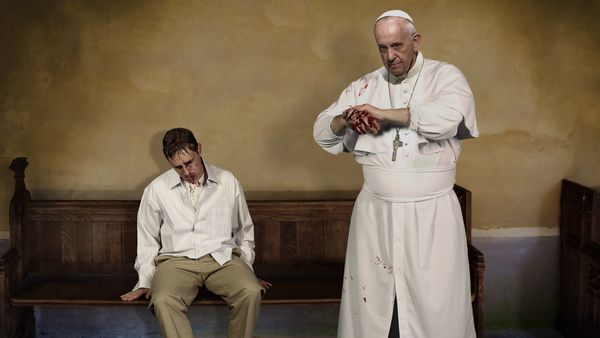
VATICAN CITY—Grasping the back of the man’s collar with one hand while pummeling his face with the other, Pope Francis reportedly beat a confession out of an uncooperative Catholic parishioner Thursday in a backroom of St. Peter’s Basilica. “Listen, buddy, I haven’t even gotten warmed up yet, so we can either keep doing this the hard way, or you can spit out some penance right now. So, what is it? Have you taken the Lord’s name in vain, borne false witness? Maybe a couple minutes being held facedown in the baptismal font would help you remember a sin or two,” said the Vicar of Christ, rolling up the sleeves of his vestments before grabbing a long, heavy papal mace and repeatedly smacking it into his open palm, causing the limp, bloodied man to finally admit to neglecting his familial duties and coveting others’ possessions. “There, was that so bad? Now say 10 Hail Marys and get out of my fucking sight.” The pope then reportedly gave the moaning man one more kick in the ribs as a reminder to come to next week’s Mass with something to confess.
In Search Of…Bishop Pike: Was Bishop Pike a minister, martyr, or madman? Original broadcast: 15 February 1982. Leonard Nimoy narrates:
James Albert Pike (February 14, 1913 – September 9, 1969) was an American Episcopal bishop, prolific writer, and one of the first mainline religious figures to appear regularly on television.
His outspoken, and to some, heretical views on many theological and social issues made him one of the most controversial public figures of his time. He was an early proponent of ordination of women, racial desegregation, and the acceptance of LGBT people within mainline churches. Pike was the fifth Bishop of California. Late in his life he explored psychic experimentation in an effort to contact his recently deceased son. [In 1966, Pike’s son Jim took his own life in a New York City hotel room. As the video above indicates, Jim took his own life due to questions regarding his “masculinity.”]
(Wikipedia.org)
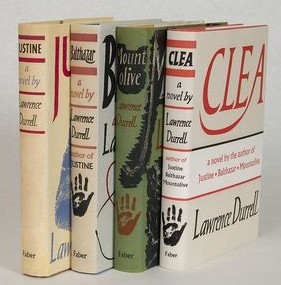
The Alexandria Quartet is a tetralogy of novels by British writer Lawrence Durrell, published between 1957 and 1960. A critical and commercial success, the first three books present three perspectives on a single set of events and characters in Alexandria (Egypt), before and duringWorld War II. The fourth book is set six years later.
As Durrell explains in his preface to Balthazar, the four novels are an exploration of relativity and the notions of continuum and subject–object relation, with modern love as the theme. TheQuartet’s first three books offer the same sequence of events through several points of view, allowing individual perspectives of a single set of events. The fourth book shows change over time.
The four novels are:
In a 1959 Paris Review interview,[1] Durrell described the ideas behind the Quartet in terms of a convergence of Eastern and Western metaphysics, based on Einstein’s overturning of the old view of the material universe, and Freud’s doing the same for the concept of stable personalities, yielding a new concept of reality.
(Wikipedia.org)