The Preposterous Universe

constituents

By Sean Carroll

Scientists tend to believe that the elementary structures underlying the world we observe are ultimately simple and beautiful, even (or especially) the structures we have not yet discovered. Still, this basic elegance does not always manifest itself directly — the universe we see is something of a mess.

This pie chart is a rather prosaic representation of a truly impressive accomplishment: an inventory of the relative amounts of the different substances comprising our universe. Yellow is ordinary matter — atoms, molecules, dust, stars, planets, both visible and invisible — or what cosmologists call “baryons” (since most of the mass of ordinary matter comes from the protons and neutrons inside atomic nuclei, and protons and neutrons are classified by particle physicists as baryons). Baryons make up about five percent of the known universe (actually closer to four percent, but let’s not be picky). We know this from a variety of independent measurements, including the results of nucleosynthesis in the Big Bang, measurements of temperature fluctuations in the cosmic microwave background, and (less precisely) by direct detection. Everything we have ever seen is only one-twentieth of everything there actually is.

This leaves 95% of the universe as stuff which is completely invisible. As depicted, it comes in two components: 25% “dark matter” (in red) and 70% “dark energy” (in blue). The difference between the two is in how they behave: dark matter acts like ordinary particles, in that it collects into dense regions (like galaxies or clusters of galaxies), whereas dark energy is smoothly distributed throughout space and slowly-varying in time. The best candidate for dark energy is the cosmological constant, or “vacuum energy”: the idea that there is a nonzero amount of energy density inherent in the fabric of spacetime itself.

Dark matter and dark energy are not theoretical constructs which were invented by cosmologists because they seemed interesting; observational data have forced us into positing their existence. Even though they are invisible, both dark matter and dark energy give rise to a gravitational field; we can feel their effects. Dark matter contributes to the total gravitational field of galaxies and clusters, which we measure by observing the velocities of nearby particles, or the deflection of light passing by. Dark energy is smoothly distributed, but affects the geometry of spacetime itself: it makes distant galaxies appear to accelerate away from us, and it “flattens” the geometry of space, two effects which have been directly observed. These dark components are exactly the opposite of the “ether” that was popular a century ago: everyone expected ether to exist but nobody could find evidence of it, whereas nobody expected dark matter or dark energy, but we found them despite ourselves.

Although this picture of a mostly-dark universe fits a wide variety of empirical data, at a deeper level it makes no sense to us. In particular, why are the amounts of ordinary matter, dark matter, and dark energy basically similar, when they could easily have been vastly different? This puzzle is especially acute for the dark energy as compared to the total matter (ordinary plus dark), since the matter density is diluted away as the universe expands, while the dark energy density remains close to constant. So the approximate coincidence we observe today between the amount of dark energy and the amount of matter is a short-lived one (cosmologically speaking) — earlier on, the matter was dominating, and before too long (a few billion years) the dark energy will have completely taken over. The history of cosmology teaches us again and again that we do not live in a special place in the universe, but this state of affairs seems to be indicating that we live in a special time. (Personally I think it’s probably just a coincidence, but there very well could be something more profound going on.)

evolving constituents
 

For more discussion, see my Cosmology Primer, or my article “Dark Energy and the Preposterous Universe” (htmlastro-ph/0107571), or slides from my related talk, or other discussions on my reviews page.

(preposterousuniverse.com)

Isaac Newton and Astrology

Witness for the Defence or for the Prosecution?

by Robert H. van Gent[1]

Introduction

From times immemorial, astrology has been a determining factor in the decisions and actions of men of all ranks and stations. At the begin of the 17th century, great scientists as Tycho Brahe, Galileo Galilei, Johannes Kepler and Pierre Gassendi – now best remembered for their roles in the development of modern physics and astronomy – all held astrology in high esteem.

However, at the end of the 17th century, the scientific community had completely turned away from astrology. For some the subject of derision, others preferred to ignore it completely – so, hardly a single word on astrology, either pro or contra, is to be found in the works of scientists as Christiaan Huygens (1629-1695)[2] or Isaac Newton (1642-1727).

However, in the case of Newton, the astrological literature presents a different view and even claims that Newton was in secret an ardent student of astrology.[3] As evidence the following anecdote is often quoted: when the astronomer Edmond Halley (1656-1742), of comet fame, once spoke depreciatively on the subject of astrology, Newton is said to have berated him with the remark: “Sir Halley, I have studied the matter, you have not!”

How much value may we store in such a testimony? The first questions that should be answered are: what is the source for this statement and what evidence is there that Newton ever “studied the matter”.

Portrait of Isaac Newton painted in 1689 by Sir Godfrey Kneller (Farleigh House, Farleigh Wallop, Hampshire)

The Evidence from Newton’s Writings

During the past few decades, an enormous amount of studies have been published on Newton, reaching a high-water mark during the tercentenary of the publication of Newton’s Philosophiæ naturalis principia mathematica(1687). Many of his hitherto unpublished papers, notably those from the so-called ‘Portsmouth Collection’, have been edited and commented on.

However, none of these studies have turned up one shred of evidence that Newton ever conducted any research on astrology.[4] One of the foremost Newton scholars, the English historian of science Derek Thomas Whiteside has stated that he never found any reference to astrology among the 50 million words which have been preserved from Newton’s hand.[5]

Moreover, the claim that the Bodleian Library at Oxford possesses a rare treatise on astrology written by Newton has also proven to be completely unfounded.[6]

Newton’s Library

Corroborative evidence on how minimal Newton’s interests on astrology really were can be found by inspecting the inventory of the books from his library that was made up after his death. This inventory has been preserved and in many cases even the books themselves, with Newton’s own comments and annotations, have been traced to various major libraries.[7]

Among the 1752 books with identifiable titles on this list, no less than 477 (27.2%) were on the subject of theology, 169 (9.6%) on alchemy, 126 (7.2%) on mathematics, 52 (3.0%) on physics and only 33 (1.9%) on astronomy. Surprisingly, Newton’s books on the disciplines on which his scientific fame rests amount to no more than 12% of his library.

At his death, Newton’s library possessed no more than four books on the subject of astrology: a work by the German astrologer Johann Essler from Mainz (end 15th/begin 16th century),[8] a treatise on palmistry and astrology by the English doctor/astrologer Richard Saunders (1613-1675),[9] an almanac from the same using the pseudonym Cardanus Rider[10] and finally a work debunking astrology by the philosopher-poet and Cambridge professor Henry More (1614-1687).[11]

Newton’s Initiation into Science

Ironically, Saunder’s book on palmistry and astrology may even have been the incentive to Newton’s scientific career. On August 31, 1726, shortly before his death, Newton was interviewed by his nephew John Conduitt (1688-1737), who was collecting biographical material on his illustrious uncle.

During this interview, Newton confided to Conduitt that his interest in science had first been roused in the summer of 1663, when, as a young student at Cambridge, he purchased a book on astrology[12] at the midsummer fair at Stourbridge. Baffled by the incomprehensible astrological diagrams and calculations in this work he then studied some books on geometry and calculus (such as by Euclid, Frans van Schooten and René Descartes) and was “soon convinced of the vanity & emptiness of the pretended science of Judicial astrology”.[13]

Conduitt’s notes are also corroborated by another memorandum that was drawn up shortly after Newton’s death by his friend Abraham de Moivre (1667-1754) and which was also consulted by Conduitt.[14] Although the Newton biographer Louis Trenchard More[15]expressed his reservations against the trustworthiness of an anecdote recorded more than 60 years after the event, it is cited as completely reliable in the more authoritative Newton biographies by David Brewster[16] and Richard Samuel Westfall.[17]

Portrait of Edmond Halley painted around 1687 by Thomas Murray (Royal Society, London)
click for a larger image

Newton’s Secret Investigations

The studies into Newton’s unpublished papers mentioned above have revealed that during the greater part of his scientific career, his secret passions in fact lay in alchemy[18] and matters of theology (such as the nature of the Holy Trinity, the dimensions of Solomon’s Temple, biblical prophecies and biblical chronology).[19]

It will therefore not come as a surprise that the true source for our anecdote in fact derives from Newton’s latter interests. More than 50 years ago the American historian of science I. Bernard Cohen[20] was able to trace it back to the highly regarded Newton biographies by the English physicist David Brewster (1781-1868) in which it is cited in full as:[21]

‘… when Dr. Halley ventured to say anything disrespectful to religion, he invariably checked him, with the remark, “I have studied these things – you have not”.’[22]

The fact that Halley and Newton often quarreled on theological matters is confirmed by another remark recorded by John Conduitt, who in turn heard it from his wife (and Newton’s niece) Catherine Conduitt (née Barton; 1679-1739).[23] However, these altercations were never so intense as to cause a rift between these two great scientists.

http://www.staff.science.uu.nl/

Richie Havens: “High Flyin’ Bird”

After listening to and posting “Freedom / (Sometimes I Feel Like a) Motherless Child” by Richie Havens (see below) – whose voice has been described, by eminent New Orleanian Mike Poché, as “walnuts covered with honey” – I was reminded of this song: 

…which which opens Havens’s debut album, Mixed Bag.

I remember listening to this album when it first came out, and having the sensation that I was hearing something from some other world – or almost – a place of high imagination, of total originality.   This was particularly true of “High Flyin’ Bird”: driving percussive rhythm guitar the likes of which you generally hear only in Flamenco; a loping-rocking bass line conterpointing and grounding that rhythm; tasty Jazz guitar riffs acting as fills; drums (starting about halfway through) seeming to partake equally of the Reservation, West Africa and a New Orleans second line; all overarched, almost  dominated, by a voice that sounded like it was coming  out of some person, some being, who seemed about a thousand years old –

And all pretty hard to classify too, of course: Folk-Jazz fusion?  Americana Jazz avant la lettre?  Well, this album, released in 1966, charted in both the Jazz (1967) and Pop (1968) categories.

Personnel:

Richie Havens: rhythm guitar and vocals;

Harvey Brooks: bass;

Howard Collins: guitar;

Bill LaVorgna: drums/percussion.

*History:

“High Flyin’ Bird” was written by Billy Edd Wheeler and first recorded by Judy Henske.  It quickly became something of a folk standard, and was later covered by a good many other artists during the late Sixties, including the Jefferson Airplane, the Au Go Go Singers, Carolyn Hester,  the New Christie Minstrels, H. P. Lovecraft, Isaac Guillory, and Neil Young & Crazy Horse .  Wheeler even recorded his own version in 1967. 

*Lyrics:

There’s a high flyin’ bird, flying way up in the sky
And I wonder if she looks down, as she goes on by?
Well, [While?] she’s flying so freely in the sky

Lord, look at me here
I’m rooted like a tree here
Got those sit-down can’t cry
Oh Lord, gonna die blues

Now the sun it comes up and lights up the day
And when he gets tired, Lord, he goes on down his way
To the east and to the west he meets God every day

Lord, look at me here
I’m rooted like a tree here
Got those sit-down, can’t cry
Oh Lord, gonna die blues

Now I had a woman
Lord, she lived down by the mine
She ain’t never seen the sun
Oh Lord, never stopped crying

Then one day my woman up and died
Lord, she up and died now
Oh Lord, she up and died now
She wanted to die [fly?] and the only way to fly is die, die, die

Well there’s a high flyin’ bird, flying way up in the sky
And I wonder if she looks down as she goes on by?
Well [While?], she’s flying so freely in the sky, hey

Lord, look at me here
I’m rooted like a tree here
Got those sit-down, can’t cry
Oh, Lord, gonna die blues

Got those sit-down, can’t cry
Oh, Lord, gonna die blues, hey hey

*Remarks:

According to Wikipedia, Critic Richie Unterberger described the song as having “…an arresting minor-key melody and brooding lyrics contrasting the freedom of a bird to the singer’s earthbound misery.” 

I’d add that the same contrast is also embodied in the musical texture itself.  The rhythm guitar, bass, and the drums (once they join in) seem almost solid – indeed an excellent expression of the phrase “rooted like a tree” – but at the same time agitated, angry even – as befits someone who’s just suffered a great loss.  Contrasting with that are the soaring windhovering voice and those subtle float-fluttering Jazz guitar fills – expressions, in their turn, of different aspects of birdness, of flight, and of an ultimately wished-for liberation.

Of course, there’s more, as there always is, but just one final thought for the moment: “Those sit-down, can’t cry / Oh Lord, gonna die blues”: as a description of a state of deep grief and loss, one could do worse…

Bruce Gilden’s grotesques at Pier 24 Photography

By Charles Desmarais 

At the far end of the vast Pier 24 Photography exhibition space, halfway through the current show, a series of faces looms like severed heads mounted on pikes, hung there like the admonishments of a current-day Reign of Terror.

Bruce Gilden, the artist whose head-turning portraits of everyday Americans are on view as part of a larger exhibition at the nonprofit Pier 24 Photography through March, has been called “relentlessly cruel” and an adherent of “modern-day film noir.” He calls himself “blunt.” One picture is of a young boy, gamely trying to smile through tears that run down his cheeks at a camera shoved in his face. “I empathize with the kid, but at the end of the day, I’m a photographer,” Gilden told Time magazine.

The exhibition is “This Land,” a better-than-average survey of recent photography projects offering “diverse vignettes of life in the United States.” The show’s strengths derive from Pier 24’s broad familiarity with current threads in the timeworn fabric of straight photography. Its weakness is in its overweening trust of the photograph as a faithful reporter.

Not all the photographs in “This Land” are portraits, but there are many. They include those that come across as ennobling images of people in constrained circumstances by Katy Grannan, and works that seem the essence of empathy by Alessandra Sanguinetti. Jim Goldberg turns encounters with strangers into touching image-and-text biographical sketches, on which he collaborates with his subjects.

If the exhibition has anything to say about these pictures of people, it is that they all are stories, told about characters drawn from their makers’ experience and imagination. A photograph by Gilden may be cruel in that it ignores the inner person — the one who is real, in any moral sense of that word. I don’t know for sure if the same could not be said of the works here by Grannan, Sanguinetti and Goldberg, but they certainly make a more convincing case for their generosity.

Still, though a photographic portrait may flatter, can it ever be kind? “To photograph people is to violate them,” Susan Sontag famously wrote. “It turns people into objects that can be symbolically possessed. Just as a camera is a sublimation of the gun, to photograph someone is a subliminal murder — a soft murder, appropriate to a sad, frightened time.”

A portrait, of course, is not only a description but also a symbol, subject to manipulation through a vast array of micro-decisions. Even if the artist does not fawn, the subject might select that certain spot, some special garb or tilt of head, to convey an ideal that would never be reflected in the face.

Gilden’s closely cropped pictures are masks, with setting and the trappings of status hacked away. They are grotesques, in the medieval sense, fantastic morphed humans that both frighten and ridicule.

More Information

This Land: 10 a.m.-5 p.m. Monday-Friday by appointment. Through March 31. Free. Pier 24 Photography, Pier 24 and the Embarcadero, San Francisco. 415-512-7424. www.pier24.org

I don’t like Gilden’s portraits at all. Even if, in the end, they are no less true than more conventional portraits, the question comes down to motive, as it would in adjudicating any murder.

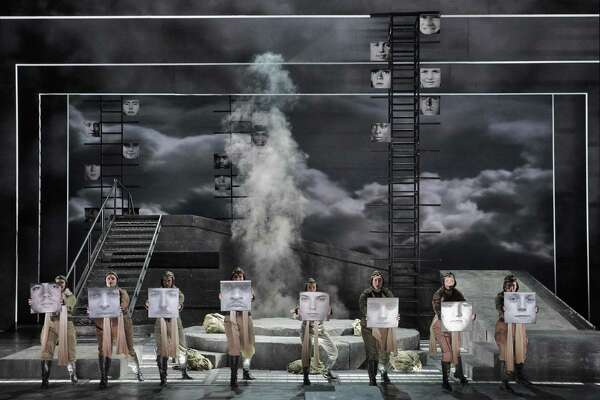
I think of an unexpected and deeply moving visual passage that takes place at one point in Francesca Zambello’s production of Richard Wagner’s “Ring” Cycle, currently at the San Francisco Opera. As the Valkyries sing of fallen heroes, they suddenly hold up to the audience tightly cropped photographs of faces. They are pictures of American soldiers killed in action during the Civil War, World Wars I and II and in Afghanistan and Iraq.

These photographs, to the eye, are unremarkable, yet their effect on the heart in this performance is crushing.

Charles Desmarais is The San Francisco Chronicle’s art critic. Email: cdesmarais@<DP>sfchronicle.com Twitter: @Artguy1 Free weekly newsletter: http://bit.ly/<DP>ArtguyReviews.

Homosexuality of Jesus explored by 18th-century philosopher Jeremy Bentham

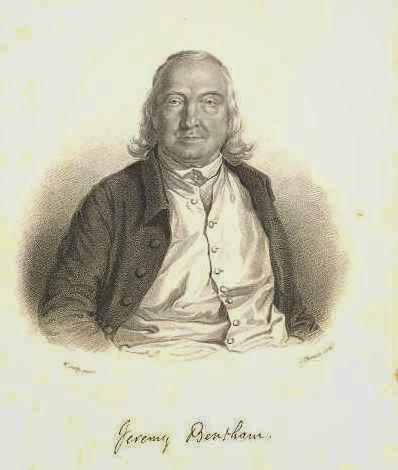
Jeremy Bentham portrait by Henry William Pickersgill

Biblical arguments for LGBTQ rights and a queer Jesus may seem like new ideas, but they were pioneered about 200 years ago by an influential British philosopher — in writings that were published only recently.

Philosopher Jeremy Bentham (1748 – 1832) presented Biblical evidence for Jesus’ homosexuality as part of his theological defense for same-sex love in “Not Paul, but Jesus Vol. III.” It was published for the first time in 2013 and is freely available to download or view online. He died on June 6, 1832.

Bentham didn’t dare publish it during his lifetime because he feared being labeled a “sodomite” himself. At the time “buggery” was punished with death by hanging in England.

This champion of sexual freedom was far, far ahead of his time. “Not Paul, but Jesus” lays out many of the same arguments that are still used today by LGBTQ

Christians and our allies: debunking the scriptures typically used to condemn LGBTQ people and pointing out that Jesus never said anything about homosexuality. Bentham goes on to present an idea that many still consider blasphemous. He suggests that Jesus had male-male sexual relationships.

Bentham wrote the book so long ago that the word “homosexuality” had not been invented yet. Instead he has a chapter titled “The eccentric pleasures of the bed, whether partaken of by Jesus?” His language may sound quaint, but his ideas are right on target for today. Bentham himself struggled with words for what we call homosexuality, deliberately creating new vocabulary so he could avoid the negative connotations associated with the terminology of his day (sodomy, buggery, perversion, etc.).

Bentham is best known as the founder of Utilitarianism, a philosophy that advocates “the greatest happiness of the greatest number of people” A respected thinker during his lifetime, Bentham was also far advanced on a wide range of other legal, economic and political issues. He coined the word “international.” He was one of the first proponents of animal rights. He supported women’s equality and opposed slavery and capital punishment. He corresponded with various world leaders, including US presidents Jefferson and Madison. Several South and Central American nations sought his advice in creating their constitutions and legal codes. Born and raised in a devout Anglican family in London, he became an agnostic who believed that religion was an instrument of oppression. His solution was separation of church and state.

Bentham sheds light on “clobber passages”

In the third volume of “Not Paul, but Jesus Vol. III,” Bentham corrects false interpretations of what would later come to be called the “clobber passages.” He identifies the sin of Sodom as gang-rape. He puts the sexual prohibitions of the Hebrew scriptures into historical context, pointing out that many of the other taboos are no longer enforced.

Bentham dismisses Paul’s condemnations of homosexuality as an asceticism not shared by Jesus himself. He sees romantic love between Old Testament heroes Jonathan and David — and possibly between Jesus and his beloved disciple John, noting that the Bible reports their loving touch without condemnation.

Jeremy Bentham engraving by J. Thomson, from a painting by W. Derby (courtesy of the Bentham Project)

Bentham goes on to analyze the account in Mark’s gospel of “the stripling in the loose attire” (now usually known as “the naked young man”) at the arrest of Jesus — a passage that continues to fuel 21st-century speculations in the LGBTQ community. He urges readers to consider the most “probable interpretation” for the nakedness. (In a different manuscript he made it clear that the youth was probably a male prostitute loyal to Jesus.) Bentham even hints that Jesus was killed for homosexuality, asking readers to consider what interaction with a naked man could be “so awful” that it leads to cruel execution.

Pro-LGBTQ Christians today often note that Jesus never said anything against homosexuality. Bentham makes the same point in his own elaborate way, with sentences such as: “In the acts or discourses of Jesus, had any such marks of reprobation towards the mode of sexuality in question been to be found as may be seen in such abundance in the epistles of Paul—in a word, had any one decided mark of reprobation been so to be found as pronounced upon it by Jesus, in the eyes [of] no believer in Jesus could any such body of evidence as hath here been seen [to] present itself be considered as worth regarding.”

Indeed Bentham’s main purpose in all three volumes of “Not Paul, but Jesus” is to show the error in following the ascetic Paul instead of the true Christianity of the more tolerant Jesus, who accepted the human pursuit of pleasure. This concept is introduced in the first volume of “Not Paul, but Jesus” was published in 1823. Fearing hostile reactions, Bentham used the pseudonym Gamaliel Smith. The second volume, which deals with the early church, and the third volume, which focuses on sexual morality, remained unpublished.

Bentham wrote a lot about homosexuality

Bentham wrote more than 500 pages explaining his liberal views on homosexuality during the last 50 years of his life.  Some of these documents may have circulated among his followers, but none of it was published during his lifetime.

The first Bentham writings on homosexuality to be published were primarily secular. His 1785 essay “Offences Against One’s Self: Paederasty” is considered the first document arguing for decriminalization of homosexuality in England. He reasoned that consensual sex between same-sex partners should not be punished because it does not harm anyone. The essay was not published until 1931, when a fragment first appeared in print. The full essay was finally published in 1978.

Only now are Bentham’s writings on Jesus and homosexuality coming to light. The third volume of “Not Paul, but Jesus” was not published in any form until 2013. It was released last year by the Bentham Project at University College London, which counts him as its spiritual father.

In January 2014 Bentham’s own overview of the “Not Paul, but Jesus, Volume 3” appeared as a chapter in a book published by Oxford University Press: “Of Sexual Irregularities, and Other Writings on Sexual Morality” by Jeremy Bentham. (More info at: http://ukcatalogue.oup.com/product/9780199685189.do)

A section on “Jesus’s Sexuality” is also included in the 2012 article “Jeremy Bentham: Prophet of Secularism” by Philip Schofield, director of the Bentham Project. He draws on the “Not Paul” book and another set of manuscripts to draw powerful conclusions such as this:

Bentham claimed that, unlike Paul, Jesus did not, according to any account that appeared in the four Gospels, condemn either the pleasures of the table or the pleasures of the bed. On the contrary, Jesus’s opposition to asceticism was shown in his condemnation of the Mosaic law in Matthew 9: 9–17…. Bentham pointed out that Paul’s most forceful condemnation was directed towards homosexuality. Bentham responded that not only had Jesus never condemned homosexuality, but that he had probably engaged in it. There were, moreover, many females in Jesus’s immediate circle, and again Bentham saw no reason why Jesus might not have engaged in heterosexual activity as well.

Bentham’s mysterious life an lasting impact

Although Bentham doggedly defended consensual sexual activity between same-sex couples for half a century, his own love life remains a mystery. The son of a wealthy lawyer, he was a child prodigy who grew up to be a brilliant and eccentric recluse, living alone in London in what he called “a state of perpetual and unruffled gaiety.” He referred to his home as his “hermitage.” He lived there with a “sacred teapot” called Dicky, a favorite walking stick named Dapple, and a beloved tom cat addressed as the Reverend Doctor John Langborn. He declared, “I love everything that has four legs,” and allowed a colony of mice to share his office. One study concludes he had Asperger Syndrome, a high-functioning form of autism. Check this link for an 1827 description of Bentham’s eccentricities.

The philosopher’s influence continued to grow after his death as his supporters spread his ideas. Most of what is now known as liberalism is rooted in Bentham’s philosophy. His diverse followers included economist John Stuart Mill and feminist firebrand Frances “Fanny” Wright, who once exclaimed in a poem, “Oh had I but the Lesbyan’s lyre, / Blue-eyed Sappho’s fervid strain, / Then might I hope thy blood to fire…”.

Contemporary queer theologians such as Robert Shore-Goss have recognized him too. Shore-Goss writes a section about Bentham in the chapter on “Christian Homodevotion to Jesus” in his book “Queering Christ: Beyond Jesus Acted Up.”

During his 84 years Bentham wrote manuscripts totaling more than 5 million words, and many remain unstudied and unpublished. The Bentham Project is busy recruiting volunteers worldwide to transcribethem. More words of wisdom are likely to emerge from this prophet of LGBTQ rights who once summed up his approach to life by saying: “Create all the happiness you are able to create: remove all the misery you are able to remove.”

Not Paul, but Jesus Vol. III by Jeremy Bentham, edited by Philip Schofield, Michael Quinn and Catherine Pease-Watkin, is now freely available to download or view online at:
http://blogs.ucl.ac.uk/bentham-project/2013/04/30/not-paul-but-jesus-vol-iii/

___
Top image credit:
Jeremy Bentham portrait by Henry William Pickersgill (Wikimedia Commons)

____
This post is part of the LGBTQ Saints series by Kittredge Cherry. Traditional and alternative saints, people in the Bible, LGBTQ martyrs, authors, theologians, religious leaders, artists, deities and other figures of special interest to lesbian, gay, bisexual and transgender and queer (LGBTQ) people and our allies are covered. It is also part of the Queer Christ series by Kittredge Cherry at the Jesus in Love Blog. The series gathers together visions of the queer Christ as presented by artists, writers, theologians and others.

Copyright © Kittredge Cherry. All rights reserved.
http://www.jesusinlove.blogspot.com/
Jesus in Love Blog on LGBT spirituality and the arts

Kittredge Cherry
Follow

Kittredge Cherry

Founder at Q Spirit
Kittredge Cherry is a lesbian Christian author who writes regularly about LGBTQ spirituality.She holds degrees in religion, journalism and art history.She was ordained by Metropolitan Community Churches and served as its national ecumenical officer, advocating for LGBTQ rights at the National Council of Churches and World Council of Churches.

Opinion: “Meet the Renegades of the Intellectual Dark Web”

Here are some things that you will hear when you sit down to dinner with the vanguard of the Intellectual Dark Web: There are fundamental biological differences between men and women. Free speech is under siege. Identity politics is a toxic ideology that is tearing American society apart. And we’re in a dangerous place if these ideas are considered “dark.”

I was meeting with Sam Harris, a neuroscientist; Eric Weinstein, a mathematician and managing director of Thiel Capital; the commentator and comedian Dave Rubin; and their spouses in a Los Angeles restaurant to talk about how they were turned into heretics. A decade ago, they argued, when Donald Trump was still hosting “The Apprentice,” none of these observations would have been considered taboo.

Today, people like them who dare venture into this “There Be Dragons” territory on the intellectual map have met with outrage and derision — even, or perhaps especially, from people who pride themselves on openness.

It’s a pattern that has become common in our new era of That Which Cannot Be Said. And it is the reason the Intellectual Dark Web, a term coined half-jokingly by Mr. Weinstein, came to exist.

Most simply, it is a collection of iconoclastic thinkers, academic renegades and media personalities who are having a rolling conversation — on podcasts, YouTube and Twitter, and in sold-out auditoriums — that sound unlike anything else happening, at least publicly, in the culture right now. Feeling largely locked out of legacy outlets, they are rapidly building their own mass media channels.

The closest thing to a phone book for the I.D.W. is a sleek website that lists the dramatis personae of the network, including Mr. Harris; Mr. Weinstein and his brother and sister-in-law, the evolutionary biologists Bret Weinstein and Heather Heying; Jordan Peterson, the psychologist and best-selling author; the conservative commentators Ben Shapiro and Douglas Murray; Maajid Nawaz, the former Islamist turned anti-extremist activist; and the feminists Ayaan Hirsi Ali and Christina Hoff Sommers. But in typical dark web fashion, no one knows who put the website up.
Image
Christina Hoff SommersCreditDamon Winter/The New York Times

The core members have little in common politically. Bret and Eric Weinstein and Ms. Heying were Bernie Sanders supporters. Mr. Harris was an outspoken Hillary voter. Ben Shapiro is an anti-Trump conservative.

But they all share three distinct qualities. First, they are willing to disagree ferociously, but talk civilly, about nearly every meaningful subject: religion, abortion, immigration, the nature of consciousness. Second, in an age in which popular feelings about the way things ought to be often override facts about the way things actually are, each is determined to resist parroting what’s politically convenient. And third, some have paid for this commitment by being purged from institutions that have become increasingly hostile to unorthodox thought — and have found receptive audiences elsewhere.

“People are starved for controversial opinions,” said Joe Rogan, an MMA color commentator and comedian who hosts one of the most popular podcasts in the country. “And they are starved for an actual conversation.”

That hunger has translated into a booming and, in many cases, profitable market. Episodes of “The Joe Rogan Experience,” which have featured many members of the I.D.W., can draw nearly as big an audience as Rachel Maddow. A recent episode featuring Bret Weinstein and Ms. Heying talking about gender, hotness, beauty and #MeToo was viewed on YouTube over a million times, even though the conversation lasted for nearly three hours.

Image

Joe RoganCreditDamon Winter/The New York Times

Ben Shapiro’s podcast, which airs five days a week, gets 15 million downloads a month. Sam Harris estimates that his “Waking Up” podcast gets one million listeners an episode. Dave Rubin’s YouTube show has more than 700,000 subscribers.

Offline and in the real world, members of the I.D.W. are often found speaking to one another in packed venues around the globe. In July, for example, Jordan Peterson, Douglas Murray and Mr. Harris will appear together at the O2 Arena in London.

Candace Owens, the communications director for Turning Point USA, is a sharp, young, black conservative — a telegenic speaker with killer instincts who makes videos with titles like “How to Escape the Democrat Plantation” and “The Left Thinks Black People Are Stupid.” Mr. West’s praise for her was sandwiched inside a longer thread that referenced many of the markers of the Intellectual Dark Web, like the tyranny of thought policing and the importance of independent thinking. He was photographed watching a Jordan Peterson video.

All of a sudden, it seemed, the I.D.W. had broken through to the culture-making class, and a few in the group flirted with embracing Ms. Owens as their own.

Yet Ms. Owens is a passionate Trump supporter who has dismissed racism as a threat to black people while arguing, despite evidence to the contrary, that immigrants steal their jobs. She has also compared Jay-Z and Beyoncé to slaves for supporting the Democratic Party.

Many others in the I.D.W. were made nervous by her sudden ascendance to the limelight, seeing Ms. Owens not as a sincere intellectual but as a provocateur in the mold of Milo Yiannopoulos. For the I.D.W. to succeed, they argue, it needs to eschew those interested in violating taboo for its own sake.

“I’m really only interested in building this intellectual movement,”Eric Weinstein said. “The I.D.W. has bigger goals than anyone’s buzz or celebrity.”

And yet, when Ms. Owens and Charlie Kirk, the executive director of Turning Point USA, met last week with Mr. West at the Southern California Institute of Architecture, just outside of the frame — in fact, avoiding the photographers — was Mr. Weinstein. He attended both that meeting and a one-on-one the next day for several hours at the mogul’s request. Mr. Weinstein, who can’t name two of Mr. West’s songs, said he found the Kardashian spouse “kind and surprisingly humble despite his unpredictable public provocations.” He has also tweeted that he’s interested to see what Ms. Owens says next.

This episode was the clearest example yet of the challenge this group faces: In their eagerness to gain popular traction, are the members of the I.D.W. aligning themselves with people whose views and methods are poisonous? Could the intellectual wildness that made this alliance of heretics worth paying attention to become its undoing?

There is no direct route into the Intellectual Dark Web. But the quickest path is to demonstrate that you aren’t afraid to confront your own tribe.

The metaphors for this experience vary: going through the phantom tollbooth; deviating from the narrative; falling into the rabbit hole. But almost everyone can point to a particular episode where they came in as one thing and emerged as something quite different.

A year ago, Bret Weinstein and Heather Heying were respected tenured professors at Evergreen State College, where their Occupy Wall Street-sympathetic politics were well in tune with the school’s progressive ethos. Today they have left their jobs, lost many of their friends and endangered their reputations.

All this because they opposed a “Day of Absence,” in which white students were asked to leave campus for the day. For questioning a day of racial segregation cloaked in progressivism, the pair was smeared as racist. Following threats, they left town for a time with their children and ultimately resigned their jobs.

Sam Harris says his moment came in 2006, at a conference at the Salk Institute with Richard Dawkins, Neil deGrasse Tyson and other prominent scientists. Mr. Harris said something that he thought was obvious on its face: Not all cultures are equally conducive to human flourishing. Some are superior to others.

“Until that time I had been criticizing religion, so the people who hated what I had to say were mostly on the right,” Mr. Harris said. “This was the first time I fully understood that I had an equivalent problem with the secular left.”

After his talk, in which he disparaged the Taliban, a biologist who would go on to serve on President Barack Obama’s Commission for the Study of Bioethical Issues approached him. “I remember she said: ‘That’s just your opinion. How can you say that forcing women to wear burqas is wrong?’ But to me it’s just obvious that forcing women to live their lives inside bags is wrong. I gave her another example: What if we found a culture that was ritually blinding every third child? And she actually said, ‘It would depend on why they were doing it.’” His jaw, he said, “actually fell open.”

Image

Sam HarrisCreditDamon Winter/The New York Times

“The moral confusion that operates under the banner of ‘multiculturalism’ can blind even well-educated people to the problems of intolerance and cruelty in other communities,” Mr. Harris said. “This had never fully crystallized for me until that moment.”

Before September 2016, Jordan Peterson was an obscure psychology professor at the University of Toronto. Then he spoke out against Canada’s Bill C-16, which proposed amending the country’s human-rights act to outlaw discrimination based on gender identity and expression. He resisted on the grounds that the bill risked curtailing free speech by compelling people to use alternative gender pronouns. He made YouTube videos about it. He went on news shows to protest it. He confronted protesters calling him a bigot. When the university asked him to stop talking about it, including sending two warning letters, he refused.

While most people in the group faced down comrades on the political left, Ben Shapiro confronted the right. He left his job as editor at large of Breitbart News two years ago because he believed it had become, under Steve Bannon’s leadership, “Trump’s personal Pravda.” In short order, he became a primary target of the alt-right and, according to the Anti-Defamation League, the No. 1 target of anti-Semitic tweets during the presidential election.

Other figures in the I.D.W., like Claire Lehmann, the founder and editor of the online magazine Quillette, and Debra Soh, who has a Ph.D. in neuroscience, self-deported from the academic track, sensing that the spectrum of acceptable perspectives and even areas of research was narrowing. Dr. Soh said that she started “waking up” in the last two years of her doctorate program. “It was clear that the environment was inhospitable to conducting research,” she said. “If you produce findings that the public doesn’t like, you can lose your job.”

When she wrote an op-ed in 2015 titled “Why Transgender Kids Should Wait to Transition,” citing research that found that a majority of gender dysphoric children outgrow their dysphoria, she said her colleagues warned her, “Even if you stay in academia and express this view, tenure won’t protect you.”

Nowadays Ms. Soh has a column for Playboy and picks up work as a freelance writer. But that hardly pays the bills. She’s planning to start a podcast soon and, like many members of the I.D.W., has a Patreon account where “patrons” can support her work.

These donations can add up. Mr. Rubin said his show makes at least $30,000 a month on Patreon. And Mr. Peterson says he pulls in some $80,000 in fan donations each month.

Mr. Peterson has endured no small amount of online hatred and some real-life physical threats: In March, during a lecture at Queen’s University in Ontario, a woman showed up with a garrote. But like many in the I.D.W., he also seems to relish the outrage he inspires.

“I’ve figured out how to monetize social justice warriors,” Mr. Peterson said in January on Joe Rogan’s podcast. On his Twitter feed, he called the writer Pankaj Mishra, who’d written an essay in The New York Review of Books attacking him, a “sanctimonious prick” and said he’d happily slap him.

And the upside to his notoriety is obvious: Mr. Peterson is now arguably the most famous public intellectual in Canada, and his book “12 Rules for Life” is a best-seller.

The exile of Bret Weinstein and Ms. Heying from Evergreen State brought them to the attention of a national audience that might have come for the controversy but has stayed for their fascinating insights about subjects including evolution and gender. “Our friends still at Evergreen tell us that the protesters think they destroyed us,” Ms. Heying said. “But the truth is we’re now getting the chance to do something on a much larger scale than we could ever do in the classroom.”

“I’ve been at this for 25 years now, having done all the MSM shows, including Oprah, Charlie Rose, ‘The Colbert Report,’ Larry King — you name it,” Michael Shermer, the publisher of Skeptic magazine, told me. “The last couple of years I’ve shifted to doing shows hosted by Joe Rogan, Dave Rubin, Sam Harris and others. The I.D.W. is as powerful a media as any I’ve encountered.”

Mr. Shermer, a middle-aged science writer, now gets recognized on the street. On a recent bike ride in Santa Barbara, Calif., he passed a work crew and “the flag man stopped me and says: ‘Hey, you’re that skeptic guy, Shermer! I saw you on Dave Rubin and Joe Rogan!’” When he can’t watch the shows on YouTube, he listens to them as podcasts on the job. On breaks, he told Mr. Shermer, he takes notes.

“I’ve had to update Quillette’s servers three times now because it’s caved under the weight of the traffic,” Ms. Lehmann said about the publication most associated with this movement.

Image

Michael ShermerCreditDamon Winter/The New York Times

Yet there are pitfalls to this audience-supported model. One risk is what Eric Weinstein has called “audience capture.” Since stories about left-wing-outrage culture — the fact that the University of California, Berkeley, had to spend $600,000 on security for Mr. Shapiro’s speech there, say — take off with their fans, members of the Intellectual Dark Web may have a hard time resisting the urge to deliver that type of story. This probably helps explain why some people in this group talk constantly about the regressive left but far less about the threat from the right.

“There are a few people in this network who have gone without saying anything critical about Trump, a person who has assaulted truth more than anyone in human history,” Mr. Harris said. “If you care about the truth, that is quite strange.”

Emphasis is one problem. Associating with genuinely bad people is another.

Go a click in one direction and the group is enhanced by intellectuals with tony affiliations like Steven Pinker at Harvard. But go a click in another and you’ll find alt-right figures like Stefan Molyneux and Milo Yiannopoulos and conspiracy theorists like Mike Cernovich (the #PizzaGate huckster) and Alex Jones (the Sandy Hook shooting denier).

It’s hard to draw boundaries around an amorphous network, especially when each person in it has a different idea of who is beyond the pale.

“I don’t know that we are in the position to police it,” Mr. Rubin said. “If this thing becomes something massive — a political or social movement — then maybe we’d need to have some statement of principles. For now, we’re just a crew of people trying to have the kind of important conversations that the mainstream won’t.”

But is a statement of principles necessary to make a judgment call about people like Mr. Cernovich, Mr. Molyneux and Mr. Yiannopoulos? Mr. Rubin has hosted all three on his show. And he appeared on a typically unhinged episode of Mr. Jones’s radio show, “Infowars.” Mr. Rogan regularly lets Abby Martin — a former 9/11 Truther who is strangely sympathetic to the regimes in Syria and Venezuela — rant on his podcast. He also encouraged Mr. Jones to spout off about the moon landing being fake during Mr. Jones’s nearly four-hour appearance on his show. When asked why he hosts people like Mr. Jones, Mr. Rogan has insisted that he’s not an interviewer or a journalist. “I talk to people. And I record it. That’s it,” he has said.

Mr. Rubin doesn’t see this is a problem. “The fact is that Jones reaches millions of people,” he said. “Going on that show means I get to reach them, and I don’t think anyone is a lost cause. I’ve gotten a slew of email from folks saying that they first heard me on Jones, but then watched a bunch of my interviews and changed some of their views.”

Image

Dave RubinCreditDamon Winter/The New York Times

The subject came up at that dinner in Los Angeles. Mr. Rubin, whose mentor is Larry King, insisted his job is just to let the person sitting across from him talk and let the audience decide. But with a figure like Mr. Cernovich, who can occasionally sound reasonable, how is a viewer supposed to know better?

Of course, the whole notion of drawing lines to keep people out is exactly what inspired the Intellectual Dark Web folks in the first place. They’re committed to the belief that setting up no-go zones and no-go people is inherently corrupting to free thought.

“You have to understand that the I.D.W. emerged as a response to a world where perfectly reasonable intellectuals were being regularly mislabeled by activists, institutions and mainstream journalists with every career-ending epithet from ‘Islamophobe’ to ‘Nazi,’” Eric Weinstein said. “Once I.D.W. folks saw that people like Ben Shapiro were generally smart, highly informed and often princely in difficult conversations, it’s more understandable that occasionally a few frogs got kissed here and there as some I.D.W. members went in search of other maligned princes.”

But people who pride themselves on pursuing the truth and telling it plainly should be capable of applying these labels when they’re deserved. It seems to me that if you are willing to sit across from an Alex Jones or Mike Cernovich and take him seriously, there’s a high probability that you’re either cynical or stupid. If there’s a reason for shorting the I.D.W., it’s the inability of certain members to see this as a fatal error.

What’s more, this frog-kissing plays perfectly into the hands of those who want to discredit the individuals in this network. In recent days, for example, Mr. Harris has been labeled by the Southern Poverty Law Centeras a bridge to the alt-right: “Under the guise of scientific objectivity, Harris has presented deeply flawed data to perpetuate fear of Muslims and to argue that black people are genetically inferior to whites.”

That isn’t true. The group excoriated Mr. Harris, a fierce critic of the treatment of women and gays under radical Islam, for saying that “some percentage, however small” of Muslim immigrants are radicalized. He has also estimated that some 20 percent of Muslims worldwide are Islamists or jihadis. But he has never said that this should make people fear all Muslims. He has defended the work of the social scientist Charles Murray, who argues that genetic differences may explain differences in average IQ across racial groups — while insisting that this does not make one group inferior to another.

But this kind of falsehood is much easier to spread when other figures in the I.D.W. are promiscuous about whom they’ll associate with. When Mr. West tweeted his praise for Ms. Owens, the responses of the people in the network reflected each person’s attitude toward this problem. Dave Rubin took to Twitter to defend Ms. Owens and called Mr. West’s tweet a “game changer.” Jordan Peterson went on “Fox and Friends” to discuss it. Bret Weinstein subtweeted his criticism of these choices: “Smart, skeptical people are often surprisingly susceptible to being conned if a ruse is tailored to their prejudices.” His brother was convinced that Mr. West was playing an elaborate game of chess. Ms. Heying and Mr. Harris ignored the whole thing. Ben Shapiro mostly laughed it off.

So when he tweets “only freethinkers” and “It’s no more barring people because they have different ideas,” he is picking up on a real phenomenon: that the boundaries of public discourse have become so proscribed as to make impossible frank discussions of anything remotely controversial.

“So many of our institutions have been overtaken by schools of thought, which are inherently a dead end,” Bret Weinstein said. “The I.D.W. is the unschooling movement.”

Am I a member of this movement? A few months ago, someone suggested on Twitter that I should join this club I’d never heard of. I looked into it. Like many in this group, I am a classical liberal who has run afoul of the left, often for voicing my convictions and sometimes simply by accident. This has won me praise from libertarians and conservatives. And having been attacked by the left, I know I run the risk of focusing inordinately on its excesses — and providing succor to some people whom I deeply oppose.

I get the appeal of the I.D.W. I share the belief that our institutional gatekeepers need to crack the gates open much more. I don’t, however, want to live in a culture where there are no gatekeepers at all. Given how influential this group is becoming, I can’t be alone in hoping the I.D.W. finds a way to eschew the cranks, grifters and bigots and sticks to the truth-seeking.

“Some say the I.D.W. is dangerous,” Ms. Heying said. “But the only way you can construe a group of intellectuals talking to each other as dangerous is if you are scared of what they might discover.”

Bari Weiss is a staff editor and writer for the Opinion section.  @bariweiss

Damon Winter joined The Times as a photographer in 2007. He won the 2009 Pulitzer Prize for Feature Photography for his coverage of Barack Obama’s presidential campaign.  

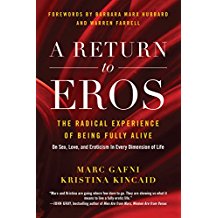
More from “A Return to Eros: The Radical Experience of Being Fully Alive (on Sex, Love, and Eroticism and in every dimension of Life)” by Marc Gafni and Kristine Kincaid

Heiros Gamos, the divine marriage, is the hidden mystical doctrine of God is Eros.

Your Unique Gender will directly affect your sexuality. Attraction is no longer aroused only between male and female or even between masculine and feminine. Attraction is between Unique Genders—that is, between Unique Selves. And that opens up entirely new worlds.

Prostitution is sex without a story. The classic expression of the de-storying of intimacy is the archetypal refusal of the prostitute to kiss. The kiss is the time when all distinctions between subject and object melt. She refuses because it is too difficult to depersonalize a kiss. She has sold her body, but she is trying to protect her soul. He may enter her physical space, but he is denied entry into her story, which is her spirit.

Emily Dickinson: “A home is a holy thing / nothing of doubt and distrust / can enter its portals.”

Mary Mackey in “The Kama Sutra of Kindness: Position No. 2” says:

love comes from years
of breathing
skin to skin

tangled in each other’s dreams
until each night
weaves another thread

in the same web
of blood and sleep

Our English word fantasy derives from the Greek word phantasia, which derived from a verb that meant “to make visible, to reveal.”

The most important thing in the world, implies wisdom master Nachman of Bratslav, is to be willing to give up who you are for who you might become.

Our fear of imagination is our fear of our own greatness.

Imagination is the very essence of who we are. We generally regard ourselves as thinking animals, Homo sapiens. Descartes’ “I think, therefore I am” is hardwired into our cultural genes. The closest Hebrew word to “human,” or the latin homo, is adam. The word adam derives from the Hebrew root meaning “imagination. The stunning implication is that the human being is not primarily Home sapiens but what we will call Homo imaginus.

Man is described as being created in the divine image. “Divine image” does not mean a fixed and idolatrous copy of divinity. God has no fixed form, Instead, God is the possibility of possibility.

And man is made in that image.

Love and Eros skills are modeled by the sexual. Sex is our teacher.

There is a deeper form of sexual arousal that is provoked not by the perception of physical beauty but by the perception of love. This is somewhat more common in women than men but relatively rare in both. Imagine how the world would change if men were aroused to sex by the perception of love. The entire structure of reality and relationships—and with that, political, power and everything else—would radically change. It would be a world moved by Eros rather than pseudo Eros.

There is a wonderful pre-marriage ceremony in biblical myth called tenaim. It represents the mystical merging of the two souls that occurs even before the wedding. It is a spiritual prenuptial agreement in which we read a bill of mutual commitment where both sides commit “not to run away and not to disappear.” It seems redundant—if you do not run away, then, of course, you will not disappear! That is unless you remain physically present yet are not available. Or worse, if you cause your partner to disappear. You do everything you are supposed to do –in the kitchen, in the bedroom, and in the family room—but your partner has long since disappeared from your consciousness.

Martha Beck said in her book Expecting Adam: “Whoever said love is blind is dead wrong. Love is the only thing that lets us see each other with the remotest accuracy.”

Kabbalists say: On their wedding day, the bride and groom reveal God by revealing the Divine in each other. The bride sees something in the groom—a glimpse of his infinite specialness, his divinity—that no one has previously been privileged to witness. And the groom likewise perceives something in the infinite specialness of his bride, something that no one—not her parents, not her best friends—have been able to grasp fully. We stand moved, humbled, and quietly ecstatic as we witness the revelation of divinity, of the God who walks among us. All lovers are revealers of the Divine in each other. They are God seeing God.

And “All love is the love of God,” wrote Menahem Recanati, a Renaissance mystic. Love is to perceive another person unmasked, in the pristine beauty of his spiritual and emotion nakedness. Love is the pleasure produced by such a perception, when our loving awareness strips the beloved of all outer coatings until she stands fully revealed before the perceiving mind.

D.H. Lawrence: “What’s the good of man unless there’s a glimpse of a God in him? And what’s the good of woman unless she’s a glimpse of a Goddess of some sort?”

The goal is to achieve erotic union with Being precisely in the same way sexual love achieves erotic union with the beloved. The highest perception of loving is the realization that you are part of God.

Co-Author Marc Gafni tells a story of kids at a summer camp:

Out of nowhere, I asked them, “When was the last time someone told you that you were beautiful?” Silence. “We need a first volunteer,” I said pushing them. So one brave nine-year-old gets up and, with a flutter of hesitation, says, “My mother told me on Saturday that I was the ugliest little girl she knew.” Silence. This time the quiet was worlds sadder but somehow more real. Then a little boy, looking not more than ten, raised his hand and said, “My mother was in the Holocaust. And she says that if she had known that I would be her son, she wouldn’t have worked so hard to survive.”

And then the stories came tumbling out. Of parents, so many parents, who weren’t lovers, who didn’t know how beautiful their children were. Stories of so many parents who broke the commandment to love. My heart broke.

To remind another of her full beauty, you have to be fully aware of your own. The Master of the Good Name has a wonderful teaching on the biblical mandate to “love your neighbor as you love yourself.” He points out that the mandate is actually, a statement of fact: you love your neighbor precisely as much as you love yourself.

Narcissism is to be in love with your external self, your mask. This is not a good idea because sooner or later masks fall off, and then you are left loveless. Self-love is to love your internal self, your Holy of Holies.

When someone looks at us with erotic, loving eyes, we feel energized, uplifted and embraced. We become more vibrant, audacious, and alive. We feel safer in the world. The sense of alienation, separateness, and loneliness of our empty days and painful nights seems to lift.

To love is to become God’s verb. To love is to see with God’s eyes.

Persian poet Hafiz in “The Sun Never Says:”

Even
After
All this time
The Sun never says to the earth,
“You Owe
Me.”

Look
What happens
With a love like that,
It lights the
Whole
Sky.

Paradoxically, it is in the sexual that the glimmerings of sainthood first appear. It is through the consistent commitment to the growth of the other—expressed through regular and spontaneous acts of giving—that you become a lover.

Talmudic sages: “In a place where there is nobody, try to be somebody.”

We need a politics of love! This is possible because the underlying reality of the universe is relationship and interdependence, not loneliness and alienation.

We need a gross national product not based solely in economic terms. In such a scenario, a company that was highly profitable financially but insensitive to human dignity in measurable ways would not be given the same benefits or would be taxed at a higher rate.

Because our social norms need to be changed, frustration with life as we know it is often an indication of sanity and inner balance. It means we have not succumbed to the superficial values touted by our society.

Our deepest desire is to give, to be lovers. We cannot have a delusion of grandiosity, for we are, in fact, grand.

To create a politics of love, of Eros, we don’t need to start a new political party. We just need a small group of people with a shared vision who are willing to stand together. As anthropologist Margaret Mead said, “Never doubt that a small group of thoughtful, committed people can change the world. Indeed, it is the only thing that ever has.”

The sexual models the erotic: Giving and Receiving are one. In sex, we transcend the world of win-win, common goals, give-and-take, and getting even. The sexual models a different order of reality, where giving and receiving are indistinguishably one.

Aphra Behn, first Englishwoman to earn her living by her writing in the mid-17th century:

I saw ’em kindle with Desire,
While with soft Sighs they blew the Fire;
Saw the Approaches of their Joy,
He growing more fierce and she less coy . . .
His panting Breast to hers now joined,
They feast on Raptures unconfined;
Vast and luxuriant! Such as prove
The Immortality of Love.
For, who but a Divinity
Could mingle Souls to that Degree;
And melt them into Ecstasy . . .

The Kabbalists viewed kissing as the highest model of Eros. Of the two modes of communication with the mouth, speech requires a subject/object relationship. Kissing bridges that difference. This is the erotic model of union.

Song of Songs: “Kiss me from the kisses of your mouth, for your love is more wonderful to me than wine.”

The sexual and erotic means giving up control.

Beat poet Allen Ginsberg:

Please master can I touch your cheek
please master can I kneel at your feet . . .
please master can I gently take down your shorts
please master can I have your thighs bare to my eyes
please master can I take off your clothes below your chair
please master can I kiss your ankles and soul . .
please master, please look into my eyes,
please master order me down on the floor.

Persian poet Hafiz in poem “Tripping Over Joy”:

What is the difference
Between your experience of Existence
And that of a saint?
The saint knows
That the spiritual path
Is a sublime chess game with God
And that the Beloved
Has just made such a Fantastic Move
That the saint is now continually
Tripping overJoy
And bursting out in Laughter
And saying, “I surrender!”’
Whereas, my dear,
I am afraid you still think
You have a thousand serious moves.

Ultimately the refusal to retreat—accept limitation and loss of control—is the source of evil. Only the human ability to step back and give up ownership and domination holds out hope for a good, kind and gentle world. This is what it means to be a lover. (Also what it means to be a Translator or an RHSer.)

Marc Gafni says: Loss of control in a relationship means that it is no longer Adam and Eve, it is Adam and Even. Adam must view Eve as even to himself, or the relationship is doomed.

Letting go of control in our prayers: According to Dr. Larry Dossey, who cites from numerous sources, the prayer that is truly effective is the one in which we ask for healing without specifying a particular outcome.

Slavery in biblical myth is the symbol of non-erotic living. A slave does not make independent decisions. His evaluation of reality, his testimony, is considered inadmissible in a court of law; most critically, he may not initiate his own marriage.

What do we call out at the moment of sexual climax? The common possibilities: the first is that we cry out “Oh, God.” The second is the name of the beloved. The third is that we call out “Yes.” At this moment of ultimate vulnerability, and thus authenticity, there is blurring of names. The name of the other and the name of God become almost interchangeable. The “Yes” is the same “Holy Yes,” which reality cries out at the moment of the original big bang that birthed reality. The “Yes” is the radical affirmation of the unrelenting goodness of life and our place in the universe. The name of God and the name of the beloved are one. Yes!

Our true birth is not our physical appearance at the end of nine months of gestation. Rather it is the person you are on the day you die. There is no greater tragedy than to die without ever having been born. To be a great artist of self, one must access the full erotic energy of the universe. Only this energy allows you to defy inertia and create the infinitely unique being that is you. The person of evolved consciousness is the one who creates her original self and transcends the overwhelmingly powerful urge to be an imitation.

The desire for sexual pleasure tells us in the most direct of terms that the cosmos evolves through delight. Reality evolves because it is pleasurable is a fair summation of the leading edges of both mysticism and contemporary science.

The very process of evolution could be fairly described as the evolution of pleasure.

Shame is when pleasure stops short of infinity.

When you live the erotic life, you realize that pleasure is the source of all ethics. The source of all meaning and ethics is pleasure.

Eros must always lead to ethics.

During loving sexual connection, we realize that the ego walls we have worked so hard to erect and protect are not real. We die to the world of separation and cry out “Oh, God” as we are ushered for a moment into the reality of union.

When we are in love, we are in love with all creation, because lovers perceive, in the bliss of their erotic experience, the essential oneness of all existence.

In Hebrew the word for “neighbor” also means, amazingly, “evil.” Love your evil: that is to say, integrate your shadow, and you will be able to avoid projecting it onto your neighbor. Only then will you be able to love your neighbor.

Unity is outrageous love consciousness—compassionate union with all beings, the highest level of enlightenment.

St. Augustine: “Love God and do what you will.”

Persian poet Hafiz in his poem “A Barroom View of Love”:

Love is grabbing hold of the Great Lions’ mane
And wrestling and rolling deep into Existence
While the Beloved gets rough
And begins to maul you alive.

Or:

True Love, my dear,
Is putting an ironclad grip upon
The soft, swollen balls
Of a Divine Rogue Elephant
And
Not having the good fortune to Die!

Because you say ‘ow’ instead of ‘ah’–because the sensation appears as a menace instead of a friend—doesn’t mean that it’s not from the same source.”

Geoffrey Chaucer: “It is certain that envy is the worst sin that is: for all others sin against one virtue, whereas envy is against all virtue and all goodness.”

Registration still open for “Discovering ERIS”

I am writing to let you know that the new support/study group as shown below will begin either Saturday, July 28 or Sunday July 29 around 8:00 am PST.  Thank you to those who have already been in touch with me regarding the group.  Here again are the registration details if you wish to join us.

Discovering ERIS

The symbolism and significance of a new planetary archetype

KEIRON LE GRICE

SUPPORT/STUDY GROUP ONLINE

Begins either Saturday July 28 or Sunday July 29 around 8:00 am PDT

Six 60 minute consecutive weekly meetings

With Group Facilitator: Zoë Robinson H.W.,M.

REGISTRATION

Write to Zoë at: lifeodysseys01@gmail.com with your request to register and please include your:

Name and e address:

Mailing address: (city and country)

Time Zone Name: ( i.e., PDT Pacific Daylight Time):
Best Day & Time you are available to meet online:

You will be informed of the specific meeting day and time once the data is received and coordinated from registered participants.

Total Fee for 6 weekly, 60 minute meetings: £45 (USA$60 / 50 euros approx.) 50% discount for active participants in any of my other

current groups: Total: $30 Payment may be sent to my UK PayPal account:

Open your PayPal account. (Alternative payment methods available upon request) Send payment to:lifeodysseys01@gmail.com

Under: Family and Friends or Gifts

Payment plan available.

I look forward to your participation as a co-adventurer in consciousness for self- discovery. Please write with questions or concerns. Thank you.

Aloha Blessings, Zoë

P.S.  Please note that this is not a Prosperos event, but is presented in the same spirit as the school.

Consciousness, sexuality, androgyny, futurism, space, the arts, science, astrology, democracy, humor, books, movies and more