Getting in the groove

Music reminds us that the mind is more than a calculator. We are resonant bodies as much as representing machines
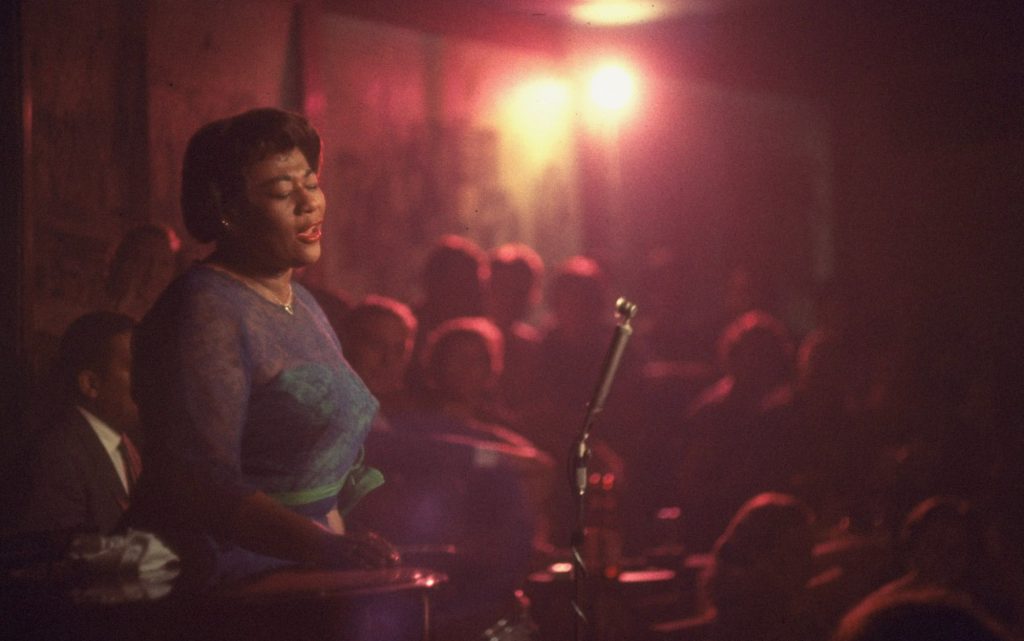
Ella Fitzgerald performing at Mister Kelly’s nightclub in Chicago in 1958. Photo by Yale Joel/The LIFE Picture Collection/Getty

15 January 2018 (aeon.co)

Jenny Judge is a philosopher, musician and writer-at-large whose work has appeared in The Guardian, The Philosopher’s Magazine and Medium’s subscription programme. She holds a PhD in musicology from the University of Cambridge, and is currently working on a second PhD in philosophy at NYU. Her research interests include the philosophy of mind, cognitive science and aesthetics.Listen here

Brought to you by Curio, an Aeon partner

Edited by Sally Davies

The 55 Bar in Greenwich Village, with its bulging ceiling tiles and strings of fairy lights taped haphazardly to the walls, looks more like the clubhouse of a rural Irish sports team than a New York City jazz venue. Yet some of the musical experiences I’ve had in that dingy basement have bordered on the otherworldly. When I’m pinned to the back of my seat by the mind-warping rhythms of a drummer, or the harmonic ingenuity of an improvising guitarist, I often have the feeling that my body ‘gets’ things in a way my brain can’t. I find myself physically responding to nuances in the musical texture that have been and gone before I have time to formulate thoughts about them. I can speculate to some extent about what I’ve heard after the fact – that snare hit was perhaps a shade early; that cadence resolved just a fraction too late ­– but in the moment, I can’t quite articulate what it is that I’m reacting to. My grasp on what I’m hearing doesn’t seem cognitive. It seems visceral.

But talk of ‘visceral, non-cognitive grasping’ sounds hopelessly vague from a philosophical standpoint. In philosophy, it’s common to describe the mind as a kind of machine that operates on a set of representations, which serve as proxies for worldly states of affairs, and get recombined ‘offline’ in a manner that’s not dictated by what’s happening in the immediate environment. So if you can’t consciously represent the finer details of a guitar solo, the way is surely barred to having any grasp of its nuances. Claiming that you have a ‘merely visceral’ grasp of music really amounts to saying that you don’t understand it at all. Right?

Humans do, of course, represent features of the world, and perform mental operations on that information. We owe many of our most striking successes as a species to doing just that: it’s how we built aqueducts, and steam engines, and computers. But just as often, we allow ourselves to be borne along by the currents of what’s swirling around us without abstracting away from it. Getting swept up in a musical performance is just one among a whole host of familiar activities that seem less about computing information, and more about feeling our way as we go: selecting an outfit that’s chic without being fussy, avoiding collisions with other pedestrians on the pavement, or adding just a pinch of salt to the casserole. If we sometimes live in the world in a thoughtful and considered way, we go with the flow a lot, too.

I think it’s a mistake to dismiss these sorts of experiences as ‘mindless’, or the notion of a merely visceral grasp of something as oxymoronic. Instead, I think that the lived reality of music puts pressure on philosophers to broaden their conception of what the mind is, how it works, and to embrace the diversity of ways in which we can begin to grapple with the world around us.

Discussions about how we gain access to reality usually begin with perception. Yet philosophers of perception tend to be almost exclusively concerned with vision. Music, as a consequence, seldom makes it onto the agenda. This comes at a cost: not only has the immediate experience of events attracted far less philosophical attention than the experience of objects, but the role of the body in our experience of movement and change has been sidelined, too.

Now, the world contains many things that we can’t perceive. I am unlikely to find a square root in my sock drawer, or to spot the categorical imperative lurking behind the couch. I can, however, perceive concrete things, and work out their approximate size, shape and colour just by paying attention to them. I can also perceive events occurring around me, and get a rough idea of their duration and how they relate to each other in time. I hear that the knock at the door came just before the cat leapt off the couch, and I have a sense of how long it took for the cat to sidle out of the room.

Both objects and events have a structure. My desk lamp has parts – a square base, a hinged ‘neck’, a circular shade – which are related to each other in space in a particular way: the base is connected to the neck, which is connected to the shade, and so on. Similarly, events have temporal structure: they have parts that are related to each other in time (the knock at the door, for instance, is composed of three sequential raps roughly equivalent in duration). But events and objects differ in an important respect. If I want to examine the parts of my lamp, or figure out how exactly they fit together in space, I can squint at it, pick it up, or turn it around. But while the lamp obligingly submits to my investigations, events extend me no such courtesy. The ‘happenings’ in my environment are constantly sliding into the past, out of reach. And though I could chase after the lamp, were it suddenly to gather up its cable and flee, I can’t pursue a fleeting event to ‘get a good look’ at it.

You can experience a waltz as graceful without any idea that its grace arises via a distinctive temporal patterning

We can discern some coarse-grained properties of a drum-beat just by listening – the kick happens first, then a snare, with a hi-hat somewhere in the middle – but figuring out its precise temporal structure is much less straightforward. Was that snare slightly early, or was it slightly late? It’s like glimpsing the outlines of an intricate architectural filigree through a thick fog, without being able to clear the air. But even if fine-grained temporal structure is opaque to perception, it might not be entirely beyond our ken – because, fortunately, action is more sensitive to temporal detail than perception.

We can move our bodies in response to temporal details too fine for us to consciously experience. In a study published in 2000, the psychologist Bruno Repp at Yale University asked subjects to tap along with a rhythmic sequence of tones, delaying all the tones after a particular point in the sequence by the same tiny amount. He observed that subjects’ tapping patterns compensated rapidly for the change, despite the fact that they were unaware of it. Outside the lab, live performances often feature changes in temporal structure, such as small tempo increases, that even the players producing the sounds fail to notice even while they’re playing along.

Sometimes the temporal detail we’re tracking physically does manifest in our conscious awareness, in the guise of a characteristic ‘feel’. The beats played by the drummer Questlove on the album Voodoo (2000), by American songwriter and producer D’Angelo, have a distinctive temporal structure – the precise details of which we might fail to represent, but can experience as a kind of characteristic looseness, or trippiness. Likewise, you can experience a Viennese waltz as graceful without having any idea that its grace arises from its distinctive temporal patterning, where the first beat is lengthened, the second shortened, and the third given the barest of accents.

The subliminal tracking of temporal structure, which hovers around the fringes of conscious awareness, doesn’t just happen when we listen to and play music. It’s a core component of how we comprehend speech, too. In fact, everyday speech is saturated with fine-tuned musical features that are crucial to making ourselves understood. Say the following two sentences aloud:

I was happy.
was happy.

You probably lengthened the word ‘was’ the second time around. By doing so, you managed not only to convey ‘I was happy in the past,’ but also to imply ‘… though not any more.’ Detecting temporal structure in sound is key to grasping what other people mean, and also to conveying meaning ourselves.

But the success of a face-to-face conversation involves more than just processing an interlocutor’s utterance and emitting a series of comprehensible noises. Consider the following everyday exchange:

Good morning! How are you doing?
I’m very well, thanks. How are you?
I’m doing great. It’s a beautiful day out there.
It certainly is!

Now imagine this brief conversation happening again, but this time with each utterance beginning half a second before the previous one has finished. Or imagine each utterance happening 10 seconds after the previous one. It’s not just what you say that matters, or how you say it: the timing and rhythm matters, too.

A 2009 study by the sociologist Tanya Stivers at the University of California, Los Angeles, and her colleagues found that it’s the norm in most languages and cultures to avoid overlaps and to take turns in conversation, with some local variation. Delivering an affirmative response to a question within 36 milliseconds is judged ‘on-time’ in Japan, while in Denmark you can take 203 milliseconds and still be judged timely. Even though the ‘huge’ inter-turn Nordic silences observed by non-Nordic anthropologists aren’t all that large, such comments reveal that deviations from one’s own acculturated norms are seen as highly salient. In other words, what is experienced as a ‘delay’ – and thus as an indicator of dissent, since confirmations are generally delivered faster than opposing statements – differs across cultures. A congenial Danish tourist in Japan might well be puzzled to find herself taken for something of a contrarian.

Musical rhythms call for conscious movement in a way that visual, tactile and even spoken rhythms do not

Rhythmic turn-taking is not the only musical aspect of speech. Greetings and farewells are ordinarily delivered in the upper part of the vocal register (hence why it’s offputting when someone flatly intones: ‘Goodbye’). The difference between expressing sincerity or sarcasm – ‘Well, isn’t that just great!’ – boils down to differences of pitch, syllable duration and articulation. And it’s hard to address a small baby without finding oneself using hugely exaggerated pitch contours, not to mention repeating words ad nauseum (an instinct for which we shouldn’t punish ourselves, however, since there’s evidence that repetition and over-the-top prosodic features aid a child’s linguistic learning). The most stirring parts of political speeches often involve repetition, and sometimes even embryonic rhythms (‘we shall fight on the beaches, we shall fight on the landing grounds’). As Cicero put it in his History of Famous Orators, the would-be master of rhetoric needs to realise that ‘even in Speaking, there may be a concealed kind of music’.

There might also be a concealed kind of movement. In a 1970 study, the psychologist Adam Kendon noticed that when a speaker singles out an individual within a group, the person being addressed begins to move and nod. Kendon speculated that the addressee thereby ‘differentiates himself from the others present, and at the same time he heightens the bond that is being established between him and the speaker’. The addressee also tended to move in time with emergent rhythms in the utterances of the speaker (an observation that recent studies have confirmed). Kendon hypothesised that the coordination of movement between speaker and listener might enable the listener to time his own entry as a speaker, much as a musician might begin to move conspicuously with the music before she enters with her part.

Movement clearly plays a role in speech, yet its role is importantly different from the role it plays in music. If you were to draw your interlocutor’s attention to the ways in which you were timing your movements, everyone would start feeling a bit awkward and the whole communicative project would derail. But attending to musical movement does not destroy its effect. If anything, it heightens it: dancing becomes more enjoyable the more you pay attention to your movements, and the movement of those around you. Musical rhythms call for conscious (as opposed to unconscious) movement in a way that visual, tactile and even spoken rhythms do not: we seem not only to hear musical beats, but to feel them, too. So just how is it possible to feel a sound in the first place?

It’s 1665. The pressing need to find a reliable way of measuring longitude at sea has led to an arms race among astronomers and mathematicians, who are scrambling to find an accurate method of measuring duration. The Dutch astronomer Christiaan Huygens has recently been catapulted into pole position by the accuracy of his new invention, the pendulum clock.

On 22 February, Huygens writes to R F de Sluse to tell him about a curious phenomenon he has observed in his workshop. Having hung two of his clocks from a common wooden beam placed across the backs of two chairs, Huygens had gone about his business before returning to find the clocks showing an ‘odd sympathy’. The pendula had synchronised. Initially baffled, Huygens eventually realised that each clock was producing small vibrations in the wooden beam, and that it was the interaction of these two patterns of vibration that was responsible for the sympathetic movement.

The spontaneous synchronisation of oscillating systems has since become known as ‘entrainment’, and it has been observed in a vast array of physical and biological systems – from the illumination patterns of fireflies to the wingbeats of free-flying barnacle geese to the tendency of an applauding audience to start clapping in synchrony.

Movement to musical rhythms used to be cast in terms of computation: the listener extracts information from musical sounds, forms a temporal representation and transforms that into an action signal. But more recently, psychologists have begun to model rhythmic musical movement as a process of entrainment, whereby oscillations inside the listener become synchronised with rhythmic cues in the environment in a relatively automatic, spontaneous way. No intervening computations are required: the existence of natural resonances between brain, body and world is enough.

If we are the only speaking apes, we would appear to be the only dancing apes, too

Appealing to little oscillators inside us might seem worryingly occult until one recalls that the brain isn’t just an inert chunk of meat. The activity of neurons can give rise to macroscopic patterns as a consequence of how they’re connected to each other – in the same sort of way that individual spectators at a football match, sensitive to the movement of their neighbours, can collectively make a Mexican wave.

Studies have shown that neuronal groups in our brains do, indeed, entrain to rhythmic stimuli. Rhythm-processing involves increased coupling between auditory and premotor cortex, a part of the brain involved in planning and executing bodily movement. It also recruits the basal ganglia, a group of structures deep in the brain involved in motor control, action selection and learning. Intriguingly, even when subjects are instructed not to move in response to what they hear, the basal ganglia is recruited in the processing of auditory beats – though not when they are presented with regular visual rhythms. Patients with Parkinson’s disease, who suffer from impaired basal ganglia function, show deficits in duration-discrimination and the ability to synchronise their finger taps with auditory rhythms.

It seems that moving in response to temporal structure is not something we have to ‘work out’ how to do. Detecting and responding to temporal patterns, in music and elsewhere, is more likely a matter of allowing oneself to be borne along by the natural, spontaneous resonances that already exist between our bodies, our brains and the temporal contours of the sounding world.

Most creatures, even our nearest primate relatives, don’t seem to experience musical beats in quite the same movement-involving way that we do. If we are the only speaking apes, we would appear to be the only dancing apes, too. But we shouldn’t be too hasty in our self-congratulation. Entrainment to other rhythmic stimuli in the environment is ubiquitous in the animal kingdom – and the uses to which our fellow beasts can put environmental rhythms is impressive indeed.

Where do birds go in the winter months? The Ancient Greeks hypothesised that they hibernated in holes in the ground, or transformed into other species of birds; other civilisations thought that they became barnacles, or concealed themselves at the bottoms of lakes. Such bizarre theories are, in a way, less implausible than what we now know to be true: that creatures weighing less than a box of matches can fly non-stop for thousands of miles over land and sea with no navigational aids, consuming their own bodies as fuel, calculating their route with such precision that they often end up landing not only in the same tree, but on the same twig as they did the year before. And a few months later, they do it all again in reverse.

So-called ‘calendar birds’ migrate at the same time every year, regardless of weather. Magnetic sensitivity and the sense of smell are thought to be instrumental to the success of these voyages. But scientists also think that migrating birds are highly sensitive to time: both to elapsed duration, and also to the presence of circannual, or yearly, environmental rhythms. The ability of these birds to ‘know’ exactly when to depart is thought to rely on entrainment to patterns in the environment that repeat annually, such as changes in the light-dark cycle. Once they get to their winter breeding grounds, where the light-dark cycle is reversed, an internal ‘clock’ is thought to keep track of how much time has elapsed since their departure; a cascade of biological events, such as fat deposit and even the shrivelling of internal organs, begins in the weeks before it’s time to return home. Once the voyage is underway, in either direction, entrainment is what allows the bird to keep track of regularities in the Earth’s magnetic field, and the ‘clock’ keeps count of how long it has been flying on each ‘bearing’.

The tiny Northern wheatear doesn’t travel the 15,000 km from Alaska to southern Africa twice a year by consciously representing the route, or the environmental patterns by which it is calibrated. Maybe the bird blindly implements the instructions of its biological sat-nav like a computer executing code: there might be ‘nothing it’s like’ for the bird to be sensitive to circannual rhythms. However, the contrary is also possible: perhaps at least some of those environmental patterns ‘feel’ a certain way to the bird, much as particular rhythmic patterns feel ‘trippy’ to us despite our failure to represent their precise structure. In 1851, the English writer Henry Mayhew noted that, as the season for migration approaches, ‘the caged nightingale shows symptoms of great uneasiness, dashing himself against the wires of his cage or his aviary, and sometimes dying in a few days.’ It is difficult to read such accounts and not sense what it is like for a bird to feel the pull of the voyage.

Entrainment provides a powerful theoretical tool for exploring how we manage to resonate with the world, and each other, in real time. It offers an embryonic account of how we can act astutely even when there’s no time for conscious thought. And while many of the entrainment processes that regulate the functioning of our brains and bodies never make it into awareness, some of them – like viscerally ‘getting’ a guitar solo – arguably do.

Our conscious experience of time is philosophically puzzling. On the one hand, it’s intuitive to suppose that we perceive only what’s happening right now. But on the other, we seem to have immediate perceptual experiences of motion and change: I don’t need to infer from a series of ‘still’ impressions of your hand that it is waving, or work out a connection between isolated tones in order to hear a melody. These intuitions seem to contradict each other: how can I perceive motion and change if I am only really conscious of what’s occurring now? We face a choice: either we don’t really perceive motion and change, or the now of our perception encompasses more than the present instant – each of which seems problematic in its own way. Philosophers such as Franz Brentano and Edmund Husserl, as well as a host of more recent commentators, have debated how best to solve the dilemma.

But the experience of time involves more than just the perception of events occurring at a distance from us. We also experience time by instigating events through our actions, as well as encountering the actions of others. To relish the flow of a chat with a friend, or to feel the groove of a beat, is to have a distinctive kind of temporal experience where the observation of time becomes entwined with how one inhabits it – but in each case, the experience is less a matter of representing temporal structure than of entraining to it, resonating with it.

Reasoning is often a matter of being ‘struck’ by a thought, of having one’s intellect set in motion by ideas

Is resonance without representation always a mindless affair? Not necessarily. Reason wasn’t always thought of in terms of representation, for one thing. In 1769, the French philosopher Denis Diderot offered the following characterisation of the thinker, in his dialogue with his friend Jean Le Rond d’Alembert:

The sensitive vibrating string oscillates and results for a long time after one has plucked it. It’s this oscillation, this sort of inevitable resonance, that holds the present object, while our understanding is busy with the quality which is appropriate to it. But vibrating strings have yet another property – to make other strings quiver. And thus the first idea recalls a second, and those two a third, then all three a fourth, and so it goes, without our being able to set a limit to the ideas that are aroused and linked in a philosopher who meditates or who listens to himself in silence and darkness.

This is a far cry from the modern characterisation of the philosopher as one who contemplates propositions from a position of detachment, in order to reflect on the world without being moved by it. For Diderot, at least, the philosopher must listen keenly, and attune himself to the patterns that he seeks to understand. But even cursory introspection reveals that the processes of reason themselves are saturated with resonance. Reasoning is often a matter of being ‘struck’ by a thought, of having one’s intellect set in motion by ideas. We say that a speaker’s message ‘resonated’ with us when we not only comprehend it, but find it compelling. Far from being at odds with reflection, then, resonance might be its close companion.

Human attempts at making sense of the world often involve representing, calculating and deliberating. This isn’t the kind of thing that typically goes on in the 55 Bar, nor is it necessarily happening in the Lutheran church just down the block, or on a muddy football pitch in a remote Irish village. But gathering to make music, play games or engage in religious worship are far from being mindless activities. And making sense of the world is not necessarily just a matter of representing it.

Music is a reminder to philosophers of mind that perceptual experience isn’t exhausted by vision. It prompts the recognition that conscious experience is dynamic, encompassing motion and change. But music also nudges philosophers toward a conception of the mind as more than just a very sophisticated calculator. If humans are representing machines, we are resonant bodies, too.

An Unshakable Trust in Life: How to Let Go in Meditation

BY CRAIG HAMILTON | MAR 12, 2021 | craighamiltonglobal.com

Many of us come to meditation to help us relax and deal with the stress in our lives. But as we evolve in the practice, we begin to discover that the goal of meditation is less about physical relaxation and more about existential relaxation. As we begin to experience and align with the deeper dimensions of consciousness and awareness, our superficial stress and anxiety naturally drops away and we begin to experience a fundamental trust in life itself. In this video, Craig guides an experiential journey into the heart of this foundational trust in life and how it can be accessed through meditation practice.

Below the audio is an edited transcript of the talk and a downloadable MP3, if you’d prefer to engage the content in that way.

Want to download the mp3 version? Click here.

Why do we have lawns anyway? (And what we can do instead)

Photo of grass lawnDAVID MCALLISTER/FILE

BY LANDON IANNAMICO | STAFF

March 20, 2021 (dailycal.org)

If I were to ask you to picture the average American home, you would probably think of a suburban landscape with white picket fences, luxurious minivans and well-manicured, rich green lawns. Despite the fact that most Americans do not live in these kinds of households, this is what most of us are subconsciously trained to aspire to live in — the quintessential image of the “American Dream.” The anxiety and pride involved in maintaining a better lawn than your neighbor is an often-joked about but still very real obsession for many people across the country, as having a good lawn is often seen as a symbol of prosperity, discipline and freedom. To have enough excess time and energy in your life to spend on cultivating a lawn means that you are a successful member of society — not just economically, but in spirit and values.

But where did this obsession come from? A lawn, taken out of context, is a very peculiar landscaping choice. It is neither incredibly decorative nor useful, and in terms of land use, it is extraordinarily inefficient. It is essentially a large swathe of land that produces nothing except a space to do recreational activities, most notably for dogs, children and golfers, and it often takes an immense amount of care to maintain. In drought-prone areas such as California, a lawn is a dreadful sponge for unnecessary water use, soaking up an average of 1 to 1 ½ inches of water a week, which adds up to 365 to 547.5 inches a year. To put that in perspective, Berkeley, on average, receives a total of 25 inches of rain per year. And of course, there is the upkeep; it is generally recommended to mow your lawn at least once a week, and the average American can spend about 70 hours a year on lawn and garden care. When you add all that on top of the fact that a place such as the Bay Area is incredibly tight on space, the pros of using up precious land to have a lawn seem to get pretty slim.

To have enough excess time and energy in your life to spend on cultivating a lawn means that you are a successful member of society — not just economically, but in spirit and values.

Lawns can be made from a variety of different grass species, which are usually determined by the region. But even with these accommodations in mind, fescue, the most popular lawn grass in California, is actually native to a completely unrelated region of Europe and Asia that is much cooler and wetter than California. Despite its name, Kentucky bluegrass, the most popular lawn grass nationwide, is also native to Europe. Both of these grasses are considered ‘cool season grasses,’ meaning they thrive in regions with cool winters and hot summers, and grow best when the temperatures are 60 to 75 degrees Fahrenheit. Both Kentucky bluegrass and fescue have had adverse environmental effects since their introduction to America during the 1800s, as they invade native grasslands all over the country and diminish native biodiversity. Fescue, in particular, also has the added side effect of carrying fungal endophytes that give the plant protection from getting eaten by insects, which drastically reduces the available food for important native insect species, and can also have adverse effects on livestock and native grazers that try to feed on it.

So not only do lawns make a devastating impact on the environment, but they are also an immense time, resource and energy suck. And what do we get in return? For many families, a backyard lawn is an outdoor space to relax and play around in — maybe have a barbeque or play fetch with the dogs. But what about the front lawn, the turf on which most neighborly lawn rivalries are settled, and where people rarely just ‘hang out’? Is it purely for decoration? Is it purely to settle petty psychological disputes and announce to the world how successful, rich and in control of your life you are by way of your impossibly luscious verdant field?

Turns out, historically, yes. Lawns originated in Europe in the 16th century when French and English castles desired the land immediately surrounding their property to be free from trees so that soldiers could see if enemies were coming to attack. These fields were usually filled with thyme or chamomile, and were kept short by grazing livestock. Sometime in the 17th century, the practice trickled down to other smaller wealthy landowners, who perhaps wanted to replicate the status and feeling of a castle in their own homes. They started maintaining fields of closely shorn grasses around their homes. Instead of using livestock to keep it adequately cropped, they switched to manual labor such as scything. Since a large piece of land dedicated to a lawn signified that you could afford the manpower necessary to maintain it and weren’t bothered by the lost income from not planting a more productive crop in the lawn’s place, lawns became a way to demonstrate your wealth and power.

Lawns came into America around the same time they gained popularity in Europe, and for the first half of U.S. history, they were mostly confined to the upper class. Demand for grass began with the very first settlers, who found inadequate grasses for grazing in the northeast, and requested shipments of European grasses so that their livestock could survive. By the 18th century, all sorts of imported grasses had colonized the American continent along with the settlers, causing many farmers to rely on imported grass varieties rather than find native ones that could adequately fit their needs. By the 19th century, grass became available for residential use.

Lawns came into America around the same time they gained popularity in Europe, and for the first half of U.S. history, they were mostly confined to the upper class.

Still, during the 18th and the beginning of the 19th century, lawns were by no means common. Many households instead had a flower garden in the front and an enclosed yard in the back. However, the popularity of wide expanses of green was increasing in Europe, which inevitably led to wealthy Americans following suit. Thomas Jefferson and George Washington both enjoyed the aesthetic and implemented lawns in Monticello and Mount Vernon respectively, and images of the green fields in these places became widespread and began to gain popularity with other wealthy landowners.

The growing popularity of lawns for the average American over the course of the 19th and 20th centuries was preceded by several different elements. One element was the encouragement from the U.S. Department of Agriculture when they held a display about how to establish a lawn in 1876. A little later on, the public park movement popularized the idea of a lawn as a place of communal gathering, which helped aid the lawn as a front yard statement: It was a place where you could gather with your neighbors in contrast to the enclosed, private backyard. The creator of this movement, Frederick Law Olmsted, also was one of the first to design suburban developments, where every house got its own lawn. A handful of decades later, the popularization of automobiles and commuting meant that homeowners desired having a nice front display for commuters to drive past and stare at. And finally, in the post-WWII era, there was a boom of building blue-collar tract housing which implemented front lawns to mimic upper middle class housing, which brought lawns to the working class. This time period also roughly correlated to the popularization of suburbs, and over the course of the rest of the century, lawns have cemented themselves as a mainstay of a respectable American home.

Throughout all this history, the common thread is that lawns seem to be a class symbol. Whether you were a nobleman in 17th century England or a suburbanite today, the lawn is a symbol of success—a reflection of who you are as a person. A good, clean, weed-free lawn is a sign you have the wealth and resources to devote to such a fundamentally meaningless project. This, at least on an unconscious level, is a flex against everyone who doesn’t have such a privilege. Likewise, for people who don’t yet have the resources for a lawn, it is something to aspire to. Despite the absolute drudgery and impracticality that is, for many, the reality of maintaining a lawn, we still persevere, because somewhere deep down inside, we are scared that if we didn’t, we would be failures as people.

Whether you were a nobleman in 17th century England or a suburbanite today, the lawn is a symbol of success—a reflection of who you are as a person.

But what if we decided to go against this, to relinquish the clutch lawns hold on the American heart? The lawn, at least in California, has always been a ridiculous enterprise. To grow a crop that needs as much as 22 times the rainfall we naturally get in our dry, arid, chaparral Bay Area climate, just for the sake of decoration and showing off, is nothing short of insanity. Sure, some may argue it also provides a recreational area, but how often are front lawns really used for that purpose? How many front lawns sit day in and day out, sucking up water from the world and energy from their owners, giving nothing in return?

There are tons of alternatives to lawns that can be more appropriate for the California climate. Xeriscaping, or the practice of using drought tolerant plants for decorative landscaping, is rapidly becoming more popular as homeowners are trying to keep their front yards looking neat and elegant while cutting down their water costs and environmental impact. Xeriscaping can involve non-native plants such as certain succulents that work with the local environmental conditions, or can even incorporate native Bay Area plants such as deergrass and sticky monkey. If you enjoy spending time and energy tending to your lawn, then functional gardens, such as ones filled with food or medicinal plants, can also be a great use of outdoor space that can benefit not just you but the entire community, if you choose to share your harvest.

If you are looking to fill up space with something simple and elegant but low maintenance, there are many different kinds of more drought tolerant groundcover plants that don’t require nearly as much work as lawns, such as Angelina sedum or the ice plant. If you want an area for kids to play around or to do other activities, you can implement mulch, pavement or durable ground cover plants such as clover or yarrow, both of which can thrive in California with minimal upkeep and little to no irrigation after they are established. And of course, if you absolutely must have grass, you can use more low maintenance, drought resistant grass species, such as buffalograss, blue grama or sheep fescue, which all require a fraction of the water regular fescue and Kentucky bluegrass needs.

And of course, there is always the best option of them all: You can opt for an entirely native landscape filled with plants such as coyote mint, California poppy, narrow leaf milkweed and tons of other options that are already perfectly tailored to the Bay Area environment. After putting in the initial work to establish these plants, you can create a nearly self-sustaining ecosystem that may act as a lifeline for some local small animal species, such as insects and birds. You may be working with such a small amount of land you may think it won’t even matter, but little sanctuaries of native biodiversity can be crucial to sustaining local wildlife, especially in a place as heavily populated as the Bay Area.

No matter what your reason for wanting a lawn is, there is a better option out there that is more constructive for your space, time, energy and the environment. Let’s quit the insanity and cure California of this obsession once and for all. Stop growing lawns and start using your land productively — whether that be for the local ecosystem, the larger environment, the community or even just yourself.

Contact Landon Iannamico at liannamico@dailycal.org

Desert Dust Sweeps Into Beijing, Causing China’s Worst Sandstorm In 10 Years

March 15, 20219:36 AM ET (NPR.org)

SCOTT NEUMAN

A woman cycles along a street during a sandstorm in Beijing on Monday.Noel Celis/AFP via Getty Images

Residents of Beijing woke up to a choking orange hue in the air on Monday as strong winds whipped up dust from the Gobi Desert and deposited it across northern China. The country’s weather bureau is calling it the worst such sandstorm in a decade.

In Beijing, morning commuters navigated cars and motorbikes through the haze, which NPR’s Emily Feng describes as “Mars-like.”

The thick cloud of dust also caused more than 400 flights at the capital’s two main airports to be canceled, The Associated Press reports.

Beijing resident Flora Zou told Reuters that “It looks like the end of the world,” adding, “In this kind of weather I really, really don’t want to be outside.”

Beijing’s air quality index, which last year averaged around 80, saw readings at 999 on Monday. The U.S. Environmental Protection Agency considers 100 or less on the index to be “acceptable” and its highest health warning level is pegged at “301 or higher.”

Monday’s sandstorm ranged from Xinjiang and Gansu in China’s northwest to Inner Mongolia and Hebei, the weather bureau said, announcing a “yellow alert” due to the conditions, according to the South China Morning Post. In all, 12 provinces and cities in northern China were engulfed in the sandstorm, as were parts of neighboring Mongolia, according to China’s Global Times, a newspaper published by the Chinese Communist Party.

Motorists commute on a road during the sandstorm in Beijing, which also engulfed large parts of the country’s north on Monday.Greg Baker/AFP via Getty Images

In Mongolia, authorities reported six deaths and dozens of people missing as a result of the sandstorm, the BBC reports.

Decades of deforestation in China used to bring monthly sandstorms to Beijing and other parts of China, but a government-sponsored tree-planting program in recent years has reduced their frequency.

Am I my connectome?

Each human brain possesses a unique, intricate pattern of 86 billion neurons. If science can map it, immortality beckons

19 March 2021 (aeon.co)

The wiring diagram of a human brain revealing connections. Courtesy of the consortium of The Human Connectome Project

Phil Jaekl is a writer with a scientific research background in cognitive neuroscience. He completed his PhD at York University in Toronto, and went on to research positions in Barcelona, Spain and Rochester, New York. His writing appears in The AtlanticThe Guardian and Wired, among others. His debut nonfiction book, Out Cold, about the history of using cold as a therapeutic tool, is available for pre-order. He lives in Tromsø, in Norway’s Arctic region.

Edited by Pam Weintraub

In the Asturias region of northwest Spain, a cave drawing of a woolly mammoth has a single, internal feature: a large red heart. This work of art, at least 14,000 years old, likely depicts a successful hunt and bloody wound. From the earliest days of our species, the detection of a pulse, the preservation of respiration and the beating of a heart have served to separate a piece of meat from a living being.

The fundamental connection between breathing, heartbeat and life itself began to change as knowledge of the brain’s role in consciousness evolved and as technology made it possible to use machines to operate the heart and lungs while a patient remained on life support. Today, we define life and death by the presence or absence of brain activity. That makes sense because, unlike other organs, the brain not only signals life, but is essential to you, the individual, to your own unique qualities of identity, memory, knowledge and subjective experience of the world.

To better understand how the brain underlies selfhood, we need to understand its complex form; its intricate structure at the level of connections between neurons. After all, understanding biological structure has revealed the nature of many diverse life forms. Plants thrive because their typically broad leaves are perfect for transducing light energy into vital chemical energy. Similarly, eyes, whether human or insect, enable the transduction of light from one’s surroundings into electrical signals within the nervous system. These impulses carry information that represents features of the surrounding environment. But when it comes to the relationship between structure and function, brains have remained an enigma. There’s a lot more to them than to other organs that have specific functions, such as eyes, hearts or even hands. These organs can now be surgically replaced. Yet, even if a brain transplant were possible, you couldn’t just switch your brain with another person’s and maintain the same mind. Such an idea of brain replacement is a logical fallacy.

What is it about a brain that creates individual experience?

Upon birth, a person’s brain structure is largely prescribed by experience in the womb and their unique genetic code. As we age, experience continues to imprint unique changes on the brain’s neural connectivity, increasing connections in some areas while decreasing them in others, accumulating reroutes upon reroutes as a person ages and learns, gaining knowledge and experience. Additionally, there are alterations in the strength of existing connections. These processes are especially evident in twins, whose brains are strikingly similar when born. However, as they grow, learn and experience the world, their brains diverge, and their essential selves become increasingly unique.

Essentially, this process creates memory, something so fundamental that it unconsciously surfaces in every aspect of our sense of self. Even our unconscious knowledge of movements needed for riding a bike, speaking a word or even walking require memory. Incredibly, hypothermia victims, who have undergone hours of clinical death signified by an absence of both heart and brain activity can achieve a state of full recovery, demonstrating that neural electrical activity alone is not essential for the storage of memory in the brain.

Although there are indeed anatomical regions that appear to serve relatively specific functions, one’s memory is not formed, stored or recalled within the activity of any single brain region. Certain structures, such as the amygdala and the hippocampus, play key roles but trying to find memory in one specific area is simply impossible. It would be like trying to listen to Beethoven’s Fifth but hearing only the strings (duh duh duh, duuuh!). Instead, memory, in its broadest sense, lies in the uniqueness of a brain’s entire connective structure, known as the connectome. The connectome consists of its complete network of neurons and all the connections between them, called synapses. It is argued that, fundamentally, ‘you are your connectome’.

Thus, a key to unlocking the correspondence between the connectome and memory is to elucidate the entire circuitry of the brain. Tracing the wiring at this scale is no easy task when considering the sheer complexity involved. A mere cubic millimetre of brain tissue contains around 50,000 neurons, with an astonishing total of around 130 million synapses, according to some estimates. An entire human brain, however, is more than 1 million cubic millimetres and contains around 86 billion neurons, nearly equivalent with estimates of the number of stars in our galaxy.

The most relevant number is the one representing the total sum of synaptic connections, which comes in at a mind-numbing c100 trillion. Once the possible paths that electrical neural signals can run on across these connections are determined, only then might it be possible to comprehensively know the patterns of activity integral to memory and to subjective experience.

Obtaining connectomes could go a long way to answering some fundamental questions about the relation between neurons and behaviour. I asked Jeff Lichtman, a neuroscientist at Harvard University and a pioneering connectomicist, what we could do with a human connectome, should we be able to reproduce it, and he said the benefit would be profound. We could, for instance, come up with far more effective therapies for neurocognitive disorders such as schizophrenia or autism – problems thought to be caused by miswiring – though we still aren’t sure how.

Lichtman’s research has been inspired by the insight that, across species, the brain’s wiring diagram changes as individuals grow and develop through life. But his greatest motivation is charting the unknown reaches of the mind imprinted in the connectome data itself. He compared the connectome, in this respect, to genomics. Having a full human connectome, he noted, would be analogous to a full genome – opening a universe of discovery we can’t even fathom right now.

But simpler models of connectomes from other species have already helped science advance. Researchers at the Allen Institute for Brain Science in the US, for instance, have traced the circuitry of an entire mouse brain, showing how different types of neurons connect various anatomical regions. A collaboration at the Janelia Research Campus, involving Google scientists and centred at the Howard Hughes Medical Institute in Ashburn, Virginia, mapped a large, central region of the fruit-fly connectome at the level of individual neurons; a feat that took more than 12 years and at least $40 million.

It’s crucial that the extracted brain is preserved accurately to maintain its complex connectome before it’s sliced up

Even before these remarkable accomplishments, pioneering researchers mapped the complete connectome of the roundworm, Caenorhabditis elegans, back in the 1980s – all of its 302 neurons and around 7,600 synapses – fuelling research for years. Complex simulations of activity on the roundworm connectome are revealing the synchronised activity patterns underlying its wriggling movements.

Across species, synchronisation and coordination of neural signals between seemingly distant brain regions within a connectome provide the scaffold for execution and memory of ordered sequences of events. For example, when young birds learn their songs, they encode, store and retrieve the sound patterns they hear from other birds, in various chains of neurons which, in turn, activate sequences of muscle movements that create the same sonic patterns. Currently there are at least 20 ongoing studies investigating relations between the human connectome and its role in memory, many coordinated by an organisation called the Connectome Coordination Facility of the US National Institutes of Health.

Mapping a connectome at the level of single neurons, however, is currently impossible in a living animal. Instead, animal brains must be extracted, perfused with a fixative such as formaldehyde and sliced up as many times as possible before being analysed structurally in order to painstakingly find individual neurons and trace their paths. To achieve this, the properties of each new slice are recorded using various microscopy techniques. Once that’s been done, patterns of electrical flow can be estimated from different neuron types and from connections that excite or inhibit other neurons. What’s crucial is that the extracted brain is preserved accurately enough to maintain its intricate, complex connectome before it’s sliced up.

Currently, it’s unlikely that any human brain has been preserved with its entire connectome perfectly intact. Our brains degrade too quickly after death. Without oxygen-rich blood flow, there’s a marked drop in metabolic activity, the set of chemical reactions that maintains an organism’s cellular life. When the brain’s cells stop metabolising, irreversible structural damage from a lack of fresh oxygen can begin within just five minutes. Slicing up a brain for connectome mapping thus requires preserving it as soon as possible to minimise this damage.

And so, to actually maintain the exact structure of the entire connectome, you need a preservation method where every single neuron and each of its synaptic connections are held in place – a requirement that must succeed about 100 trillion times over, for an individual human.

The implications surrounding a human brain-preservation technique that can keep the entire connectome intact are profound. If indeed, you are your connectome, defined by all the memories and essences of you imprinted in its structure, then it’s essentially you that’s preserved. Your connectomic self.

Theoretically, the logic suggests the prospect of escaping death.

In 2010, a group of neuroscientists came together over shared interest in this idea, actualising their motivations by creating the Brain Preservation Foundation (BPF). The president and co-founder of the BPF is Ken Hayworth, also a senior scientist at the Janelia Research Campus. Over the phone, he told me that he hoped to involve scientists in making brain preservation an option for patients with terminal illness. ‘I know someone in a hospital who is dying and there is simply no option for them now,’ he said. ‘If nobody advocates for this procedure, surely it will never happen … I will want this option when it is my time to face a terminal illness.’

Soon after forming, the BPF began offering a $100,000 cash prize, donated by the Israeli tech entrepreneur and poker player Saar Wilf, for new methods of connectome preservation. The competition was structured in two stages based on increasing brain size: a small-mammal prize and a large-mammal prize. With a set of detailed evaluation guidelines involving molecule-level electron microscopy scans, the challenge was put forth to anyone willing to undertake the enormous effort involved.

And who best to undertake the challenge than the cryonics community, devoted to cryopreserving terminally ill people (or just their brains) right after death, in hopes that they will be thawed after storage in liquid nitrogen in a future that has a cure. Hayworth wanted the prize money to prompt them to demonstrate the effectiveness of their preservation techniques. He told me: ‘The prize was meant to motivate the cryonics providers to “put up or shut up”.’

But by 2018, cryonics still hadn’t put up. Instead, scientists from a private cryobiological research company in California, 21CM (for 21st-Century Medicine), focused on preserving frozen specimens, won both stages, claiming the preservation prize after demonstrating intact connectomes in a preserved rabbit brain and subsequently in a preserved pig brain. Greg Fahy, 21CM’s founder and an experienced cryobiologist, innovated the prizewinning technique along with Robert McIntyre, a graduate of the Massachusetts Institute of Technology (MIT). The process, technically called aldehyde-stabilised cryopreservation, but now branded vitrifixation, hinges on using a fast-acting fixative called glutaraldehyde, previously used as a disinfectant, in combination with other chemicals that cause the brain to enter a vitrified physical state, hence the name, vitrifixation.

He wondered if he could somehow extract a memory from a brain – essentially a ‘living memory’

The process spelled a revolution for futurists because the connectomes were deemed intact after cryogenic freezing down to at least -135°C. At this temperature, all metabolic, biological processes cease to the point of enabling indefinite storage, potentially for hundreds, if not thousands of years, with no sign of rotting. Assuming the relevant logic regarding the connectomic self and the role of memory is correct, vitrifixation can essentially enable the preservation of you, indefinitely, in a form of suspended animation.

McIntyre has long held that there’s great value in preserving not just the physical brain structures but memory itself, held within those structures. After all, human progress depends on the transference of information over time, via great leaps of innovation. The first such leap was achieved upon the establishment of oral language and the next upon written language, which could more accurately preserve information, possibly for longer stretches of time. ‘Could you imagine going back in time and telling someone, in a time before written language, that one day it will be possible to turn anything they can speak into carvings in stone that can last aeons, for anyone in the distant future to discover? They wouldn’t have believed you,’ McIntyre told me over the phone.

He was first inspired by the prospect of using neuroscience to extract memories from brains, because they contain far more information about experiences and events than any other current form of preservation, such as writing, audio or even video. After listening to recordings of his grandmother talking about travelling by covered wagon from Oklahoma to Texas, among other historic life experiences, he wondered if it could be possible to somehow extract a memory from a brain – essentially a ‘living memory’, the first-hand perspective of actually being there – the information you’re missing after you read, for example, a history textbook, as compared with personally having lived through that same history yourself.

As a student, he visited a neuroscience lab, where researchers called the idea outlandish and impossible to achieve. Instead, he decided to approach the problem computationally, by using artificial intelligence (AI) to solve it. He completed coursework at MIT, and in 2014 accompanied his father to a cabin in the wilderness to finish the dissertation for his PhD. The two of them took a walk that changed his life. While toting handguns in case of rattlesnake attack, his father asked him, aside from AI, how he might salvage memory directly. They concluded that the best way was to leave it up to the future to create technologies that are largely unimaginable to us now, while preserving the substrate of those memories, the connectome itself.

If connectomes hold memories that can be re-experienced, their importance is unique. Take the wisdom achieved by soldiers after experiencing life-changing events during a war. It’s one thing to read about world wars in textbooks or even in personal memoirs, but those forms of information don’t directly carry the detail contained in a living memory of experiencing war firsthand. It’s a deep sort of wisdom, McIntyre believes, that could enrich humanity with the knowledge, foresight and judgment needed to divert it from an unsustainable, species-ending path.

Now, through vitrifixation, there was finally a technique for immortalising memories in the connectome that BPF scientists could advocate. Unfortunately, the fixative agent used to perfuse the vascular system in vitrifixation is entirely and directly fatal. You couldn’t immortalise memories without killing their creator.

If you were to go through the procedure, after experiencing your last thought, a general anaesthetic will be used to subdue you. Then, your chest will be opened and your arteries connected to a perfusion apparatus. After being exsanguinated and pumped with glutaraldehyde, it will diffuse into your brain’s capillaries and cease all metabolic activity, killing you nearly instantly while connecting proteins constitute your brain into a robust, lasting meshwork. Afterwards, your brain will be perfused with antifreeze to prevent damage before it’s extracted and cryogenically stored indefinitely.

To make a terrible pun, it seems like a no-brainer. The treatment (death) is worse than the problem: living memory lost. Yet both Hayworth and McIntyre believe that vitrifixation, though fatal, offers a type of immortality, if the essence of someone can be scanned for all the relevant information and then somehow transferred to an artificial medium; one that essentially replaces the brain, from a functional standpoint. Crucially, this medium, when ‘running’ would have to accurately and sufficiently conduct the patterns of neural activity that support one’s memory, identity and experience to evoke their unique consciousness.

This goal is called ‘whole-brain emulation’. After all, why do brains have to consist of only biological material? And if minds can run on a network of connections, can’t they be ‘substrate independent’ such that all the information essential to a mind is contained in the arrangement and operation of those connections, not any given substrate itself?

Although the relevant science is in its infancy, some significant achievements exist. Many approaches foresee computational mediums for emulating brain activity involving digital information spaces. Currently, brain-computer interfaces enable thought-controlled activity of prosthetic machines. Moreover, actual neural prosthetics are directly replacing brain cells. It’s form to function in the truest sense. What’s more is that multimillion-dollar tech enterprises such as Neuralink, Kernel, Building 8 and DARPA are forging even more advanced connections between mind, brain and computer that increase the possibility of such whole-brain emulation.

We must ask if we’re consigned to exist as the very molecules that presently constitute ourselves?

So how exactly would you emulate something as astronomically complex as a brain? Two approaches have gained traction. The first, and most popular, involves creating a digital simulation of the connectome and its activity, perhaps at a molecular scale, and then setting it free in cyberspace. In this grandiose scheme, the simulation is so complete and accurate that it becomes an emulation with the emergent property of a person’s identity, memory, consciousness, thoughts and feelings in the same way that we currently understand subjective experience to be an emergent property of someone’s active biological brain. As it’s been construed, this future involves the possibility of living in a virtual, simulated world where you mingle with other emulated minds. The second approach involves transplanting the emulated brain into a prosthetic self, the ultimate cyborg in which every part of you is synthetic. In this case, your mind could exist in the real world with a completely artificial body.

But perhaps you would go no further in survival than your lifeless, vitrifixed brain and whatever might remain of the rest of your corpse. In either scenario, even if the ‘new you’ were to be a complete, conscious emulation with the same memories, identity, feelings and subjective self, there remains the striking possibility that it wouldn’t actually be you. Rather, a doppelgänger: a duplicate, identical in all respects. After all, it should be just as possible to create multiple instances of a new you; then, which would be you? All? In this way, memories, identity and conscious subjective experience is like a song that can be played on any instrument that can produce its neural notes.

Alternatively, definitions of personal identity and survival could come to surround you as a continuous property, rather than as a binary, yes/no alternative. When you’re old, you’re essentially only partially the same person as you were when you were born, but at no point in the transition does the younger you die while the old you is suddenly created. Essentially, we must ask whether we are consigned to exist as the very molecules that presently constitute ourselves? As we explore consciousness and connectomes, our ways of thinking about them could evolve by great leaps. In my conversations with Lichtman, Hayworth and McIntyre, I heard a similar message: although the possibility of reanimation is the current beachhead, by the time we can achieve it, human knowledge, culture and technology are likely to alter the form it takes.

When I probed McIntyre on this, he simply said: ‘If brains can do it [eg, revive after clinical death in survivors of cardiac arrest], we can do it – and we’ll figure out how.’ Like Lichtman (who considers himself a ‘presentist’ rather than a futurist), McIntyre made an analogy with the discovery of DNA. ‘When it was discovered 70 years ago, nobody really knew what to actually do with it, and now…’ Hayworth adds: ‘This is really not happening any time soon.’ But also: ‘humanity will eventually succeed in understanding the brain, and in developing the scanning and simulation technologies that are needed … humanity will eventually figure it out.’

With such far-reaching prospects comes great responsibility. Vitrifixation’s potential for escaping death entails numerous ethical questions that remain unanswered, despite formal consideration: would there be equal opportunity to engage the process or would it be exclusive to those who can afford it, for example? How would one’s memories be safeguarded against tampering, destruction or theft? Who would have ownership? Under what circumstances could memories in a virtual connectome be accessed, and by whom?

One issue seems less fraught: the potential for making vitrifixation an option for terminally ill patients as soon as it can be achieved.

Taking on all this, McIntyre and his former roommate at MIT Michael McCanna founded a controversial venture capital startup after winning the $100,000 prize. Their company is a brain bank initiative called Nectome. Its primary goal, as stated on the company’s website, is to preserve and essentially archive human memory. So far, Nectome has raised more than $1 million in funding and has received a $960,000 federal grant from the US National Institute of Mental Health for ‘whole-brain nanoscale preservation and imaging’. The federal grant explicitly mentions the possibility of a ‘commercial opportunity in offering brain preservation’.

Undergoing vitrifixation could amount to nothing more than suicide at a considerable financial cost

Nectome already has a list of at least 30 supporters, each having given a $10,000 donation. The process, which has never actually been performed on a living human, is technically legal in five US states under current physician-assisted suicide laws for those who are terminally ill. Nectome’s only human vitrifixation, in fact, was performed on the brain of an elderly woman whose corpse was given to McIntyre by the body-donation company Aeternitas Life. The operation was performed just 2.5 hours after the woman’s death, resulting in one of the best-preserved brains in existence.

It’s no surprise that Nectome has seen some serious controversy. The donations are incorrectly construed in various media reports as ‘deposits’ for suicidal procedures, something that McIntyre denies outright. ‘Those donors wanted to become early supporters. We don’t offer any brain preservation service,’ he told me when I asked. But responding to the uproar, MIT ended an ongoing neuroscience collaboration with the company in 2018.

The sobering fact of the matter is that anyone hoping to become a Nectome client might very well have a futile wait. The claim that the self can be found in the connectome is still a long way from being proven, and there might never be any way to determine if consciousness can exist in a machine. Undergoing vitrifixation could amount to nothing more than suicide at a considerable financial cost.

No one should be rushing out to get their brains preserved when there’s no guarantee that it will work, Hayworth states. Instead, he says he just wants to further the science. ‘It might not work, obviously, but people are dying. [Vitrifixation] is already proven to reliably preserve precisely those structures and molecules that modern neuroscience says encode us. Therefore, terminal patients should have the opportunity to take that chance, if they wish.’

From the current views of Lichtman to the futurist optimism actualised by Hayworth and McIntyre, one sentiment is consistent: the connectome has the potential to immensely impact our future in unknown, but meaningful ways.

Consciousness, sexuality, androgyny, futurism, space, the arts, science, astrology, democracy, humor, books, movies and more