
From Wikipedia, the free encyclopedia

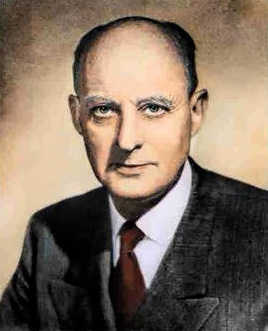
Karl Paul Reinhold Niebuhr[a] (1892–1971) was an American Reformed theologian, ethicist, commentator on politics and public affairs, and professor at Union Theological Seminary for more than 30 years. Niebuhr was one of America’s leading public intellectuals for several decades of the 20th century and received the Presidential Medal of Freedom in 1964. A public theologian, he wrote and spoke frequently about the intersection of religion, politics, and public policy, with his most influential books including Moral Man and Immoral Society and The Nature and Destiny of Man. The latter is ranked number 18 of the top 100 non-fiction books of the twentieth century by Modern Library.[25] Andrew Bacevich labelled Niebuhr’s book The Irony of American History “the most important book ever written on U.S. foreign policy.”[26] The historian Arthur Schlesinger Jr. described Niebuhr as “the most influential American theologian of the 20th century”[27][28] and Time posthumously called Niebuhr “the greatest Protestant theologian in America since Jonathan Edwards.”[29]
Starting as a minister with working-class sympathies in the 1920s and sharing with many other ministers a commitment to pacifism and socialism, his thinking evolved during the 1930s to neo-orthodox realist theology as he developed the philosophical perspective known as Christian realism.[30][verification needed] He attacked utopianism as ineffectual for dealing with reality, writing in The Children of Light and the Children of Darkness (1944), “Man’s capacity for justice makes democracy possible; but man’s inclination to injustice makes democracy necessary.” Niebuhr’s realism deepened after 1945 and led him to support American efforts to confront Soviet communism around the world. A powerful speaker, he was one of the most influential thinkers of the 1940s and 1950s in public affairs.[27] Niebuhr battled with religious liberals over what he called their naïve views of the contradictions of human nature and the optimism of the Social Gospel, and battled with religious conservatives over what he viewed as their naïve view of scripture and their narrow definition of “true religion”. During this time he was viewed by many as the intellectual rival of John Dewey.[31]
Niebuhr’s contributions to political philosophy include utilizing the resources of theology to argue for political realism. His work has also significantly influenced international relations theory, leading many scholars to move away from idealism and embrace realism.[32] A large number of scholars, including political scientists, political historians, and theologians, have noted his influence on their thinking. Aside from academics, activists such as Myles Horton and Martin Luther King Jr., numerous politicians that include Hillary Clinton, Hubert Humphrey, Dean Acheson, James Comey, Madeleine Albright, and John McCain, as well as former US Presidents Barack Obama[33] and Jimmy Carter;[34] have also cited his influence on their thought.[26][35][36][37] Recent years have seen a renewed interest in Niebuhr’s work, in part because of Obama’s stated admiration for Niebuhr.[38] In 2017, PBS released a documentary on Niebuhr, titled An American Conscience: The Reinhold Niebuhr Story.
Aside from his political commentary, Niebuhr is also known for having composed the Serenity Prayer, a widely recited prayer which was popularized by Alcoholics Anonymous.[39][40] Niebuhr was also one of the founders of both Americans for Democratic Action and the International Rescue Committee and also spent time at the Institute for Advanced Study at Princeton, while serving as a visiting professor at both Harvard and Princeton.[41][42][43] He was also the brother of another prominent theologian, H. Richard Niebuhr.
Early life and education
Niebuhr was born on June 21, 1892, in Wright City, Missouri, the son of German immigrants Gustav Niebuhr and his wife, Lydia (née Hosto).[44] His father was a German Evangelical pastor; his denomination was the American branch of the established Prussian Church Union in Germany. It is now part of the United Church of Christ. The family spoke German at home. His brother H. Richard Niebuhr also became a famous theological ethicist and his sister Hulda Niebuhr became a divinity professor in Chicago. The Niebuhr family moved to Lincoln, Illinois, in 1902 when Gustav Niebuhr became pastor of Lincoln’s St. John’s German Evangelical Synod church. Reinhold Niebuhr first served as pastor of a church when he served from April to September 1913 as interim minister of St. John’s following his father’s death.[45]
Niebuhr attended Elmhurst College in Illinois and graduated in 1910.[b] He studied at Eden Theological Seminary in Webster Groves, Missouri, where, as he admitted, he was deeply influenced by Samuel D. Press in “biblical and systematic subjects”,[46] and Yale Divinity School, where he earned a Bachelor of Divinity degree in 1914 and a Master of Arts degree the following year,[47] with the thesis The Contribution of Christianity to the Doctrine of Immortality.[1] He always regretted not taking a doctorate. He said that Yale gave him intellectual liberation from the localism of his German-American upbringing.[48]
Marriage and family
In 1931 Niebuhr married Ursula Keppel-Compton. She was a member of the Church of England and was educated at the University of Oxford in theology and history. She met Niebuhr while studying for her master’s degree at Union Theological Seminary. For many years, she was on faculty at Barnard College (the women’s college of Columbia University) where she helped establish and then chaired the religious studies department. The Niebuhrs had two children, Christopher Niebuhr and Elisabeth Niebuhr Sifton. Ursula Niebuhr left evidence in her professional papers at the Library of Congress showing that she co-authored some of her husband’s later writings.[49]
Detroit
In 1915, Niebuhr was ordained a pastor. The German Evangelical mission board sent him to serve at Bethel Evangelical Church in Detroit, Michigan. The congregation numbered 66 on his arrival and grew to nearly 700 by the time he left in 1928. The increase reflected his ability to reach people outside the German-American community and among the growing population attracted to jobs in the booming automobile industry. In the early 1900s Detroit became the fourth-largest city in the country, attracting many black and white migrants from the rural South, as well as Jewish and Catholic ethnics from eastern and southern Europe. They competed for jobs and limited housing, and the city’s rapid changes and rise in social tensions contributed to the growth in numbers of Ku Klux Klan members in the city, which reached its peak in 1925, and to the Black Legion. During that year’s city election campaign, in which the Klan publicly supported several candidates, including for the office of mayor, Niebuhr spoke out publicly against the Klan to his congregation,[50] describing them as “one of the worst specific social phenomena which the religious pride of a people has ever developed”. Only one of their several candidates gained a seat on the city council, and Charles Bowles, the mayoral candidate, was defeated.[50]
First World War
As America entered the First World War in 1917, Niebuhr was the unknown pastor of a small German-speaking congregation in Detroit (it stopped using German in 1919). All German-American culture in the United States and nearby Canada came under attack for suspicion of having dual loyalties. Niebuhr repeatedly stressed the need to be loyal to America, and won an audience in national magazines for his appeals to the German Americans to be patriotic.[51] Theologically, he went beyond the issue of national loyalty as he endeavored to fashion a realistic ethical perspective of patriotism and pacifism. He endeavored to work out a realistic approach to the moral danger posed by aggressive powers, which many idealists and pacifists failed to recognize. During the war, he also served his denomination as Executive Secretary of the War Welfare Commission, while maintaining his pastorate in Detroit. A pacifist at heart, he saw compromise as a necessity and was willing to support war in order to find peace—compromising for the sake of righteousness.[52]
Origins of Niebuhr’s working-class sympathy
Several attempts have been made to explicate the origins of Niebuhr’s sympathies from the 1920s to working-class and labor issues as documented by his biographer Richard W. Fox.[53] One supportive example has concerned his interest in the plight of auto workers in Detroit. This one interest among others can be briefly summarized below.
After seminary, Niebuhr preached the Social Gospel, and then initiated the engagement of what he considered the insecurity of Ford workers.[54] Niebuhr had moved to the left and was troubled by the demoralizing effects of industrialism on workers. He became an outspoken critic of Henry Ford and allowed union organizers to use his pulpit to expound their message of workers’ rights. Niebuhr attacked poor conditions created by the assembly lines and erratic employment practices.[55]
Because of his opinion about factory work, Niebuhr rejected liberal optimism. He wrote in his diary:
We went through one of the big automobile factories to-day. … The foundry interested me particularly. The heat was terrific. The men seemed weary. Here manual labour is a drudgery and toil is slavery. The men cannot possibly find any satisfaction in their work. They simply work to make a living. Their sweat and their dull pain are part of the price paid for the fine cars we all run. And most of us run the cars without knowing what price is being paid for them. … We are all responsible. We all want the things which the factory produces and none of us is sensitive enough to care how much in human values the efficiency of the modern factory costs.[56]
The historian Ronald H. Stone thinks that Niebuhr never talked to the assembly line workers (many of his parishioners were skilled craftsmen) but projected feelings onto them after discussions with Samuel Marquis.[57] Niebuhr’s criticism of Ford and capitalism resonated with progressives and helped make him nationally prominent.[55] His serious commitment to Marxism developed after he moved to New York in 1928.[58]
In 1923, Niebuhr visited Europe to meet with intellectuals and theologians. The conditions he saw in Germany under the French occupation of the Rhineland dismayed him. They reinforced the pacifist views that he had adopted throughout the 1920s after the First World War.