
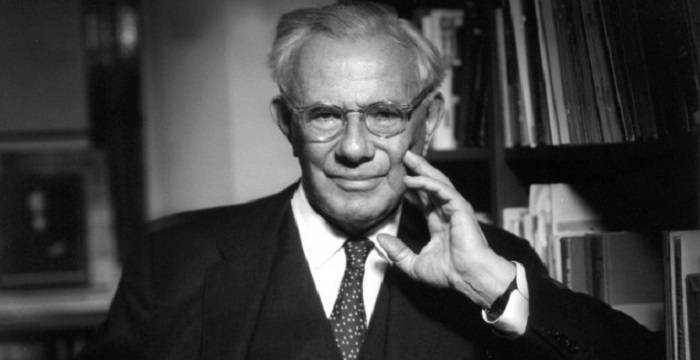
From Wikipedia, the free encyclopedia
| Paul Tillich | |
|---|---|
| Born | Paul Johannes Tillich August 20, 1886 Starzeddel, Province of Brandenburg, Prussia, German Empire |
| Died | October 22, 1965 (aged 79) Chicago, Illinois, United States |
| Nationality | German American |
| Occupation | Theologian and philosopher |
| Notable work | 1951–63 Systematic Theology1952 The Courage to Be |
| Spouse(s) | Hannah |
| Children | René (b. 1935), Mutie (b. 1926) |
| Theological work | |
| Language | EnglishGerman |
| Tradition or movement | Christian existentialism |
| Main interests | OntologyPhilosophical theologyExistential analysis |
| Notable ideas | Method of correlationProtestant principle and Catholic substance[1]Ground of being[2]New Being[3]KairosTheonomy[4] |

| Part of a series on |
| Lutheranism |
|---|
| Luther’s rose |
| showBook of Concord |
| showTheology |
| showSacraments and worship |
| showOrganization |
| showHistory |
| showMissionaries |
| showBible translators |
| showTheologians |
| vte |

Paul Johannes Tillich (August 20, 1886 – October 22, 1965) was a German-American Christian existentialist philosopher and Lutheran Protestant theologian who is widely regarded as one of the most influential theologians of the twentieth century.[5] Tillich taught at a number of universities in Germany before immigrating to the United States in 1933, where he taught at Union Theological Seminary, Harvard Divinity School, and the University of Chicago.
Among the general public, Tillich is best known for his works The Courage to Be (1952) and Dynamics of Faith (1957), which introduced issues of theology and culture to a general readership. In academic theology, he is best known for his major three-volume work Systematic Theology (1951–63), in which he developed his “method of correlation”, an approach that explores the symbols of Christian revelation as answers to the problems of human existence raised by contemporary existential analysis.[6][7] Unlike mainstream interpretations of existentialism which emphasized the priority of existence over essence, Tillich considered existentialism “possible only as an element in a larger whole, as an element in a vision of the structure of being in its created goodness, and then as a description of man’s existence within that framework.”[8]
Tillich’s unique integration of essentialism and existentialism, as well as his sustained engagement with ontology in the Systematic Theology and other works, has attracted scholarship from a variety of influential thinkers including Karl Barth, Reinhold Niebuhr, H. Richard Niebuhr, George Lindbeck, Erich Przywara, Langdon Gilkey, James Luther Adams, Avery Cardinal Dulles, Dietrich Bonhoeffer, Sallie McFague, Richard John Neuhaus, David Novak, John D. Caputo, Thomas Merton, Robert W. Jenson, Thomas F. O’Meara, and Martin Luther King Jr. According to H. Richard Niebuhr, “[t]he reading of Systematic Theology can be a great voyage of discovery into a rich and deep, and inclusive and yet elaborated, vision and understanding of human life in the presence of the mystery of God.”[9] John Herman Randall Jr. lauded the Systematic Theology as “beyond doubt the richest, most suggestive, and most challenging philosophical theology our day has produced.”[10]
In addition to Tillich’s work in theology, he also authored many works in ethics, the philosophy of history, and comparative religion. Tillich’s work continues to be studied and discussed around the world, and the North American Paul Tillich Society, Deutsche Paul-Tillich-Gesellschaft, and l’Association Paul Tillich d’expression française regularly host international conferences and seminars on his thought and its possibilities.
Biography
Tillich was born on August 20, 1886, in the small village of Starzeddel (Starosiedle), Province of Brandenburg, which was then part of Germany. He was the oldest of three children, with two sisters: Johanna (born 1888, died 1920) and Elisabeth (born 1893). Tillich’s Prussian father Johannes Tillich was a conservative Lutheran pastor of the Evangelical State Church of Prussia’s older Provinces; his mother Mathilde Dürselen was from the Rhineland and more liberal.
When Tillich was four, his father became superintendent of a diocese in Bad Schönfliess (now Trzcińsko-Zdrój, Poland), a town of three thousand, where Tillich began primary school (Elementarschule). In 1898, Tillich was sent to Königsberg in der Neumark (now Chojna, Poland) to begin his gymnasium schooling. He was billeted in a boarding house and experienced a loneliness that he sought to overcome by reading the Bible while encountering humanistic ideas at school.[7]
In 1900, Tillich’s father was transferred to Berlin, resulting in Tillich’s switching in 1901 to a Berlin school, from which he graduated in 1904. Before his graduation, however, his mother died of cancer in September 1903, when Tillich was 17. Tillich attended several universities — the University of Berlin beginning in 1904, the University of Tübingen in 1905, and the University of Halle-Wittenberg from 1905 to 1907. He received his Doctor of Philosophy degree at the University of Breslau in 1911 and his Licentiate of Theology degree at Halle-Wittenberg in 1912.[7] His PhD dissertation at Breslau was The Conception of the History of Religion in Schelling’s Positive Philosophy: Its Presuppositions and Principles.[11]
During his time at university, he became a member of the Wingolf Christian fraternity in Berlin, Tübingen and Halle.[12]
That same year, 1912, Tillich was ordained as a Lutheran minister in the Province of Brandenburg. On 28 September 1914 he married Margarethe (“Grethi”) Wever (1888–1968), and in October he joined the Imperial German Army as a chaplain during World War I. Grethi deserted Tillich in 1919 after an affair that produced a child not fathered by Tillich; the two then divorced.[13] During the war, Tillich served as a chaplain in the trenches, burying his closest friend and numerous soldiers in the mud of France. He was hospitalized three times for combat trauma, and was awarded the Iron Cross for bravery under fire. He came home from the war shattered.[14] Tillich’s academic career began after the war; he became a Privatdozent of Theology at the University of Berlin, a post he held from 1919 to 1924. On his return from the war he had met Hannah Werner-Gottschow, then married and pregnant.[15] In March 1924 they married; it was the second marriage for both. She later wrote a book entitled From Time to Time about their life together, which included their commitment to open marriage, upsetting to some; despite this, they remained together into old age.[16]
From 1924 to 1925, Tillich served as a Professor of Theology at the University of Marburg, where he began to develop his systematic theology, teaching a course on it during the last of his three terms. While at Marburg, Tillich met and developed a relationship with Martin Heidegger.[17] From 1925 until 1929, Tillich was a Professor of Theology at the Dresden University of Technology and the University of Leipzig. He held the same post at the University of Frankfurt from 1929 to 1933. Paul Tillich was in conversation with Erich Przywara.[18]
While at the University of Frankfurt, Tillich traveled throughout Germany giving public lectures and speeches that brought him into conflict with the Nazi movement. When Adolf Hitler became German Chancellor in 1933, Tillich was dismissed from his position. Reinhold Niebuhr visited Germany in the summer of 1933 and, already impressed with Tillich’s writings, contacted Tillich upon learning of his dismissal. Niebuhr urged Tillich to join the faculty at New York City’s Union Theological Seminary; Tillich accepted.[19][20]
At the age of 47, Tillich moved with his family to the United States. This meant learning English, the language in which he would eventually publish works such as the Systematic Theology. From 1933 until 1955 he taught at Union Theological Seminary in New York, where he began as a Visiting Professor of Philosophy of Religion. During 1933–34 he was also a Visiting Lecturer in Philosophy at Columbia University.[7]Tillich’s gravestone in Paul Tillich Park, New Harmony, Indiana
.jpg)
Tillich acquired tenure at the Union Theological Seminary in 1937, and in 1940 he was promoted to Professor of Philosophical Theology and became an American citizen.[7] At Union, Tillich earned his reputation, publishing a series of books that outlined his particular synthesis of Protestant Christian theology and existential philosophy. He published On the Boundary in 1936; The Protestant Era, a collection of his essays, in 1948; and The Shaking of the Foundations, the first of three volumes of his sermons, also in 1948. His collections of sermons gave him a broader audience than he had yet experienced.
Tillich’s most heralded achievements, though, were the 1951 publication of volume one of the Systematic Theology (University of Chicago Press), and the 1952 publication of The Courage to Be (Yale University Press).[21] The first volume of the systematic theology examines the inner tensions in the structure of reason and being, primarily through a study in ontology. These tensions, Tillich contends, show that the quest for revelation is implied in finite reason, and that the quest for the ground of being is implied in finite being. The publication of Systematic Theology, Vol. 1 brought Tillich international academic acclaim, prompting an invitation to give the prestigious Gifford Lectures in 1953–54 at the University of Aberdeen. The Courage to Be, which examines ontic, moral, and spiritual anxieties across history and in modernity, was based on Tillich’s 1950 Dwight H. Terry Lectureship and reached a wide general readership.[7]
These works led to an appointment at Harvard Divinity School in 1955, where he was University Professor,[22] among the five highest ranking professors at Harvard. He was primarily a professor of undergraduates, because Harvard did not have a department of religion for them, but was thereby more exposed to the wider university and “most fully embodied the ideal of a University Professor.”[23] In 1959, Tillich was featured on the cover of Time magazine.[24]
In 1961, Tillich became one of the founding members of the Society for the Arts, Religion and Contemporary Culture, an organization with which he maintained ties for the remainder of his life.[25] During this period, he published volume two of the Systematic Theology, as well as the popular book Dynamics of Faith, both in 1957. Tillich’s career at Harvard lasted until 1962, when he was appointed John Nuveen Professor of Theology at the University of Chicago. He remained at Chicago until his death in 1965.
Volume three of Tillich’s Systematic Theology was published in 1963. In 1964, Tillich became the first theologian to be honored in Kegley and Bretall’s Library of Living Theology: “The adjective ‘great,’ in our opinion, can be applied to very few thinkers of our time, but Tillich, we are far from alone in believing, stands unquestionably amongst these few.”[26] A widely quoted critical assessment of his importance was Georgia Harkness‘ comment: “What Whitehead was to American philosophy, Tillich has been to American theology.”[27][28]
Tillich died on October 22, 1965, ten days after having a heart attack. In 1966, his ashes were interred in the Paul Tillich Park in New Harmony, Indiana. His gravestone inscription reads: “And he shall be like a tree planted by the rivers of water, that bringeth forth his fruit for his season, his leaf also shall not wither. And whatsoever he doeth shall prosper.” (Psalm 1:3)
Philosophy and theology
Being
Tillich used the concept of being (Sein) throughout his philosophical and theological work. Some of his work engaged with the fundamental ontology of Martin Heidegger.[29]
For “being” remains the content, the mystery, and the eternal aporia of thinking. No theology can suppress the notion of being as the power of being. One cannot separate them. In the moment in which one says that God is or that he has being, the question arises as to how his relation to being is understood. The only possible answer seems to be that God is being-itself, in the sense of the power of being or the power to conquer nonbeing.— Tillich[30]
Tillich’s preliminary analysis of being ascends from the human subject‘s asking of the ontological question (“What is being itself?”), upwards to the highest categories of metaphysics.[31] He distinguishes among four levels of ontological analysis: self-world;[32] dynamics and form, freedom and destiny, and individualization and participation;[33] essential being and existential being;[34] and time, space, causality, and substance.[35]
Being plays a key role throughout Tillich’s Systematic Theology. In the opening to the second volume, Tillich writes:
When a doctrine of God is initiated by defining God as being-itself, the philosophical concept of being is introduced into systematic theology … It appears in the present system in three places: in the doctrine of God, where God is called the being as being or the ground and the power of being; in the doctrine of man, where the distinction is carried through between man’s essential and his existential being; and finally, in the doctrine of the Christ, where he is called the manifestation of the New Being, the actualization of which is the work of the divine Spirit.— Tillich[36]
God as the ground of being
Bust of Tillich by James Rosati in New Harmony, Indiana

Throughout most of his work Tillich provides an ontological view of God as being-itself, the ground of being, and the power of being, one in which God is beyond essence and existence.[37] He was critical of conceptions of God as a being (e.g., the highest being), as well as of pantheistic conceptions of God as universal essence. Traditional medieval philosophical theology in the work of figures such as St. Anselm, Duns Scotus, and William of Ockham tended to understand God as the highest existing being[citation needed], to which predicates such as omnipotence, omniscience, omnipresence, goodness, righteousness, holiness, etc. may be ascribed. Arguments for and against the existence of God presuppose such an understanding of God. Tillich is critical of this mode of discourse, which he refers to as “theological theism,” and argues that if God is a being, even if the highest being, God cannot be properly called the source of all being. With respect to both God’s existence and essence, moreover, Tillich shows how difficulties beset Thomas Aquinas‘ attempt to “maintain the truth that God is beyond essence and existence while simultaneously arguing for the existence of God.”[38]
Though Tillich is critical of propositional arguments for the existence of God as found in natural theology, as he considers them objectifying of God, he nonetheless affirms the reality of God as the ground of being. A similar line of thought is found in the work of Eric Voegelin.[39] Tillich’s concept of God can be drawn out from his analysis of being. In Tillich’s analysis of being, all of being experiences the threat of nonbeing. Yet, following Heidegger, Tillich claims that it is human beings alone who can raise the question of being and therefore of being-itself.[40] This is because, he contends, human beings’ “infinite self-transcendence is an expression of [their] belonging to that which is beyond nonbeing, namely, to being-itself … Being-itself manifests itself to finite being in the infinite drive of the finite beyond itself.”[41]
Tillich addresses questions both ontological and personalist concerning God. One issue deals with whether and in what way personal language about the nature of God and humanity’s relationship to God is appropriate. In distinction to “theological theism”, Tillich refers to another kind of theism as that of the “divine-human encounter”. Such is the theism of the encounter with the “Wholly Other” (“Das ganz Andere”), as in the work of Karl Barth and Rudolf Otto. It implies a personalism with regard to God’s self-revelation. Tillich is quite clear that this is both appropriate and necessary, as it is the basis of the personalism of biblical religion altogether and of the concept of the “Word of God”,[42] but can become falsified if the theologian tries to turn such encounters with God as the Wholly Other into an understanding of God as a being.[43] In other words, God is both personal and transpersonal.[44]
Tillich’s ontological view of God has precedent in Christian theology. In addition to affinities with the concept of God as being-itself in classical theism, it shares similarities with Hellenistic and Patristic conceptions of God as the “unoriginate source” (agennetos) of all being.[45] This view was espoused in particular by Origen, one of a number of early theologians whose thought influenced Tillich’s. Their views in turn had pre-Christian precedents in middle Platonism. Aside from classical and Christian influences in Tillich’s concept of God, there is a dynamism in Tillich’s notion of “the living God,” reflecting some influence from Spinoza.[46]
Tillich combines his ontological conception of God with a largely existential and phenomenological understanding of faith in God, remarking that God is “the answer to the question implied in man’s finitude … the name for that which concerns man ultimately.”[47] This is notably manifest in his understanding of faith as ultimate concern. Following his existential analysis, Tillich further argues that theological theism is not only logically problematic, but is unable to speak into the situation of radical doubt and despair about meaning in life. This issue, he said, was of primary concern in the modern age, as opposed to anxiety about fate, guilt, death and condemnation.[48] This is because the state of finitude entails by necessity anxiety, and that it is our finitude as human beings, our being a mixture of being and nonbeing, that is at the ultimate basis of anxiety. If God is not the ground of being, then God cannot provide an answer to the question of finitude; God would also be finite in some sense. The term “God Above God,” then, means to indicate the God who appears, who is the ground of being, when the “God” of theological theism has disappeared in the anxiety of doubt.[49] While on the one hand this God goes beyond the God of theism as usually defined, it finds expression in many religious symbols of the Christian faith, particularly that of the crucified Christ. The possibility thus exists, says Tillich, that religious symbols may be recovered which would otherwise have been rendered ineffective by contemporary society.
Tillich argues that the God of theological theism is at the root of much revolt against theism and religious faith in the modern period. Tillich states, sympathetically, that the God of theological theism
deprives me of my subjectivity because he is all-powerful and all-knowing. I revolt and make him into an object, but the revolt fails and becomes desperate. God appears as the invincible tyrant, the being in contrast with whom all other beings are without freedom and subjectivity. He is equated with the recent tyrants who with the help of terror try to transform everything into a mere object, a thing among things, a cog in a machine they control. He becomes the model of everything against which Existentialism revolted. This is the God Nietzsche said had to be killed because nobody can tolerate being made into a mere object of absolute knowledge and absolute control. This is the deepest root of atheism. It is an atheism which is justified as the reaction against theological theism and its disturbing implications.[50]
Another reason Tillich criticized theological theism was because it placed God into the subject-object dichotomy. The subject-object dichotomy is the basic distinction made in epistemology. Epistemologically, God cannot be made into an object, that is, an object of the knowing subject. Tillich deals with this question under the rubric of the relationality of God. The question is “whether there are external relations between God and the creature”.[51] Traditionally Christian theology has always understood the doctrine of creation to mean precisely this external relationality between God, the Creator, and the creature as separate and not identical realities. Tillich reminds us of the point, which can be found in Luther, that “there is no place to which man can withdraw from the divine thou, because it includes the ego and is nearer to the ego than the ego to itself”.[51]
Tillich goes further to say that the desire to draw God into the subject–object dichotomy is an “insult” to the divine holiness.[52] Similarly, if God were made into the subject rather than the object of knowledge (The Ultimate Subject), then the rest of existing entities then become subjected to the absolute knowledge and scrutiny of God, and the human being is “reified,” or made into a mere object. It would deprive the person of his or her own subjectivity and creativity. According to Tillich, theological theism has provoked the rebellions found in atheism and Existentialism, although other social factors such as the industrial revolution have also contributed to the “reification” of the human being. The modern man could no longer tolerate the idea of being an “object” completely subjected to the absolute knowledge of God. Tillich argued, as mentioned, that theological theism is “bad theology”.
The God of the theological theism is a being besides others and as such a part of the whole reality. He is certainly considered its most important part, but as a part and therefore as subjected to the structure of the whole. He is supposed to be beyond the ontological elements and categories which constitute reality. But every statement subjects him to them. He is seen as a self which has a world, as an ego which relates to a thought, as a cause which is separated from its effect, as having a definite space and endless time. He is a being, not being-itself[48]
Alternatively, Tillich presents the above-mentioned ontological view of God as Being-Itself, Ground of Being, Power of Being, and occasionally as Abyss or God’s “Abysmal Being”. What makes Tillich’s ontological view of God different from theological theism is that it transcends it by being the foundation or ultimate reality that “precedes” all beings. Just as Being for Heidegger is ontologically prior to conception, Tillich views God to be beyond being.[53] God is not a supernatural entity among other entities. Instead, God is the inexhaustible ground which empowers the existence of beings. We cannot perceive God as an object which is related to a subject because God precedes the subject–object dichotomy.[53]
Thus Tillich dismisses a literalistic Biblicism. Instead of rejecting the notion of personal God, however, Tillich sees it as a symbol that points directly to the Ground of Being.[54] Since the Ground of Being ontologically precedes reason, it cannot be comprehended since comprehension presupposes the subject–object dichotomy. Tillich disagreed with any literal philosophical and religious statements that can be made about God. Such literal statements attempt to define God and lead not only to anthropomorphism but also to a philosophical mistake that Immanuel Kant warned against, that setting limits against the transcendent inevitably leads to contradictions. Any statements about God are simply symbolic, but these symbols are sacred in the sense that they function to participate or point to the Ground of Being.
Tillich also further elaborated the thesis of the God above the God of theism in his Systematic Theology.
… (the God above the God of theism) This has been misunderstood as a dogmatic statement of a pantheistic or mystical character. First of all, it is not a dogmatic, but an apologetic, statement. It takes seriously the radical doubt experienced by many people. It gives one the courage of self-affirmation even in the extreme state of radical doubt.— Tillich, Systematic Theology Vol. 2 , p. 12
… In such a state the God of both religious and theological language disappears. But something remains, namely, the seriousness of that doubt in which meaning within meaninglessness is affirmed. The source of this affirmation of meaning within meaninglessness, of certitude within doubt, is not the God of traditional theism but the “God above God,” the power of being, which works through those who have no name for it, not even the name God.— Tillich, Systematic Theology Vol. 2 , p. 12
… This is the answer to those who ask for a message in the nothingness of their situation and at the end of their courage to be. But such an extreme point is not a space with which one can live. The dialectics of an extreme situation are a criterion of truth but not the basis on which a whole structure of truth can be built.— Tillich, Systematic Theology Vol. 2 , p.12