
“I wish Karl would accumulate more capital instead of writing about it.”
–Karl Marx’s mother
From Wikipedia, the free encyclopedia
| Karl Marx FRSA[1] | |
|---|---|
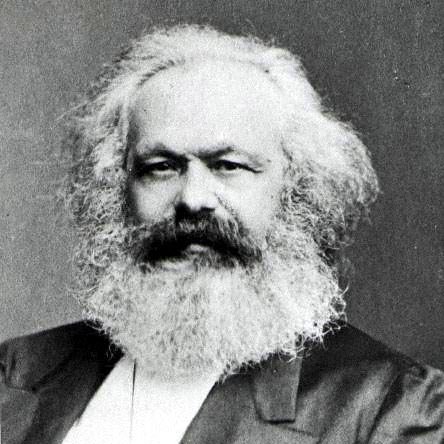
| Karl Marx in 1875 | |
| Born | Karl Heinrich Marx 5 May 1818 Trier, Prussia, German Confederation |
| Died | 14 March 1883 (aged 64) London, England |
| Buried | Tomb of Karl Marx, Highgate Cemetery, London, England |
| Nationality | Prussian (1818–1845)Stateless (after 1845) |
| Spouse(s) | Jenny von Westphalen (m. 1843; died 1881) |
| Children | 7, including Jenny, Laura, and Eleanor |
| Parents | Heinrich Marx (father)Henriette Pressburg (mother) |
| Relatives | Louise Juta (sister)Jean Longuet (grandson) |
| Philosophy career | |
| Alma mater | University of BonnUniversity of BerlinUniversity of Jena (PhD)[2] |
| Era | 19th-century philosophy |
| Region | Western philosophy |
| School | Dialectical materialismHistorical materialismMarxism |
| Main interests | Philosophy, economics, history, politics |
| Notable ideas | Marxist terminology, surplus value, contributions to the labour theory of value, class conflict, alienation and exploitation of the worker, materialist conception of history |
| Influences[show] | |
| Influenced[show] | |
| Signature | |


Karl Heinrich Marx[12] (5 May 1818 – 14 March 1883) was a German philosopher, economist, historian, sociologist, political theorist, journalist and socialist revolutionary.
Born in Trier, Germany, Marx studied law and philosophy at university. He married Jenny von Westphalen in 1843. Due to his political publications, Marx became stateless and lived in exile with his wife and children in London for decades, where he continued to develop his thought in collaboration with German thinker Friedrich Engels and publish his writings, researching in the reading room of the British Museum. His best-known titles are the 1848 pamphlet, The Communist Manifesto, and the three-volume Das Kapital (1867–1883). His political and philosophical thought had enormous influence on subsequent intellectual, economic and political history, and his name has been used as an adjective, a noun and a school of social theory.
Marx’s critical theories about society, economics and politics – collectively understood as Marxism – hold that human societies develop through class conflict. In capitalism, this manifests itself in the conflict between the ruling classes (known as the bourgeoisie) that control the means of production and the working classes (known as the proletariat) that enable these means by selling their labour power in return for wages.[13] Employing a critical approach known as historical materialism, Marx predicted that, like previous socio-economic systems, capitalism produced internal tensions which would lead to its self-destruction and replacement by a new system known as socialism.
For Marx, class antagonisms under capitalism, owing in part to its instability and crisis-prone nature, would eventuate the working class’ development of class consciousness, leading to their conquest of political power and eventually the establishment of a classless, communist society constituted by a free association of producers.[14] Marx actively pressed for its implementation, arguing that the working class should carry out organised revolutionary action to topple capitalism and bring about socio-economic emancipation.[15]
Marx has been described as one of the most influential figures in human history, and his work has been both lauded and criticised.[16] His work in economics laid the basis for much of the current understanding of labour and its relation to capital, and subsequent economic thought.[17][18][19] Many intellectuals, labour unions, artists and political parties worldwide have been influenced by Marx’s work, with many modifying or adapting his ideas. Marx is typically cited as one of the principal architects of modern social science.[20][21]