All posts by Mike Zonta

Fascism & Violence | Under The Skin with Russell Brand, Henry Giroux & Brad Evans


Russell Brand
Published on Mar 3, 2019

Today’s guests are Henry Giroux a Professor with specialisation in Critical Pedagogy at McMaster university in Ontario, Canada and Brad Evans a Professor of Political Violence & Aesthetics at the University of Bath, UK.
Today we discuss power, corruption, revolution and new systems. This is a proper academic episode, you’re gonna learn. Brad & Henry are brilliant thinkers and brilliant educators.

Subscribe to my channel here: http://tinyurl.com/opragcg
(make sure to hit the BELL icon to be notified of new videos!)

You can get my new book Mentors here (and as an audiobook!): https://amzn.to/2t0Zu9U

SUNDAY NIGHT TRANSLATION GROUP – 3/10/19

Translators:  Melissa Goodnight, Richard Branam, Mike Zonta, Hanz Bolen, Alex Gambeau

SENSE TESTIMONY:  Insufficient skill and lack of dominion causes poor quality and state of limbo
.

5th Step Conclusions:

1)  Truth is limitless, limbo-less skill, super-vision, the only doing, and all that is done.

2)  One Infinite Consciousness Beingness, is adeptly knowing the fully effective and successful authority, that commands control and asserts mastery, thus assuring the caliber of excellence, is always settled and resolved.

3)  The i AM I is thoroughly done to perfection in Design and Intelligence, that is the Mastery of all skill is the Soul Spirited Knowledge and Wisdom.

4)  Elegant Truth is boundless authority and agreement doing all there is with skillful quality, besides which there is none else.

5)  To come.

Famed Stanford Prison Experiment was a fraud, scientist says

By Tamar Lapin (NYPost.com)

One of the most famous–and controversial– psychology studies ever conducted is a fraud, a scientist claims in a new report.

Not only was the Stanford Prison Experiment a sham, but it’s mastermind, Stanford psychology professor Philip Zimbardo, pushed participants towards the results he wanted, Dr. Ben Blum claims in a report published on Medium last week.

The 1971 experiment pitted young male volunteers against each other – with some assigned to act as guards and the others as inmates in a mock prison. As the experiment began, the fake guards immediately took to their roles, instituting authoritarian measures and torturing the inmates, who passively took the abuse.

The study was supposed to last two weeks but guards were reportedly so cruel, it had to be stopped after six days.

The study made a cynical conclusion about human nature: those who are put in positions of power will naturally abuse their authority.

And people placed in situations where they are powerless, would become submissive or even crazy.

Since then, the experiment has been the subject of books, TV-show episodes, documentaries and feature films.

Blum’s expose — based on previously unpublished recordings of Zimbardo, a Stanford psychology professor, and interviews with the participants — offers evidence that the “guards” were coached to be cruel.

One of the men who acted as an inmate told Blum he enjoyed the experiment because he knew the guards couldn’t actually hurt him.

“There were no repercussions. We knew [the guards] couldn’t hurt us, they couldn’t hit us. They were white college kids just like us, so it was a very safe situation,” said Douglas Korpi, who was 22-years-old when he acted as an inmate in the study.

In a recorded clip of the experiment, Korpi was seen locked in a dark closet, naked under a thin white smock, screaming “I’m burning up inside!” and kicking furiously at the door.

But the Berkeley grad now admits the whole thing was fake.

“Anybody who is a clinician would know that I was faking,” he said. “If you listen to the tape, it’s not subtle. I’m not that good at acting. I mean, I think I do a fairly good job, but I’m more hysterical than psychotic.”

One guards told Blum he pretended to be a sadist for kicks.

“I took it as a kind of improv exercise,” Dave Eshelman said. “I believed that I was doing what the researchers wanted me to do… I’d never been to the South but I used a southern accent.”

Zimbardo has admitted that he was an active participant in the study, meaning he had influence over the results. At one point, he handed the “guards” batons, which could have implied to them that using physical force was okay. Yet, he maintained that their behaviors arose organically.

The study has long been subject to scrutiny — it was never published in a mainstream journal or subjected to peer review – but it is still widely taught in schools.

Blum’s report has spurred professors to call for the experiment to be scrapped from textbooks.

“Psychologists: please read this. We must stop celebrating this work. It’s anti-scientific. Get it out of textbooks,” tweeted UC-Davis psychology professor Simine Vazire.

“It’s also irresponsible in many other ways (socially, politically),” she added. “I’m embarrassed that my field treated this work and this man as heroic.”


7 Things About Sex and Love That Sigmund Freud Nailed

In honor of Freud’s birthday, let’s celebrate his important discoveries.

Posted May 04, 2018 (psychologytoday.com)

by Sue Kolod, Ph.D.

In honor of Freud’s birthday (May 6), we present seven important discoveries Freud made about love and sex.

Freud put sex on the map. He realized that even babies have erotic feelings and that all parts of the body can be erotic. Freud knew that love, sex, fantasies, and even ambivalence are on our minds consciously AND unconsciously.

CC0 Creative Commons
Source: CC0 Creative Commons

If we’re being honest, Sigmund Freud got some things wrong. He didn’t understand female sexuality very well and made a big mistake when he asserted that the clitoral orgasm was unimportant except as a precursor of the more important, vaginal orgasm.  BUT he did get several very important things right! Here are 7 of his most important discoveries about love and sex:

1) Sexuality is Everyone’s Weakness – and Strength: Sex is a prime motivator and common denominator for all of us. Even or perhaps especially, the most prudent, puritanical-appearing individuals struggle greatly against their sexual appetites and expression.  For evidence one need only look to the many scandals that have rocked the Vatican and fundamentalist churches. Freud observed this struggle in men and women in Victorian Vienna. But our sexuality defines us in healthy and altogether essential ways, too.  If you don’t believe your Freudian therapist, just ask Samantha Jones from HBO’s Sex and the City.

2) Every Part of the Body is Erotic: Freud knew that human beings were sexual beings right from the start.  He took his inspiration from the baby nursing at the mother’s breast to illustrate the example of a more mature sexuality, saying, “No one who has seen a baby sinking back satiated from the breast and falling asleep with flushed cheeks and a blissful smile can escape the reflection that this picture persists as a prototype of the expression of sexual satisfaction later in life.”  He knew, too, that sexual excitation is not restricted to genitalia, as pleasure is achieved through erotic attachment to any area of the body. Even today many people have great difficulty accepting this idea.

3) Homosexuality is Not A Mental Illness: ​He noted that gay people are often distinguished by especially high intellectual development and ethical culture. In 1930, he signed a public statement to repeal a law that criminalized homosexuality. And in his famous letter to a mother wishing to cure her son of homosexuality, Freud wrote that, “Homosexuality is assuredly no advantage, but it is nothing to be ashamed of, no vice, no degradation; it cannot be classified as an illness”. This was in 1935.

4) All Love Relationships Contain Ambivalent Feelings: Among Freud’s various discoveries was the ambivalence involved in all close and intimate relationships. While we may consciously feel genuine and realistic loving towards a spouse, partner, parent, or child, things are never exactly what they seem to be.  In the world of the unconscious, beneath even the most loving and caring involvement are feelings, fantasies, and ideas that are negative, hateful, and destructive.   Freud recognized that this mixture of love and hate in close relationships is part of human nature and not necessarily pathologic.

5) We Learn to Love from our Early Relationships with Parents and Caregivers: Our early relationships with parents and caregivers help us to form a “love map” that persists throughout our lives. This is sometimes referred to as “transference”. Freud pointed out that when we find a love object we are actually “re-finding” it. Hence the often recognized phenomenon of individuals who select partners that remind them of their mother/father. We’ve all seen it.

6) Our Loved One Becomes a Part of Ourselves: Freud described something amazing: We incorporate aspects of those we love into ourselves. Their characteristics, beliefs, feelings, and attitudes become part of our psyche. He called this process “internalization”. Expressions like “my spouse is my better half” or “I am searching for my soul mate” contain Freud’s conception of the depth of connection between people who love each other.

7) Fantasy is an Important Factor in Sexual Excitement: In our sexual fantasies we often conjure up all kinds of strange and “perverse” scenarios which add to sexual excitement and hopefully lead to climatic pleasure.  This is quite normal and it doesn’t mean that we actually want to engage in such scenarios (or maybe we do).

So, on Freud’s birthday, let’s celebrate his important discoveries which still have a profound impact on how we think about love and sex.

Susan Kolod, Ph.D., is Chair of the Committee on Public Information and editor of the blog Psychoanalysis Unplugged at the American Psychoanalytic Association. She is supervising and training analyst, faculty, and co-editor of the blog Contemporary Psychoanalysis in Action at the William Alanson White Institute. Dr. Kolod has a private practice in Manhattan and Brooklyn.

About the Author

A.Word.A.Day with Anu Garg

omphaloskepsis

PRONUNCIATION:
(om-fuh-lo-SKEP-sis) 

MEANING:

noun:
1. Contemplation of one’s navel.
2. Complacent self-indulgent introspection.

ETYMOLOGY:

From Greek omphalos (navel) + skepsis (act of looking, examination). Ultimately from the Indo-European root spek- (to observe), which also gave us suspect, spectrum, bishop (literally, overseer), despise, espionage, telescope, spectator, and spectacles. Earliest documented use: 1925.

USAGE:

“[The club’s] demise has acted as a trigger for one of those periodic outbreaks of omphaloskepsis about the present and future of clubland.”
Jim Carroll; Ibiza’s Clubs May Be Following the Money — But There’s No Substitute for Great Music; Irish Times (Dublin); Sep 23, 2016.

“Love’s Philosophy”

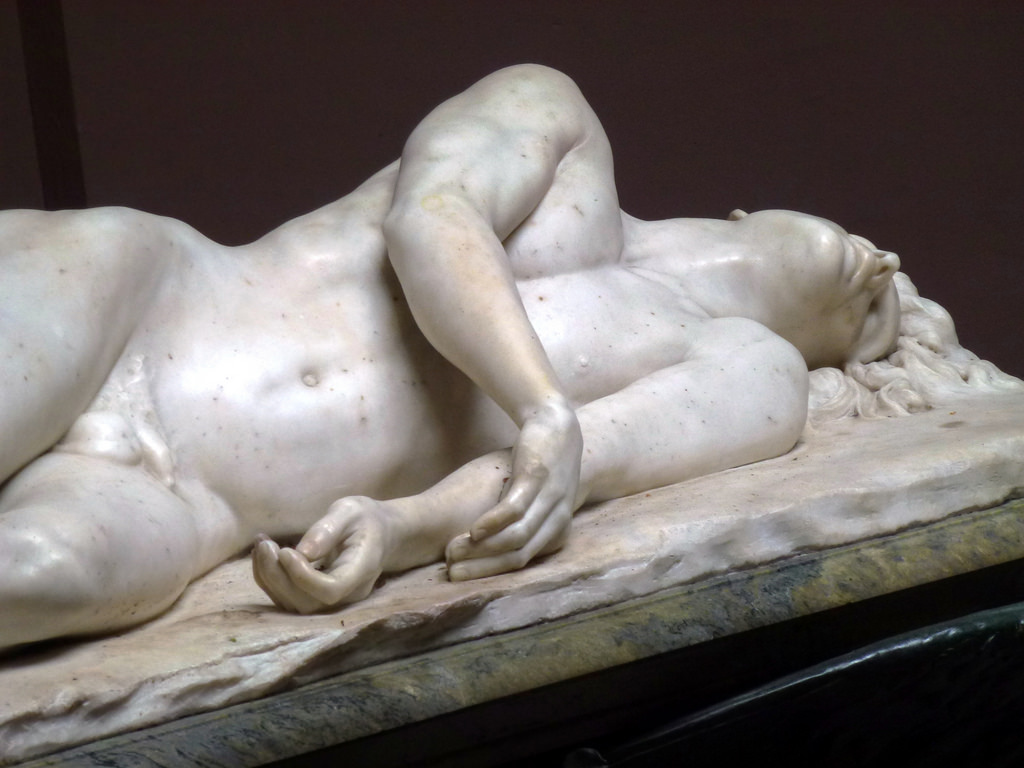
The Shelley Memorial at University College, Oxford.  The memorial consists of a white marble sculpture of a reclining nude and dead Shelley washed up on the shore at Viareggio in Italy after his drowning, sculpted by Edward Onslow Ford, associated with the New Sculpture movement

BY PERCY BYSSHE SHELLEY

The fountains mingle with the river
   And the rivers with the ocean,
The winds of heaven mix for ever
   With a sweet emotion;
Nothing in the world is single;
   All things by a law divine
In one spirit meet and mingle.
   Why not I with thine?—
See the mountains kiss high heaven
   And the waves clasp one another;
No sister-flower would be forgiven
   If it disdained its brother;
And the sunlight clasps the earth
   And the moonbeams kiss the sea:
What is all this sweet work worth
   If thou kiss not me?

David Hume’s is-ought problem

David Hume raised the is–ought problem in his Treatise of Human Nature.

The is–ought problem, as articulated by the Scottish philosopher and historian David Hume (1711–76), states that many writers make claims about what ought to be, based on statements about what is. Hume found that there seems to be a significant difference between positive statements (about what is) and prescriptive or normative statements (about what ought to be), and that it is not obvious how one can coherently move from descriptive statements to prescriptive ones. The is–ought problem is also known as Hume’s lawHume’s guillotine or fact–value gap.

A similar view is defended by G. E. Moore‘s open-question argument, intended to refute any identification of moral properties with natural properties. This so-called naturalistic fallacy stands in contrast to the views of ethical naturalists.

More at:  https://en.wikipedia.org/wiki/Is%E2%80%93ought_problem