
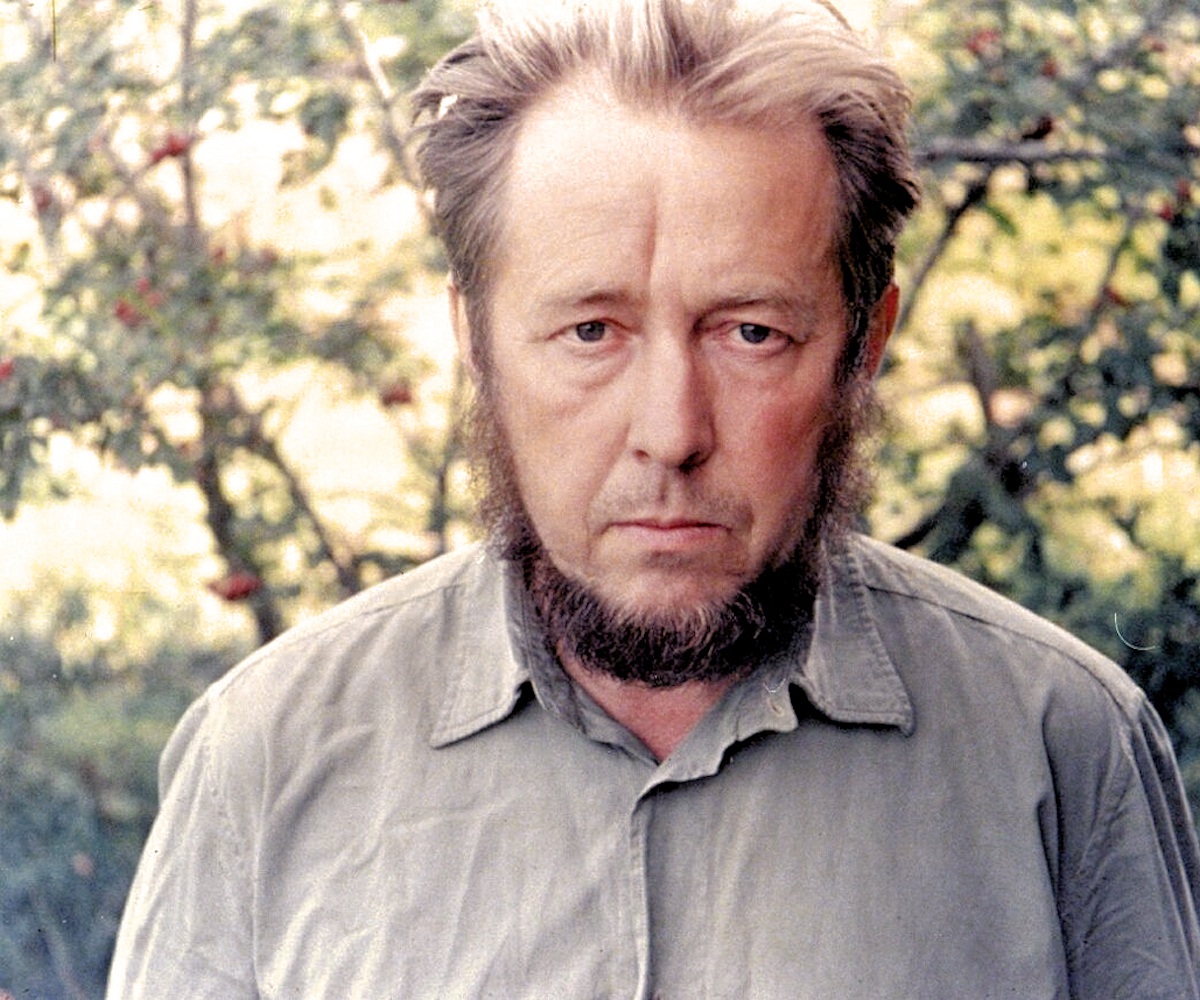
Jordan B. Peterson quotes Aleksandr Solzhenitsyn as saying that “…the line dividing good and evil cuts through the heart of every human being.” After viewing the entirety of Peterson’s Bible Series – posted by Mike below – I remembered that I had a copy of the first volume of The Gulag Archipelago, which includes Parts I and II, and decided it was high time to read at least that much.
What follows (from Part I, pp. 167-168) is the passage from which Peterson drew the above quotation. But first a little context: When the passage starts, Solzhenitsyn has just been arrested and is being forced marched, with seven other prisoners, “from the army counterintelligence center to the counterintelligence headquarters of the front.”
“I smiled in pride that I had been arrested not for stealing, nor treason, nor desertion, but because I had discovered through my power of reasoning the evil secrets of Stalin, I smiled at the thought that I wanted, and still might be able , to effect some small remedies and changes in our Russian way of life.
“But all that time my suitcase was being carried by others.*
“And I didn’t even feel remorseful about it! And if my neighbor, whose sunken cheeks were already covered with a soft two-week growth of beard and whose eyes were overflowing with suffering and knowledge, had then and there reproached me in the clearest of clear Russian words for having disgraced the honor of a prisoner for appealing to the convoy for help and had accused me of haughtiness, of setting myself above the rest of them, I would not have understood him! I simply would not have understood what he was talking about. I was an officer!
“And if seven of us had to die on the way, and the eighth could have been saved by the convoy, what was to keep me from crying out: ‘Sergeant! Save me. I am an officer!’
“And that’s what an officer is, even if his shoulder boards aren’t blue!†
“And if they are blue? If he has been indoctrinated to believe that even among other officers he is the salt of the earth? And that he knows more than the others and is entrusted with more responsibility than others and that, consequently, it is his duty to force a prisoner’s head between his legs, and then to shove him like that into a pipe…
“Why shouldn’t he?
“I credited myself with unselfish dedication. But meanwhile I had been thoroughly prepared to be an executioner. And if I had gotten into an NKVD school under Yezhov, maybe I would have matured just in time for Beria…
“So let the reader who expects this book to be a political exposé slam its covers shut right now.
“If it were only all so simple! If only there were evil people somewhere insidiously committing evil deeds, and it were necessary only to separate them from the rest of us and destroy them. But the dividing line between good and evil cuts through the heart of every human being. And who is willing to destroy a piece of his own heart?
“During the life of every heart this line keeps changing place; sometimes it is squeezed one way by exuberant evil and sometimes it shifts to allow enough space for good to flourish. One and the same human being is, at various stages, under various circumstances, a totally different human being. At times he is close to being a devil, at times to sainthood. But his name doesn’t change, and to that name we ascribe the whole lot, good and evil.
“Socrates taught us: Know thyself!
“Confronted by the pit into which we are about to toss those who have done us harm, we halt, stricken dumb: it is after all only because of the way things worked out that they were the executioners and we weren’t.
“If Malyuta Skuratov had summoned us, we, too, probably have done our work well!
“From good to evil is one quaver, says the proverb.
“And correspondingly, from evil to good!”
________
* Solzhenitsyn is the only officer in the group of forced-marching prisoners; the rest are enlisted men (plus one German POW), who, because such things are expected, take turns carrying Solzhenitsyn’s suitcase…
† Blue shoulder boards were worn only by the officers of the secret police of the USSR, variously called, during its long and checkered history: the Cheka, OGPU, NKVD, NKGB, MGB, KGB…