
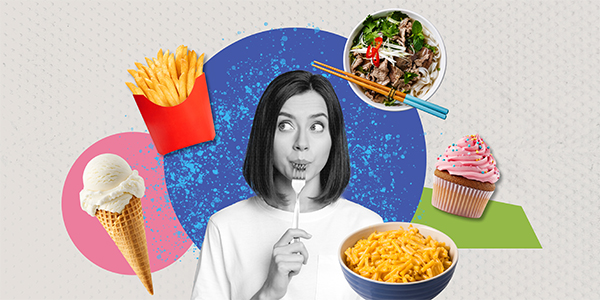
CREDIT: KNOWABLE MAGAZINE
Nostalgia plays a big role in the meals that bring us solace — which mean we might be able to recondition ourselves toward healthier foods that still soothe
By Debbie Koenig 04.27.2026 (knowablemagazine.org)
Support sound science and smart stories
Help us make scientific knowledge accessible to all
Donate today
When I’m stressed, I often crave kasha varnishkes, an Ashkenazi Jewish dish made from buckwheat groats, sautéed onions and bow-tie noodles that appeared on nearly every holiday table as I grew up. Thanks to its distinctive aroma, my husband can’t even be in the same room with the stuff. For him, comfort comes in a bowl of pasta with his Sicilian great-grandmother’s tomato sauce. When there’s no time for old-world cooking, ice cream works for both of us.
This is the essence of a term apparently coined in a 1966 newspaper column by psychologist Joyce Brothers: “Adults, when under severe emotional distress, turn to what may be called ‘comfort food’ — food associated with the security of childhood, like mother’s poached egg or famous chicken soup.”
YOU MAY ALSO LIKE
What can we do about ultraprocessed foods?

What we talk about when we talk about food
Foods of abuse? Nutritionists consider food addiction
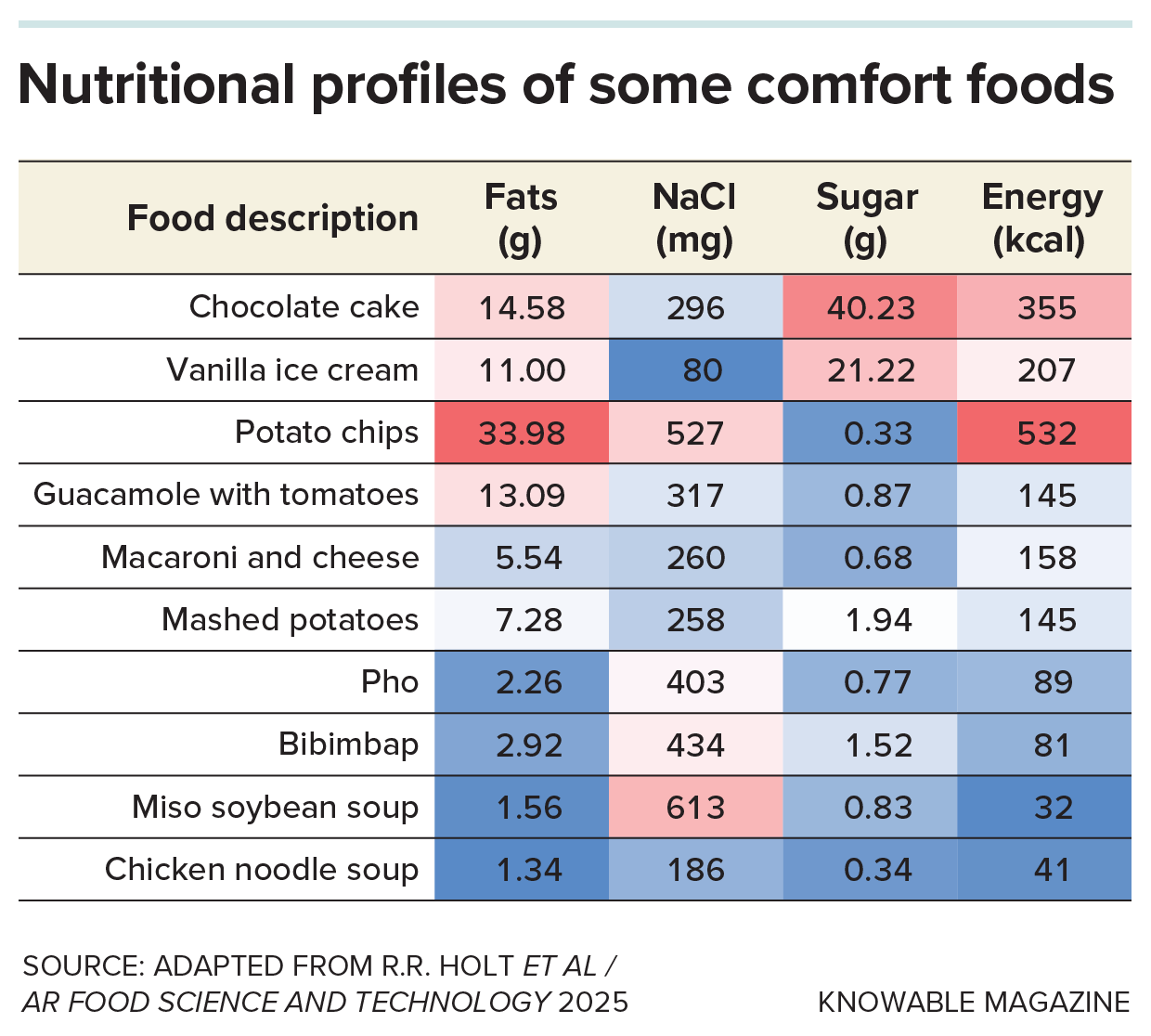
Back in Brothers’ day, most comfort food (like most foods) would have been homemade or minimally processed. But in the decades since, food manufacturers have used increasingly sophisticated technologies to create affordable, highly processed versions of favorite American comfort foods like mashed potatoes, cake and ice cream. Calorie-laden and heavy on salt, fat and sugar, these ultraprocessed foods make today’s comfort foods more bingeable and less healthy than those of previous generations.
Science, though, may show the way to comfort foods that are more healthful and have fewer calories. Research shows that the effects of these foods are largely psychological, so you might be able to train your brain to seek more nutritious foods — or maybe find the comfort you seek without eating anything at all.
Ultraprocessed
Thanks to the modern world’s need for convenience, odds are high that at least one of your comfort foods is ultraprocessed. In a not-yet-published study, A. Janet Tomiyama, a psychological scientist at UCLA, examined data from the UCLA Eating in America Study, in which 1,760 respondents who self-identified as “comfort eaters” listed their top three choices. Of the 300 comfort foods listed by participants, 42.7 percent were ultraprocessed, Tomiyama’s team found.
These foods approximate their homemade analogs with ingredients that are extracted from whole foods, rather than using the foods themselves. For instance, all mac and cheese is processed since both macaroni and cheese are themselves minimally processed — but ultraprocessed versions use the most highly refined options. They often include stabilizers, flavor enhancers and other substances you wouldn’t use in your home kitchen, added to maximize shelf life, and the palatability produced by salt, fat and sugar. And since heavily processed foods tend to require little to no cooking, busy parents have come to rely on them.
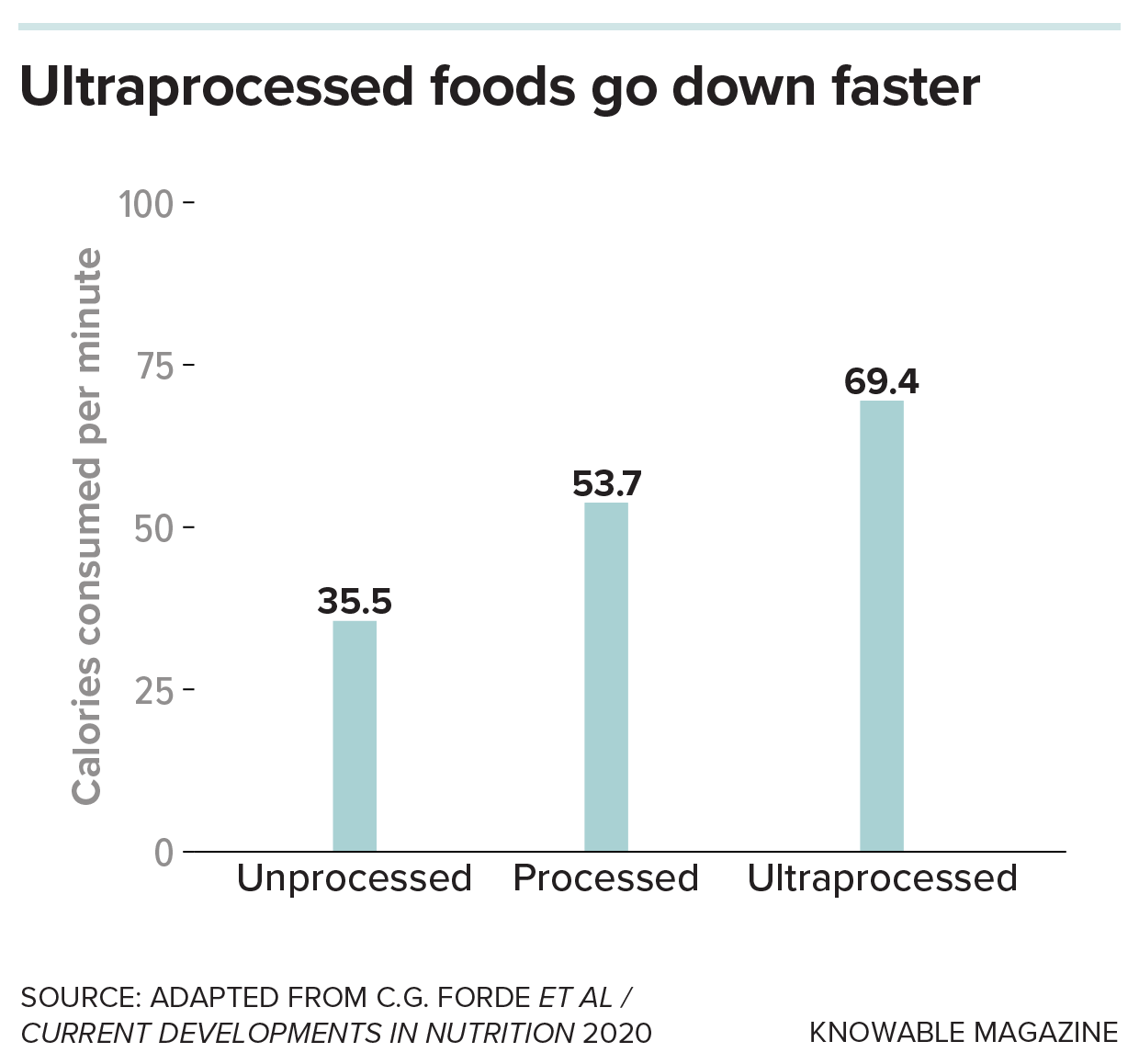
Ultraprocessed foods are also easier to overeat, because they require less chewing — processing strips away the ingredients’ innate structure, so the product goes down quicker. Research shows that we consume them faster than unprocessed or minimally processed foods, taking in up to twice as many calories per minute. In a 2024 study, participants ate an ultraprocessed breakfast sandwich prepared either on commercial toast with margarine, ham, and cheese or a minimally processed sandwich using bread from a local bakery and eggs cooked in soybean oil. The meals were matched for calories and macronutrients, but the ultraprocessed sandwiches went down faster, with fewer bites and less chewing — and those who ate them reported feeling more hunger afterward than those who’d eaten the whole-food option.
But that’s not all: Scientists have evidence that ultraprocessed foods pose risks beyond mere overindulgence. Some research also suggests that these packaged foods, especially sweet ones, can hijack the brain’s reward system to create an addictive effect.
To try to sidestep the link between ultraprocessing and comfort, nutrition scientists are working to understand how and why certain foods lift our moods. They’ve found that Brothers was right: Comfort food does reach back to childhood.
In a 2025 study, for example, University of Pittsburgh sociologist Nick Rogers and colleagues conducted long-form interviews to find out why, exactly, comfort food is so comforting. Nearly every one of the 27 demographically diverse participants, each of whom was interviewed for about an hour across several occasions, described an emotional attachment to particular dishes they ate as children, though the specific dishes varied by culture. Those experiences steeped the foods in memories of good times, of feeling safe and cared for. As adults, participants said, they turned to those foods during bouts of loneliness.
“Comfort food has an ability, it seems, to make us feel safe, content and connected in a way that maybe nothing else can quite match,” Rogers says.

Familiarity, reliability and convenience factored in for many of the participants, so it’s not surprising that ultraprocessed foods like McDonald’s french fries and Kraft macaroni and cheese got name-checked. But the childhood link still holds: Because food manufacturers have spent decades engineering ultraprocessed foods to be cheap, accessible and enticing, parents have come to lean on them heavily — and now their children carry those associations forward.
It is, in essence, conditioning. “Most cultures celebrate with food, or they use food as a way to come together with friends and loved ones,” Tomiyama says. “People learn to associate that with positive emotions, and that connection gets strengthened across a lifetime, but especially in your early years.”
This means that the food each of us finds comforting is highly personal, stemming from a combination of psychological, cultural and physiological factors, says John Munafo, a flavor scientist at the University of Tennessee, who cowrote an article about the science of comfort food in the 2025 Annual Review of Food Science and Technology. Without the psychological connection to a specific food, you may enjoy eating it, but you won’t find the soothing sensation you seek.
To many Americans, comfort food is synonymous with indulgence, but the food’s nutritional value varies by culture, Munafo’s review of the research makes clear. As a third-generation American, I myself turn to carbs, carbs and more carbs. But had I been raised in Vietnam, I might opt for pho, a soothing beef broth with rice noodles and good-for-you garnishes like fresh herbs. In Colombia, I might have been raised on ajiaco, a restorative soup of chicken, potato and corn. The psychological connection matters more than the food itself.
Nostalgia, that wistful yearning for a time when you felt happy and connected to others, is a key element of comfort food’s power, says Chelsea Reid, a social psychologist at the College of Charleston. She and colleagues conducted four experiments, published in 2025, exploring the links between food nostalgia, social connectedness and comfort. When they asked participants to rate foods on their ability to evoke feelings of nostalgia and comfort, they found that the more nostalgia a food inspired, the more likely it was to make the participant feel comforted: Participants would recall times when they felt connected to others, and those recollections enhanced their mood. In other words, Reid says, the comfort food served as a reminder of missing friends and caregivers.
In three out of four of Reid’s experiments, participants didn’t actually eat anything. Instead, they just visualized the experience of eating certain foods and wrote about the imagined experience, then rated the foods for nostalgia and comfort. Even without eating, they experienced emotional benefits. This fits with previous research that found merely writing about comfort food can reduce feelings of loneliness.
“It points to the psychological component being incredibly important, maybe over and above active chewing or tasting,” Reid says. “It’s really the pairing of, ‘This is what the food means to me, this is the situation I consumed it in, and with these individuals,’ that seems to be driving that relationship.”
Reid’s research suggests that while the mood-boosting effects of comfort food are genuine, it may not be only the act of eating that provides them. Just thinking about your culinary source of comfort could evoke similarly warm, nostalgic feelings.
Stay in the Know
Sign up for the Knowable Magazine newsletter today
Reprogramming
Scientists have also explored whether we can recondition our brains to connect comfort with healthy, and thus find solace without the indulgence. In one experiment, Tomiyama and her colleagues had people listen to a recorded relaxation session, known to reduce stress, while eating fruit. The volunteers did this every day for one week, and then got the fruit alone. The Pavlovian connection worked, Tomiyama says — participants reported a greater decrease in negative emotions compared to a control group, as if their brains had learned to associate relaxation with fruit.
Another study by Tomiyama and colleagues takes this a step further. Participants were first asked to choose their preferred comfort foods from two lists, one made up of processed foods high in fat and/or sugar, and the other of fruits and vegetables. On experiment day, each participant was required to deliver a five-minute speech to induce high levels of stress. Then they were presented with their top choice from either the healthy or the unhealthy comfort food list, or no food at all. Throughout, they were monitored on physiological and psychological measures.
The results showed that everyone’s mood rebounded after the stress of the speech, whether they ate their favorite ultraprocessed food, fresh produce or nothing at all. Their negative feelings simply ebbed with time. Eating comfort food didn’t provide any extra boost beyond normal recovery, and the ultraprocessed “treat” foods were no more soothing than fruits and vegetables.
Even participants in the no-food condition, who just sat and later watched a neutral video about how hearing aids are made, felt better as the stress passed. In other words, we may be giving indulgent comfort foods credit for a mood lift we’d experience anyway.
Collectively, Reid’s and Tomiyama’s experiments suggest there’s nothing uniquely comforting about the act of eating calorie-dense, ultraprocessed foods. That’s good news for the world’s stressed eaters. “People don’t necessarily have to reach for that pint of ice cream in order to get comfort,” Tomiyama says.
So while you may think eating your childhood comfort food will make you feel better, you can almost certainly find relief another way. As for me, the next time stress has me grabbing a spoon, I plan to sketch my cookies and cream instead.
Debbie Koenig is a New York-based freelance writer who often writes about food and health, together or separately. Learn more on her website.