
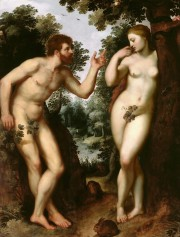
Adam and Eve (between 1597 & 1600) Art: Peter Paul Rubens
A.Word.A.Daywith Anu Garg
Last month, when I featured a week of kings who became words one of those was Herod. I had mentioned that the Massacre of the Innocents is generally considered apocryphal.
A reader challenged me with Matthew 2:16. When I pointed out historians’ skepticism, he quickly admitted some Biblical tales may be more allegory than fact.
I’ve read the Bible and I was struck by how many vivid idioms have seeped into English. This week, we’ll unpack five of them.
Adam and Eve
PRONUNCIATION:
MEANING:
noun:
1. A beginning.
2. A set of ancestors or founders.
ETYMOLOGY:
After the first humans in the Biblical account. Earliest documented use: 1789. See also: Adam’s ale and adamite.
USAGE:
“If we grant that the Adam and Eve of American poetry, Walt Whitman and Emily Dickinson, invented the modern poetic sequence … then it seems natural that every American poet since has at least attempted a long poem to contend with and extend the work of their progenitors.”
Jeffrey Skinner; Writing the Poetic Sequence; The Writer (Manchester, UK); Feb 1994.