
By Nanette Asimov,Higher Education Reporter
April 6, 2025 (SFChronicle.com)
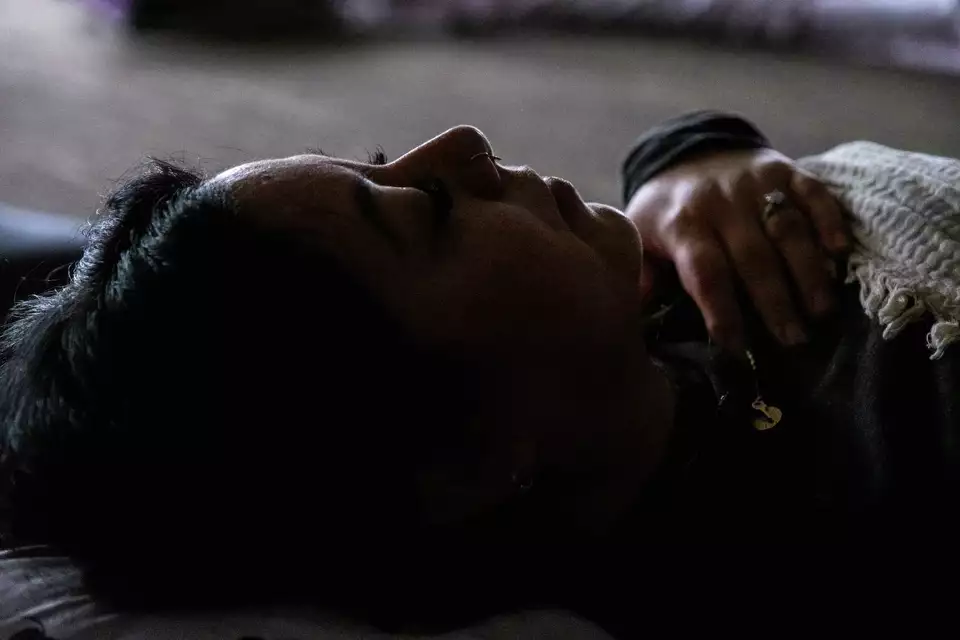
Erica London, a licensed marriage and family therapist, does Holotropic Breathwork aimed to simulate the altered consciousness of psychedelics, in a demonstration for other students in a certificate program at the California Institute of Integral Studies in February. The college will offer the nation’s first bachelor’s degree in psychedelic studies this fall.Camille Cohen/For the S.F. Chronicle
The 1960s counterculture is synonymous with San Francisco, a city where hippies roamed the Haight, tripped on acid and fled the law.
And so it is fitting that San Francisco will again run counter to the mainstream this fall when a local university unveils the nation’s first bachelor’s degree in psychedelic studies.
“Wow!” said guitarist Barry “The Fish” Melton, a counterculture icon who played at Woodstock in 1969 with Country Joe and the Fish and still does gigs in the city. “It’s amazing, quite frankly, that you could actually get a degree in psychedelics.”
Unlike those experimental days of yesteryear, when the Tibetan Book of the Dead was the closest thing to an academic textbook for hippies seeking enlightenment through the wonders of mescaline, LSD, peyote and magic mushrooms, a team of Ph.D.s is poised to help undergraduates “explore the foundations and developments in the field of psychedelic medicines, all while holding to the highest possible standards of ethics and safety.”
That’s from the brochure for the online bachelor of science degree that will debut Aug. 28 at the California Institute of Integral Studies, a well-regarded private, nonprofit university at 1453 Mission St. in San Francisco that opened in 1968.
Then there’s the list of frequently asked questions, with an answer to the most frequent one of all: “Please note that at no time does the program promote or require the use of psychedelic drugs in any manner, in accordance with the CIIS Student Handbook as well as state and federal law.”
That disclaimer mystified Melton, who said: “You’re not allowed to take any? How is anybody gonna get the degree then?”
Thanks for asking, Mr. Melton. Here’s how it works:
Three semesters online
The California Institute of Integral Studies offers no general education classes, such as English 101 or freshman biology. So undergraduates need to complete at least 60 credits elsewhere before transferring into CIIS’ new psychedelic studies program, which takes three semesters and costs $30,000 before financial aid.
“We’ll actively discourage them from doing psychedelics while in the program,” said professor Nick Walker, who will teach “Psychology and Psychedelics” this fall.
The goal is to prepare students for careers or graduate study in psychedelic-assisted therapy, a field that hovers, fittingly, just outside the legal doors of perception. Federal law bans the substances unless they’ve been approved for study in a clinical trial. But mental-health advocates, including some veterans groups, have pushed for decriminalization.
Currently, psilocybin mushrooms have been legalized only in Oregon and Colorado, where a Buddhist university, Naropa, offers a minor in psychedelics. In 2023, California Gov. Gavin Newsom vetoed a bill by Sen. Scott Wiener, D-San Francisco, that would have legalized psychedelics.
Of the 15 students admitted so far into CIIS’ online psychedelics major, 10 responded to questions from the Chronicle. Three live in the Bay Area, and two in Southern California. The others are in Texas, Colorado, Illinois, Pennsylvania and Canada’s Yukon Territory. They range in age from 25 to 48 and include a laid-off tech worker, two firefighters, an electrician, a lineman, a cannabis entrepreneur and a handful of people in health-related fields. One has a bachelor’s degree. Another has an MBA but no bachelor’s.
None is pursuing the degree for recreational purposes. Instead, they represent a new generation of users who understand psychedelics to be less “drug” than “medicine.”
Some of the admitted students report having post-traumatic stress disorder from jobs in the military or as first responders. One is a cancer survivor. Most said they have been helped emotionally by psychedelics and want to study research-based methods of helping others.
An evolving science
Their responses circle back to the origins of “psychedelic,” coined in 1957 by British psychiatrist Humphry Osmond, who thought hallucinogens could help people with mental illness. He had already treated nearly 2,000 alcoholics in Canada with LSD and found that more than 40% remained sober after a year.
To fathom hell or soar angelic / Just take a pinch of psychedelic.
That’s how Osmond introduced the word 68 years ago to the New York Academy of Sciences, combining the Greek words “psyche,” meaning mind, and “deloun,” meaning show.
But by 1970, the U.S. government had outlawed LSD, with other bans on hallucinogens to follow.
Today, scientific thinking is catching up with Osmond, who died in 2004. In California alone, psychedelic research is happening at Stanford, UC Berkeley, UCSF, UCLA and UC San Diego.
“There are billions of dollars invested in ventures hoping to get in on the ground floor for psychedelics, in medicine and business,” said Bay Area author Don Lattin, who has written two books on the history of psychedelics and believes the time is right for an undergraduate degree in the field.
Not everyone agrees.
“The idea of a bachelor’s degree in psychedelic studies seems premature to me, given that the science and scholarship on the topic are still very much in development,” said David Yaden, a researcher at Johns Hopkins’ Center for Psychedelic and Consciousness Research.
Irena Smith, a former college adviser who has worked in Stanford admissions, imagines that majoring in psychedelics “would be extraordinarily unpopular. I can see parents balking — ‘I’m going to put my hard-earned money in this?’ I think people may see this as profoundly impractical.
“That said, I don’t know anything about it.”
UCSF neurology professor Jennifer Mitchell knows a lot about psychedelics and welcomes the new degree, especially because CIIS is behind it.
“They have a very solid track record,” Mitchell said. “Academically, they are quite rigorous.”
With roots in the human-potential movement, the university offers master’s and doctoral programs ranging from “philosophy-cosmology and consciousness” to human sexuality, as well as professional certificates and online undergraduate studies. CIIS is accredited by the WASC Senior College and University Commission, the same agency that oversees Stanford and the University of California.
‘The field is going to explode’
In August, the U.S. Food and Drug Administration balked at approving MDMA — widely known as ecstasy which would have become the first psychedelic federally approved for medical treatment. The closely watched decision involved a clinical trial led by Mitchell in which 70% of participants with post-traumatic stress disorder kicked the PTSD diagnosis after taking the drug. Of those taking a placebo, 40% had the same outcome.
Yet the FDA did not slam the door. It asked for more data.
“The field is going to explode,” Walker said. “We believe that psychedelic-assisted therapy — done well and ethically — can be extremely beneficial.”
Today’s researchers say there is growing evidence that psychedelics can help people not only with PTSD, but also depression, addiction and anxiety.
“We don’t want people to dive in recklessly — a wild cowboy thing,” Walker said. “We’re definitely on the side of doing it carefully. Understanding the science. The risks. The ethics.”
Brock Blomberg, president of CIIS, said the new degree is intended to educate students “so when the regulations change, they’re prepared to follow things with all the appropriate guidelines.”
A decade ago, CIIS opened its Center for Psychedelic Therapies and Research, where graduate students learn to aid psychedelic-assisted therapy using Holotropic Breathwork, a trademarked technique that replicates feelings induced by psilocybin, or hallucinogenic “magic” mushrooms. The school has certified more than 1,000 people.
The new bachelor’s degree aims to enroll 50 students a year, with 25 in its first cohort.
Next fall’s courses will be “Psychology and Psychedelics,” “Neuroscience of Psychedelics,” “Language of Psychology” and “Global, Indigenous Knowledges, and Ecopsychedelics.” Spring instruction will focus on research, ethics and legal considerations, as well as “psychopharmacology,” or how drugs affect the mind and behavior. In their final term, students will complete a senior project — perhaps interviewing people about their psychedelic experiences — and will study advocacy and “expanding consciousness.”
A student’s perspective
“I’m excited about it!” said Michael Bochey, 31, who plans to enroll in the online program while continuing as a fire inspector in Los Angeles.
Two years ago, Bochey wasn’t excited about anything.
“I had a good relationship. A nice home. Everything was objectively pretty good. But I couldn’t figure out why I didn’t feel joy and excitement the way I did before,” he said. “Traditional talk therapy didn’t help, though I think it was a good start.”
Bochey credits psychedelics with helping him understand and address the emotional problem he was experiencing.
As a firefighter and paramedic for most of the last 12 years, terror and trauma were part of his job. Each day, Bochey expected to encounter dead or wounded people. Like the three who burned to death, leaving a teenager who “had to wake up in the hospital to find he didn’t have a family,” Bochey said. Or the eight hit in a deadly shooting at a crowded park, and the nine riddled with bullets at a house party. There was a hostage situation where the SWAT team saved the victim — and another where it didn’t.
The overwhelming pain that ambushed him “has been described as death by 1,000 cuts,” Bochey said. “It’s day after day.”
It was ayahuasca, a hallucinogenic plant, that helped Bochey confront long-suppressed emotions, “re-live” them and learn to feel them in real time, he said. He has taken the substance under the guidance of a group that leads spiritual ceremonies he said were protected by the federal Religious Freedom Restoration Act of 1993.
“The way I live my life now, I actually experience it. I’m more present,” said Bochey, who cited research showing that first-responders have higher rates of suicide than the general public.
While Bochey and many others praise their psychedelic experiences, the substances can sometimes be dangerous and lead to the infamous “bad trip.”
Psychedelics “can really change the way you see the world,” said Lattin, the author. Taking them “can also be a dangerous experience if you’re depressed or bipolar,” he added, noting that mental illness can place people at higher risk for a bad trip.
Sometimes, ingesting psychedelics can simply make you sick. In January, the U.S. Embassy in Peru issued a warning about taking ayahuasca because it can cause “negative health effects,” from nausea to death.
Moving toward the mainstream
Such risks are why Bochey and others say they want to pursue the new bachelor’s degree.
“If psychedelics can save lives — and I truly believe they can — then I want to help legitimize and integrate them into the spaces where they are most needed,” said Bochey, who is making a documentary about firefighters using psychedelics to heal from trauma.
Flat emotions also plagued Cassie Hope of San Francisco. She attributed the problem to the antidepressants she took for postpartum depression six years ago, and she quit them. Her depression returned, and in 2023 she turned to psychedelics.
Microdosing psilocybin helped somewhat, she said. But it was mebufotenin — “bufo,” a hallucinogen found in certain plants and in the glands of the Sonoran desert toad — that made all the difference. She took it during a retreat in Mexico.
“It was incredibly powerful for me,” said Hope, 43. “It gave me a whole new perspective.”
But no sooner had she emerged from the depression than she was diagnosed with cancer and told she carried mutations placing her at risk for more. Surgery triggered early menopause. Hope returned to her tech job at Salesforce, only to be laid off in November. Her misfortune persisted when she fell, injuring her sternum, then got pneumonia.
“I was just pissed. I didn’t ask for this,” she said.
In January, Hope took ayahuasca in ceremonies where the facilitator sang to each participant and tailored the songs to each person’s needs.
“I felt like he was vacuuming my soul,” she said. Psychedelics “give you so much perspective on life and the finite amount of time we have on this planet. And healing. Emotionally, physically. Healing from life.”
For Hope, the bachelor’s in psychedelic studies is the first step in becoming a facilitator herself. She sees a master’s in counseling and a certificate in psychedelic-assisted therapy in her future.
“That will enable me to do things 100% above board,” she said. “Completely legally.”
Correction: This story has been updated to note the trademark for Holotropic Breathwork.
Reach Nanette Asimov: nasimov@sfchronicle.com; Threads: @NanetteAsimov
April 6, 2025
HIGHER EDUCATION REPORTER
Nanette covers California’s public universities – the University of California and California State University – as well as community colleges and private universities. She’s written about sexual misconduct at UC and Stanford, the precarious state of accreditation at City College of San Francisco, and what happens when the UC Berkeley student government discovers a gay rights opponent in its midst. She has exposed a private art college where students rack up massive levels of debt (one student’s topped $400k), and covered audits peering into UC finances, education lawsuits and countless student protests.
But writing about higher education also means getting a look at the brainy creations of students and faculty: Robotic suits that help paralyzed people walk. Online collections of folk songs going back hundreds of years. And innovations touching on everything from virtual reality to baseball.
Nanette is also covering the COVID-19 pandemic and served as health editor during the first six months of the crisis, which quickly ended her brief tenure as interim investigations editor.
Previously, Nanette covered K-12 education. Her stories led to changes in charter school laws, prompted a ban on Scientology in California public schools, and exposed cheating and censorship in testing.
A past president of the Society of Professional Journalists’ Northern California chapter, Nanette has a master’s degree in journalism from Columbia University and a B.A. in sociology from Queens College. She speaks English and Spanish.
Link to original article: https://www.sfchronicle.com/sf/article/california-institute-integral-studies-psychedelic-20238857.php