
- Roman Trovato | Staff
- Apr 2, 2025 (DailyCal.org)
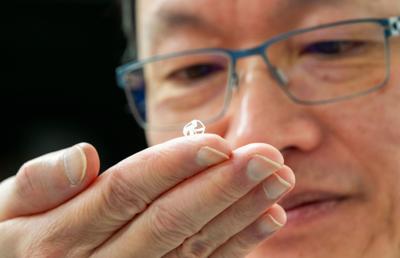
UC Berkeley engineers have created the world’s smallest wireless flying robot, which is capable of changing directions mid-air and hitting small targets.
On March 28, members and alumni of campus’s mechanical engineering department published a paper describing the results and details of its fully functioning, bee-inspired flying robot, which is the world’s smallest in its category at 9.4 millimeters.
The project began in 2019 when campus engineers learned that they could use alternating magnetic fields to create flight. Wanting to tackle the challenge of creating a miniaturized, flying robot that could utilize this technology, they eventually experimented with robots of different sizes — using a model that measured at 26.7 millimeters, then 20 millimeters and now the current 9.4 millimeter model.
The design of this micro robot consists of a 3D-printed propeller and balance ring with two magnets of opposite attraction attached to it. Given its incredibly small size, the greatest challenge lay in the power source of the robot and the electronics required to control it, according to Liwei Lin, co-author and campus professor of mechanical engineering.
By using an external magnetic field, this solved both problems: using an alternating current magnetic field, the two magnets repel each other so fast that the propeller-like robot is able to create lift and resist the force of gravity, causing it to fly. Further manipulating the strength of the magnetic field can allow the pilot to direct the robot’s flight path with incredible accuracy.
Co-author and campus Ph.D. candidate in mechanical engineering, Wei Yue, said there are a number of potential applications in which he would like to see the robot deployed — first and foremost, artificial pollination.
By flying the robot into flowers, it would be able to pick up and distribute pollen and nectar. It could also be used to fly through debris in the aftermath of catastrophic events, giving it a potential use in search and rescue missions.
Yue added that the robot could be used for certain medical operations, such as endoscopies and gastrointestinal procedures.
“If there is some company that would like to adopt this technology, we are happy to discuss and collaborate,” said co-author Fanping Sui. “We are happy to realize and deploy our product into real applications.”
Currently, the robot is not equipped with cameras or other devices that can pinpoint its exact position. However, Yue said its magnetic field propulsion has left room for the integration of technologies such as ultrasound transducers or microcameras to indicate its position, which he regards as a “future direction” for the robot.
Lin said the next steps for the team are to further the miniaturization of the robot and increase the range from which it can be flown.
“I think the next target could be something about one millimeter in terms of size,” Lin said. “By reducing the size, theoretically, we also require smaller magnetic fields to drive, and such that potentially we can move the robot to (be controlled from) a little bit longer distance.”